World War Heroica
| Story |
|---|
| They called it the Ash Line. |
| It stretched for miles across the plain, a chain of burned forts and watchtowers, where the soil was black and the air always smelled of smoke. Between the two sides, Empire and Freevalor, lay a wasteland of broken siege engines, charred armor, and the bones of things no one could name. |
| No one remembered when the front had first formed. The generals called it a "temporary stalemate." The soldiers called it the edge of the world. |
| Captain Seran had been stationed there for six months. The Empire's banners hung limp in the windless air, their gold thread turned gray by soot. Across the scorched valley, the Freevalor camps showed flickering silhouettes against their fires, like ghosts waiting for dawn. |
| Every morning began with the same ritual: lighting the wardfires, checking the charms, scraping the ash off the parapets. The mages said it kept the corruption away. The soldiers said it kept them busy. |
| Once a week, the horns would sound, the signal for another "push." That meant three days of hell. Catapults hurled jars of burning oil that stuck to flesh and screamed when it burned. Ballistae launched bolts that could penetrate half a dozen men. The sky turned black, then green, then red. When the wind shifted, it rained blood instead of ash. |
| Seran used to keep count of the dead. He stopped when he realized no one else bothered. |
| The healers did what they could, which wasn't much. Bodies can heal, but not courage. The priests blessed the wounded and buried the rest. Their hymns mixed with the constant, distant thunder of the front. The rhythm of a world slowly eating itself. |
| At night, the Freevalor horns answered the Empire's. Songs drifted across the no man's land, haunting and low. No one heard the words, but the melody carried exhaustion instead of hatred. Some of Seran's men hummed along before realizing what they were doing. |
| On the eighty-seventh day, an order arrived from the capital: advance five miles by dusk, "to secure the advantage." The parchment still smelled of perfume and wax. No one at the capital had smelled the ash. Seran laughed when he read it. The same five miles both armies had been dying over for two years. |
| The attack went as expected. The ground opened, the air burned, the living screamed. When the dust settled, the line had moved, perhaps twenty paces forward, perhaps not at all. |
| That night, Seran stood on the rampart, watching the wardfires gutter. Across the valley, he saw the enemy rebuilding their own, fire answering fire. He thought, for a moment, that he saw a soldier waving. Maybe it was just the shimmer of heat. |
| He raised his hand anyway. |
| No one saw him. No one would have cared. |
| By dawn, the horns sounded again. The war was still there, unmoving, eternal. Two nations locked together, burning the world between them just to prove it was theirs. |
| And in the gray light, the Ash Line breathed. |
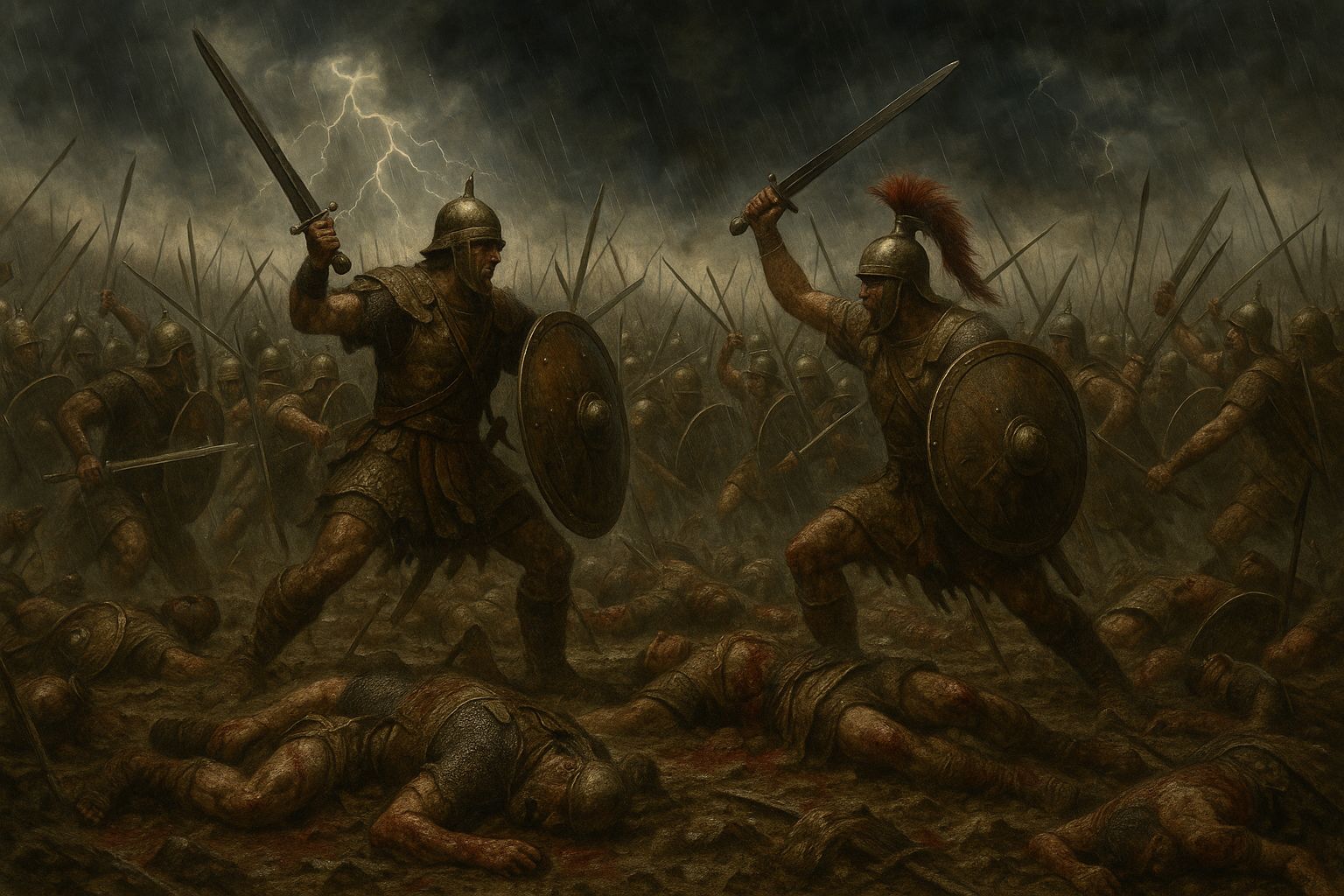
Description
The world stands at its breaking point. What began as a slave uprising in the Empire has spiraled into the greatest conflict in living memory, a war of nations, faiths, and ambitions that consumes everything it touches. Armies march across continents, fleets clash in blood-stained waters, and alliances shift faster than loyalties can hold.
The Spark
The Empire, long feared and envied, has begun to fall apart from within. A failed campaign against an army of former slaves, followed by humiliating defeats as the slaves sacked Rexantium and Ventusa, left its armies scattered and its authority weakened. Into that vacuum rose the unthinkable, not just a few slaves rising, but a coordinated slave revolt, led by former gladiators, servants, and field workers who turned the weapons of their masters against them.
What started as chaos became organized resistance. Cities burned, plantations were seized, and the roads once ruled by Imperial banners are now haunted by insurgent bands. The Empire's governors beg for reinforcements that never come, while its generals turn on each other, blaming rivals for failures they cannot explain.
The Shifting Balance
The fall of one power invites the rise of others. Across the world, nations long kept in check by Imperial dominance see their chance.
Zanakwe abandons centuries of stillness and marches beyond its borders for the first time. Zarhalem moves with quiet precision, its merchant princes funding both sides of distant wars while securing new trade routes and puppet rulers. Mataraaj, torn by civil war, finds unity in a common foe; a political marriage binds the warring sides, and their fleet sails for Estoria. Grashkaar, seeing the approaching fleet, abandons their peace philosophy, and makes an uneasy alliance with the Empire.
Draknir, restless and hungry, sees the chaos as opportunity, raiding, conquering, enslaving anew in the name of vengeance and gold.
The nations already at war with the Empire, Freevalor, Karuun Rebellion, and Caerduin throw themselves into the fray with renewed hope, aligning with whichever major power promises protection, offering their own land as staging grounds for foreign armies. Their leaders speak of liberation, but all know they are pawns in a larger game.
The Olydrian Isles, once proud and insular, now sell their fleets to the highest bidder. Their admirals care little who wins, so long as the coffers stay full. The seas around the central continents are a battlefield of shifting banners, where today's ally may become tomorrow's prize.
The Great Fracture
Within a few short years, almost every nation touching the central seas is drawn into the war, willingly or not. Armies trample the borders that once defined them. Small kingdoms are consumed by larger neighbors, and alliances twist upon themselves. Some cities change hands so many times that their people forget who rules them.
The war is fought as much in shadows as on the field. Prophets declare rival gods to be the true cause of victory or defeat. Spies and assassins shape battles before they begin. Mercenaries, exiles, and escaped slaves drift across the world, fighting for coin or vengeance.
In some regions, famine follows the armies like a second enemy, and the dead outnumber the living. Columns of refugees move like rivers of ash, their shadows crossing lands already stripped bare.
The Shadow Beyond
The war has no single front. It is not good against evil, nor order against chaos - only the old world devouring itself in desperation. Every victory is a wound, every triumph another reason for revenge.
In the farthest corners, mountain enclaves, remote isles, and kingdoms hidden beyond sand, the war is still a rumor. Some send aid, others fortify their borders. Many whisper that when the great powers finish killing each other, the survivors will sweep in and conquer what remains.
No one calls it by one name. Some say The War of Chains, others The Sundering of Empires, or simply The Burning Years. But among common folk, one phrase has taken hold, bitter, fearful, and true.
They call it simply The War, for no other conflict endures beside it, and the whole world bleeds as one.
Tone and Themes
World War Heroica is a story of collapse, vast, tragic, and human. It is not a war of good and evil, but of exhaustion, ambition, and pride. Every nation bleeds for its own vision of survival, and no one remembers what the first victory was for. The tone is grim, elegiac, and vast: the sound of a world tearing itself apart, too tired to stop.
Themes
- The Death of Empires: Power decays not through defeat, but through the weight of its own arrogance.
- Freedom and Vengeance: The revolt that sought liberation becomes another engine of war.
- The Futility of Victory: Every triumph feeds the next conflict; peace is just the pause between disasters.
- War as Transformation: Nations destroy themselves to be reborn, not realizing what they become.
- The Shared Wound: Across faiths and borders, suffering unites the world more deeply than any alliance ever could.
World War Heroica is the moment when the world stops asking who will win, and begins to wonder if anything will survive.