World War Heroica - The Aftermath
| Story |
|---|
| The war had ended for two months, but no one on the border believed it. |
| The soldiers still woke before dawn, still checked their armor, still waited for horns that never sounded. The habit of fear was harder to kill than any enemy. |
| Captain Dalen sat by what was left of the rampart, sharpening a sword that had no edge left. The mud beneath him was dry now, cracked into plates of gray dust. A single flower had grown through one of the cracks, pale and crooked. He ignored it. |
| His camp was empty but for six men. Once it had held five hundred. The rest had gone home, or tried to. There was talk that Freevalor had won, though no one knew what that meant anymore. The messengers said the Empire had fallen. The priests said the gods were silent. The traders said nothing and counted their coins. |
| At dusk, a column of refugees passed through, led by an old woman on a mule. Behind her came children, carts, and a dozen half-starved oxen pulling what might once have been a chapel. When Dalen asked where they were from, she just said, “From after.” |
| They camped nearby, too tired to beg, too numb to fear. At night, he heard them singing softly, not hymns, not war songs, just the kind of tune people use to remember when the world made sense. |
| In the morning, one of his soldiers, a boy who still looked sixteen, asked if they should offer protection. |
| “From what?” Dalen said. |
| The boy didn’t answer. There were no enemies left, only hunger and ghosts. |
| Later, as they broke camp, Dalen walked to the top of the old embankment and looked out. The valley below was green again, faintly, with the first shoots of spring. Beyond it, the ruins of a Freevalor fort gleamed white in the sun. For the first time in years, there was no smoke. |
| He wondered if that meant peace, or if peace was just what came when there was nothing left to burn. |
| He sheathed the sword, turned, and gave the order to march north. Not toward home, because no one knew where that was anymore, but toward a village said to still have bread and walls. |
| Behind them, the valley was silent except for the wind. |
| The flower by the rampart bent in it, then straightened again. |
Description
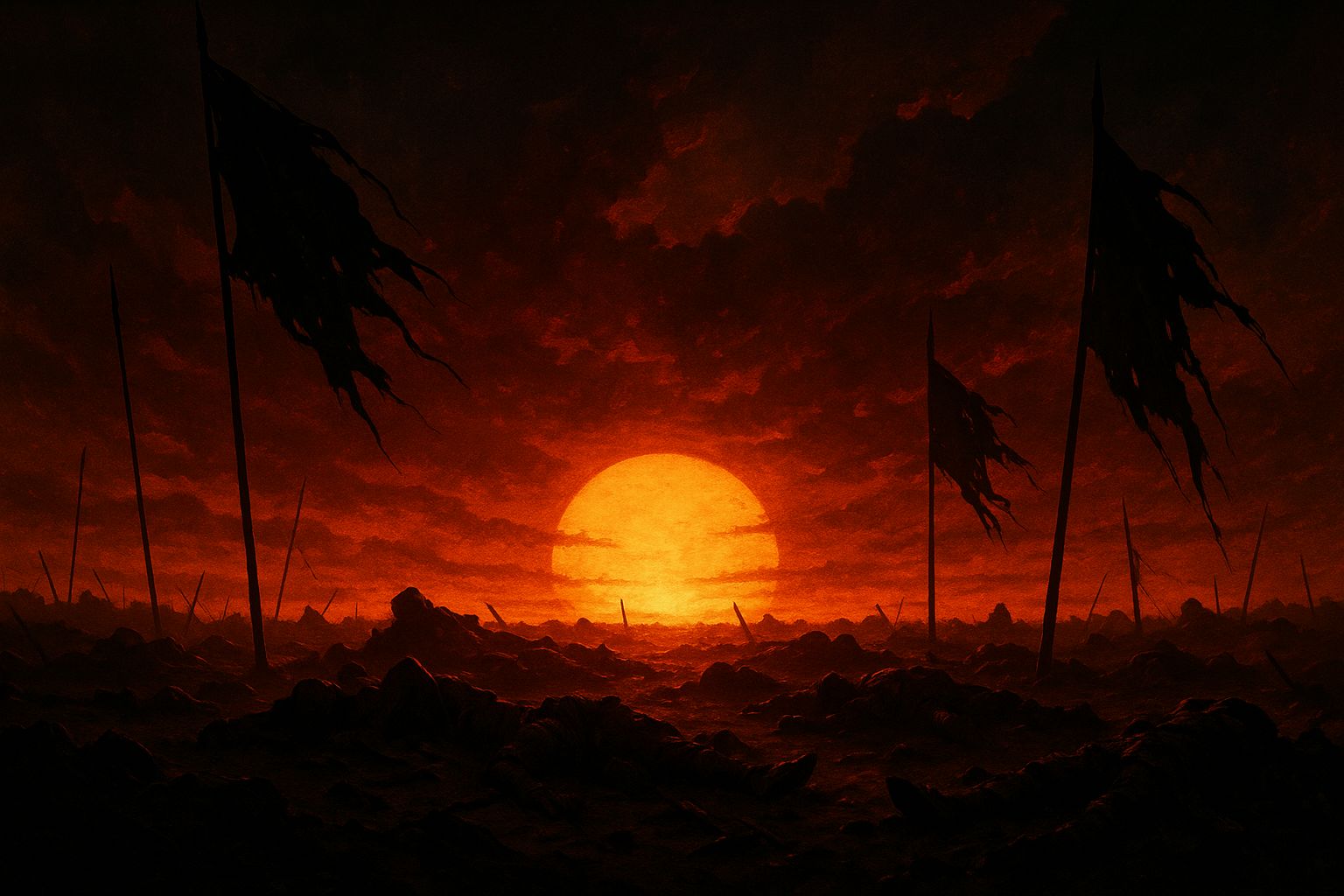
The greatest war the world has ever seen has ended, but no one can truly claim victory. The armies are broken, the land is scarred, and entire generations have been lost. The world is a ruin held together by exhaustion. The banners that once filled the sky now hang tattered in burned cities, and the victors are too few and too hollow to celebrate.
A Divided Empire
The Empire, once the heart of power, lies shattered. Its armies bled dry and its authority broken, it has split into two realms, divided along the Caelvion, the West Empire, centered on the old heartlands and ruled by surviving nobles clinging to fading glory, and the East Empire, ruled by an increasingly more insane emperor, who holds great purges against imagined foes. Between them lies a wasteland of lawless provinces where old loyalties mean nothing.
The slave revolt that began the war changed everything, but not for the slaves. If anything, slaves are worked harder and more cruelly than ever before.
The Fractured Lands
Freevalor has won its freedom at last. Its cities lie in ruins, but the people walk with pride, even as hunger stalks them. The Karuun Rebellion ended in triumph, the Empire has been driven from Montosho, though the jungle is filled with graves instead of crops.
Estoria, long an Imperial province, has declared independence. It stands now as part of a fragile coalition with Grashkaar, who abandoned its pacifism to survive the war. Together, they hope to hold their borders against the ambitions of Mataraaj, whose unity now frays under new losses.
The Twin Cities emerged stronger than ever. Their merchants armed both sides, traded in secrets, and grew rich from the misery of others. They now stand as a financial empire that rivals any kingdom, their coin more feared than any sword.
The Shifting South
Zanakwe rose as the great victor of the east, conquering Zarhalem and placing its merchant princes under their rule. Yet the victory poisoned itself, the holy war against Mataraaj rages on, with Zverilov crushed between them, its people scattered.
The Desert Rim has grown powerful. Their slave markets thrive again, fueled by starving prisoners of war and broken captives sold by once-proud nations. In a world desperate for labor and food, few ask where the slaves come from. The Rim’s markets ring with the cries of the hungry, not the guilty.
The Northern Seas
The northern coasts are a wasteland of raids and wrecks. The long war between Draknir and the Olydrian Isles left both kingdoms gutted. Their fleets are shattered, their warriors restless. Peace is a word neither dares to speak aloud. Coastal towns burn with every moon, and the bones of ships rot in every harbor.
Caerduin, drunk on victory, has overrun Albirica. Rumors spread of massacres so terrible that even its allies look away. Imperials or collaborators, military or civilian, it matters little. Caerduin want every trace of the Empire gone. Refugees spill across borders, bringing stories of slaughter and retribution that grow darker with every retelling.
The War of the West
Far to the west, Srel hurled its armies against Yelthari, driving them to the edge of the Lake of Life, only to be met by Itzalcoa, which turned the front into a mess of endless slaughter. Amazireth, holding its borders by miracle alone, made a pact with the West Empire, sending troops to aid their secession in exchange for protection from the Sreli advance. They survived, but at great cost; their temples stand empty, their soldiers buried in unmarked graves, yet many see them as the rising power in the area.
The Quiet Powers
While the world bled, Eclipse, Solanthar, and Sylvaranith watched. Their armies never marched, their cities never burned, and now they stand untouched, prosperous and untouched, and poised to become the next great powers. Their scholars speak of rebuilding the world, though few trust their intentions.
Elarune, long beset by invaders, used the chaos to reclaim its inland lands. The pressure on its borders vanished, but the coast remains lost, and its raiding parties are too weak to take it back.
The Steppe Orcs, once mercenaries in every army, have spread across the world. Some have settled, founding small enclaves far from their homelands. Others wander still, hired blades and looters without cause. They are reminders that the war never truly ended, it only scattered.
Faith, Famine, and Ruin
Para Omros burned its strength in a doomed crusade against Draknir, throwing zealot after zealot into the sea until no men remained to till their fields. They praise martyrs while their children starve.
Famine grips the world. Fields lie fallow, villages empty, cities starve. War prisoners and refugees are traded for scraps of food, sold into slavery by those who once swore to destroy it. Disease follows the starving, and the smell of smoke still hangs over the central seas.
The rest of the world, the outer kingdoms, the hidden isles, the deep jungles, survived by staying out of the war. They took in refugees, sold grain and iron to both sides, and now count their silver. They look upon the ruins of the old powers and see opportunity.
The Age of Ashes
The war has ended, but peace has not begun. Armies still skirmish out of habit. Borders mean nothing. Prophets proclaim that the gods turned away in disgust, leaving mankind to rot in its own blood.
There is much to rebuild, but no one has the strength. Nations limp on, half-alive, sustained only by memory and pride. In the ruins of fallen cities, traders, prophets, and mercenaries already gather, drawn by the scent of opportunity.
Tone and Themes
World War Heroica – The Aftermath is a portrait of a world too weary to rise and too proud to fall. The tone is somber and reflective, not the noise of battle, but the silence that follows it. Victory feels hollow, peace unreachable. The war has ended, but the cruelty that birthed it endures in new forms.
Themes
- The Cost of Survival: The world endures, but every nation pays a price that makes victory meaningless.
- Cycles of Ruin: The same greed and fear that caused the war now shape its rebuilding.
- False Peace: Armies may rest, but the spirit of war lingers, in famine, slavery, and vengeance.
- The Rise of the Unbroken: Those who stayed out of the war inherit a broken world and the chance to rule its ashes.
- Faith in Decline: The gods are silent, and humanity must face what it has done without them.
The Aftermath is not about what was won, but about what remains.