Where's the Moon
| Story |
|---|
| They said the moon had been gone for ten years, but Mara still looked for it every night. |
| The villagers laughed at her for it, or rather, they used to, before the laughter turned quiet. Before people stopped going out after dusk at all. |
| She had been a child when it broke, standing barefoot on the hill above the fields, watching the white face in the sky split open like an egg. The sound came a moment later, a single, impossible crack that she still heard when she dreamed. The stars that night were wrong, and they had never been right again. |
| Now she was grown, and the world was smaller. The sea no longer moved. The crops came in fits and starts, like the earth itself forgot how to breathe. At night, the shadows grew too long, and the dark had weight. |
| Still, every evening she climbed the hill with her lamp and sat on the same rock. She told herself it was for habit, not hope. But she always looked up. |
| The priest came once to scold her. "Faith looks forward, not upward," he said. "The gods have set a new order." His hands trembled when he said it, though the lamp in them never flickered. He told her that the fragments were being destroyed, that the world would heal. He said the dark was only a test. |
| But later, in the market, Mara saw him again, buying moonstone dust from a smuggler, his eyes hollow and desperate. Everyone swore it was heresy, that touching a fragment corrupted the soul, but half the town wore them on cords around their necks now - pale shards that gleamed faintly even when covered. They called them "blessings of the fallen light." |
| That night, the air smelled like salt though they lived a hundred miles from the sea. The dogs whimpered and would not leave their kennels. |
| Mara went to the hill again. She did not bring a lamp. The darkness pressed against her eyes until it almost felt warm. |
| Something moved across the horizon, far beyond the reach of the stars. For a moment, she thought she saw light, not white, not silver, but a deep, red pulse, like a heartbeat behind clouds. |
| She whispered, "Is that you?" |
| And the clouds whispered back. |
| She did not sleep that night. When the dawn came, gray, thin, and late, she returned to the village to find the priest's house empty. His lamp still burned on the altar, steady and bright, though the oil had long since run dry. |
| That was the first time Mara noticed the shadows moving before the people who cast them. |
Description
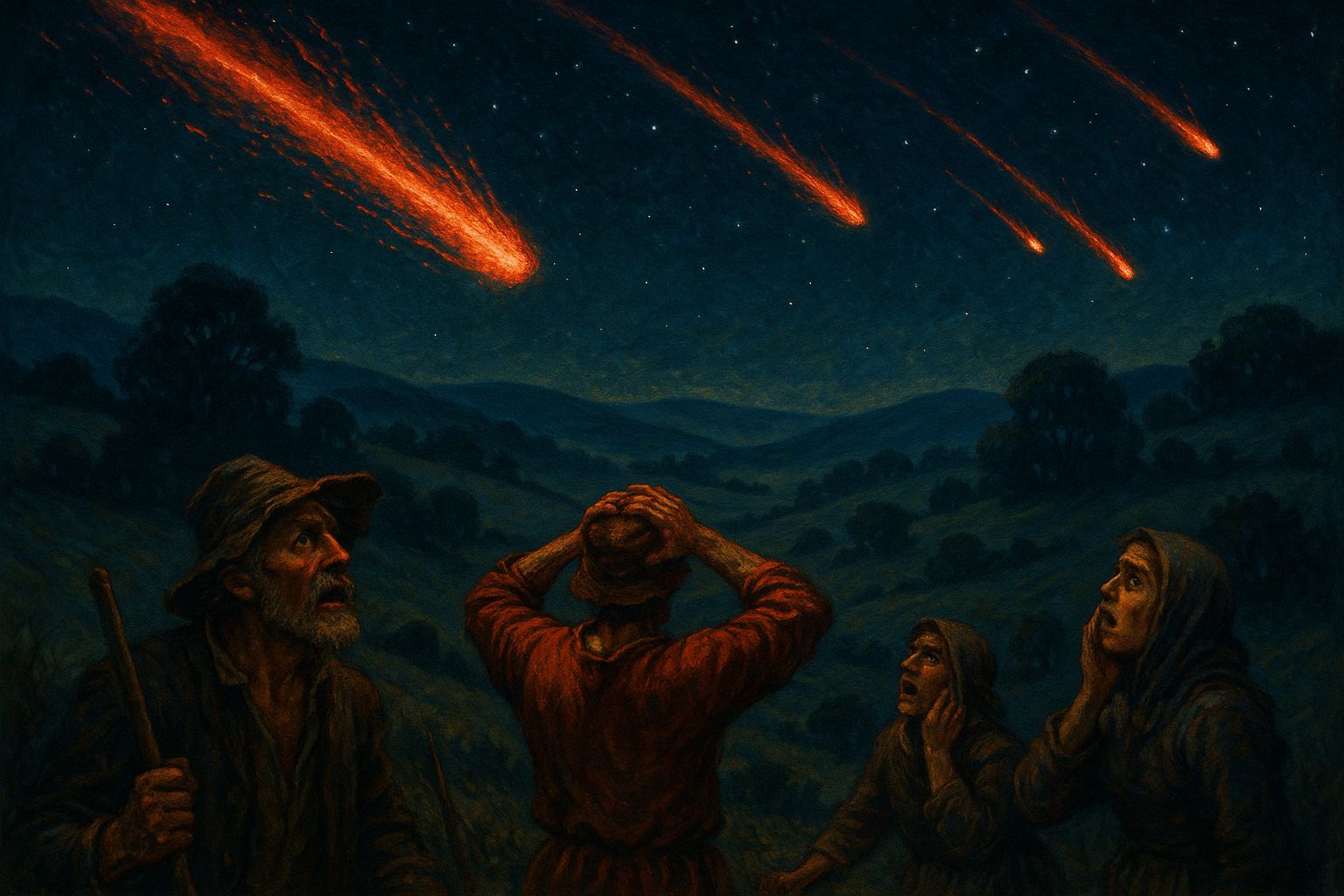
One night, during a perfect full moon, the world looked up and watched it die. Without omen or prophecy, the moon shuddered, cracked, and burst into a thousand burning fragments. The sound came a heartbeat later, like the sky itself breaking. Fire rained across the world, and the sky burned like paper. For days, the heavens glowed red, and for nights thereafter, there was only darkness.
When the ash cleared, the moon was gone.
No one knows how or why. Theories spread like ash; some blame the gods, others the arrogance of magicians, or the weapons of forgotten empires. The only certainty is that something greater than mortal power tore the heavens apart, and left the world open to things that should never have been seen.
The Long Night
The loss of the moon broke more than the sky.
Tides faltered. Seasons lost rhythm. Birds vanished first. The herds followed. The world forgot how to sleep. The nights are now absolute, a darkness so deep that even fire seems to shrink inside it. Travelers go mad beneath the starless vault, swearing they hear whispers in the dark.
Night creatures multiply unchecked. The stars themselves have changed, new constellations forming where none had been before, patterns that scholars say move when not observed.
Temples hold vigils that never end, burning lamps to keep back the dark. In the wild, people say the shadows have grown thicker, heavier, and that sometimes, when you walk beneath them, they look back.
The Falling of the Fragments
The fragments of the shattered moon struck everywhere, deserts, oceans, cities, even mountains. Each crater glows faintly, as if the stone remembers starlight. Some pieces still burn years later, pulsing with unnatural heat. Others sink into the earth, twisting what grows near them.
At first, they seemed inert, mere wreckage of a cosmic accident. Then people began to die.
Those who linger near a fragment too long begin to fade. Their blood turns thin, their shadows lengthen, and their eyes forget the difference between light and dark. Their shadows move before they do. Their reflections whisper in voices not their own. Eventually, they vanish, leaving only a shape scorched into the ground, as if something had stepped out of them.
Scholars and priests agree on one thing: the fragments are not just stone. They tore holes through the veil between worlds as they fell, and from those wounds, demons slip freely into Heroica.
The Open Veil
In the past, demons could only enter through deliberate summoning or great magical catastrophe. Summoning circles fail now. The air itself is the circle. Now, they come unbidden.
They crawl from moon craters, seep through cracks in temple floors, rise from rivers that have turned black. Some possess corpses, some take shape from mist or flame, and others walk openly, cloaked in human skin.
Their forms are chaotic, as if born from broken reflections of the same source, winged shadows, horned silhouettes, or glimmering shapes that look wrong in the dark. They speak in voices that make fire flicker and glass bleed.
Even small demons can spread corruption through the land, turning animals feral and driving men to murder. The greater ones gather around the largest fragments, drawn to their power like carrion to rot.
Each fragment acts as a gate, a tear in the skin of the world. As long as they remain, the veil cannot mend. For a time, the world can only watch. Then, slowly, the living begin to fight back.
The Hunt for the Fragments
For once, priests, magicians, and kings agree on something: the fragments must be destroyed. Yet they argue over who will hold them first.
But destruction is not simple. A fragment cannot be broken by mundane means, not steel, not fire, not magic. Only ritual can close the wound, a process that binds the fragment back into nothingness.
Each ritual is unique to the fragment's location and nature. Some demand the blood of willing sacrifice, others the presence of sunlight. Some require the cooperation of beings who despise each other, such as demon and priest.
Worse, each ritual draws attention. The demons know what threatens them, and they guard the fragments fiercely. Legions have been swallowed whole trying to reclaim just one.
The work has fallen to small, desperate groups: heretics, mercenaries, and wanderers who risk their souls for the world's survival. They are called Moonscourers, and most die before completing even one ritual.
The Broken Faiths
Every faith has its own explanation for the moon's destruction.
- The priests of Omros claim Omros shattered it to punish mankind for pride.
- The prophet-ascetics of Mataraaj teach that the moon's death marked the birth of a new god, one of shadow and fire.
- The Tikirri, if they still live, call it The Falling Shell, the death of heaven's insect mother.
- The Empire calls it sorcery, the final sin of ancient heretics.
In truth, no one knows. The gods are silent. Some say they died with the moon.
The Age of Shadow
Centuries may pass before the world recovers, if it ever does. The night remains long and unnatural. The stars seem further away. Sea voyages are perilous, for without tides, the oceans grow strange and still.
In this darkness, new powers rise. Demon cults flourish, worshiping the fragments as divine relics. Black markets trade in moon fragments said to grant visions or immortality. Kingdoms fortify their borders, mistaking each other for the true enemy while the real threat grows beneath the stars.
Some scholars whisper that if every fragment is reclaimed, the moon could be remade, but at what cost, and under whose rule?
Tone and Themes
Where's the Moon is a story of cosmic collapse and creeping dread. It is not just about demons but about a world robbed of its rhythm, forced to survive without light or certainty.
It explores fear, faith, and futility, the horror of fighting for a world that may already be lost. It is the darkness after the gods, the silence of the sky, and the knowledge that maybe something watches from where the moon used to be.
The moon is gone. The night belongs to something else now.