Sorcerors
| Story |
|---|
| The palace had not slept in three nights. Thunder rolled endlessly above the city, though no rain fell. Curtains whipped in wind that came from nowhere, and lightning struck the same spire again and again, refusing to stop. |
| King Alren had locked himself in his throne room, raving that the gods were judging him. He had summoned every priest and healer in the capital, but none could quiet the storm. When at last he ordered the royal sorceror, Lethan Arval, brought before him, the guards found the old man already waiting in the hall, cloak unruffled, eyes calm. |
| Lethan bowed low. “Majesty. The storm is yours.” |
| The king stared at him, trembling. “Mine?” |
| “Your fear called it. Your guilt feeds it. Magic listens when it should not.” Lethan stepped forward, his hand trailing faint lines of light in the air. “I will silence it.” |
| “Can you?” the king whispered. |
| “I can try.” |
| He walked to the tall doors and pushed them open. Wind howled through the hall, ripping tapestries from the walls, tearing pages from books. The throne itself shook. Lethan raised both hands, drawing symbols with fingers steady as quills. The air shimmered, and the lightning froze in place, a web of white fire suspended over the city. |
| He spoke softly, each word shaping the energy, twisting it, weaving it back into itself. His voice was almost gentle, like a teacher quieting a restless student. |
| The king watched, eyes wide, as the thunder dimmed to a murmur. The air settled. The storm’s heart, a sphere of pulsing light, hung above the spire like a living sun. Lethan extended his arm toward it. |
| “Majesty,” he said, still calm, “this is what you have made.” |
| The king fell to his knees. “Destroy it.” |
| Lethan shook his head. “It cannot be destroyed. Only balanced.” He pressed his palm forward, and the sphere shrank, folding in upon itself until it became a single spark. He caught it between his fingers and placed it in a crystal vial. |
| The wind ceased. The silence that followed was immense. |
| Lethan turned, face pale but steady. “I will keep it,” he said. “It is a mirror. It will show you if the storm returns.” |
| The king bowed his head, unable to speak. |
| Years later, when courtiers whispered about Lethan’s unnatural calm or the strange light sometimes flickering in his study, no one dared to ask what it was. But every time thunderclouds gathered over the palace, they broke apart before the first strike. |
| And in the high tower, the old sorceror would look up from his books, open the crystal vial, and smile faintly, whispering, “Not yet.” |
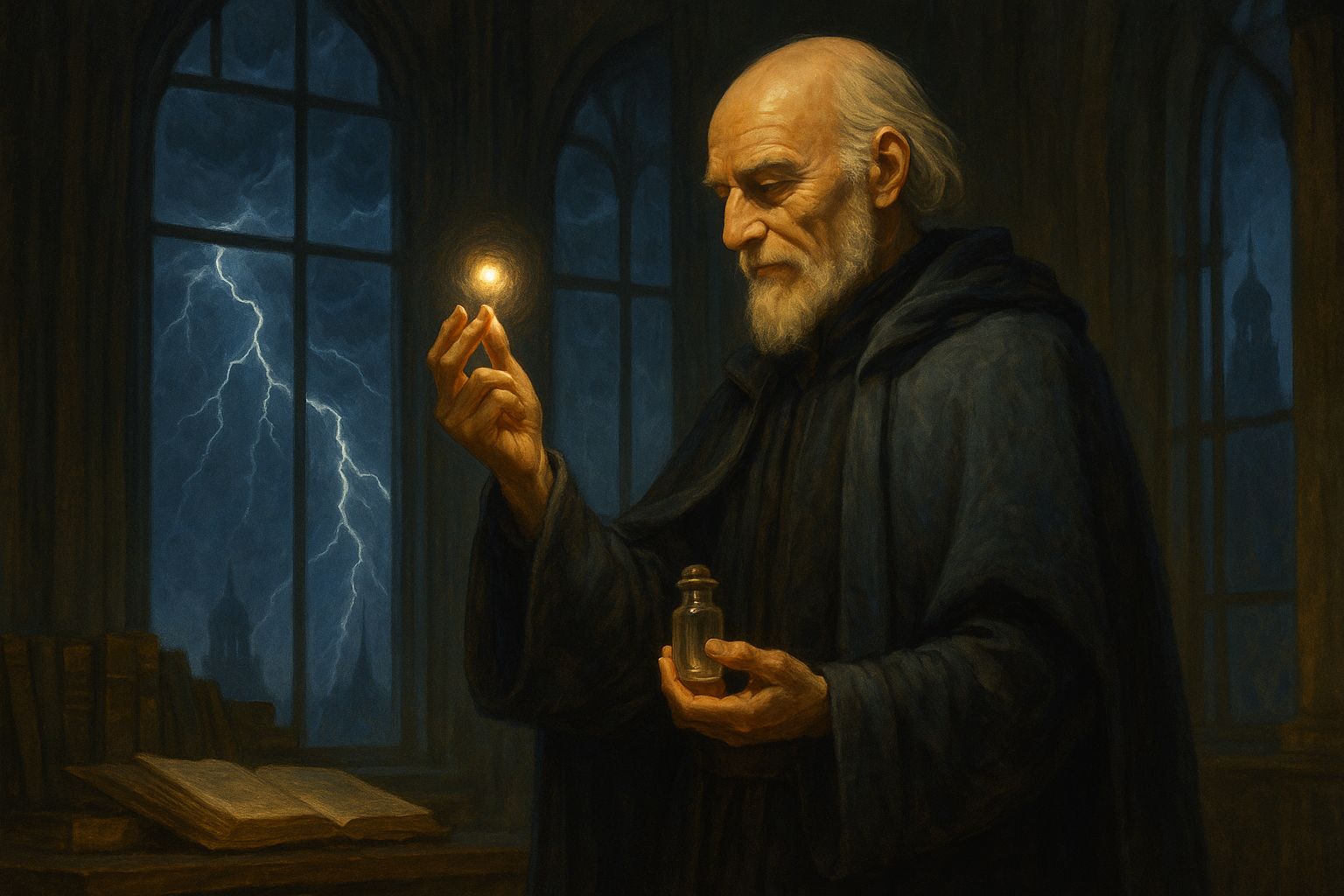
The Seekers of Essence
Sorcerers are the students of magic itself. While others summon, charm, or invoke, sorcerors seek to understand the underlying fabric that binds all enchantment together. They spend years in study, isolating the principles of magic as one might dissect a living thing to see how it breathes.
They are the keepers of knowledge, the ones who can identify a spell’s source, unravel its pattern, or weave it into new form. Where other mages call upon powers, the sorceror studies their structure, dissects their symbols, and learns their limits.
To the sorceror, magic is not a gift or a curse, it is a phenomenon, a law to be studied, measured, and, if possible, mastered.
The Art of the Weave
Sorcerors devote their lives to understanding the “Weave,” the invisible threads that connect all magical forces. Through careful observation, they learn to detect disturbances, to reinforce spells, or to dismantle them entirely. They are the ones who can strengthen a charm, cleanse a curse, or bind enchantments into steel, glass, or stone.
Their greatest skill lies in manipulation, bending the form of magic without invoking its source. To others, it appears effortless, but behind that ease lies decades of ritual, trial, and error. Many die not through recklessness, but through the quiet collapse of experiments that went a fraction wrong.
Metamagic and Experimentation
Every sorceror must understand other branches of magic, not to practice them, but to test their theories. A necromancer’s spell might serve as a study of permanence, a summoner’s circle as a study of containment, a witch’s curse as a study of corruption. All are data to the sorceror’s greater work. They are seldom powerful in these other branches; to them, such spells are only simple test cases.
Their workshops are filled with scraps of parchment, etched stones, and humming relics that glow faintly in the dark. Most sorcerors see their craft as a science. They measure power in patterns and consequences, not morality.
Advisors and Scholars
Because of their discipline and precision, sorcerors are often tolerated where others are hunted. Kings and nobles employ them as advisors, wardens, and keepers of forbidden tomes. When a curse falls upon a house, a sorceror is called to unmake it. When relics awaken or demons whisper through cracks in the world, the sorceror is asked to bind or silence them.
Yet few truly trust them. They are respected but rarely loved, for their eyes always seem to see more than they should.
The Cost of Study
Magic demands sacrifice. The sorceror’s price is rarely blood, but time, obsession, and isolation. Their single-minded devotion leaves little room for family or friendship. Many grow detached, speaking more to the laws of magic than to other people. Some forget to eat, sleep, or feel.
A few lose themselves entirely, their minds dissolving into the patterns they study. There are tales of sorcerors who became little more than flickering silhouettes of energy, still wandering the halls of their towers, murmuring equations to the empty air.
The World’s View
Among the magical arts, sorcery is considered the safest, and yet it still inspires unease. To common folk, the sorceror’s detachment is unnatural. They see too much, care too little, and speak in riddles. They may be welcome in courts and libraries, but always as guests, never as kin.
Still, they are needed. In times of plague, curse, or chaos, when lesser magics fail or misfire, it is the sorceror who restores balance. And though their methods are cold, the world is quietly grateful for their presence.
Though tolerated in royal courts and academies, sorcerors are often viewed with deep unease by the temples. To the faithful, their study of magic as a mere natural force borders on blasphemy. Sorcerors dissect divine miracles as they would curses or charms, reducing holy power to patterns and equations. Priests whisper that such arrogance invites divine punishment, but the sorcerors only record those, too, as data.
Theories and Fears
Some whisper that the greatest sorcerors no longer merely study the Weave, they become part of it. When a sorceror dies, their essence may remain tangled within the flow of magic, living on as a faint consciousness that watches from the gaps between spells. Others claim that in their quest to understand magic, they invite it to understand them in return.
There are old stories of sorcerors whose reflections move a heartbeat too late, or whose shadows trace sigils on their own. Whether these tales are true or simply the fears of those who live near great power, none can say.