Shamans
| Story |
|---|
| The mist was endless. |
| It curled around the roots of trees that had no bark, no leaves, only slow movement, as if they breathed. Each step sank into something soft that was not soil. The air shimmered, not cold or warm, just there, full of whispers that dissolved when listened to. |
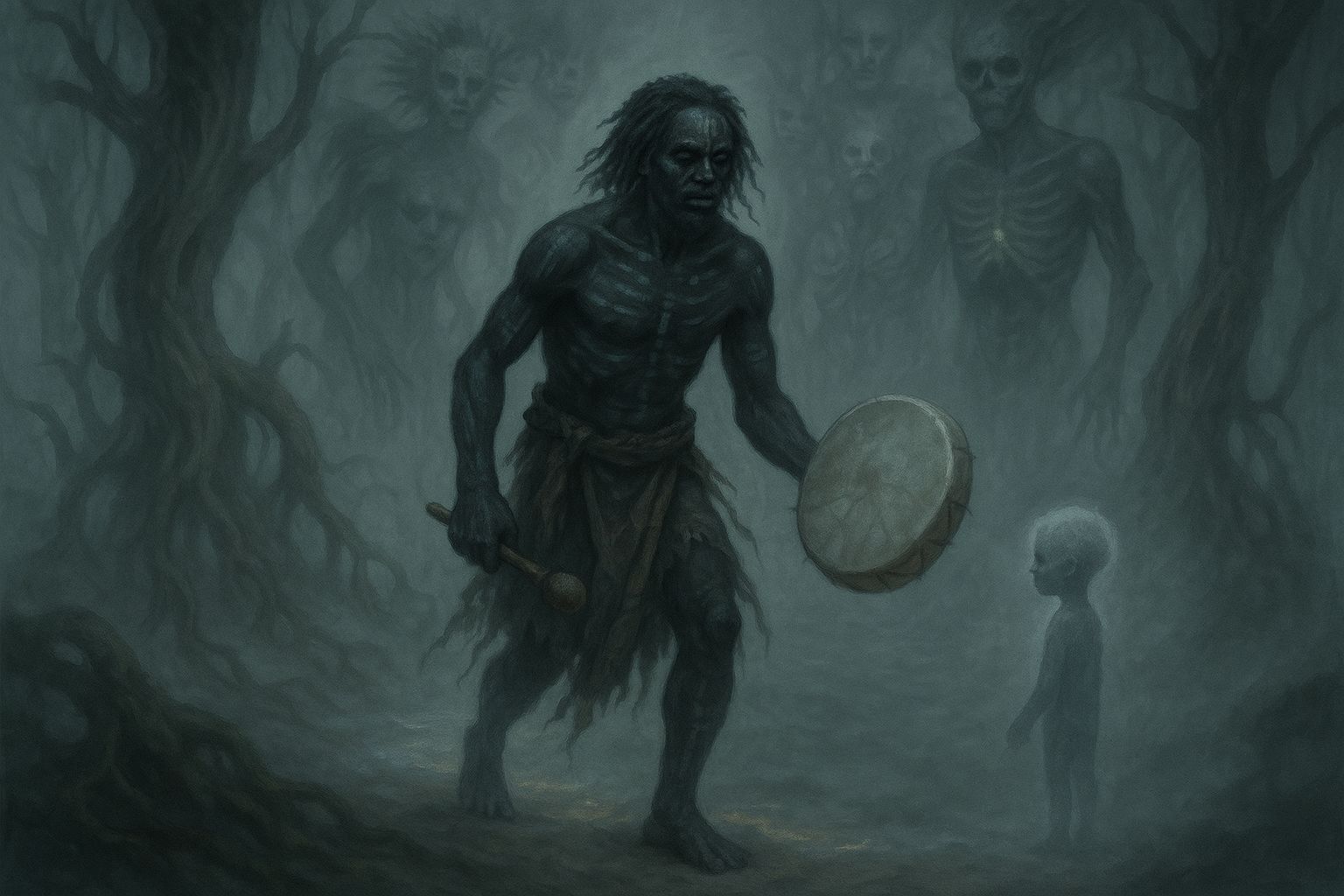
| The shaman walked barefoot, carrying only his drum. Its hide was pale as moonlight, its frame carved from bone and smoke. He struck it once. The sound rippled through the fog like a wave. Shapes stirred. |
| He did not speak. Words were too heavy here. |
| From the mist came faces, some known, others never seen. A woman with eyes of water, a child made of feathers, a man whose ribs were open, and within them stars burned quietly. They looked at him and smiled with too many mouths. |
| He kept walking. |
| The path wound downward, though there was no ground. Every step left behind a flicker of color that vanished when he looked back. He passed a river that flowed upward into the air, its surface made of faint laughter. He touched it and felt a hundred memories that were not his. |
| “Shaman.” |
| The voice came from everywhere. It sounded like his own. |
| He stopped, the drum still beating, slow and deep. |
| “You have come too far.” |
| “I follow the trail,” he said, though his mouth did not move. “The spirit is lost. I would bring it home.” |
| The mist thickened. Something vast shifted within it, unseen, patient. The air trembled like a held breath. |
| “You walk the space between,” said the voice. “Few return whole.” |
| The shaman struck his drum once more. “Then I will return in pieces.” |
| Silence. Then the mist parted, revealing a plain of silver light. On it stood the spirit he sought, a child’s outline, faint as smoke. It turned to him, eyes wide, unafraid. |
| He knelt, offering his hand. The spirit hesitated, then reached out. Their fingers touched, and for a moment he saw everything, the child’s first cry, the mother’s song, the sickness, the last sigh. All at once, and gone again. |
| He struck the drum one final time. The world folded inward like water closing over a stone. |
| When he opened his eyes, he was back beside the cold fire, the body of the child sleeping, breathing softly. |
| He smiled, though the mist still clung to the corners of his sight. Somewhere behind it, in that other place, something large watched and waited, and the faint echo of the drum still beat in answer. |
| He whispered a prayer of thanks and lay back, knowing he had not truly returned. Only borrowed time from the mist. |
The Voice Between Worlds
Across the worlds’ many lands and peoples, shamans are those who walk the border between the mortal world and the realm of spirits. Though their customs vary from tribe to tribe, their purpose is the same: to listen, to mediate, and to keep balance between what breathes and what lingers unseen.
Some call upon the spirits of their ancestors, others speak with the winds, rivers, or beasts. To the shaman, the world is alive, every stone and leaf holds memory, every storm or sickness a voice to be understood. They are the ones who ask, who listen, and who answer when the spirits whisper back.
Trance and Communion
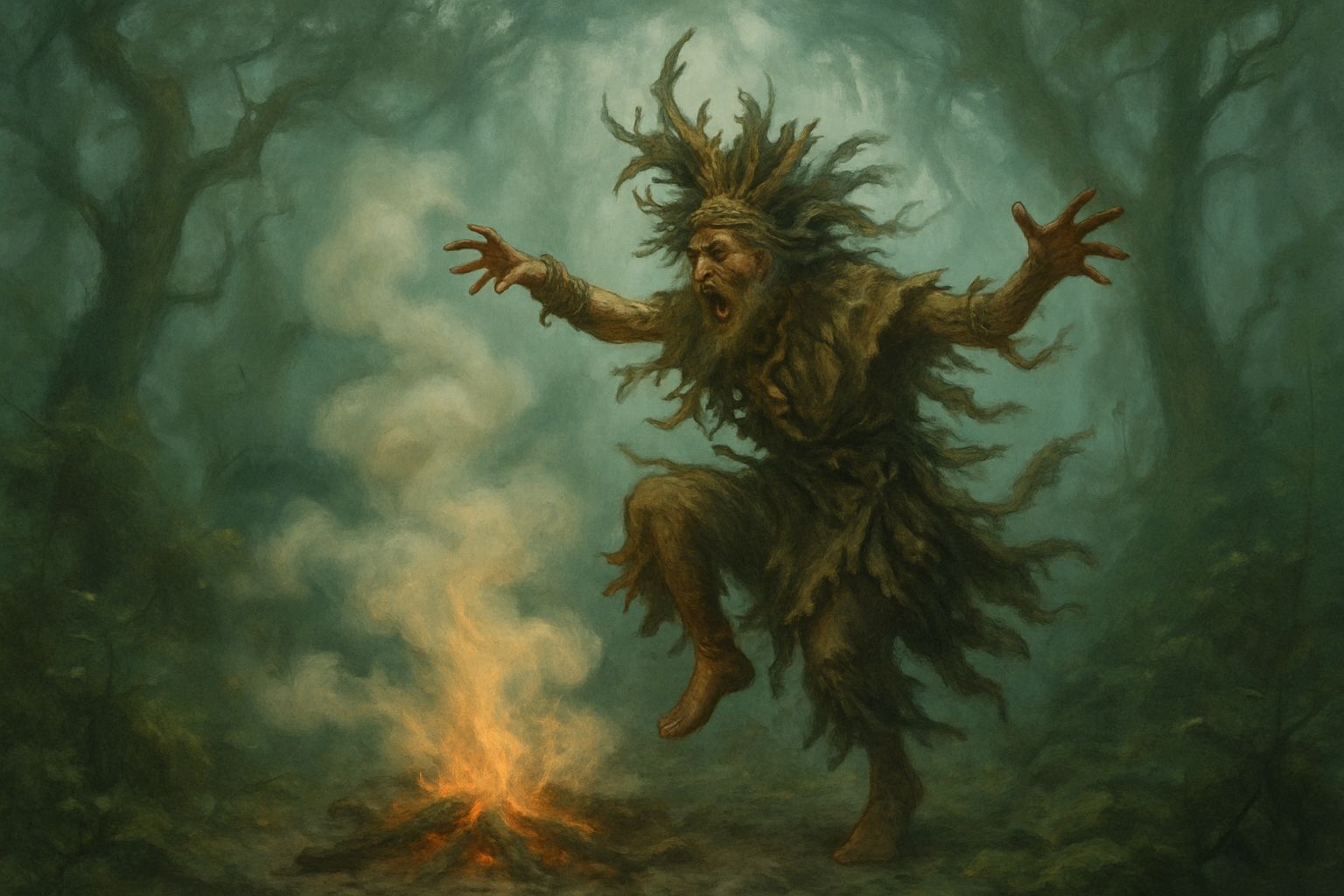
Communication with spirits requires leaving part of the self behind. Shamans enter trances through rhythmic drumming, chanting, dance, fasting, or the use of hallucinogenic herbs. Their minds drift into the veil between life and death, where dreams and truth mingle.
There, they walk the spirit paths, vast plains of light and shadow where voices speak without tongues. Few remember these journeys clearly, for the spirit world does not obey mortal logic. Many describe it as beautiful and terrible in equal measure, where love and horror wear the same face.
Sacrifices are sometimes made to open these paths: food, blood, or smoke offered to the unseen, gifts of respect and exchange.
Sometimes, when a shaman returns from trance, the spirit world clings to them. Faint lights drift behind their steps, the scent of rain or smoke follows them indoors, and their shadow moves as if still walking the paths beyond. Elders say these are echoes of the places they have touched, reminders that no one crosses the veil without bringing something back.
Spirits and Allies
The shaman’s greatest gift is connection. They may call upon ancestral spirits for wisdom, bargain with nature spirits for healing or rain, or bind restless ghosts to bring peace to the dead.
Some are accompanied by spirit animals, creatures that have chosen them rather than been chosen. A mouse, raven, or fox might guide a shaman’s visions, speak in dreams, or appear only in the moments between waking and sleep. Unlike a witch’s familiar, a spirit animal is not a spy or a leash, but a companion, sometimes real, sometimes ethereal, always equal.
Healers and Guardians
In most tribes and villages, the shaman is healer, seer, and judge. They interpret signs in the flight of birds or the stirring of wind, mix herbs to mend wounds, and settle disputes with the weight of ancestral wisdom. Chiefs and kings may rule the living, but it is the shaman who keeps peace with the dead.
Their power is often quiet, yet respected. When the shaman speaks, even the proudest warrior listens, for none wish to anger the spirits that walk unseen beside them.
The Path of Binding
Not all shamans serve as gentle mediators. In some lands, they practice the art of spirit binding, forcing the dead or the unseen into vessels of bone, wood, or clay. These shamans walk the edge between guidance and domination.
They craft dolls or fetishes to house bound spirits, using them for healing, protection, or vengeance. A spirit trapped in such a vessel may whisper advice or scream to be released, depending on how it is treated. The strongest of these shamans can command the dead to rise, as mindless corpses or as willing servants bound by oath or fear.
This practice is often called the Black Path or Blood Road by other shamans, for it demands sacrifice and precision. A single misstep can draw something far older and hungrier than the spirit intended. Yet even among these darker arts, not all who bind do so for evil. Some believe that binding a spirit saves it from greater torment, or uses its pain to heal the living.
The Shadow of Madness
The spirit world gives wisdom, but also danger. Some shamans journey too deeply into the other side and cannot return whole. They begin to see things others cannot, hear whispers that never stop. The line between vision and delusion blurs, and they drift between both worlds like ghosts still trapped in their own flesh. Their life is a balance on the edge of madness.
Old shamans say this is the final price of their calling: the more clearly you see the spirits, the less you belong among the living.
The World’s View
To most of the world, shamans are figures of awe rather than fear. They are strange, yes, wild, painted, their eyes clouded with unseen truths, but they are not reviled like witches or summoners. Their power is natural, ancient, and necessary. Even great empires sometimes keep shamans in secret, for there are illnesses and omens no scholar can cure.
Yet those who practice spirit binding walk a narrower path. To their people, they are both protectors and threats. The same man who calls rain might also command a spirit to rot an enemy’s crops. Respect and fear walk hand in hand.
Theories and Fears
Scholars debate what spirits truly are, souls of the dead, echoes of divine creation, or reflections of mortal thought. Some claim shamans do not speak to spirits at all, but to fragments of their own minds shaped by ancient instinct. Yet the results are undeniable: the rain comes, the wound heals, the dead sleep.
There are darker whispers too, that some shamans no longer serve as mediators, but as vessels. Their bodies remain, but their spirits wander free, leaving something else behind to wear their skin.
The Spirit World
The spirit world is not another land so much as the inner truth of this one. It lies beside the waking world like a shadow beside a body, shaped by the same places, the same lives and the same wounds. Shamans reach it through trance, crossing the border between life and death to walk paths of light and shadow where mortal logic grows thin and uncertain.
It has no true colors of its own. The land, the sky and all things within it are drained to shades of black, white and grey. Color belongs to spirits alone, each marked by an aura of its own hue. That color does not reveal anything as simple as good, evil, courage or fear. It appears to be nothing more, and nothing less, than the spirit's own name. There are no noble colors and no wicked ones. A cruel spirit may burn with gold, and a gentle one with red. Only the dead follow a clearer pattern. Their auras always carry a grey cast, and whatever other color remains within them is weak, faded and slowly ebbing away.
Reflection and Exaggeration
The spirit world reflects the state of the living world, but never plainly. It shows essence rather than surface. A battlefield may appear blasted, dead and broken even generations after the grass has grown back. A place of long sorrow may feel hollow and cold, its shapes thin and distant. A healthy forest, by contrast, does not merely resemble itself. It becomes more fully itself. Trees rise higher, undergrowth crowds thick and lush, and flowers bloom in impossible abundance. The spirit world does not copy the world. It judges it, deepens it and reveals what it means. Places retain spiritual residue and are shaped by what has happened there.
The same is true of living beings. A spirit tends to wear the shape its owner believes to be true. One who sees themselves as mighty may appear tall, broad and radiant with presence. One who lives in fear may become small, hunched and skittish, forever ready to flee. The spirit self is not a disguise. It is self-image laid bare.
Dangers of the Spirit Paths
The spirit world is no harmless dream. Shamans speak with spirits there, bargain with them and sometimes bind them, but the paths are dangerous and do not forgive carelessness. Some spirits lie. Some spirits lie. Others speak with perfect sincerity and are still wrong. Though they may know things hidden from the waking world, they are no more infallible than any mortal being.
Some mimic the dead. Some are older, darker and hungrier than the shaman intended to meet. Those who walk too deeply may lose part of themselves, returning clouded, changed or not wholly alone.
Among its worst dangers are predatory spirits. These do not kill spirits in any final sense, but seize, enslave and feed upon them. A weaker spirit may be drained for ages, trapped in the service of something stronger and more ravenous. Such predators are a danger to wandering shamans as well. If a shaman lingers too long, a hungry spirit may fasten onto them, block their return and feed instead on their life force. Even if they escape, there remains the risk that something follows them back into the waking world. Some scholars argue that this is the root of hauntings and ghostly infestations, that what people call a haunting is sometimes not the dead returning, but a predatory spirit riding home on a human soul. It is a feared theory, though not a proven one. The fear is well aligned with existing shamanic warnings that no one crosses the veil without bringing something back.
In this way, the spirit world is both revelation and threat. It offers truth, guidance and power, but every step within it carries risk. To walk there is to see the world more clearly, and to place one's own spirit within reach of things that are always watching.