Summoners
| Story |
|---|
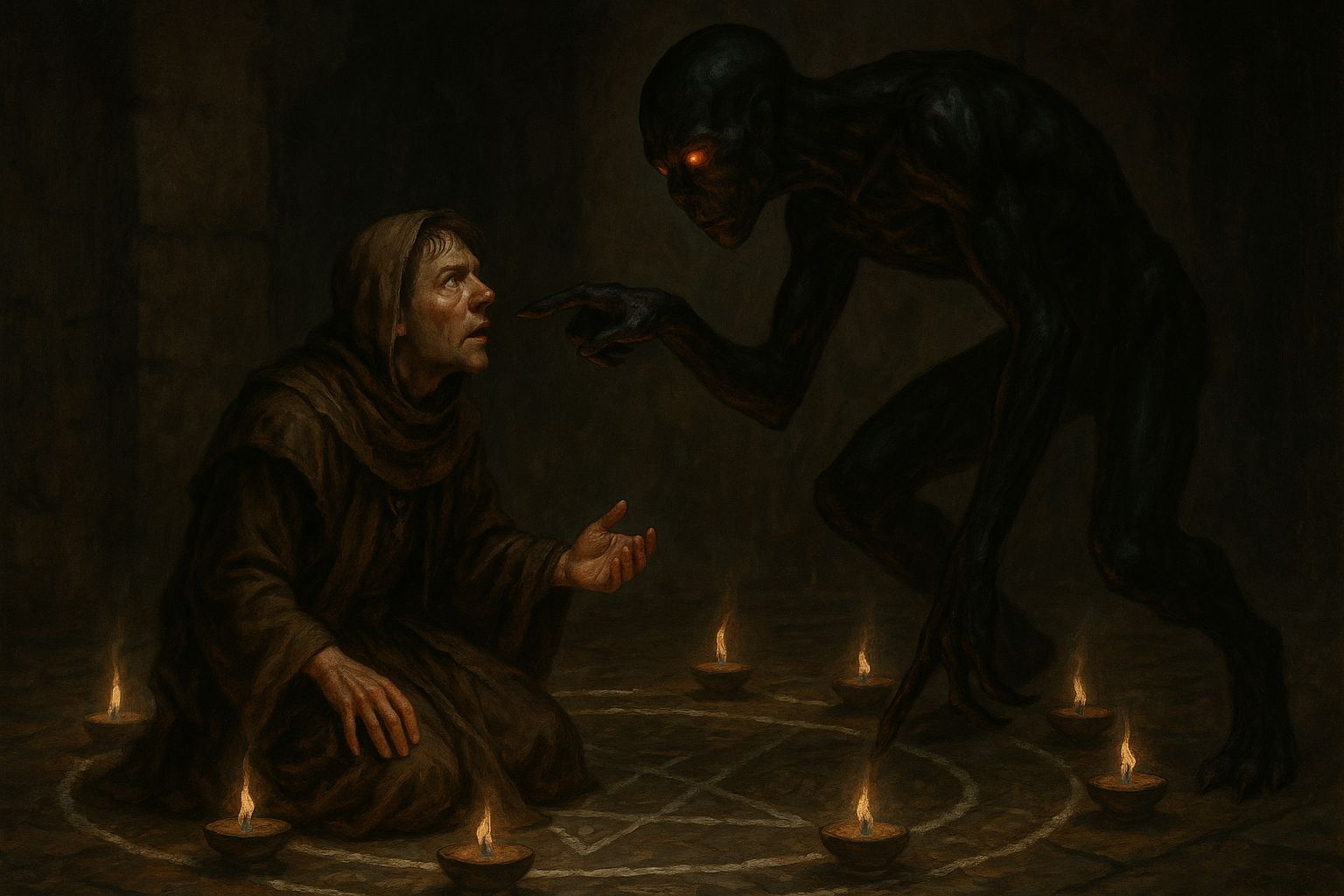
| The cellar smelled of wax and rust. Candles guttered in shallow bowls, their flames bending inward toward the center of the circle. Edran knelt among them, robes dusted with chalk and salt, lips moving in precise rhythm. Every syllable hung in the air like a knife. |
| He had spent three years preparing for this night. Three years tracing names from forbidden tablets, copying sigils by the light of dying coals. He did not seek power, or so he told himself, only knowledge. But knowledge, he had learned, never came alone. |
| The circle was perfect. He had checked it seventeen times. Blood from his own hand sealed the final rune. The air shifted, the candles flared blue, and then the shadows began to move. |
| It stepped into form, a thing that might have been human if not for its skin like shiny black leather and its eyes that burned like distant suns. It regarded the circle with lazy amusement. |
| "You know my name," it said. |
| Edran swallowed. "I do. I call you forth to bargain." |
| The demon’s smile was slow and cruel. "Then bargain, mortal." |
| He kept his voice steady. "I offer a fragment of my life, freely given, in exchange for knowledge of the lost city beneath the marshes." |
| "A fair offer," the demon said. It tilted its head. "But you misunderstand what ‘life’ means to me." |
| Edran’s hand trembled. The candles dimmed. |
| "Specify, then," he said, heart hammering. |
| "I will take your sleep," said the demon. "You will never dream again. You will close your eyes and stare into the dark until death. In return, I will give you what you seek." |
| He hesitated. The silence pressed upon him. The demon leaned closer, the edge of its form licking the air like flame against glass. |
| "Accept," it whispered. "Or draw a better circle next time." The deamon quickly lashed out and with one finger flicked the tip if Edrans nose. Not hard enough to damage, just to make the point. |
| Edran nodded once. A contract appeared before him, and he pressed his bloody thumb to it. The circle flared white, and the demon was gone. |
| When dawn came, the marshes whispered to him, names of stones and ruins long buried. His eyes burned with knowledge. And when he tried to sleep, he found only the dark, endless, waiting, filled with shapes he could no longer banish. |
| He had his answer. The demon had its price. |
The Scholar’s Gamble
Summoners are mortals who dare to call upon demons, not through blind desperation, but through calculated study. They are the learned heretics, scholars who believe that knowledge and preparation can tame the infernal. Unlike witches, who trade their freedom for power, summoners seek to borrow that power, temporarily, and on their own terms.
They spend years collecting scraps of infernal lore: true names, sigils, seals, and rituals. To a summoner, the demon is not a god to worship or a master to serve, but a dangerous force to bargain with. Their arrogance lies in the belief that intellect and preparation can outmatch the cunning of a creature born of malice.
Circles and Names
The summoner’s greatest defense is the circle, a structure of chalk, salt, and blood that both summons and binds a demon within it. As long as the circle holds and the demon remains within its bounds, the demon cannot strike. But every summoner knows the truth: circles fail. Chalk cracks, names are mispronounced, and demons are patient.
To call a demon safely, one must know its true name and understand what it desires. Some crave blood, others suffering, others only amusement. The art of summoning is not just control, but negotiation. Each pact is a contest of wit and will, a game where the price of losing is one’s mind or soul.
The Art of Bargaining
Summoners do not bind themselves for life. Their pacts are transactional, one offering, one favor, and then release. A sacrifice for a task, a task for a task. The more skilled the summoner, the more precise the terms. But even the most careful words can be twisted.
Demons delight in bending agreements to cause harm without breaking them. A demon asked to kill a tyrant may do so by collapsing his castle upon his people. A demon tasked with finding lost knowledge may steal it from the summoner’s own memory. Every deal has a hidden blade. Even more, they love to try to create a situation where the summoner will fall into deeper dependency of the demon by necessity.
Make no mistake, demons bargain honestly, but never in good faith. They'll honor the contract, but will twist it to fit their designs at every opportunity.
A summoner’s strength is not measured by the power of the demons they call, but by their ability to choose which demon to summon, and to leave the circle alive when the task is done.
The Cost of Practice
Summoning takes a toll. Each contact leaves traces of the infernal upon the caller. Prolonged dealings warp the mind, twist the dreams, and slowly erode the barrier between the mortal and the abyssal. Some summoners claim to hear whispering even when no ritual is active. Others begin to see faint shapes watching from the corners of rooms.
A few lose the line entirely and become what they feared, vessels through which demons act freely in the world. These are called open summoners, their bodies living conduits for powers they once sought to master. Open summoners are rare and feared, for through them, demons may act without ritual or name.
The World’s Judgment
As hated as witches, summoners are feared as well as despised. They consort with the same beings, even if they claim to do so with control. Temples condemn them as corrupters of the natural order, and most common folk believe summoning to be a step toward damnation.
Yet rulers, generals, and ambitious nobles sometimes employ summoners in secret. A well-placed curse, a vanished rival, or a demon forced to spy through shadows, such services are too useful to ignore. Of course, the summoner always charges a price, and not all who hire them live long enough to regret it.
Demons and the Dance of Control
Demons view summoners with a mix of disdain and amusement. They see them as clever children playing with knives. For all their careful sigils and rules, summoners remain mortal, imperfect, fallible, and easy to tempt. Eventually, they will make the fatal mistake.
Many demons pretend to be weaker or dumber than they are, waiting for the summoner to grow careless. Others reward obedience with truth, helping their summoners rise in power, only to betray them when ambition peaks. The summoner believes the circle grants control. The demon knows it only grants time.
Theories and Fears
Some scholars whisper that summoners are essential to the demons’ designs. Every ritual opens a small rift between worlds, weakening the veil that separates Heroica from the infernal planes. If this is true, then every successful summoning, no matter how brief, brings the world closer to ruin.
Others suggest that the most powerful summoners have already crossed the line, no longer mortal, no longer human. Some believe they dwell in hidden towers where the air stinks of sulfur, commanding armies of bound demons and waiting for the day their circles finally break.