Grishna
The skirmish had ended in fragments.
One moment there had been hooves and shouting, the dry snap of arrows and the close ugly sound of steel meeting bone. The next, the steppe had opened up again, wide and indifferent, swallowing the riders that pulled away and leaving only the trampled circle where the clash had happened.
Nasheem stood in the churned grass with his blade low and his breath steady, as if he refused to let the fight pull him out of himself. A fallen orc lay in front of him, knocked from the saddle, winded and blinking dirt from his eyes. The orc’s horse had circled back a few paces away, snorting, reins dragging, unsure whether to flee or return.
Nasheem took one step forward, lifting his sword to finish it clean. Not anger. Not vengeance. Simple calculation, the way sailors end a storm damaged rope before it snaps at the wrong time.
Grishna moved between them.
She did not shout. She did not plead. She put her body where the strike would land and said one word, flat as stone.
"Don’t."
Nasheem halted with the blade halfway raised, surprise breaking through his usual composure. He looked at her as if he had misunderstood the language.
"I did not think orcs were the merciful sort," he said.
Grishna’s shoulders rose and fell in a shrug that carried no apology.
"We aren’t."
She tipped her chin toward the orc on the ground, then toward the retreating riders in the distance, now only dark specks against the sky.
"But if you kill that one," she continued, "you inherit what he leaves behind. His women. His children. His responsibilities. His hungry mouths. That is how it works when you cut a man out of the world."
Nasheem’s eyes flicked down to the orc’s gear, the quality of the tack, the markings on the bridle, the well kept weapon belt. Signs of status, not a desperate raider. Grishna watched him connect the pieces.
"He is good," she added. "Good means people followed him. Good means he fed people. That usually means a lot of them."
Nasheem let out a short breath, almost a laugh but not quite.
"I see," he said quietly.
He lowered his sword and shifted his stance, turning the angle of his body so the blade no longer threatened. Then he looked down at the orc, who had managed to sit up, one hand pressed to his ribs, eyes narrowed in wary expectation.
Nasheem spoke with the calm tone of a man negotiating a docking fee.
"Let us call this one a draw," he said. "Agreed?"
The orc stared at him for a moment, as if trying to decide whether this was a trick or an insult. Then he pushed himself to his feet with a grunt, wiped blood and dirt from his mouth with the back of his wrist and gave a single short nod.
He walked to his horse without haste, swung into the saddle and gathered the reins. Before he turned away, he looked back once, eyes hard, and offered the closest thing the steppe had to a promise.
"Next time," he said.
Then he rode after his own, the horse’s hooves thudding into the grass until the sound thinned and vanished into wind.
Nasheem watched him go, then sheathed his sword with a controlled motion that made it clear he disliked being corrected in front of strangers. He turned to Grishna.
"You saved me there," he said, voice low.
Grishna met his eyes, expression unchanged.
"I did," she said.
Nasheem’s mouth twitched. "I will remember."
"You should," Grishna replied. "You cut a man down, you do not just cut him. You cut what hangs on him."
She glanced out over the steppe, where the riders had disappeared and the grass was already lifting itself back up, trying to pretend none of it had happened.
"Now," she added, "we move. Before his cousins decide you are worth chasing."
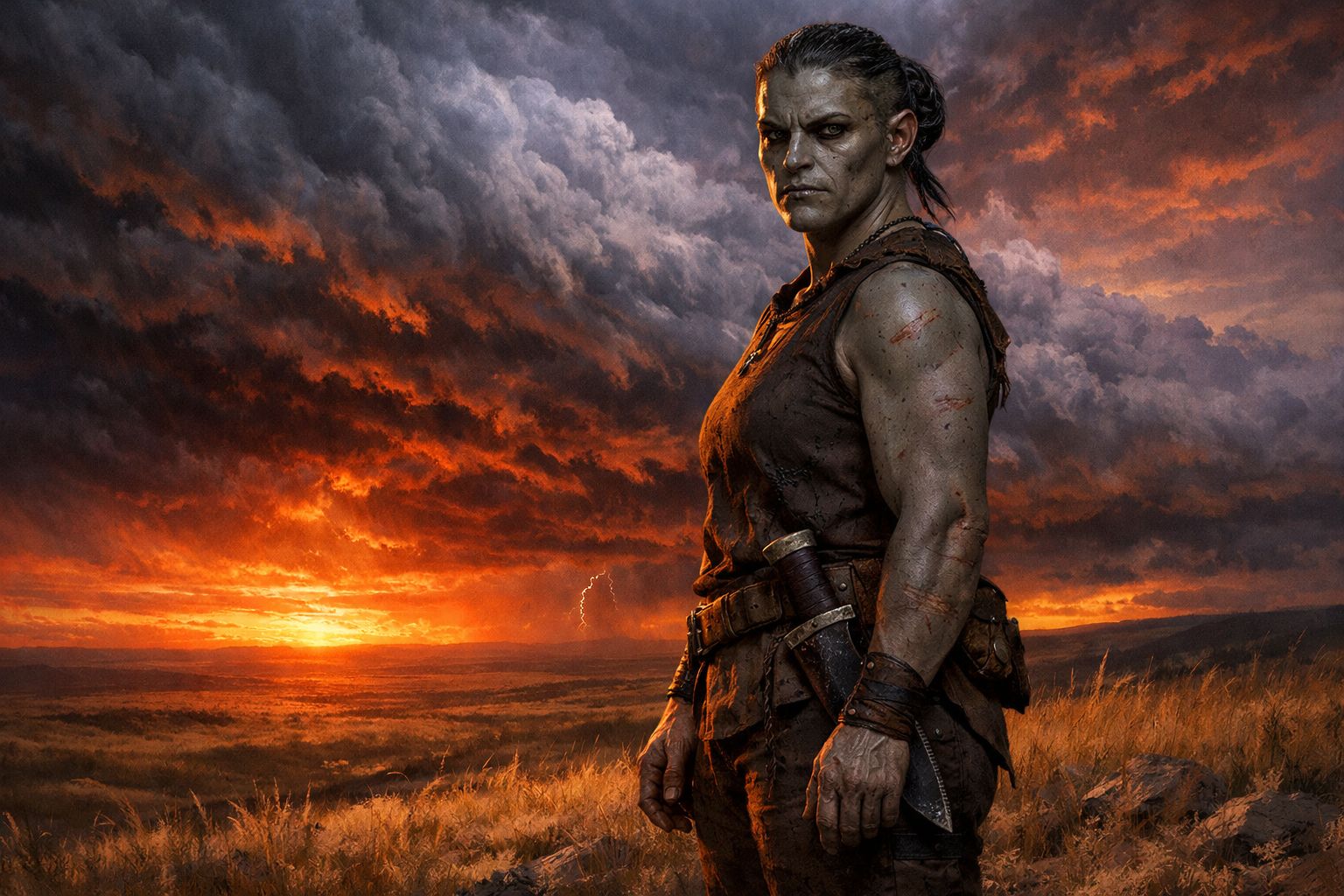
Grishna is a small framed orc woman in her mid thirties, human sized but built like a corded rope. Drogath lends her to the Blue Marlin as a guide and cultural buffer for travel across the Skarthuun steppes. She is not presented as a favor to the crew so much as a practical extension of Drogath’s authority, a way to keep the expedition moving and to keep it from creating a mess that reflects back on him.
Grishna’s value is not battlefield prowess. It is competence in the hard work that keeps people alive in open country, plus an instinctive grasp of orc social codes, taboos, insult boundaries, hospitality rules and what kinds of strength matter to whom. She is tough in a way that does not ask for recognition.
Appearance and Presence
Grishna is wiry and muscular with narrow hips, strong forearms and a posture that reads alert even when she rests. She keeps her hair practical, usually braided tight and wrapped so it does not whip in the wind. Her skin is scarred in small honest ways, cuts that healed crooked, burns from cooking stones, rope marks from hauling loads and a healed bite on one shoulder that she refuses to explain unless pressed by someone she respects.
Her gear looks like camp gear, not warrior finery. Knife, flint, cord, a small bone needle case, a battered pot hook and a strip of leather for quick lashings. The dagger is always within reach. She is not eager to fight but she is not hesitant either. If she has to cut someone, she cuts to end it, not to warn.
Background and Why Drogath Trusts Her
Grishna came to Drogath’s attention as the kind of person who sees problems before they become emergencies. Drogath values that because he understands logistics in his bones. He lends her because she can get outsiders through orc lands without forcing him to send warriors to babysit them.
Grishna also understands the unspoken layers of obligation. She knows when a gift must be refused once and accepted the second time. She knows which questions are safe to ask and which ones imply weakness. She knows how to read a boast for what it is, a challenge, a greeting, a warning or a request for reassurance disguised as contempt.
Personality and Values
Grishna respects strength over talk. To her, strength is not only muscles. It is composure. Follow through. The ability to do something unpleasant without turning it into theater. She warms fastest to the crew’s fighters because they tend to communicate in action, boundaries and consequences.
Her speech is direct and stripped of softening. She does not do politeness rituals unless they are meaningful to her culture. This will make her read as rude in many scenes, but she is not trying to offend. She is trying to be clear and she expects others to be clear back. To her, nice platitudes signal deception.
She does not show feelings often. When she does, it is unfiltered. If she laughs, it is loud. If she is angry, it is sharp and immediate. If she is frightened, she becomes quieter and more dangerous, not louder.
Role in the Skarthuun Steppes
Practical Guide
Grishna reads weather through wind taste, cloud edges and how animals behave before the crew ever sees a storm line. She knows where water will still be drinkable and where it will be poison with salt or rot. She can set a camp that does not silhouette itself on the horizon, that keeps scent down and that lets watchers see without being seen.
She pushes the crew toward routines that reduce friction. Pack order. Who carries what. When to stop. When to move. Where to place the fire if a fire is allowed at all. She does not ask permission to do these things. She states what must happen, then does it.
Social Buffer
Grishna’s second job is making sure the crew does not accidentally insult the wrong people or accept the wrong kind of hospitality. She knows which steppe groups will treat outsiders as guests, which will treat them as prey and which will treat them as a bargaining chip.
When needed she can speak on the crew’s behalf in the blunt orcish manner that signals strength rather than pleading. She is not diplomatic in human terms. She is precise in orc terms, which is more useful here.
Life on the Blue Marlin

Development on the Ship
Grishna’s presence starts as someone who keeps camp. She organizes stores, patches gear, keeps routines tight, spots waste and corrects it without ceremony. She watches who is tired, who is hungry and who is fraying. She does not comfort with words, but she will shove food into a hand, tighten a strap, fix a leak and call that care.
Inspired by Amaxia, she will want to become a true warrior. She will train with the marines and she has a natural ability for it. She fights with aggression, strength and relentlessness, overwhelming the opponent.
Her weapon of choice is a scimitar with her big knife for parrying and close in work in the other hand. In a brawl she prefers brass knuckles.
Social Confusion
Orc society’s gender roles are strict enough that Grishna has built her whole sense of order around them. Female warriors do not fit inside her categories and she will stumble over that. Not with hatred, but with genuine confusion that turns into scrutiny.
She will likely treat Amaxia as a contradiction that must be explained. Her first instinct will be to assume there is a hidden social role that makes it acceptable, perhaps a ritual exception, perhaps a vow or perhaps a shame that forced a path. If Amaxia refuses the premise and simply is what she is, Grishna will take longer to adjust and the adjustment will be visible.
Grishna has lived her entire life in a strict social hierarchy and Ileena does not play that game. Ileena is not above the hierarchy, she is outside it, it does not concern her. This both mystifies and intrigues Grishna, but she feels that she needs to understand more of it to adapt to her new life.
Complications and Cover
In the countries around the central oceans, Grishna will be assumed to be either a slave or an escaped slave. Because of that she will need to be accompanied by other crew when ashore. It is easier to navigate questions when Scarnax or another senior crew member is present to set the tone and shut down the wrong kind of interrogation, and it prevents opportunists from trying to “claim” her.
In the regions beyond, orcs are not known, so it will not be an issue.
Relationships with the Crew
Amaxia
Once Grishna gets over the initial confusion, she finds a twin soul in Amaxia, even if she does not understand her dark moments. She calls her "her battle sister".
Mbaru
Grishna admires Mbaru as a brawler and his way of not speaking unnecessarily fits her.
Scarnax
At first, leadership not based on physical strength felt odd to her, but she grew to appreciate it and has great respect for him.
Ormun
She does not get him. He is strong and soft at the same time and that does not make sense to her. Yet, the few times she needs someone to talk to, he is the one.
Ileena
Grishna is intrigued by Ileena’s animal nature and total self confidence. Ileena’s refusal to engage with hierarchy becomes a quiet lesson Grishna cannot stop studying.
Ayesha
Ayesha’s reliance on clever words makes Grishna feel distrust, but she cannot deny the results. Over time, she understands that diplomacy is just another facet of warfare.
Secrets and Complications
She has a personal line she will not cross. She will guide through danger, she will fight if forced, but she will not participate in actions that violate what she considers camp law, especially anything that endangers children or breaks hospitality rules once they have been invoked properly.
If the crew earns her respect, she may start bending her own rules for them, then get angry at herself for doing it. That internal conflict can surface as sudden harshness after a moment of warmth.
Roleplaying Notes
Keep her posture grounded and efficient. She does not fidget. She watches. When she speaks, she aims for the shortest sentence that lands. She rarely asks a question that can be avoided and when she does ask one, it is because the answer matters for survival or status.
When challenged, she does not escalate with volume. She escalates with certainty. She will call a bluff without anger, as if stating the time.
If she shows emotion, let it come out big and then be gone. A flash of laughter, a hard grin, a sudden fury or a quiet moment of unexpected softness around a child or a small creature, then back to the work.
Using Grishna in Play
Grishna is most effective when she prevents problems early, then becomes the person who can tell the crew, bluntly, what kind of trouble they are walking into if they ignore her. She should not solve every challenge. She should frame them, warn about the social consequences and handle the parts that only an insider can handle.
She also gives you a clean way to externalize steppe culture without exposition. Instead of explaining, let her correct. Let her refuse. Let her accept a gift in a way that reveals rules. Let her shut down a conversation because the wrong person is watching.