Nephyla
| Story |
|---|
| Amaxia burst out of Nephyla's tent like a drawn blade finally loosed. |
| She paced three hard steps into the lantern light, then turned on Junia with a look of pure disbelief. |
| "She wanted me to wipe her ass." |
| Junia, who had been sorting bandages beside a saddle bundle, closed her eyes for a brief moment and sighed. |
| "I am a healer," she said, rising. "I have dealt with worse. Some of it from you." |
| Amaxia stared at her in outrage, but Junia had already ducked into the tent. |
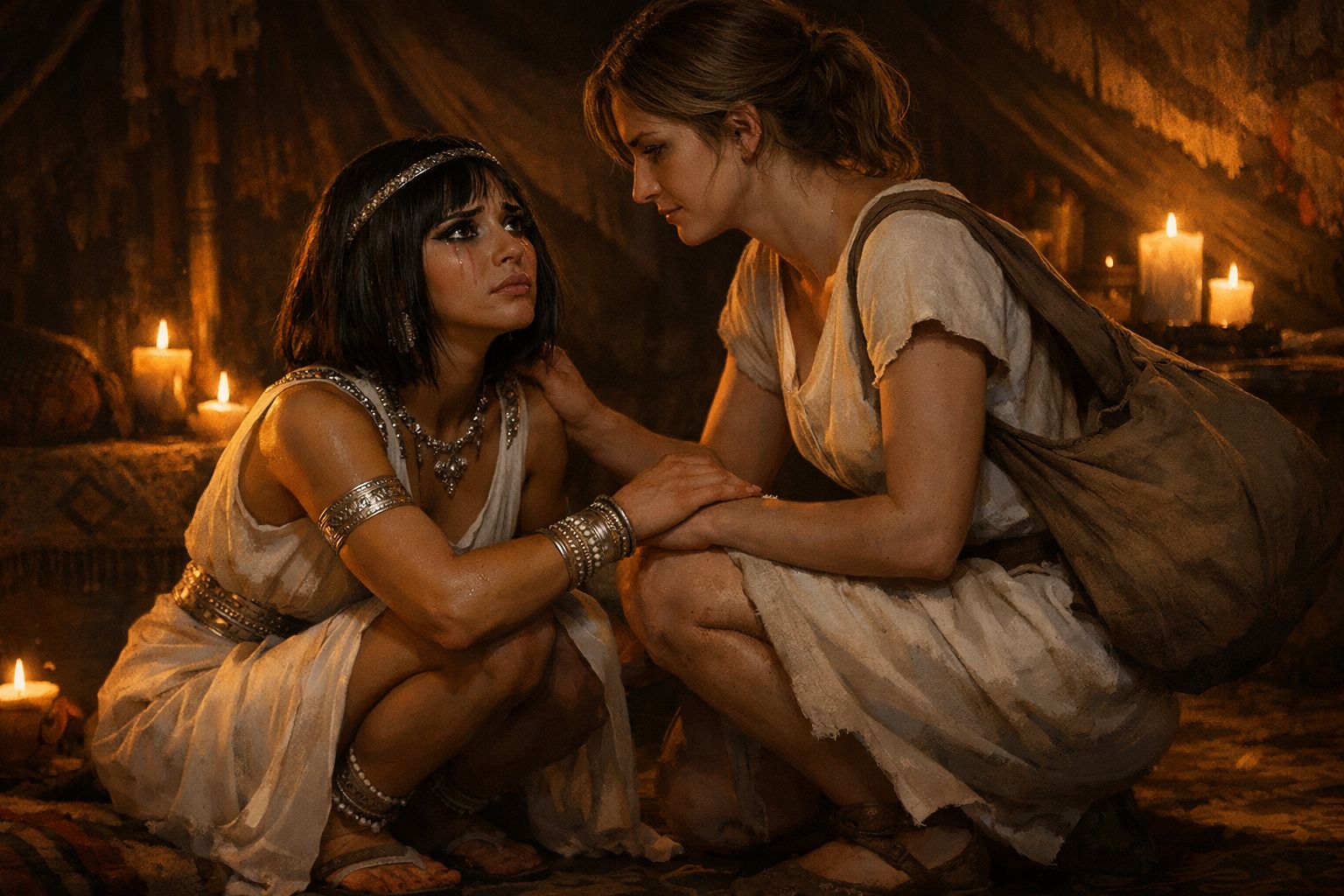
| Inside, Nephyla sat stiffly on a pile of blankets, silk wrinkled, eyes shining with fury and humiliation. She looked up at Junia and said, with enormous effort, "I do not know how. There were always slaves for that." |
| For a moment Junia simply looked at her. Then her face softened. She sat down beside her and laid a hand on her shoulder. |
| "All right," she said gently. "I will show you." |
| The relief on Nephyla's face was immediate and almost painful to see. |
| Outside, Amaxia folded her arms and glared at the tent while Nasheem, wisely silent, pretended to be fascinated by his cup. |
| A few minutes later Junia stormed back out, red-faced and scandalized. |
| "No," she snapped toward the tent. "Absolutely not. Figure it out yourself!" |
| Then she turned to Amaxia and hissed, "She said the slaves always finished with a 'pleasurable touch', and she expected the same." |
| Nasheem nearly choked, spraying wine through his nose. |
| Amaxia looked at the tent, then at Junia, then up at the sky as if asking the gods whether they were mocking her personally. |
| "You see?" she said. "This is what I am dealing with." |
| Junia stood fuming for a moment, then some of the anger drained out of her. She sat down beside Amaxia on the saddle blanket and stared at the tent glowing softly in the dark. |
| After a while she said quietly, "It is quite sad, actually." |
| Amaxia let out a breath through her nose. |
| "Yes," she said. "And still annoying." |
| Junia nodded. |
| "She really does not know. Not how to do simple things. Not how to ask. Not how to be anything except served." |
| Amaxia was silent for a moment, then grunted in reluctant agreement. |
| Junia looked toward the tent again. |
| "We will just have to teach her," she said. "One thing at a time." |
| Amaxia sighed heavily. |
| "That," she said, "is going to take a while." |
Background
Nephyla was never raised to be a woman. She was raised to be a function.
In Lumekhet she was the night made flesh, the gatekeeper of rebirth, the one who carried souls across the sky and returned them to the world beyond the Zareth. Servants dressed her, bathed her, fed her, carried her, praised her, feared her, and built their entire lives around her moods and rituals. She did not ask. She did not negotiate. She did not explain herself. She existed at the center of a sacred machine and everyone around her existed to keep that machine running.
Then the machine broke.
When the crew of the Blue Marlin pulls her down from a public death beneath the gaze of the Sun, they do not rescue a capable exile or a fallen queen with hidden strengths. They rescue a woman who has been shaped into helplessness by worship. She comes with them as if it were the most natural thing in the world. It does not occur to her that she might need permission. Of course they will take her. Of course they will make room. Of course someone will solve the practical details. That is how the world works.
At first, she is wrong about almost everything.
Life Aboard the Blue Marlin
Nephyla arrives aboard the Blue Marlin as a creature of silk, outrage, and impossible assumptions. Ship food is beneath her. Hard beds are an insult. Salt spray ruins her hair. She does not know how to lace her own clothing properly, how to carry her own things, or how to sleep when the deck moves under her. More than once she sits staring at some ordinary problem in silent fury, as if willing reality itself to correct its offense.
She makes demands instead of requests. She tells people to help her as if she were granting them purpose. She thanks no one at first, because gratitude belongs to equals, and she has never lived among equals.
This makes her infuriating.
It also makes her pitiable.
The crew gradually realizes that beneath the arrogance is not hidden competence, but vast absence. In palace life she was protected from every ordinary failure. Outside that world she is, in some ways, almost childlike. Not innocent, never that, but undeveloped. She has no sense for practical labor, little grasp of ordinary friendship, and no instinct for the thousand small negotiations by which normal people live together.
Yet once the first shock fades, curiosity begins to take root. She watches. She listens. She starts asking questions with a hunger that surprises even her. Why is this rope tied that way? How do you mend cloth? Why do I have to wait to speak? Why does the cook taste the stew before serving it? Why does no one kneel?
At first she still phrases these things as commands. Over time, less and less so.

Personality and Temperament
Nephyla is proud, demanding, vain, and used to obedience as completely as other people are used to air. She can be cutting without even meaning to be cruel, because so much of her speech was shaped in a world where everyone below her was expected to absorb injury in silence. She does not understand modesty, compromise, or the ordinary dignity of labor. These are not values she rejected. They are values she was never taught.
Yet she is not empty.
She is highly observant when she chooses to pay attention. She has an instinctive eye for symbolism, ritual, status, beauty, and insult. She remembers names, phrases, and gestures with eerie precision. She carries herself with a grandeur that does not vanish even when she is frightened, and in moments of stillness there is something almost unbearably sad about the way she tries to preserve that dignity when everything else has been stripped away.
Her temper is quick, but so are her emotions. Fury, humiliation, grief, wonder, envy, and gratitude all run close beneath the skin. The difference is that she only knows how to express some of them. Anger comes easily. Thankfulness does not. Dependence shames her. Kindness confuses her. Helplessness enrages her so deeply that it sometimes leaves her in tears.
She is difficult because she is damaged, and damaged because she was never allowed to become fully human while she sat enthroned as something divine.
Her old life still shows in the way she speaks, and those long trained to obey authority often find themselves yielding before they mean to. She has an uncanny ability to detect hierarchies, status, and lack thereof, and to put pressure on exactly the right point to get those with lesser status to back down.
Development Arc
Nephyla's story is not one of hidden power. It is one of dismantling. She goes from being Ka-Iah, the living Moon goddess, to becoming Nephyla, becoming an ordinary person.
At the beginning she believes, or at least feels, that she still is what she was in Lumekhet. The world has wronged her, not changed her. She expects service, obedience, reverence, and when those things fail to appear she lashes out in anger or collapses into private despair. The first stage of her journey is humiliation. She cannot command the sea to still itself. She cannot make food appear. She cannot even solve the small discomforts of daily life without help.
Then comes dependence.
Acts of pity and kindness begin to crack her open. Someone shows her how to make a bed aboard ship. Someone helps her wash sand from her hair. Someone quietly fixes a mistake she cannot admit she made. At first she accepts these things as her due. Later she begins to understand that they were gifts. That realization changes her more than any sermon could.
From there she grows hungry to learn. Not all at once, and never neatly, but steadily. She asks questions. She watches people work. She tries and fails and tries again. Her pride does not vanish, but it changes shape. It becomes stubbornness rather than entitlement. She remains socially clumsy, still more likely to tell than ask, but warmth starts to appear where cold command once lived.
In time she becomes softer, stronger, and more real. Not less herself. On the contrary, for the first time in her life, she starts to become something other than the role she was made to inhabit.
Relations on the Blue Marlin
Junia becomes one of the first people she trusts. Junia's patience, gentleness, and refusal to be impressed by divine status make her difficult to intimidate and strangely easy to rely on. Nephyla resents that at first. Later she begins to seek Junia out when frustration or fear become too much to carry alone, because Junia does not judge, she just helps.
With Ivy she forms a more painful and more important bond. Ivy understands helplessness from the opposite end of the world, not as privilege, but as violation. Nephyla is forced, slowly, to confront that there are forms of powerlessness she never even imagined. Their friendship grows through friction, discomfort, and moments of genuine recognition. It is one of the relationships most likely to change her.
Nasheem becomes another quiet anchor. His grace, humor, and ability to move through tension without flinching unsettle her at first. He treats her neither as a goddess nor as a broken thing, and that balance earns her respect. In time she comes to value his company, even when she would never say so plainly.
With Ileena she has a strange kind of mutual understanding and near constant irritation. Both hate being told what to do. Both carry themselves with instinctive certainty. Both react badly to constraint. Yet where Nephyla is shaped by hierarchy and ritual, Ileena is shaped by appetite, freedom, and movement. They recognize something fierce in each other, but do not get along well. Their clashes can be sharp, though beneath them lies a reluctant recognition.
At first, Nephyla saw Ormun as little more than a brute, useful for strength and carrying burdens. But he was one of the few on the Blue Marlin willing to keep speaking to her through all her arrogance and abrasiveness, and one of the first to see the wounded person beneath them. Over time, that grew into an unlikely friendship. Ormun is one of the very few who can tell her when she is overstepping without provoking her, because even in correction he never loses sight of her humanity. More clearly than anyone else aboard, he understands that for all her former power, she was also a slave to the world that shaped her. In his quiet way, he helps her begin to understand it too.
Roleplaying Notes
Speak with certainty, even when uncertain. Assume space will be made for you. Give orders where requests would be more appropriate. React to ordinary inconveniences as if they were personal insults from the universe. Let pride flare up quickly.
But also show the gaps.
Pause at simple practical tasks. Stare at objects you do not know how to use. Let confusion curdle into anger, then into humiliation. When alone with someone you trust, let the facade crack. Let tears come from frustration rather than softness. Let gratitude emerge awkwardly, almost painfully, as if the words themselves do not fit in your mouth. Even accepting comfort comes hard.
As she develops, keep the core of her voice. She should never become casually humble. She learns warmth before humility, curiosity before wisdom, friendship before ease. Even when she becomes kinder, she should still sound like someone who once expected the world to kneel.
That is what makes the change matter.
The Spirit World and Ivy
If Ivy watches her in the spirit world, she stands out at once. Other spirits keep the same aura, steady and unchanging, but Nephyla's shifts with the cycle. By day it is a dull red glow. By night it becomes a bright white beacon.
Do not draw attention to this for the players. Just mention her aura in passing when the opportunity arises and let it sit there quietly. If they notice the pattern, it works as a small piece of foreshadowing, an Easter egg suggesting that she may be more than she appears.