Magic Is Evil
| Story |
|---|
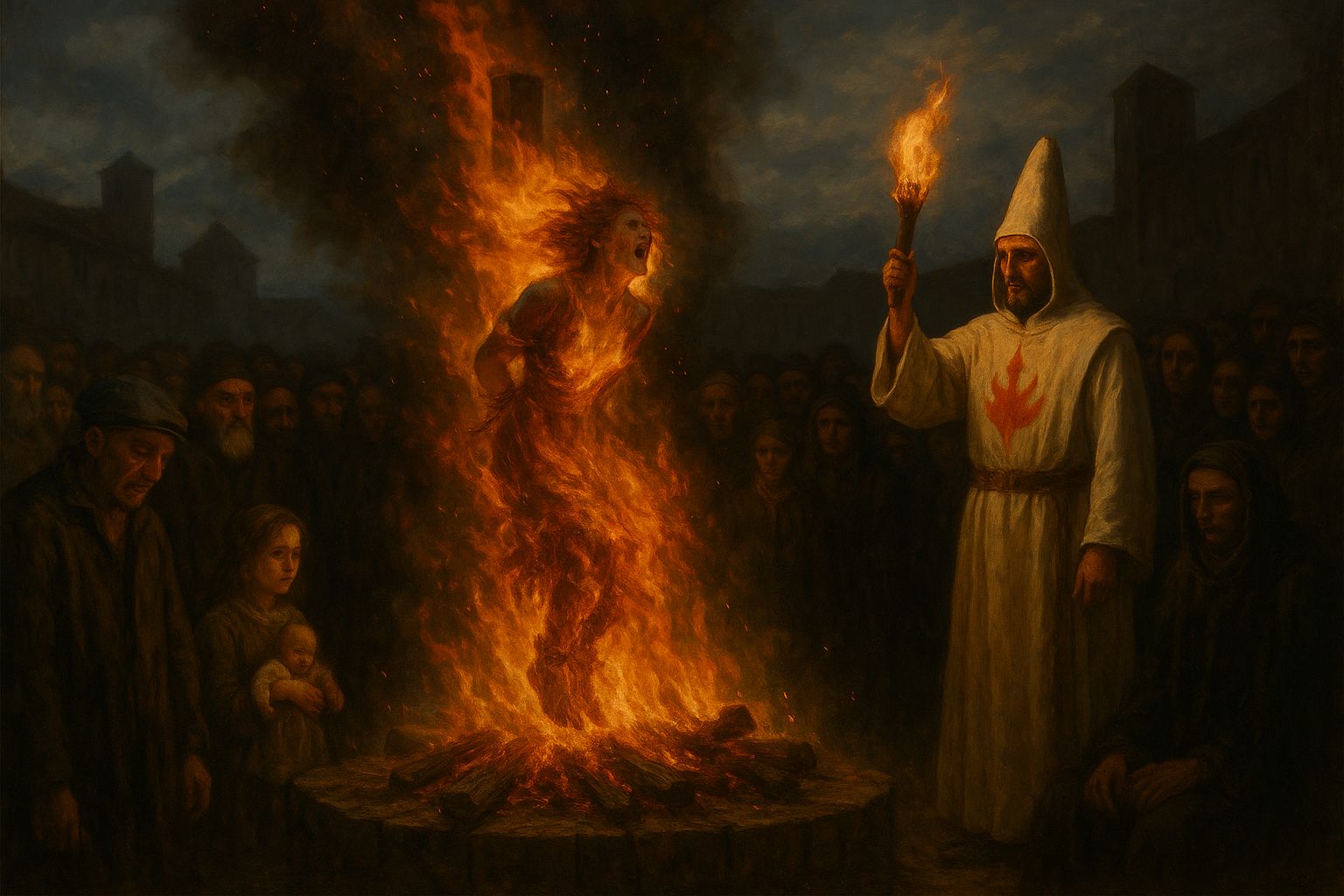
| The fire had already been built when they dragged her into the square. |
| It was dusk, and the wind smelled of rain and smoke. The crowd had gathered in silence, faces gray with the long habit of fear. No one spoke the woman’s name. To name her was to share her guilt. |
| She was small, no older than thirty, her hair matted with mud. Her wrists were bound, but she didn’t struggle. Only her eyes moved, searching the faces around her, a fisherman, a priest, a child clutching a doll. None looked back. |
| The inquisitor raised his torch. His armor was black, marked with the sigil of the Flame. The light shone in his eyes like worship. “This woman,” he said, “has been found guilty of consorting with unseen powers. She healed a dying boy without prayer. She spoke words not of the Book. She called down light where none should shine.” |
| He turned to the crowd. “What is the punishment for such evil?” |
| “Fire,” they whispered. |
| He smiled, pleased. “Then let her be clean again.” |
| The torch touched the wood. The crackling began softly, almost politely, then grew into a roar. The woman gasped once, but her voice was lost beneath the chant: Truth by flame, faith by fire. |
| When the smoke thickened, the inquisitor turned to the boy’s mother, who stood pale in the front row. “Your son lives,” he said, “by her corruption. Pray for his soul, lest her sin cling to him.” |
| The woman nodded, trembling. She would pray, and tomorrow she would thank the gods that her son still breathed. |
| By nightfall, the square was empty again. Ash drifted through the streets, mixing with rain. From a nearby window, a child watched the embers die and whispered the word he’d heard the condemned woman speak before they took her away. |
| It was a word for light. |
| Nothing happened. But the air seemed to shiver, just for a moment, as if remembering what it had once been. |
Description
Once, magic was power. Now, it is blasphemy.
Across Heroica, the art once seen as divine or enlightened has become synonymous with corruption, heresy, and death. The people no longer ask what magic is, only who is hiding it. The fear is so deep that even a whisper of sorcery is enough to turn friends into executioners.
The world has decided: magic itself is evil.
The Root of Fear
No one remembers exactly when the fear began. Some trace it to great catastrophes, each one tied to a sorcerer’s pride or a failed ritual. Every age had its calamity, and in every calamity there was a mage. Others say it began in the Empire, after the banishment of the Crimson Synod. Whatever the cause, the lesson endured: where magic goes, ruin follows.
Over centuries, the stories merged into truth. Mothers warn children that magicians drink souls. Priests preach that spellcraft is the voice of demons. Kings outlaw magic in word and deed, and inquisitors roam from village to village, their red brands glowing in the dark.
Magic is no longer a tool. It is a curse. Those who wield it are treated as plaguebearers.
The Witch Hunts
The witch hunts began as law. Now they are instinct.
Any who display unnatural skill, sudden healing, or strange knowledge are accused. Once accused, there is no defense. Villagers drag suspects to the pyres, or hand them to inquisitors who extract confessions through “divine proof”: the knife, the flame, the drowning stone. Even children are questioned, their dreams torn apart for traces of forbidden light.
Healers are hanged beside necromancers. Scholars who study the stars are burned beside midwives. The smell of smoke and fear has become part of daily life.
Even the act of defending the accused marks one as guilty. The mob believes what it wants to believe, and reason has long fled.
In most nations, such as Para Omros and the Empire, witchfinding has become a profession, supported by tithes and temple law. Elsewhere, it is simply the will of the mob, guided by rumor and panic.
The Outlawed Arts
No distinction is made between types of magic. All are damned equally. No creed, no circle, no craft is spared. Whether they pray, brew, heal, or read, all are condemned alike.
Healers and Alchemists
Once honored for their service, healers are now feared. Their touch is called “the hand of corruption.” Villages forbid healing that works too well. Only prayer and poultice are trusted, anything faster is witchcraft.
Alchemists fare little better. Their mixtures are seen as bottled sorcery, their furnaces as demon mouths. Many burn with their laboratories.
Shamans and Druids
Those who commune with spirits or nature fare worst of all. In the north, druids are hunted as forest cultists. In the jungle, shamans are mutilated, their tongues cut out so they cannot whisper to the wind. Even among their own tribes, they live half-exiled, feared for what they might bring down upon their people.
Sea Elves
The sea elves’ art of shaping wood has damned them. Fishermen say their crafts move of their own accord, and that their ships are “grown from witchbone.” Now, wherever sea elves are found, they are hunted. Some have retreated into uncharted waters, while others wander as fugitives, hiding their gift beneath scars and silence.
Sorcerers and Scribes
Those who once pursued the deeper mysteries of the world now live like rats in ruins and caves. Spellbooks are burned wherever they are found. Even the symbols of arcane study, circles, runes, sigils, are outlawed. In some places, the very writing of magic is punishable by death, for “letters can lie as easily as tongues.”
The Inquisition
In the great cities, witch hunts have evolved into bureaucratic purges. The Inquisition of Para Omros keeps ledgers of the condemned, long lists of names crossed out in red. Each province has its own order of judges, priests, or knights whose sole purpose is to hunt magic users.
They claim to act in the name of purity and safety. They call themselves the Flame of Truth.
Their interrogations are scripture: confession by fire, purification by drowning, enlightenment by blade. They do not hide their cruelty; they sanctify it. In their eyes, a magician’s suffering is not punishment but prayer, proof that evil burns when touched by holiness.
Even kings fear the Inquisition’s power, for it answers not to crowns but to faith.
The Hidden Ones
And yet, magic has not vanished. It has gone underground.
Hidden covens meet beneath cathedrals and ruins, using blood or shadow to mask their spells. Wanderers carve sigils into bone and stone, praying that the old wards still hold. Some disguises are simple, a magician posing as a healer, a witch as a midwife, but others are elaborate, entire cults built around hiding a single mage.
A secret language of symbols and gestures circulates among the hunted. They call themselves the Veiled Order. Their creed is simple:
“Magic is not evil. Fear is.”
Still, even among them, paranoia reigns. Betrayal is common. Trust is death.
The Price of Fear
The world has grown poorer for its hatred.
Without healers, plagues spread unchecked. Without shamans, crops wither in places once fertile. Without sea elves, shipwrights forget the old arts. The balance that magic once kept is gone, and yet no one dares to name it aloud.
In the darkest corners, heretics whisper that the world itself is dying of its own fear. That the world, stripped of its protectors, now lies open to the demons it once held at bay.
But when such words are spoken, the torches always find the speaker.
Tone and Themes
“Magic Is Evil” is not a story of witches and heroes, but of fear made law, a world where ignorance wears the mask of faith.
It explores how terror spreads faster than truth, how purity becomes cruelty, and how civilization devours its own protectors in the name of safety.
Magic still exists, hiding in the cracks and shadows, whispering to those brave or foolish enough to listen. But to speak a spell aloud is to light a beacon for your own destruction.
The world has chosen darkness over danger, and now even its miracles burn. Someday, the smoke will clear, and nothing holy will remain.