Heroica 40000
| Story |
|---|
| The execution began at noon, under a sky the color of brass. |
| The historians sat among the spectators, hidden beneath local robes, their lenses disguised as jewelry. The arena of Luminara was vast, a ring of red stone filled with banners and the roar of ten thousand voices. In the center stood a single woman, a captive from Amazireth, stripped to the waist, her skin marked with sigils of shame drawn in ash. |
| A herald shouted the crimes. None were crimes by their standards; refusing to kneel for the Empire banner, resisting Empire forces, worshipping false gods, giving birth to enemies of the Empire. The crowd jeered, their laughter rising in rhythm, a living tide of devotion and bloodlust. |
| Then the executioners entered: six of them, masked and silent, bearing hooked poles and curved knives. A chariot circled the arena, carrying the banners of the victorious army, their edges still stained from yesterday's battle. Music swelled, bright and triumphant. |
| Dr. Halden raised his recorder. "Observation log. This appears to be a ritualized death, sanctioned as civic spectacle. The crowd's emotional intensity suggests genuine religious fervor. They believe this cruelty is sacred." |
| Beside him, Sera said nothing. Her hands shook, eyes fixed on the prisoner who, though terrified, still tried to stand straight. When they began the dismemberment, she turned away. |
| By the end, the cheering drowned even the screams. The herald announced that the woman's name would be erased from all records, that her blood would "fertilize the courage of the faithful." |
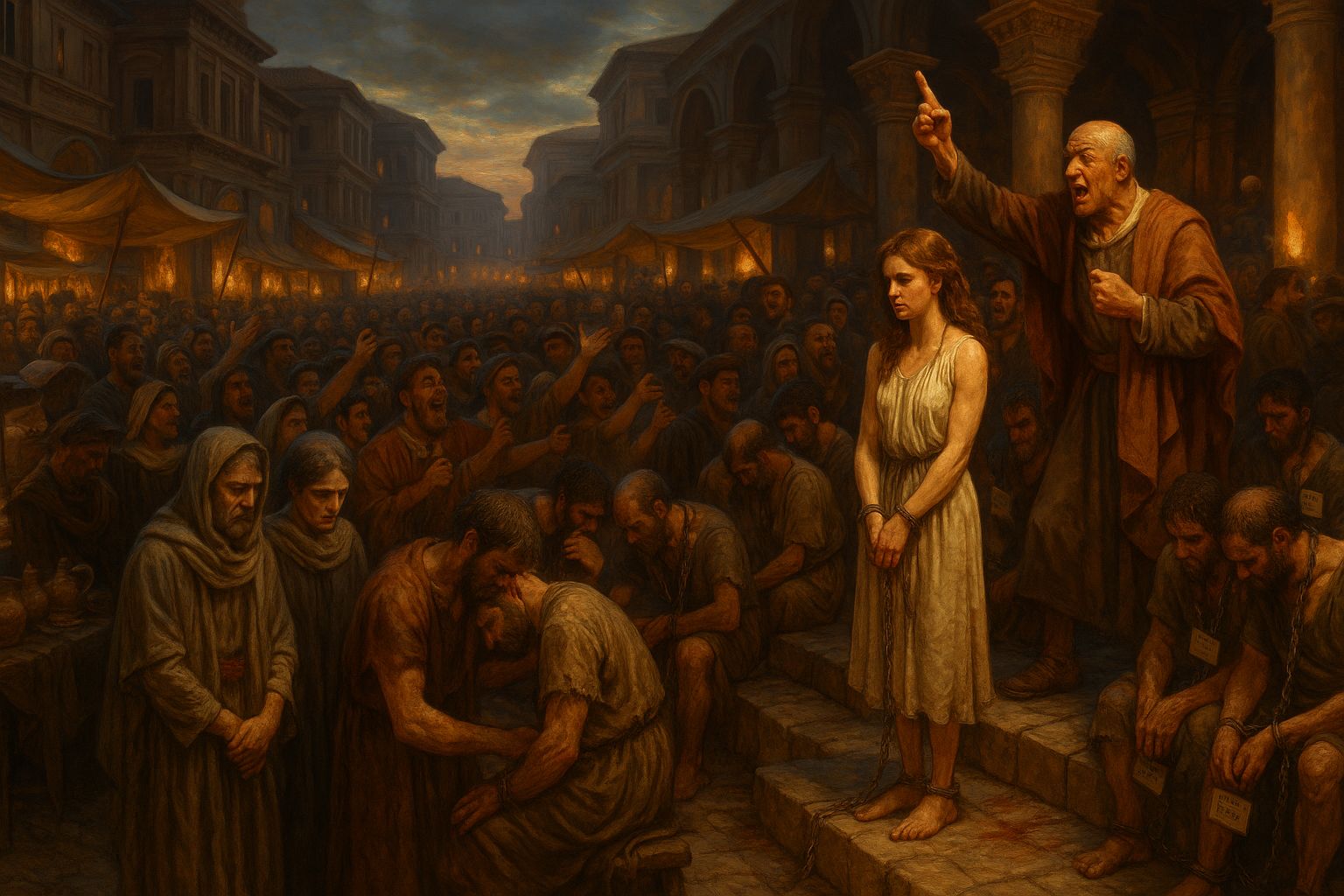
| The team left with the crowd, silent and sick. The air outside was heavy with incense and heat. They passed through the arches that led to the lower quarters, where the sound of chains clinking filled the streets. |
| The slave market had begun its evening trade. |
| Children were weighed like livestock. A woman with fine hair was auctioned for her eyes. The crowd that had shouted for death now haggled for flesh, their laughter unchanged. |
| Dr. Halden stopped, voice low. "They don't see it," he said. "They don't see any of it." |
| Sera stared at the rows of cages, each labeled neatly with price and origin. "They see," she said. "They just don't care." |
| The others walked on, heads lowered, their robes brushing against the dust and blood that covered the stones. Behind them, the arena bells rang again, a call for the next performance. |
| And somewhere deep below, under the noise and the heat, the recorder clicked off, saving every sound. |
Description
The age is distant, the ruins of Heroica buried beneath a thousand layers of time. Civilization rose again after the Fall, but its reborn empires stand on sand. Historians of the far future know only fragments, collapsed mythologies, black strata of fused glass, and inexplicable radiation in the old continents. Something happened, an apocalypse so complete that even its name was lost.
Now, after centuries of speculation, the Temporal Research Directorate has done the unthinkable. A team of historians, linguists, and cultural analysts has been sent back forty thousand years, to the final decade before the Fall. Their mission: to observe, record, and discover what destroyed the first age of man.
The Mission
The team are not soldiers, but scholars. They come from a rational, secular age that has forgotten cruelty, hierarchy, and superstition. They expect the ancient world to be primitive but not inhuman. What they find instead is Heroica, a world where slavery, sacrifice, and divine tyranny are everyday truths. Kingdoms wage endless wars for glory, and commoners die believing their suffering pleases the gods.
It is a world so cruel and alien that the team struggles to stay sane. They are repulsed by what they see, yet forbidden to intervene. Intefering is to put the mission in jeopardy. The Directorate's protocols are clear: observe, record, keep a low profile. But those rules were written by people who have never watched a child die in a slave pit.
At first they whisper to one another about keeping their distance. Soon they argue over whether they have a moral duty to act.
The Tools of the Future
They are disguised as locals, their clothing and speech crafted through exhaustive research. Most of their advanced equipment was left behind. Each carries only a few hidden tools, a medical patch, a recorder disguised as simple wood jewellery, and the temporal anchor, a small crystalline device that allows them to return to their own time once the mission ends.
It is their lifeline, the one thing that can tear them free of the coming catastrophe.
Until they lose it.
The Lost Device
After their insertion, things goes immediately wrong. They get attacked, robbed, and left with only their clothes and recorders.
At first, they think it can be found. They trace rumors of "a star fallen to earth," of priests worshiping a shard that glows with inner light. When they finally see the signs for themselves, they realize with horror that someone else has the anchor, and is experimenting with it.
The World They Walk
Heroica is in its twilight. The old empires crumble under their own cruelty. Famines spread. War burns from coast to coast. The historians travel as merchants, healers, or scribes, moving through the dying world while trying to remain unseen.
They see wonders their civilization never imagined, and horrors their age cannot comprehend. They record everything: the languages, the myths, the slow collapse of magic. They begin to understand that Heroica's people live every day in the shadow of fear. Its gods are silent, its miracles fading, its rulers desperate.
Everywhere they go, they find echoes of themselves, half-seen figures in murals, myths of travelers who fell from the stars. They realize they are not the first version of themselves to pass through this time.
For the team, the experience becomes unbearable. They debate whether to break protocol and interfere. They begin helping villages in secret, or fall into despair or madness, seduced by the very age they came to study.
The Culture Clash
The deeper they travel, the greater the gulf grows between their values and the world's. They come from a civilization that has forgotten hunger and violence; here, those are the only constants. They try to reason with people who measure life in obedience and faith. To locals, their compassion looks like weakness. To them, Heroica's order looks like hell.
Their idealism becomes a curse. They cannot save everyone, and every act of mercy risks exposing what they are. As they adapt to survive, they begin to lose their sense of superiority, and perhaps their sense of self.
They offer medicine to a dying child, only for her parents to try to stone them for defying the gods.
The Shadow of the Future
Then they learn the truth: changing history is meaningless. The apocalypse they came to witness will reset everything, wipe the timeline clean. Their own future will rise on the ashes regardless of what they do here. That knowledge frees them and damns them both.
Some see it as license to act, to kill, to save, to play god in a dying world. Others cling to their mission, desperate to understand rather than change. But the end is coming, and time itself trembles.
The Catastrophe
The team's search ends in chaos. The temporal anchor has fallen into the hands of a petty cult in one of the dying cities. To them it is divine, an artifact that hums, glows, and defies understanding. They have spent months "experimenting" with it: pressing its surface, pouring blood on it, speaking prayers to its hum.
And one day, it answers.
The activation tears the world apart. Light brighter than the sun floods the horizon. The seas turn to steam, the sky fractures, and mountains ripple like cloth. The device, only meant for expert hands, folds space and time inward, consuming everything.
The historians watch as Heroica ends, not through prophecy or war, but through curiosity and ignorance, the same forces that built both their age and this one.
The Last Choice
There is no saving the world. The only question left is whether they can escape it. Some want to flee back to their own time, carrying the truth. Others want to stay, to guide the few survivors who will build the future society, or to die with the world they helped destroy.
In the final moments, as the apocalypse closes in, they realize the paradox: the Fall of Heroica was not a mystery to uncover. It was their arrival. The end of history was always the beginning of their mission.
Tone and Themes
Heroica 40000 is a story of arrogance and consequence. It is science fiction through the lens of dark fantasy - a meeting of enlightenment and savagery where both sides are monstrous in their own ways.
It is about the danger of believing we can understand history without changing it. About the futility of moral superiority when faced with true brutality. And about the inevitability of collapse, whether by the hand of gods, kings, or the curious fools who thought they could study the past without becoming part of it.