Waverider Story - Campaign - Author's Notes
Tazulmar
Desert nomads, crossing the desert on giant centipedes
| Story |
|---|
| The sun had just risen when the Sulmar of Miraz Khalim left the Oasis of Painted Stones. Their Shar'zul, Jahrak, carried them onward, its bronze plates glinting like shields. The air shimmered already with heat, though the day had barely begun. Scouts on camels rode ahead, their silhouettes wavering against the endless dunes. |
| By the fifth day the water skins felt lighter. The desert stretched in every direction, broken only by wind-carved ridges and the skeleton of some forgotten beast half-buried in the sand. That night, a sandstorm rolled in with the roar of the sea. The tribe lashed themselves to the platform, covering the children with heavy hides. Jahrak sank its legs deep, lowering its body to shield them. The wind screamed and sand hammered them until dawn. When it finally passed, the world was remade. The dunes had shifted, the sky was white, and no landmarks remained. |
| The people grew fearful, whispering that a Zhuril-djinn had turned against them. Khalim stood tall, his hair still full of sand, and ordered the drums brought out. The drummers struck a steady rhythm, and the singers began a low, rising chant. Jahrak lifted its head, antennae tasting the air, and began to move with purpose, following the vibration of song as though the desert itself had opened a hidden path. |
| Two days later, with their skins nearly empty, they came upon the Oasis of Black Palms. Water shimmered under the trees like a mirror. The tribe collapsed in joy, filling skins, laughing, washing the storm-grit from their eyes. Khalim, though, did not drink until the last child had cupped her hands in the pool. He stood by Jahrak, stroking the great creature's antennae, whispering, "The desert tested us, and we endured." |
| That night the fires burned high on the centipede's back, the tribe's voices echoing across the still dunes, a song of thanks to the Sahiri-djinn who had at last shown mercy. |
| Story |
|---|
| Marcus of Estoria had thought himself prepared. He had bought fine desert robes, a silk scarf to keep the sun off his neck, and two camels laden with gifts. He had even practiced the desert tongue. But when he first climbed the swaying ladder to the platform on the back of Jahrak the centipede, he realized nothing could prepare him for this. |
| The platform creaked like a ship, the beast's many legs rippling across the dunes with a rhythm that turned his stomach. Families moved easily around him, children laughing, women sewing, men repairing saddles, as if this strange life on a monster's back were the most natural thing in the world. |
| At dusk the nomads sang. Their voices rose and fell in haunting chords, the sound so unlike anything Marcus had heard in the Empire's temples. He sat apart, clutching his waterskin, until a boy of perhaps ten years pressed a hand-drum into his lap and smiled. Marcus struck it clumsily, and the others only laughed, weaving his clumsy beats into their song. |
| Three nights later they reached an oasis, where another tribe had set up camp. The Shar'zul lowered itself, and the tribe descended to the water with songs of thanks. Fires were lit, goat was roasted, and Marcus was drawn into their circle. They danced barefoot in the sand, their laughter rising like sparks. When he averted his eyes as the women bathed in the pool, they only laughed louder, splashing him until he sputtered with water and shame. |
| On the final night of the feast, Marcus watched as lovers slipped away into the shadows. It startled him, how open they were, how free, yet how bound to one another by trust. He thought of his own people, with their walls and locks and jealous whispers, and for the first time he wondered who was truly civilized. |
| When they set out again, Marcus sat at the edge of the platform, watching Jahrak's antennae sweep the sands. The desert stretched endlessly before them, the moonless sky full of stars, yet he felt no fear. The tribe sang, and even the vast silence of the Great Desert seemed to sing in reply. |
Description
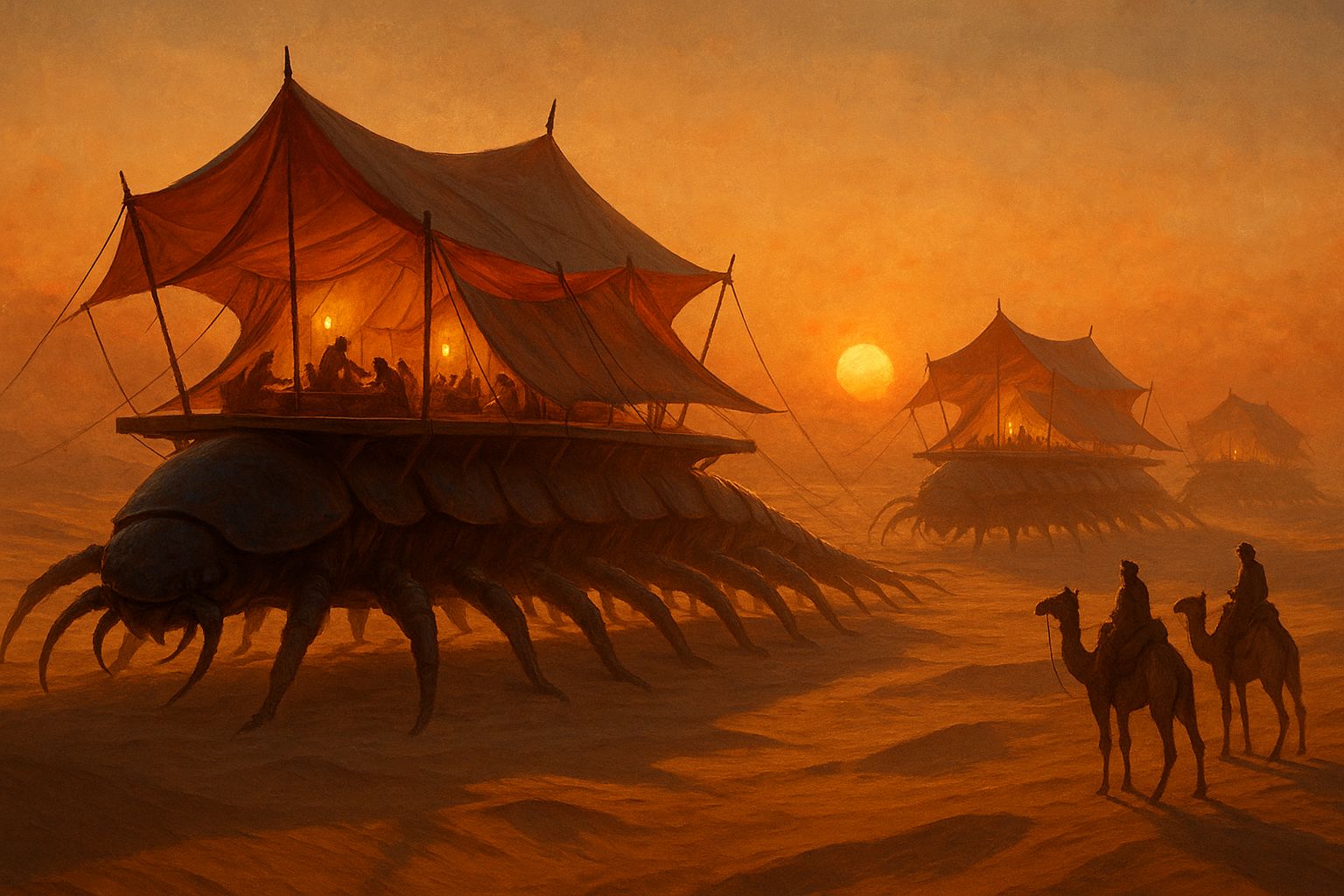
The people of the Great Desert call themselves the Tazulmar, the People of the Dune Sea, though outsiders usually just say "the centipede riders." Their existence is tied completely to the shifting dunes, the scarce oases, and the massive sand-centipedes they alone can master. They also use camels for scouting.
The Centipedes
The creatures are called Shar'zul, meaning "Children of the Sand." They are blind, armored with plates like bronze, and can sense vibrations over long distances. Capturing and taming a young centipede is considered the highest rite of passage. The best handlers, known as Zharim, are revered almost like priests.
While immense and terrifying, the centipedes are docile herbivores. A fully grown centipede can reach 30-50 paces in length, though, so one has to be careful to not accidentally get crushed. Even though they are docile, they provide a magnificent fighting platform, should the tribe be attacked, each animal a moving fortress.
A Shar'zul can travel over the desert faster than a galloping camel and without tiring. Their many legs grip the dunes and keep them from sinking, and they can ascend steep slopes with ease. They cannot swim, but can cross shallow rivers or flooded wadis by raising their bodies high above the water.
At night, they rest half-buried in the sand, their bodies forming windbreaks for the camp. When they move, the platforms on their backs sway gently like ships on a rolling sea.
The Valley of Birth
The oasis lies in a narrow canyon in the far eastern desert, known only as the Vale of Shuraz. A spring seeps from the canyon wall into a pool of green water, shaded by palms, and beneath the sand near its edge the centipedes lay their eggs. No outsider has ever been allowed to see it. The journey there is perilous, but every Sulmar must return once in a generation, to bring forth a new beast.
The Hatching Rite
When an egg is chosen, the nomads circle it in silence until the eldest begins the Song of First Breath. Their voices weave together for hours, sometimes days, until the shell trembles and splits. The newborn Shar'zul emerges pale and soft, glistening in the dawn light, only the size of a man. It crawls across to the singers, tasting their skin, brushing its antennae against their cheeks. By this ritual it learns their scent and rhythm of breath, and the Tazulmar believe the djinn of the desert bind its soul to theirs.
A centipede who hatches alone, without song or scent, becomes a wild Shurazul, wild and untrainable.
The Years of Training
After the hatching, the young centipede remains at the oasis, fed on cactus fruit, crushed locusts and dried vgetables. The Zharim trainers guide its growth with patience. First it learns to follow simple commands by tapping on the sand. Then comes the shaping of its instincts: learning to halt, turn, or lie still at the faintest whistle.
After six moons, it can carry loads of water jars. At one year, it may pull sledges. At two, its carapace has hardened like bronze plates, its many legs strong enough to carry a full platform of tents and families. Only then may it leave the Vale of Shuraz, bound forever to its tribe.
The Life of a Shar'zul
A Shar'zul does not merely serve as transport, it is treated as family. Its antennae are used in greeting, brushing across children and elders alike. Songs are sung daily to remind it of its bond. If a Shar'zul dies, the tribe may grieve as if they had lost a brother or sister.
The Tazulmar call their centipedes by name, as kin. A well-bonded Shar'zul will live 30 to 50 years, though some ancient ones are said to have reached 70, their shells as hard as stone. Each is painted with patterns of ochre and ash, marking the family it carries. When one dies, the tribe gathers to sing the Song of Last Sand, as the wind buries its remains beneath the dunes.
A Rare Pilgrimage
Because the beasts live so long, most families only return to the Vale of Shuraz once or twice in a lifetime. The journey is sacred, and children born on such pilgrimages are often given names like Shuriel or Kazun, meaning "desert-borne." To travel without a Shar'zul is considered dangerous, for the desert spirits test those who go on foot.
Families and Leadership
Each traveling group is called a Sulmar, usually two to five families bound by blood and oath. They move together on the backs of their centipedes, which carry raised wooden platforms with tents, storage chests, and even fire pits. The eldest of the Sulmar, the Miraz, guides the group, though authority is more advisory than absolute. A wise Miraz, like Grandmother Sahrin of the Deep Winds, is treasured. A foolish Miraz soon finds the younger voices simply ignoring them.
Their society is surprisingly equal, and men and women have the same rights and options. While they don't own slaves, prefering to only have trusted family members in the group, they do occasionally carry slaves as cargo across the desert.
Justice and Conflict
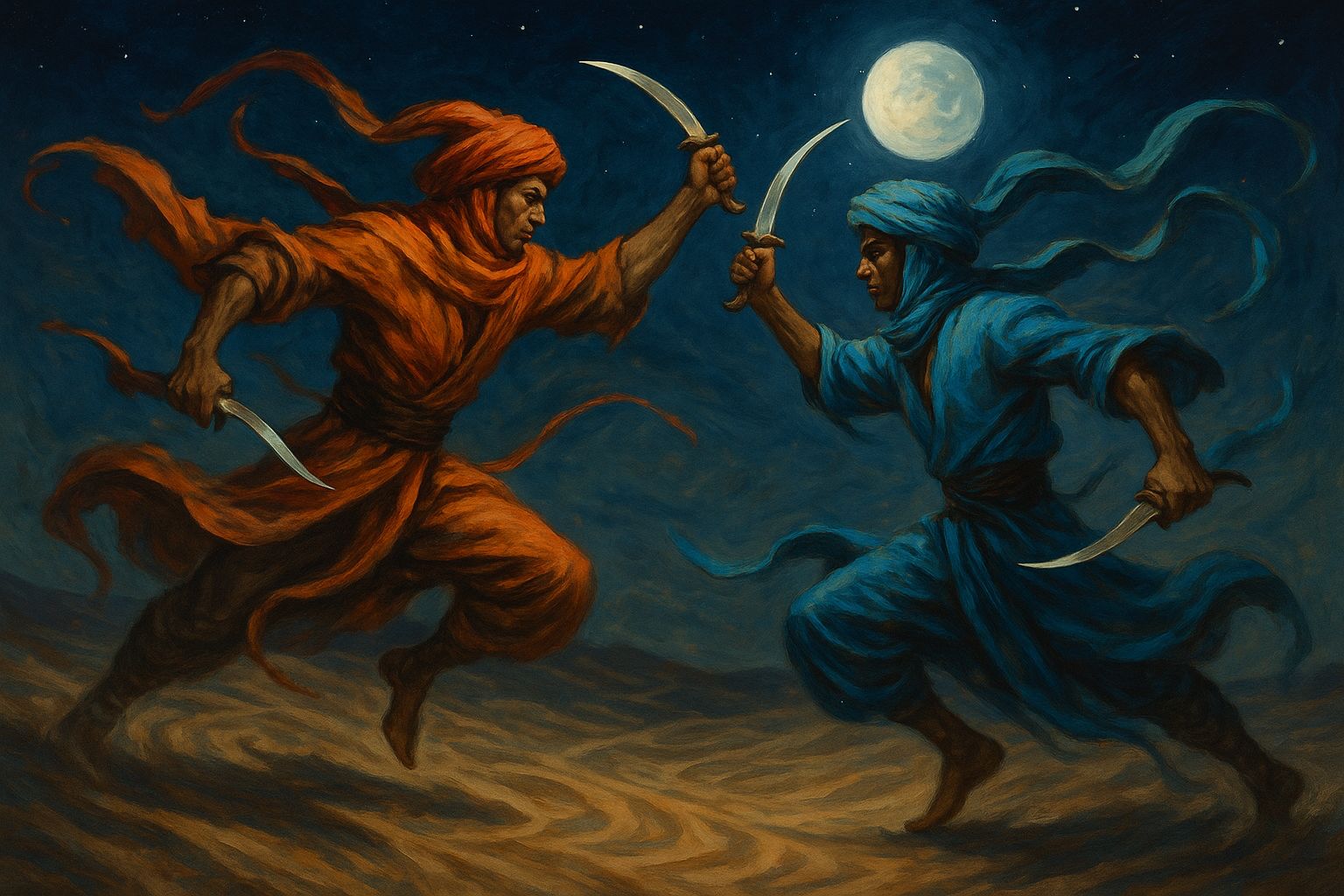
Within a Sulmar, the Miraz acts as arbiter when disputes arise. Most quarrels are settled with restitution - water, food, or trade goods paid to the wronged party. More serious crimes, like violence within the tribe or breaking sacred taboos, are resolved by duel with curved knives beneath the stars, usally only to first blood, the loser's blood spilled into the sand as an offering to the djinn. On the rare occasion when a duel is to the death, the two duellists walk out into the dunes, and only one returns, so that their families will not have to witness the duel. Exile is rare, but it is the harshest punishment: to be sent walking alone into the desert, without a centipede, is almost always a death sentence.
Religion of the Shifting Djinn
Their songs to the desert djinn are haunting and complex, woven in call and response. The nomads say that each dune has a spirit, birthed in the breath of the wind and swallowed when the sands change. The good ones, called Sahiri, bring cool breezes and guide travelers to water. The bad ones, Zhuril, stir sandstorms and thirst. A song sung wrong may turn a Sahiri into a Zhuril. At night, when the fire burns low, the singers known as Dahrim sit in a circle, chanting until the dunes seem to dance with unseen shapes.
Relationship with Djinn
Though most Tazulmar treat the djinn as fleeting spirits of wind and dune, there are whispers of greater, eternal beings that linger beyond the shifting sands. Bargaining with them is dangerous, for they never trade evenly. A singer who seeks their power may be forced to offer memories of their childhood, years of their life, or the soul of a firstborn child. Such bargains are never spoken of openly, but the haunted eyes of certain Dahrim betray the price they have paid.
Social Practices
The great feast between tribes is called the Night of Three Moons, even when the moons do not align. For three nights, there is drumming, camel races, contests of archery, and endless spiced dates and fermented mare's milk. During these nights, lovers find each other without shame. A child born of such a union is said to be "desert blessed", a gift of the djinn. Names like Jalir Three-Moon or Nahla Blessed-of-Dunes are common among them.
These feasts are a way to prevent inbreeding, and procreation within the tribe is a strict taboo. Living so closely together, though, means that there are few taboos against nudity.
Appearance and Dress
The Tazulmar wear flowing robes of pale linen or dyed wool, cut loose to shield them from the sun and allow air to flow beneath. Bright sashes of beetle-shell silk hold their garments in place, and many wear scarves soaked in scented oils to keep the dust away. Jewelry is common, usually carved bone beads, amber pendants, or bands of hammered bronze. Both men and women often paint their faces with streaks of ochre or ash to protect against glare, and tattoos of dunes, centipedes, or moons coil across their arms and backs, marking family ties and great journeys.
Music and Instruments
Song is the lifeblood of the Tazulmar, and their instruments are simple but powerful. Drums of stretched lizard-hide echo across the sands, their beats steadying both the singers and the Shar'zul. Flutes carved from bone whisper like desert winds, while long horns of polished horn or shell bellow warnings that carry for miles. For night feasts, they string small harps of gut and carapace, their tones sharp and quick, mimicking the chirp of desert insects. The nomads say each instrument has its own djinn, and must be fed with a drop of water before it is played.
Death and Afterlife
The dead are returned to the desert, wrapped in simple cloth and buried beneath the sands with a bowl of water and a strip of dried fruit. Some Sulmar burn their dead on pyres atop the Shar'zul, sending their ashes to the winds. These Sulmar believe the spirits of the dead can become djinn themselves, fleeting but watchful, dancing over the dunes. During the Night of Three Moons, the tribes sing to call their ancestors back for a time, so that the living and the dead may feast together.
Outsiders and Trade
The Tazulmar trade amber from the desert, salt, rare beetle-shell dyes, and dried cactus fruits. They bring these to the warlords of the Rim and to the markets of Lumekhet. They bring goods to ships going to Estoria. In return, they take worked steel, silks, and luxuries rare in the desert. The Rim respects them, for without them their riches would not flow. While Lumekhet see them as potential hollows, they tolerate them as long as they don't linger too long, for without them no caravan would cross the wastes.
It is whispered that spies sometimes pay handsomely to travel with a Sulmar, since they alone can slip through the desert unseen. The nomads themselves claim neutrality, but gold has a way of bending even desert-hard wills.
Their sexual practices has given them a reputation as "anything goes", and they are sometimes called "sluts of the desert", but they do stay within the boundaries of these feasts and their own people, so the reputation is uncalled for. An outsider openly challenging their virtue is likely to face a knife fight to the death.
Possible Secrets
The Djinn Bargain
While the nomads say the djinn are fleeting, some elders whisper that a few are eternal. The most gifted singers, the Dahrim, may secretly bargain with such djinn for power. A Dahrim who sings alone at night might not be praying, but bargaining.
The Songs are Maps
The long chants the tribes sing during travel are not only prayers. The verses themselves encode directions, landmarks, and distances between oases. An outsider who could learn the full song and the code would never be lost in the desert, which is why the Tazulmar never sing the same verse in front of strangers.
The Outsider's Path
Though they present themselves as few in number, there are rumors of a secret Sulmar devoted entirely to guiding outsiders, spies, assassins, fugitives, across the desert for staggering sums. These nomads may have ties to every power on the desert's edge, pulling strings from the dunes.
Adventure Hooks
The Song of Maps
A scholar from Lumekhet has paid handsomely for the full verses of a desert travel song. When a nomad singer goes missing, the tribe accuses the outsiders of theft. The adventurers must navigate suspicion, rescue the singer, and perhaps uncover the hidden cartography of the chants.
The Outsider's Path
A noble from the Empire has vanished, last seen entering the desert with guides. Rumors point to the secret Sulmar that ferries spies across the sands. The adventurers are sent to find him, but every clue leads deeper into treachery and the shadowy dealings of the nomads.
Bones in the Sand
A ruined battlefield has been uncovered by shifting dunes, scattered with the bones of long-dead Shar'zul. Some say their spirits still linger, lashing out in sandstorms. A Sulmar hires the adventurers to recover sacred relics, but the nomads are not the only ones searching the sands.