Waverider Story - Campaign - Author's Notes
Lumekhet
Life and death, sun and moon in ancient Egypt.
| Story |
|---|
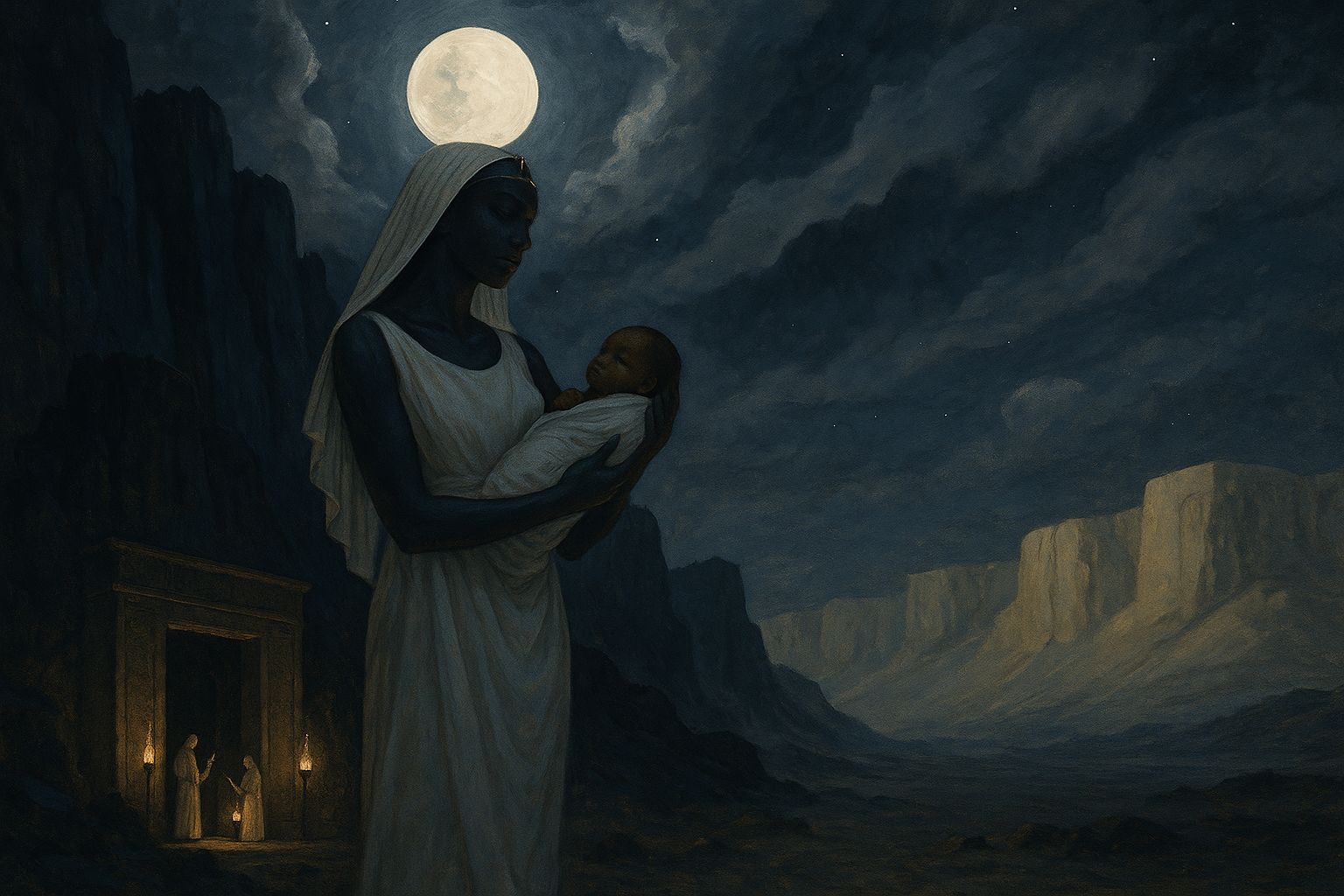
| The young woman gave birth on the polished limestone, like so many before her, beneath the first light of dawn. She had been brought across the Zareth River three hours ago, carried in a curtained palanquin by silent priestesses. The wind in the east carried the breath of sun-warmed stone and the scent of crushed jasmine. When the child cried, the midwife smiled. He had arrived clean, with open eyes and no shadow behind them. |
| They would return him across the river before nightfall. No one stayed long in the land of light. Life begins in the east, but it must walk westward. |
| Years passed. |
| The boy became a scribe. He married. He worked the fields and sang in temple courtyards. He watched his parents age. He watched his own hands grow calloused. He had children of his own. When he grew old, he asked to be buried with his sandals on. |
| When his time came, they placed coins of polished bone on his eyes and painted a silver crescent on his chest. His body was ferried across the Kenu River, into the realm of shadow. The black basalt cliffs loomed above the necropolis like teeth, jagged and eternal. |
| There, priests lit lanterns of moon-glass. They spoke his name three times, then sealed him in stone. The full moon rose. |
| And far above, behind veils of silver cloud, the Queen of the Night lifted her gaze to the west. |
| The soul stirred. |
| She took it into her arms. |
| And far across the desert, beyond the shining limestone cliffs, a new child was born. |
Description
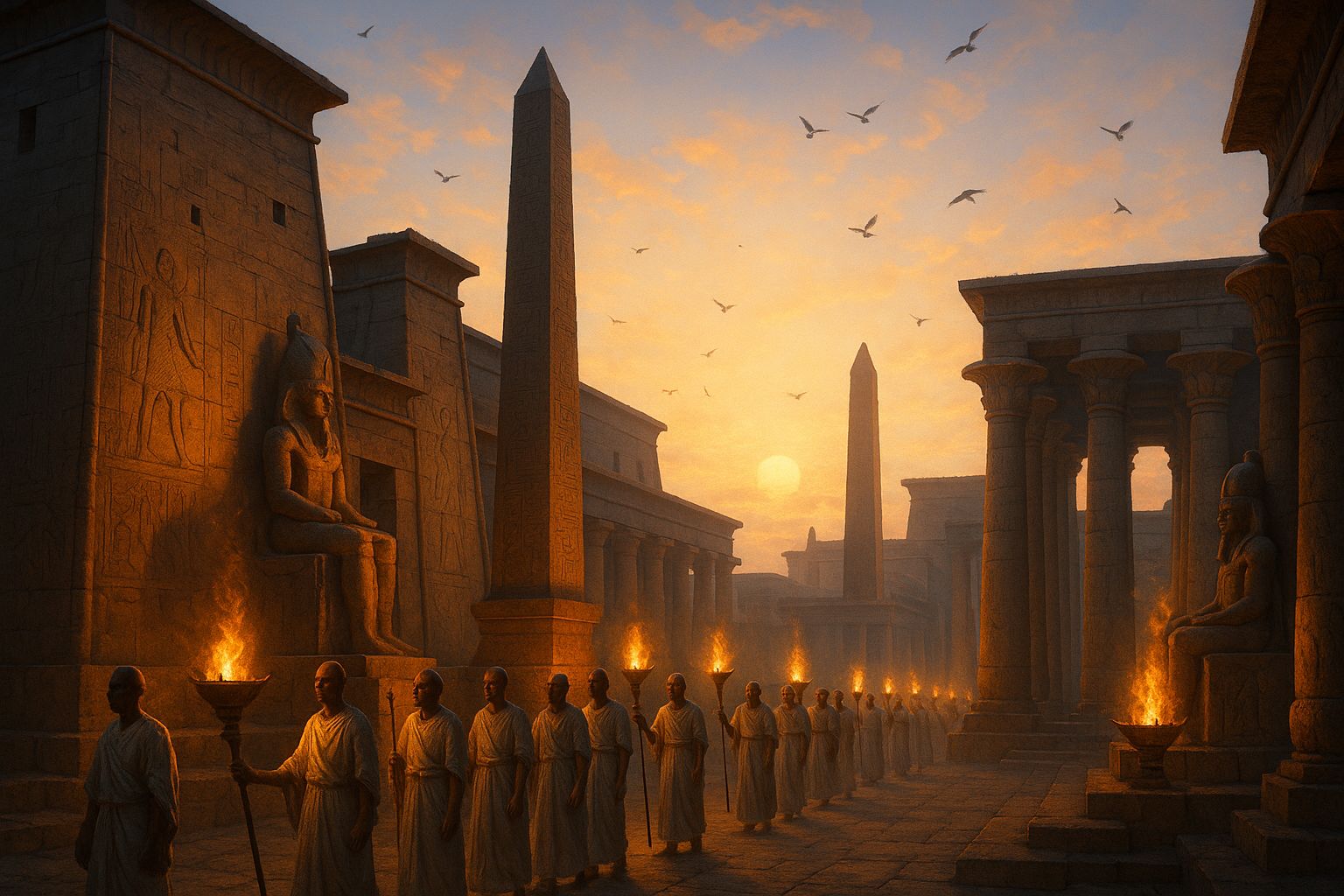
Lumekhet is a land of blinding sun and whispering moon, an ancient desert kingdom cradled between two sacred rivers, the Zareth to the east and the Kenu to the west. Life pulses in the golden corridor between these twin waters, where ochre-bricked cities rise like mirages and the scent of incense mingles with the heat-warped air. Beyond the rivers lie the thresholds of the divine places mortals tread only at the beginning or the end of their earthly journeys.
To the east, beyond the Zareth, gleam the Lifestone Heights, radiant white mountains sacred to Ka-Ra, the Sun-God King, the living pharaoh. Here, light is believed to be most pure, untouched by shadow. It is the land of life, and all births occur there. Heavily guarded sanctuaries, carved into shining rock, serve as sacred birthing temples where women are brought to deliver souls into the world in a new body, under the blessing of the sun. No one lingers here, life begins, and then all must return to the central land.
To the west, past the Kenu, loom the Basalt Teeth, jagged and dark, consecrated to Ka-Iah, the Moon-Goddess Queen and sister-wife of the pharaoh. This is the realm of death. Here lie the Shadow World, monumental tomb-complexes etched into the black stone like wounds in the earth, where kings, nobles, and commoners alike are laid to rest. In Lumekheti belief, the Sun watches each life until its end, whereupon the Moon lifts the soul and carries it back across the desert sky to be born anew in the east.
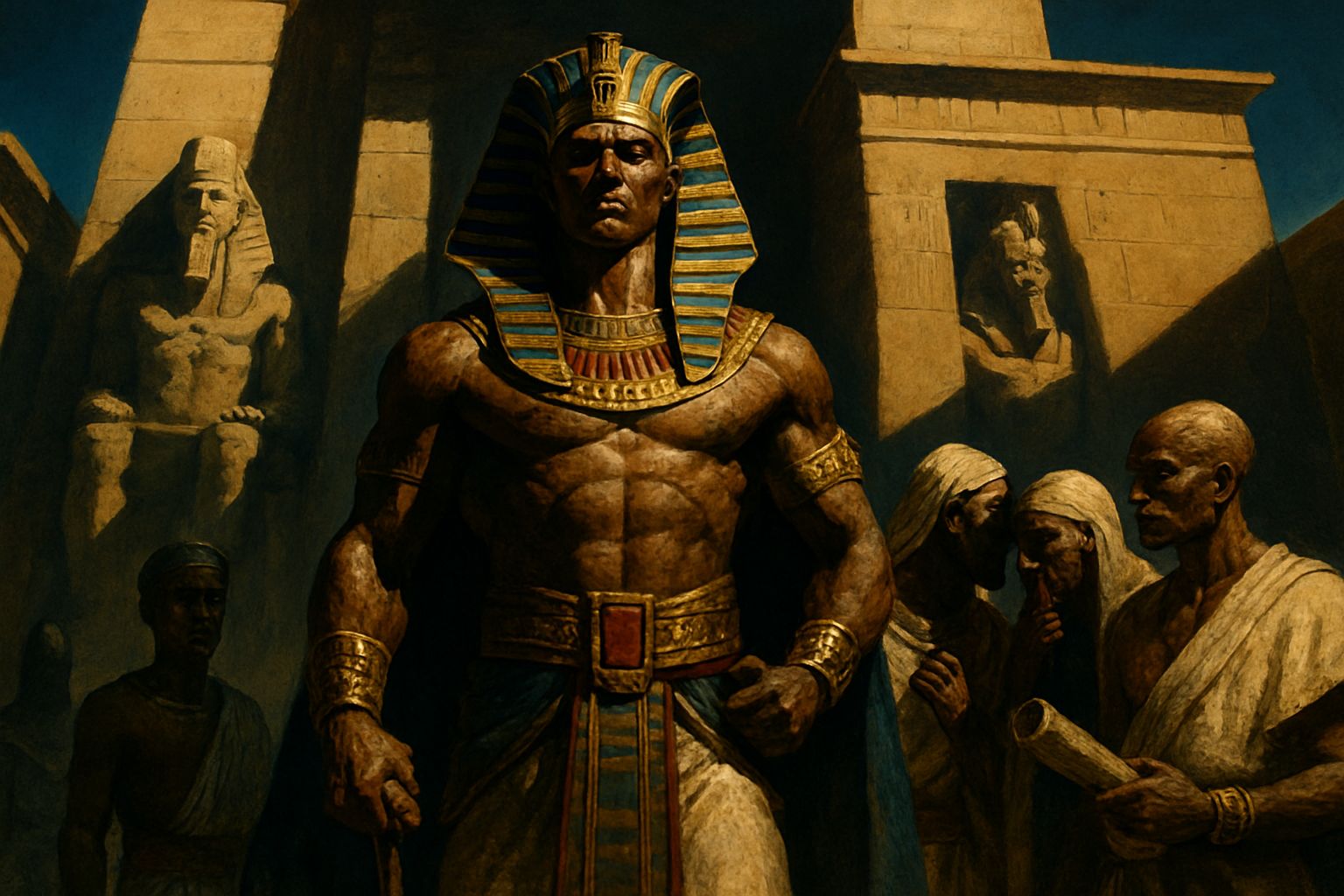
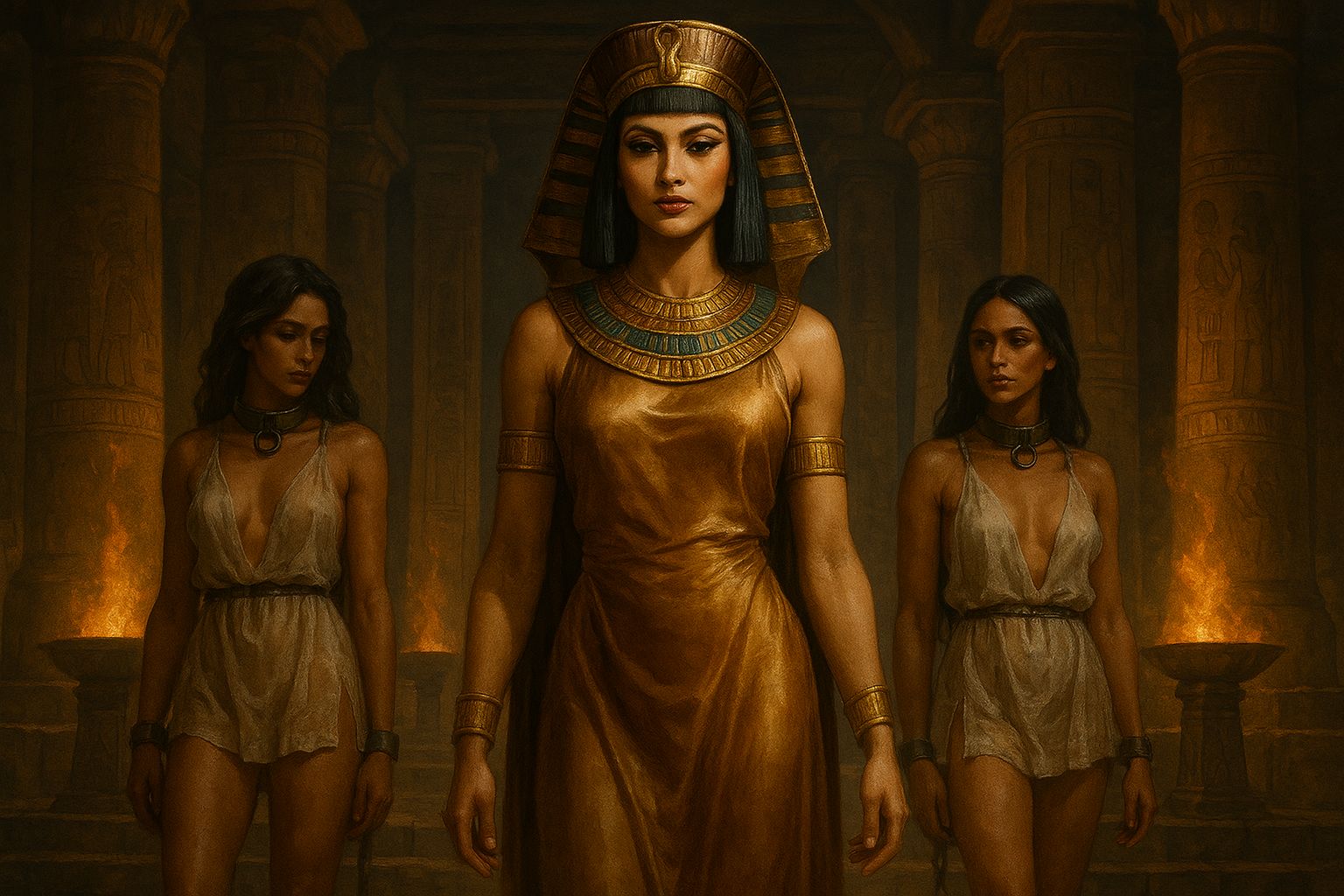
Between these sacred extremes lies the fertile cradle of civilization, the Riverbelt, an oasis of agriculture, temples, and intrigue. Here, the divine siblings reign in divine majesty, embodying the eternal cycle. The pharaoh, embodiment of the Sun, rules by decree, bringing judgment and light. His queen, the Moon made flesh, is his mirror-silent, mysterious, and feared as the gatekeeper of the soul's return.
To be born in Lumekhet is to be carried into light. To die is to walk west into shadow.
Life and Death in Lumekhet
Newborns have no souls, but one born beyond the Zareth will be filled by a waiting soul, carried there by Ka-Iah. They live out their life between the rivers, and when they die, they are entombed beyond the Kenu. They rest in their tombs until the next full moon, when Ka-Iah carries them back, to be born in a new body.
To ensure they rest, they are buried with enough belongings to keep them sustained until the next full moon. It's also common to bury them with some of their treasures, and gifts from loved ones. However, some souls are restless, and during the night, they hunt for a new body to possess. For this reason, only the very most desperate grave robbers would dare to go beyond Kenu during the night.
If a birth happens and there is no soul to fill it, a Hollow is created. This is rare, but does happen, and the risk is greater the closer to a full moon the birth is. As there are only souls waiting beyond the Zareth, all children born between the rivers are put to death by the priests. This is uncommon, though, as women travel across Zareth well in advance of the birth.
Geography
Lumekhet has very little contact with the outside world, due to its secluded location. This also means that there is litte need for an army, except as a local police force, especially as their geography and religion don't favour expansionism. They do have some trade with the desert nomads, though, who cross the desert with valuable goods. Likewise, an occasional ship might reach them.

Governance
Though the gods walk among them, the priesthood of Lumekhet is never content with mere worship. Within the hallowed halls of the Sun Temples and the Moon Crypts, whispered plots take shape like serpents in the sand. The high priests claim to serve, but each seeks to sway divine will, to interpret prophecy in their favor. No one would dare to aspire to hold the scepter and crescent themselves, but anything below that is a constant power struggle.
Society
The people of Lumekhet live within a divine hierarchy. At the highest tier stand the twin gods made flesh: Ka-Ra, the pharaoh and Sun incarnate, and Ka-Iah, the Moon Queen and guardian of souls. Their presence is absolute, their word unchallenged. Below them, the priesthood holds immense authority. Every aspect of society is filtered through their interpretation of divine will.
Beneath the priests are scribes, judges, artisans, and overseers. Scribes, in particular, are highly respected. Writing is a sacred act, a tool of memory and magic, and to write a name is to bind it to eternity. Artisans and builders are also honored, especially those who serve the temples or work on tombs. To carve a pharaoh's likeness or prepare a burial chamber is to take part in the cycle itself.
Farmers form the foundation of Lumekheti society. They are devout and organized, working state-managed plots of land between the rivers in service to temples and granaries. Labor is structured around the flood seasons, festival days, and celestial signs.
Slavery exists, though it is bound by strict law and religious limitation. Most slaves are criminals, debtors, or war captives from distant raids by desert nomads. They are used primarily in construction or temple maintenance, and some even serve within priestly households. Slaves are expected to obey without question, but they are still given burial rites to ensure they do not return restless.
Marriage is sacred, often arranged, and always bound by station. Large families are common, and children are taught from a young age to revere the cycle and respect the divine siblings. Ancestors are honored through offerings and family shrines, and lineage is recorded carefully by local scribes.
Crime is rare but punished severely, often by exile to the desert or enslavement. Theft from tombs, however, is seen not just as a crime, but a spiritual infection, and is always punished by death.
Daily Life
Life in Lumekhet is defined by rhythm: sun, moon, labor, prayer. The day begins before dawn, with a prayer to Ka-Ra offered as the horizon begins to glow. Workers gather at irrigation canals, fields, and workshops, often singing hymns or listening to a temple scribe read the day's decree. Temples ring their bells at each solar hour, dividing time into work, rest, offering, and reflection.
Markets open as the sun climbs, filling the city squares with spice carts, fruit vendors, weavers, and scribes-for-hire. Incense rises from shrines at every corner. Even the poorest neighborhoods contain a wall niche for Ka-Ra and Ka-Iah, where neighbors leave bread or flowers. Food is simple, flatbread, onions, figs, dried fish, and lentil stew, but always eaten together, with reverence for the gods who watch over the meal.
At midday, labor halts during the Hour of Stillness, when the sun is highest and Ka-Ra's gaze is strongest. It is believed that to work in this hour invites divine scrutiny. Many rest or meditate in the shade of stone courtyards.
Children are raised communally in extended families, educated by elder relatives and temple tutors. Boys and girls are both taught to read, recite prayers, and serve in ritual roles during festivals. At age twelve, a child's dreams are read by a moon priest, who determines their spiritual alignment and likely destiny.
Festivals are frequent and tightly woven into the calendar-harvest rites, full moon dances, funerary parades, and birth feasts. On these days, citizens don ceremonial paint and linen robes, offering carved tokens or clay lamps to float on the rivers.
Nights are quieter, but never without ritual. Lamps are lit in every home to guide the Moon Queen's gaze, and no one speaks loudly after sundown. It is said that noise in the dark draws attention from the wrong kind of spirits.
Even in rest, the people of Lumekhet live with purpose. Every act, from pouring water to folding a robe, is part of the pattern. To live rightly is to walk with the sun. To die well is to sleep in the arms of the moon.
Possible Secrets
Not All Souls Return
It is widely believed that Ka-Iah carries every soul back across the sky at the full moon. This is not true. Some souls are lost, consumed by spirits, fractured by trauma, or unworthy in the Moon's eyes. The priesthood knows this, but hides it, fearing panic or spiritual despair. A growing cult claims to speak for the lost, and their rites involve blood, mirrors, and forbidden names.
The Hollowborn are Increasing
Hollows are supposed to be rare. Yet the priesthood has quietly begun tracking a rise in their births. Something is disturbing the balance, souls are not returning as they should. Some whisper that the moon no longer shines as brightly as it once did. Others blame a forgotten tomb deep in the basalt, cracked open by a quake.
A Rebirth Returned Too Soon
A girl was born during a blood moon, when Ka-Iah should not have taken any souls. Yet she bears the birthmark of a priest long dead, speaks ancient dialects in her sleep, and knows secrets she should not. The priests intended to kill her, but her mother fled across the desert with her. Now she is hunted.
The Necropolis Breathes
Tomb workers have reported that certain sealed vaults under the Basalt Teeth are warm. Air moves through cracks that should be solid. One worker vanished after saying he heard singing from beneath the stone. The Moon Priests have sealed off three necropoli and declared them cursed. No one has entered or left in months.
The First Pharaoh Still Walks
According to sacred history, the first pharaoh ascended to the heavens. In truth, he was entombed alive after he defied Ka-Iah's laws and tried to remake the cycle. His tomb was sealed with seven names and buried in a canyon known only to the High Priests. But now, someone has broken the seventh seal.
The Sun Seeks to Eclipse the Moon
Ka-Ra, the Sun-King, grows tired of sharing power. In secret, he plots to break Ka-Iah's grip on the cycle, claiming dominion over both life and death.
The Moon Queen Has Her Own Plans
Though presented as the divine partner of Ka-Ra, Ka-Iah has begun to move independently. Her priests speak more of dreams, cycles breaking, and a new era of shadow. Some suspect she wishes to no longer return souls at all, but to keep them. Forever.
A Hollow Leads a Temple
One of the high-ranking priests of a major temple is a Hollow. No one knows how he passed the tests. He does not dream, yet interprets them for others. He is eerily beloved, rarely questioned, and whispers spread that he is creating a new ritual-one that does not rely on Ka-Iah's grace.
Adventure Hooks
Moonless Crossing
A noblewoman dies just before the full moon, but the ferrymen refuse to take her body west, claiming the river spirits are restless. Her family offers a fortune to brave souls willing to escort her corpse across the Kenu before the moon rises-or risk her becoming one of the restless dead.
The Empty Cradle
A child born in the eastern sanctuaries appears healthy but has shown no signs of dreaming. The midwives are unsure if he is Hollow or merely slow to stir. The party is asked to escort the family to a remote oracle, who claims she can see whether the soul truly entered the body, or what might be waiting instead.
The Painted Moon
A famous mural in a moon-temple has begun to change. Figures once hidden are now visible beneath the surface. The high priestess believes it's a divine message and seeks skilled explorers to descend into a sealed sub-chamber to uncover what lies beneath the temple.
Dust Between the Rivers
Villagers report strange figures walking the dunes at midday, vanishing just before being seen clearly. A temple emissary believes something is stirring beneath the sands between the rivers and sends the party to investigate a half-buried ruin recently uncovered by the wind.
A Soul Delayed
A child shows clear signs of being the reborn soul of a long-dead prophet, but the timing is wrong. The child was born a full cycle too early. The priests are divided. Some say it's a blessing. Others, a mistake. The players are sent to retrieve the prophet's original burial records to determine if the soul truly departed, or if it never did.
The Whispered Boatman
An old man claims to have seen a third river in a dream, a hidden stream where lost souls drift, never to be reborn. Now he's missing. His family hires the players to find him, but they're not the only ones looking. A group of masked pilgrims believe the dream is real and want to follow him there.