Waverider Story - Campaign - Author's Notes
Itzalcoa
Aztecs, but worse.
| Story |
|---|
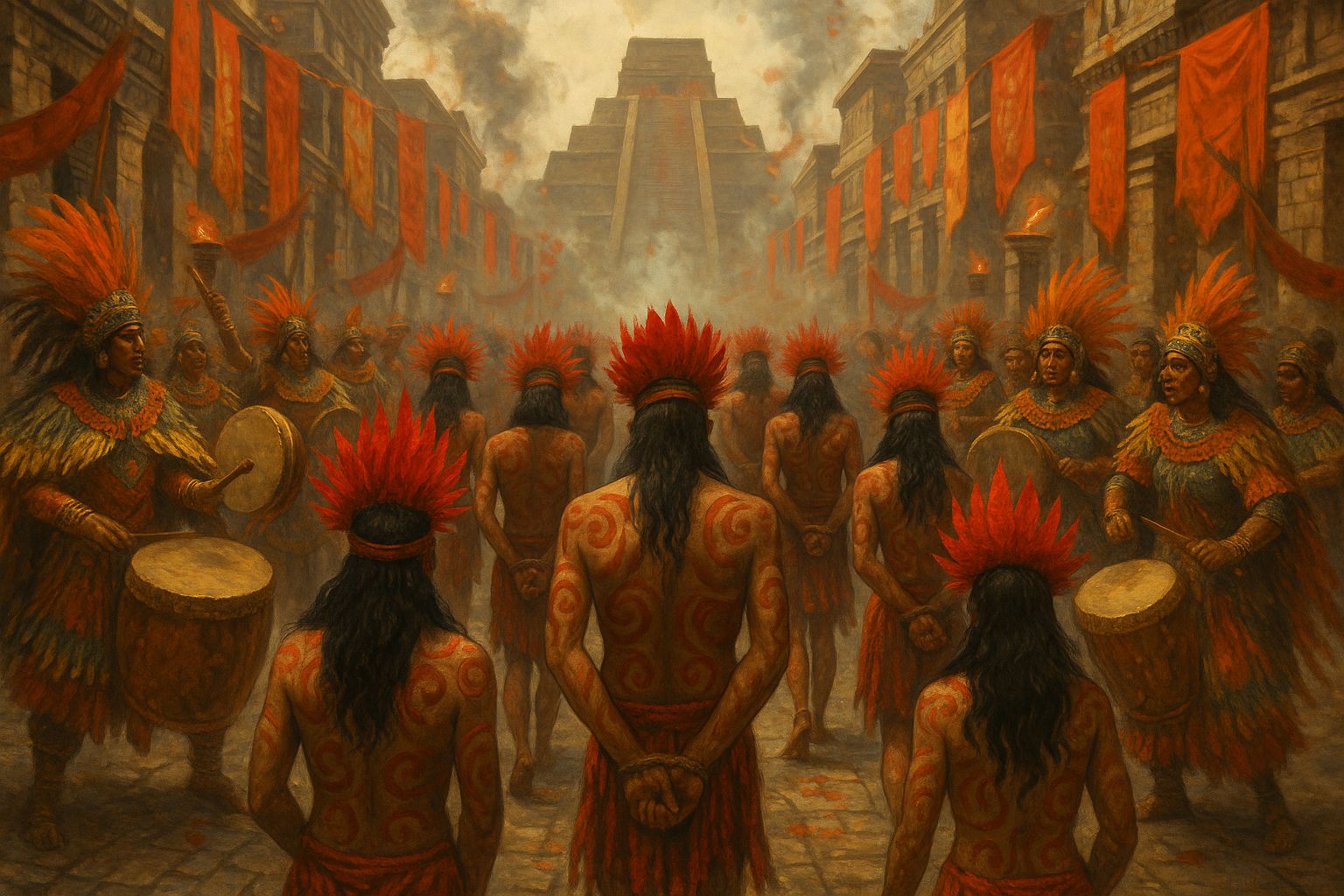
| The feathers itched against my brow. They had placed them there at sunset, crimson plumes bound with cords of black obsidian. When they crowned me, I heard the whisper in the crowd: Xochitl tecuhtli, the Flower Lord. That is what they call us now. Flowers for the gods. |
| The drums began. Slow, steady, like the beat of my own heart. I tried not to look at the ziggurat, looming above us with its dark steps streaked red. Instead I looked at my hands, trembling, and I thought of the fields I would never see again, of my mother's laughter, of the river where I used to swim. |
| Then the priest touched my shoulder. Her hand was cold as stone, and when I met her eyes I knew there was no escape. She nodded, and I lifted my arms as I had been taught. The serpent coils. The jaguar prowls. The flower opens. |
| The people swayed with me, chanting words I did not understand. Children scattered black dust at my feet. Every step of the dance was a step toward the altar, though a moon still lay between me and the knife. |
| I felt the terror rising in my throat, but I swallowed it. If I faltered, they would drag me anyway. Better to dance. Better to let them believe the gods were pleased. |
| The drums stopped. The cords bit into my wrists again as they led me away. I looked up once more at the ziggurat, shining in the last light of the sun, and I wondered if the gods were already watching me, smiling, hungry, waiting. |
| Story |
|---|
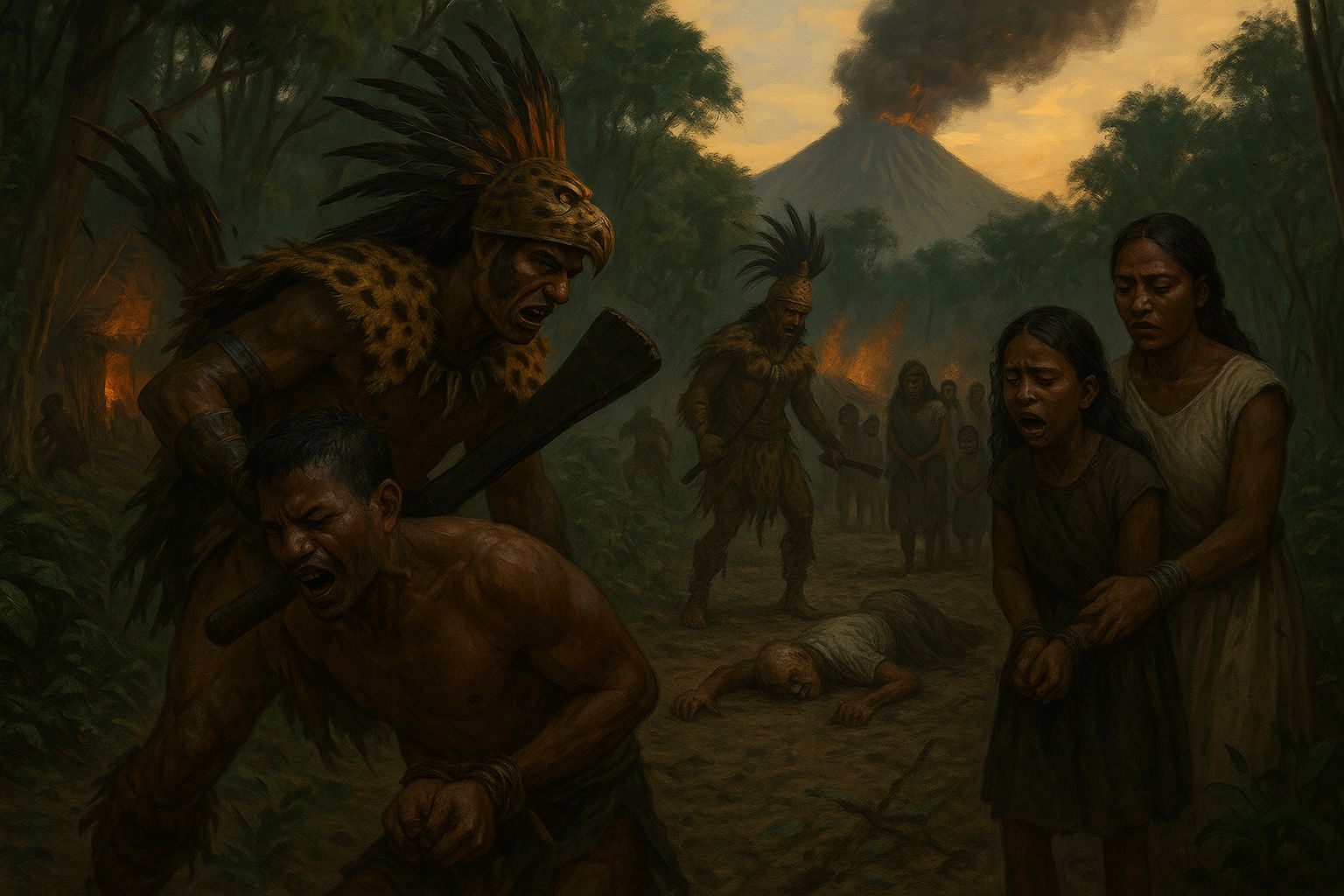
| The first sound was the whistle. High and shrill, it cut through the morning jungle like a knife. We thought it was only a jungle bird coming down from the mountains, until the dogs began to bark. |
| By the time the sun rose, they were upon us. Warriors with jaguar pelts on their shoulders and eagle feathers streaming from their heads, obsidian clubs gleaming black in the morning light. They did not charge to kill. They struck with the flat of their weapons, breaking bones, knocking us senseless. Those who fell screaming were bound in cords of maguey fiber, dragged across the dirt like sacks of grain. |
| I tried to run. I thought the forest would hide me, but the warriors knew the paths better than I. One leapt from the brush, his face painted with fangs, and slammed his club into my ribs. The pain stole my breath. As he tied my wrists, I saw his eyes - not angry, not merciful. Only empty, as if I were already gone. |
| Behind me, the village burned. The smoke rose high, as if to signal the gods themselves. The old were cut down, the children gathered with us in a line. My little sister screamed for our mother, but the priestess among them told her to hush. "The Serpent of Obsidian must drink," she said, "and you will be its vessel." |
| We were marched south, toward the shadow of the volcano. The jungle swallowed the last sight of our homes, and with each stumbled step the drums grew louder. |
Description
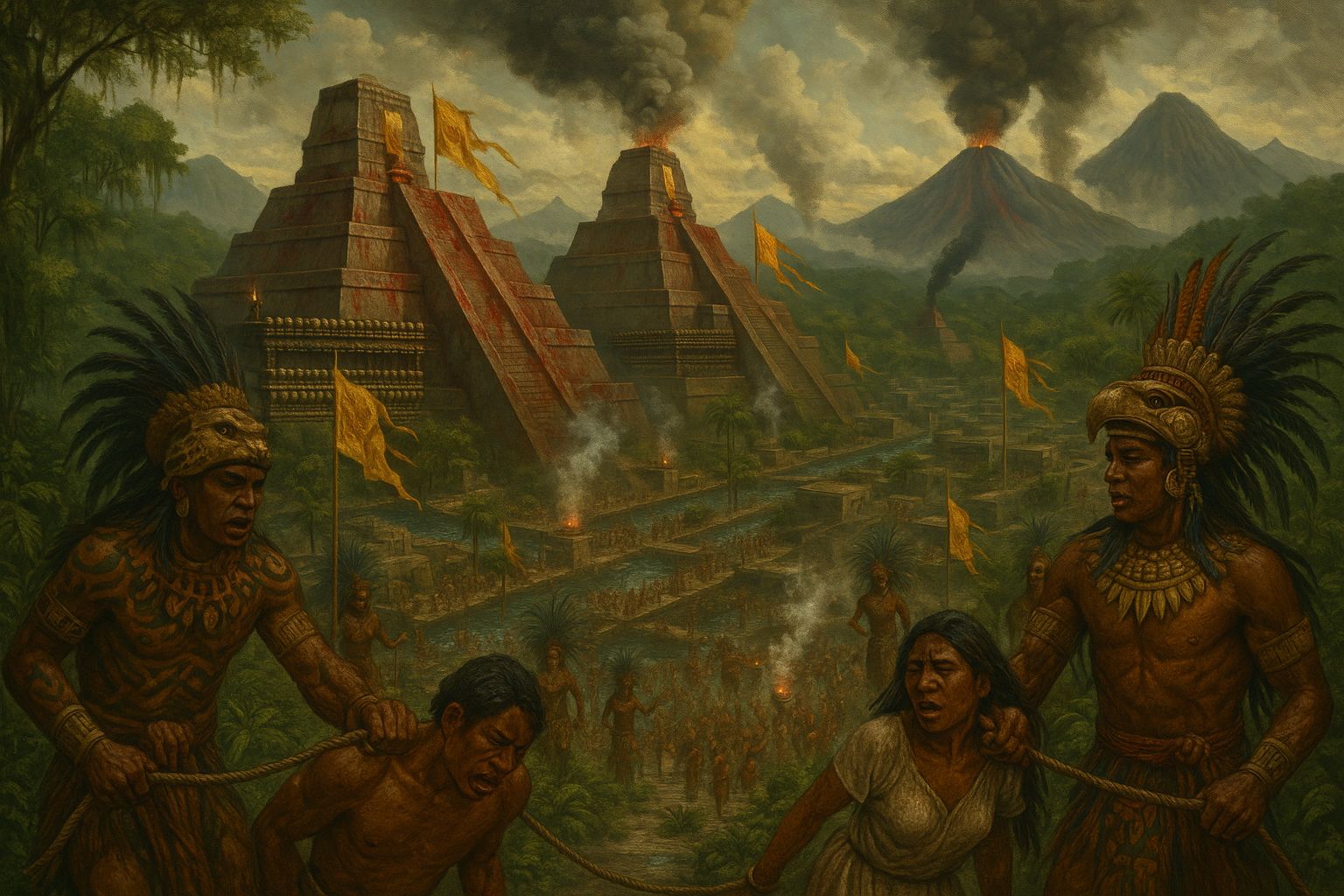
Itzalcoa is a proud and terrible nation, resting in the high jungles of Xochitl Valley. From afar its golden banners gleam, its vast cities dominated by immense step pyramids that rise like mountains above the canopy. Beyond them loom the smoking peaks of several active volcanoes, their ash clouds often veiling the skies. To the Itzalcoans these mountains are the mouths of the gods, forever threatening to vomit fire upon the land. But up close the air is heavy with incense, blood, and the muffled sobs of captives awaiting their fate.
Government and Society
The supreme ruler of Itzalcoa is the Xuey Tlanecayotl (Great Flame of Power), a title currently held by King Teyocan Quauhtli. His word is absolute, and he embodies both divine mandate and worldly authority.
Beneath him the realm divides into two mighty branches:
- The Cohuatzin (Priesthood), led by High Priestess Xilnamiya, who claims to speak the words of the gods themselves. The priests are feared, for they decide when the gods are displeased and demand more screams.
- The Cuauhmeh (Army), led by Warlord Oceloyah, whose warriors march in jaguar pelts and eagle feathers, their obsidian clubs black with the dried blood of past victims. The clubs are their favored weapon, as they can use the blunt side to capture victims alive, and the side tipped with a cruel obsidian spike to kill if needed.
The balance of power is precarious. The priests whisper of famine, plague, or omens whenever they crave more blood, and the warriors must feed their hunger with raids against neighbors. When the volcanoes rumble, the priests proclaim it as proof that the Cruel Ones are stirring, demanding rivers of blood to soothe their wrath.
Architecture and Cities
The capital city, Tzompanco, rises upon a plateau carved with canals and causeways. At its heart stands the Xuey Ziggurat of Chalchiuhtzin, a massive stone pyramid streaked with centuries of blood. Skulls line its base in racks called tzompantli, grim reminders of sacrifice. Ash from the nearby volcano of Teoteyoc often drifts across its steps, so that black dust mingles with the red stains of blood.
Other great cities include Cuetzalpan, famed for its arena of sacrifice, and Yolquican, where the river runs red after each grand festival. Some settlements cling to the fertile slopes of the volcanoes themselves, their fields enriched by the very fire they fear. When the mountains erupt, whole villages are swept away, later rebuilt as if nothing had happened, for the Itzalcoans believe survival is granted only by appeasement.
Religion
The Itzalcoans believe all gods are evil. To them, the divine are not protectors but devourers of life. The gods are called Tezhuameh, the Cruel Ones. Among them:
- Itzlicoatl, the Serpent of Obsidian, who drinks blood through the earth.
- Tlaltecayo, the Devourer of Flesh, who feeds on screams carried in the wind.
- Xochimictlan, the Flower of Knives, whose beauty masks endless cruelty.
The volcanoes themselves are seen as the open maws of these beings, and eruptions are taken as their laughter or their hunger rising. Sacrifices are meant not to honor but to distract and satisfy these beings, keeping them from turning their wrath directly upon the people.
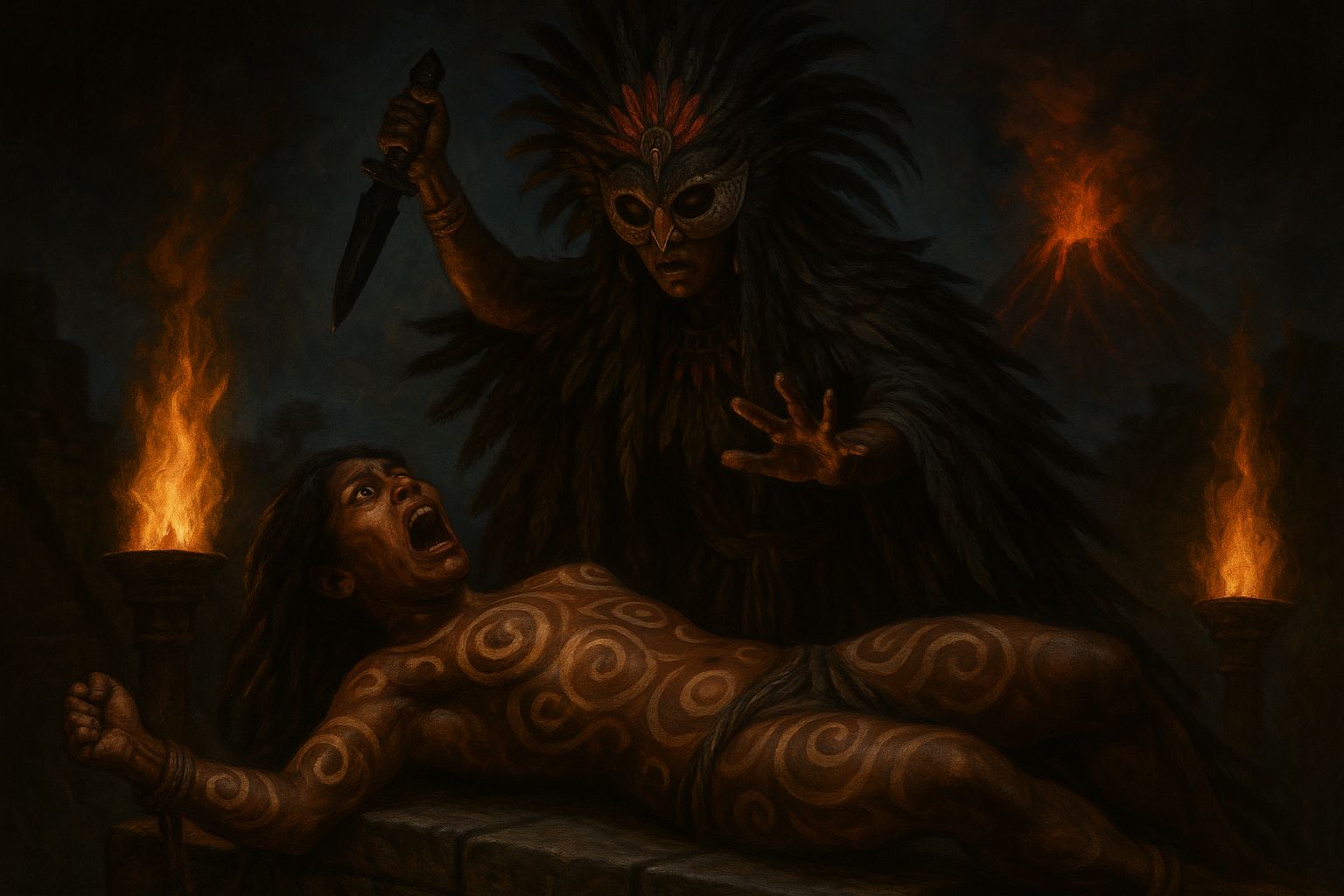
In Itzalcoa, the division of sacrifice is as rigid as it is cruel. Male priests take men to the altar, claiming only they understand the ways to break a warrior's body so his screams will carry far. Women are given to the priestesses, who whisper that only they know how to unmake a woman's pride and draw terror from her heart. This is not mercy but calculation, each torment tailored, each cry shaped, so that the Cruel Ones may taste the fullest flavor of suffering.
Priesthood Presence
The Cohuatzin are everywhere. Even in the smallest villages a priest watches, marking omens in the flight of birds or the crack of thunder, deciding whose blood will satisfy the Cruel Ones. Their codices are written in red, the pages stiff with dried blood, and to question them is to invite the altar.
Warfare and Sacrifice
The Itzalcoans are notorious for their Flowery Wars, raids not for territory but for captives. Warriors mark their prestige not by how many they kill, but how many they capture alive for the altars.
Victims endure years of slavery before their appointed day, a way to make sure they know the full terror of what lies ahead for them. The Dance of the Doomed begins a moon before sacrifice, binding terror into ritual. Each chosen victim is crowned with crimson feathers and made to step through the same motions every night before the watching crowds - the serpent coiling, the jaguar prowling, the flower opening. The priests say this pleases the gods, but the true purpose is to stretch fear into every breath of the condemned, to strip away hope day by day until only dread remains. By the time the knife descends, their screams are not only of pain but of weeks of mounting terror, a harvest the Cruel Ones are said to savor most.
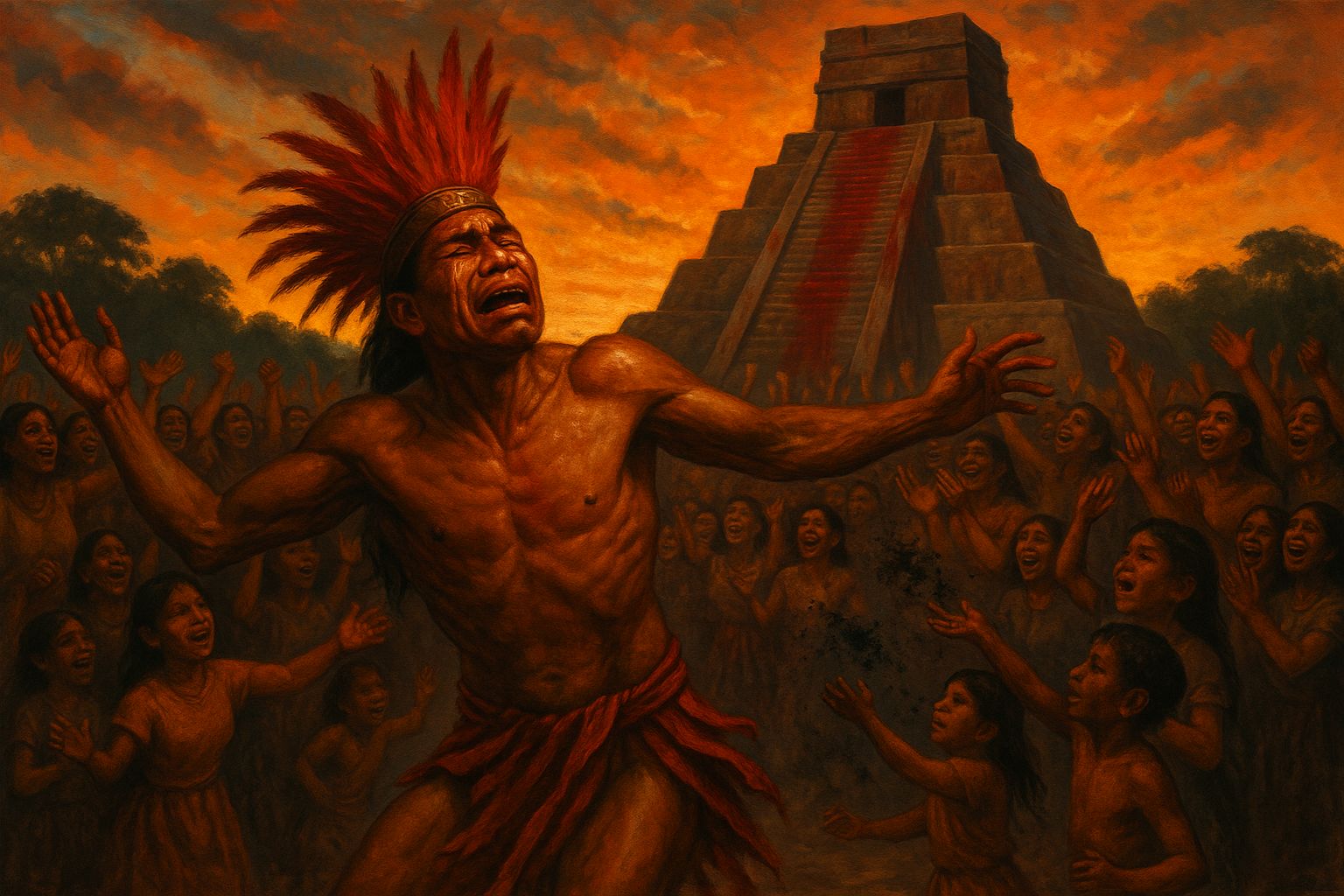
Some festivals last an entire week, each morning beginning with hundreds dragged up the ziggurat steps. Their screams echo through the jungle, said to keep the sun itself from falling from the sky and the volcanoes from drowning the land in fire.
The arenas, called Cuauhcalli (House of Eagles), are perhaps the cruelest rites. Bound warriors are given crude weapons and forced to fight waves of others until they collapse, only to be dragged away and finished upon the altar. The crowds cheer, for the gods are thought to delight in the spectacle.
Culture
Despite its terror, Itzalcoa is also a land of artisans, poets, and astronomers. They weave brilliant feathered cloaks, carve obsidian statues that gleam like midnight, and compose chants said to guide souls into the underworld. Their calendar stones are vast discs carved with the monstrous faces of the gods, recording the days until the next demanded sacrifice. The great astronomers of Cuetzalpan watch the skies not only for the sun and stars, but also to divine when the volcanoes will stir, tying omens of fire to the blood spilled on the altars.
Yet to outsiders, none of this beauty can eclipse the horror. To the northern tribes, Itzalcoa is remembered only in nightmares, as the land where one's children are dragged away screaming into the night, and where mountains themselves seem to roar for blood.
Volcanoes
Teoteyoc, the Burning Maw
The largest and most feared volcano, looming over Tzompanco. Its eruptions are said to be the laughter of Tlaltecayo, the Devourer of Flesh. During great festivals, captives are sometimes thrown alive into its glowing crater, their screams rising with the smoke to please the gods.
Xicaltepetl, the Smoking Flower
A cone-shaped mountain near Cuauhzochitl. When its slopes bloom with fire, the priests proclaim it the breath of Xochimictlan, the Flower of Knives. Its ash is collected and used in body paint for the Dance of the Doomed, marking victims with the sign of inevitable death.
Coaxoch, the Serpent of Ashes
A long, jagged ridge stretching across the valley. It is said to be the spine of Itzlicoatl, the Serpent of Obsidian, who writhes beneath the earth. Tremors along its slopes are seen as the serpent stirring, demanding blood to calm its thrashing.
Tzitzimitl, the Star-Eater
A smaller but unpredictable peak in the eastern jungles. Priests claim that when Tzitzimitl smokes at night, it is consuming stars themselves, and that only vast sacrifice can restore their light. Farmers living in its shadow often abandon their homes during such nights, leaving offerings of blood and food at its slopes to beg for mercy.
Ayauhcoatl, the Mist Serpent
A dormant volcano, its slopes shrouded in mist. The priests warn that its silence is the most dangerous of all, for a silent god is a waiting god. It is said that one day Ayauhcoatl will awaken with a single roar so great it will swallow the valley whole. For this reason, captives of high status - captured princes and noblewomen - are reserved for its festivals.
Celoyahuatl, the Jaguar's Roar
This volcano's eruptions are said to be the roaring of a jaguar spirit chained beneath the earth. The Cuauhmeh (army) believe their war-cries echo its voice, and warriors sacrificed here are painted with jaguar spots before being cast into the flames.
Atlitzin, the Water Bride
Steam often rises from its slopes where snowmelt meets fire. Myths say Atlitzin is the unwilling bride of Itzlicoatl, forever weeping as he coils around her. Her tears form rivers in the valley. When eruptions come, the priests say it is her despair at failing to escape.
Yohuacayotl, the Heart of Night
A high, shadowed peak that glows red only at night. The priests call it the beating heart of the underworld, visible in the world of men. It is said the stars themselves are pinned to the heavens by its fire, and should it ever go dark, the night sky will collapse.
Astronomy and Volcanoes
The astronomers of Itzalcoa keep two calendars: one of stars and one of fire. They carve the rhythm of eruptions into great stone discs, claiming each cycle reveals when the gods' hunger will peak. Festivals and wars are timed by these fire calendars, so that blood is spilled in harmony with the mountains' wrath.
Relations
Beyond the jungles of Itzalcoa, other realms know of Itzalcoa only through rumor, smoke on the horizon, and the testimony of broken survivors. No kingdom dares to ally with them, and few are in a position to make war against them. Jungle tribes skirt their territory, never crossing into its shadow, for even a single step may see them seized for the altar.
Raids against the jungle tribes to the north are common, but they seldom raid across the Tarnixan river, as the pygmy tribes there are too good at guerilla warfare, making the raids too costly.
To most nations, Itzalcoa is not a neighbor but a nightmare, a place to be shunned and feared, best left to consume itself in blood and fire.
Possible Secrets
The Hollow Gods
Some astronomers and priests whisper in secret that the eruptions and tremors are not divine wrath at all, but natural. They risk death if discovered, for to claim the gods do not demand blood would shatter the entire foundation of power.
The Silent Rebellion
Among the slaves taken from northern villages, a hidden network plots revolt. They pass messages in songs and carvings, waiting for the day when they will strike in the very shadow of the ziggurats.
The Priestess's Bargain
High Priestess Xilnamiya is said to have a hidden pact with one of the volcanoes. Some believe she once offered her own child to Teoteyoc and that in return she can predict its eruptions with uncanny precision.
The Buried Ziggurat
In the deep jungle lies an older pyramid, half-buried in ash from a past eruption. It is taboo to approach it, for the priests claim it was the site of a sacrifice gone wrong, when the gods devoured their worshippers instead of sparing them. Some explorers say the walls are covered in carvings that show a time before the gods were called evil.
The Bloodless Sect
A secret cult exists even within Tzompanco, made of artisans and scribes, who believe that the gods can be appeased with ritual alone - dances, fire, and song without blood. They hide their rites in festivals, disguising them as common revelry.
The Chosen Never Die
A rumor persists that not all victims perish. A handful are taken alive into the depths of the volcanoes, never to return. Some claim they are transformed into guardians of the gods, others that they are simply enslaved by the priests for secret purposes.
The Forgotten God
Old carvings hint at a god not of cruelty, but of silence and rest, long erased from official codices. The priests forbid even speaking of it, for a god without hunger undermines the truth of their faith. Yet some slaves murmur its name in the dark, hoping for mercy.
Adventure Hooks
The Flowery Hunt
A northern tribe hires the party to protect their village from an impending Itzalcoan raid. When the warriors arrive, the group must hold the line against capture, knowing the enemy seeks to take them alive for the altar.
Prisoners of the Ziggurat
The characters are captured in battle and thrown into the slave pens of Tzompanco. They must endure the brutal Dance of the Doomed and find a way to escape before their turn comes to climb the steps.
The Festival of Screams
The party arrives in Itzalcoa during a grand festival. The streets are alive with color, music, and sacrifice. Amid the chaos, they must complete a mission - perhaps stealing a relic or rescuing a captive, without drawing the attention of the priests.
Ashfall
One of the great volcanoes erupts, burying villages and choking the valley in ash. Amid the panic, the priests declare that even greater sacrifices are needed to calm the gods. The adventurers must navigate the chaos to save innocents, retrieve lost treasures, or escape the choking death.
The Cuauhcalli Games
The characters are forced into the arena of Cuetzalpan. They must fight wave after wave of enemies, buying time for a desperate plan to turn the crowd or escape.
The Astronomer's Warning
An Itzalcoan astronomer predicts an eclipse that coincides with a major festival. The priests believe it means the gods will demand thousands of lives. The adventurers must choose whether to prevent the slaughter, exploit the distraction, or use the event to strike at a rival.
The Poisoned Cloak
An Itzalcoan noble commissions the party to fetch rare feathers or dyes for a cloak meant for the king himself. Unknown to the party, the cloak is meant to be poisoned, and their involvement will draw them into lethal court intrigue.
Children of the Sun
A band of escaped captives, mostly children, begs the party to guide them out of the valley before the priests reclaim them. The jungle is full of dangers, and Itzalcoan trackers are already on their trail.
The Heart of Fire
The king sends warriors into a volcanic cavern to retrieve a relic said to lie within molten stone. The adventurers might be hired as guides, rivals racing for the same prize, or prisoners forced to delve into the fire as living offerings.