Changelings
| Story |
|---|
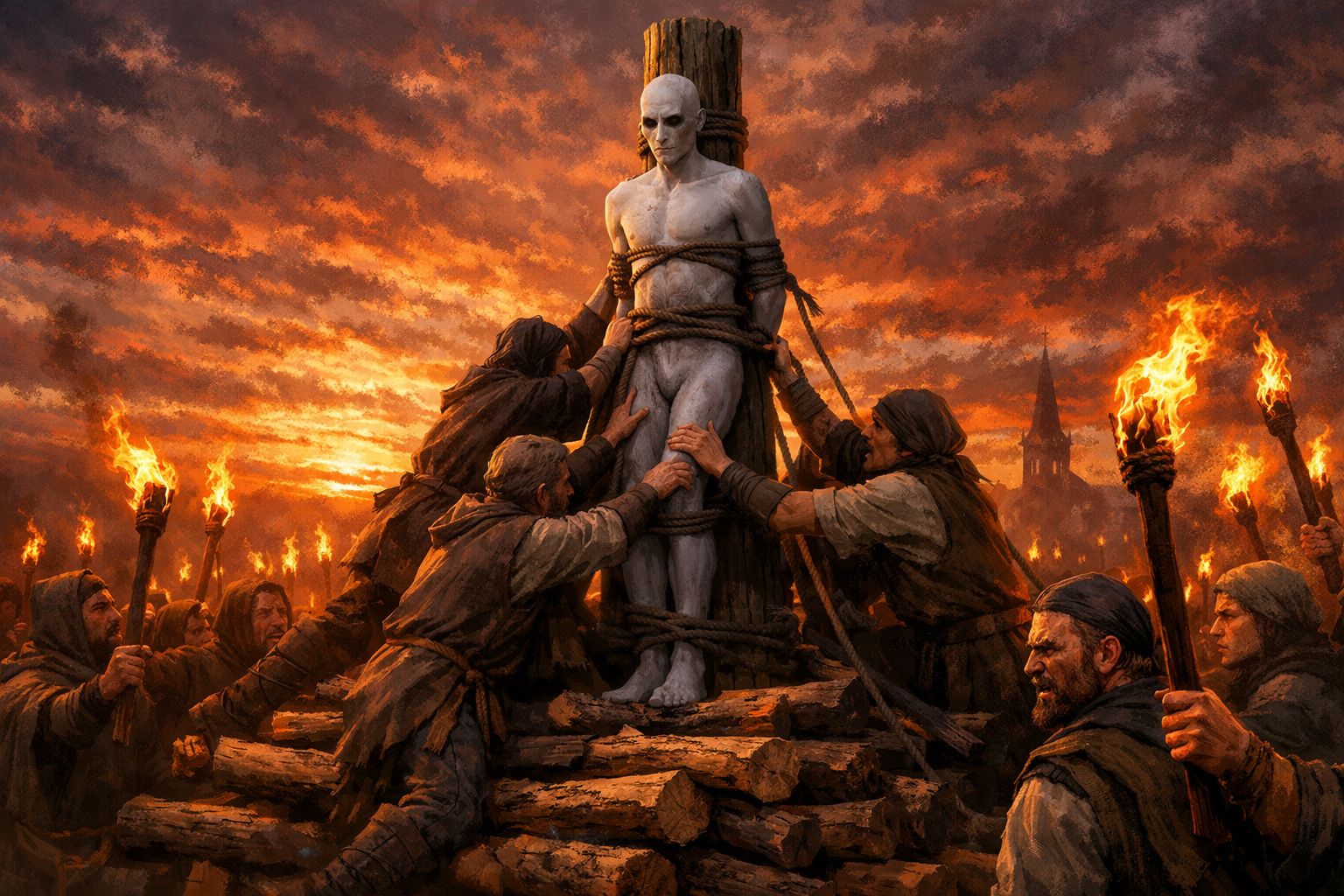
| Mayor Halven Drost stood on the steps of his own hall with his hands raised, trying to hold his face steady. The square below him was packed tight, faces shiny with sweat and rain mist, shoulders pressed together around a single certainty that had arrived too fast to be argued with. Torches smoked. A bell had been rung until the rope frayed. Someone had dragged a salt sack up onto the cobbles like it was a holy relic. |
| "Answer us," shouted Bera Kint, the cooper’s widow, voice hoarse from leading the chant. "When Jannik Sorell broke his leg on the river road, who carried him to my door." |
| Halven blinked once. His eyes moved left, then right, searching the crowd as if the answer might be written on a face. "There are many Janniks," he said. "It was the miller’s boy who carried him, not me." |
| The response hit the square like a gust. People laughed, not with humor, but with the hard relief of being proven right. Bera stepped forward, pointing a finger as if it were a knife. |
| "My husband did," she said. "He came home limping after, because he carried Jannik alone. You stood in my kitchen that night. You ate my stew. You told me the road would be fixed by spring. Say the words you used." |
| Halven’s mouth opened, then closed. He swallowed. His gaze flicked to the hall doors behind him, then back to the crowd that blocked every path. |
| Old Tomas Vell pushed through, white hair plastered to his forehead. "In the flood year, when the river took the north dock, you promised me three new pilings. You told me to bring oak. Where from?" |
| Halven’s jaw tightened. "The ridge west of town." |
| Tomas spat onto the stones. "The west ridge is pine and scree. Oak does not grow there. You never stood on it once in your life." |
| A murmur rolled through the crowd, not doubt but satisfaction. Hands reached up, grabbing Halven’s sleeves, his collar, his belt. Someone yanked him off balance and the square surged forward, dragging him down the steps. He stumbled, boots skidding, and a fist struck his face. Another struck his ribs. He bent and they hauled him upright again, because they wanted him standing for the proof. |
| "Salt," Bera said. |
| A man with a butcher’s forearms shoved forward, grabbed a fistful from the sack and jammed it into Halven’s mouth. Halven tried to spit it, then tried to swallow, then gagged as if his throat had forgotten how to work. His eyes watered. He retched hard onto the stones, choking and heaving until the salt came back in white clumps and bile. The crowd roared at the sound like it was a confession. |
| "See," someone shouted. "It cannot bear it." |
| They hit him again, not to kill, but to force the moment they all wanted. Halven’s limbs jerked as he tried to cover his head. The torches wavered. A horse tied near the well threw its head up, eyes wide, nostrils flaring. Its handler grabbed the reins too late. The animal screamed, a thin terrified sound, and reared hard enough to snap the rope. It bolted through the edge of the crowd, hooves striking stone, people leaping aside. |
| The square went quiet for a heartbeat, then louder. Someone yelled, "Even the horse knows what you are." |
| "Show us," Bera said, stepping close enough to see the whites of Halven’s eyes. "Show us what you are." |
| Halven’s face twisted. Not pain now, something else, like a mask trying to hold onto a skull that did not want it. His mouth opened in a silent snarl. His skin seemed to pull wrong across his cheekbones. The crowd leaned in, hungry for the final certainty, and then the certainty arrived. |
| He changed. |
| It was not a clean reveal. It was a collapse of falsehood, features slipping, proportions shifting, a body refusing to maintain the borrowed shape. The mayor’s familiar face was gone, replaced by something that looked wrong in the torchlight, too pale, too sharp, too intent. The crowd erupted, not in horror, but in triumph. |
| "Changelings," someone cried, as if the word itself could be used like a club. |
| Men ran to stack broken furniture and old fence rails near the hall steps. A torch was thrust down into the pile to test how fast it would take. Others did not wait for the fire. They were already scattering into side streets, calling names, kicking doors, hunting for the rest of his family. |
| Bera stood with her hands on her hips, breathing hard, eyes bright with vindication. "We caught it early," she said, voice shaking with something like joy. "Before it could spread. Before it could replace more of us." |
| Heads nodded all around her. People looked at each other with hard grateful grins, then with quick measuring glances that lasted a fraction too long. A man stepped back from his neighbor. A woman pulled her child closer. Someone whispered a name and someone else flinched. |
| The pyre began to crackle. In the firelight, the square felt clean for the first time in months, and nobody could say exactly why. |
Every child learns the warning early. A changeling is not a strange neighbor or a misunderstood wanderer. A changeling is a predator that wears a person like a coat.
Their method is simple. Changelings kill, then they take the face. They do it for safety at first, then for access, then for power. When a changeling can walk into a home as a friend, walk into a court as a trusted advisor, walk into a temple as a priest, it does not need an army. It only needs time.
They are patient infiltrators. They do not strike like beasts. They settle into communities, learn habits, learn names, learn what you love and what you fear, then begin to rearrange lives until the town belongs to them. When trouble follows, it is blamed on bandits, sickness, famine or politics. That is the point.
What People Believe They Want
Most folk say a changeling cannot build anything of its own. It can only steal. It takes a life, takes a place at the table, takes a role in the village, then removes anyone who might notice. A single replacement is bad luck. A pattern of replacements is infiltration. A town that ignores the pattern becomes a feeding ground.
They expand one household at the time, one village, one town, one kingdom, and if left unchecked, the world.
Some priests go further and claim changelings are not only criminals but blasphemies. They wear the holy shapes of mortals while lacking a true soul, and every borrowed prayer is an insult to the gods.
Signs And Tests
Some things are known about them. If a village suspects infiltration, the tests come out fast.
- Left handed people are changelings, being mirror images of humanity.
- Changelings eat the person they copy to steal their form.
- Changelings cannot eat salt.
- Changelings have a low pain threshold.
- Changelings have blood that never clots.
- A changeling submerged in water will eventually reveal their true form.
- Changelings will not pray to the gods, for their false souls may be burned away.
- Changelings will not keep a dog or horse, since animals sense what they are.
- A changeling who looks into a mirror sees only their true face.
- A changeling can instantly recognize another changeling.
Origins
No one agrees on where changelings came from, and that disagreement fuels the fear. The most common stories are all bad.
- Some say they were children stolen from cradles by fae and returned wrong.
- Some say they were cursed bloodlines, the punishment for a king who begged for immortality and was given endless faces instead.
- Some say they are traitors who sold themselves to demons, trading their souls for the right to wear any life they want.
The Pale Hunt
When the Great Empire was at its height, the stories say the threat became too large to ignore. A famine struck and whispers spread that it was sabotage, not weather. Priests claimed divine revelation, that changelings walked among the people, poisoning wells and unseating rightful rulers, and the inquisition confirmed it. The Empire responded with a drastic emergency measure, the Pale Hunt.
It was brutal by design. Inquisitors moved province by province demanding proof of purity. Towns were forced to recite lineage oaths under priestly scrutiny. Salt ordeals were common. Suspects were bound, cut and tortured because people believed pain would unmask what words could not. Entire villages burned when fear decided hiding was the same as guilt. Families broke apart under accusation, and neighbors proved loyalty by offering up someone else.
The Pale Hunt is remembered as a horror and as a necessity. A horror because it turned towns into mobs. A necessity because it was the only method harsh enough to stop an enemy that could wear any face. The chief inquisitor, Lord Veynar, kept the Black Ledger of names, and the legend insists even nobles and courtiers fell when their age or vigor was judged too suspicious to be natural.