Marine Shaedra
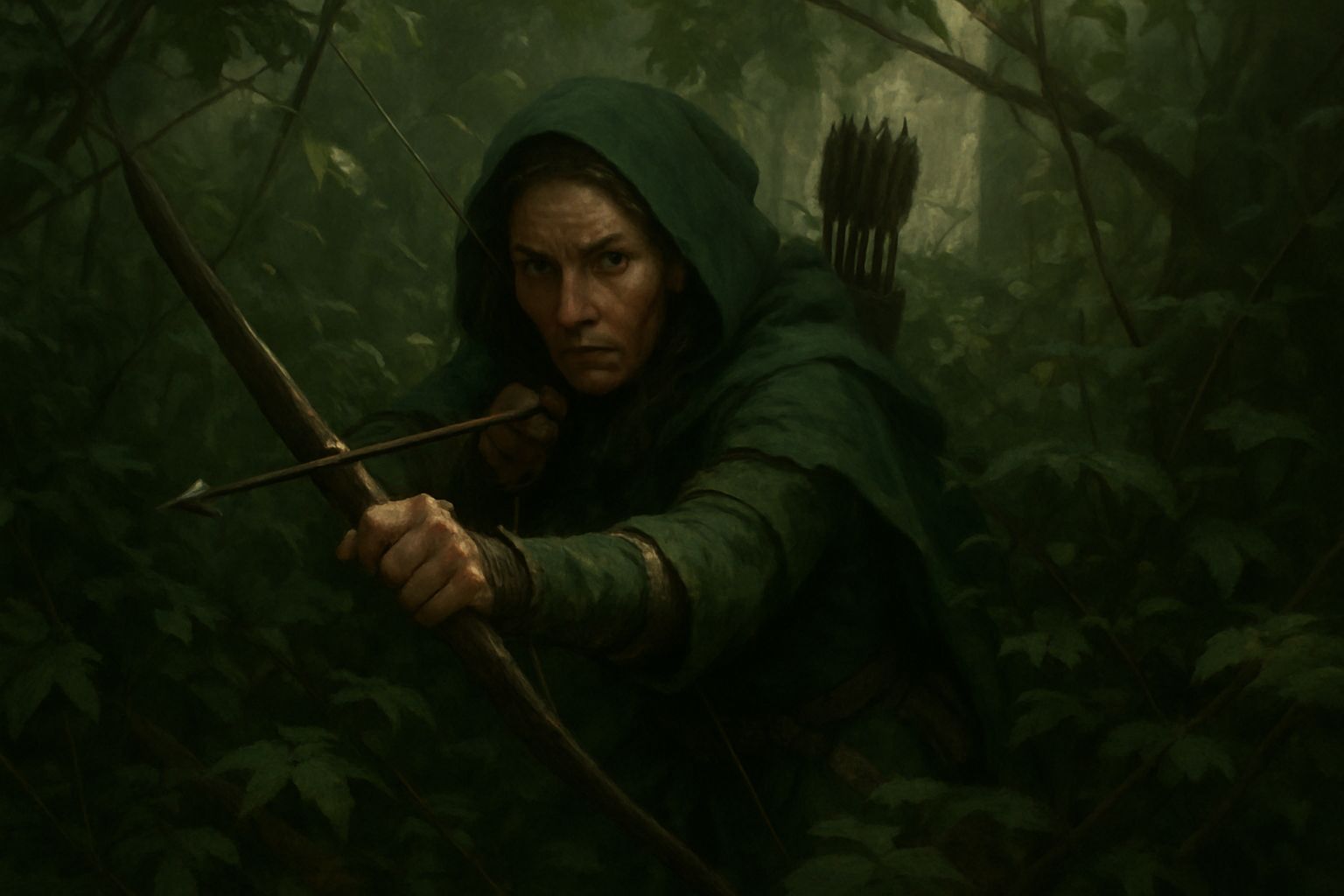
The canopy held the day dim and green, light strained through leaves and never quite reaching the ground. Shaedra moved where it was darkest, not because she feared being seen but because men like these became careless when they thought no one watched.
Five of them. Raiders, not travelers. Rope on their belts, flesh knives at their hips, the stink of old smoke in their clothes. One carried a sack that clinked softly when he walked. Chains.
Shaedra watched from behind hanging moss and learned their rhythm in a handful of breaths. The leader with a red scarf tied around his arm. The young one too eager, drifting toward the trees to show courage. Two in the middle talking low and laughing like the forest was a joke. One quiet man at the back, eyes scanning, breathing like he was trying to be smart.
A thought tried to rise, soft and tired. Let them pass. Save your strength.
It sounded like surrender wearing a polite mask.
She touched the bowstring and waited for the leader to stop, for the moment when he raised a hand and the others bunched without thinking. When it came she exhaled.
The first arrow took him under the jaw. He folded without a sound, the red scarf sagging like a dead banner.
The second arrow hit one of the laughing men through the throat. He dropped his knife and tried to hold his life in place with his hands. Then he fell into the ferns and the ferns swallowed him.
Shouts burst out. The young one spun, eyes wide, searching the trees like the threat might be everywhere at once. The quiet one crouched behind a trunk and listened hard, forcing fear into discipline.
Shaedra was already moving. Sideways, not back, slipping through thorn and root where pursuit would be slow and loud. She left them a snapped twig, placed on purpose, a small sound to pull them deeper.
They followed in a loose cluster, stumbling, arguing, panic turning them stupid. Shaedra kept them at a distance and let fatigue do the work. Every time they slowed she gave them a whisper of her presence, a scrape of bark, a leaf disturbed, just enough to keep them walking.
Night fell in Elarune like water poured into a bowl. The last green drained away and the world became sound and scent. Shaedra became the thing that owned this darkness.
They had stopped in a tight knot under the trees, no fire, no comfort, only the rustle of nervous hands and the quick breaths of men who had started to understand. One of them, broad shouldered and scarred, could not sit still. He stood and walked a few steps away, muttering a curse as if the world owed him ease.
Shaedra came up behind him and clamped a hand over his mouth. Her blade slid in under his ribs, clean and quiet. She eased him down into the roots and held him until he stopped moving, because leaving too early was how men screamed.
Two left.
She circled wide and waited for the second to give her a single mistake. A glance. A shift. A moment of attention spent on the wrong thing.
When it came her arrow took the quiet one through the eye. Brutal. Final. No chance for a warning.
The young one made a thin sound and bolted.
Shaedra raised her bow and tracked him through trunks and vines. She could have ended him. The shot was there.
She aimed for the arm instead.
The arrow hit high and punched him sideways into a fern bank. He cried out, clutching at the shaft, staring back into the dark like a child looking for a parent that would not come.
Shaedra stepped into a strip of moonlight where he could see her shape clearly, bow in hand, posture steady. No rush. No mercy performance. Just certainty.
“You tell them,” she said. “You tell every man who thinks this is easy. You come to Elarune, and the forest keeps the count.”
His mouth opened, closed, opened again.
“Who are you,” he rasped.
Shaedra felt the old ache press against her ribs. Names. Faces. A village that had become ash.
She did not give him one.
“I am what you did not see,” she said.
He stumbled up and ran, blood bright on his arm, crashing through undergrowth until the forest swallowed him and the night went quiet again.
Shaedra listened until even the echoes were gone. Then she turned back into the dark and let the canopy close behind her.
Background
Shaedra is a hunter from Elarune, a woman in her forties shaped by long days under canopy and longer nights listening for what does not belong. She is not driven by glory or pride. She is driven by patterns, signs, the small wrongness that tells her where danger is coming from before anyone else believes it.
Years ago she left her village on a cautious errand, following rumors and traces that felt off. While she was gone the slavers came. The raid was fast and complete, leaving only ash, blood, silence, and the kind of absence that never stops hurting. Everyone she loved was taken or killed, and the fact that she was not there has eaten at her ever since. That guilt did not turn into tears or speeches. It turned into motion.
For several years she fought the raids from the shadows, striking camps, cutting lines, freeing whoever she could and disappearing before retribution arrived. It was not heroic war. It was hungry, dirty guerilla work with small victories and a rising pile of names she could not save. In time she accepted the truth she hated most, that she could not stop the machine alone. She could only bleed against it until there was nothing left of her.
When it became clear that staying meant a slow death and no answers, she left Elarune for Estoria, hoping to find a ship to sign on to. She carried little besides her bow, her tools, and the knowledge that a wider world was the only place left to search for what the raid had stolen.
Joining The Blue Marlin
In Estoria she happened upon the Blue Marlin. It offered her something her years of solitary war never could, reach. A moving base, a crew with teeth, and the ability to search for her family across oceans instead of dying in the undergrowth. She joined for one simple reason. If any part of her family still lives she will not find them by staying where the raid began.
She did not join in a burst of loyalty or romance. She joined the way she does most things, after watching, testing, and deciding. The ship was not safe, but it was purposeful. That mattered more.
Life Aboard The Blue Marlin
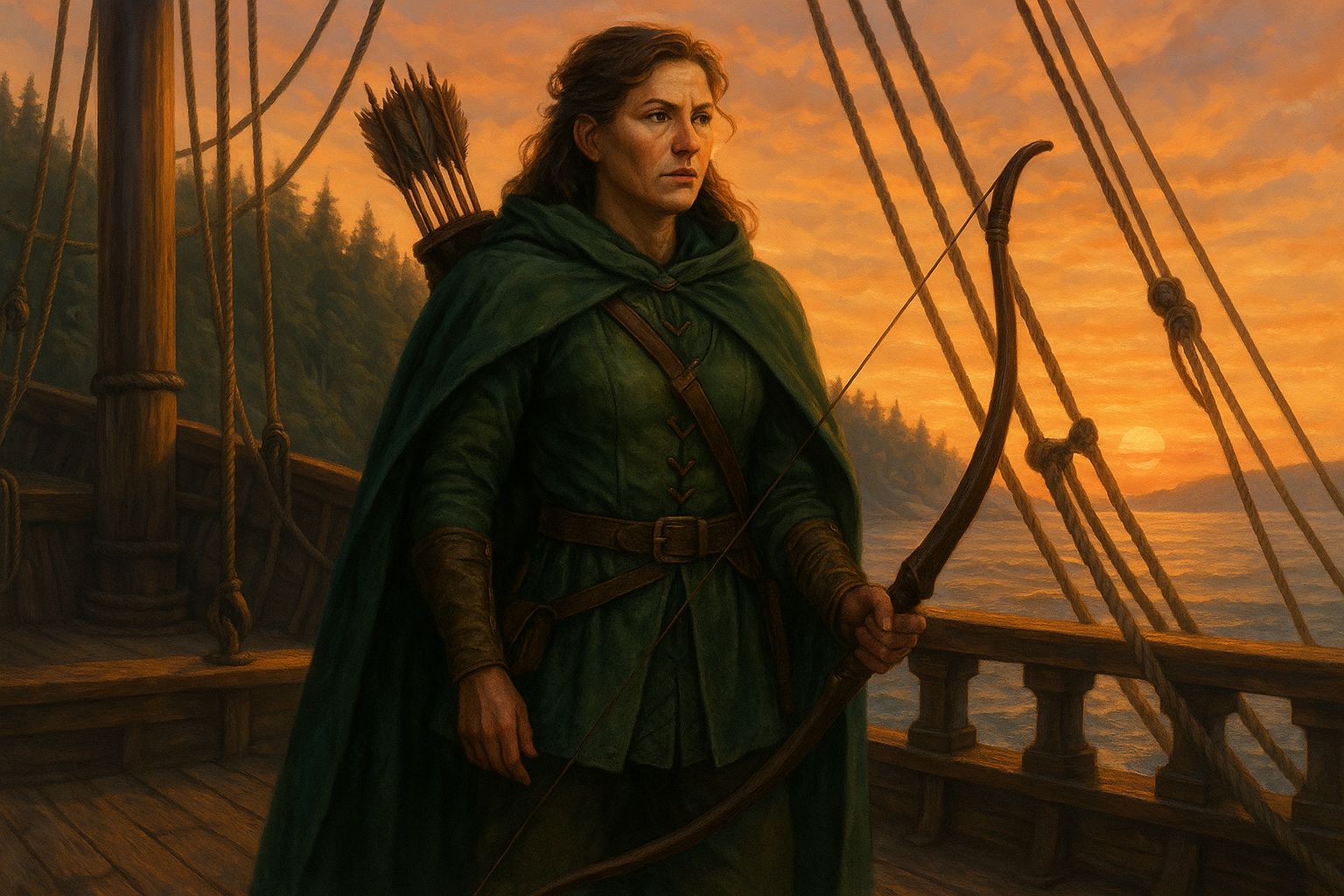
Shaedra keeps to the edges of rooms and the edges of decks. She chooses the aftcastle or the rail, places where she can see without being surrounded. When the ship is in port she watches the docks like a tree line, reading the flow of people and the way attention clings to the hull.
She is useful in the unglamorous moments. Quiet approach, quiet departure, quiet certainty about which street is wrong and which silence means someone is there. When fog rolls in and the world turns muffled she becomes sharper, not calmer. She does not soothe herself with denial. She tightens her focus until the threat has a shape.
At sea she is steady. She keeps her kit in order, checks fletching and cord, looks for weather shifts early, and rarely needs to be told twice. She does not seek company, but she is present, a reliable shape on the deck when others cannot sleep.
Personality And Temperament
Shaedra is not talkative. She does not fill silence to make others comfortable, and she does not explain herself unless the explanation solves a problem. She carries a darkness that is not melodrama but weight, the kind that settles behind the eyes when you have replayed the same failure for years and cannot find a version of the past that forgives you.
She can brood, and she can go distant when memory bites. What keeps her functional is discipline. She still eats, still checks lines, still sharpens, still listens. Even when she is lost in thought she is rarely careless. She can be suspicious with strangers and hard to impress, especially when someone shows up with a story and a request.
She is not cruel, but she is direct. She does not soften hard truths to spare pride. If she approves of someone, it shows in small ways, the way she positions herself, what she chooses to watch, the fact that she stops questioning them.
Skills And Methods
Shaedra is a hunter in the full sense, not just someone who shoots well. She reads tracks, broken branches, disturbed routine, and the way people move when they think no one is watching. She is comfortable in wilderness, alleyways, and the threshold between them. She moves ahead of the group when a plan requires stealth, and she trusts her hearing enough to stop everyone on a single lifted hand.
Her approach is pragmatic. She prefers clean solutions, quiet removals, and ending a threat before it grows teeth. If forced into open violence she does it without flourish, then goes quiet afterward, as if talking would invite the dead to speak back.
In a fight she favors distance, angles, and denying the enemy clean choices. She is not reckless with arrows. She chooses shots that matter, then relocates before the enemy can answer.
Slave Markets And The Search
In every port Shaedra learns the same routes before she learns the taverns. Where the auctions are held. Where the chains are sold. Which streets the caravans use when they arrive and which doors they slip through when they do not want to be seen.
She does not go in like a hero. She goes in like a hunter. Eyes up. Hands empty. She listens first. Names, accents, the way sellers talk about stock when they think no one cares. She watches for Elarune in the small signs others miss. The tattoos. The carved knots used as keepsakes. The cadence of forest speech when someone has been dragged too far from home to fully hide it.
When she asks questions, she does it under a mask. She poses as a customer, someone with coin and a practical interest, because that is the only shape a slaver listens to without suspicion. Her voice stays flat, her face stays still, and she lets the seller assume whatever makes the conversation easiest. She asks without flinching. Not loud, not pleading, not angry. Controlled, precise questions that sound like commerce even when they are not. Where did this lot come from, which river, which coast, how long since the raid, who was the buyer, who handled transport, who paid for the papers. She learns which sellers lie quickly and which lie slowly, and she keeps coming back because repetition makes people careless.
If she hears that a captive is from Elarune she becomes relentless. She asks for names, family lines, village markers, anything that can anchor a stranger to her memory. She trades small coin for small truths. She offers to buy information.
She does not always tell the crew what she is doing. Not because she is ashamed, but because she refuses to turn her search into a shipboard ritual of pity. Those who know learn the signs anyway. The way she disappears early on the first day in port. The way she comes back at dusk smelling of dust and sour wine and places where people are treated like objects. The way she cleans her hands longer than necessary after, as if scrubbing can remove what she has seen.
Her questions change over time. At first it is only family. Names that she repeats to herself until they feel like prayer. Later it becomes the network, the edges of the machine that swallowed her village. Which captain runs which route. Which noble buys forest people for private work. Which auction houses accept unregistered cargo. She cannot stop the trade alone, she knows that, but she can map it. She can find the threads that lead outward. She can keep looking until she finds a face she recognizes, or until the last possibility is buried under truth.
Relationships On The Ship
Shaedra has great respect for Captain Scarnax, seeing him as a person of integrity who cares for his crew as if it was his family. She does not idealize him. She simply believes he means what he says and that he will not spend lives casually. To her that is rare enough to matter.
There is solid trust between her and the other marines. She trusts them to watch her back and they trust her to put arrows where they are needed. She is not the loudest among them, but she is often the one who notices the shift in enemy intent first, the moment a skirmish stops being posturing and becomes lethal.
She likes Nasheem, though she finds his bravado tiring when it stretches into noise. She does not really understand Ayesha, since diplomacy is not her way, but she can see that whatever Ayesha does works and she respects results. With most of the crew Shaedra does not chase friendship. She lets it form slowly, built on competence, shared danger, and time.
Roleplaying Notes
Play Shaedra as a person who conserves words the way others conserve water. Let her notice the thing no one else notices, then make her act on it without drama. When guilt surfaces do not turn it into confession. Turn it into a longer watch, a harder edge, a sudden need to move.
Her driving need is not vengeance, even if vengeance is sometimes convenient. Her driving need is to find out what happened to her people and to prove to herself that leaving the village did not mean abandoning it. When she fails she does not collapse. She tightens, endures, and adds the new failure to the weight she already carries, then keeps walking.