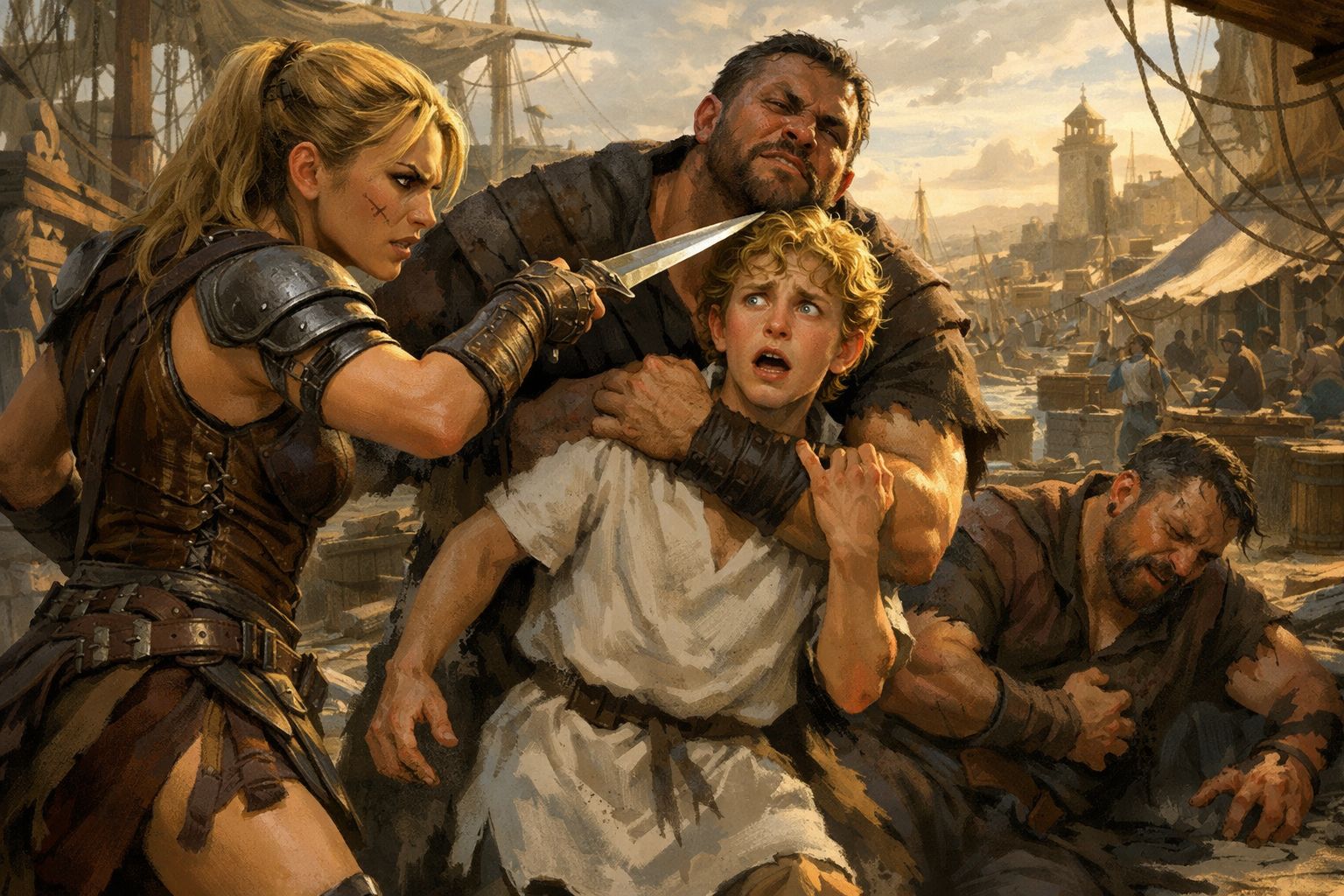
Silvio
The house always changed its breathing when Thessa returned.
Silvio felt it first in the servants, the way they stopped speaking mid sentence, the way hands hurried to smooth cloth that did not need smoothing. Even the lamps seemed to pull their light inward as if brightness could be blamed for something. He was in the corridor outside the bathing room with a folded stack of linen in his arms, trying to be exactly where he was supposed to be and nowhere that could be noticed. The stone beneath his feet was cool. The air smelled of oils and citrus and the faint iron tang of the training yard that clung to her when she came in from the city. He lowered his gaze and made his shoulders round, the posture of someone who was not a person, just a piece of the house that could be moved without thought.
Thessa’s boots struck the floor like punctuation. She did not walk like other people. She arrived. The sound carried ahead of her, heavy and certain, and it told the whole household what shape the next hour would take. When she entered the corridor her cloak was half undone, the clasp hanging loose as if she had ripped it open rather than unfastened it. Her hair was damp at the roots with sweat, and a thin line of red marked one knuckle where she had split skin against something hard. She looked past the servants who bowed. She looked past the carved pillars and the fine mosaics of spear maidens and sunlit victories. She saw Silvio in the same way a person sees a cup when they are thirsty, not as something alive, but as something useful.
He tried to step aside. He tried to melt into the wall. He held his breath because sometimes even breathing felt like noise. Thessa stopped anyway, right in front of him, and for a moment he thought he had succeeded, that she would move on, that she would take her anger to her steward or her sisters or the sparring ring. Her eyes dropped, focusing, and he knew the moment she decided.
"You," she said, like a command to an object.
Silvio’s mouth went dry. He managed the smallest nod. "Mistress."
Her hand shot out and closed on his arm above the elbow, fingers hard as clamps. The linen slipped in his other hand, the stack tilting as he scrambled to keep it from hitting the floor, because spilled linen meant a lecture from the housekeeper, meant extra work, meant another reason for someone to be irritated. Thessa did not care. She pulled him close enough that he smelled the heat on her skin, the bitter edge of wine and frustration.
"I have had a day full of fools," she said. Her voice was low and controlled, which was always worse than shouting. "I need to relax. You will make yourself useful."
Silvio’s throat tightened around the words that wanted to come out, words he had learned not to say. Please. Not tonight. I am tired. I am afraid. He swallowed them like stones. He nodded again because nodding was safer than silence. She dragged him toward her chambers, not violently, not like a fight, but with the casual certainty of ownership. His feet stumbled once on the edge of a rug. She tightened her grip in warning and did not slow.
Inside, the room was too clean. Too bright. The bed was made as if nobody slept there, only performed. As Thessa dragged him in, Silvio caught sight of Halen, one of the house men, waiting outside with a rag over his wrist and a bucket at his feet, eyes down, expression blank. He did not look up. He was already there to erase whatever would be left behind. Thessa shut the door with her heel and finally let go, but her attention remained on him like a hand around his throat.
She dropped onto the bed. "Make that mouth useful," she barked. Silvio kept his movements careful. He did what he had learned to do. He tried to be compliant in all the correct ways. He tried to anticipate. He tried to keep his face blank enough that it would not invite anger, soft enough that it would not invite cruelty.
It did not work.
Thessa’s breath came sharp, impatient. She moved like someone trying to force calm into her body and finding it would not hold. The tension in her shoulders did not ease. Her eyes stayed hard, pinned on something he could not see, some insult from the city that had followed her home. Silvio felt himself trembling and tried to stop, because trembling made her notice him as a failure. He tried harder, tried to disappear inside obedience, he could not undo her day, could not erase whatever shame or irritation she had brought through the doorway.
Her expression changed first. Not to sadness, never that. To disgust, as if the air had gone stale.
"Useless," she said, flatly, and the word landed like a slap even before her hand moved.
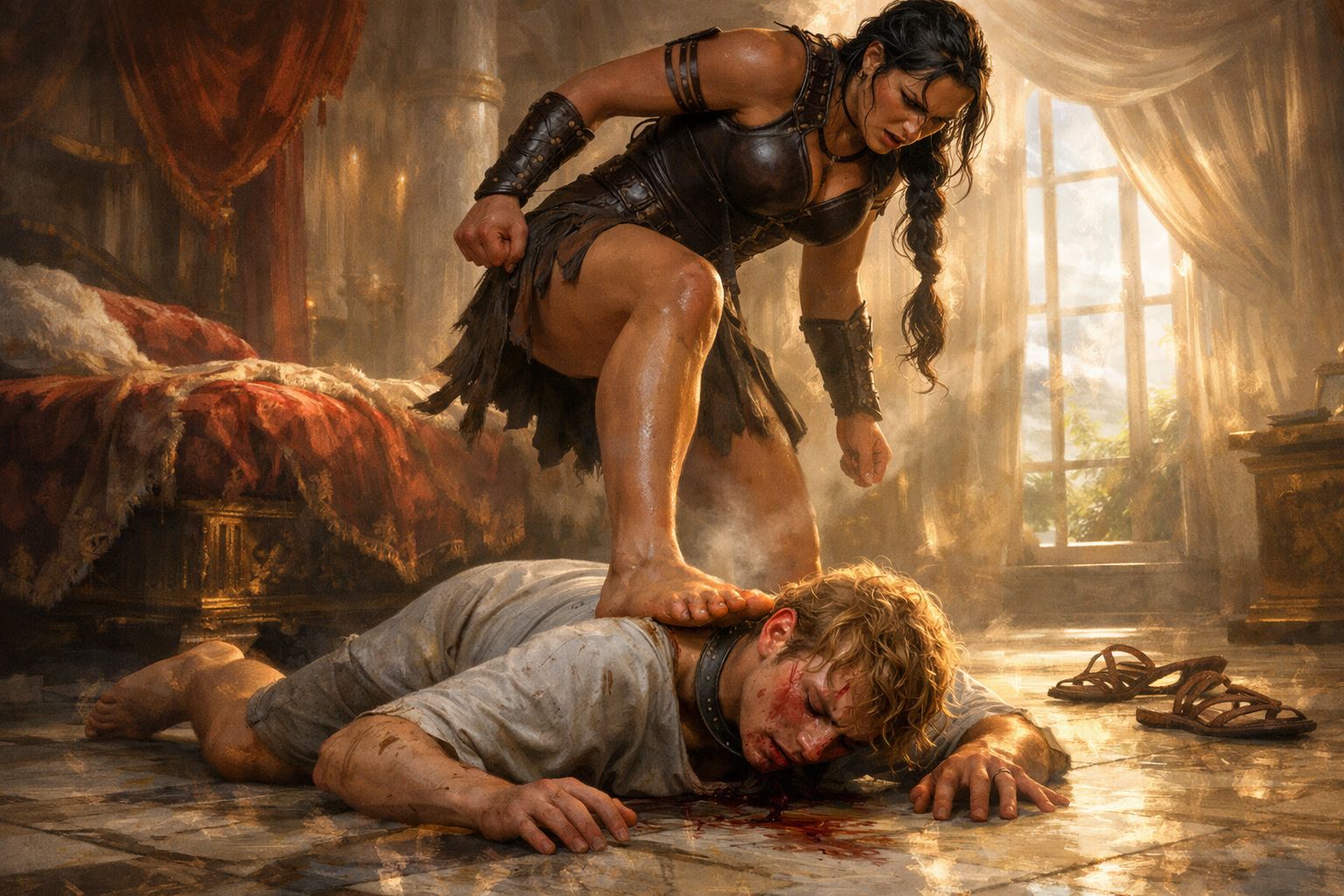
She kicked him away. He stumbled back, hit the edge of a low table, and fell. The impact knocked the breath out of him in a thin, humiliating sound. He curled by instinct, arms up, knees drawn in, the shape that made him smaller, the shape that made him less interesting. Thessa’s foot clipped his side, not to kill, not to break, just to remind him what she was and what he was. She kicked again, impatient, like moving a piece of furniture out of her path. The room spun slightly. He tasted dust and copper. He kept his eyes down because looking at her face would make it worse.
"Get out of my way," she said. "I will find someone who can actually do something right."
Then she was gone, the door opening and shutting, the sound of her footsteps retreating down the corridor to some other part of the house, someone else to absorb her mood. The silence that followed was not peaceful. It was a vacuum. Silvio lay where he had fallen, shaking with pain and shame and the strange relief of being dismissed. His lip was bleeding. His body ached where the kicks had landed, and his mind raced in circles that always ended at the same truth.
He was not safe here. He never had been. He never would be.
He stayed curled until the trembling eased enough that he could move without making noise. He wiped his mouth on his sleeve and hated himself for it, hated that he was still trying to keep the room neat, still thinking like a servant who might be punished for leaving a smear on the floor. He forced himself to sit up, slow, careful, listening for footsteps. None came. In the distance he heard laughter, the bright sound of other people’s lives, and it made something in him go cold.
He looked at the door, at the line of light beneath it, and in that thin strip he saw the shape of the rest of his life if he stayed. More days like this. More nights where she returned irritated and he became the place she put it. More bruises. More apologies. More shrinking. More disappearing until she finally lost her temper enough to kill him.
Silvio pressed his forehead to his knees and breathed until the nausea passed. When he lifted his head again, the decision had already settled in him like a stone that could not be moved. He did not know the details yet. He did not know how. He only knew that the first real opening, the first moment the house blinked, he would be gone.
He would leave even if leaving killed him, because staying was killing him already.
Overview
Silvio is a late teen who looks younger than he is because he learned early that looking small keeps blows lighter and attention lower. He came to the Blue Marlin as a stowaway and stayed because the ship rewarded usefulness instead of obedience. He is now the crew’s quiet specialist for climbing, infiltration and the sort of work that solves problems without starting fights.
Appearance
Silvio is lean and wiry, built for hanging from beams and squeezing through spaces nobody else would try. His hands are marked by rope burn and old bruises that healed wrong. He keeps his hair short for practicality and because long hair was something his former owner liked to grab.
He dresses like a sailor who expects to be dirty fast. Loose shirt, soft boots, a belt with small pouches that never jingle. When he needs to work, he darkens his face and hands with soot and oil, not as theater but because it keeps him from being seen.
Background
Silvio was enslaved in Amazireth as a house slave, which sounds safer than it was. His owner was a prominent amazon warrior named Thessa Vael of House Arkeion, celebrated for victories and feared for her temper. In public she was disciplined and glorious. In private she used him as an outlet when rage or humiliation needed somewhere to go.
He learned the rules that keep you alive in such a household. Speak only when spoken to. Learn footsteps. Predict moods. Become invisible before anger arrives. He also learned the hidden geography of a large house, where servants sleep, where guards drink, which doors are watched and which are only meant to look watched.
His escape was not heroic. It was desperate, quiet and ugly. A dockside errand. A moment when the right overseer looked the wrong way. Silvio vanished into cargo shadows and crawled into a ship’s belly. He did not know the name Blue Marlin then. He only knew it was leaving.
Joining the Blue Marlin
They found him quickly, not because he was clumsy but because the ship is run by professionals who notice everything. Silvio expected the usual result. Pain, chains, being sold back, being made an example.
Instead, an accident gave him a narrow chance. A line failed high up and the repair needed someone light enough to climb and brave enough to do it without freezing. Silvio went up like he had been born in rigging, hands and feet moving with instinctive precision, tied the new rope and came down shaking but alive.
After that, he had value that could not be denied. He earned a place by doing what he could do better than anyone else and by never abusing that trust.
Life Aboard the Blue Marlin
Silvio lives small. He sleeps where he can hear trouble coming, often near the rigging access or in a corner of the sailors’ quarters where he is not boxed in. He eats fast, eyes down, leaving the table as soon as it is polite enough to do so. He keeps his tools hidden and organized: picks wrapped in cloth, wax for locks, a thin blade that is more utility than weapon.
On the ship, his gift is vertical movement. He can reach the top of a mast in weather that makes other sailors cling and pray. He can cross an outrigger spar in darkness without a lantern. In port, he becomes a different kind of useful. Windows, roofs, back alleys, bolts and barred doors. He gets in, he gets out, and most of the time nobody knows anything happened until the crew already has what it needs.
He does not steal for joy. He steals like someone performing surgery. Quick, careful, no extra harm.
Talents
Silvio is a natural climber and an exceptional cat burglar. He can move on walls, beams and ropes with a kind of calm competence that does not match his ordinary shyness. His hands are sensitive. He feels a lock the way a musician feels a string and he has learned to listen for the smallest change in tension.
He is also good at being overlooked. Crowds slide past him. Guards forget him. People remember a young figure, not the person beneath it. This is not magic. It is survival turned into craft.
His weakness is open confrontation. He freezes when voices rise and he flinches when someone moves too fast. His instinct is to shrink, apologize and vanish, even when he has done nothing wrong.
Personality and Temperament
Silvio never had a real childhood and this has shaped who he is. He is shy, socially awkward and easily embarrassed. He is polite to a fault and tends to answer questions too honestly because he cannot think fast enough to lie smoothly. When he is nervous he talks less, not more, and his eyes drop to the floor as if the deck might offer instructions.
Violence repulses him. Not in the abstract, but physically. Raised voices make his stomach tighten. A fist on a table can make him recoil. If a fight breaks out he does not cheer and he does not watch. He looks for an exit, a hiding place, someone who might need help getting away. He has seen too much violence used as entertainment and too much used as entitlement.
He does not judge the crew for doing what they must. He simply cannot be comfortable around it. When he is forced to act, he chooses restraint first, flight second and only then whatever is necessary to survive.
Relationships With the Crew
Scarnax is the person Silvio trusts in the way a former slave trusts anyone: cautiously, with constant testing, with quiet attention to patterns. The captain’s consistency matters more than kindness. Silvio watches for the moment the mask drops and it never does.
Skarnulf has taken him as a kind of apprentice. Skarnulf teaches him ship habits and street habits, how to read a crowd, how to spot a knife hand before the knife appears. Silvio, in return, gives Skarnulf a much needed emotional anchor, even if his tough man image does not allow him to admit it.
Junia is Silvio’s private gravity. He is in love with her and it shows in small betrayals of self control: how he appears when she needs something carried, how he listens too closely when she speaks, how he blushes when she praises him for being careful. Junia does not notice, partly because she is busy, partly because she has her own social awkwardness, partly because Silvio has no idea how to be seen on purpose. The rest of the crew knows and finds it quietly endearing.
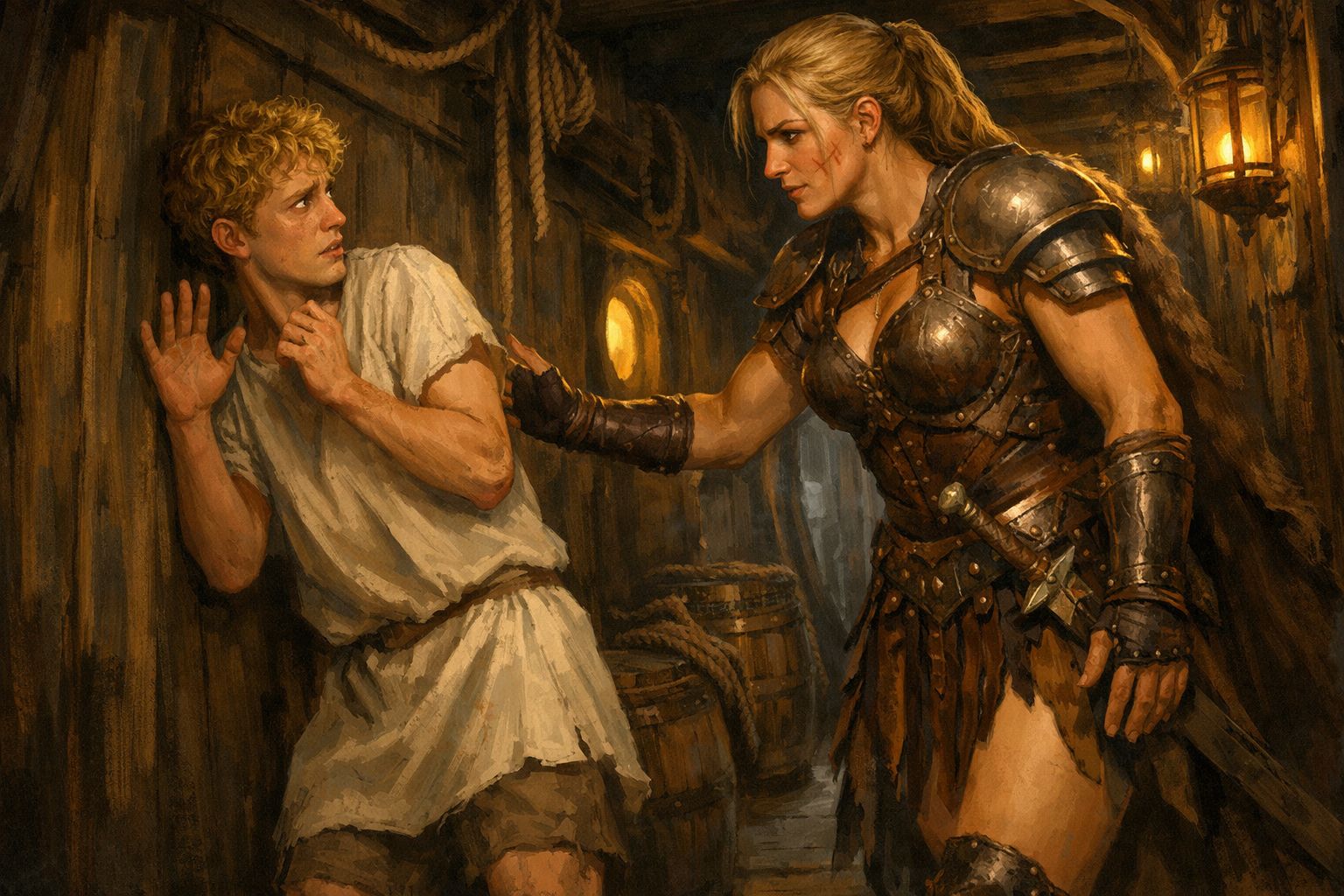
Amaxia intimidates him. Her build, her directness, the way she occupies space, it all echoes his former owner too closely. Amaxia noticed the pattern quickly and has tried to soften around him. That attempt makes him more nervous because it feels like a trap or attention and attention used to be dangerous. Over time, this can become a slow, meaningful bond if handled gently, Silvio learning that strength can be protective and Amaxia learning that gentleness is also strength.
Ayesha treats him with professional respect. She does not coddle him and she does not push him into social performance. When she needs something done quietly, she gives him clear instructions and a clear exit. That simple competence is one of the ways Silvio measures safety. Her diplomatic skills can get him to sometimes open up to her, but he still finds her overt femininity intimidating.
Silvio’s relationship with Ileena is complicated in a way neither of them chose. Ileena feels close to him because she is naturally affectionate and treats proximity as ordinary, sitting too near, leaning on him, touching his shoulder or wrist as if contact is just another kind of speech. To Silvio, that ease reads as power. Her lack of shyness feels like a quiet declaration of "I do what I want" made so casually she does not even realize she is saying it, and his mind translates that into the old rules of masters and slaves. Her touches scrape against old instincts that mistake attention for possession. He tenses, his eyes drop, he goes quiet, and Ileena does not connect any of it to fear. In her mind she is being kind, so she offers more of the very thing that makes him retreat.
Pelonias taught him to read, which was a very big emotional step for him, as slaves are not taught to read in Amazireth. To him, it became a mark of freedom, for which he is very grateful.
He is broadly liked. His awkwardness reads as harmless, his work saves lives and his refusal to brag makes him easy to root for. The ship has many loud personalities. Silvio gives it a soft center.

Wounds and Triggers
Silvio’s past left him with a learned fear response that can be mistaken for cowardice. If someone grabs his wrist, blocks a doorway or raises a hand too fast, he may shut down or bolt. He hates being cornered and he hates being watched while he eats.
He also struggles with praise. Compliments can make him suspicious because praise used to be the calm before demands. If someone thanks him warmly, he may dismiss it, minimize what he did or physically retreat.
These are not flaws to fix quickly. They are habits to unlearn slowly.
Growth Arc
Silvio’s long arc is learning that safety can be real, not temporary. The Blue Marlin gives him something Amazireth never did, belonging without ownership. His skills already give him a role. The harder part is letting that role become an identity instead of just camouflage.
If you want a direction for him, lean into three slow changes. First, he begins to ask for what he needs instead of enduring. Second, he begins to accept being seen when he does good work. Third, he finds a way to face violence without becoming violence, which might mean protective action, medical assistance, sabotage or simply the courage to speak up when someone stronger is about to do something cruel.
Using Silvio in Play
Silvio is a problem solver for barriers, surveillance and urban obstacles. He is also an emotional weather vane. If he is panicking, something is truly wrong. If he is calm, the situation is probably manageable.
He works best when given clear goals, minimal spectacle and an exit plan. If a scene forces negotiation, intimidation or public performance, he becomes a pressure point that can reveal the crew’s character. Do they protect him, use him, dismiss him, tease him too hard. The answers matter.
Roleplaying Notes
Keep three things in mind when playing Silvio: Likeable, harmless and emotionally protectable.
- Keep your voice soft and your sentences short, especially in groups.
- Avoid eye contact until trust is established, then glance up in quick checks.
- Flinch at sudden movement and raised voices, then try to pretend you did not.
- Do not brag. If praised, deflect or change subject.
- Move like a shadow when working, but become visibly unsure when attention turns toward you.
- Show care through action rather than words, especially around Junia.
- When violence starts, look for escape routes, hiding places and nonviolent ways to end the situation.
Game Master Resources
This section contains a few stories which can be used at appropriate moments to make sure the crew notices him and takes him to their heart. Use them as is, or as inspiration, or just pluck good moments from them.
Visit to Junia
Silvio knocked so softly on Junia’s cabin door that he almost hoped she would not hear it.
But she did. She opened at once, saw it was him, and stepped back with an easy warmth that only made him more nervous.
“Silvio? Come in.”
He slipped inside, shoulders tight, eyes lowered. Junia shut the door and waited. He had clearly rehearsed this, but now that he was here, the words would not come.
“I need help,” he said at last. “Back in Amazireth... my mistress had a healer do something to me.”
Junia’s face changed, not to pity, but to focus.
“You can speak plainly with me.”
He swallowed hard. “The tree is strong, but there is no seed.” He looked sick with shame. “I feel like less of a man.”
Junia understood at once. “I can help,” she said gently. “But I will need to examine you, and touch you.”
He blushed fiercely, but nodded. With shaking hands, he lowered his trousers and sat rigid on the edge of her bunk. When Junia touched him, he flinched.
“Easy,” she said. “Just relax.”
A warmth spread from her hands as she worked her magic, feeling the damage done to him and carefully undoing it. Then his body reacted.
Silvio made a panicked sound. “I’m sorry. I’m sorry.”
Junia looked up at him, calm and steady. “That is a normal reaction. You do not need to apologize.”
Then a brief expression passed over her face, disgust sharp and real. Silvio saw it and went still with fear, as if expecting a blow.
But Junia shook her head. “Not at you. Sometimes I feel echoes of what was done before. Whoever worked on you was cruel.” His first instinct was still apology, but she cut that off at once. “No. You were hurt. That is not your fault.”
When she finished, she leaned back, tired but satisfied. “It should work now. It will take a week, but it is done.”
Silvio hesitated, then asked in a small voice, “Did it look all right?”
Junia frowned slightly. “What do you mean?”
He stared at the floor. “She used to come home drunk, use me, then say it was worthless. Often she beat me after.”
Junia’s expression softened with a sadness deeper than pity. “There is nothing wrong with you, or your 'tree',” she said. “The problem was with the wine. And with her.”
His face went strange then, relief and shame tangled together. On impulse, Junia stepped forward and gave him a brief, supportive hug.
Silvio froze, then awkwardly hugged her back.
Then he remembered he was still not wearing trousers.
He jerked away in horror, grabbed for them, pulled them up in a fumbling rush and blurted, “Thank you,” before fleeing the cabin.
Junia sat down on the edge of the bunk after he was gone. She shook her head once, smiling sadly to herself.
“Poor boy,” she murmured.

Encounter with Amaxia and Skarnulf
Morning on the Blue Marlin came quietly, with the creak of rope, the soft knock of water against the hull and the muted footsteps of early risers already at work above. Silvio stepped out of his cabin into the narrow passage and found Amaxia waiting a few paces away.
She was not blocking the way. She was not trying to corner him. If anything, she looked as if she had made an effort to seem less imposing than usual, shoulders held still, hands at her sides, voice ready before her body moved.
“You cried out in your sleep,” she said, more carefully than she usually spoke. “I wanted to see if you were all right.”
Silvio stopped at once. Then he stepped back before he could stop himself.
“I’m sorry.”
Amaxia’s face tightened, not with anger, but with the same pained frustration that always came when kindness landed wrong.
“That is not what I meant.”
“I didn’t mean to disturb you,” he said quickly, the words coming too fast now. “Or wake anyone. I’ll be quieter next time.”
“I’m not angry,” she said. “I’m trying to help.”
Then she took a step toward him, probably thinking the reassurance needed warmth behind it. Silvio stepped back again just as quickly, shoulders drawing in, fear rising in him faster than thought. Amaxia stopped immediately. The hurt showed on her face before she could hide it.
Before either of them could force the moment any further, Skarnulf came down the passage. He took in the whole scene in one glance and stepped into it without making a spectacle of himself.
“I’ll handle it,” he said to Amaxia. “Better if you leave him to me for now.”
Amaxia hesitated. She clearly hated that answer. Helping by withdrawing was not a lesson that came easily to her. But she knew he was right. After a moment she gave a short nod and looked back at Silvio.
“I meant no harm,” she said.
“I know,” Silvio answered softly, and that somehow made it sadder.
Amaxia held his gaze for one more heartbeat, then turned and headed for the ladder to the deck, her stride controlled and hard, as if she were angry at the whole world and trying not to be angry at him.
When she was gone, Skarnulf leaned one shoulder against the wall beside Silvio and let the silence settle before he spoke.
“She means well,” he said at last.
“I know,” Silvio answered. He looked miserable now more than frightened. “That’s the problem. I know she’s kind. I know she wants to help. But strong amazons scare me. My fear gets there before my head does.”
Skarnulf nodded slowly, as if none of that surprised him.
“Amaxia is probably the one person on this ship who understands you best,” he said. “She went through something very similar. Not the same shape, maybe. But close enough.”
Silvio gave a small helpless shrug. “I know that too.”
He rubbed his hands together, restless and ashamed. “But feelings can’t be reasoned with.”
“Not quickly,” Skarnulf said. “But over time, even feelings can change. Fear learns slowly. Slower than thought. Slower than fairness. But it can learn.”
Silvio looked down the passage where Amaxia had gone.
“I don’t want to hurt her,” he said quietly. “She looks at me like she’s done something wrong.”
Skarnulf’s voice stayed calm. “She thinks strength should solve things. This one won’t. Not by force.”
For a moment Silvio said nothing. The ship moved gently around them, alive in all its ordinary ways, and that ordinariness seemed to steady him more than any argument could.
Then he nodded.
“All right,” he said. “I’ll try. Not all at once. But I’ll try.”
Skarnulf gave a short approving grunt.
Silvio hesitated, then added, “And... please apologize to her from me.”
Skarnulf looked at him for a long second. “I’ll tell her,” he said. “But one day, you tell her yourself.”
Silvio managed the faintest ghost of a smile at that. “One day.”
Skarnulf pushed off the wall. “Good. Now come on. Best not to face Yasmira after breakfast is already on the table.”
That got a weak breath of laughter out of Silvio, and together they headed up toward the deck, where the smell of food and the ordinary noise of the ship waited to make the morning feel a little less fragile.
Proving His Skill
The coast rose beside them like a wall, high and sheer and dark with wetness. At the bottom the sea had eaten into it, leaving a shadowed undercut where the waves struck and hissed and withdrew again. Above that, the whole cliff seemed to lean outward, as if the land itself had begun to fall into the sea long ago and then stopped halfway. It looked wrong in a way that made everyone on deck stare longer than they meant to.
Scarnax stood at the rail with Pelonias beside him, both looking up into the haze. Far above, thin smoke drifted across the sky, faint but unmistakable. Not a wildfire. Too controlled for that. Cookfires, perhaps. A settlement. Something hidden above the stone.
“There is something up there,” Pelonias said at last, shading his eyes.
“Looks that way,” Scarnax answered.
Ileena was perched lightly near the rail, balanced as easily as if she stood on flat ground. She studied the cliff for a long moment, head tilted, then gave a sharp little shake of her head.
“No climbing,” she said. “Too steep. Too wet. Too smooth. Stone like fish skin.”
That should have settled it. If Ileena thought a climb was impossible, most of the crew would not even have considered arguing. But from farther back, quiet enough that they nearly missed it, came Silvio’s voice.
“It could be done.”
They all looked around at once.
Silvio stood near the mast with one hand still resting on a coil of rope, as if he had not fully decided whether he meant to speak until the words were already out. Under all their attention he looked ready to fold into himself, but he did not take it back.
“If you can get me to the base,” he added, more softly, “I think I could do it.”
Scarnax frowned at once. “Silvio.”
Silvio lifted his eyes just enough to meet the captain’s. “I can do it.”
“If Ileena says it is impossible,” Scarnax said, “then it is dangerous.”
Silvio nodded immediately. “I know.”
Pelonias glanced between them, interested now. Ileena narrowed her eyes at Silvio, not mocking, but reassessing him.
Scarnax let the silence sit for a moment. He did not like it. That was plain on his face. Then again, Scarnax rarely liked plans that ended with people dangling over the sea.
“I do not like it,” he said at last. “But if you are sure, we will try. The moment you doubt yourself, you come back. No risks. No pride. If it feels wrong, you return. Clear?”
“Yes, Captain,” Silvio said.
A skiff was lowered and brought in close under the cliff. Up near the stone it looked even worse. The undercut forced them close beneath the overhang before Silvio could reach the wall at all, and the rock above them gleamed dark with spray. The waves lifted and dropped the boat in small ugly surges that made the whole cliff seem to sway.
Silvio slipped off his shoes and handed them into the boat. Then he reached out, tested the stone with his fingertips and found the first hold.
For a moment nobody spoke.
Then he began to climb.
He did not move quickly. There was no Ileena-like grace in it, no catlike ease, no flourish at all. He climbed with slow, careful confidence, as if each hold had to be persuaded before he trusted it with his weight. Fingers, toes, shift, pause. Then the next move. Then another.
On the skiff below, no one spoke. On the Blue Marlin, the whole ship seemed to go still.
Higher and higher he went, never fast, never reckless, just patient in a way that became almost unbearable to watch. Once he stopped so long that Pelonias muttered something under his breath and Scarnax’s jaw tightened.
“Fetch Junia,” Scarnax said quietly, not taking his eyes off the cliff. “Just in case.”
Someone on the ship ran.
Still Silvio climbed.
The whole crew watched as if breathing too hard might shake him loose. Even Ileena had gone completely still now, eyes fixed on him. Scarnax gripped the rail so hard his hand had gone white across the knuckles.
At last, after what felt like far too long, Silvio reached the top. He vanished over the edge, and for one awful moment there was nothing at all but the sound of water below.
Then a rope dropped down the cliff.
A heartbeat later his voice came from above, small with distance but clear enough to carry.
“Town!”
The whole ship breathed again. Pelonias laughed first, more from relief than amusement. A murmur ran over the deck like a released wave. Ileena’s tail gave one slow flick. "I was wrong," she said. "He is good."
Scarnax only shook his head and stared upward.
“If he had climbed any slower,” he said, “we would all have passed out from holding our breath.”

Silvio Finally Connects with Amaxia
This is best planted in the first act of the Necropolis arc, making the Amazireth arc hit harder.
The port was busy in the way bad ports often were, loud enough to hide trouble and crowded enough to make trouble feel ordinary. Dockworkers shouted over crates, sailors pushed through the alleys between warehouses and the air smelled of tar, sweat and tide rot.
Silvio moved through it carefully, keeping close to walls when he could. Yasmira had sent him for some herbs and spices from a quay stall, and he carried the small wrapped parcel like it gave him a reason to be there.
He noticed the two men too late.
One stepped out from beside a stack of old nets, broad and confident. The other drifted in from the side, thinner, sharper, with the look of a man who enjoyed finding fear in other people.
“Easy,” the broad one said. “Hand over the parcel. Purse too, if you’ve got one.”
Silvio took a step back. At once the man grabbed his wrist.
The world narrowed.
Before Silvio could do more than freeze, the thinner one smiled, leaned close and slapped him. Not hard enough to injure. Hard enough to humiliate.
“Please,” Silvio heard himself say, hating the word even as it came out.
Then the thin man dropped.
Amaxia had appeared so fast Silvio had barely seen her move. One thug lay in the dirt after a single strike from the hilt of her sword. The other stood frozen, still holding Silvio’s wrist while her blade rested against his throat.
She did not raise her voice.
“I strongly suggest,” she said, “that you let go of him and run.”
He let go at once and ran without argument.
Amaxia slid the sword away and turned to Silvio. At first he still looked afraid. She was angry, armed and strong, exactly the kind of presence that had always taught his body to fear before his mind could think.
She saw it and kept still.
“Silvio,” she said, forcing her voice gentler. “I am a strong angry woman. That part is true. But I am on your side. I will always be on your side. But I am not Thessa. Never that.”
That broke something open in him.
He stepped forward and hugged her with a desperation that surprised them both. Amaxia went stiff for a heartbeat, then found herself and wrapped her arms around him, holding him steady while the fear and shame shook out of him.
“It’s all right,” she said quietly. “I’ve got you.”
When he finally loosened his grip, he still looked too overwhelmed to speak. Amaxia glanced around at the harbor and made a face.
“Come,” she said. “Let’s find somewhere private, drink a lot of wine and trade stories about the bastards who made us. I think we both need to get it out.”
Silvio could only nod.
So she picked up the fallen parcel, kept close beside him and led him away from the quay, and for the first time her strength felt less like something to fear than something he could lean on.