Shaman Ivy
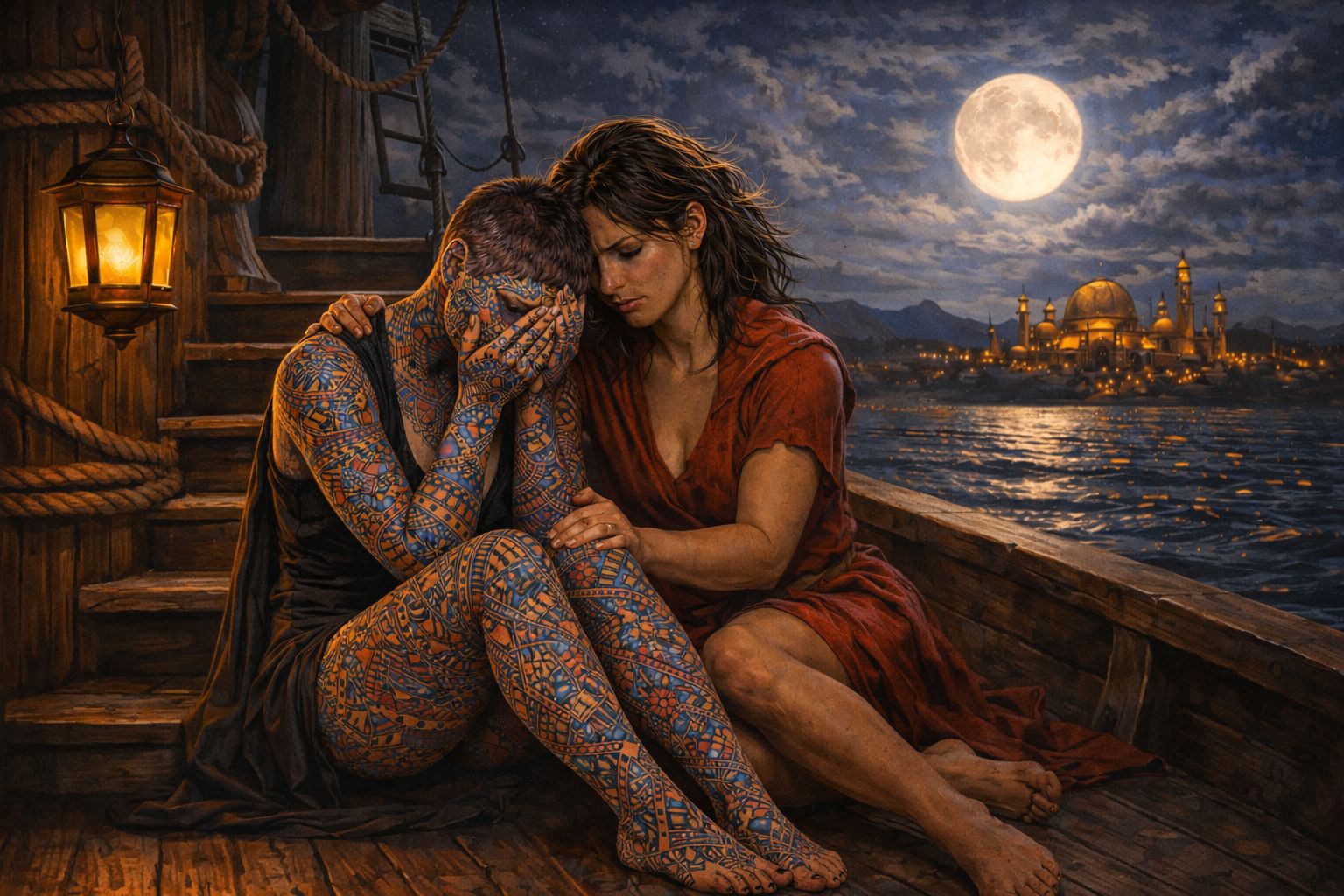
Cassandra found Ivy near the stern after dusk, where the noise of the rest of the ship had thinned into creaking wood, dark water and the low slap of waves against the hull. A lantern burned a little way off, not close enough to feel intrusive. Ivy sat wrapped in a light shawl she did not really need, one hand holding the fabric closed across herself as if the gesture still did something. Cassandra did not sit too near at first. She knew too well how kindness could feel like pressure when it came at the wrong distance.
For a while neither of them said anything. Ivy stared out over the black water, though Cassandra doubted she saw any of it.
Several times, Ivy tried to start something, but could not get it out.
At last Cassandra spoke, her voice quiet and even.
"You do not have to tell me anything."
Ivy swallowed. Her fingers tightened around the shawl. "I know."
Cassandra nodded once and waited.
Ivy took a breath that caught halfway. "But I have to get it out. If I do not say it, it stays inside me exactly the way he left it."
That made Cassandra look at her more closely, though still without crowding her. Ivy turned a little, enough that the lantern light found one of the dense bands of tattooing that curved down from her hip and disappeared under the edge of the shawl around her legs. She touched one part of it with two fingers, carefully, as if even now she could not quite bear her own hand there.
"This part," she said. "Here."
Her voice had gone thin. Cassandra eased herself down to sit beside her, leaving Ivy room to pull away if she wished. She did not.
"He had been working up that leg for weeks," Ivy said. "Slowly. Deliberately. He liked taking his time. He said it made the final piece more harmonious. He wanted perfection." Her mouth twisted around the word. "By then he had reached the inside of the thigh."
The words came in fits now, each one seeming to scrape on the way out.
"He had me on my back on the table. Strapped down. Both wrists. The other leg too, but that one was less important. This one..." She shut her eyes. "He fixed it so tightly I could not move it at all. Not even a little. The way it pulled hurt almost as much as the needle. Maybe more. It was always hot in that room, but that day it was the hottest part of the day, and he wanted the sun. He always wanted the sun. He said it showed him the skin properly."
She gave a small, ugly laugh that was not laughter at all.
"So the shutters were open, and the light came through the window and fell straight on me. He said I looked almost divine like that. Naked. Spread out. Sweating. Shaking."
Cassandra said nothing. She knew when silence was the gentlest thing she could offer.
"I tried not to move." Ivy's hand was trembling now where it rested on her leg. "I always tried not to move. But it hurt too much. It was the inner thigh and every touch felt... it felt..." Her voice broke on the word and she had to start again. "I started shaking. I could not stop it. The table was slick under me. Sweat, blood, all of it. I remember looking at the edge of the wood and watching it drip down. I remember that more clearly than his face."
She pressed the heel of her hand against her mouth for a moment, breathing through it.
"He laughed," she said at last. "Not angry. Not annoyed. Amused. As if I had done something charming for him. He looked at the blood and sweat running together and said he needed inspiration."
Now her face changed. Cassandra saw it happen. The skin around Ivy's eyes tightened, her mouth quivered and suddenly she was no longer only remembering. She was there again.
"He leaned over me," Ivy whispered. "Slowly. Slowly enough that I knew he wanted me to understand that he was choosing every heartbeat of it. Then he licked it." Her voice dropped further, thinned almost to nothing. "From here."
Her fingers touched the lower part of her thigh.
"And upward."
She stopped.
The ship creaked softly around them. Somewhere forward, somebody laughed at some joke half heard through the night. It felt impossibly far away.
Ivy's shoulders folded in on themselves. One hand flew to her face. The other clutched at the shawl and then at Cassandra's sleeve, almost without seeming to know she had done it.
Cassandra moved at once. She slid close, put one arm around Ivy and let Ivy turn into her if she wanted. Ivy did, with a low broken sound she seemed to hate for escaping her. Cassandra held her firmly, one hand at the back of her head, the other across her shoulders.
"You do not have to keep going," Cassandra murmured. "You can stop. You have said enough."
For a little while Ivy could not answer. Her breathing had gone ragged. Cassandra felt the effort it took for her not to bolt upright and pull away in shame. She kept holding her, steady and unhurried, the way one might hold something frightened without making it feel trapped.
At last Ivy dragged in a breath and another. When she spoke, her words were blurred.
"He stopped high enough that I knew what he meant. He wanted me to know he could do worse. That he was being generous by not doing it." She swallowed hard. "Then he slapped my leg and told me to be still."
Cassandra closed her eyes for a moment. Not because she was surprised. Not because she could not imagine it. Because she could. Too easily.
Ivy pressed her forehead against Cassandra's shoulder, ashamed now not only of the memory, but of telling it. Cassandra knew that shame too. Knew how it came after truth, as if the body itself regretted speaking.
"You do not have to be ashamed with me, we have both lived the same story" Cassandra said softly.
Ivy gave a small, bitter sound. "I know."
They stayed that way a little longer until Ivy's breathing steadied. When she finally drew back, she kept one hand gripping Cassandra's wrist, as if some part of her still needed the contact to prove where she was. Her face was wet, but she was no longer unraveling. She wiped at it once, angrily, then looked down at the marks on her leg.
"I am glad he is dead," she said.
There was no drama in it. No fire. Just exhausted truth.
Cassandra watched her for a moment and saw not only hatred, but relief and guilt and grief all tangled together.
"I am glad too," Ivy said, quieter now. "And I am glad she found me. That they all came for me. That I am here." Her mouth trembled again, but she held it steady this time. "I do not know what my life is now. But at least it is mine. Or it can be."
Cassandra's eyes had drifted out over the dark water. Her hand still rested on Ivy's shoulder. When she answered, the words came low, almost like something spoken to herself before it reached anyone else.
"I know," she murmured. Then again, with a faint nod and a distance in her gaze that belonged to older memories. "I know."
For a while after that they sat in silence, both caught in painful memories, side by side in the lantern dim, while the Blue Marlin moved through the dark like a living thing carrying both of them forward.
Background
Ivy is Shaedra’s niece, the daughter of her sister, and one of the few surviving living links to the home Shaedra lost. She grew up in Elarune and was being trained as a shaman when slavers fell upon her village. Some were killed, others were taken, and Ivy disappeared into the long, faceless trade routes of slavery. She was eighteen when that happened.
She does not speak in detail about the years that followed. What the crew understands is only the broad outline. She was bought and sold more than once, passed from owner to owner across years she now treats as a sealed chamber in her mind. By the time she reached Zarhalem, she was twenty-five and already deeply scarred inside, even before the final cruelty that would define how the world first sees her.
In Zarhalem she was sold to Nazeer al Qadim, an artist of high reputation among the decadent elite. His trade was to buy beautiful slaves, tattoo elaborate designs across their entire bodies, then sell them on as ornaments, prestige objects and personal toys for the rich. Over more than half a year, Ivy was subjected to long, painful and degrading sessions as he transformed her into one of his living works. When the work was finally complete and he prepared to sell her at a far higher price, she saw Shaedra in the slave market, searching the faces of the enslaved for someone she might know. That chance meeting led to the rescue that brought Ivy aboard the Blue Marlin.
Joining the Blue Marlin
Ivy did not join the crew because she had nowhere else to go. That would not have been enough, and she would have known it. She joined because the life she had before was broken off unfinished, and the Blue Marlin offered one of the few places in the world where she might still grow into something beyond what had been done to her.
Before her capture, she had been training as a shaman, but that training was never completed. Even now, she is no master. She lacks the confidence, knowledge and protective grounding that a full mentor would have given her. Still, she has real ability, and she offers it to the crew as both service and purpose. In accepting her, the Blue Marlin does more than shelter a rescued woman. It gains someone useful, someone spiritually sensitive and someone whose path may become important far beyond Zarhalem.
For Ivy herself, joining the ship is also an act of defiance. If she leaves the world to define her by what was carved into her skin, then she remains a victim and an object. If she stays, works and grows, then she becomes something else. The Blue Marlin gives her room for that possibility.
Appearance and Presence

Ivy is a young woman in her mid twenties, slight and fine boned, with an almost fragile elegance that makes the violence done to her feel even more obscene. She carries herself carefully, as if fully relaxing into her own body still feels unsafe. There is often a reserve to her posture, especially around strangers, and even when she stands still there can be a faint impression of someone ready to flinch, withdraw or make herself smaller without meaning to.
Her most striking feature is the tattooing that covers all of her visible body. Nazeer al Qadim covered her in dense, intricate patterns meant to turn her into a living ornament. The designs are beautiful in a cold, deliberate way, refined and technically masterful, but Ivy does not experience them as beauty. She experiences them as violation made permanent. Others may see artistry. She sees the proof that her body was taken from her and used.
That tension defines her presence. At first glance she can seem exotic, delicate and almost unreal, the kind of woman whose appearance draws eyes in any crowded place. On second glance, the unease begins. There is sadness in her face, caution in the way she moves, and a deep reluctance to be looked at too long. People with any sensitivity quickly understand that her appearance is not a performance she chose. It is a wound she has to wear on the outside.
She does not try to cover up the tattoos. For her, it would feel like surrender.
Life Aboard the Blue Marlin
Life aboard the Blue Marlin is the first life Ivy has had in years where usefulness is not the same thing as ownership. That difference matters more to her than she always knows how to say. She works where she can, learns what she can and tries, in quiet ways, to earn the place she has been given. She is not loud, and she does not push herself into the center of the ship’s social life, but she is present. Over time, her presence becomes part of the rhythm of the crew.
She is especially drawn to quieter spaces on the ship. Corners of the deck at dusk, the sound of water against the hull, the strange privacy of a ship at night when most of the crew has gone below. These are the moments where her breathing settles and her mind grows less crowded. She is not yet fully at ease anywhere, but the Blue Marlin comes closer than any place since Elarune.
In rougher ports she prefers not to go ashore alone. Her appearance draws attention, and not all of it is the harmless attention of curiosity. To slavers and other predators, she looks valuable. She knows this, and the knowledge sits in her nerves like an old injury that never healed correctly. When possible, she moves with an escort, preferably Amaxia or Ormun. Amaxia offers sharp competence and unmistakable danger. Ormun offers visible strength and the protective loyalty of a guard dog, yet kindness and empathy. With either beside her, the world feels less eager to close its hand.
Personality and Temperament
Ivy is quiet, thoughtful and emotionally bruised, but she is not empty or broken into passivity. Beneath the pain there is intelligence, sensitivity and a will that survived things which should have crushed it. She does not reveal herself quickly. Trust is difficult for her, and she has learned too well that warmth can be feigned and kindness can become leverage. Even so, when she does begin to trust, she does so with real depth.
She carries shame that is not truly hers, which means she often judges herself more harshly than anyone around her does. She feels ugly in ways that have little to do with ordinary beauty and everything to do with what was done to her. Compliments can unsettle her because they seem to touch the very thing she cannot separate from violation. She does not yet know how to believe that something forced on her could still be seen as beautiful without reducing her to an object again.
Despite this, Ivy is not humorless, and not without hope. There are moments, especially in safe company, when a softer self appears, gentler and younger than the woman the world has made her become. However, the weight is still always near. She might be having a happy moment in a conversation, then happen to glimpse her arm, and the moment fades.
She can be curious, quietly compassionate and deeply attentive to the moods of others. Pain has sharpened her awareness. She often notices discomfort, fear or hidden sadness before it is spoken.
Shamanic Ability
Ivy’s value to the crew lies partly in the path she was meant to walk before that path was broken. She was training as a shaman in Elarune when she was taken, and though the training stopped, it did not vanish. She retains the gift, or the opening, that made such training possible in the first place.
She can enter the spirit world, or at least approach it, but doing so is not without risk. It never is, but she is not fully trained, lacks the proper depth of guidance and does not always know how to protect herself properly. A skilled and grounded shaman knows how to cross thresholds, how to return cleanly and how to recognize what should not be allowed to follow back. Ivy does not always know those things. She can be useful, but she is also a risk. There is always the possibility that she reaches too far, stays too long or brings some trace of that other side back with her.
That makes her dramatically useful aboard the Blue Marlin. She is not a polished specialist with a neat function. She is a developing force, half formed and unstable, someone whose abilities may grow into something remarkable or dangerous or both. In lands where spirits, souls and the health of the land matter deeply, her role may become increasingly important. For now, the crew accepts that using her gift means accepting uncertainty with it.
Ivy's Shamanic Future
For now, Ivy should be run as powerful but unfinished. She has real talent, not merely sensitivity. She was already on the shamanic path before slavery tore that life apart, and the gift survived even though the training did not. She can enter the spirit world and sometimes reach farther than is wise, yet she lacks the grounding, discipline and protection of a fully trained shaman. In play, that means her power should feel raw, instinctive and slightly unstable. She is not weak. She is dangerous in the way an unshaped blade is dangerous. Over time, as she heals and gains confidence, that same gift can become something formidable.
Her long arc should tie spiritual growth directly to self-acceptance. Ivy does not become powerful by forgetting what was done to her, but by refusing to let it define her. As she slowly makes peace with her own body, tattoos and all, she becomes more centered in the spirit world as well. That is when rumors can begin to spread among spirits and shamans of the almost mythic "multi-colored woman", a figure unlike any other, because where all other auras are singular, hers is kaleidoscopic. She should feel unique, not as a chosen one in a grand prophetic sense, but as someone whose suffering, survival and emerging strength have made her spiritually unlike anyone else. In time, she can grow into a highly competent and genuinely powerful shaman, not despite her scars, but through the hard won wholeness that comes from finally making them part of herself.
Bonds with the Crew
Shaedra is the center of Ivy’s emotional world aboard the ship, whether either of them is comfortable with that fact or not. Ivy feels deep gratitude toward her aunt, not only for the rescue itself but for the proof that she had not been forgotten. For Shaedra, the situation is harder. She loves Ivy, but that love is knotted together with guilt over not finding her sooner, not protecting the family and not being able to undo what happened. This makes Shaedra more awkward in tenderness than Ivy might wish, though the feeling beneath it is real.
Ormun has become one of Ivy’s anchors. He is steady, unthreatening and emotionally plain in the best possible way. With him, she does not feel watched, handled or evaluated. With Ormun, there are never any lies or empty words. He gives her a kind of safety that does not demand performance. He also helps her with the quieter scars, the ones that live in fear, self disgust and the expectation of harm.
Cassandra helps in a different way. She understands slavery from the inside, and because of that Ivy never has to explain certain kinds of shame or fear to her. Cassandra also carries the visible proof that gentleness and dignity can survive captivity. Her bond with Ormun, and the feelings growing there, may matter more to Ivy than Cassandra realizes. Seeing that kind of affection helps Ivy understand that what people are to each other matters more than outward appearance.
Ileena helps in perhaps the strangest and most direct way. Because Ileena places spiritual value on body paint and has no civilized instinct for shame, she can meet Ivy’s appearance from an angle no one else does. She may admire the tattoos without admiring the violation, and that distinction matters. Where others might tread carefully, Ileena can sometimes break through Ivy’s self hatred with a blunt honesty that lands harder because it is not crafted as comfort.
Amaxia, finally, represents another form of safety. Ivy may not bare her soul to her, but she feels safer when Amaxia is near, especially in hostile ports. There is reassurance in having someone beside her who looks ready to break the hands of anyone who reaches where they should not. Amaxia sees too much of her own past in Ivy to stay indifferent. She is not good at comfort, but her protection is real.
Scars and Recovery
Ivy’s damage is not a single wound. It is layered. There is grief for Elarune and for the life she should have had. There is the long deadened stretch of years in slavery that she does not speak about. There is the more recent, concentrated degradation under Nazeer al Qadim, whose work made her body into a surface for someone else’s vanity. All of this lives inside her at once.
Recovery for Ivy is therefore not a matter of one revelation or one comforting conversation. It is ongoing work. She has to learn that she is not dirty because she was used, that beauty imposed by violence does not erase her personhood and that she may still have a future not defined by ownership. The crew helps, but none of them can do that work for her. They can only stand near enough, long enough and honestly enough that she slowly starts to believe another way of seeing herself might be possible.
This is one of the reasons her shamanic path matters so much. It gives her a future shaped by skill, risk and meaning rather than by victimhood alone. She is not simply surviving what happened. She is trying to become someone beyond it.
Motivations
Ivy wants safety, but not safety alone. She wants to reclaim a life that feels like hers. She wants meaning. She wants to complete something that was interrupted before she was old enough to understand its value. She wants to stop feeling like a body marked by somebody else’s choices and start feeling like a person again.
She is also motivated by gratitude, though not in a servile sense. The Blue Marlin gave her rescue, but more importantly it gave her a chance to belong without being owned. She wants to repay that with real usefulness. That desire can make her brave in moments when she should perhaps be more cautious, especially if she thinks her spiritual gift might help protect the people who saved her.
Deep down, Ivy also wants something more difficult and more intimate. She wants the day to come when she can look at herself without flinching. She is not there yet. But she has begun walking toward it.
Roleplaying Notes
Play Ivy as quiet rather than meek. She is damaged, but not empty. Her silences should feel full of thought, caution and feeling, not absence.
She does not speak easily about her years in slavery. Do not force those details unless there is a very good reason. What matters more is how those years live on in behavior, caution and moments of unexpected pain.
Her discomfort with her appearance is profound, but do not reduce her to self loathing alone. She should also show intelligence, gentleness, spiritual sensitivity and a slow growing will to become more than what was done to her.
When she uses shamanic ability, it should feel meaningful and a little dangerous. She is useful, but not safe in the way a fully trained spiritual guide would be. There should always be the sense that she is touching something larger than herself without fully knowing where the edges are.