Waverider Expedition - Walled City of the Titans
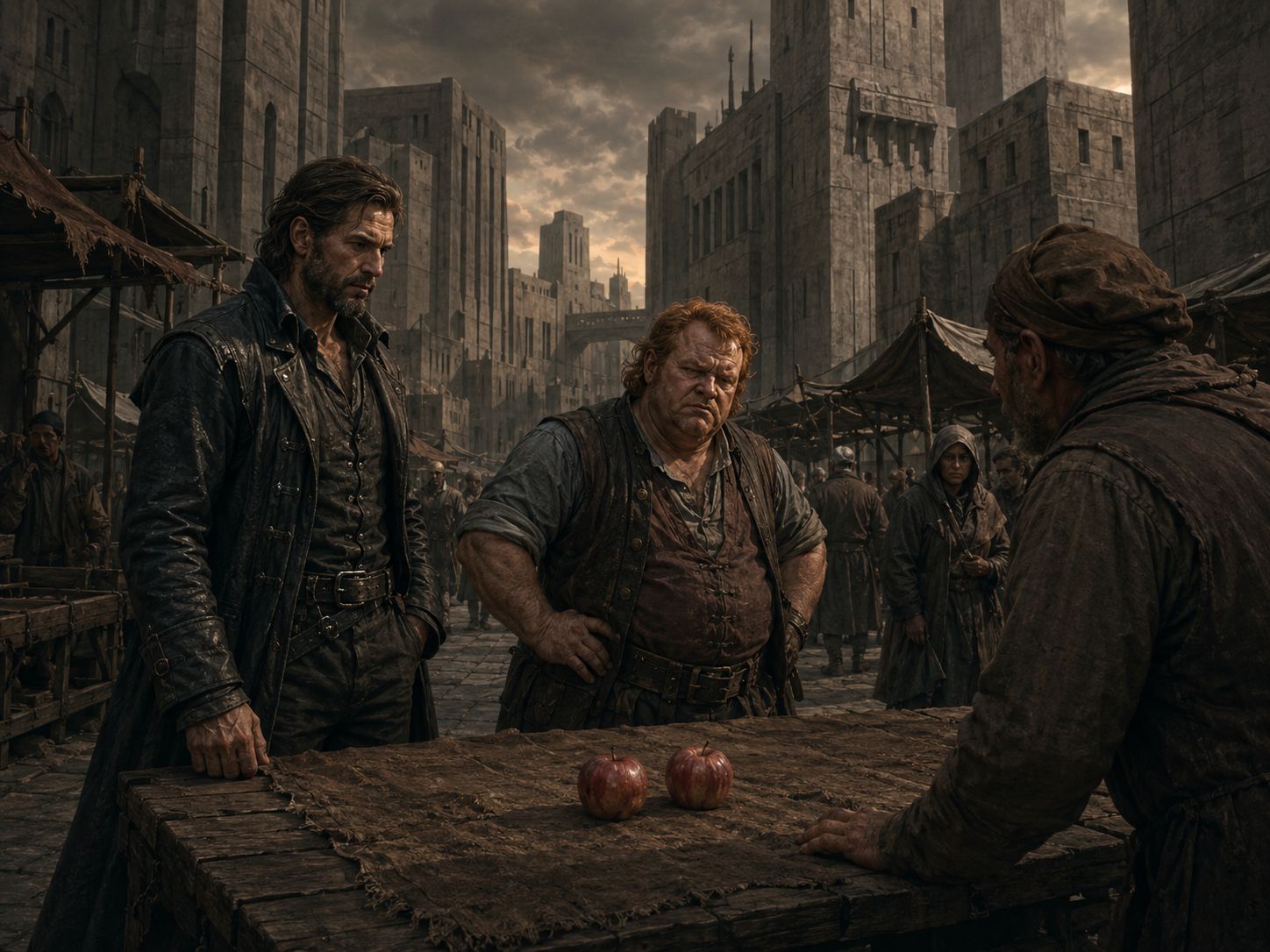
The Waverider entered the southern harbor beneath walls too large for human hands. The city rose in three rings of pale stone, each higher than the last, with a palace at the center like a mountain carved into obedience. Otto the Dwarf stood at the rail, chewing bread and glaring at the gate.
"Too big," he said.
Brannick looked down at him. "That is your expert conclusion?"
"Aye. Wasteful too. You could fit a tavern in the empty space above that arch."
Arven kept sketching. "Perhaps the builders were larger than us."
"Then they should have built smaller," Otto the Dwarf said. "Less walking."
Solonex did not answer. He was watching the harbor below. Ships waited before toll docks. Clerks argued with captains. Priests blessed voyages beside fishmongers and charm sellers. Guards stood beside ration carts while women with empty baskets waited in lines that did not move. When the warehouse doors opened, the crowd pressed forward without cheering. Hunger could be noisy. Relief could be noisy. This was neither. These people had learned how much sound was safe.
At the Titan Gate, a clerk inspected their papers, cargo, weapons, destination and crew. His pen paused when he saw Otto the Dwarf.
"Dwarf," the clerk said. "Owned, contracted or tolerated?"
"Fed. Barely," Otto the Dwarf replied.
"Crew," Solonex said. "His name is Otto the Dwarf. He is our carpenter."
"Ship’s property, then."
"No," Solonex said. "Crew. Write that."
The clerk wrote without looking amused. "Outer ring landing approved. Entry beyond the Second Wall requires council invitation. Public sale of cargo requires customs record. Public distribution of strategic goods requires council license."
Brannick frowned. "Strategic goods?"
"Grain, oil, salt, medicine, iron, timber, rope, coin in large quantity and anything else which may disturb market order."
Otto the Dwarf leaned toward Brannick. "Best not hand out rope. City might strangle itself."
The clerk did not smile.
In the outer ring, food sat guarded in markets while children watched from alleys. There were figs, smoked fish, wheat cakes, cheese and little pastries shaped like towers, all priced beyond the hands reaching for them in silence. A shrine to three sea gods stood at a corner, crowded with offerings from sailors asking for safe passage. Two steps away, a boy stared at barley loaves as if looking hard enough might pull one into his hands.
Brannick’s voice was low. "We have grain aboard."
"We do," Solonex said.
"Enough to spare."
"Not enough to feed the city."
"Enough to matter."
Solonex watched the boy glance from bread to guard to bread again. "That is sometimes enough to get people killed."
They were received in the outer council office after noon. Two old councilors asked about maps, cargo, toll exemptions and whether the Waverider could move valuables quietly. The third representative was younger, severe and almost plain in dress. His name was Alber Vannig. He listened more than he spoke.
No one asked about the ration lines.
At last Solonex said, "We carry lawful cargo. We are not here to move noble stores out of the city while the outer ring goes hungry."
The room cooled.
Alber smiled faintly. "And what would you recommend, Captain? Open the granaries? Let crowds decide policy by hunger?"
Brannick answered before Solonex could. "If the granaries are full and children are empty, someone has already decided policy by hunger."
One of the old councilors flushed. "You are a cook, are you not?"
"Yes," Brannick said. "Hunger is my expertise."
Otto the Dwarf opened one eye. "He is very good at feeding people. You seem to have mastered the other thing without help."
Alber’s smile faded only when Solonex spoke.
"I have seen ships die because captains protected the wrong stores," Solonex said. "They kept the silver dry while the water barrels cracked. They locked the biscuit room while the crew weakened. Then one morning they found they no longer had a crew. Only hungry men standing very close together."
"The city is not a ship," Alber said.
"No," Solonex replied. "A ship can sink quickly."
In the end, the council allowed the Waverider to sell part of its grain to the city, to be distributed through official channels. Outside, Brannick laughed once without humor.
"They will steal half of it."
"More than half," Arven said.
"Then why agree?" Otto the Dwarf asked.
Solonex looked toward the ration warehouse. "Because less than half is not nothing."
Near sunset, under the eyes of clerks, guards and hungry people, sacks were unloaded. Two carts went toward the poor sectors. A third remained inside.
"That one goes to the Second Wall," Brannick said.
"Yes," Solonex said.
"We could stop it."
"Not without blood."
Across the square, the boy from the market appeared with two smaller children. One of them waved.
A guard shoved him back with the butt of his spear, not hard enough to break bone, but hard enough to make him fall.
Brannick moved, but Solonex caught his sleeve.
The square had gone quiet. Not because the shove was shocking, but because everyone understood that the wrong reaction could make it worse.
Alber Vannig appeared at the edge of the crowd. Solonex wondered how long he had been watching.
"Captain Virellus," Alber said. "You make yourself difficult to ignore."
Solonex released Brannick.
"He is a child," Brannick said.
"He is hungry," Alber replied. "There are many hungry children. That is precisely the problem."
"And the answer is to shove them out of sight?"
Alber looked toward the ration carts. "No. The answer is to prevent hunger from becoming command."
For one moment, his eyes moved across the crowd, measuring not pity, but possibility.
"You should leave with the morning tide," he said.
"That was our intention," Solonex replied.
"Good. This city has enough hunger without importing foreign conscience."
The Waverider sailed at dawn.
Behind her, the Walled City of the Titans stood clean, ordered and unbreakable in the morning haze. Brannick watched it shrink behind them.
"We should have done more," he said.
"Yes," Solonex answered.
Brannick looked at him. "That is not an answer I enjoy."
"It is not one I enjoy giving."
Solonex watched the highest terrace of the palace, where one still figure stood above the city, watching the harbor.
"A starving city does not always fall when the hungry rise," he said. "Sometimes someone teaches the hungry to fear each other first."