Player Info - Waverider Story - Campaign - Author's Notes
Walled City of the Titans
Dictatorship and paranoia in an ancient city
| Story |
|---|
| The clerk did not look frightened. That was the first thing which made him frightening. |
| He sat behind a stone counter built for hands larger than his whole body, beneath an archway so tall that even the customs flags hanging from it looked small and ashamed. The hall behind him climbed upward into darkness, all straight lines, hard angles and stone blocks so vast that no mason alive could have moved them. Every sound echoed too long. Every footstep became an accusation. |
| "Name," the clerk said. |
| The sailor gave it. |
| "Ship?" |
| He gave that too. |
| "Nation?" |
| "Estoria." |
| The clerk’s pen stopped. Only for a moment, but everyone in the line noticed. Two soldiers by the gate shifted their spears. A woman behind the sailor quietly tucked a prayer charm back beneath her sleeve. |
| "Purpose?" |
| "Trade." |
| "Cargo?" |
| "Olive oil, sailcloth, copper fittings." |
| "Religious items?" |
| "Only charms. Sailors’ things." |
| "Non-human passengers or crew?" |
| "Yes, a dwarf." |
| "Foreign coin?" |
| "Some." |
| The clerk held out his hand. The sailor placed the purse on the counter. It was opened, counted and weighed. Each coin was examined as if it might contain a treasonous thought. Behind the counter, another official watched the sailor’s face rather than the silver. Not a guard. Not a clerk. Just a still man with soft eyes and no visible weapon. |
| The sailor looked away first. |
| "You will remain in the outer ring," the clerk said. "You will keep these papers visible. You will report changes of lodging before sunset. You will not enter the Second Wall. You will not discuss religion. You will not speak of council affairs. You will not approach military docks. You will not shelter fugitives, beggars, priests, non-humans, changelings, suspected changelings, masked persons, veiled persons or persons without proper papers. Your dwarf and any religious items do not leave the ship. If found ashore, they will be treated as contraband." |
| He stamped the document. |
| "Welcome to the Walled City of the Titans." |
| Outside, the harbor roared with trade. Inside the gate, no one spoke above a murmur. |
| High above them all, beyond the second wall, beyond the third, the palace of the vanished builders rose into the pale sky like a throne made for a god who had forgotten to die. |
Description
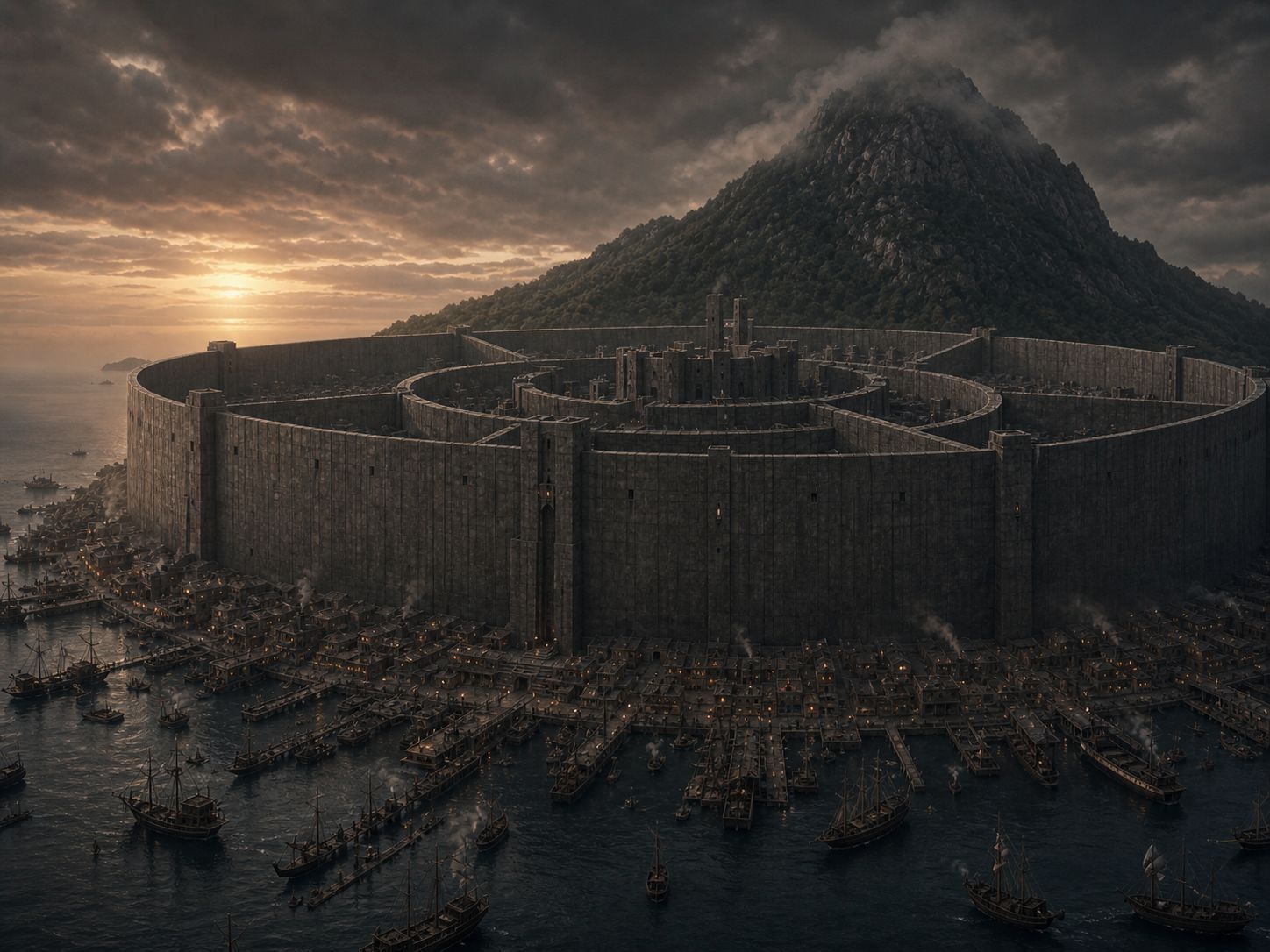
The Walled City of the Titans is an ancient island city in the Ladder Islands, set along one of the most important sea routes between the Great Empire and Morvelyn. Its harbor is small compared to the great trade ports of the world, but its position is nearly perfect. Ships passing through the Ladder Islands often had little choice but to pass near its galleys and toll towers. For centuries, that was enough to make the city wealthy.
The city itself is older than its current people by an unknown span of time. No one knows who built it. The popular name claims titans, but that is no more certain than any other theory. Scholars have argued for giants, cyclops, ogres, divine servants, pre-human kings and even a vanished race of philosopher-kings who built upward because they considered the earth beneath them unclean. None of these theories can be proven. The only certain fact is scale. The doors, stairs, halls, wells, arches and central palace were not built for humans.
There are no statues. No murals. No reliefs. No portraits. No carved faces looking down from lintels. The vanished builders left architecture, nothing else. This absence has made the city more unsettling than any ruin filled with idols. Its makers were enormous, disciplined, rich in stone and perhaps utterly hostile to images. Some scholars believe they had a religion which forbade representation. Others believe the city itself was the image, a sacred diagram drawn in walls, rings and height.
Today, humans live inside that diagram like rats nesting inside a dead war god’s armor.
The Walled City of the Titans was once ruled by an aristocratic council of twenty-one councilors, elected every twelve years by the noble houses. That system was corrupt, proud and oligarchic, but it was stable as long as tolls flowed. The plague in Morvelyn changed everything. Trade collapsed. The tolls dried up. The noble families retreated behind the inner walls with their wealth, while the common districts in the outer ring sank into poverty, rationing and anger.
One year ago, Councilor Alber Vannig staged a coup. He accused most of the council and many rebel leaders of being changelings in foreign service. They were executed in public, by fire, blade and hanging according to the accusation attached to each name. The remaining councilors submitted. Alber took the title Councilor Supreme and kept the machinery of the old republic around him as a dead mask.
The Walled City of the Titans is now a dictatorship of papers, informers, soldiers and fear. Its public enemy is the "changeling scourge." Its private reality is simpler. A changeling is anyone Alber needs removed.
This turns existing fear into state policy. Changelings are already a hidden people feared and hunted because the idea that a neighbor might not be who they seem terrifies common folk, while mentalists are distrusted because intrusion into thought is seen as a violation even rulers still find useful. Alber combines both fears into one machine. He hunts imaginary changelings with real changelings and uses hated mentalists to manufacture certainty where none exists.
Geography and Position
The Walled City of the Titans occupies most of a steep, rocky island in the Ladder Islands. The island has little fertile land, few beaches and only two natural harbors. The southern harbor is deep, defensible and crowded with toll docks, customs houses and shipyards. The northern harbor is smaller, colder and reserved almost entirely for the military fleet.
The island’s value is not soil but position. Ships moving between Imperial waters, Morvelyn, Freevalor, the northern coasts and the outer Ladder Islands often pass within reach of the city’s patrols. In earlier days, the fleet demanded tolls with bureaucratic precision. Pay, receive a sealed passage token and sail on. Refuse, and galleys shadowed the ship until hunger, wind or fear settled the matter.
The plague in Morvelyn damaged this system badly. Trade did not stop completely, but it thinned to a trickle. What remained became slower, riskier and less predictable. Merchants took longer routes. Some risked pirates instead. Some simply had nothing left to ship. The Walled City of the Titans had built its entire society around taxing movement, and when movement slowed, the city began to starve from the outside inward.
The city has always imported much of its food. That fact matters. The rich can store grain. Soldiers can be paid in ration rights. The poor cannot eat walls, no matter how grand those walls are.
The City of the Vanished Builders
The Walled City of the Titans is circular in plan, though not perfectly so. The outer wall follows the island’s natural ridges, enclosing harbor, lower city, warehouses, markets and the poorest residential sectors. Inside it rise two more rings of wall, each older, higher and stranger than the last.
The builders favored height, mass and severe geometry. The city is made of enormous pale-gray stone blocks fitted so tightly that even now a knife cannot slide between many of them. Streets climb by ramps as often as stairs. Doorways rise too tall. Windows are narrow, vertical and placed uncomfortably high. Human additions cling to the ancient bones: wooden balconies, rope lifts, patched stairways, stalls built into giant alcoves and whole neighborhoods squeezed into spaces that were once perhaps storage bays, guardrooms or ritual vestibules.
The architecture has almost no ornament. Even noble homes built into ancient structures retain the style by imitation: plain stone, straight lines, high ceilings and a deliberate lack of decoration. In the Walled City of the Titans, wealth is shown by location first, then polish, height, silence and empty space. A noble house with a room too large to heat is making a statement.
The Three Rings
The Outer Ring
The outer ring holds the docks, markets, warehouses, foreign quarter, naval supply yards and the crowded common districts. It is the only part of the city foreigners may legally enter. It is also the part most visibly ruined by Alber’s rule.
Many streets are partitioned into walled sectors. These were once administrative divisions, perhaps older than the human city itself. Under the old council, the sector gates were mostly used for fire control, tax counting and quarantine. Under Alber, they are tools of containment. A sector can be locked down in minutes. Food can be allowed in or withheld. Soldiers can search one block without alarming the next. A person can vanish behind a gate while the neighboring street continues selling fish.
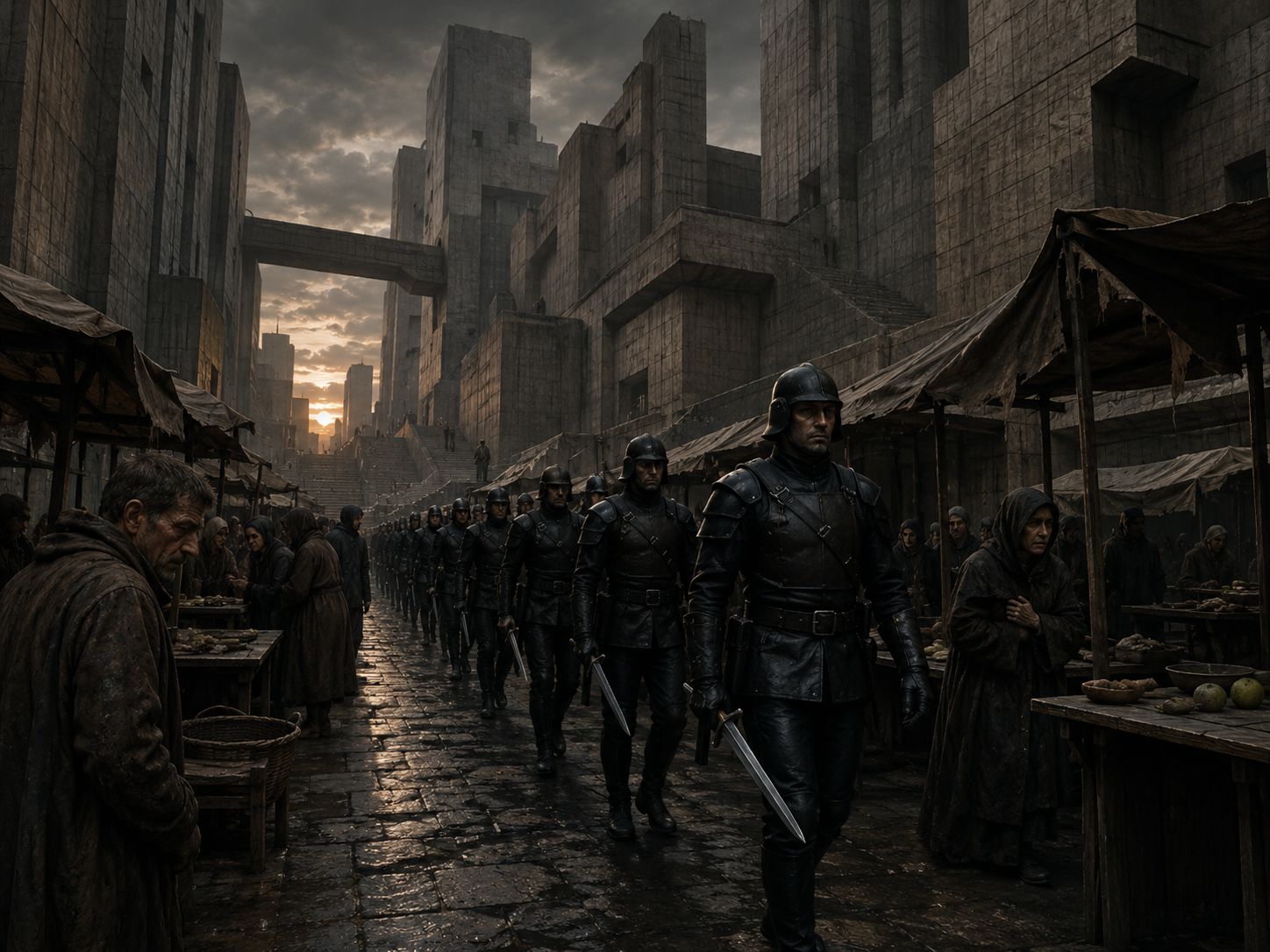
The outer ring smells of salt, smoke, tar, boiled cabbage and fear. Papers are checked constantly. Curfew bells matter. Notices appear overnight. Someone whose name is on the morning wall may not be alive by noon.
The Second Ring
The second ring belongs to wealthy merchants, lesser nobles, military administrators, high clerks and the families whose loyalty Alber still requires. It has cleaner streets, better water, private guards and food that still arrives fresh. The people here are frightened, but not yet desperate. They dislike Alber’s methods when used against them, but many were content enough when those same methods were confined to the outer ring.
The second ring is where the old republic still pretends to breathe. The surviving councilors attend ceremonies, issue decrees and sit beneath Alber in the Hall of Twenty-One Seats. Everyone knows they are puppets. Everyone also knows that puppets can still whisper.
Foreigners are forbidden here without special writs. Commoners from the outer ring may enter only for work, and must leave before the evening gate closure unless sponsored by a noble household.
The Inner Ring
The inner ring surrounds the palace-like central structure. This is Alber’s seat of power, though even he occupies only a fraction of the building. The old noble houses maintain compounds here, guarded, paranoid and increasingly resentful. Food stores are hidden in cellars. Private soldiers drill behind closed courtyards. Marriage alliances are negotiated like siege plans.
The inner ring is cleaner than the rest of the city, but less alive. It has too much space, too many locked doors and too few children in the streets. People speak softly, not because they are calm, but because echoes travel in the old stone.
The Palace Without a God
At the center of the city stands the great palace, though no one knows if it was truly a palace. It rises in stacked terraces, towers and vertical halls, severe and monumental. Its main entrance is too large for any human procession. Its central stairs are so high that wooden half-steps have been added to make them usable. Some upper galleries can only be reached by scaffolds, pulleys or ladders built by later generations.
There are no obvious temples in the Walled City of the Titans, which makes the palace even more important. It may have been a royal seat, a fortress, a ritual center, an observatory or the body of a dead religion expressed as architecture. Alber has made it his residence and seat of government.
The palace is the symbolic heart of Alber’s rule. He did not build it. He does not understand it. He cannot fully occupy it. Yet he stands in its shadow and claims authority from its scale.
History
The Age of the Builders
Nothing certain remains from the first age of the city. The vanished builders left no writing that humans can read, no statues, no bodies and no clear tools. Some sealed chambers contain stone basins, smooth platforms, vertical shafts and acoustic galleries where whispers travel impossible distances. Scholars have measured, argued and died without proving anything.
Human legends say the first settlers found the city empty. No siege marks. No mass graves. No signs of panic. Only an abandoned circular city, clean of its makers, waiting for smaller people to crawl inside.
The Toll Republic
The human city grew rich by mastering location. Its fleet was never the largest in the world, but it was disciplined, well supplied and backed by walls no raider could reasonably storm. The Council of Twenty-One ruled through law, tolls, contracts and noble monopoly. It was not kind, but it was predictable.
Noble houses bought votes, arranged marriages, controlled docks and treated the city’s wealth as a private inheritance. Commoners grumbled, but prosperity softened anger. A dockworker might hate the nobles while still eating well because ships kept coming.
The Morvelyn Plague
The plague in Morvelyn broke the city’s balance. The Walled City of the Titans had depended on Morvelyn’s trade, fear, evacuation traffic, medicine trade, funeral trade, desperate luxury trade and every form of commerce that moves through a dying land. When that movement collapsed or rerouted, the toll republic discovered that it had little else.
The council protected noble reserves first. Grain stores were "secured." Emergency taxes fell hardest on the outer ring. Harbor laborers were paid late, then in ration slips, then not at all. The poor began selling tools, furniture, heirlooms and eventually children.
The Sector Riots
Unrest began as hunger protest, then turned into riots. Sectors locked their gates against tax collectors. Dock crews refused toll duty. Some soldiers lowered their spears when they recognized cousins, creditors and former shipmates in the crowd. Rebel speakers called for grain audits, council reform and the opening of noble granaries.
This was the moment when the old republic could have changed. Instead, Alber acted.
The Changeling Coup
Councilor Alber Vannig claimed to have uncovered a foreign changeling conspiracy funded by Morvelyn remnants, Imperial agents, Freevalor agitators and pirate gold. The accusation was absurd in its breadth, but useful for that reason. Anyone could be included.
He moved first against the loudest rebels and the councilors most likely to negotiate with them. Arrests came before dawn. Trials were brief or nonexistent. The executions were brutal and public.
The charge of changeling infiltration worked because it did not need proof. In a world where changelings are already feared, doubt is enough. Alber understood that fear of impostors makes people distrust even their allies. A hungry crowd can become a rebellion. A suspicious crowd becomes isolated households peering through shutters.
Government
The Walled City of the Titans is officially still a council republic. The Council of Twenty-One still exists. Elections are still scheduled. Seals are still impressed. Decrees are still issued in the old formula.
In practice, all power belongs to Councilor Supreme Alber Vannig.
Alber rules through emergency authority, renewed every month by unanimous council vote. The councilors who remain understand the performance. They vote because they are watched. They sign because their families are inside the inner ring. They speak because silence would be interpreted.
The central institutions are the Supreme Chancery, the Office of Civic Purity, the Toll Fleet Command, the Sector Wardens and the Inner Grain Authority. All answer to Alber, though each competes for access, favor and silver.
- The Supreme Chancery writes law and propaganda.
- The Office of Civic Purity hunts dissidents, priests, suspected changelings and anyone Alber marks.
- The Toll Fleet Command controls the navy, toll patrols and slave raids.
- The Sector Wardens control gates, curfews, food lists and local informers.
- The Inner Grain Authority manages rationing, confiscation and storehouse records.
This is not a chaotic tyranny. It is organized, stamped, witnessed and filed.
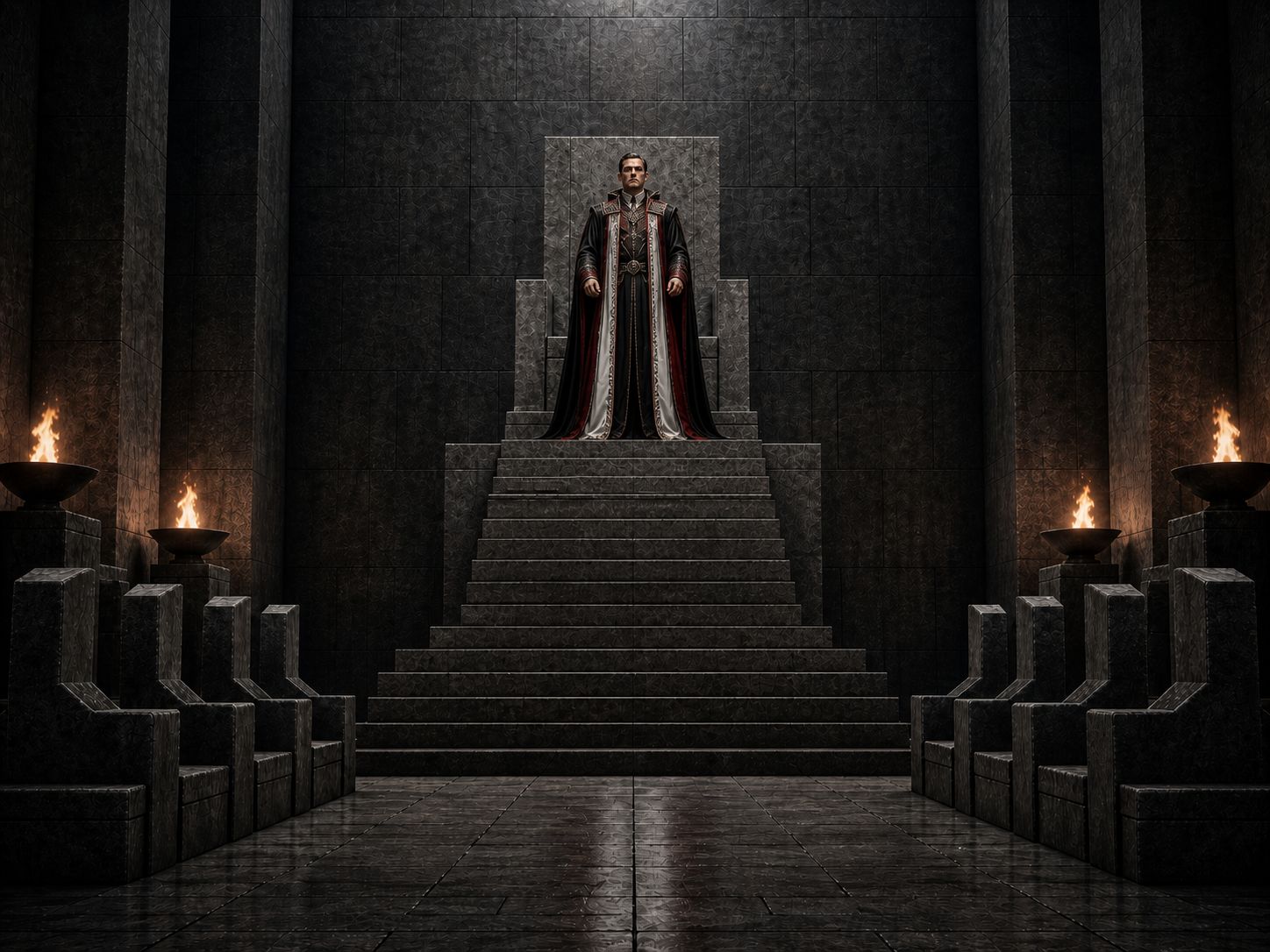
Councilor Supreme Alber Vannig
Alber Vannig was once a capable councilor from a middling noble house, not the richest, oldest or most respected. He built his career through committees, audits and naval finance, the kind of dull work ambitious nobles avoided until they needed it. That made him dangerous. He knew where the money was. He knew which officers were underpaid. He knew which grain contracts were fraudulent. He knew which councilors had secret debts.
He is not a madman in the frothing sense. He is worse than that. He is lucid, patient and convinced that fear is the only honest foundation of rule. Alber believes people obey ideals only when fed, law only when watched and gods only when frightened. Since the city can no longer feed everyone, he has chosen watching and fear.
He presents himself plainly. No crown. No divine costume yet. He wears severe black and iron-gray robes, carries no visible weapon and speaks in a measured voice. His title, Councilor Supreme, is deliberately bureaucratic. He wants dictatorship to sound like procedure.
He has three obsessions.
- He believes the old noble families will betray him if they can.
- He believes the common people are useful only while divided.
- He believes the vanished builders understood power in a way modern humans have forgotten, and that the architecture contains the key to their understanding.
The claim that he intends to declare himself a god may be rumor, but it is plausible rumor. Alber has outlawed religion, seized temples and moved into a palace that may itself have been sacred. Even if he does not believe in divinity, he may believe that other people need something absolute to fear.
Alber’s Inner Circle
Veyrn Klagst, Master of Civic Purity
Veyrn Klagst runs the Office of Civic Purity. He is narrow, pale, tireless and quietly delighted by procedure. He does not shout during interrogations. He corrects spelling on confession records. He is the sort of man who can ruin a family because a date on a travel paper does not match a dock ledger.
He believes in Alber completely, though not necessarily in Alber’s accusations. To Veyrn, truth is less important than obedience. A false confession still teaches the city what resistance costs.
Hedda Brasken, Admiral of the Toll Fleet
Hedda Brasken commands the fleet. She is one of the few people Alber cannot easily replace. Under the old republic, she collected tolls. Under Alber, she raids, blockades, hunts slaves and occasionally turns pirate when the target is weak enough and deniable enough.
She is practical, not ideological. Alber keeps her paid. She keeps the fleet loyal. Their alliance will last until one of those facts changes.
She still calls her ships toll cutters, never raiders. It is a small lie, but she maintains it with naval discipline.
Marn Holtzer, Voice of the Remaining Council
Marn Holtzer was once Alber’s rival. Now he is the public face of submission. He announces decrees, chairs council sessions and smiles with dead eyes while standing one step below the Councilor Supreme.
He may be broken. He may be waiting. No one knows.
Elsbet Graul, Mistress of Rations
Elsbet Graul controls food distribution. She is hated more directly than Alber by the outer ring because her clerks are the ones who reduce allotments, deny appeals and mark families for relocation. She tells herself numbers are cleaner than politics. This is a lie, but a useful one.
Rudrik Vaul, Captain of the Second Gate
Rudrik Vaul commands the gate between the outer and second ring. He rose from common soldier to officer during the coup, and Alber uses him as proof that loyal service can lift a man. Rudrik knows this is propaganda. He also knows his family eats because of it.
Anselm Rauk, Palace Surveyor
Anselm Rauk is an architect, scholar and prisoner in all but name. Alber uses him to explore the palace and interpret the builders’ structure. Anselm suspects the city’s layout is not merely defensive, but ritual or mathematical. He has begun hiding notes where the Office of Civic Purity cannot find them.
Changelings and the State Lie
The official claim is that changelings have infiltrated the Walled City of the Titans, replacing councilors, priests, dock officials, rebels and foreign merchants in order to weaken the city for conquest.
The truth is that Alber employs several changelings himself. Alber does not trust them, but he trusts leverage, and leverage works better on the hunted than on the safe.
They are not trusted. They are trapped. Some work for him because he holds their families. Some because he can expose them. Most because the Office of Civic Purity gave them a choice between service and fire. Alber uses them as infiltrators, false witnesses, decoys and convenient proof. If convenient, a changeling agent can pose as a rebel conspirator, be "unmasked" and die in public, confirming whatever story Alber needs confirmed.
The regime’s central lie is made functional by the very people it publicly exterminates. It is ugly, hypocritical and politically useful.
Known or suspected changeling agents include Yorrik Many-Wounds, who plays the role of rebel courier so often that some rebels believe he is real; Lena Vossk, who can imitate a dead council clerk well enough to forge old records; and The Pale Brother, whose true name is unknown even to Alber’s officers.
Mentalists in Alber’s Service
Mentalists are rare, feared and deeply useful to tyrants. In the Walled City of the Titans, they serve the Office of Civic Purity in controlled isolation. Officially, they are "truth auditors." Unofficially, they are weapons used to break resistance, test loyalty and create fear that even silence is unsafe.
This is especially effective because mentalists are already seen as violating something more intimate than flesh. The thought that a ruler might employ them in secret makes every private conversation dangerous.
The most important mentalist in Alber’s service is Othmar Seel. He is kept in comfortable confinement inside the second ring, escorted everywhere and forbidden casual contact. He is not cruel by temperament, but he is weak. He tells himself that his work prevents civil war. He knows this excuse grows thinner every month.
Another is Jaska Nerren, an illusion-weaver used during public trials. She can make a condemned prisoner’s face seem to ripple, sag or briefly become inhuman from the crowd’s perspective. The crowd does not know they are seeing illusion. They see proof.
Society
The Walled City of the Titans is divided by wall, ration and paper. Every wall gate is also a paper gate.
In the outer ring, daily life is a negotiation with bureaucracy. A citizen needs papers to move between sectors, papers to draw food, papers to work the docks, papers to host a traveler, papers to bury the dead and papers to explain why a family member missed labor duty. Losing papers can be worse than losing money. A person without documents becomes legally soft, easy to seize, question or erase.
The common people are hungry, angry and careful. They do not speak openly in taverns. They glance at hands, accents, scars and habits, searching for signs of informers or supposed changelings. Families teach children not to repeat what they hear at home. Neighbors disappear. Their rooms are emptied. Their names become dangerous to mention.
In the second ring, people live better but sleep worse. They know the system cannot last. They see the accounts. They see that the fleet cannot raid enough to replace trade, that the army cannot be fed forever by squeezing the poor and that noble wealth is being consumed rather than invested. They are not starving, but they are trapped in a machine they helped build.
In the inner ring, the noble families remain wealthy enough to plot. Their problem is courage. Any family that moves too early dies alone. Any family that waits too long may be devoured by Alber, famine or revolt.
The Noble Houses
House Grask
House Grask was minor before the coup, rich in neither ships nor old blood, but it supplied clerks, inspectors and ward captains when Alber needed loyal hands. Its members now fill offices once reserved for better names. The older houses call them jumped-up ink rats. House Grask calls that jealousy.
House Vannig
Alber’s house was once respectable but not dominant. Now its crest, a black tower over a white circle, is everywhere. Older nobles sneer privately that the Vannigs were accountants who mistook ledgers for bloodlines. They do not sneer in public.
House Krayl
An old naval house with deep ties to the toll fleet. Hedda Brasken is not of House Krayl, but many of her captains are. If the fleet turns on Alber, House Krayl will likely be involved.
House Dornholt
A grain and warehousing house. They profited from the crisis before Alber seized the emergency stores. They hate him, fear the poor and cannot decide which enemy matters more.
House Falkren
A scholarly house, historically tied to study of the ancient city. Their libraries contain records of sealed chambers, old collapses and forbidden surveys. Alber watches them closely.
House Mervask
The richest surviving merchant-noble house, with foreign contacts in Morvelyn, Freevalor and the Empire. Alber accuses them indirectly but has not moved against them yet, probably because he needs their networks.
The Common Districts
The outer ring is divided into old sectors, each with its own gate, watch office, ration hall and rumor ecology.
Harbor Sector is still busy, though thinner than before. Foreigners are watched here. Sailors drink here. Spies work here. Every tavern has at least one person secretly listening for the Office of Civic Purity.
Ropemakers’ Ward smells of tar and hemp. It has become a center of quiet resistance because naval workers understand exactly how dependent Alber is on the fleet.
Low Bell Sector is one of the poorest districts. Its bell rings for ration lines, curfew, searches and executions. Children here play games about hiding papers before soldiers come.
Ash Court was once a market square. Now it is used for public burnings of supposed changelings. The stones are blackened. People avoid crossing it unless forced.
Old Ramp is a steep district built along one of the builders’ giant access ramps. It is crowded with stacked wooden homes, illegal shrines and hidden passages between ancient wall voids.
The Salt Houses store fish, brine and bodies when executions outpace burial permissions. The smell never leaves.
Religion
Before Alber, the Walled City of the Titans was religiously permissive. Sailors prayed to sea gods, merchants to trade gods, nobles to household ancestors, refugees to whatever gods had followed them from home and scholars to abstract builder-spirits no one else understood. There was no single state faith, partly because the city had always depended on foreign trade. Anything went, as long as it did not interfere with tolls.
Alber has outlawed all religion.
His official argument is that religion provides cover for changeling codes, foreign loyalties and priestly conspiracies. Temples have been closed, shrines confiscated and public rites forbidden. Priests who submit may become "civic moral instructors," stripped of divine language and forced to preach obedience, hygiene and vigilance. Those who refuse disappear.
This is politically useful but spiritually dangerous. Denying the gods is not a mild philosophical position. Religion is woven through daily life, and the divine is not easily dismissed. The broader world treats gods as real presences in the world, not mere superstition, which means Alber may be provoking powers he does not understand.
Secret worship continues everywhere.
In the outer ring, people hide charms in floor cracks, whisper prayers into bread dough and scratch tiny symbols under ration bowls.
In the second ring, nobles maintain private chapels behind false walls.
In the fleet, sailors still make offerings before departure, but now they do so quickly, with one lookout posted for waves and another for informers.
A dangerous rumor claims Alber intends to declare himself the only lawful god of the city. A more informed version is that he will not use the word god at first. He will declare himself "Sole Civic Intercessor," the only permitted mediator between people, law, destiny and the silent will of the city. That feels more like Alber. Less theatrical. More chilling.
The Military
The Walled City of the Titans has two real military strengths: its fleet and its walls.
The army is not large enough to conquer abroad, but it is well paid, well fed and reliable for internal repression. Alber understands that hungry soldiers become rebels, so the army eats before the poor. This keeps order now and guarantees hatred later.
The city guard has been reorganized into sector companies. Their work is less crime prevention than population control. Gate duty, document checks, search sweeps, arrest support and crowd suppression define their lives.
The fleet is more dangerous. It was once a toll enforcement fleet, built for interception, inspection and intimidation. Its captains know the local waters intimately. Its ships are fast enough to catch merchants, disciplined enough to avoid most pirate traps and numerous enough to threaten smaller island communities.
Since the collapse of toll income, Alber has turned the fleet toward slave hunting and deniable piracy. Amazireth, Freevalor and Kai'ono are favored targets because raids against them can be justified as striking enemies, rebels or non-Imperial peoples who lack the immediate ability to retaliate against the walls. This creates useful friction with several existing powers. Freevalor already relies on irregular sea power and pirates against the Empire, while Kai'ono has deep hostility toward slavers and the Empire from past raids. Morvelyn is not a target for slave raids, due to a fear of the plague.
The fleet’s current cruelty is also its weakness. Sailors signed up to collect tolls, escort ships and earn prize money. Some are willing slavers. Some are not. A ship ordered to seize villagers from Kai'ono or raid Freevalor refugees may obey, but obedience is not the same as loyalty.
Foreigners and Law
Foreigners may enter only the outer ring. They must register ship, cargo, crew, cargo value, religion, weapons, lodging, contacts and intended departure. They receive stamped papers which must remain visible when challenged.
No non-humans may step ashore. This rule is absolute in public, though bribes and covert landings still happen. Ogres, elves, catlings, dwarves and anyone visibly not human are turned away, confined aboard ship or seized if found ashore.
Amazons are officially human, but treated as military contraband unless protected by foreign papers, and those papers are often declared irregular.
Weapons are restricted. Large arms require seals. Armor draws immediate attention. Hidden weapons are treated as proof of hostile intent, as are shields.
Foreign religious items are confiscated if taken ashore. Priests are not recognized as priests. Missionaries are treated as spies.
The most dangerous phrase in the city is "irregular papers." It can mean a missing stamp. It can mean execution.
Economy
The old economy rested on tolls, harbor fees, pilotage, warehousing, naval enforcement, repair work, financial services and controlled smuggling. The city did not need to produce much because it taxed passage.
That system is dying.
Alber’s new economy rests on confiscation, ration control, slave raids, emergency taxes, forced loans from nobles and military payment. This is not sustainable. It extracts wealth faster than it creates it. It keeps soldiers loyal by starving the city’s productive classes. It drives merchants away, which reduces tolls further, which requires more confiscation.
Some noble families have discovered that Alber has begun pledging future toll rights as security for military loans, selling tomorrow’s city to pay today’s guards. The phrase whispered in the second ring is "he is quarrying the foundation to raise the roof." In simpler terms, Alber is taking bricks from the foundation to build the penthouse.
Resistance
Resistance in the Walled City of the Titans is fragmented by design. Alber’s system makes trust dangerous. Any rebel cell may contain an informer, a changeling agent, a desperate relative or someone already touched by a mentalist. Captured rebels are tortured, not for confession, since guilt has already been decided, but for names, routes and habits.
Still, resistance remains.
The Bread Ledger is a network of ration clerks led by Marta Fennig, who secretly alters food records to keep marked families alive. They are not revolutionaries by temperament. Alber made arithmetic into treason, so they became traitors by counting honestly.
The Rope Cell is based among dockworkers and ropemakers. They sabotage naval readiness in tiny ways: a delayed coil, a weakened line, a misfiled supply order, a pilot given the wrong tide note. Their leader is Karst Breyger, a former toll sailor whose brother was executed as a changeling.
The Second Table is a loose group of lesser nobles who meet under the pretense of private dinners. They want Alber gone, but mostly to save their own class. They are useful, cowardly and dangerous.
The Hidden Altars are not one faction but many secret religious circles. Some want survival. Some want revenge. Some believe the gods will punish Alber if given the right sacrifice, sign or prophet.
The Ash Widows are women whose husbands, wives, children or siblings were executed in the coup. They carry messages through mourning customs, funeral cloth, laundry marks and food baskets. They are less cautious than other rebels because they have already lost too much.
Notable Places
The Titan Gate
The main harbor gate stands beneath an arch built for huge bodies. Human customs offices occupy the side chambers like parasites in a whale bone. Every foreigner entering the city passes through here.
The Hall of Twenty-One Seats
The old council chamber lies in the second ring. The seats are human-made, but the hall is not. The ceiling vanishes upward into shadow. Alber’s raised chair now stands behind the old speaker’s place, making the councilors turn their backs slightly to address him. It is a subtle humiliation.
Ash Court
The execution square for accused changelings. Burn marks, old hooks, black posts and official notice boards dominate the space. Mothers pull children past it quickly. Informers linger there as if enjoying the air.
The Third Gate
The gate into the inner ring. It is operated by counterweighted stone mechanisms few fully understands. It has never been breached. Alber trusts it more than any living soldier.
The Palace of the Vanished
The central structure. Alber’s residence, government heart and growing obsession. It is rumored that its lower chambers are now being explored for the first time, and that its upper halls remain partly unreachable. Its deepest doors may not have been opened since the builders vanished.
The Silent Market
A once-famous trade arcade now operating under heavy surveillance. Merchants still bargain, but quietly. Prices are written more often than spoken. Beggars are removed before foreign ships arrive.
The Salt Houses
Fish warehouses turned holding cells when needed. Prisoners kept here hear gulls, water and the scraping of salt barrels. The guards claim the salt reveals changelings. It does not.
The Tall Wells
Ancient shafts descending deep below the city, lined with smooth stone. Some still provide water. Others are sealed. Dropping a stone into certain wells produces no sound of impact.
Relations
The Great Empire
The Empire dislikes Alber, but tolerates him for now. In its stronger days, it might have forced the Walled City of the Titans into submission, blockaded its harbors or replaced Alber with a more convenient client. Those days are fading. Internal strife, mismanagement and competing crises have weakened the Empire’s reach, and the city’s walls make any direct intervention costly.
A brutal human dictatorship controlling a strategic island is unpleasant, but not necessarily worse than instability, piracy or Freevalor influence.
Imperial officials would prefer the Walled City of the Titans weak, dependent and predictable. Alber is none of those things, but he is also human, anti-religious, hostile to Freevalor and useful as a disruptive force in the Ladder Islands. For now, the Empire watches, bribes, threatens and waits for a cheaper opportunity. It does not need to love Alber to postpone dealing with him. They may secretly fund rivals, buy naval access or encourage Alber’s paranoia when useful.
The Empire is old and still dangerous, but its fleets do not rule the seas, which leaves room for a smaller naval power to matter.
Morvelyn
Morvelyn’s plague shattered the city’s economy, though not by intent. Refugees, plague ships, abandoned contracts and dead trade houses all left marks in the Walled City of the Titans.
Alber’s propaganda often names Morvelyn as a source of changeling infiltration because a ruined land makes a convenient shadow. In truth, Morvelyn likely has little strength to spare.
Freevalor
Freevalor sees the Walled City of the Titans as a slaver threat and possible Imperial proxy. Alber sees Freevalor as rebel contagion. The situation is likely to worsen. Freevalor’s pirate-linked naval networks may already be planning retaliation, especially if Walled City ships strike Freevalor-aligned coasts.
Amazireth
Amazireth hates the Walled City of the Titans for slave raids and will answer violently if it can catch a ship away from the walls. Alber underestimates them at his peril. Amazireth does not forgive humiliation.
Kai'ono
Kai'ono remembers slavers. Walled City raids make them enemies quickly. Because Kai'ono’s strength is dispersed across islands, Alber may think them easy prey. That is a mistake. Island peoples who know their waters can make a fleet bleed slowly.
Pirates
Pirates compete with the Walled City fleet but also do business with it. Some captains buy slaves, forged papers or passage tokens. Others hate Alber because his ships interfere with raiding routes. Pirate cities have a long habit of surviving because attacking one risks retaliation from many, which means Alber must choose carefully where he pushes.
Changelings
Changelings everywhere fear the Walled City of the Titans. The city’s propaganda may spread beyond its walls, inspiring copycat hunts elsewhere. At the same time, changelings trapped in Alber’s service may become tragic allies if someone can reach them.
Using the Walled City of the Titans in Play
The Walled City of the Titans works best as a pressure cooker. The walls should not merely be scenery. They should shape every decision. Getting in is easy enough if one is human, documented and obedient. Moving freely is hard. Getting someone out is harder. Starting a fight is foolish unless the goal is to die quickly or trigger something larger.
The mood is not "guards attack on sight." It is worse. The guard smiles, checks your paper, asks why one corner is damp, asks who signed this, asks why the ink is different, asks you to wait, asks another official to look, then asks why you are sweating.
The city should make players hide things they normally rely on. Non-human crew cannot come ashore openly. Priestly habits become dangerous. Casual jokes become risks. False names need supporting papers. Heroism must become careful, quiet and logistical.
The best conflicts are internal.
- Can the crew rescue someone without exposing a rebel network?
- Can they trust a changeling who works for Alber?
- Can they deal with nobles who oppose tyranny only because they are losing?
- Can they start a revolt knowing the fleet may shell the outer sectors?
- Can they get out before their own papers become a trap?
Possible Secrets
The No-Image Law Was Fear
There is no art because the builders feared images. Anything depicted could become real, possessed or remembered by something outside the world. Their strict architecture was a defense against imagination.
Alber Has Already Been Touched
Alber’s growing certainty, religious ambition and obsession with the palace may not be wholly his own. Something in the palace may be influencing him, not through command, but by rewarding his worst instincts.
The Mentalist Is Breaking
Othmar Seel has read too many prisoners and carries fragments of their terror, loyalty and rage. He may be near collapse. If he breaks, he could expose Alber, destroy innocent minds or project panic across an entire sector.
The Council Was Not Innocent
Some executed councilors were innocent of changeling conspiracy but guilty of worse things: famine profiteering, slave trading, murder or secret dealings with pirates. Alber’s coup was built on lies, but not all his victims were clean.
The Palace Was Never Sacred
For generations, scholars and nobles claimed the central structure was a palace, temple or divine seat because that made it feel meaningful. Anselm Rauk has found evidence that it may have been an administrative storehouse, census hall or transport hub. Alber’s grand symbolism may rest on a glorified warehouse.
The Council Helped Build the Coup
Several surviving councilors knew Alber was preparing emergency arrests and supported him, expecting him to crush the riots and then step aside. He did not. They are not merely cowards now, but failed conspirators trapped by the man they empowered.
The Fleet Is Running Its Own Slave Trade
Some captains are not simply obeying Alber. They are hiding captives, falsifying cargo, selling people privately and keeping profits off the official ledgers. Alber needs the fleet too badly to punish them openly.
Adventure Hooks
Papers for the Dead
A rebel contact asks the crew to smuggle identity papers into the outer ring. The papers belong to people already listed as dead, and that is the point. The dead can move more freely than the living if the right clerk looks away.
The False Changeling
A dockworker accused of being a changeling is actually human, but the rebel cell protecting him includes a real changeling who cannot risk exposure. Saving one innocent may doom another unless the crew finds a third path.
The Inner Ring Dinner
House Mervask invites the crew to a private dinner in the second ring, offering information about the Waverider or another campaign lead. The invitation is legal. The route is legal. The conversation is not.
The Toll Fleet Prize
A slave hunter ship lies in the military harbor, its human prisoners marked for sale and its non-human prisoners scheduled for disposal before inspection. The crew can attempt rescue, sabotage or negotiation, but foreigners are forbidden near the naval docks.
The Mentalist’s Apology
Othmar Seel secretly contacts the crew through a dream, apologizing for reading one of them during entry inspection. He claims he can help them, but only if they remove him from Alber’s service. This may be sincere. It may also be a trap planted in his own mind.
The Godless Procession
Alber announces a civic procession through Ash Court, displaying confiscated idols, priestly relics and supposed changeling corpses. Hidden worshippers plan to strike. The Office of Civic Purity knows enough to prepare a massacre, but not enough to stop it cleanly.
The Palace Surveyor’s Map
Anselm Rauk has hidden a partial map of the palace’s lower chambers. Alber wants it. The rebels want it. A noble house wants to sell it. The map may show a way through the walls, or something that should remain sealed.
The Fleet Does Not Sail
A squadron ordered to raid Freevalor refuses to leave harbor after sailors find prayer marks carved into their oars. Alber calls it sabotage. The sailors call it an omen. The crew is caught between mutiny, repression and a chance to cripple the fleet without open battle.
The Collapse Begins
Food riots erupt in three outer sectors at once. The gates close. Soldiers prepare to fire. Noble conspirators offer support if the crew helps remove Alber, but only after the mob has weakened him. The crew must decide whether they are aiding a revolution, a coup or merely the next version of the same cruelty.