Zanakwe
Power and blood in the jungle.
The crowd gathered at dawn in the Square of Fangs, where the white marble was already stained dark from older sacrifices. The air smelled of heat, feathers, and blood. At the center stood Mbalame’s Hand, the great hammer swaying slightly on its chains, its shadow like a predator crouched upon the anvil.
A slave knelt there now, bound with bronze chains, his eyes wide with terror. He had tried to run, they said, slipping into the jungle night. Caught and dragged back, his punishment was already chosen: the feet.
Priests in white feathers, streaked crimson from old cuts, circled the platform. One held a bowl carved from bone, chanting to Inzoka the Serpent. “Blood flows, wisdom coils. Accept this offering, open your mouth to drink.”
The king himself watched from a high dais, his bare chest gleaming in the sun, his vambrace barbs catching the light. His voice carried across the crowd. “Ngolo the Leopard demands strength. A slave who flees shows weakness. Let his blood teach us.”
At his gesture, the executioner released the chain. The hammer swung, slow at first, then faster, its weight humming through the air. It struck the slave’s bound feet with a loud clang, so loud that it almost, but not completely masked the sound of crushing bones. The man screamed once, then collapsed in shock, blood pouring across the anvil into the waiting bowl.
The priests raised the bowl high. The crowd roared, some in approval, others in fear. The hammer was hoisted back up by a dozen slaves, dripping red.
In the comfortable shadows of their balconies, the nobles chatted idly while sipping wine.
Children pointed and whispered that they could hear Mbalame laughing in the chains.
The next criminal was brought forward.
The Tale of Ngolo and Inzoka
Long before Zanakwe was stone and marble, before the first king raised the Pyramid of Fangs, the jungle belonged only to the spirits. Ngolo the Tiger was strongest of them all, a hunter whose roar shook the trees and whose claws split rivers. But Ngolo was restless. He ruled the jungle beasts, yet his throne was empty.
So he sought counsel from Inzoka the Serpent, who lay coiled in the roots of the world. Her eyes glowed like embers, and her tongue tasted every secret in the air.
“You are mighty, Ngolo,” she hissed, “but strength alone cannot bind the world. A throne must be built not from claws, but from blood.”
Ngolo snarled. “Blood is for the prey, not the hunter.”
But Inzoka only smiled. “Every hunter feeds. Even you. Take blood into your power, and the spirits will bend to you.”
So Ngolo hunted not beasts, but men. He slew the first of mortals with his claws, and their blood spilled into the earth. Inzoka drank it, and from that mingling rose the first sorcery. With each death, Ngolo’s roar grew stronger, and with each drop, Inzoka whispered deeper secrets.
Yet the other spirits feared them. Akeba the Parrot called them defilers, Kalundu the Crocodile swore to drown them, Chisabo the Scorpion raised her sting in anger. But none could defeat them, for Ngolo was strength and Inzoka was cunning.
Together they chose a mortal, a man of great courage, and poured their power into him. They crowned him the first king of Zanakwe. His throne was built of marble from Ngolo’s claws and sealed with Inzoka’s blood-runes.
Since that day, the kings of Zanakwe have ruled by tiger’s strength and serpent’s wisdom. The duel of kings is Ngolo’s trial. The blood magic is Inzoka’s gift. And all who live beneath the canopy are bound by their pact.
The priests end the tale with a chant:
“Strength in the claw, wisdom in the coil. Blood in the bowl, power in the throne.”
The Sting Beneath the Throne
In the days when the first kings still ruled, the nobles of Zanakwe grew proud. They dressed in feathers brighter than the sun, boasting of their strength and their bloodlines. Yet among them was envy, and envy grows teeth.
One noble, Lord Tembalo, desired the throne. But he knew he was not strong enough to defeat the king in the Leopard’s Trial. His body was soft, his arms weak. So he turned not to Ngolo, but to Chisabo the Scorpion, the spirit of secrets and poison.
Tembalo crept into the swamps at night, and there he whispered to the shadows. “Chisabo, teach me a way to win what I cannot by strength.”
The spirit came, small as a scorpion at first, but with eyes burning like coals. She crawled upon his arm, and her voice echoed in his bones.
“To claim what you cannot win, you must strike where no eyes see. Feed me blood, and I will give you venom.”
So Tembalo cut his hand and let the blood drip onto the ground. Chisabo drank, and her sting grew long and cruel. She showed him the path of poisons, how to dip his barbs in venom, how to whisper lies into ears, how to turn brother against brother.
When the Leopard’s Trial came, Tembalo challenged. He struck the king not with strength but with venom hidden on his vambrace. The king faltered, his blood boiling, and Tembalo crushed him. He rose, and for a season he sat the throne.
But Ngolo and Inzoka had seen. They whispered to Mwihla the Swarm, and Mwihla’s hunger fell upon Tembalo’s house. His children wasted away, his slaves rotted in their chains, his wife’s flesh blackened with stings unseen. In the end, Tembalo was dragged to Mbalame’s Hand, where the hammer fell upon his chest, and his blood was given to Inzoka to cleanse his treachery.
Since that time, the priests tell this tale at the Night of Whispers. Nobles are reminded that Chisabo still listens, still hungers, and still waits to whisper her venom into ambitious ears.
And the moral, always spoken last:
“Strength may win the throne, but deceit always stains it.”
Description
In the deepest jungles lies Zanakwe, the Crown of Blood, a mighty empire both feared and admired. Its capital, also named Zanakwe, is a wonder of the world: a white marble city rising above the choking green, its palaces and temples carved with the stories of spirits and kings. Gleaming walls dazzle travelers, cool fountains provides comfort in the palaces, but within them the empire’s heart beats in blood and slavery.
Zanakwe stands upon two unshakable pillars: slave labor and blood magic. Slaves, drawn from conquered peoples, endless raids and trade toil in fields, quarries, and workshops, while their blood, shed in sacrifice or punishment, fuels the empire’s sorcerers. Priests weave spells of strength, healing, and stormcalling from crimson offerings, their bowls forever brimming with what the spirits demand.
The Throne of the Tiger
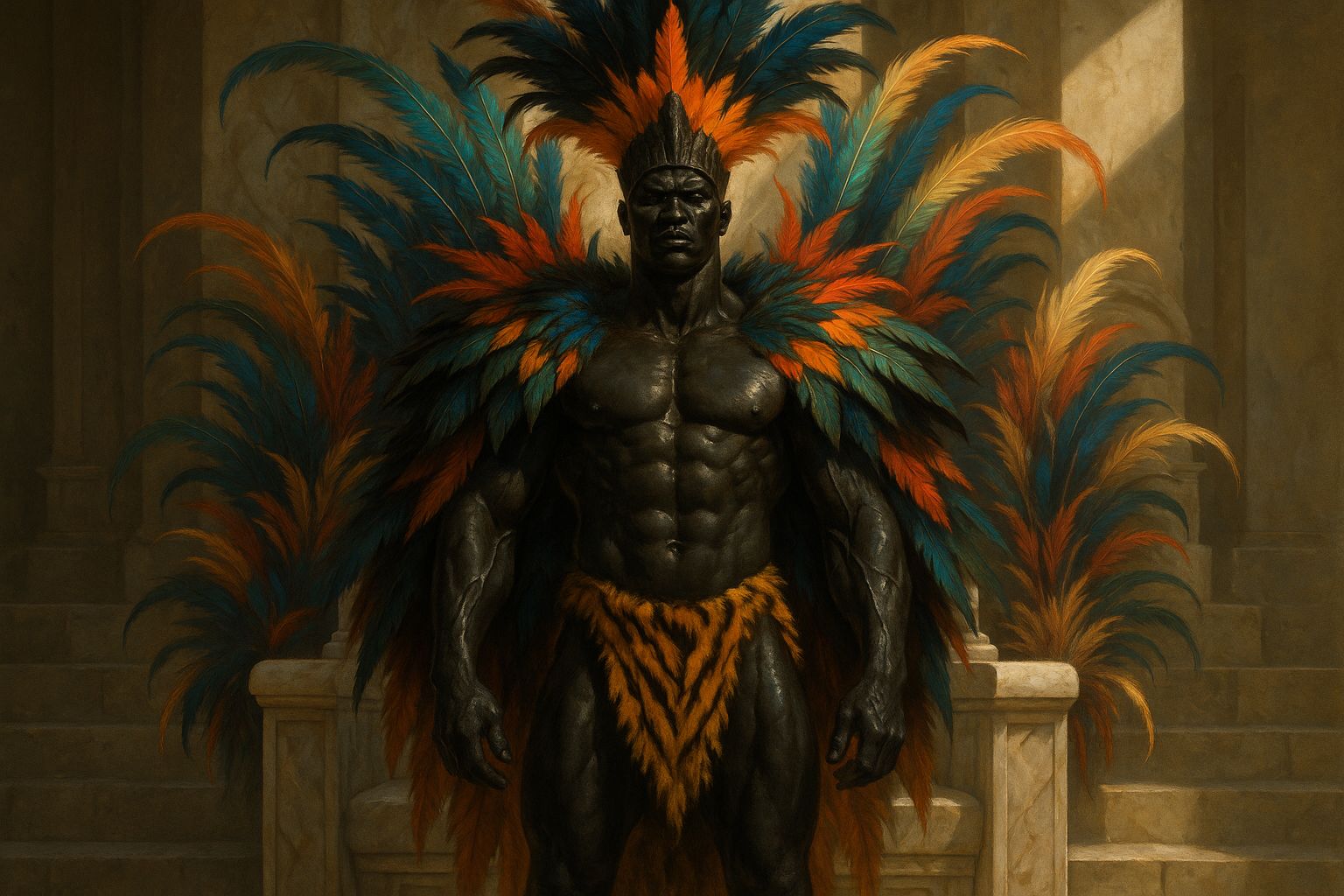
At Zanakwe’s core lies a tradition as brutal as it is sacred: every six years the king must defend his rule in a duel to the death. Only nobles may contend for the right to rule, and they are winnowed through a cycle of blood duels until a single challenger emerges. The weapons are always the same: a stone-headed club and a metal vambrace bristling with sharp barbs. The fights are savage, and the spirits are believed to watch closely. Victory crowns the survivor as ruler and spiritual leader, while defeat is brutal death.
The current king, Ngolo-Mwanga the Unbroken, has held the throne for thirty years, prevailing through five such duels. His survival is seen by many as proof that he is favored by Ngolo the Tiger himself. Others whisper darker things: that he drinks too deeply of blood, and that the spirits keep him alive for reasons of their own.
The Noble Houses
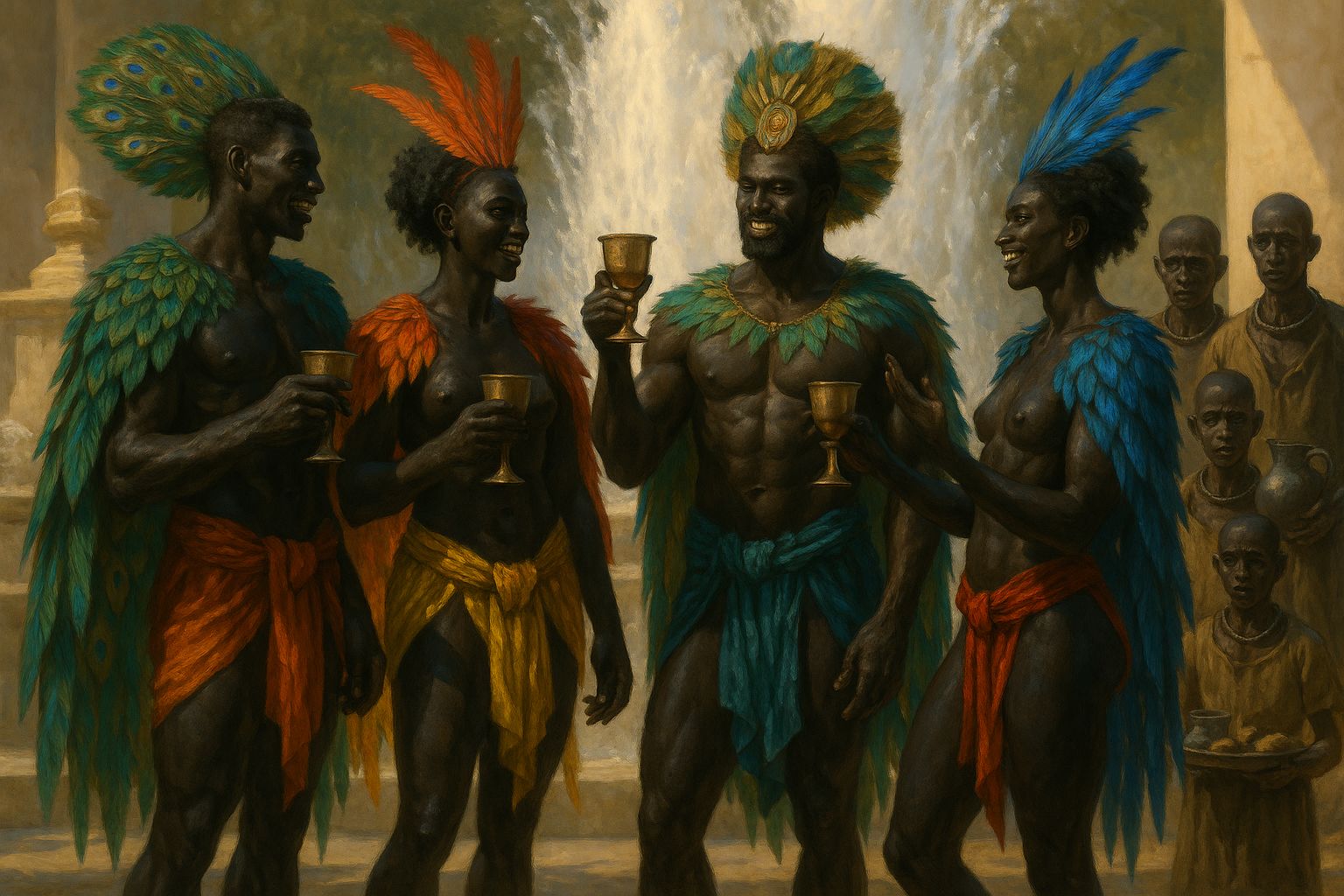
The nobles live in their marble palaces, marble from the White Teeth mountains, from the mining town of Tshanda. It's a pleasant life on the surface, cool fountains and pools, waited on by slaves, but beneath the surface, it's a dog eat dog world.
There is a constant shuffling for power, and intrigue and ritual duels are the way things are run. This happens between noble houses, but also within noble houses. It is believed that whoever wins a duel was right, and that a duel is a sure test of truth. That said, a knife in the back isn't uncommon either.
The nobles adorn themselves in brightly feathered garb, each family claiming descent from Akeba’s feathers, while the king himself embodies Ngolo. Each family has their own distinct patterns, somewhat like family crests. The clothes are minimal and revealing, both to accomodate the jungle climate and to show their well trained bodies, as a strong body is considered extremely important. Slaves, on the other hand, are only allowed rags, at most, and many slaves have no clothes at all.
The Hammer of Judgment
Law in Zanakwe is not merciful, but crushing. Punishment is carried out with Mbalame’s Hand, a massive iron hammer suspended on a scaffold above an iron anvil. The heavy hammer, weighing several times the weight of an adult man, and is suspended at a height of four men. Before each blow, priests chant to Inzoka the Serpent, calling the blood to strengthen the empire’s wards.
The condemned are laid upon the anvil, and the hammer is released. Its impact destroys body and spirit alike, while priests gather every drop of blood. The crime determines the body part struck: thieves lose their hands, runaway slaves their feet, deserters their legs, rapists and adulterers their pelvis, traitors their chest, nobles their head. Though some are meant to survive, most perish from shock and blood loss. Those who live are marked as Broken Ones, reminders of Zanakwe’s unbending order.
The people believe that Mbalame, the bone-crushing spirit of the elephant, hungers for these moments, and that every strike echoes his wrath across the jungle.
Religion: The Path of the Spirits
The empire’s faith is not in distant gods but in the living spirits of the jungle. The king is called the Spirit-Caller, chosen to speak for them all. There are many such spirits, but these are the most important:
- Ngolo the Tiger: Spirit of kingship, strength, and war. Patron of rulers and warriors.
- Mbalame the Elephant: Spirit of wisdom and terrible power. Patron of justice and punishment.
- Inzoka the Serpent: Spirit of patience, blood, and hidden wisdom. Patron of sorcerers and sacrifice.
- Akeba the Parrot: Spirit of beauty, voice, and noble blood. Patron of lineage and art.
- Kalundu the Crocodile: Spirit of rivers, endurance, and death. Patron of those drowned and the unyielding.
- Chisabo the Scorpion: Spirit of vengeance, poison, and treachery. Patron of assassins and oath-breakers.
- Mwihla the Swarm: Spirit of hunger, rot, and inevitability. Patron of endings.
The religion is not confined to temples, every hunt, every death, every sacrifice is a prayer.
Festivals of Blood and Spirit
The Leopard’s Trial
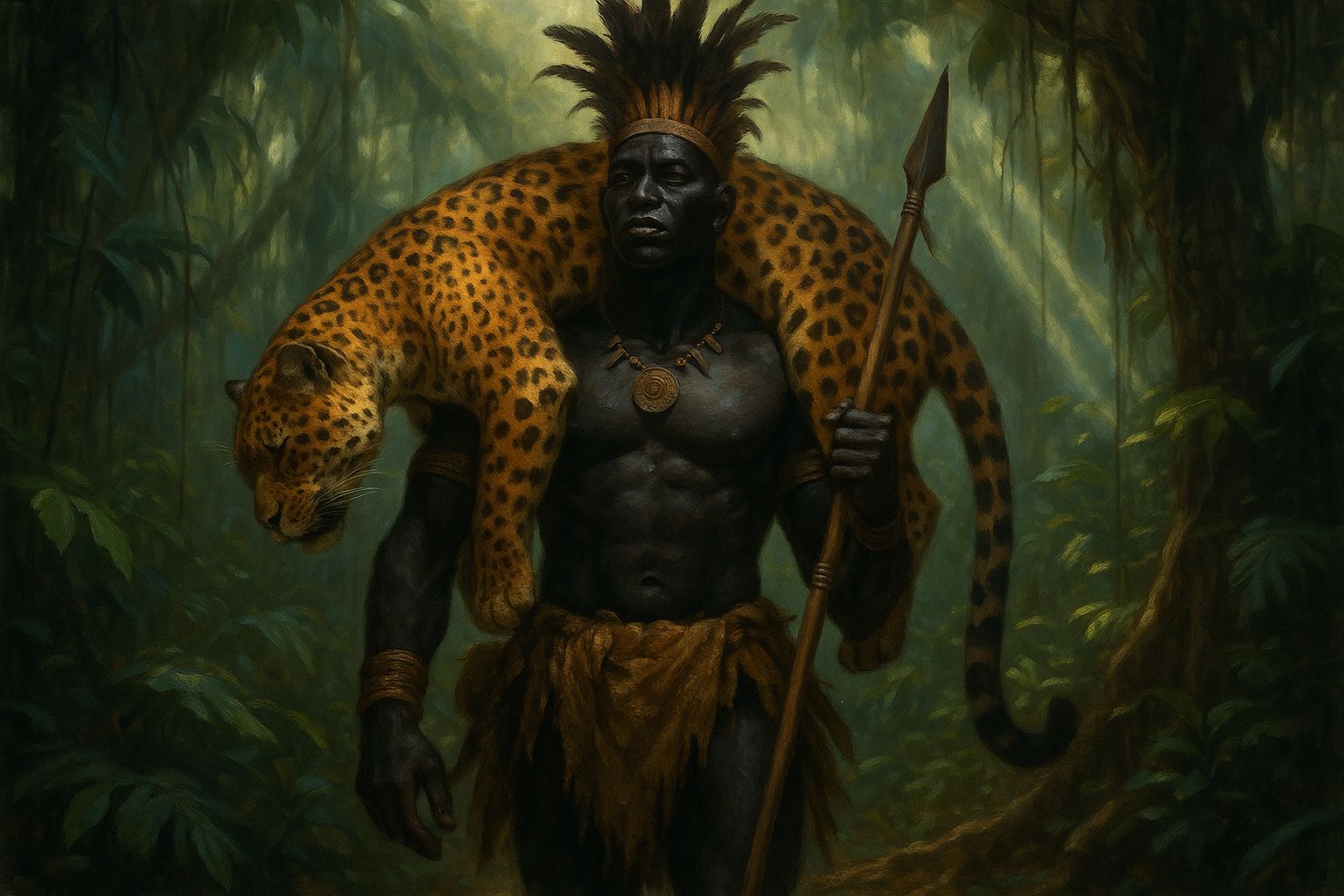
Held before the king’s duel, marked by ritual hunts, gladiatorial contests, and bloodletting to honor Ngolo.
The Crimson Flow
A yearly rite when slaves are sacrificed into the Ndale River, their blood turning the waters red to appease Kalundu the Crocodile and call the rains.
The Night of Whispers
Nobles bleed themselves into bowls and sleep, seeking dreams from Mwihla’s swarm-chants, which are said to foretell fate.
Blood Magic
In Zanakwe, blood is more than life, it is essence, strength, and spirit made liquid. Blood fuels sorcery, binds oaths, heals wounds, and curses enemies. The priests say it carries the breath of the spirits, and when spilled in the proper way, it can be bent to the will of man. No other form of magic is recognized in the empire. To shed blood is to call directly to the spirits.
In practical terms, blood magic works much the same as other magic, but it can only be fueled by blood. They can not use any other means to recharge mana.
Ritual Practices
The Bowl of Binding. Two nobles cut their palms into a shared bowl. Their pact, whether marriage or alliance, is sealed in blood, binding them before the spirits. Breaking such an oath invites Chisabo the Scorpion’s sting.
The Red Circle
A ritual in battle where soldiers spill their own blood into the ground, forming a ward to protect them. The blood burns with Inzoka’s coils, confusing the enemy.
The River’s Feast
Sacrifices are bled into the Ndale River. Kalundu the Crocodile drinks the offering, and in return the rains come.
The Whisper-Bowl
A priest bleeds into a gourd and drinks it mixed with herbs. Visions follow, believed to be voices of the spirits.
Blood Magic in War
Zanakwe’s armies are dreaded because their priests walk among them. Before battle, slaves are slaughtered and their blood painted across warriors’ bodies. This makes them fearless, as the blood is said to carry Ngolo’s roar. Arrows dipped in blood are believed to strike truer, while wounds sealed with noble blood close faster. Priests also curse enemies by flinging bowls of blood into their ranks, calling Mwihla the Swarm to rot their flesh.
The Sorcerer-Priests
Known as Izihlangu, “the Shielded,” these blood-mages are second only to the king. They dress in white feathers stained with crimson, and their bodies are covered with scar-lines from constant self-bloodletting. Each priest carries a staff tipped with bone, hollowed to hold blood that can be sprayed upon an altar or battlefield.
They are both feared and revered. Some are healers who save lives through blood-working, others are butchers who use blood to destroy. All live in service to the spirits, and all believe Zanakwe’s strength exists only because blood is offered without end.
Dangers of Blood Magic
Blood is power, but also hunger. If too much is drawn, the spirits themselves are said to stir and demand more. Rituals can backfire if the offering is insufficient, and Mwihla the Swarm may devour the mage from within. Many priests bear scars, not just from knives but from the unseen hand of spirits angered by their work.
Some whisper of the Scarlet Hollow, a hidden temple where forbidden rites are practiced. There, slaves are drained dry not in ritual but in cruelty, and the blood is pooled into vats to birth abominations. Its existense is denied, but the rumours persist.
Foreign Relations
The Zanakwe rarely ventures far beyond its jungle, preferring dominance through its magic and fearsome reputation. The Great Empire views them with suspicion but not hostility, preferring to trade exotic goods and slaves rather than wage a war across sea and jungle. In markets, their bright feathers, blood-crystals, and jungle spices are treasures sought after across the world.
Both empires despise each other. Zanakwe see the empire as flabby pigs, the Empire see Zanakwe as prancing peacocks.