Campaign: Lumekhet
Act Synopsis
Lumekhet is an arc of divine politics, sacred horror, and forced transition. The Blue Marlin arrives in a land where life and death are not abstractions but the organizing principle of the entire kingdom. The Sun rules life and the day, the Moon rules the dead and the night, and the priesthood around them turns that cosmic order into intrigue, fear, and power. The crew comes seeking the Waverider’s trail, but instead gets pulled into a struggle between the two divine rulers, forced to choose whether information is worth complicity, and whether rescue is worth the cost of making enemies of a whole sacred order. Lumekhet’s own structure makes this possible. The kingdom is built around divine hierarchy, priestly rivalry, and the belief that the Moon carries souls from death back toward birth, while the outside world touches it only lightly through rare ships and desert nomads.
The arc begins in Oshiren, then shifts into flight, concealment, and desert travel. By the end, the crew is no longer simply following a ship. They are carrying a fallen goddess, traveling with the Tazulmar into harsher lands, and moving toward Ssar'et under pressure from both pursuit and the deeper wrongness of the world beyond Lumekhet.
Arrival in Oshiren
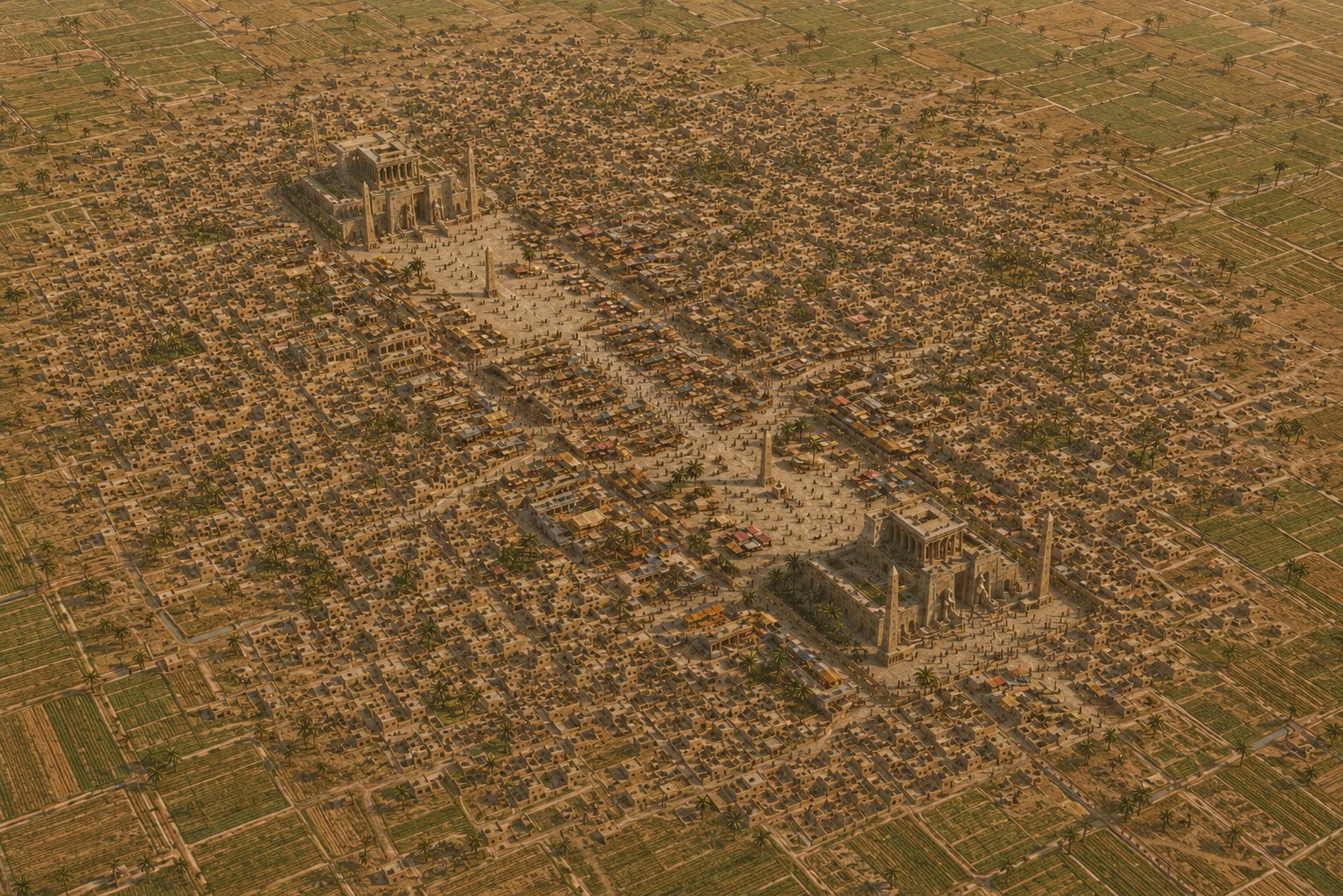
The Blue Marlin reaches Oshiren, a city shaped by sun-baked stone, sacred order, and the quiet pressure of priestly authority. The crew parts ways with Thaleia for a time, giving her room to follow her own curiosity through the city while they pursue the Waverider’s trail through more formal channels. What they quickly learn is that the Waverider crew was here, and that both divine rulers had dealings with them. That alone makes their inquiry dangerous. In Lumekhet, nothing touching the Sun or the Moon remains merely practical. Questions become political the moment they are asked. Oshiren should feel impressive, ritualized, and faintly oppressive, a place where even ordinary life exists under the gaze of cosmic hierarchy.
The crew manages to secure an audience with the Sun for the following day. Before that audience can happen, however, the city’s sacred balance shifts. A messenger arrives with a different summons, more urgent and more dangerous.
Remember that there is plenty of time for exploring the city between these audiences.
The Moon’s Private Summons
The crew is called into the presence of the Moon before they ever stand before the Sun. This should feel like being drawn behind the visible order of Lumekhet into the private machinery of divine rivalry. The Moon claims to know what they seek and admits that she knows they intend to speak with the Sun as well. She believes something is moving against her within the palace and priesthood, and she wants outsiders to serve as her eyes. In exchange, she offers the information the crew needs about the Waverider’s path onward.
This section establishes several things at once. First, the Moon is not a passive holy figure but a participant in Lumekhet’s political struggle. Second, the crew are already being used. Third, debt enters the story early. She is willing to trade real information for action, and once the crew accepts that bargain, they are no longer neutral observers. They are entangled.
The Audience With the Sun
The next day, the crew stands before the Sun. If the Moon’s court is private, shadowed, and inward, the Sun’s should feel formal, exposed, and absolute. The audience reveals that the Sun does not know the next step of the Waverider’s journey. What he does know is that the crew met the Moon, and that matters greatly to him. His questions circle that meeting more than the Waverider itself.
The point of this section is not simply to deny information. It is to confirm that the crew has stepped into a live conflict. The Sun should feel intelligent, controlled, and deeply alert to anything that might threaten his position. By the time the audience ends, the crew should understand that whatever tension exists between the Sun and the Moon is real, immediate, and dangerous to stand near.
The Moon Pays Her Debt
The crew returns to the Moon and gives their account. She judges what they learned, fills in what they do not understand, and finally gives them the information they came for. The next confirmed lead points toward Varr’thol in Ssar’et. This is the formal Waverider clue, the path that would normally send the crew onward by ship.
That clue matters, but it is not the only one.
Preparing for Departure
As the crew prepares to return to the Blue Marlin and depart, Thaleia reappears with a second discovery. In her usual way, she has followed a different trail, one based not on courts and divine audiences, but on curiosity, local contacts, and stubborn attention. She has found Tazulmar traders who can confirm that Kethra and Rahim separated from the main Waverider trail and traveled overland with them toward Ssar’et. They can confirm the route and add fragments of lived memory to it. This second lead is important because it creates the split between sea route and desert route, and because it draws the crew physically away from the ship at exactly the wrong time.
Arrest, Flight, and the Closing Net
The situation in Oshiren collapses fast. News spreads that the Moon has been arrested for conspiracy. Soon after, word follows that the crew, and Thaleia with them, are also wanted. The city is no longer a place to ask questions. It has become a trap. The Tazulmar, pragmatic and accustomed to surviving in lands that distrust them, offer disguises and temporary shelter.
At the same time, the crew realizes they are too late to simply retreat to the Blue Marlin and sail away. The ship has been forced to flee under pursuit. This should feel like a hard, visual loss rather than a convenient absence. Their home is still out there, still moving, but no longer within reach. Since the crew already knows the intended destination, the obvious assumption is that the Blue Marlin will try to make for Ssar’et by sea if she can. That leaves the crew stranded on land, hunted, and dependent on the Tazulmar if they want any hope of reunion.
The Moon’s Execution
During the days that follow, the crew learns the full shape of the Moon’s punishment. She is to die by the Sun. Chained in public without shade, she will be left to burn slowly beneath the sky, fed and watered only enough to prolong the process. She remains alive because her suffering is meant to be seen.
This is where Lumekhet’s cruelty becomes most specific. The execution is not merely political. It is cosmological theater, punishment in the language of the kingdom’s own sacred order. Since the Moon gave the crew what they needed, and since her fall follows so closely after their involvement, the sense of debt should become personal. She is no longer only a ruler or source of information. She is someone they may feel responsible for leaving to an obscene death.
Hiding in Oshiren and the Rescue
The middle of the arc is built around increasing pressure. The crew must remain hidden in a city hunting them while also deciding whether, and how, to save the Moon. The rescue is not meant to be a straight military operation. The guards are relatively few, because the regime assumes divine terror will do much of the work for them. The hard part lies elsewhere. Timing, concealment, physical weakness, moral pressure, and the risk of drawing the full force of priesthood and state down upon themselves all matter more than numbers.
If they do rescue her, they do not gain a grateful ally in any simple sense. They gain the Moon herself, fallen from absolute power into helplessness, entitlement, fury, and dependence. That is where her real story begins. She joins the journey not by asking, but by assuming there is no world in which she would not be taken along. That should feel entirely natural to her, and deeply aggravating to everyone else.
Departure With the Tazulmar
Once the city section breaks, the arc shifts into motion. The Tazulmar agree to take the crew overland toward Ssar’et, but not instantly. They need time to finish trade, restock, and prepare. That delay gives the Oshiren material room to breathe, and it ties the escape to the rhythms of caravan life rather than the crew’s urgency alone.
The Tazulmar are not just transport. They are a mobile society whose authority is familial, whose Shar’zul are treated as kin rather than beasts, and whose way of life stands in strong contrast to Lumekhet’s fixed sacred order. Traveling with them turns the second half of the arc into more than transit. It becomes a cultural shift, a movement from palace intrigue into desert endurance, trade, oral tradition, and the vulnerable intimacy of shared travel.
Thaleia joins the caravan as well, no longer just a temporary interruption but an active part of the route onward.
The Moon in Exile
As the caravan moves away from Lumekhet, the Moon becomes a constant source of friction. She has spent her entire life being served and does not yet understand how to live any other way. She makes demands, assumes obedience, and treats every practical discomfort as a personal insult from reality itself. At the same time, the journey begins exposing the truth beneath that behavior. Outside the palace she is not merely arrogant. She is catastrophically unequipped for ordinary life.
At this stage, the point is not what she can contribute, but what begins to crack. Its job is to make her legible. Her old self remains intact in voice and reflex, but small cracks begin to show. Frustration, helplessness, dependence, and the first awkward experiences of genuine kindness start the long process of dismantling her divine identity. Lumekhet may be behind her physically, but she continues carrying that world inside herself.
The Stranger in the Caravan
Partway into the journey, another traveler, Isetnefer, joins the Tazulmar. She is charming, composed, and unusually easy to listen to. She claims to be traveling toward Ashaket and proves helpful in small ways, especially in explaining customs, smoothing over moments of tension, or speaking with an authority that does not quite match her position.
She is a Hollow.
That truth should remain hidden until after it matters. The point is not to present her as an obvious threat, but to let unease accumulate around her. She knows slightly too much. People listen to her too readily. One young man becomes particularly fascinated by her. Then one morning they are both gone, and do not return. Only afterward does the shape of the danger become clear. This ties directly into Lumekhet’s cosmology, where Hollows are one of the great failures of the cycle of life and death, rare but terrifying signs that the sacred order can break.
Desert Pressure and the Attack
For much of the route, the trip remains tense but manageable. Close calls, the need to remain incognito, the Moon’s recognizable face, and the caravan’s need to stop for trade in towns and villages keep the journey under constant pressure. The caravan endures heat, distance, and the strain of carrying both fugitives and wounded pride through hostile country. The first major open violence comes just before the deep desert, when forces loyal to the Sun catch up and attack.
The assault should feel like a final reach of Lumekhet’s hand. It is not a full war party so much as a determined strike meant to finish what the city began. The caravan survives, but not cleanly. One of the three Shar’zul is killed, and the loss must land as grief, not logistics. For the Tazulmar, this is the death of a companion, protector, and home all in one. During the fight, Thaleia proves her worth by stopping a panicked Shar’zul from bolting, earning respect that intellect alone could never have bought her.
End State
The act ends not in triumph but in diminished survival. The crew has escaped Oshiren, carried the Moon out of public death, lost the Blue Marlin for now, tied themselves to the Tazulmar route, and taken their first real steps into the harsher desert world beyond Lumekhet. They now head toward Ssar’et under strain, one Shar’zul short, with the Moon in tow, Thaleia more deeply attached to the journey, and the knowledge that the Waverider’s path has truly split.
Lumekhet should leave the players with a few clear impressions. The kingdom is beautiful, sacred, and rotten with priestly intrigue. Its theology gives shape to both wonder and horror. The crew gained the information they needed, but only by becoming part of the conflict. Most importantly, they leave not just with a destination, but with a person whose fall from divinity has only just begun.
Ivy and the Spirit World
If Ivy enters the spirit world during the day in Lumekhet, she sees only the spirits of the living.
If she enters it during the night, she sees the spirits of the dead drifting from west to east, following the sacred path of the dead through Lumekhet’s cycle.
If she enters the spirit world to look at Isetnefer, she sees nothing at all. No spirit, no aura, no presence. It is as if Isetnefer is simply not there.
Meyrha's Vision
Morning had only just begun to lift the gray from the sea, and the mouth of the Kenu river was visible when Meyrha came up on deck.
She moved carefully, one hand on the rail, as if the ship’s planks were less steady than usual. Her blue veil was tied, but badly. Her face looked drained and tight with the aftermath of a night that had offered her no rest. Meyrha’s visions come unbidden and leave visible strain, and her sleep is rarely undisturbed even when nothing is wrong.
She found Scarnax near the stern, watching the morning water with the stillness he wore when he was thinking too much.
"I saw something," she said.
That was enough to make him turn fully toward her.
Meyrha pressed her fingers briefly to her temple, searching for pieces she could still hold.
"Not clearly. It came apart too fast." Her voice was thin at the edges. "But I remember light chasing darkness. Burning it. And the darkness needed help."
Scarnax frowned.
Meyrha looked out over the sea, but not as if she were seeing the sea.
"And I remember emptiness," she said. "Not darkness. Emptiness. That means danger. We must not be drawn into it."
For a few breaths Scarnax said nothing. Then he gave the small, tired half smile of a man who had learned what prophecy was worth.
"I expect it will make perfect sense when it is too late."
Meyrha nodded once. She looked neither offended nor surprised.
"Yes," she said. "Visions often do."
Meyrha’s vision is fragmentary, but its meaning is straightforward in hindsight.
The light chasing and burning the darkness refers to Ka-Ra moving against Ka-Iah. The darkness in need of help is the Moon.
The emptiness is something else entirely, and should be treated as a separate warning. It points toward the Hollow and means danger. The important thing is that the vision does not explain itself clearly at the time. It only becomes legible once events have already begun to unfold.
Arrival in Oshiren
Oshiren rose from the riverbelt in sun baked layers of ochre stone and pale plaster, all straight walls, carved lintels and banners that hung heavy in the heat. The streets below the harbor gate were already crowded, not with the rough chaos of Estoria or the swagger of pirate ports, but with a more orderly kind of bustle. Scribes sat beneath painted awnings with reed pens and neat stacks of scrolls. Priests in white and gold moved through the press like they owned not just the road but the air above it. Vendors called out over baskets of figs, flatbread, onions, dyed cloth and strings of beads shaped like crescents and sun discs. Incense drifted from shrine niches cut into almost every wall, and somewhere farther in, temple bells marked the passing hour with calm, unquestioned authority.
Thaleia Myrinos turned in a slow circle just inside the gate, already half lost to whatever patterns only she could see. Her braid was coming loose, her satchel rattled with vials and folded notes, and her eyes had the dangerous brightness they always got when the world offered her something new.
"Well," she said, almost to herself. "They were not exaggerating."
Then she looked back at Nasheem and Ayesha with sudden sincerity.
"Thank you. Truly. The ride, the tolerance, and the repeated interventions on behalf of my continued survival."
Her attention was already drifting past them, deeper into the city.
"I have heard very interesting things about the Tazulmar. Their beasts alone would justify a month of work, and I am told they bring dried specimens from the deep desert that no one here can properly name. I think I will continue on my own from here."
Nasheem smiled and offered her his hand.
"Then I hope our paths cross again, scholar."
She took it with a quick, ink stained grip and returned the smile in distracted miniature.
"So do I. You have all been unreasonably useful."
She looked between them one last time.
"Thank you for the passage."
Then she hitched her case higher on her shoulder and hurried off into the crowd with the heedless speed of a woman who had already stopped thinking about streets, thieves or consequences.
Ayesha watched her vanish between a funeral litter painted with silver crescents and a file of temple servants carrying baskets of flowers.
"She will either discover something valuable," she said, "or have to be dragged out of a sacred pit by sunset."
Nasheem let out a soft laugh.
"Then let us hope for the valuable thing first."
They moved on into the city together, letting the current of Oshiren carry them inward. The streets narrowed and widened without warning, opening from busy market lanes into little courtyards where water trickled through stone channels and children played beneath painted eyes of the Sun. Everywhere there was order, but not ease. The people bowed quickly when priests passed. Guards stood in pairs at intersections, not aggressive, but always watching. Even the shade felt supervised.
They had not gone much farther when a young man in temple white came weaving through the crowd with the focused urgency of someone carrying someone else's authority. He stopped before them, bowed shallowly and fixed his eyes on them only long enough to confirm that he had the right foreigners.
"You are expected," he said. "At noon tomorrow, you will attend upon the Sun in his palace. Present yourselves at the eastern court gate. Do not be late."
Nasheem inclined his head as if palace summonses found him every week.
"We will be there."
The messenger bowed once, then vanished back into the human flow with the same speed he had arrived. Nasheem watched him go, then turned to the others with the faintest trace of amusement.
"Well. That was easy."
Ayesha did not slow. Her gaze remained on the avenue ahead, where the white upper walls of the palace caught the sun so harshly that they almost hurt to look at.
"No," she said, calm and precise. "It never is."
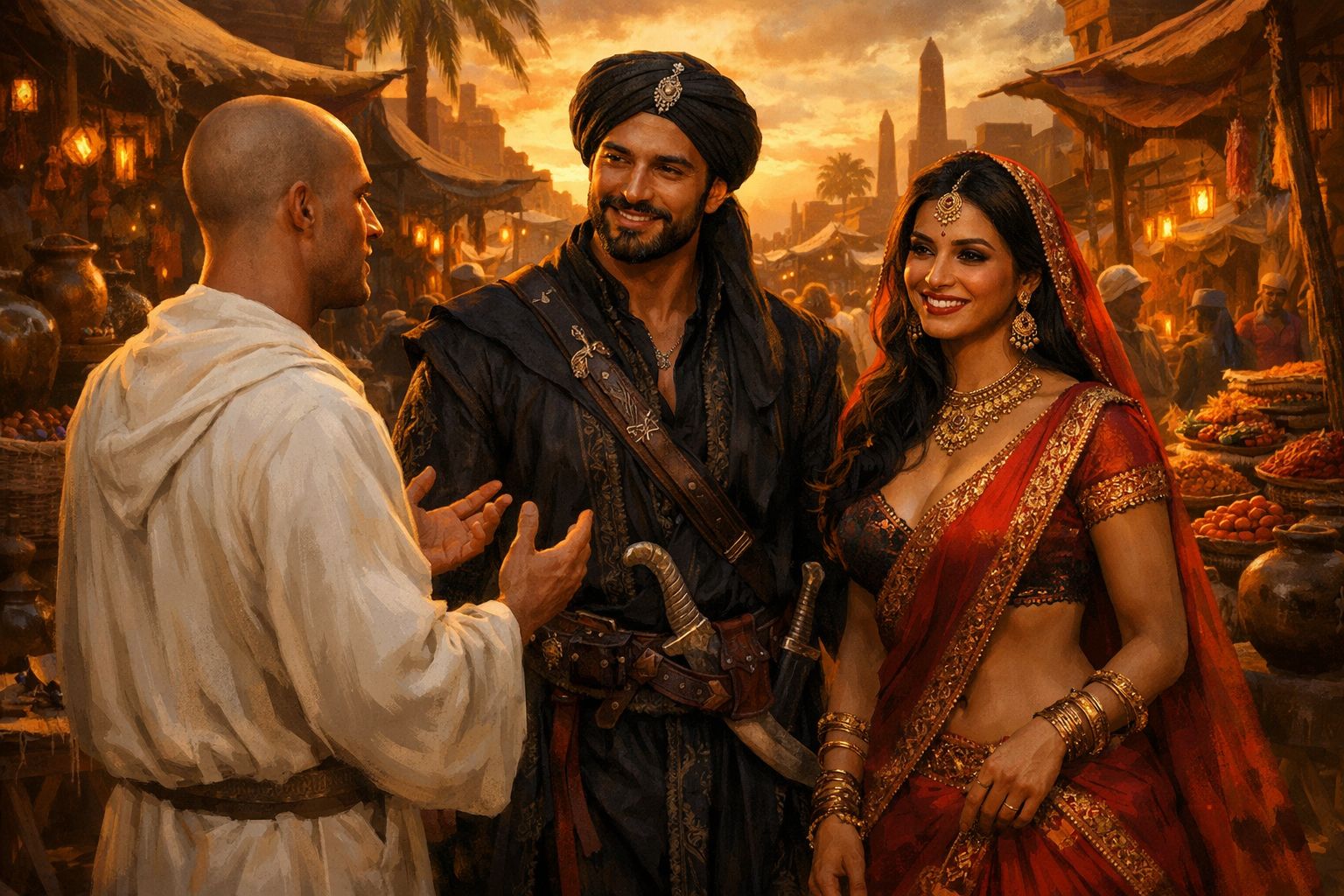
This scene introduces Lumekhet through first impression. Oshiren should immediately feel distinct from earlier ports. It is busy, wealthy and impressive, but also rigid, ceremonial and faintly oppressive. The goal is to let the players feel that they have entered a city where religion is not background color. It is the structure everything else is built around.
This scene also performs two practical tasks. It sends Thaleia onto her own track in a natural way and places the crew on the path toward the Sun’s court almost at once.
The Mood of Oshiren
Oshiren should feel alive, but not loose. This is not a chaotic trade port or a rough sailor town. It is a sacred capital where even crowded public life moves within an understood order.
Use concrete details.
The streets are broad in some places and narrow in others, paved in worn stone and lined with ochre walls, pale plaster and carved reliefs painted in faded reds, blues and golds. The sun reflects hard off bright surfaces, making the city feel hot, exposed and watchful.
Markets are busy, but measured. Vendors sell bread stamped with solar symbols, strings of beads shaped like crescents and scarabs, dyed linen, dates, figs, oils and funerary offerings. Scribes sit beneath awnings, writing letters and contracts for those who can pay.
Shrines are built into walls all across the city. Small bowls of oil burn in them. Flowers dry in the heat. People touch forehead or chest as they pass, often without even slowing down.
Priests and temple servants are visible everywhere. When they pass, people make space automatically. No one stops and stares. No one mutters. The movement is practiced and instinctive.
Guards stand at intersections, gates and temple approaches. They are not swaggering enforcers. They are calm, disciplined and always watching.
The emotional tone should be clear. Oshiren is beautiful, but not comfortable. It is orderly in a way that makes outsiders feel observed.
How to Signal the City’s Character
The city should not yet feel openly threatening. It should feel structured enough that the players know they are missing rules everyone else understands.
- A merchant lowers his voice when temple attendants pass.
- A child is pulled gently out of the path of a priestly procession.
- A porter carrying something heavy steps aside into the heat rather than force sacred personnel to change course.
- The auctions at the slave market are quiet and ordered. Instead of shouting bids, small gestures are used.
- A joke dies halfway to being told.
These details tell the players that power here is everywhere, and ordinary people live in constant awareness of it.
Use sound and smell. Sandals on stone. Distant bells. Murmured prayers. Incense. Hot dust. Bread. Perfume oils. River damp. A faint trace of embalming resin drifting from districts tied to sacred death.
Thaleia Leaves
Thaleia parts ways with the crew shortly after they enter the city. She is thankful for the ride and says she intends to continue on her own. She has heard interesting things about the Tazulmar and wants to follow that lead.
Keep this brief in play unless the table lingers on it. Its purpose is to send her onto a separate track in a way that feels natural and in character. It also makes clear that she is not joining the crew at this stage, even if circumstances will soon pull her back into the story.
Asking Around in Oshiren
If the crew asks around in the harbor, markets, taverns or among traders, temple servants and scribes, they quickly confirm that the Waverider was here. It was too large, too strange and too impressive to be forgotten easily. Sailors remember the size of her. Dockworkers remember the labor of handling her. Merchants remember foreign crew with coin and questions. A few people even remember that the ship drew attention from high places, which in Oshiren is never an innocent thing.
What they do not get is a destination. No one in the harbor knows where the Waverider went next. The answers become vague the moment the crew pushes past recognition. People shrug, guess or repeat hearsay, but nothing solid emerges. This should make it clear that the Waverider’s presence was known, but her departure was not public knowledge. If the crew wants the trail onward, ordinary town gossip will not be enough.
The Summons
Soon after entering the city, the crew is approached by a formal messenger. He informs them that they are expected to attend an audience with the Sun at noon tomorrow at the palace.
This should feel efficient and slightly unsettling. The crew has only just arrived, and already the machinery of the city has noticed them.
Do not make the messenger conversational. He is there to deliver expectation, not invitation.
What the Summons Means
On the surface, this is progress. The crew has barely begun pulling on the thread, and already the city answers back.
Underneath that, it should feel a little too easy.
The players should begin to understand that asking questions here is not a neutral act. They are already visible. Someone is already paying attention.
You can reinforce this through minor reactions around them. Nearby people glance over, then look away. A shopkeeper grows suddenly more polite. A servant pauses just a little too long before moving on.
Do not overplay this. The city should feel aware, not yet hostile.
How to Run the Scene
Keep the structure clean.
- First, establish the harbor edge of Oshiren and let Thaleia break away almost immediately on her own errand.
- Second, let the crew move through the city, take in its rhythm and ask around about the Waverider.
- Third, deliver the summons.
After that, the scene has done its job. Let the players react, ask questions or explore, but do not overload the arrival with too much explanation. The important thing is that they leave the scene with a strong sense of place and the clear expectation of tomorrow’s audience.
Oshiren Event List
These are optional events to flesh out Oshiren before the rescue and flight take over. They should make the city feel alive, tense and structured, while also giving the players things to do. None of them should derail the arc. Think of them as pressure points, side currents and small tests that reveal Lumekhet through play.
Harbor and Market Events
A Dockside Witness
A harbor scribe, ferryman or grain porter remembers the Waverider crew and is willing to talk, but only if treated carefully. He recalls useful details about how much attention the ship drew, which officials took notice and which district some of the crew visited. If pushed too hard, he clams up or grows frightened.
This gives the players a social lead and reinforces that the Waverider was noticed by powerful people.
Trouble With a Merchant
A merchant tries to cheat the crew on exchange, weights or quality, assuming foreigners are easy prey. If challenged, he becomes indignant and loudly invokes local custom. The players can back down, force a better deal or win by involving a scribe, guard or temple official.
This is a good way to show that Oshiren is orderly, but not generous.
The Silent Slave Auction
The crew comes across a slave auction run with eerie calm. No shouted bids, just raised fingers, nods and a scribe marking prices. A buyer notices them watching and offers to help them to bid, asks if they are buying for temple or household use or quietly assumes they are wealthy foreigners.
This gives the players a chance to react morally, socially or pragmatically, and shows Lumekhet’s cruelty in a distinct local form.
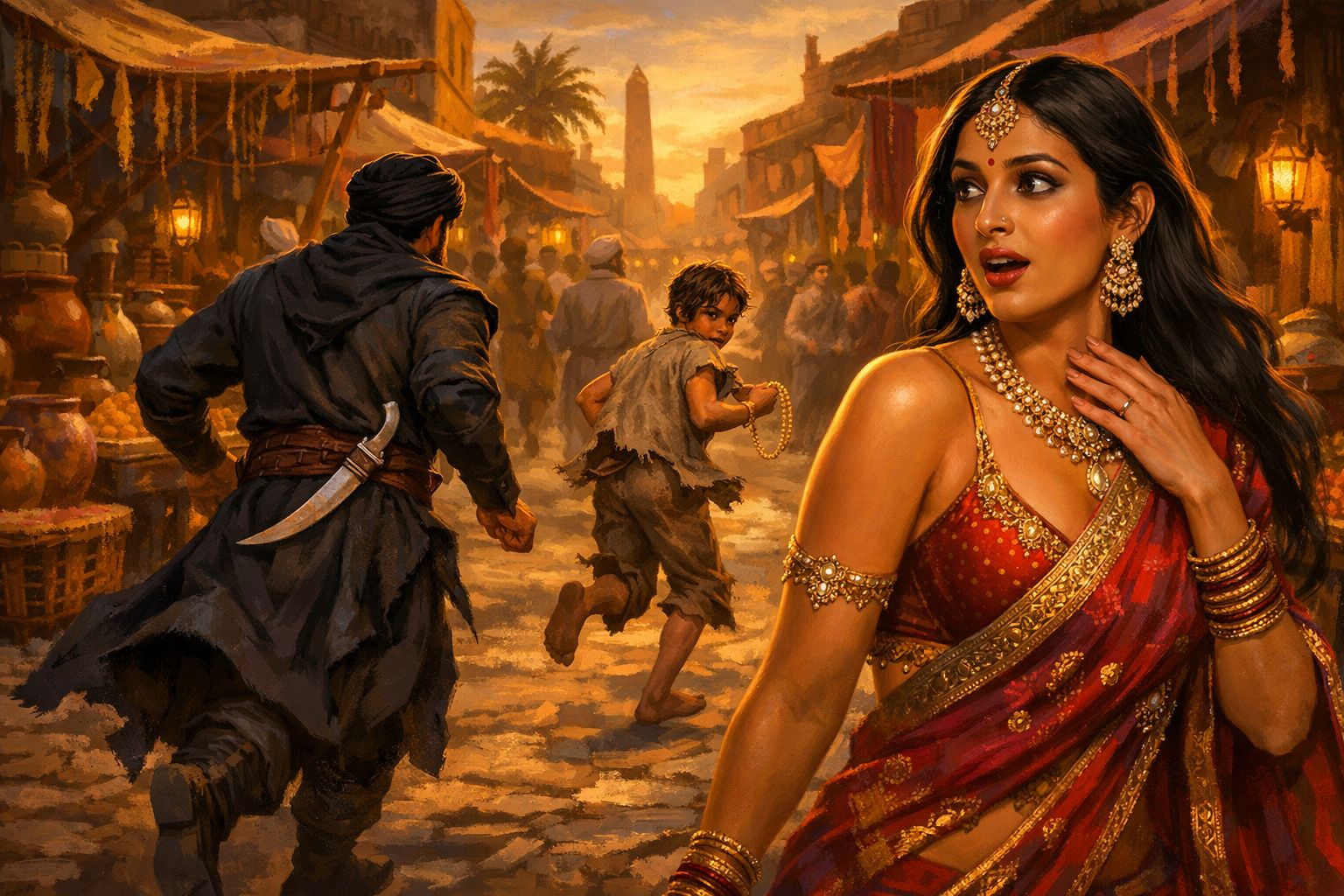
A Pickpocket in the Crowd
A child or thin young thief lifts a purse, tool or trinket from one of the crew and vanishes into a market lane. Chasing them leads the players into narrower streets, shrine corners or neighborhoods they would not otherwise see. If caught, the thief is frightened rather than bold and may know useful rumors in exchange for mercy.
This gives movement and a street level look at Oshiren.
Temple and Authority Events
A Procession Blocks the Street
A temple procession forces everyone aside. The players can either comply, try to cross anyway or use the delay to observe who in the city gets special treatment. A priest, acolyte or guard may note anyone who does not understand the rules and remember them later.
This is simple, but good for teaching the city’s instincts.
A Petition at the Shrine
At a wall shrine, the players see a woman begging a temple servant for mercy for a relative who has been denied burial. The players can intervene, donate, intimidate or simply listen. The servant is not necessarily cruel, only rigid and certain that sacred procedure matters more than grief.
This shows how ordinary suffering gets filtered through priestly order.
A Temple Scribe Offers Help
A minor temple scribe offers to help the crew navigate permits, audiences or formal customs, for a fee or favor. He may be genuinely useful, mildly corrupt or simply eager to attach himself to important foreigners.
This gives the players a way to move more easily through Oshiren while creating a relationship that may later complicate things.
City Life and Cultural Friction
A Birth Crossing
The players witness or hear of a guarded procession of a pregnant woman being taken east across the Zareth toward the birthing sanctuaries. This can lead to questions, religious discussion or a brush with priests who explain the custom only as much as they think outsiders deserve to know.
This gives a direct glimpse of Lumekhet’s cosmology in action.
A Funeral Ferry
At dawn, the crew sees a body ferried west toward the Kenu, attended by mourners carrying oil lamps and offerings. A mourner, ferryman or funerary servant may speak with them if approached respectfully. If handled badly, the players may deeply offend local custom.
This is another strong way to make the life and death cycle tangible.
Thaleia’s Separate Trail
If Thaleia is still moving independently at this stage, the players may hear of a foreign scholar asking odd questions about caravans, desert routes, strange beasts or the Tazulmar. Following that trail can reconnect them to her earlier than planned or simply confirm that she is busy making her own trouble.
This ties her separate movement into the city naturally.
Information and Waverider Leads
Someone Saw Them at the Palace
A servant, porter or market seller mentions that the Waverider crew were somehow connected to the Sun’s court, the Moon’s court or both. The speaker does not understand the significance, but they remember the fact because it was unusual.
This pushes the players toward the main court thread.
A Desert Contact
A trader, camel handler or caravan broker mentions that foreigners from the Waverider had also asked about overland routes and desert tribes. This does not give the whole answer, but it foreshadows the later split between sea route and desert route.
This is especially useful if you want the Tazulmar thread to feel seeded early.
Best Uses
If you want Oshiren to feel rich without sprawling too wide, pick one event from each of these groups.
That gives the city texture, gives the players things to do and keeps the main line of the arc moving.
The Moon’s Private Summons
This scene escalates the tension before the audience with the Sun ever happens. The crew has barely had time to absorb the first summons when a second arrives, and that alone should tell them something is wrong. In a normal court structure, one divine audience would already be extraordinary. Two in the same day, from rival centers of sacred authority, should feel impossible.
The purpose here is simple. The crew must understand that they are no longer just asking questions about the Waverider. They are already inside Lumekhet’s internal struggle.
The Second Messenger
A few hours after the Sun’s messenger departs, another messenger arrives. This one comes from the Moon.
The contrast matters. Where the Sun’s messenger should feel public, formal and administrative, the Moon’s should feel quieter and more intimate, but not gentler. The message is delivered with restraint and courtesy, but also with absolute certainty. The crew is informed that the Moon wishes to receive them at her palace just after sunset.
The wording should sound like invitation. The reality should be unmistakable. This is not a choice.
How It Should Feel
The key note is pressure through politeness.
No threats are spoken. No guards need to be displayed. No raised voices are needed. The force of the summons lies in the simple fact that in Lumekhet, one does not decline a divine ruler without consequence.
This should feel slightly more unsettling than the summons from the Sun. The first audience could still be read as opportunity. The second turns opportunity into entanglement.
The crew should feel that they are being drawn behind the visible order of the city and into something more dangerous.
How to Present the Messenger
The messenger should be calm, respectful and unreadable. He is not there to negotiate, explain or answer questions. He is there to ensure that the summons is delivered and understood.
If the crew tries to treat this as optional, the messenger should not argue. He should simply repeat the expectation with the same measured courtesy, making it clear through tone rather than open statement that refusal is not a real path.
That is more effective than open intimidation. It tells the players that Lumekhet does not need to shout. Its hierarchy is too deeply rooted for that.
What the Scene Communicates
This scene tells the players several important things at once.
- First, the crew has become visible very quickly.
- Second, the Moon knows about the Sun’s interest, or at the very least is moving on the same board at the same time.
- Third, the crew is now in a position where even agreeing to one audience may already be politically meaningful to the other side.
Do not explain all this outright. Let the summons itself create the unease.
Running the Scene
Keep it short.
The scene is not about conversation. It is about impact. A second summons, delivered before the first audience has even taken place, is the point.
- Let the messenger arrive.
- Let the crew hear the words.
- Let them realize that this is framed as courtesy but backed by sacred authority.
- Then end the scene and let the pressure sit.
Key Impression to Leave Behind:
- The Sun’s summons felt like progress.
- The Sun’s summons felt like progress. The Moon’s summons makes it clear that progress here comes with sides, whether the crew chooses one or not.
- The crew should feel that they are being drawn into a conflict whose edges they can sense, but not yet understand.
The palace of the Moon stood apart from the bright severity of the Sun’s domains, though not so far that one could forget whose city this was. Pale stone walls caught the last light of evening, and bowls of oil burned in carved niches high above the entrance. The servants who received them spoke only enough to direct them inward, then left them in a vast hall built more like a temple than a residence.
Great columns rose in two lines toward a ceiling lost in shadow, painted with silver crescents and black stars. Braziers burned between them, low and steady, casting more glow than warmth. The floor was polished dark stone, veined like still water. There were no courtiers, no music and no murmur of household life. Even Scarnax, who trusted grandeur less the more of it he saw, felt the place pressing in on him. Nasheem took it in with quiet attention. Ayesha simply waited.
At last a servant stepped forward, struck a bronze staff once against the floor and raised his voice.
"Ka-Iah, the Moon-Goddess Queen and daughter-wife of Ka-Ra, the Sun-God King and the living Pharaoh."
Then she entered.
For a moment, she seemed less like a ruler than like an image made flesh. Her gown flowed in silver that caught the brazier light like moonlit water. A black silk cape fell behind her, deepening the cold brilliance of the dress. Upon her head rested a golden crown topped by a silver disc. Two slave girls followed close behind her, twins by the look of them, young and carefully trained, in short silk tunics with lowered eyes and perfect posture, ready to serve the instant they were commanded.
The Moon did not ask who stood before her. She came to a stop and looked at them as though names were details she either already possessed or had no use for.
"You came to Oshiren in pursuit of the Waverider," she said. "You have asked after it and learned only that it was here. I know more than the harbor does. I have the information you seek."
Her voice was low and clear, without softness in it, and the hall seemed built to carry it.
"You will stand before Ka-Ra tomorrow. My father. My husband. The Sun-God King. I have reason to believe that something moves against me in this city, in the palace and in the temples. You will return to me afterward and tell me what passed between you. In exchange, I will tell you what you came here to learn."
Ayesha gave a polite nod.
"Information for information is a fair trade. We will do it."
For the briefest moment, confusion crossed the Moon’s face, as if the possibility of refusal, or even the idea that this had been a choice, had never truly occurred to her. Then the expression was gone.
She turned at once and departed, her black cape whispering over the stone. The twin slave girls followed close behind her.
The audience ended with her absence. No dismissal was needed. The hall seemed larger now, and colder, and the three of them were left with the same understanding.
They had not simply been received.
They had been taken into something already in motion.
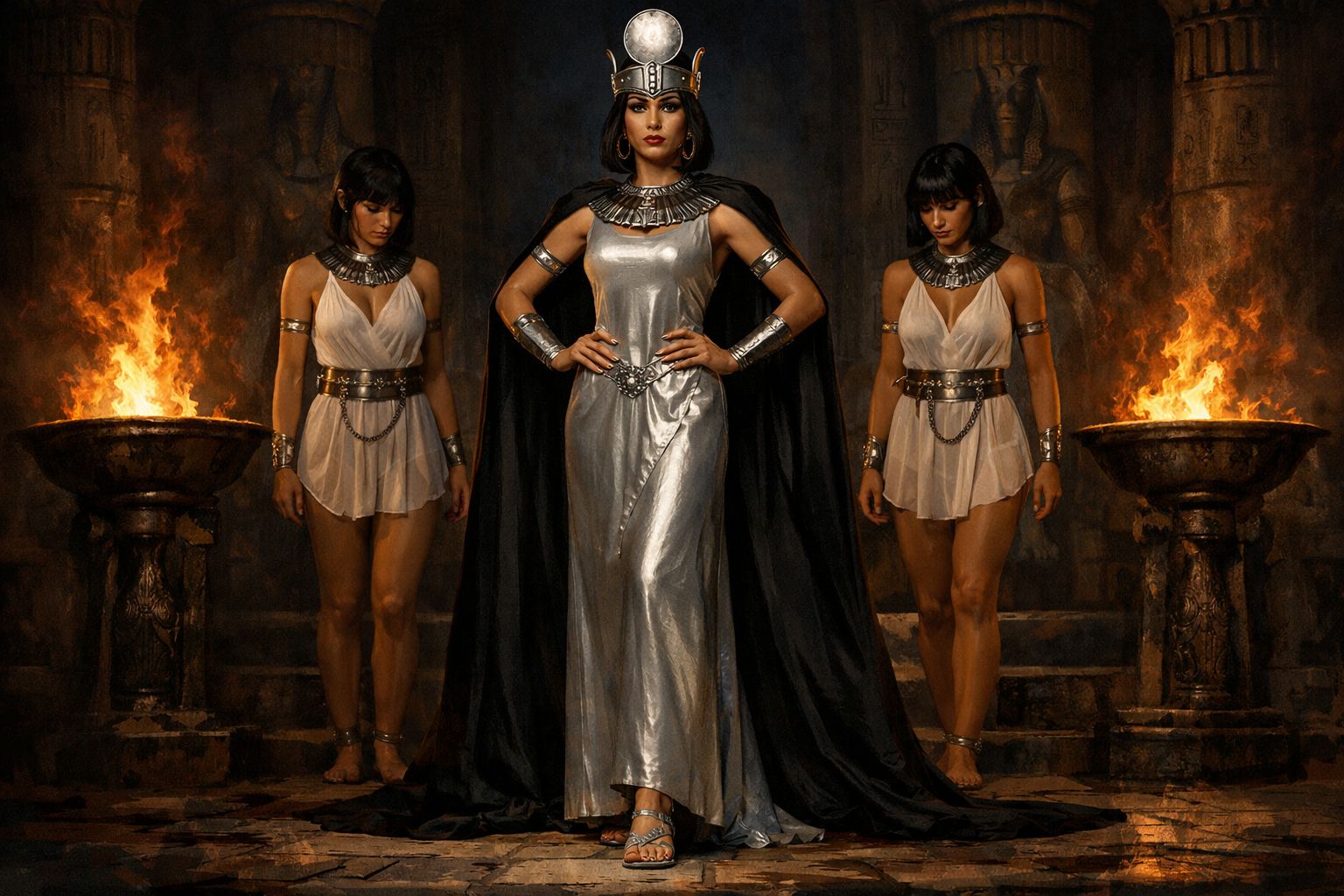
This scene introduces Ka-Iah in person and makes clear what kind of ruler she is. The important point is that this is not a discussion. It is a monologue delivered in the form of an audience. The crew is there to listen, not to shape the exchange.
Ka-Iah’s Presence
Ka-Iah does not waste time on names, courtesies or ritual pleasantries. She already knows why the crew is in Oshiren, knows they are following the Waverider and knows they will stand before Ka-Ra the next day. She gets straight to the point.
She tells them that she suspects danger around herself and wants them to report back after their audience with the Sun. In return, she will give them the information they seek.
The key is that she does not frame this as a plea or even as a true bargain between equals. She presents it as the obvious next step.
Key Impression
Ka-Iah is intelligent, informed and entirely used to obedience. Even in politeness, she should feel imperious. The momentary confusion when the crew treats her offer like a choice is important. It shows how completely she assumes compliance.
The Audience With the Sun
The palace of the Sun was nothing like the Moon’s.
Where her halls had been shadowed, silvered and inward, his seemed built to deny the very existence of concealment. Light poured through high openings and struck every polished surface until the whole place seemed to glow with its own hard radiance. The servants who led them inward spoke little and moved quickly, as if even lingering in these spaces too long without purpose might be taken for disrespect. They were brought into a great audience chamber and left to wait beneath pillars painted in white, gold and vermilion, their capitals shaped like open lotus blooms. Bronze braziers burned there too, but here the flames felt ceremonial rather than intimate, one more expression of sanctioned heat and brightness.
Nasheem’s face was composed, though the place put a different sort of tension into him than the Moon’s hall had. Ayesha remained still and unreadable, but she had already understood what the room was telling them. The Moon’s audience had been made to feel private. This one was meant to feel absolute.
At last a herald struck the floor with a long golden staff and cried out in a voice that rang through the chamber.
"Ka-Ra, the Sun-God King and the living Pharaoh, a thousand times reborn."
Then he entered.
If Ka-Iah had seemed arranged like a perfect image, Ka-Ra seemed arranged like a claim no one was meant to dispute. His loincloth blazed white and gold. Jewels flashed at throat, wrist and brow. The crown he wore rose above him in a shape that made the eye travel upward before it came back down to his face, which was handsome in the way polished bronze was handsome, bright, hard and touched by nothing soft. His body was muscled, like a marble statue. Priests and attendants followed at a measured distance, but none of them mattered. The room belonged to him before he ever crossed it.
He took his place and let silence settle first.
Then his gaze moved over the three of them, not like a host receiving guests, but like a judge measuring what use might be found in testimony.
"You were received by Ka-Iah last night."
It was not phrased as a question.
Ayesha inclined her head.
"We were summoned, yes."
His eyes shifted to her, then away again.
"What did she ask of you."
No greeting. No inquiry after origin. No performance of divine generosity. Just that.
Ayesha answered with careful precision.
"She wished to know what would pass in this audience."
Ka-Ra’s expression did not change.
"And you agreed."
Again, not a question.
Scarnax could feel the shape of the thing now. They had not come for answers. They had been brought here to be read against someone else.
Nasheem spoke, his voice respectful and even.
"She offered information in exchange for information, Majesty."
Ka-Ra’s eyes moved to him then, and lingered a heartbeat longer than was comfortable.
"And you deal easily with my queen."
There was no heat in the words. That made them worse.
He asked where they had first made contact with her servants. How quickly the summons had come. Whether she had received them alone. Whether priests had stood nearby. Whether she had named enemies. Whether she had spoken of fear. Whether she had seemed agitated. Whether she had asked what passed in the harbor before they ever entered her hall. Whether she had mentioned the temples.
Each answer only opened the way for another question. Whenever Ayesha tried to turn the exchange toward the Waverider, the Sun stepped past it as though the name were no more than a marker on a road he had no wish to walk. He acknowledged that he knew what ship they sought. He acknowledged that he knew why foreigners might come asking after it. Then he let the matter fall as if it were beneath the true business of the room.
The true business was always Ka-Iah.
What had she worn. How many servants had attended her. Had she seemed calm. Had she spoken his name with reverence. Had she made demands or requests. Had she spoken of treachery. Had she asked them to return. Had she assumed obedience.
Ayesha answered what could be answered and left the rest smooth and empty. Nasheem gave him nothing extra. Nasheem, increasingly irritated, said as little as possible, sensing that the less he offered this man, the less of himself would remain in the room afterward.
It did not matter. Ka-Ra was not looking for facts alone. He was listening to tone, to hesitation, to emphasis, weighing Ka-Iah through the reflections cast by strangers. The Waverider had brought them into his court, but the ship itself was almost incidental. Whatever struggle lay under Lumekhet’s sacred order, it was alive here, immediate and sharp enough that even their presence had been turned toward it.
At last the questions stopped.
Ka-Ra looked at them one final time, and there was something almost insulting in the calm satisfaction of it. Not because he had learned everything, but because he had taken what he wanted and saw no need to pretend otherwise.
Then, without dismissal or farewell, he turned and walked from the chamber.
The priests and attendants followed at once.
The audience was over.
For a few moments the three of them remained where they were, in all that burning light, with nothing to show for it except one clear truth.
The Sun-God King cared very much about the Moon and very little about helping them.
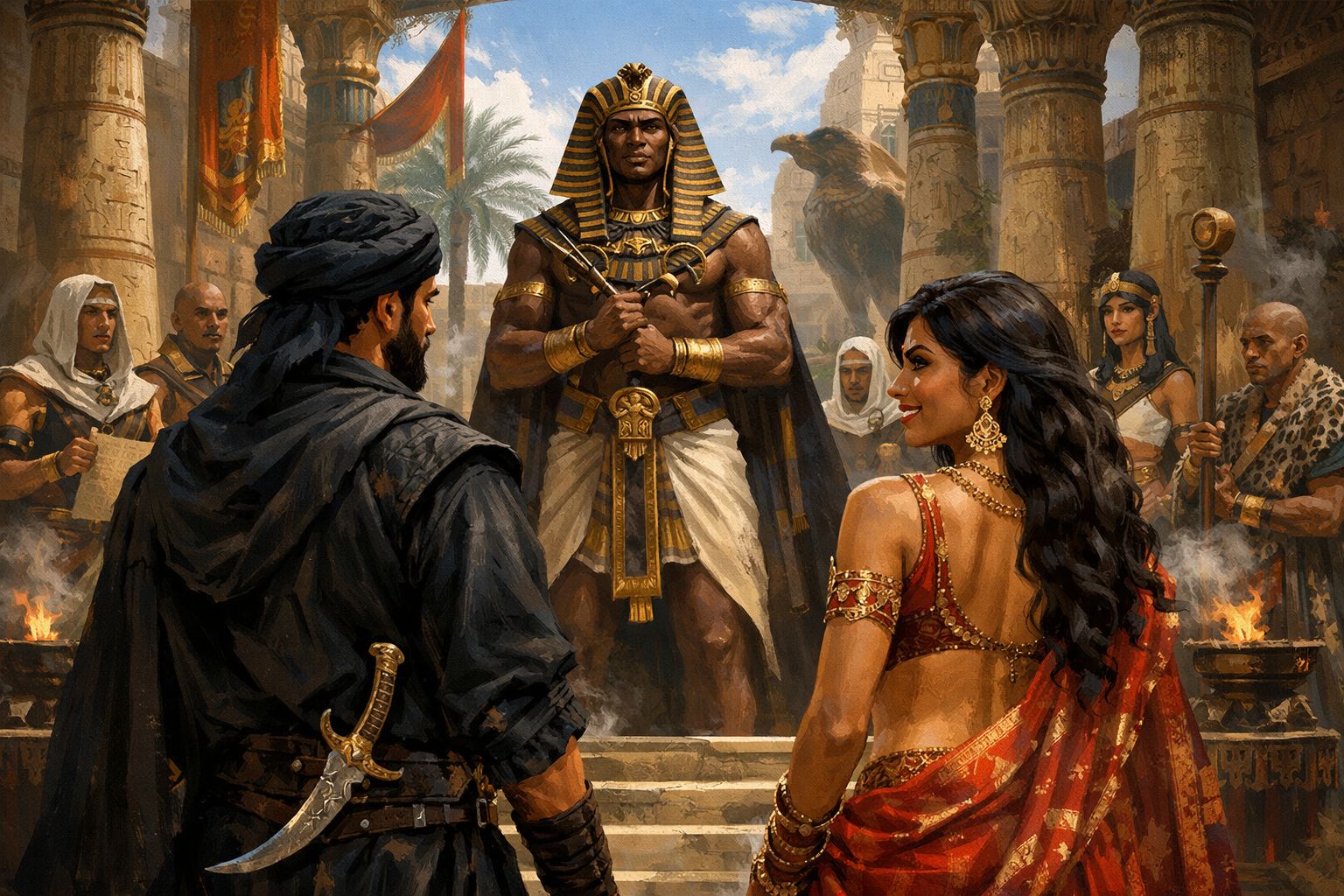
This scene should sharply distinguish Ka-Ra from Ka-Iah. Where the Moon’s audience is controlled and private, the Sun’s is exposed, formal and aggressive. The important point is that this does not feel like an audience in the usual sense. It feels like an interrogation.
Ka-Ra’s Focus
Ka-Ra shows no real interest in helping the crew with the Waverider. He acknowledges that he knows why they are in Oshiren, but he does not meaningfully engage with that subject.
His real interest is Ka-Iah.
He questions the crew repeatedly about their meeting with her, what she asked, how she behaved and what she seemed to want. He ignores attempts to redirect the exchange. The crew should leave understanding that whatever conflict exists between Sun and Moon is active, immediate and far more important to him than their own business.
Key Impression
The audience yields almost nothing useful about the Waverider, but it reveals a great deal about Ka-Ra. He is controlled, suspicious and deeply concerned with Ka-Iah and her actions.
When he has what he wants, he simply leaves. Like Ka-Iah, he does not treat the encounter as a conversation between equals.
The Moon Pays Her Debt
They were not made to wait long this time.
That alone told Ayesha more than any servant ever would.
The same hall received them, the same forest of columns, the same low braziers burning in the dimness, but the careful stillness of the first audience had been disturbed. Servants stood more tensely at the edges now. The air felt tighter. Less ceremonial. More like the moment before a sealed jar cracked.
Nasheem noticed it as soon as they entered. The place no longer felt staged for effect. It felt lived in. Agitated. Ayesha saw the center of it almost at once.
Ka-Iah was already there.
She was not seated. She was pacing in a short line before the far end of the hall, silver dress whispering over the dark stone, black cape shifting behind her like a strip of night dragged across the floor. The silver disc above her brow caught the firelight each time she turned. The twin slave girls stood a few paces behind, hands folded low, eyes cast down, their stillness sharper now, less ornamental and more careful.
A servant stepped forward, lifted his bronze staff and drew breath.
"Ka-Iah, the Moon-..."
She cut him off with a flick of her hand so small it might have been nothing at all.
The servant fell silent at once.
Ka-Iah did not bother with approach, greeting or performance. She stopped where she was, fixed her gaze on them and said, "What was said."
Not who spoke first. Not whether the Sun had received them well. Not even the pretense of calm.
Ayesha answered because that was plainly what the room required.
"He had no real interest in us," she said. "Nor in the Blue Marlin. Nor in the Waverider, beyond knowing why we had come. The only subject that truly mattered to him was you."
For a heartbeat, the hall seemed to go hollow.
Then the Moon’s face broke open.
"That dirty old bastard," she spat, the words raw and hot and shockingly mortal in that sacred room. "You are going to repeat what you did to my mother."
The twins lowered their eyes even further. One of them swallowed. The other went very still, as if stillness itself might make her invisible.
Nasheem felt the hair rise slightly along his arms. Not from fear of her, exactly. From the suddenness of seeing the divine peel away and leave behind the woman beneath it, furious and frightened and for an instant almost breakable.
No one spoke. No one was fool enough to step into that moment.
Ka-Iah mastered herself quickly, but not instantly. She drew one sharp breath, then another. By the time she looked at them again, the mask was back in place. Not perfectly. Perfectly was gone now. But enough.
"Information for information," she said, and her voice was once again cool enough to frost bronze. "The Waverider continued to Varr'thol in Ssar'et."
There it was. The thing they had crossed half the world to chase, delivered with cold indifference.
Ayesha inclined her head once. Nasheem gave no visible reaction, though he felt the shape of the name settle into memory at once. Nasheem’s eyes narrowed by a fraction, already turning the route over in his mind.
Ka-Iah did not look at any of them for long. Having paid her debt, or the first piece of it, she had already withdrawn somewhere behind her own face again. She turned at once and walked from the hall, black silk trailing after her. She looked calm and collected, but the sound of her steps betrayed her urgency.
The twin girls followed close behind.
No one announced the audience ended. No one needed to. The room itself seemed to exhale only after she was gone.
This time, as they stood in the silver gloom she had left behind, the three of them knew a little more than before.
Not enough.
This scene shows the first real crack in Ka-Iah’s composure. The audience is still controlled by her from beginning to end, but unlike the first meeting, the strain is now visible. The crew should feel at once that something has changed between the two audiences.
Ka-Iah’s Control
As before, this is not a conversation. Ka-Iah still directs the exchange at all times. She does not invite discussion, and she moves immediately to the one thing she wants to know: what Ka-Ra said.
Even in agitation, especially in agitation, she remains the center of the room. The crew reports. She reacts. She gives the promised information. Then she leaves.
The Change in Mood
The important contrast is the mood.
The first audience is cold, composed and deliberate. This one is restless, strained and much less carefully staged. Ka-Iah is waiting for them, visibly impatient, and she interrupts even the formal announcement. That alone should signal that her control is under pressure.
Her brief outburst matters. It is the clearest glimpse so far of the fear beneath her divine poise. The mask returns quickly, but not before the crew sees that the grandeur is real and fragile at the same time.
Key Impression
Ka-Iah is still imperious, still the one directing the scene, but now the crew has seen the person beneath the role. That makes her more legible, more dangerous and more vulnerable all at once.
Preparing for Departure
The Blue Marlin was alreadyready to cast off from the dock when the shouting began.
Scarnax did not look up at once. Men shouted on quays for a hundred reasons, and most of them had nothing to do with him. He was watching a pair of deckhands wrestle a crate of dried provisions into place while the last coils of rope were being cleared from the rail. The harbor smelled of tar, fish slime, hot wood and morning salt. Beside him, Nasheem leaned one arm on the rail with the lazy ease of a man who looked relaxed even when he was paying attention to everything.
Then the voice rose above the rest.
“Wait! Wait for me!”
Nasheem turned first, and the grin came to him immediately. “There she is,” he said. “I swear by all the gods, she always arrives exactly like this. Never early, never calmly. Always as if chased by scholars, creditors or carnivores.”
Scarnax finally looked and gave a short snort. Thaleia was sprinting down the quay with her satchel bouncing against her hip, loose papers clutched in one hand and half a dozen things hanging from her belt that looked as if they ought to have been packed away hours ago. Her braid had partly come undone again. She nearly collided with a porter, swerved around a basket of eels and hit the gangplank at speed.
“Let her on before she kills herself,” Scarnax muttered.
Thaleia came up onto the deck breathing hard, bent forward with her hands on her knees, trying and failing to speak before she had enough air. Nasheem watched her with open amusement. “Take your time,” he said. “We would hate for this dramatic entrance to end without a proper announcement.”
She straightened, still catching her breath, eyes bright with the kind of excitement that meant she had already forgotten every ordinary practical concern in the world. “I have it,” she said. “A trail. Waverider.”
That wiped the humor from both men at once.
Scarnax’s expression sharpened. Nasheem pushed himself off the rail and stood properly now, all easy charm replaced by attention. “Go on,” he said.
“The Tazulmar,” Thaleia said, speaking faster now that she had breath enough to keep up with her thoughts. “I found some of them before dawn, out by the caravan edge. They told me two people from the Waverider crossed with them through the desert. Rahim and Kethra. Not just names overheard in passing. They remembered them. They travelled together long enough to leave stories.”
At Kethra’s name, something tightened in Nasheem’s face, small but unmistakable. Scarnax saw it, then looked back to Thaleia. “Can they still be found?”
She nodded quickly. “They are camped outside the city. Not leaving yet. They said they would talk.”
Scarnax did not hesitate. “Then we are not sailing yet.” He raised his voice toward the quarterdeck and the nearest hands. “Hold departure. Secure the moorings again.”
Then he turned to Nasheem. “Gather a team. You go with Thaleia and find these Tazulmar. Hear every word they have about Rahim and Kethra, and see what else they know about where the Waverider went after.”
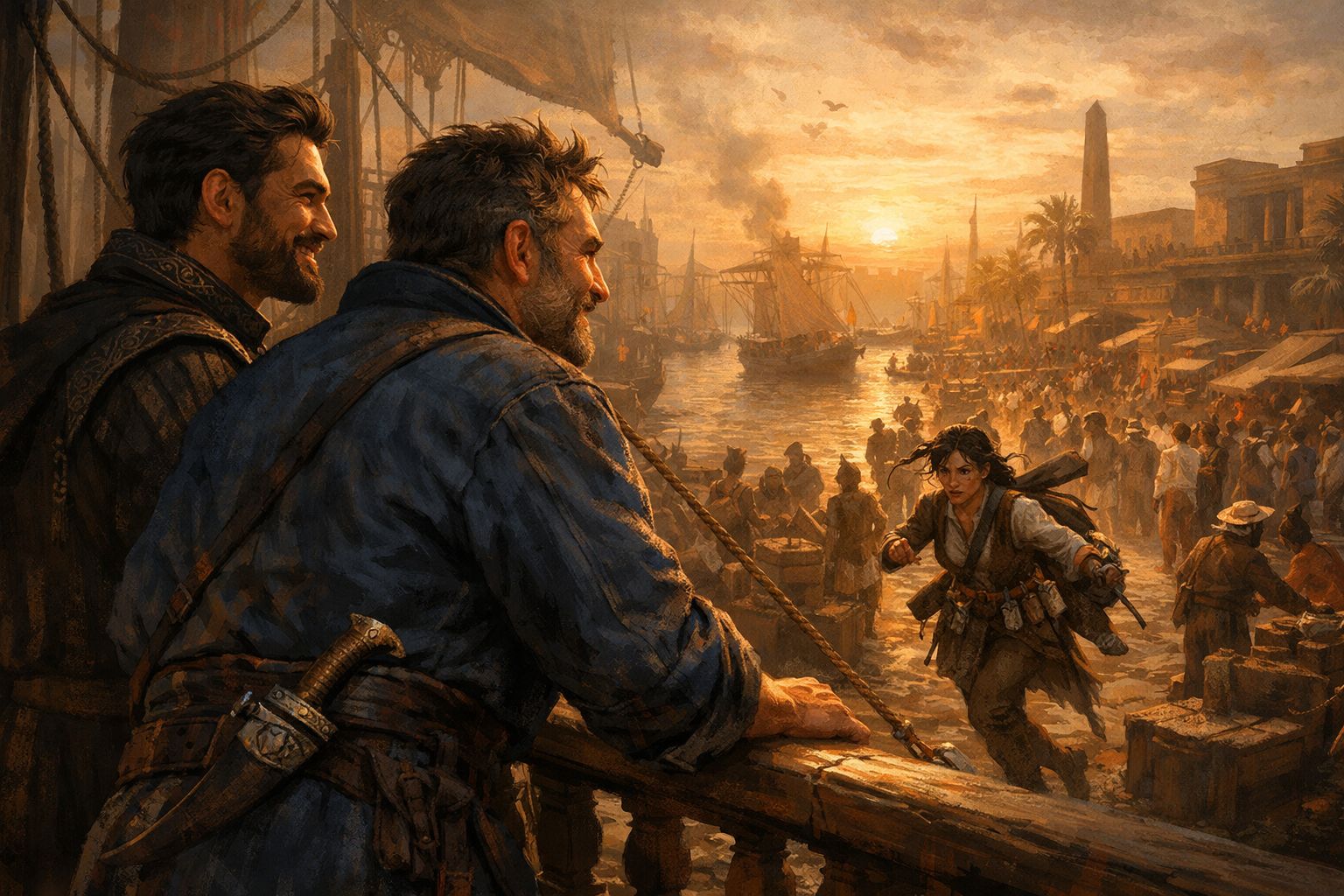
This is a very short transition scene. Its purpose is simply to interrupt departure and redirect attention toward the Tazulmar.
Thaleia’s Information
Thaleia arrives with a concrete lead. She has spoken to the Tazulmar and learned that Rahim and Kethra from the Waverider travelled with them through the desert. The important part is that this is not just a rumor or a name picked up in passing. The Tazulmar remember them well enough to have stories about that journey, which makes the trail immediate and worth following.
How to Run It
Keep the scene brief. Thaleia appears, delivers the information and makes clear that the Tazulmar are still close enough to be questioned directly. That is enough to stop departure and trigger immediate follow-up. Do not let the scene expand into a longer exchange. The real content lies in the next scene, when the Tazulmar are actually spoken to.
Meeting the Tazulmar
The Tazulmar camp lay beyond the last mud walls of Oshiren, where the city thinned into scrub, dust and glaring heat. From a distance it looked modest enough, just a scatter of dark tents and pale cloth moving in the wind, but as they drew closer the true shape of it emerged.
Three Shar'zul rested around the outer perimeter like living towers.
Even Ayesha slowed a little at the sight of them. Their long legs were like carved pillars, their harnesses heavy with bone charms and bronze fittings that knocked softly together when they moved. Their dark eyes followed the approaching strangers with the calm of things too large to fear them. Thaleia, by contrast, lifted a hand at once and waved with the easy excitement of someone who had already decided she would be welcomed. Nasheem glanced up at the nearest beast and remarked that he would have preferred to know in advance that the camp was guarded by creatures large enough to crush a man without noticing.
The Tazulmar received them with warmth and unhurried courtesy. They were led inward beneath layered awnings where the light turned softer and the air smelled of dust, animal warmth and tea. Cushions were laid around a woven rug, a brass kettle waited over coals and an old man sat ready to greet them with the stillness of someone entirely at home with patience.
He was Miraz ibn Khalim al Hazran, elder of this part of the caravan, white-bearded and sun-cut, with steady dark eyes and the grave ease of a man who had spent his life beneath open sky.
Tea came first. Ayesha handled the first formalities with smooth grace, Nasheem sat easy but attentive and Thaleia lasted only as long as manners forced her to. Then she leaned forward and asked outright about the Waverider.
Miraz smiled faintly and said yes, they had travelled with Rahim and Kethra.
He remembered them clearly. Rahim had been quiet, watchful and sparing with words. Kethra had been harder-edged, more openly marked by what life had done to her, but steady under strain and quick to listen when it mattered. They had crossed enough desert with the Tazulmar to be considered part of the tribe. Miraz had just begun to settle into the story, and to explain more about where they had been headed, when the tent flap flew wide.
Ileena came in fast, dusty and urgent, moving with none of the ceremony the others had just spent so much care observing.
“The Moon has been arrested,” she said. “And the crew are being sought. If we want to reach the Blue Marlin first, we leave now.”
The whole tent changed in an instant. Nasheem was on his feet so quickly his cup tipped onto the rug. Ayesha rose at once, her expression gone still and sharp. Thaleia looked almost pained at having the trail break open and close again in the same breath. Shaedra was already turning toward practicalities.
Miraz did not waste time on confusion. He called out sharply and younger Tazulmar appeared at once. Robes, veils and headcloths were brought in armfuls.
“Our guests should not leave looking like themselves,” he said.
So they dressed in desert cloth as quickly as they could. Thaleia nearly tied herself into her own headwrap before Nasheem took it from her hands and fixed it properly. Ayesha covered herself with practiced neatness. Shaedra was ready almost at once. Ileena looked no less dangerous for the borrowed robes, only stranger.
Then, with hurried thanks and the promise that the rest of Miraz’s story would wait for another meeting, they slipped out through the camp disguised as travelers of dust and road while the great Shar'zul watched them in silence, and made for the Blue Marlin before the city could close around them.
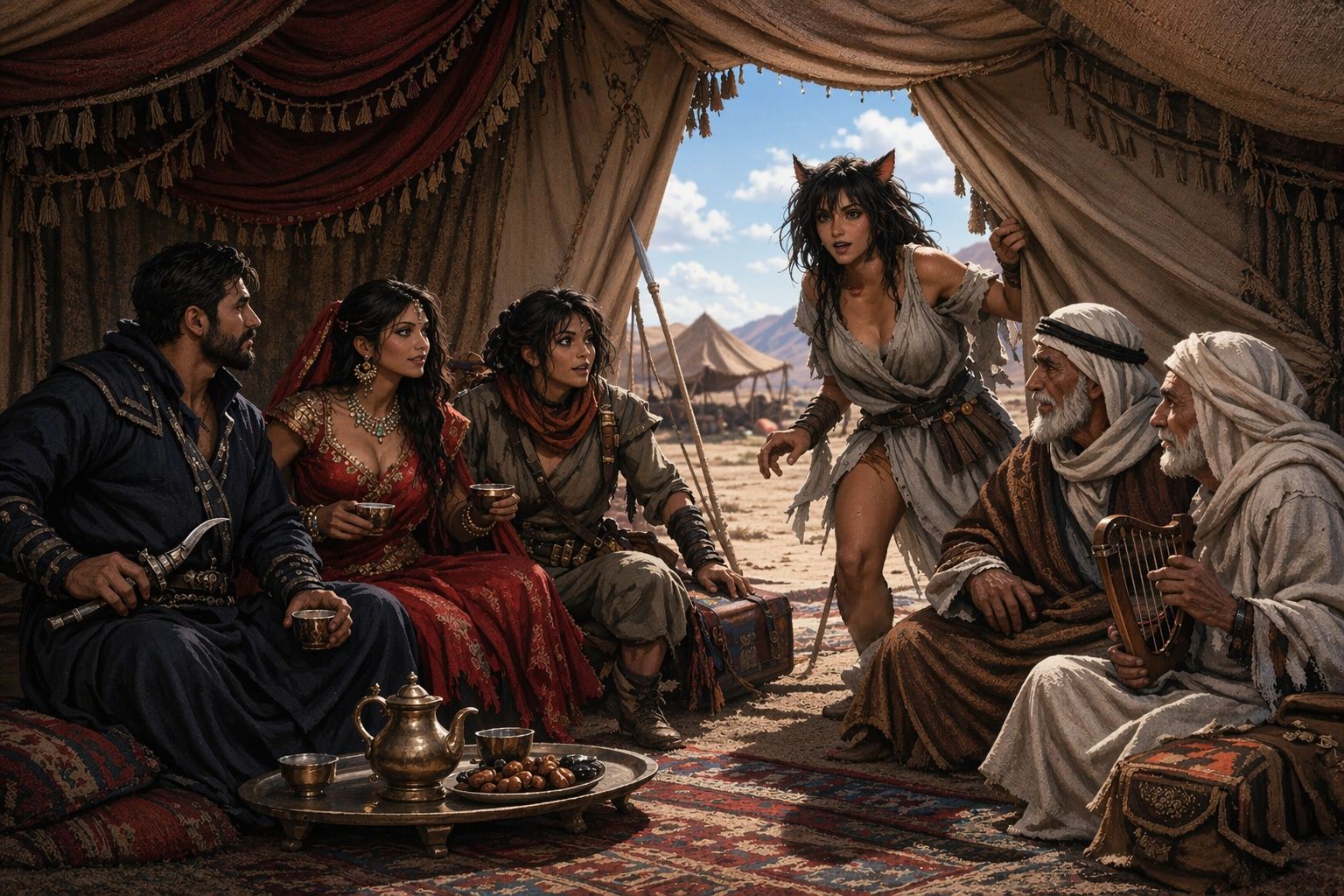
This scene does two things at once.
First, it gives the crew a first real look at the Tazulmar. They should come across as impressive, controlled and genuinely hospitable. The Shar'zul, the camp itself and the calm confidence of the elder should all help sell that these are people who calls the desert their home, not just another caravan to question and leave behind.
Second, it keeps this group away from the Blue Marlin when the crisis breaks. The crew members who go to the Tazulmar are separated from the ship at exactly the moment when events force a sudden escape. This creates the opening for the desert journey that follows.
The Tazulmar
The Tazulmar should feel sincere. They are not evasive, manipulative or mysterious for its own sake. They receive the crew warmly, offer tea and answer in a way that makes it clear they really did know Rahim and Kethra. The elder, Miraz ibn Salim al Hazran, should be able to provide enough small details that there is no serious doubt. He remembers how they behaved, how they handled the desert and what sort of impression they left behind. The important thing is not to dump the whole trail here. This scene only needs enough truth and texture to establish that the lead is real.
Because of that, the interruption should come before the conversation fully pays off. The crew gets confirmation and a taste of more, then has to leave before they can hear the whole story.
The Interruption
Someone from the ship arrives with the news that the Moon has been arrested and that the crew are now being sought. Who brings that warning matters, because that person will remain with this group and become part of the desert travel that follows.
Choose the messenger with the next stretch of the arc in mind rather than only this scene.
Nasheem and Junia are the most important names to have on the desert trip. If one of them is not among the player characters present for this scene, use that person as the messenger. That is the cleanest way to ensure they join the group naturally.
There will be another opportunity later to add one more person, so this choice does not need to solve the whole travel group at once. It only needs to make sure one key person is present from the start.
Choosing the Messenger
If neither Nasheem nor Junia is present among the player characters in this scene, send one of them from the ship with the warning.
If both are already present, have the warning brought by someone else who fits the desert journey well. Good choices are Amaxia, Mbaru or Shaedra.
How to Run the Scene
Keep the first half calm. Let the Tazulmar impress the crew. Let the elder begin to confirm the Waverider trail. Make the truth of the lead feel solid.
Then break the scene sharply.
The warning should arrive fast, with no time for proper courtesy. That sudden shift from tea and story into urgency is the point. The Tazulmar respond by helping at once, offering robes and veils so the group can move through the city less visibly. This reinforces their hospitality and gives the crew a practical way out. It also gives them at least one sympathetic group when events in Lumekhet turn against them.
Do not let the scene become a long debrief. It is a teaser, not the full meeting. The players should leave wanting to return and hear the rest.
Arrest, Flight, and the Closing Net
They reached the harbor in borrowed robes and desert veils just in time to see the Blue Marlin slipping out through the harbor mouth.
For a moment, none of them spoke.
The ship moved steadily into open water, sails full, already too far to call back. They had made it through the city, through the confusion and the danger, only to arrive in time to watch her leave without them. Thaleia stopped dead and stared. Ayesha stood very still beside her. Shaedra’s face hardened into that flat, practical disappointment that wasted no time on complaint. Ileena leaned forward slightly, as if some part of her still thought speed alone could change what was already done.
“We missed it,” Thaleia said.
“Yes,” Ayesha said quietly. “But it escaped.”
That was the truth at the center of it. The loss was sharp, but so was the relief. Whatever had broken loose in Oshiren, it had not trapped the Blue Marlin in harbor. The ship was away. The people aboard were alive. Nasheem watched it go with a tight expression, then gave a small nod, more to himself than to the others.
“Better this than watching her burn at anchor,” he said.
They stood there a moment longer, caught between despondency and gratitude, until Ileena’s attention snapped away from the sea.
“Someone is coming.”
At once they turned. A robed figure was approaching quickly across the quay. Nasheem’s hand moved under his borrowed robes toward a hidden knife. Shaedra shifted her weight. Ayesha angled herself for a better look.
Then the figure lifted a hand, and they recognized her.
Junia.
She came straight to them, breathless and tense, and did not waste a word. “Not here,” she said, pulling them toward the side of a warehouse where cargo and old nets gave them a little cover from the open quay.
Only when they were partly hidden did she stop.
“The ship got out,” she said. “Someone had to stay behind and tell you the plan. They will meet you in Ssar'et, Varr'thol.”
The names settled over them like something solid at last. Not safety, not certainty, but direction.
Ayesha looked at her sharply. “You stayed for that?”
Junia nodded. “I volunteered. I thought you might need a healer more than the ship does right now.”
Shaedra gave her a brief look of approval. Nasheem exhaled slowly. “Sound judgement, but I hope you are wrong.”
Thaleia, who had been listening with her mind already racing ahead, suddenly straightened. “Then this is all right.”
Junia blinked at her. “All right?”
“Yes,” said Thaleia, with gathering excitement. “I already arranged passage with the Tazulmar. They are going toward Ssar'et. We can go with them.”
Nasheem looked at her for a moment, then nodded once. “That is as good a plan as any.”
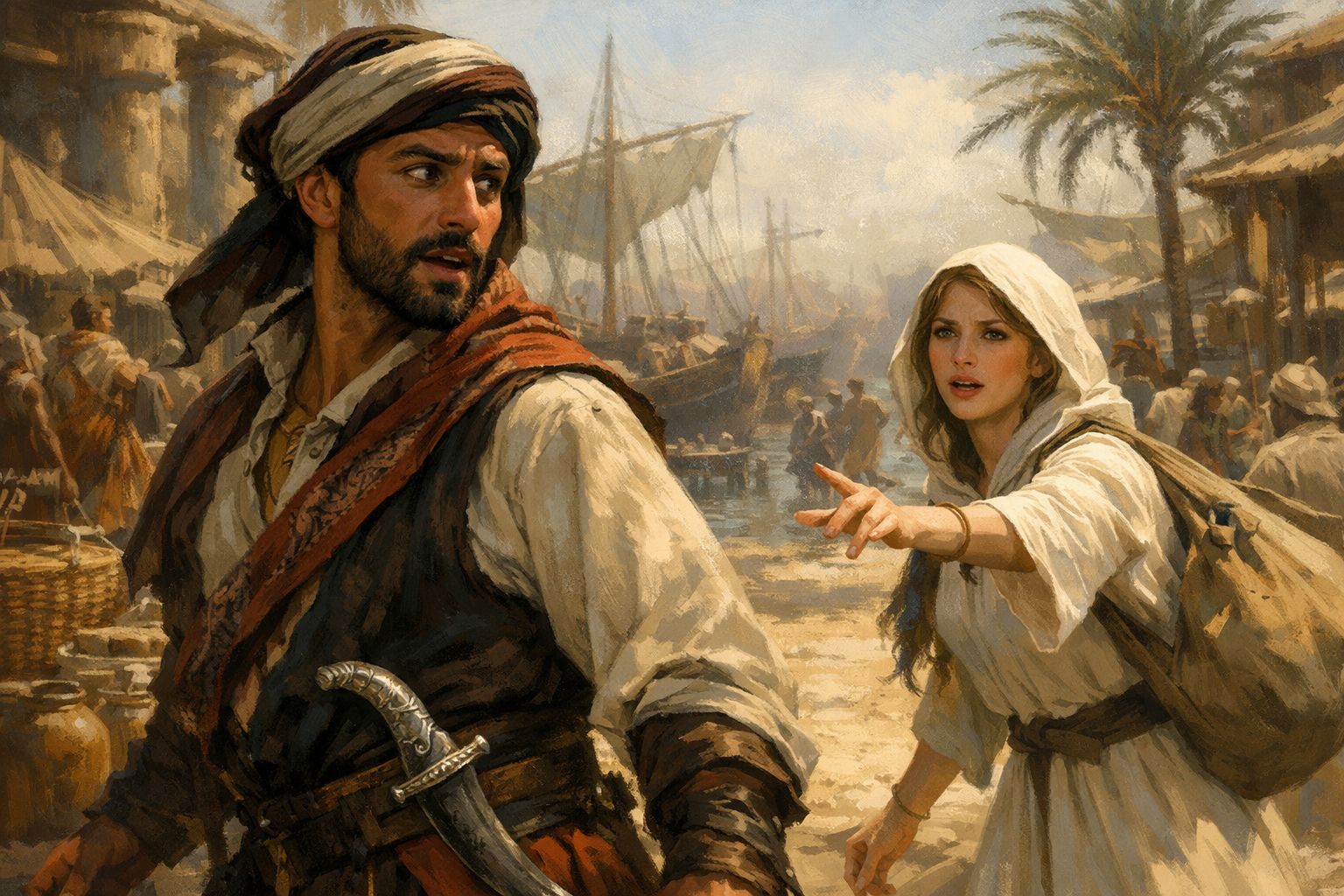
When the group reaches the harbor, the Blue Marlin is already leaving. The moment should carry both disappointment and relief. They have missed the ship, but the ship has escaped. That closes off the easy option and forces the next stage of the arc into the desert.
The Crew Member Left Behind
One crew member has remained behind to intercept them and pass on the plan. The message is simple: the Blue Marlin will meet them later in Ssar'et, Varr'thol.
Who stays behind matters. That person now becomes part of the overland group and should be chosen with the desert journey in mind. Use the same logic as in the earlier Tazulmar scene. Nasheem and Junia are the most important people to have on that stretch. If one of them is not already with the group, this is a good place to add them. If both are already present, use the slot for another strong fit from the earlier list.
Thaleia’s Suggestion
Once the immediate disappointment has settled, Thaleia provides the next step. She suggests the overland route with the Tazulmar, having already arranged passage toward Ssar'et. That gives the group a practical way forward at once and ties this scene directly back to the earlier meeting.
Running the Scene
Keep it short. The important beats are the sight of the departing ship, the handoff of the meeting point in Ssar'et and Thaleia’s suggestion that they travel with the Tazulmar. Once those pieces are in place, move on quickly. The scene is there to close one path and open the next.
The Moon’s Execution
They kept to side streets as they made their way back toward the Tazulmar camp, moving in borrowed robes through a city that had gone tight with rumor and spectacle. Too many people were drifting in the same direction. Too many voices carried that sharp, ugly note that meant something terrible was being watched in public.
The flow of the crowd pulled them toward the square before the Sun’s palace.
A platform had been built there.
And on it, in chains, stood the Moon.
Even Ileena stopped at that.
Ka-Iah was bareheaded beneath the full brutality of the day, dressed only in a thin silk tunic that clung to her wet skin. An iron collar chained her to the pole behind her, the length of it deliberate. Long enough to let her pace, kneel or cower before the crowd, never long enough to be anything but trapped. The sun had already reddened her shoulders and arms. She was not near death yet, but the point of the thing was unmistakable. This was not a swift execution. It was suffering arranged as ceremony.
They listened without drawing attention, close enough to catch the story as it passed from mouth to mouth through the crowd. Treachery. Condemnation. The sentence had already been given. She was to die by the Sun, chained there and kept alive with food and water so the heat could go on ruining her slowly. When she died, the godhood would pass to her younger sister, who would become the next daughter-wife of the Sun-God King.
Ayesha stared at the platform for a long moment. “No one deserves that.”
Junia nodded at once. “No.”
Nasheem had not taken his eyes off Ka-Iah. “And we owe her,” he said. “However blindly, we helped set this in motion.”
Nobody argued.
Ileena let out an impatient breath. “Then rescue her.”
Ayesha glanced at her. “That is not simple.”
“It never is,” Ileena said. “But more talk will not change what this is.”
Junia kept her attention on the platform, assessing the prisoner with a healer’s eye rather than a horrified one. “There is time,” she said. “This kills slowly. She will last at least a couple of days before it becomes harder than I can easily mend.”
Ileena grimaced. “And yet somehow that makes it worse.”
Nasheem dragged his gaze away from the platform and began studying the square, the guards and the approaches. “Then we think first. We need a plan.”
Ileena sighed. “More talk...”
That almost got something dry and humorless out of Shaedra, though her eyes stayed on the square. Thaleia was already looking too, from chain to platform to guards to balcony, her thoughts racing ahead in too many directions at once. Ayesha said nothing. She was thinking in a colder, more useful way now.
Then she turned away first.
“Not here,” she said. “If we stare too long, we become faces people remember.”
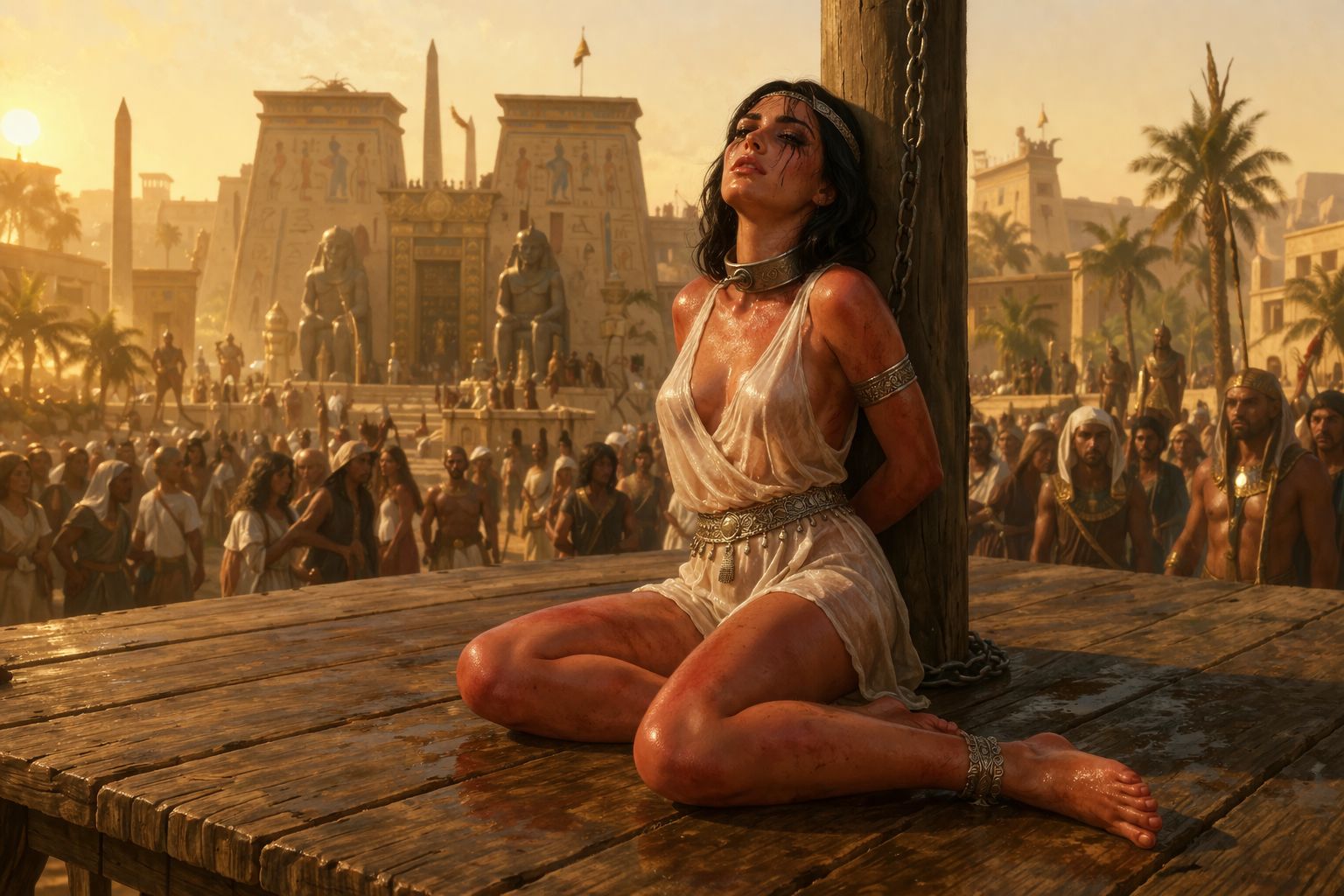
The Moon has been condemned to death for treachery. The method is deliberate and symbolic. She is not to be executed quickly, but exposed to the Sun and destroyed by it over time. In Lumekhet’s logic, this is not only punishment. It is proof. The Sun does not merely order her death. He is seen to unmake her personally.
This should be presented as sacred cruelty rather than simple brutality. The point is not only that she dies, but that she is reduced in public, stripped of protection, dignity and divine authority. Her death is staged as the visible triumph of the Sun over the Moon.
Practicalities of the Execution
She is displayed on a raised wooden platform in the square before the Sun’s palace. At its center stands a pole, and around her neck is an iron collar attached to it by a long chain. The length is intentional. She is not fixed rigidly in place. She can move about the platform, pace, sit, kneel or lie down, but she cannot leave it. That limited freedom is part of the humiliation. She is allowed enough movement to suffer visibly, but never enough to escape. She can choose which part of her faces the Sun, but she can not avoid it.
She is dressed only in a thin silk tunic and left entirely unprotected beneath the day sun. Food and water are provided regularly, not as mercy, but to prolong the ordeal. This is meant to take time. She is not supposed to collapse quickly. She is supposed to endure, weaken and be watched doing so.
Junia can truthfully judge that this is not an immediate death sentence in the space of hours. Without intervention, it will take days before the damage becomes severe enough to turn decisively toward death. That gives the crew a narrow planning window, but not the luxury of endless delay.
Guards and Public Pattern
The formal guard is surprisingly light. Only four guards are posted at the platform, one at each corner. This is not because the sentence is poorly protected, but because the regime relies more on terror, ritual and public obedience than on military force. The fear of the Sun-God King is expected to do much of the work.
During the day, the square is crowded. People come to watch, pray, gossip and take part in the spectacle. This makes any rescue attempt in daylight much more difficult, not because of the guards alone, but because of visibility, confusion and the high chance of immediate recognition.
During the night, the crowd disperses. Only the guards remain, along with whatever distant palace watchers may be on nearby walls or balconies. This makes the night the natural window for action. The square is quieter, but also more exposed in a different way. There are fewer eyes, but any movement near the platform becomes more noticeable.
Succession
The political meaning of the execution should be clear. When the Moon dies, her younger sister will inherit the role and become the next Moon Queen. She will also become the next daughter-wife of the Sun-God King. This matters because it confirms that the sentence is not only punitive. It is administrative, dynastic and theological at once. The existing Moon is being removed so that the structure can continue without interruption.
That younger sister should be understood as both successor and victim. The system does not end with one death. It simply advances to the next girl in line.
The Sun’s Presence
At intervals, the Sun appears on a palace balcony overlooking the square. When he does, the crowd responds with ovations, reverence and fear. This reinforces the intended meaning of the punishment. The Moon suffers below while the Sun looks down from safety, glory and absolute authority.
Use these moments to underline the imbalance. He is elevated, shaded and adored. She is exposed, chained and being slowly ruined in public. The contrast is the message.
The Dead Advisors
Two of the Moon’s advisors have already been killed, their throats cut in front of the platform. Their blood should make it clear that this is not a clean transfer of power. It is a purge. The Moon’s household is being dismantled around her, and she is being forced to witness what remains of her authority die first.
This also helps communicate that events moved fast after her arrest. The regime is not hesitating. It is erasing her position as thoroughly as possible.
What This Means
This is not simply an execution. It is the deliberate destruction of divine status. The Moon is being denied mystery, denied ritual distance and denied any protective dignity. She is made visible as a body under pain, while the Sun’s theology frames that suffering as justice.
That is the real horror of the scene. She is not only being killed. She is being stripped of godhood in public, reduced from sacred figure to helpless victim beneath the one power she was supposed to complement. The system is forcing her into a final role where even her death serves the Sun.
Using NPC Crew Pressure
If the players hesitate, let the NPC crew members push the issue. They do not all need to make the same case. One can focus on the cruelty of the sentence, another on the fact that the crew had a hand in bringing events to this point and another on the practical value of saving someone powerful who now has every reason to hate the Sun.
The goal is not to force the players, but to make sure the weight of doing nothing is fully present.
Hiding in Oshiren and the Rescue
Two Days and a Deadline
The Tazulmar need two full days to finish their trade in Oshiren and prepare for departure. That gives the rescue a natural deadline. Once the caravan leaves, the crew either goes with it or loses their safest route out of Lumekhet. This should create pressure without forcing immediate reckless action. The players have a little time to hide, watch, plan and choose their moment, but they do not have unlimited time.
This also solves the practical question of what happens after the rescue. The Tazulmar are willing to take the Moon with them into the desert. They do this partly out of obligation to Kethra and Rahim, whose memory carries real weight with them, and partly because hospitality is close to sacred in their culture.
For the Tazulmar, hospitality is not a soft virtue. In the desert, to turn away a stranger is to leave them to die. That reality has shaped their entire way of dealing with guests, petitioners and those in need. Once they accept someone under their protection, that protection means something.
Hiding in Oshiren
For most of the crew, moving around Oshiren in Tazulmar robes is surprisingly easy. The Tazulmar are not common in the sense of being ordinary, but they are regular enough visitors that they do not draw constant harassment. They arrive with caravan goods, rare materials and distant trade connections, so they are treated as useful outsiders rather than immediate threats. A robed figure in desert cloth can pass through the city with far less notice than a recognizable foreign sailor.
That said, do not make the disguise feel like perfect safety. Plant small tense moments to keep the risk alive. A lingering guard glance, a curious merchant asking too many questions, a servant staring a little too long, a near encounter with someone who knew the crew at the harbor, a priestly functionary clearing the way through a street crowd. None of these need to become full complications unless the players push too hard or get careless, but they should keep the city feeling dangerous.
Some crew members are simply too visible to move safely, even disguised. Ivy, Grishna and Ormun should remain hidden in the Tazulmar camp if they are part of the group. Their size, appearance or general distinctiveness make them poor candidates for sneaking through a city on edge. They can still contribute to planning, camp security and preparations for departure, but they should not be used for quiet movement in Oshiren itself, especially during the day, unless the players are knowingly taking a major risk.
Mood in Oshiren
The city should feel tense even when nothing obvious is happening. People are not loudly discussing the purge, but they know enough to fear it. Priests have vanished. Servants have been seized. Names are being spoken more quietly. Everybody understands that this is a dangerous time to be noticed. When the blade is already in motion, people lower their heads and try not to be the next target.
At the same time, daily life has not stopped. Markets still operate. Craftsmen still work. Slaves still haul, carry and serve. Bargains are still struck. Temples still receive offerings. This contrast matters. The city is not in open riot or collapse. It is functioning under fear. That makes it more unsettling, and it gives the rescue a better backdrop. The players are moving through a place where power is killing people in public and everyone else is trying very hard to pretend the world remains normal.
Planning the Rescue
Do not funnel the players toward a specific solution. Let them study the square, learn the routines and come up with their own plan. If the plan is even moderately sensible, give it a real chance to work. The point here is tension, not exact solution-hunting. Clever ideas should be rewarded, even if they are risky or improvised.
The scene works best if the players feel that they solved it their own way. Maybe they use darkness. Maybe they create a distraction. Maybe they exploit the crowd, priestly routines, a shift change or some overlooked physical detail of the platform. Maybe they stage a religious panic, a fire or a medical emergency. The exact method matters less than the sense that the rescue belonged to them.
Keep pressure on the plan while it unfolds. Even a good rescue should feel dangerous. A sensible plan should work, but not necessarily cleanly. There should be a moment when it might fail, a choice that costs time or a complication that must be handled quickly. Reward preparation and boldness, but do not make it effortless.
What Will Not Work
Politics will not save her. Legal argument will not save her. Appeal to mercy will not save her. Her death has been decreed by a god-king in a system built to obey that decree. No official within Lumekhet is going to overrule that. Even those who privately doubt or fear what is happening will not challenge it openly.
Bribes should also fail. This is not the kind of society where a few coins can outweigh fear of cosmic consequences. A guard might steal, cheat or take petty money in the right setting, but not here. The risk is too great. Silver now is not worth jeopardizing one’s place in the next life. The same logic applies to most temple servants, officials and bystanders. They may be frightened, conflicted or cruel, but they are not going to sell out a divine sentence for cash.
Physical State of the Moon

When the crew rescues her, she should not be in good condition, even if they act relatively quickly.
If they rescue her during the day, she is overheated, sun-burned and in obvious pain. She may be dizzy, weak and partially disoriented. Walking on her own may be possible for short distances, but not reliably, especially if speed is needed.
If they rescue her during the night, the heat damage from the day remains, but now her body is swinging the other way. She may be shivering from night cold, feverish from the burns and physically weaker than she first appears. Night is tactically easier, but it does not produce a healthier rescue.
Junia can stabilize her, reduce immediate danger and keep her moving longer, but she cannot solve everything on the spot. The real need is to get the Moon back to the Tazulmar camp, where there is shelter, water, supplies and most importantly, time to treat her properly. Depending on timing and the state she is in, she may need to be supported between two people or carried outright.
The Tazulmar After the Rescue
Once the Moon is brought to them, the Tazulmar should not suddenly become hesitant. If they agreed to shelter her, they do so seriously. They understand what it means to take in someone hunted, and they do not step back from that lightly. That does not mean they are reckless. They will expect speed, discipline and a clear understanding that the caravan must leave as planned. But once hospitality has been extended, it binds them.
This can also help the players feel that the rescue leads somewhere real. This matters because the rescue should feel like a true transfer of protection, not just a temporary escape from the platform.
Running the Sequence
The structure is simple. The players hide, gather information and make a plan. The city remains tense around them. The deadline of the caravan departure hangs over everything. Then they act. If the plan has a basic chance of working, let it work, but make them earn it in the moment. Once they have her, the challenge shifts from rescue to escape and treatment.
That second part matters. The platform is only the first problem. Getting the Moon across Oshiren, in weakened condition, without losing the city on their trail, should feel like the real completion of the scene.
Departure With the Tazulmar
The tent smelled of herbs, sweat and warm dust. Junia knelt beside the Moon, changing bandages with steady hands while the woman sat stiff backed on the bedding, pale with pain and angry at every touch.
“That hurts,” the Moon said sharply.
“Yes,” Junia replied, still working. "But it won't hurt in the morning."
The flap stirred and Nasheem stepped inside, ducking under the low frame.
“We break camp at first light,” he said.
Junia tied off the bandage and sat back.
“I will be done by then.”
Nasheem nodded, then looked to the woman on the bedding.
“Ka-Ra is purging everyone loyal to you. Priests, servants, scribes. You cannot remain in Lumekhet.”
For a moment she said nothing. Then her mouth twisted.
“At least I survived,” she said bitterly. “Unlike my mother.”
Nasheem did not look away.
“You are the most searched for person in the land. That means more than leaving the city or even Lumekhet. You have to leave ‘Ka-Iah, the Moon-Goddess Queen and daughter-wife of Ka-Ra, the Sun-God King and the living Pharaoh’ behind.”
She let out a short, ugly laugh.
“I am happy enough to leave the ‘daughter-wife’ behind,” she said. “And the dirty old goat with it.”
“That is not enough,” Nasheem said. “You cannot be Ka-Iah either. You cannot be Moon-Goddess Queen.”
That landed harder than the rest. She went still, staring past them for a long moment.
“My sister will be all that now,” she said at last. “For a while. Until he grows bored of her as well.”
Junia understood enough then. Quietly, she put a hand on the woman’s shoulder.
The Moon closed her eyes. When she opened them again, she looked tired in a way no court ever allowed.
She sighed.
“Then from now on,” she said, “I will be known as Nephyla.”
Nasheem gave a single nod.
“I will tell the others. Be ready to leave at first light.”
He stepped out again, leaving only the low sounds of the camp beyond the tent.
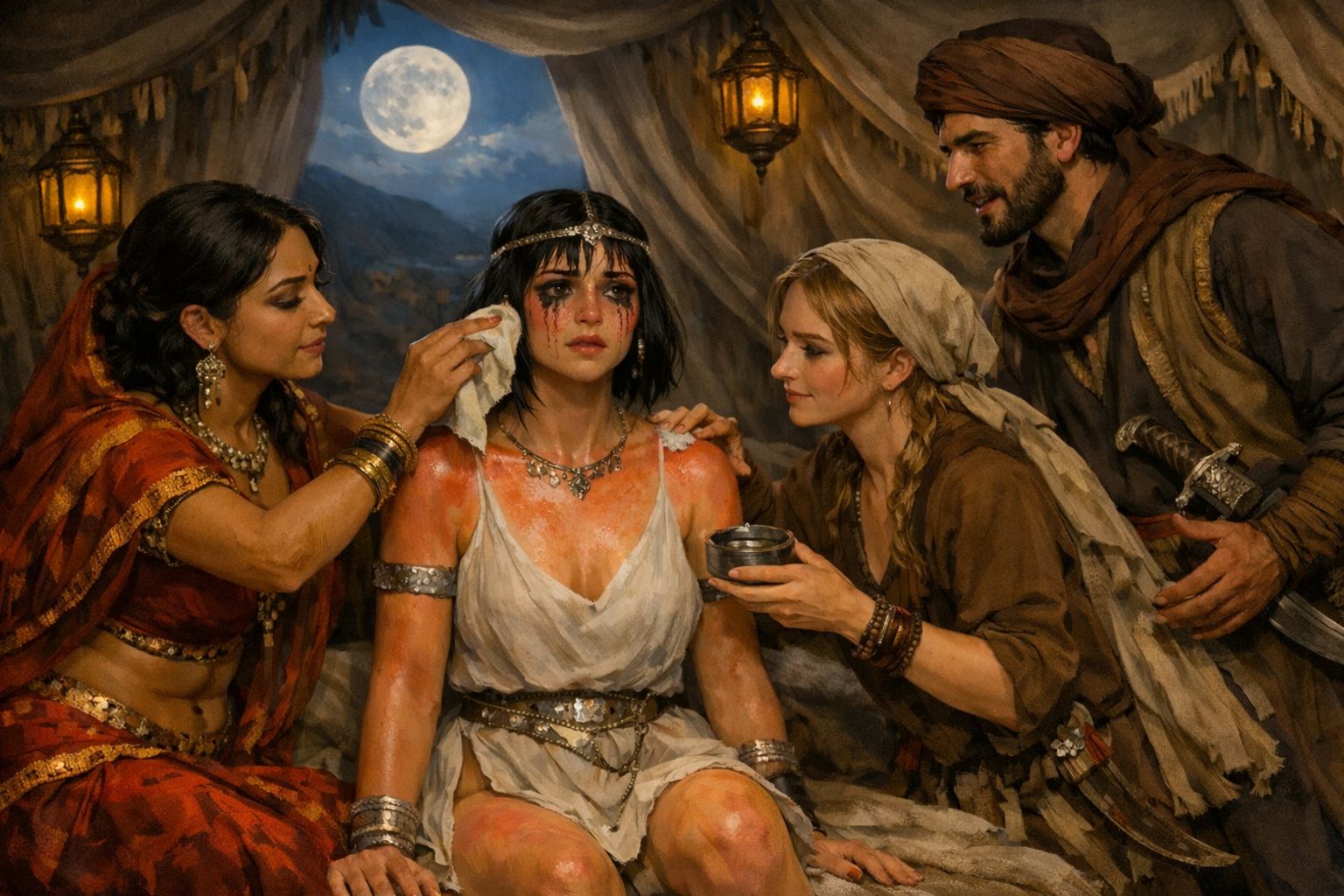
This section marks the real break with Lumekhet. Until now, the crew has still been operating inside the kingdom’s sacred structure, even while hiding from it. Once they leave with the Tazulmar, that changes. The arc moves out of palace intrigue and into caravan life, endurance and exposure.
The important point is that this departure is not only geographical. It is also personal. Ka-Iah cannot simply flee as herself. To survive, she has to accept that her old life is over.
Becoming Nephyla
This is the moment when Ka-Iah accepts that she no longer has any life left in Lumekhet. Ka-Ra is purging those loyal to her, her court is broken and her title now makes her more vulnerable rather than less. She cannot remain Ka-Iah, the Moon-Goddess Queen, and she cannot carry that identity safely into exile.
Her choosing the name Nephyla is therefore not just disguise. It is surrender, survival and the first real stripping away of her godhood. She is leaving behind not only a palace and a title, but the entire structure that made her who she was.
The name change is the first real step in her fall from godhood into personhood.
Traveling With the Tazulmar
The Tazulmar do not travel as a string of wagons or as scattered riders. Their caravan is built around the great Shar'zul, immense desert beasts that carry wooden platforms on their backs. Upon these platforms stand tents and storage frames lashed down with practiced care. The crew is assigned one of these tents and must share it. Each Shar'zul becomes like a small village.
This should immediately change the feel of travel. Space is limited. Comfort is relative. The caravan is mobile, communal and close packed. The crew is not being given private guest quarters. They are being fitted into an existing way of life.
Rashad Year-Without-Rain stood with his arms folded, looking at the crew as though judging whether they had enough sense to be allowed near something this expensive and this alive.
"Gentle giants," he said at last. "That is what outsiders say when they want to feel safe. Keep the giant part in mind."
Junia, Nasheem, Ayesha and the Moon stood listening in unusual silence. Even Nephyla, who had been unimpressed by many things since exile began, looked very small beside the nearest beast. Ileena, by contrast, had already lost interest and was crouched in the sand nearby, drawing lines with one finger and watching nothing in particular.
Rashad jerked his chin toward the closest of the three.
"That is Jahrak. Oldest of them. Wisest too, if you ask me. The broad one there with the chipped plate near the sixth segment, that is Sareth. Lazy when he can get away with it. And the skittish one at the back is Vezhur. Quickest of the three and easiest to annoy. He is the one your tent will be on."
Thaleia was writing before he had finished the first name.
"How old is Jahrak?" she asked. "And how fast can Vezhur move over steep dunes? And when you say blind, do you mean fully blind or merely light-blind, because the antennae suggest..."
Rashad looked at her for a long, dry moment.
"I mean blind enough that if you wave at him, he will not care."
Nasheem’s mouth twitched.
Rashad continued.
"Do not try to climb on or off while they are moving. Ever. I do not care how graceful you think you are. Use the folding stairs and use them when the beast is still. Fall under one of these and there will not be enough of you left for Mira to complain over."
Thaleia scribbled harder.
"Noted."
"Also," Rashad said, pointing now, "do not feed them. They are herbivores. They do not want your hand. But if your hand happens to be where the food is, they can take both in one bite and never mean a thing by it."
Nasheem clasped his hands behind his back.
"And never touch the antennae."
That landed differently. Rashad’s voice had gone flatter.
"Not to admire them. Not to test them. Not because you think the beast likes you. Do that, and even Jahrak may throw you. The antennae are for the world. You do not meddle with how they read the world."
Thaleia opened her mouth.
Rashad raised a finger without even looking at her.
"No."
She closed it again, offended but obedient, and wrote something with unnecessary force.
For a while no one said anything. The Shar'zul shifted softly in the dark, legs moving under plated bodies with a faint dry clicking, too many limbs for comfort and too much size to ever get used to. One of them let out a low vibrating hum that seemed to come up through the sand itself.
Ileena yawned.
"They are big bugs," she said. "I saw that at once. Seen big bugs before."
Rashad gave her a sidelong glance.
"And these big bugs can carry your whole tribe through a land that would kill you by noon."

Rhythm of the Caravan
The Tazulmar do not make full camp every night. They stop only for a few hours, usually after dark, when the whole caravan gathers to eat, trade stories and socialize before moving on again. Much of their sleep happens in shifts during travel, arranged around the roles in the caravan.
This makes the caravan feel strange to outsiders at first. Rest is fragmented. Time blurs. Life is organized around movement rather than stillness. A newcomer never fully gets the sense of a clean stop and a clean start. The road continues almost all the time.
This rhythm should also help the second half of the arc feel different from the city material. Oshiren was static, enclosed and politically dense. Caravan life is ongoing, exposed and physically intimate.
Scouts and Security
The Tazulmar do not rely only on the Shar'zul. They also use scouts on camels who range ahead and outward from the main body of the caravan. These scouts search for water, forage and other useful resources, but they are equally important as an early warning system.
This matters because the caravan is not blindly crossing the desert. It survives by knowledge, habit and preparation. The Tazulmar know where to go, where to stop and how to detect danger before it reaches them. That expertise should be visible in small ways all through the journey.
Little Privacy
One of the strongest cultural shocks of traveling with the Tazulmar is the lack of privacy. Life is lived close together. People wash outside. They relieve themselves outside. Lovers are separated from friends and family by little more than a thin tent wall. Children, elders, beasts and strangers all exist in close proximity.
This way of life leaves them with few taboos around the body or sex. One of the strongest taboos they do keep is inbreeding, which means outsiders and members of other tribes often draw interest.
To outsiders, this can feel shameless. To the Tazulmar, it is simply life. They are not trying to scandalize anyone. Privacy is a luxury that matters less than survival, kinship and shared movement.
This should create constant low level friction, awkwardness or adjustment for the crew. It also gives many chances to show who adapts easily, who struggles and who pretends not to notice.
Water and Food
Water is the critical resource of the caravan. It is heavy, difficult to transport and never wasted. Even though the Tazulmar know the hidden oases of the deep desert, those sources are still few and far between.
Food, by contrast, is plentiful. The Tazulmar carry large stores and their evening meals should feel generous, almost celebratory. Eating together is one of the few times the whole caravan truly gathers in one shared rhythm.
That contrast matters. They feast on food, but ration water. Newcomers may at first find this strange, but it is central to desert logic. Bread, meat and dates can be piled high. Water is measured.
The Road Out of Lumekhet
Oshiren lies deep inside Lumekhet, so the departure is not a clean jump from city to wilderness. The caravan still has trade to finish and must pass through settled country before the true desert takes hold.
The planned stops are Sekhara, Ptep, Ashaket and finally a trading camp near the source of the Zareth River. Each stop is one full day. If something delays the caravan, it becomes two. The Tazulmar do not think in half stops or partial rest. They move, or they stop.
This gives the departure stretch a useful structure. The crew is leaving, but not yet free. They are still moving through Lumekhet’s shadow, still exposed to recognition, pursuit and rumor. The road out should feel like a drawn out exhalation rather than a sudden escape.
Use these stops to show the kingdom thinning out around them. Sacred order becomes weaker, then patchier, then more distant. The caravan way of life starts to replace Lumekhet’s fixed hierarchy as the dominant reality.
Key Impression
Leaving with the Tazulmar should feel like a real change of world. The crew is no longer dealing with courts, temples and palace walls. They are now part of a moving society built on endurance, proximity and knowledge of the desert.
For Nephyla, this is the first stage of exile.
For the crew, it is the first stage of the road to Ssar'et.
Caravan Event List
These are optional events to flesh out life with the Dunewind Tribe. They should make the caravan feel lived in, crowded and socially real, while also giving the players something to do. None of them should steal focus from the main arc. Think of them as small pressures, human moments and practical problems that reveal the caravan through play.
These may also be used later in the Tazulmar campaign arc.
Daily Life and Practical Friction
Water Dispute
Khalida catches someone wasting water or suspects that someone has washed more than they should. The accusation may be true, exaggerated or simply impossible to prove. The players can calm tempers, help investigate or take sides. This is a good way to show how serious water is and how quickly small comforts become communal issues.
Sleeping Space Tension
A shared tent arrangement becomes awkward. Someone snores, sprawls, smells, keeps strange hours or is quietly trying to spend the night beside someone else. Laleh tries to smooth it over, but the players may be asked to swap places, mediate or endure it.
This is a good low level event for showing how little privacy caravan life allows.
A Missing Child
Little Hadi or another child vanishes into the moving chaos of the caravan. Panic rises quickly because a moving caravan is full of places to be crushed, lost or left behind. The players can help search, calm adults or discover that the child has simply crawled into some impossible hiding place.
This is a good way to make the caravan feel full of families, not just travelers.
Social and Emotional Events
An Evening Story Challenge
Old Samir tells a story at the evening halt, and then demands one in return from the crew. He is not interested in polished heroics. He wants something true, strange or worth remembering. If the players engage, this can build relationships and reveal character. If they refuse, Samir may decide they are poor company and say so.
Matchmaking Trouble
Nisrine, Nahla or some other socially active member of the caravan becomes convinced that two people belong together and begins nudging, arranging, embarrassing or interfering. This can be playful, awkward or irritating depending on who is targeted.
This is useful for giving the caravan a warm, meddling social life.
A Mourning Song
Zahra begins a mourning song for someone long dead or recently lost, and the whole meal changes tone. Players may join, listen or ask what the song means. This can be especially effective after the destroyed caravan or the final battle, but it also works earlier to seed the tribe’s emotional continuity.
Quiet Company
A quieter member of the caravan, Farah, Laleh, Mira or Yusef, falls into conversation with one of the crew during a watch shift or while walking beside a Shar'zul. The topic can be grief, love, family, the desert or the tribe’s way of life. Nothing dramatic has to happen. The point is to let familiarity grow.
Tension Around Nephyla
A Command Given Wrongly
Nephyla gives an order to someone who does not belong to her, perhaps casually, perhaps sharply. The reaction depends on who hears it. Some may laugh, some bristle, some obey before thinking and resent it afterward. The players may need to intervene, explain or force Nephyla to apologize.
This is one of the best recurring ways to show her social maladjustment.
A Request for Luxury
Nephyla demands some piece of old comfort, finer bedding, shade, oils, servants, privacy, special food or jewelry, as if it were entirely reasonable. The request itself can be absurd, but the underlying grief is real. The players can deny her, mock her, help her or try to translate the need into something possible.
Anxiety at Being Alone
Nephyla is left alone longer than usual and reacts badly, becoming irritable, cold or visibly unsettled. This may happen at a halt, during a market stop or while people are busy with caravan work. Someone has to notice and decide what to do with that.
This is a good event for showing that her dependence is not only arrogance.
Shar'zul and Camel Events
A Shar'zul Refuses to Settle
Vezhur or another Shar'zul becomes restless, perhaps because of weather, scent, injury or some unseen irritation. Rashad needs help keeping movement around the beast calm and controlled. A careless person can make things worse very quickly.
This gives the players a chance to learn more about the beasts and the respect they command.
Night Sounds
One of the beasts begins making strange noise in the dark. Some think it is illness, some think it is scenting danger and some think it is nothing. The players can investigate or be dragged into the superstition, caution and practical argument that follows.
Travel and Desert Pressure
Heat Sickness
Someone collapses from heat, pride or stupidity. Mira or Junia takes over, but help is needed, shade, water, carrying, clearing space, holding someone down or fetching the right supplies. This reinforces that the desert itself is a threat that punishes carelessness.
A False Water Hope
Scouts return with word of water or shade, only for it to be poor, fouled, too little or fiercely contested by reality. The disappointment hits hard and the mood of the caravan shifts. The players can help manage tempers, rationing and morale.
Sandstorm Preparations
A storm is coming, and the caravan must secure cloth, lash goods, cover faces, calm children and settle beasts fast. This is excellent for showing communal competence and the need for everyone to do their part.
Outsiders and Market Stop Events
A Young Trader Flirts Too Boldly
At a stop, a local trader or caravan youth takes interest in one of the crew, and the whole thing starts becoming public before anyone wants it to. This can be funny, sweet, awkward or dangerous depending on who is involved.
A Covert Deal
Someone in camp or town is willing to trade privately, but only if the exchange happens quietly and quickly. The players may be asked to make contact, guard the deal or decide whether the risk is worth it.
An Unwanted Question
A stranger asks a question too specific to be harmless, about Nephyla, about foreigners, about where the caravan came from or where it is headed. The players must decide whether to evade, bluff, intimidate or withdraw.
Rivalries, Pride and Internal Friction
Jalir Boasts Too Much
Jalir talks himself into trouble, a duel, a bet, a fight, a romantic misunderstanding or a promise he cannot keep. The players may have to get him out of it or decide he deserves the lesson.
This works especially well before his disappearance, because it normalizes him as impulsive.
Sada and Rashad Clash
Water, load weight or pace becomes the subject of a serious argument between Sada and Rashad. Both have a point. Both are stubborn. The players may be dragged in as extra hands or unwilling witnesses.
Qamar Demands Discipline
After some mistake, real or imagined, Qamar tightens order. More watches. Less wandering. Sharper tone. This can create friction with the crew, especially if they are already tired or do not like being told what to do by someone outside the Blue Marlin.
Parvin Passes Judgment
Parvin corners someone and delivers a cutting opinion on their behavior, romance, manners, grief or foolishness. She may be right, wrong or both. This is useful for injecting social pressure in a way that feels tribal and personal rather than official.
Best Uses
If you want the caravan to feel full and alive without becoming noisy, pick events from different kinds of pressure. Don't use too many, these can be used for the rest of the arc, and the next arc, the Tazulmar arc.
The Moon in Exile
By the time the caravan gathered for its first true halt after leaving Lumekhet behind, everyone was tired in the way only caravan travel could produce, not the clean fatigue of work finished, but the frayed, half sick exhaustion of movement that never fully stopped. The Shar'zul had groaned and swayed beneath them all day, the tent platforms shifting with every step, the heat had sat on shoulders and skulls like a hand that never lifted and the little scraps of sleep snatched in motion had only made waking worse. When evening finally came, it came with firelight, food and the low murmur of Tazulmar voices threading through the dark. After that, people began to fold inward toward rest as best they could.
Inside the crew’s tent, Junia moved first, too tired for grace. She loosened her outer layers, folded what was worth folding and sat for a moment with one hand pressed to the back of her neck. Her eyes felt full of sand. She had slept little the night before, almost not at all, because Nephyla had been hurting, and pain had no respect for dusk, dawn or a healer’s need for sleep. Ayesha was more orderly even in exhaustion, setting things aside with the same composed economy she brought to everything, though the slowness of her hands betrayed her. Nasheem removed his shoes and was asleep almost at once. Ileena had already curled herself around a pillow. Thaleia, impossibly, was still making notes about the Shar'zul.
Nephyla stood in the middle of the tent and waited.
She did not fidget. She did not pace. She simply stood there in the dim lamplight with the same expectation she might once have carried into a palace chamber, silk robes still arranged upon her, chin slightly raised, eyes half lidded from tiredness and annoyance. Outside the thin tent walls came the ordinary sounds of caravan intimacy, low voices, someone laughing too loudly, a child being hushed, the muffled cough of a camel and, not far away, the very unmistakable sounds of a couple making no serious effort to be discreet. None of it seemed to touch her. She waited as if waiting were an instruction to the world.
At last Junia looked up.
“Are you feeling all right?”
Nephyla turned her head toward her with faint irritation, as though the answer should have been obvious.
“Undress me,” she said. “So I can sleep.”
There was a small silence after that. Junia stared at her, not shocked exactly, only too tired for disbelief. Then, because she was too tired to soften anything and too tired to care, she answered with a bluntness that would have surprised anyone who knew her well.
“Do it yourself.”
Nephyla blinked.
For the first time since entering the tent, something like real uncertainty crossed her face. Not outrage. Not yet. Something smaller, stranger and almost childish in its nakedness.
“I do not know how.”
Ayesha let out a slow breath through her nose. It was not quite a sigh, but it wanted to be one. She stepped forward, reaching for the first clasp with long practiced hands.
“I will show you,” she said. “But only this time. The next time, you will do it yourself.”
She loosened one fastening, then another, and the stiffness of court dress began to come apart beneath her fingers.
After a brief pause, she added, “And I suppose I shall have to show you how to get dressed in the morning as well.”
Nephyla’s answer came at once, calm and perfectly sincere.
“Yes.”
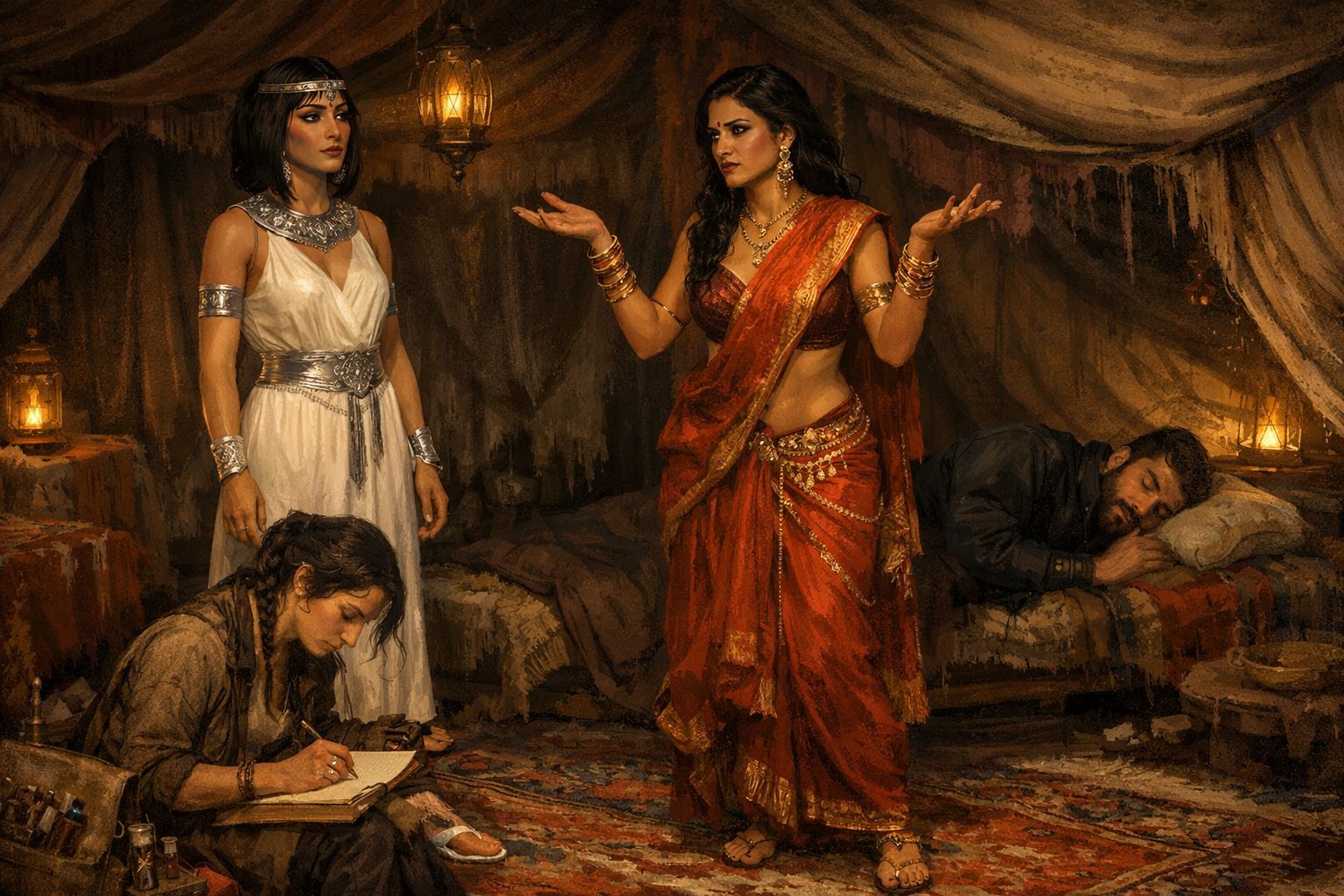
Nephyla’s change should be slow.
She does not become likable quickly. She does not become practical quickly. She does not suddenly discover humility because she has suffered. For all the power she once wielded, she is now, in almost every practical sense, a stranger in a strange land. She lacks not only skills, but habits of mind. She has never had to care for herself, carry her own weight, read ordinary social situations or understand what other people feel unless it affected her directly.
That helplessness is the point. Her old life must be broken down before anything new can grow.
Where This Arc Stops
Her larger arc may eventually lead toward gratitude, friendship and becoming a real person instead of a fake god, but not here.
In this stretch of the journey, keep her firmly in the first stages. Her old life is being stripped away. She is helpless. She becomes dependent. She receives help, often unwillingly, often without knowing what to do with it. That is enough.
Do not rush past that. There is plenty of time to develop her.
Practical Helplessness
Nephyla is not simply pampered. She is unequipped.
She may not know how to dress herself properly, wash her own clothes, manage bedding, ration supplies, keep track of personal possessions or do any of the countless small things ordinary life demands without thought. Even when shown, she will not learn all at once. Some lessons will need repeating. Others she will resent so much that she refuses to take them in until forced.
This should not be played only for humor. The comedy is real, but so is the damage. Every comic situation should end with a sharp bite as her helplessness becomes plain to see. Every small failure reminds her that she has fallen from a life in which her every need was anticipated and handled.
Social Helplessness
The deeper problem is social.
Nephyla does not yet know how to live among equals. She gives orders where others would ask. She expects obedience where others would negotiate. She speaks directly and often rudely, not because she is trying to shock, but because she has never needed to soften herself for people beneath her.
She needs to learn to ask instead of command. She needs to learn to listen instead of assume. She needs to learn that other people have feelings, limits and pride of their own, and that these matter even when they do not serve her.
At first, she will be bad at this. Let her be bad at it.
Grief for the Old Life
Nephyla should occasionally grieve what she has lost, but she will usually do so in ugly or frustrating ways.
She may ask whether she can acquire new slave girls at the next stop. She may complain about food, heat, dust, smells, bedding or the indignity of shared space. She may speak of her old life as if parts of it could simply be restored by effort or wealth. She may still expect service as if it were ordinary and natural.
These moments matter because they show that she is not only arrogant. She is mourning. The trouble is that she only knows how to mourn through the habits of entitlement that old life created.
Not Shy, Never Alone
One of the few ways she fits naturally among the Tazulmar is that she is not shy.
A lifetime of being dressed, washed, attended and watched has left her with very little instinct for privacy. Bodies do not embarrass her. Close living does not embarrass her. The constant presence of others does not embarrass her.
In fact, being alone can make her uneasy.
She is used to never, ever being alone. Servants, guards, priests, attendants, musicians, slave girls, someone was always there. Exile strips that away, and the absence should sometimes trouble her more than she knows how to admit. If she lingers near others, intrudes on company or resists solitude, that should not always read as arrogance. Sometimes it is anxiety.
How Others Should React
Different people should respond to her differently.
Some will be irritated. Some amused. Some practical. Some unexpectedly patient. The important thing is that she is not met with one single response from the world. That would make her simpler than she should be.
People like Sada or Rashad may have little patience for uselessness. People like Mira or Junia may help her more directly, though not always gently. Zahra, Farah or Parvin may see more clearly than she does what sits beneath the behavior. Others may simply find her exhausting.
This variety matters because it helps shape the help she receives. Not all help is tender. Some of it is blunt, tired or exasperated. That is fine.
Capacity for Change
Even while keeping her difficult, show the reasons beneath it.
She was made to be like this. She was raised inside absolute hierarchy, taught to command, taught to expect service, taught that her desires outranked other lives. She is not broken because she was born monstrous. She is broken because she was shaped for a role that left little room to become a person.
That should show.
She may hesitate for a moment before giving an order and then fail to soften it. She may be briefly confused by kindness. She may cling to someone who helps her and then cover it with irritation. She may remember a lesson and use it once, awkwardly, before falling back into old habits.
These are small things, but they matter. They show that, at her core, she is hurt, and that hurt can someday be healed.
Key Impression
Nephyla is not yet becoming better. She is being dismantled.
That dismantling should feel painful, humiliating and necessary. Beneath the entitlement, rudeness and dependence, there must already be the sense that a real person exists inside her, one who has never before been allowed to live.
The meal was over, and around them the caravan had begun its quiet, practiced bustle of departure. Pots were tied down, harness checked, embers stirred low. The movement gave them a kind of privacy, a small circle of firelight no one had reason to intrude on.
Ayesha watched Nephyla across the coals for a moment, then asked softly, "Why did he turn on you?"
Nephyla went still.
At first it was only hardness, a tightening in the jaw and shoulders. Then, for the first time any of them had seen, her eyes filled.
"Before me, my mother was Ka-Iah," she said. "She was his sister-wife. The Moon before me."
Her voice was steady, but only just.
"When I came of age, he lost interest in her. There were accusations. Treason. Lies dressed as sacred judgment." Her mouth twisted. "I watched her die on that podium. He made me watch. The same one they chained me to."
Junia drew in a slow breath and said nothing.
"When she died, I became Ka-Iah. I became his daughter-wife." Nephyla stared into the fire as if the words themselves disgusted her. "That was three years ago. But I would not be what he wanted. I hated him. I was revolted by him. I never truly performed as his wife."
Her tears were falling now, though she seemed almost angry at them.
"So he lost interest in me as well," she said. "And then he began looking at my little sister."
Nasheem lowered his eyes.
"She is of age now," Nephyla whispered. "I knew what would come next. The coldness. The whispers. The purge. The podium." Her voice broke. "He was going to do to me what he did to my mother, so that he could make my sister Ka-Iah and daughter-wife."
That was when the last of her composure gave way. She was openly crying now, not beautifully or gracefully, but like someone who had held it back for years and no longer could.
Ayesha moved without a word and put her arms around her.
Nephyla stiffened in confusion, as if she did not know at first what this was, how to read it, where to place it in the world. Then she clutched at Ayesha and bent into her shoulder, sobbing hard and helplessly.
Junia looked down and quietly rose. Nasheem stood with her. Neither spoke. They simply left the two women there by the fading firelight while the caravan gathered itself into motion around them.
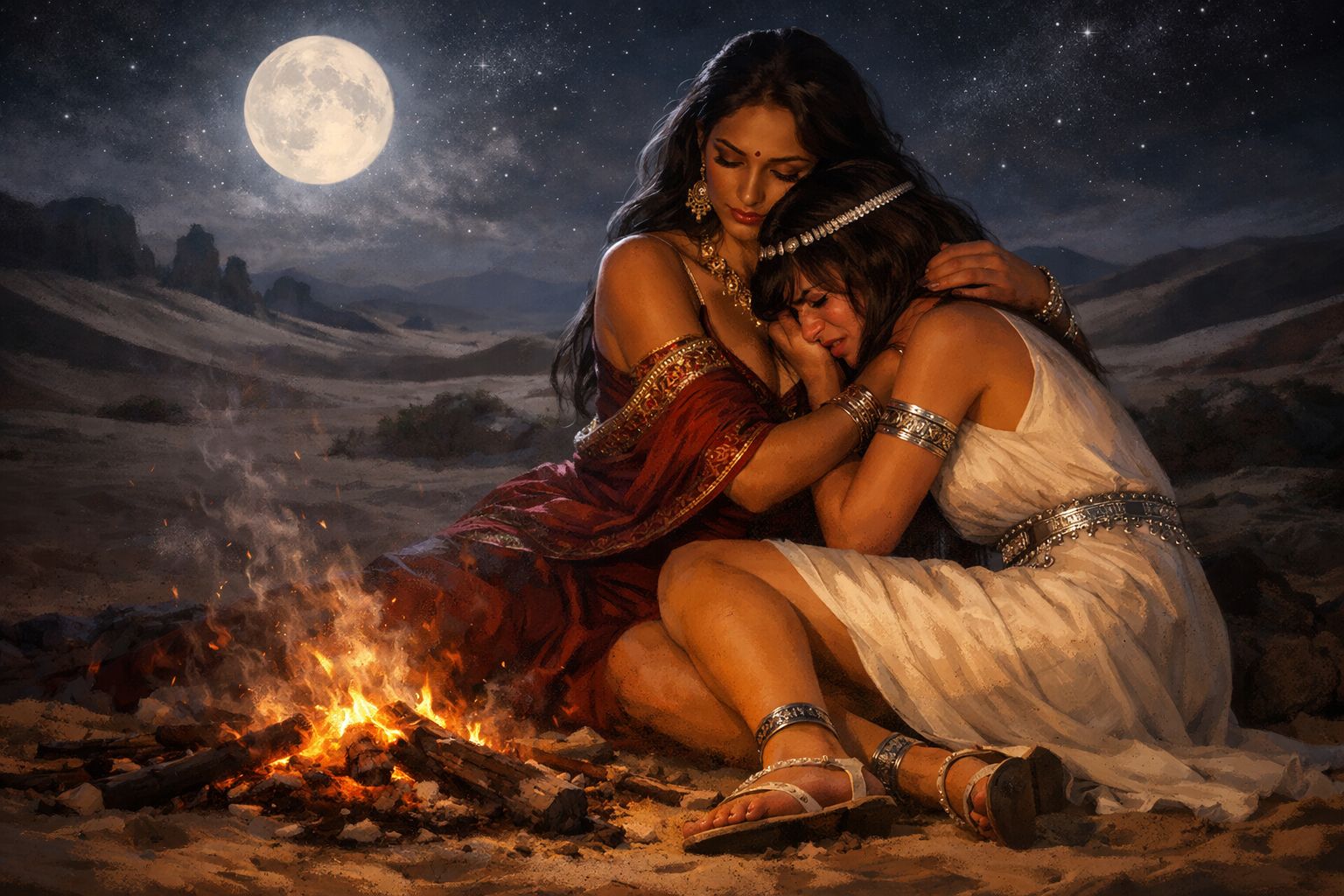
The Stranger in the Caravan
By the time the Dunewind Tribe reached Sekhara, the day had gone white with heat. The town stood low and pale against the sand, full of the brief chaos that always came when the Tazulmar arrived. Water carriers shouted. Porters ran. Children darted too close to the Shar'zul until older hands caught them and dragged them back. Goods were already being lowered from the platforms, cloth, salt, amber, dates, beetle shell dye, all the things the desert made precious by giving so little freely.
Ayesha had finished what was expected of her and stood in the shade beside one of the folding stairs, watching. Sada bint Miraz was below, as she often was, at the center of some practical dispute involving space, time and someone else’s optimism.
That was when the woman approached.
Her age was hard to place. In one glance she looked twenty, in the next forty, then somewhere between. She wore a long flowing dress marked with patterns Ayesha knew from Lumekhet, geometric patterns and abstract symbols, but the cut was not quite Lumekhet. It had the feel of something remembered and remade elsewhere.
She stopped before Sada and inclined her head.
"My name is Isetnefer," she said. "I seek passage to Ashaket."
Her voice was slow and deliberate. And when Sada answered, the woman replied just before the last word had quite left her mouth, not interrupting, only arriving a heartbeat early in a way Ayesha noticed without knowing why.
Sada looked her over.
"Passage costs water, space and patience. Which of those do you pay for?"
"Coin, first," said Isetnefer, with a smile that made her seem easier to place and harder to stop looking at.
They bargained. Isetnefer did it well, lightly and with no trace of need. She said she traveled light, ate little and would not complain.
At one point Sada said, "Ashaket is not our only stop."
"I know," said Isetnefer, and then, with the same untroubled calm, "Sekhara, Ptep, then Ashaket."
Sada frowned slightly. "People talk."
Isetnefer gave a short nod.
At last Sada named the fee. Isetnefer counted out the coin from somewhere within the folds of her dress and placed it into her hand.
"One tent corner," Sada said. "No demands. No wasted water. You follow caravan rules or you walk."
"Of course," Isetnefer replied.
They shook hands. Sada called for Laleh to find her bedding space, and Isetnefer turned at once and followed, moving with unhurried grace through the noise and heat of the caravan.

Isetnefer should enter the story quietly and stay there for a while.
Do not put too much focus on her. She is not meant to feel like an event the moment she appears. She is part of the caravan now, one more traveler among many, and the point is to let the players absorb her gradually. The feeling you want is not "something is wrong," but "she will probably matter later."
This thread should run in parallel with the rest of the journey. Let it sit beside other scenes, meals, stops, quarrels, repairs, awkwardness and ordinary caravan life. It is a slow boil.
Isetnefer Among the Tazulmar
Isetnefer joins the Dunewind Tribe for passage to Ashaket and settles into caravan life with surprising ease. She takes part in the evening meals, sits with people when spoken to and never quite becomes central, yet somehow draws attention anyway.
Her charm should feel slightly stronger than her actual actions justify. She does not need to perform much. She listens well, speaks sparingly and uses words with unusual precision. This makes her seem calm, composed and easy to like without ever becoming flashy.
Keep her slightly withdrawn. She is present, but never too available. That helps others move toward her rather than the other way around.
The First Three Days
For three days, let her take a normal part in tribe life.
She eats with the others. She may speak with Zahra, exchange a few words with Laleh, or sit near the fire listening to Samir without interrupting. She should feel as though she is fitting herself into the caravan without effort, but not trying too hard to belong.
The younger members of the tribe are especially drawn to her. This should not feel dramatic. It should feel natural, the way some people simply gather attention around them. Jalir in particular spends time talking with her. Present this as obvious romantic interest from him. He lingers near her, looks for reasons to speak to her and acts slightly more foolish than usual in her presence.
That matters because it gives the disappearance an ordinary explanation in the moment. If the players notice anything at all, it should seem like a young man chasing after a fascinating woman, nothing more.
Handling the Mood
Be subtle.
Do not show anything openly suspicious. Do not give her dramatic lines, strange smiles, visible hunger or eerie behavior. The thread works best if it feels almost too quiet to note at the time.
Use soft details instead. She is attentive. She speaks just a little too exactly. People seem to enjoy talking to her. Jalir becomes more attached to her than is wise. That is enough.
The Disappearance
On the third night, after the meal, as the caravan begins preparing to move again, both Isetnefer and Jalir are gone.
At first this may not seem alarming. Jalir’s interest has been plain, and the caravan has little privacy. But they do not return, and that changes the mood quickly.
A search begins. The only sign is a pair of tracks leading away into the dunes. Isetnefer’s things are gone as well. That matters. This was not a sudden panic or attack. She left deliberately, and Jalir left with her.
The tracks do not go far before the wind takes them. Camel scouts search outward and ahead, but find nothing.
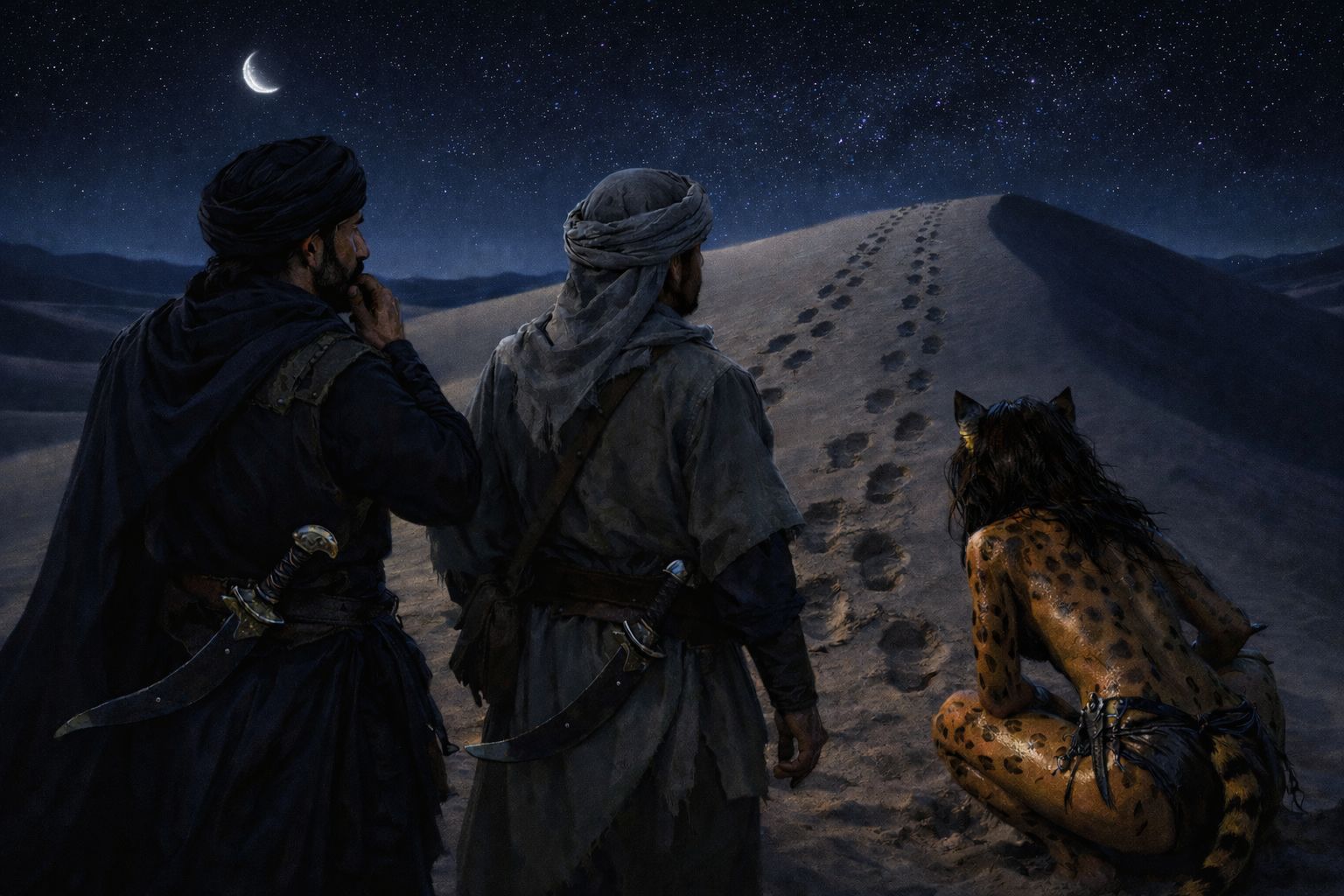
The Lost Day
Ashaket lies only one day away, but the tribe does not leave immediately. They stay one full day to continue the search.
That day should feel frustrating rather than dramatic. Heat, distance and wind work against them. The desert gives back nothing. No body, no camp, no sign of struggle, no abandoned belongings. Only absence.
By the end of that extra day, the tribe has no choice but to move on.
That decision should feel heavy. Not theatrical, just hard and practical.
Nephyla’s Recognition
The night had gone thin and cold. Scouts had returned empty handed. The wind had eaten the tracks. Jalir’s name was still being called now and then, but with less hope each time. Miraz stood beside a low fire with Old Samir, while Ayesha, Nasheem and Thaleia gathered close enough to listen. Thaleia still held her notebook, though for once she was not writing.
Nephyla remained standing.
“She was not a woman,” she said. “She was a Hollow.”
Thaleia frowned. “A what?”
Nephyla’s face had gone hard and pale in the firelight.
“In Lumekhet, the dead are carried west, and at the full moon their souls are borne back east to fill the newborn. That is the order. But sometimes the order fails. A child is born, and no soul comes. The body lives. It grows. It speaks. But there is nothing inside that should be there.”
For a moment no one said anything.
Thaleia swallowed. “You mean empty.”
“Yes,” said Nephyla. “Empty.”
Her voice grew flatter, colder, as if she were reciting something learned young and feared ever since.
“They are rare. They should be. But people are drawn to them. That is part of the horror. There is something magnetic in them. They learn people quickly. They know where to press. What to say. How to move through others.”
Miraz’s eyes narrowed.
“You say this now.”
“Because before, it was only unease,” Nephyla said sharply. “The age in her face. The way she answered a heartbeat too early. The way she seemed to know where words were going before they arrived.” Her gaze shifted toward the dark beyond the fire. “Then she vanished with your young fool, and your scouts found nothing. That made it clear.”
Old Samir nodded once.
“Aye,” he said. “I have heard such tales.”
Thaleia had gone very still.
“What do they want?”
Nephyla laughed once, without warmth.
“To fill themselves. To spoil what lives around them. To feel like people by devouring people. I do not know if even they understand it. They are hunger and seduction wearing a human face.”
The silence after that felt heavier than before.
At last Miraz exhaled.
“Then Jalir is gone.”
Nephyla did not answer. Her face said enough.
Old Samir looked into the fire.
“Best we stop spending lives on what the sand has already taken.”
Miraz stood for a moment longer, then gave the order quietly. At dawn, the search would end. The caravan would move on.
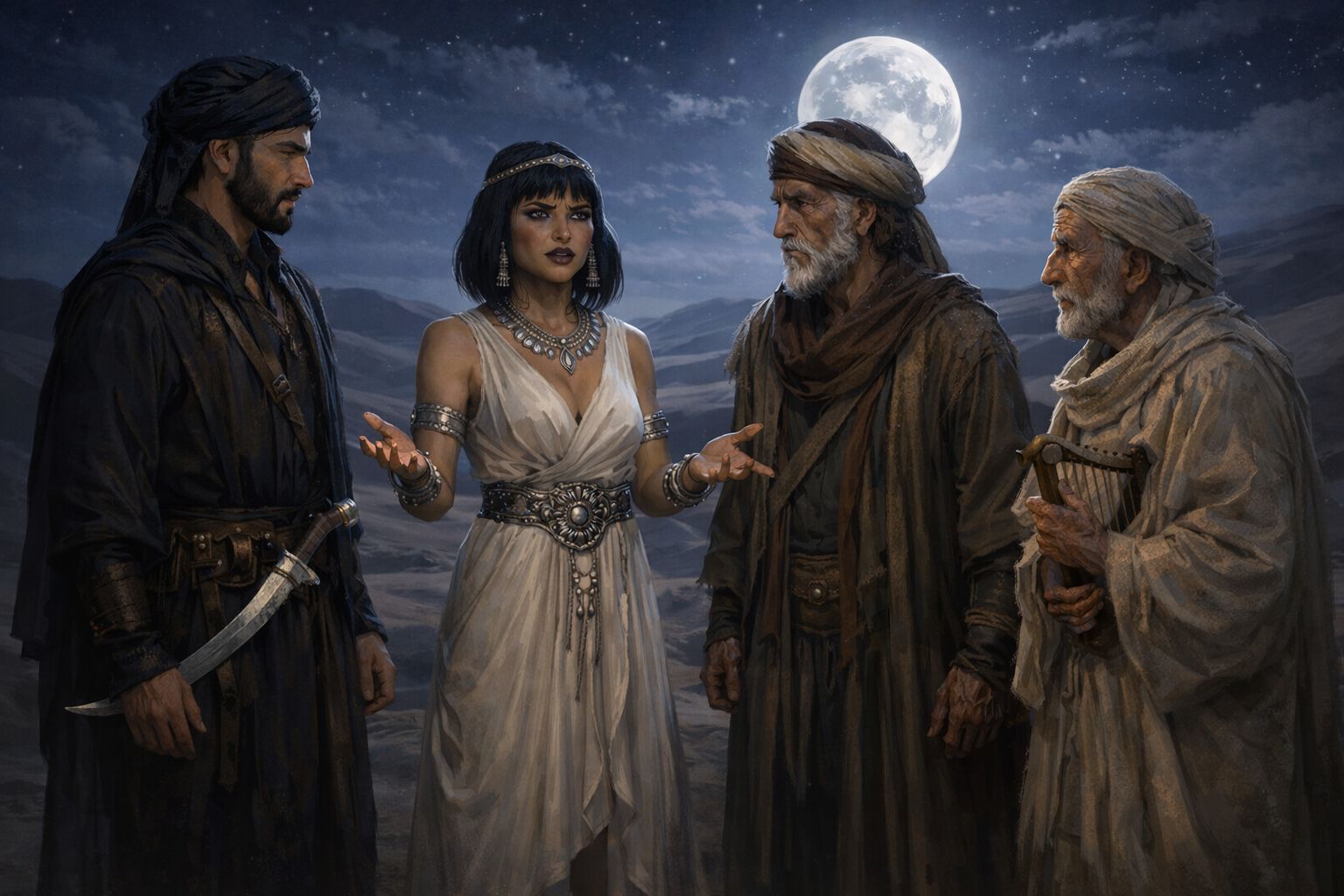
Nephyla understands the truth, or enough of it.
She may not speak at once. Let the certainty form in her first. She suspected something when they vanished, and the total failure of the search confirms it for her. Isetnefer was a Hollow.
This is where Nephyla explains what a Hollow is, not as abstract theology, but as something feared in Lumekhet. A person without a soul. A failure in the sacred cycle. Not a mere madman or wrongness of character, but a deeper absence, something that should not exist and that draws horror because it means the order of life and death can fail.
Old Samir agrees with her reading. The important thing here is not that everyone suddenly understands everything, but that the tribe accepts there will be no rescue. Whatever took Jalir is beyond ordinary search, and whatever remained of Isetnefer was never simply a traveler.
After that, the decision is made. The search ends. The caravan moves on.
Function of the Thread
This thread does several jobs.
- It gives the journey a quiet horror that arrives sideways rather than through open attack.
- It shows that danger in Lumekhet and its borderlands is not always loud, visible or violent.
- It gives the caravan a real loss, one that should matter because Jalir was foolish, likable and human, not because he was important.
- It also lets Nephyla become useful in a way that fits her old world. For once, her knowledge matters more than her helplessness.
Key Impression
Isetnefer should feel, in hindsight, like someone who was wrong in ways no one could quite name at the time.
The disappearance should not feel like a twist. It should feel like a quiet thread suddenly pulled tight, the safety of the caravan gone.
And when the caravan finally moves on, it should do so with one of its young voices missing from the evening fire.
Desert Pressure
This stretch of the journey is not about sudden escalation, but about pressure building step by step. The caravan is moving, but not freely. With each stop, the sense of being hunted should grow clearer. At first it is only inconvenience and rumor. Then signs. Then direct consequences. The goal is to build anticipation and tighten the mood, not to turn every stop into a major event.
The important thing is rhythm. Each town should feel a little worse than the last, not because each one is larger or more dramatic, but because the same threat is getting closer, better informed and harder to ignore. The desert does not yet offer safety. Lumekhet is still reaching after them.
The planned route is:
- Sekhara, 2 days
- Ptep, 2 days
- Ashaket, 2 days
- Trading camp at the source of the Zareth River, 3 days
Use these intervals well. They are long enough for caravan life, private scenes and small tensions to breathe, but short enough that the pressure never fully lifts. The road itself should feel like a narrowing corridor, carrying the caravan toward harsher country while the hunt closes in behind it.
Sekhara
The clerk arrived with dust on his sandals, ink on his fingers and the full weight of his own importance tucked under one arm in a stack of folded papers.
By then the Dunewind Tribe had already spent too long standing still in Sekhara’s heat. Goods waited half unloaded. Water skins stood in a row beside the Shar'zul. Porters shifted irritably. Sada had gone cold with anger. Miraz Khalim still had his patience, but only just.
The clerk licked a thumb, unfolded another page and gave it a little shake.
“These seals are incomplete,” he said. “Or outdated. And this quantity of trade goods may require a secondary levy, unless the exemption applies, which depends on whether your tribe counts as itinerant commercial movement or temporary migratory passage.”
Ayesha stood beside Miraz, voice calm and cool.
“You have already counted the loads twice.”
“Yes,” said the clerk. “And if I am forced to count them a third time, I shall do so with a heavy heart and a full sense of duty.”
He had the dry, pinched face of a man who had been given a stamp and intended to abuse it. Every sentence came with another flick of paper, another little flex of bureaucratic muscle.
Miraz kept his tone level.
“You know what we carry. You know what we owe. Name it plainly.”
The clerk drew himself up.
“I am trying to avoid unpleasantness. There are procedures. Regulations. Standards. Still, for a reasonable compensatory fee, I may be able to resolve certain ambiguities in your favor.”
Ayesha’s smile sharpened slightly.
“How generous.”
Then Nephyla stepped forward.
“Enough,” she said.
That was all. No raised voice. No threat. Just one word, spoken with the effortless certainty of someone who had spent a lifetime being obeyed.
The clerk froze.
Nephyla looked at him with flat contempt.
“You are delaying this caravan. You will stop. You will leave. You will not trouble us again.”
The papers sagged in his hands. For one heartbeat he looked like a man who had forgotten how his own authority worked.
Then he folded.
“Of course,” he said quickly. “Naturally. Only routine. A misunderstanding. Entirely resolved.”
He gathered his papers too fast, nearly dropped one, bent for it, muttered apologies and retreated in a stream of excuses before hurrying off down the street.
For a moment no one spoke.
Then Ayesha let out a low whistle.
“Well. That was impressive. How did you do that?”
Nephyla looked faintly puzzled.
“He is a bureaucrat,” she said. “They are all the same. One commands them, and they obey.”
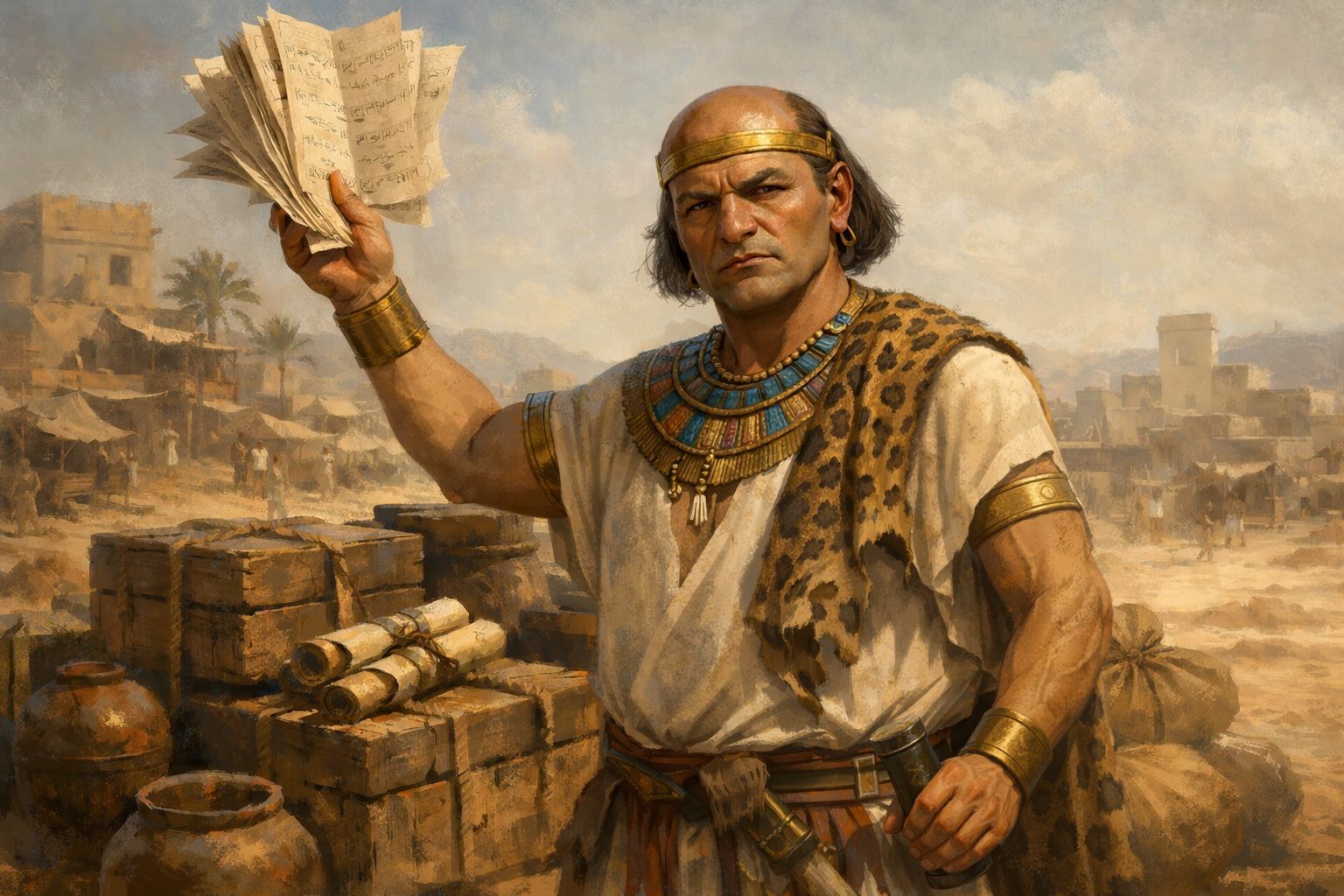
This scene exists to put pressure on the caravan without turning the stop into a major incident. The threat is small, mean and entirely human. That is what makes it useful.
The point is not danger in the sense of violence. The point is vulnerability. The Dunewind Tribe is still inside Lumekhet’s orbit, still dependent on access, trade and movement, and therefore still exposed to anyone with a scrap of local authority and a taste for squeezing travelers.
The Tax Clerk
A local tax clerk decides to remind everyone that settled people outrank nomads here.
He does not need to be impressive. In fact, he is better if he is petty, dry and completely sure that this sort of pressure is normal. He is the kind of bureaucrat who has been given a stamp, and intends to abuse that power.
He threatens delay rather than punishment. He wants to inspect goods more closely, question permits, count loads, discuss regulations or enforce some obscure local custom that only matters because the caravan cannot afford to waste time.
Eventually, it becomes clear that all of this can be solved for a "reasonable fee," which is of course not reasonable at all.
He should feel like a man who does this often, and who expects the Tazulmar to swallow the insult because moving on matters more than dignity.
Tone
Keep the threat small.
This is not a dramatic confrontation. It is a nuisance with teeth. The tax clerk is not trying to destroy the caravan. He is trying to profit from the fact that delay hurts them more than it hurts him. That is why he is effective.
The mood should be irritation, pressure and the sense that flight can be threatened just as easily by bureaucracy and greed as by soldiers.
How the Scene Plays
Let Miraz and others deal with him first.
Miraz should remain controlled. Sada may be colder and less patient. Others can argue, complain or try to reason with the man. The important thing is to let the crew feel the trap for a little while. The clerk has enough authority to be annoying and not enough dignity to be respectable.
Do not resolve it too quickly. Let the players feel how absurdly vulnerable the caravan is to one small official with too much time and too little conscience.
Nephyla Steps In
Once the scene has had time to breathe, let Nephyla step in.
She does not persuade. She does not negotiate. She simply tells him to leave and stop interfering, with the full effortless authority of someone who has spent her life being obeyed.
The clerk does not recognize her. That is not the point.
What matters is that she carries the trained certainty of absolute rank, and he folds before it at once. He may stumble, bow slightly, mutter some excuse or retreat with wounded dignity, but he goes.
Why This Matters
This moment does several useful things at once.
It shows that Nephyla’s old self is not gone. She may not know how to dress herself, but she knows how to command.
It gives her a brief moment of usefulness that comes naturally from who she used to be.
It also reminds the crew that hierarchy is not just law or clothing. Sometimes it lives in posture, timing and tone so deeply that it survives exile.
At the same time, the scene should not become triumphant. This is not Nephyla reclaiming herself. It is one old reflex still working in a smaller world.
Things to Do in Sekhara
Sekhara is safe enough for the crew to spend the day in the town, shopping, eating local food or just looking around. Give them some quiet time.
The stop at Sekhara should have felt ordinary by now. Trade, heat, dust, the constant movement of caravan life folding in and out of itself. But for Nephyla, nothing about it was ordinary. Every small task seemed to arrive already humiliating. Bedding had to be arranged by others. Water had to be fetched by others. Clothing had to be managed with thought instead of obedience. Even the simple fact of sitting in the shade without attendants, without ceremony, without anyone anticipating her needs, seemed to wear at her like grit under skin.
She sat stiff backed near the edge of camp, watching the market with open distaste, while Ayesha checked a bundle of traded cloth beside her.
At last Nephyla said, in the same tone another woman might use to ask for oil or sandals, “Go into the market and buy me two slave girls.”
Ayesha looked up slowly.
Nephyla went on, calm and matter of fact.
“They should be young and pleasant to look at. I cannot be seen with ugly slaves.”
For perhaps the first time in days, Ayesha had no answer at all.
Then something in her face changed.
She set the cloth aside, leaned in close enough that Nephyla had no choice but to meet her eyes, and when she spoke her voice was low and sharp enough to cut.
“That is not going to happen,” she said. “And if the captain ever hears you speak like that again, he will leave you in the desert. If you are lucky, he will cut your throat first.”
Nephyla stared at her.
Ayesha did not soften.
“This crew does not own slaves. It never will.”
For once, Nephyla had nothing ready. No complaint. No command. No brittle dignity to hide behind. She sat down very carefully, as if some inner support had given way without warning, and went silent.
The anger passed from Ayesha’s face as quickly as it had come. When she spoke again, her voice was calm, controlled and almost gentle.
“You will learn what you need to know,” she said. “We will teach you.”
Nephyla did not look up. She only gave one small nod.
It was the first answer she had given that sounded like obedience.

Key Impression
Sekhara should feel like a place where the caravan can still be slowed, squeezed and inconvenienced by small people with local power.
And Nephyla’s intervention should feel sharp and effective, but also revealing. For one brief moment, the person she used to be steps forward and the world reacts before it understands why.
Ptep
The purpose of this stop is not action. It is pressure.
Ptep should make the crew feel that pursuit is no longer theoretical. Someone is looking for them. Not wildly, not blindly, but with enough precision to be dangerous. The town itself remains small, quiet and ordinary. That is part of what makes the tension work. The threat arrives through questions, rumor and distant signs, not open confrontation.
The key impression should be simple: the hunt is real, and secrecy matters.
The Town of Ptep
Ptep is a small agricultural town on a promontory jutting into the Zareth. It lives by grain, river traffic and the slow practical rhythms of cultivation rather than trade or court life. This makes it useful to the caravan, but not comfortable. A place like this notices strangers quickly, especially a large Tazulmar caravan passing through.
The stop should feel exposed. Not because the town is hostile, but because it is small enough that everyone sees what arrives, who buys what and how long they stay.
Questions Asked Too Neatly
Soon after arrival, word reaches the caravan that someone has already been asking about them.
Do not make this dramatic. A ferryman, stable hand, grain factor or water carrier mentions it casually, almost as gossip. A pair of mounted men or a well dressed local intermediary passed through recently and asked about a Tazulmar caravan coming north, carrying foreigners and a woman whose face was described too carefully to be ordinary curiosity.
The description should be specific in the wrong way. Details that suggest someone is trying to identify Nephyla without naming her openly. The shape of her face. The fineness of her features.
The important point is that the questions are too exact to be chance and too cautious to be open pursuit.
No one in town necessarily understands what the question means. They only remember that it was asked, and that it stood out.
Another Caravan Ahead
Two days before the Dunewind Tribe reached Ptep, another Tazulmar caravan passed through town heading in the same general direction. People remember it mainly because two caravans in such a short span is unusual enough to be remarked upon, but no one here has any special knowledge of it.
To the crew and the Dunewind Tribe, it should read as a mildly interesting detail and nothing more, a reminder that they are not the only people who know these roads. In truth, this is the caravan the distant scouts are following, in the belief that it is the one Nephyla is on, but that should not be apparent at this stage.
Scouts in the Distance
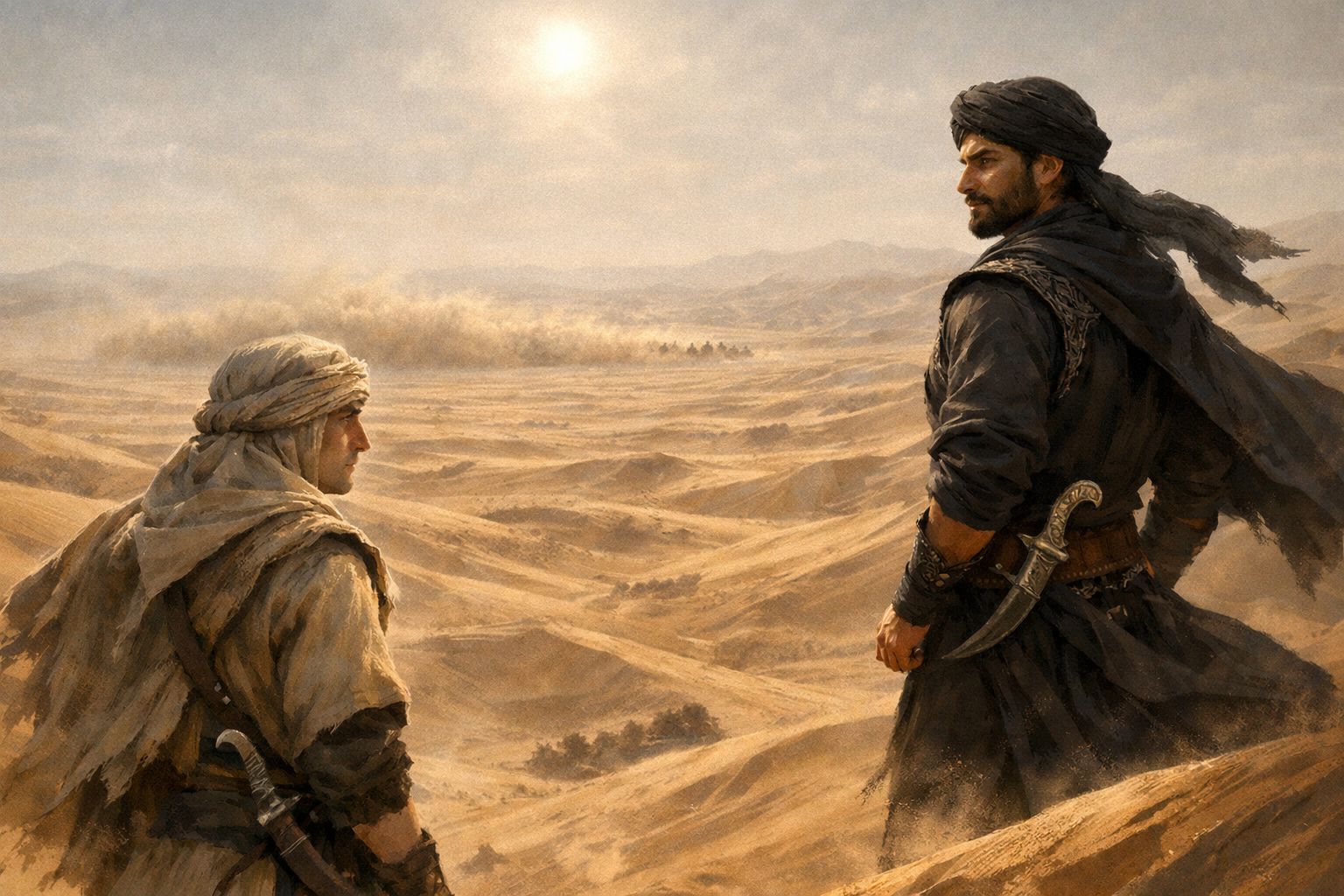
Later, someone spots movement out in the desert.
Not close. Not immediate. Just a dust cloud passing beyond the promontory, too steady to be wind, too purposeful to be dismissed.
This should not lead to combat or even contact. The point is distance.
The caravan is not under attack. It is being hunted by someone with a trail to follow.
How to Present the Tension
Keep the whole stop quiet. No arrests. No soldiers riding in. No dramatic challenge at the gate. Let the pressure come through small things.
- People remember the questions.
- Descriptions are too precise.
- The dust cloud appears and disappears.
- The caravan lowers its voice without meaning to.
That is enough.
This is the point where the crew should begin to feel that every stop inside Lumekhet carries risk, and that delay, visibility and careless talk all make that risk worse.
How the Caravan Reacts
Miraz should become more guarded, not panicked. Sada tighter and less tolerant of wasted time. Khalida more protective of water and routine. The younger members of the caravan should feel the mood shift even if they do not know all of the reason.
The crew should also feel the need for more discipline around Nephyla and the more distinct looking crew members. Less visibility, fewer chances to be studied, less room for idle wandering.
This is a secrecy scene more than a danger scene.
Why This Matters
Ptep shows that pursuit has begun to organize itself.
Someone ahead of them is asking the right questions and moving fast enough to matter. Even if the caravan keeps moving, it is no longer invisible.
Ashaket
Tarek Sandnose lay low on the rise beyond camp, his camel kneeling behind him in the dust, while his eyes moved slowly across the broken ground around Ashaket. He had the stillness of a hunting bird, so complete that for long stretches he seemed less like a man than another piece of dry stone left by the wind.
That was why he saw them first.
Two riders, armed, not close, not reckless, half hidden behind a fold in the land. Even at this distance he could see something wrong in the way they sat their horses, one slumped slightly, the other favoring an arm. Wounded. Watching.
Tarek did not call out. He only shifted back, reached down and nudged Nasheem with the side of one hand, then pointed.
Nasheem followed the line of his finger and gave one short nod.
At that exact moment, Nephyla stepped out from the tent line into the pale light.
One of the riders jerked upright and pointed. A few quick words passed between them. Then both men dragged themselves up into the saddle.
Nasheem did not waste a breath.
“Let’s go.”
He and Tarek were already moving as the words left his mouth, swinging onto their camels and driving them forward into the dust before the wounded scouts could gain too much distance.
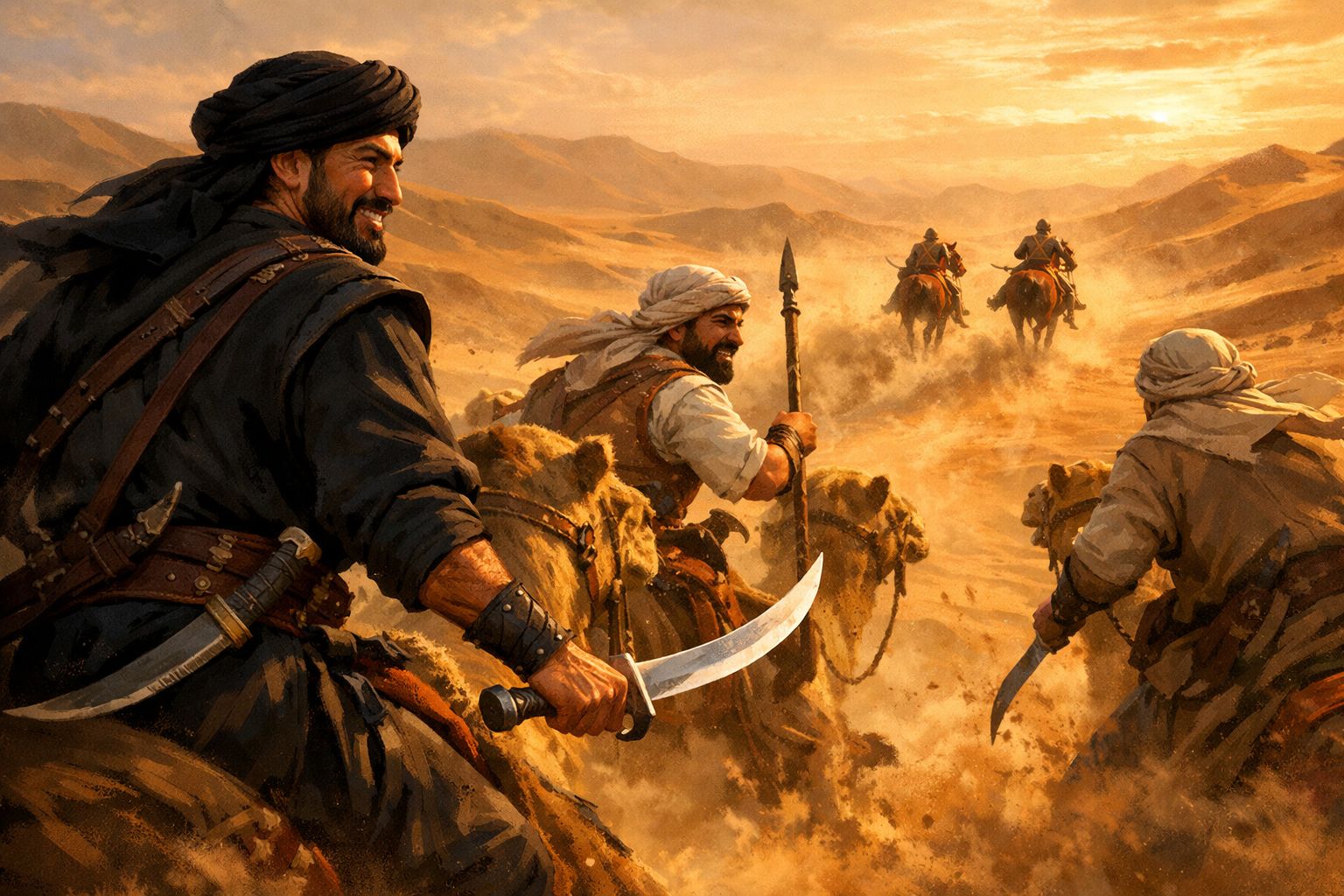
This stop is where the hunt stops being rumor and becomes immediate danger.
Until now, the pressure has been questions, signs and distance. In Ashaket, the crew should understand that people are actively moving against them, that mistakes are being made and corrected and that staying too long now carries real risk. This is also the point where the caravan is forced to leave before it wants to.
The Wounded Scouts
Two mounted scouts arrive near Ashaket, wounded and exhausted. Their horses are spent, their clothes torn and dusted with blood and sand and they ride with the unsteady urgency of men who have survived something ugly and are trying to outrun the aftermath.
The crew does not know the full story, but the truth is this: These men were part of the force hunting Nephyla. They had been tracking another Tazulmar caravan, wrongly believing Nephyla was traveling with it. That mistake ended in violence. A fight broke out, the caravan was destroyed and the scouts took losses as well. The uninjured pressed on. These two, too hurt to continue with the main force, turned back.
Then they saw the Dunewind Tribe.
Realizing the Mistake
The two scouts do not ride straight into camp. They spot the caravan first, keep their distance and observe. That is enough.
At some point, one of them sees Nephyla clearly enough to understand the truth. They have found the right caravan, and they know it.
They do not attack. They are too few, too wounded and too cautious for that. Instead, they try to break away and ride for reinforcements.
That cannot be allowed.
The Response
The important point here is urgency, not battle.
The two men are wounded, which makes it entirely possible to catch them, but they still have a head start and a clear purpose. If they get away, the hunt tightens immediately.
The Dunewind Tribe and the crew should understand this at once. Whether through Miraz, Tarek, Rashad or simple common sense, the conclusion should be clear. These men cannot be allowed to leave Ashaket alive.
This should become a brief pursuit and violent necessity, not a full set piece fight. The scouts are already damaged. The challenge is catching them before they vanish into open ground or reach others.
Tone
Play this as grim and practical.
The danger is not the two scouts themselves. The danger is what they know and who they can tell.
That makes the killing, if it comes to that, feel less like victory and more like one more ugly thing exile has forced upon the caravan.
There should be no clean triumph in it.
The scouts will not surrender. To do so would be to forfeit being reborn. In their mind, they are, quite literally, on a mission from god.
The Cost
Even if the scouts are stopped, the damage is done.
The caravan now knows with certainty that it is being hunted by organized pursuers. The danger is no longer abstract, and waiting in Ashaket becomes impossible.
This forces an early departure.
Trade is cut short. Rest is shortened. Planned business is abandoned. Whatever the Dunewind Tribe had hoped to gain here is now secondary to movement and distance.
That matters. The hunt is no longer only threatening Nephyla. It is now costing the whole caravan.
Why This Matters
This scene does several things at once.
- It confirms that pursuit is active and competent, even if not flawless.
- It forces the crew and the Tazulmar into direct bloodshed to preserve secrecy.
- It also gives real weight to the decision to keep carrying Nephyla. Others are already paying for her survival.
Ashaket should leave the players with one clear feeling.
The chase is no longer behind them. It has reached them.
The Destroyed Caravan
Tarek Sandnose came back at a gallop, Thorn’s long legs throwing dust behind them in a pale plume. He did not slow until he was almost in the middle of the Dunewind Tribe, then hauled the camel around and shouted for everyone to come forward.
Miraz Khalim was already moving before the words had fully landed. Rashad swore and turned at once. Sada’s face went hard and empty. Nasheem and Ayesha followed with the others, while Nephyla climbed down in grim silence and Old Samir dragged himself upright with a muttered curse at his knees.
Then they crossed the crest of the next dune.
And saw it.
Below them lay the other caravan, broken open across the sand.
Four Shar'zul were down, vast plated bodies collapsed like fallen towers, platforms shattered across their backs, tents ripped apart, goods spilled and trampled into blood dark sand. Around them lay the rest, men, women, children, camels, all dead. Torn cloth moved weakly in the wind. And among the bodies, in bronze and dust red, were many Lumekhet scouts.
The Tazulmar made sounds Ayesha had never heard from them before. Not shouts at first. Smaller things. A breath punched from the body. A low cry. One woman dropped where she stood. Rashad lurched forward before Miraz snapped his name sharp enough to stop him. Someone was already sobbing. The dead Shar'zul struck them like murdered kin.
Miraz took three breaths before he spoke.
“Search for survivors,” he said.
They went down into it.
Junia moved quickly from body to body, hand to throat, hand to chest, then up again. Nasheem checked the dead scouts and the caravan people with the same grim efficiency. Ayesha helped where she could. Nephyla did not flinch from the blood, but her face had gone white beneath the dust. Even Thaleia stood still beside one fallen Shar'zul, notebook forgotten in her hand.
No one lived.
At last they gathered again near the largest of the dead beasts, one antenna broken and half buried in the sand.
Nasheem looked over the scouts and said quietly, “At least many of the attackers fell.”
Miraz turned on him, grief burning through his voice.
“It is not about how many died. It is about how many remain.”
No one answered that.
Old Samir stood with one hand on the Shar'zul’s shell, his face drawn tight.
“Well,” he said at last, with grim humor too dry to be comfort, “at least Lumekhet does not know one Tazulmar from another. They will not remember Dunewind when they come back.”
No one laughed. But the meaning landed hard. This had not been meant for this caravan. The wrong people had died for the wrong quarry.
Miraz looked once over the dead, then toward the harsher dunes beyond.
“That is enough,” he said. “We leave now. Only the deep desert can save us.”
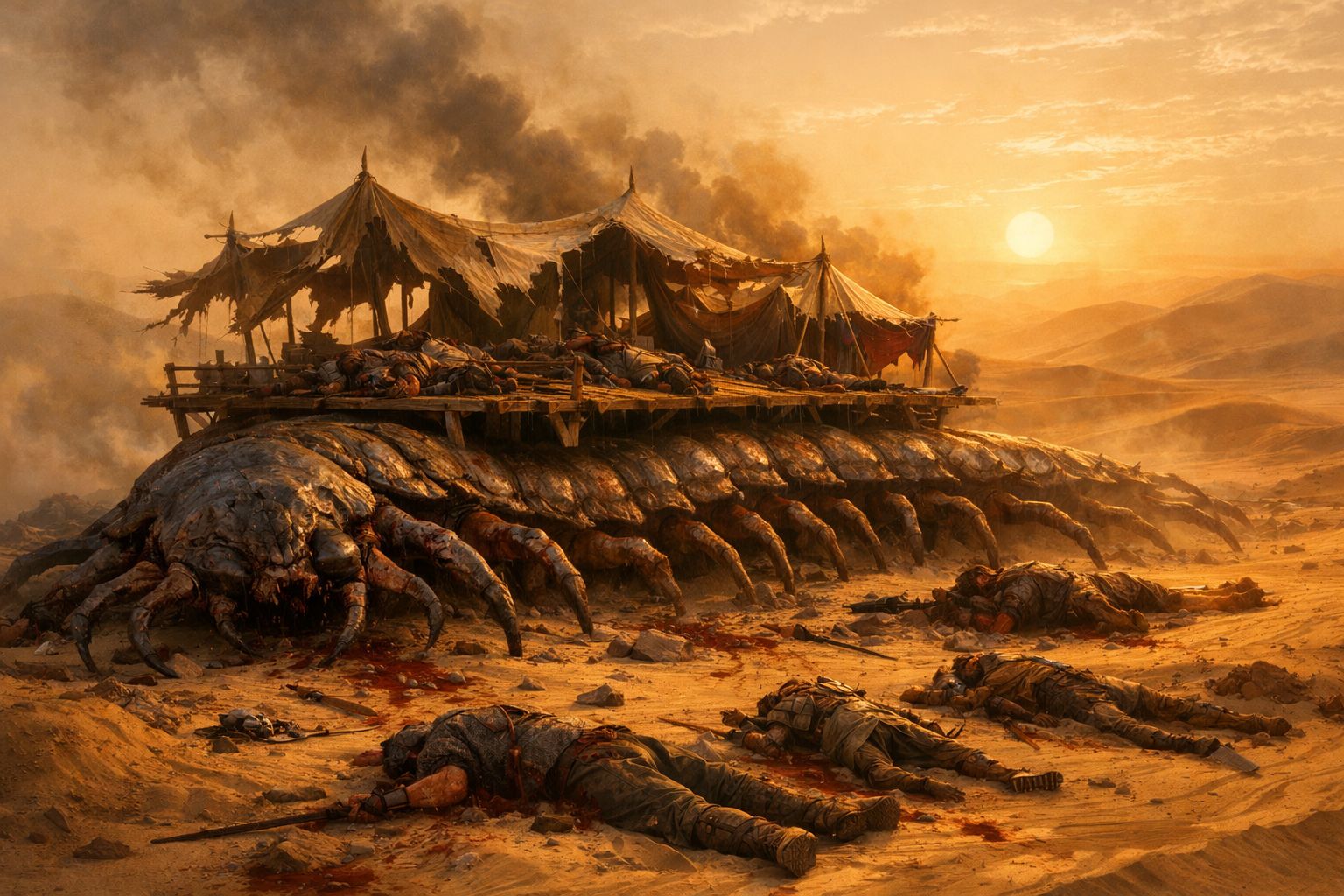
This scene is the moment when the hunt becomes undeniable in its full brutality.
Until now, the caravan has seen pressure, signs and consequences. Here, they see the cost laid out in the open. This is not a warning, not a rumor and not a close call. It is slaughter. The point of the scene is shock, grief and the understanding that the danger behind them is both real and merciless.
What They Find
One day before reaching the trading camp near the source of the Zareth, the Dunewind Tribe comes across the remains of the other Tazulmar caravan they heard about earlier.
It has been annihilated.
Four Shar'zul lie dead. Every man, woman and child in the caravan has been killed. Every camel has been killed as well. The bodies of many Lumekhet army scouts also lie among the dead, making it clear that there was a fight, but not a clean one. This was not a raid for goods or captives. It was a violent mistake followed by slaughter.
The sight should be overwhelming.
Broken platforms. Torn tents. Spilled goods. Blood in the sand. Great dead Shar'zul collapsing in on themselves like fallen towers. Silence where there should have been voices, animals and movement.
The Tazulmar Reaction
The Tazulmar should be deeply shaken by this.
The killing of the people is horrific enough, but the dead Shar'zul strike them with a special kind of grief and fury. These are not beasts of burden in their eyes. They are kin, companions and the moving heart of a caravan’s life. To kill one is terrible. To kill four is close to sacrilege.
Do not let the scene become only about human death. The reaction to the Shar'zul should be just as strong, and in some cases stronger. Some of the Tazulmar may go first to the beasts, touching shell, whispering names or standing in stunned silence beside them. Others may rage openly. Others may become cold and practical in the way people do when grief is too large to handle directly.
This is a communal wound, not just a tactical discovery.
What It Means
By now the players can likely piece together what happened, or enough of it.
This was the caravan the hunters followed by mistake. They attacked it believing Nephyla was there. They were wrong, and the wrong people paid for it with their lives.
That realization should land hard.
The hunt is no longer only a threat to the Dunewind Tribe. It has already destroyed another caravan entirely. The cost of carrying Nephyla is now visible in corpses, blood and dead Shar'zul.
Tone
Do not rush this scene.
Let the players absorb it. Let the Tazulmar react. Let the silence do some of the work.
This is not an investigation scene and not a puzzle to solve. The details matter only insofar as they reinforce brutality. The scene exists to make the danger feel immediate, personal and irreversible.
The emotional focus should be:
- Shock at the scale of the slaughter.
- Grief, especially among the Tazulmar.
- Rage at the desecration of the Shar'zul.
- The understanding that there is no longer any safety in Lumekhet.
The Shift Forward
After this, the route ahead changes in emotional meaning.
The deep desert is no longer just the next stage of the journey. It is the only place that offers any real hope of safety. Settlements, roads and known stopping points now feel exposed, compromised and reachable by those pursuing them.
This is the point where the players should understand that the hunt has already killed for Nephyla, and will kill again.
This scene should therefore mark a transition. The caravan is no longer simply traveling onward. It is fleeing toward the only refuge left.
The deep desert.
The Trading Camp at the Source of the Zareth
The trading camp looked busy until the Dunewind Tribe tried to buy something.
Then the distance appeared.
Sada went first, because of course she did, striding toward a grain seller with the clipped patience of a woman already too pressed for time. The man listened, eyes flicking once toward the Shar'zul, once toward the desert beyond, then began apologizing before she had even named the quantity. Another trader claimed his stock was promised elsewhere. A third smiled nervously, agreed in principle and somehow found a reason to disappear into the back of his tent before coin ever changed hands.
By the time Ayesha and Nasheem had tried two more stalls, the pattern was plain. No one wanted a quarrel. No one wanted to insult the Tazulmar openly. They only wanted to avoid being seen helping them. So the refusals came wrapped in soft voices and lowered eyes, all fear and caution and transparent lies. The camp would not fight them. It would simply step back and let them feel, one polite, but evasive answer at a time, how alone they had become.
This stop should feel tense, exposed and hurried. The caravan has reached the edge of deeper safety, but not safety itself. The camp is not an ally, not an enemy and not a battlefield. It is a place trying to survive between danger and profit, and that makes it cautious in all the ways that are least convenient for the Dunewind Tribe.
The key mood is simple: grab what is needed and leave before the hunt catches up.
The Camp’s Position
The trading camp knows the Dunewind Tribe is being hunted, or at least knows enough to act as if it does.
This does not make the camp openly hostile. In fact, most people there would prefer not to make an enemy of the Tazulmar. The camp depends heavily on caravan trade, and no one wants to damage that relationship more than necessary. At the same time, they do not want to be drawn into a fight they are not equipped to win.
So they choose the safest cowardice available.
They will not attack. They will not raise an alarm. But they will also not help in any open way. No willing labor. No public trade. No visible support. No one wants to be seen standing with the caravan when the hunters return.
The camp is protecting itself, and in doing so makes everything harder.
Water as the Immediate Problem
Food is not the main issue here. The Dunewind Tribe still carries decent stores, and while they would like to supplement them, they are not yet desperate.
Water is the real problem.
The spring at the source of the Zareth is here, and the caravan must fill skins, jars and storage vessels before pushing deeper into the desert. But because the camp refuses open assistance, the Tazulmar must carry the water themselves from the spring to the Shar'zul and storage frames.
That creates two pressures at once.
First, it is hard work and takes time.
Second, it spreads the caravan out. People move back and forth between spring, camp edge and the Shar'zul. That makes security much harder. The caravan cannot stay tight and defended while also doing what it needs to survive.
The crew should be needed here. This is not a stop where they stand aside while the tribe handles logistics. Carrying water, watching approaches, organizing movement and keeping an eye on Nephyla and the more distinctive crew members all matter.
Special Supplies
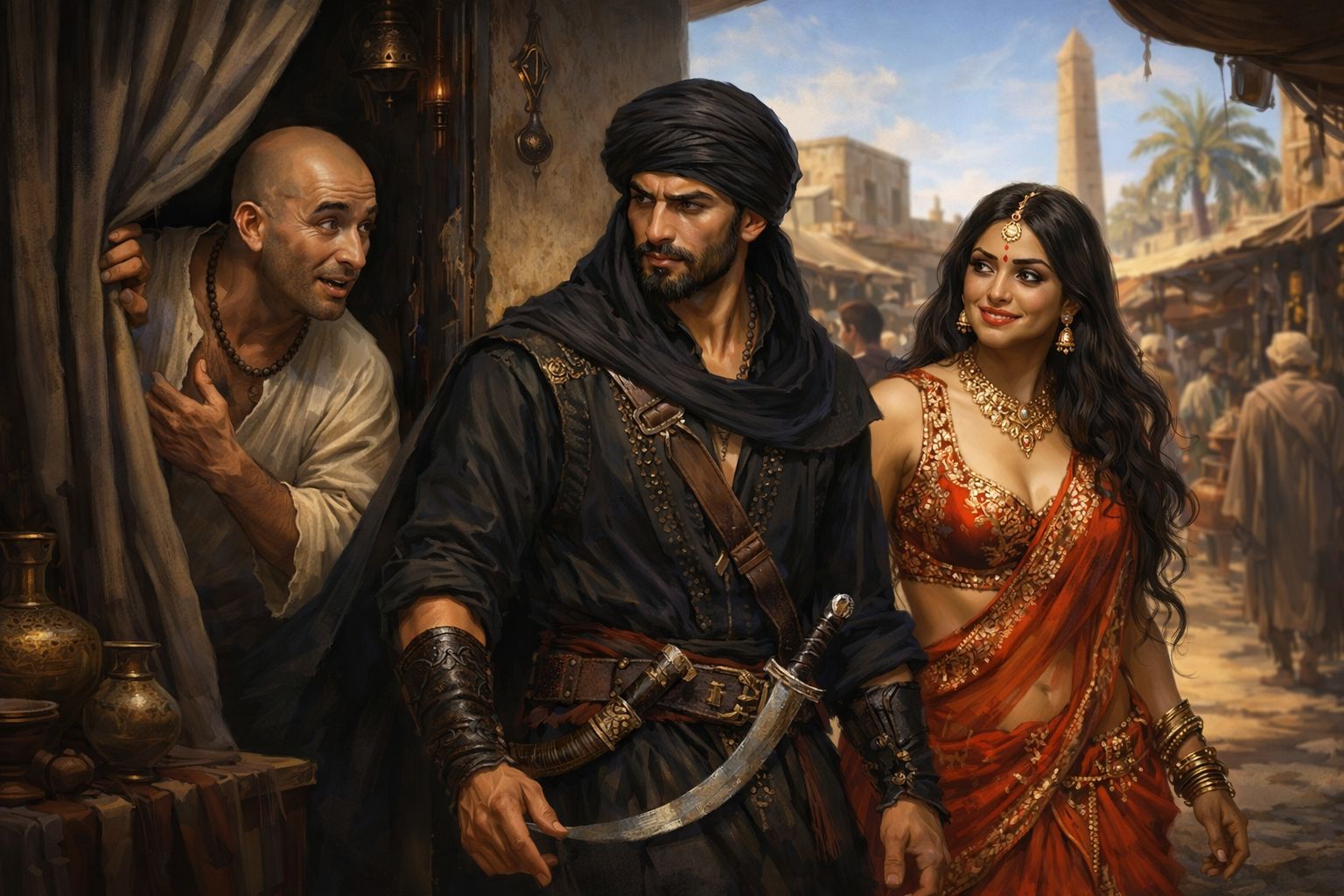
The caravan also needs some food, minor trade goods and a few specialist supplies before entering the deep desert. Salt, cloth, lamp oil, medicines, repair materials and whatever else the Game Master wants to emphasize can all be part of this.
The camp will not trade openly.
That means the crew may be useful in a different way here. Someone in camp will probably be willing to make a covert deal if the price is good enough and the risk feels low enough. This creates room for small negotiation scenes, furtive exchanges and the quiet ugliness of people wanting profit without responsibility.
Keep these deals narrow and hurried. The point is not to turn the stop into a social sandbox. The point is to show that even help, when it comes, comes nervously and through side channels.
Time Pressure
Everything in this stop should feel rushed.
The caravan does not want to remain here any longer than necessary, and for good reason. The spring is valuable, the camp is known and the route is predictable. If the hunters are still moving, this is one of the most likely places for them to return to.
So this stop should run as a compressed, practical scramble.
- Get water.
- Get what can be bought.
- Keep watch.
- Avoid exposing Nephyla.
- Leave.
That is the whole logic of the scene.
News of the Hunters
The camp has already seen the scouts.
Some of them arrived lightly wounded, asked questions, took stock of the place and moved on without staying to resupply. It suggests urgency and confidence. They thought they were still close enough to the trail not to waste time.
Reports vary depending on who is asked. Some say there were ten. Some say twenty. Some insist it was fifty. The camp trades in rumor as much as goods, and with each retelling, especially from people repeating what they only heard from someone else, the number seems to grow. The exact count matters less than the uncertainty.
What matters is this:
- The hunters were here.
- They were wounded, but still moving.
- They did not stop to prepare properly.
- They are likely to come back.
That should sharpen the mood immediately.
How to Run the Pressure
Keep the pressure practical, not theatrical.
No speeches. No major confrontation in the market. No dramatic refusal from the whole camp. Just evasive traders, nervous looks, missing laborers, awkward silences and the constant sense that time is being wasted where it cannot afford to be wasted.
The caravan should feel burdened not by one villain, but by many small refusals.
This is also a good place to let different caravan members show themselves under strain. Sada becomes clipped and relentless. Khalida more severe around water use. Miraz harder and less patient than usual. Rashad may become protective of the Shar'zul if the work becomes chaotic. The crew should feel that everyone is stretched.
Why This Matters
This stop shows that even neutral ground is no longer neutral.
The Dunewind Tribe is close enough to the deep desert to taste safety, but still close enough to Lumekhet’s reach to be isolated, denied and pressured. The hunt is now shaping the behavior of people who do not even intend to fight.
This reinforces a final shift in the arc. The caravan is no longer simply enduring pursuit. It is being squeezed by the knowledge of pursuit, even where no enemy is visible.
Key Impression
The trading camp should feel like the last difficult breath before the deep desert.
- The water must be gathered.
- The supplies must be secured.
- The camp will not stand with them.
- The hunters may return at any time.
This is not a place to linger. It is a place to strip what is needed from the edge of civilization and run.
The Attack
The attack did not arrive like thunder.
It arrived as fragments.
A dust cloud. A shout. The sudden dying of ordinary voices. Fires kicked apart. Children dragged inward between crates and tent poles. Camels screaming as riders mounted. The great bodies of the Shar'zul drawing closer together, their platforms creaking as the Dunewind Tribe pulled its moving village tight.
Then the scouts hit.
Nasheem saw the first one come over the rail of the platform almost before he understood he had moved. One hand caught the man’s wrist before the blade came down, the other drove steel up under the ribs. The scout fell backward, but another was already there, hauling himself over the edge with blood on his sleeve and murder in his face. Nasheem cut low this time, slashing through the grip hand, then kicked him back into the sand below where the hard feet of the Shar'zul swallowed him at once.
All around him the battle came in flashes. A camel rearing. Someone shouting. A spear skidding across planks. The deep, panicked hum of a Shar'zul in pain.
Ileena was nowhere.
Then she was everywhere.
A scout lunged between two tents and suddenly screamed, folding around a knife he had never seen coming. She slipped out from under one hanging cloth, tail low, body bent, black eyes bright with battle focus, then vanished again before the next man even knew she was there. A moment later another attacker jerked upright with her blade buried high in his side. She wrenched it free and was gone again, scurrying between ropes, crates and swaying tent walls like something small, fast and entirely lethal.
Nasheem barely had time to register her before another boarding hook clattered against the platform edge.
He cut the rope. A scout climbed anyway.
They met hard and close, shoulder to shoulder, the kind of fighting with no shape to it, only breath, impact and the knowledge that one slip would kill.
A Tazulmar woman resolved the deadlock with a knife, felling the scout.
Then someone shouted across the chaos, raw enough to cut through everything.
“Jahrak is down!”
For one impossible heartbeat the battle thinned around the words.
Nasheem turned. So did others. Out in the sand, half obscured by riders and dust, old Jahrak was on the ground.
The great Shar'zul lay collapsed on one side like a fallen tower, one long leg twitching once against the blood dark sand. People were screaming near him, Tazulmar voices cracking open in grief and fury so naked they barely sounded human. One rider was hacking at the shell even now, and three others died for it almost immediately, swallowed by enraged defenders.
Then the platform lurched so hard Nasheem nearly lost his footing.
Their handler had taken a spear.
He saw it only as another glimpse, a body thrown backward, the shaft dropping from him, then the man tumbling off Vezhur’s neck and striking the sand below. The whole platform rocked again, harder this time, as Vezhur gave a shrill, terrible vibration and began to stampede.
Crates slammed sideways. Tent ropes snapped taut. Someone fell. The world tipped into panic.
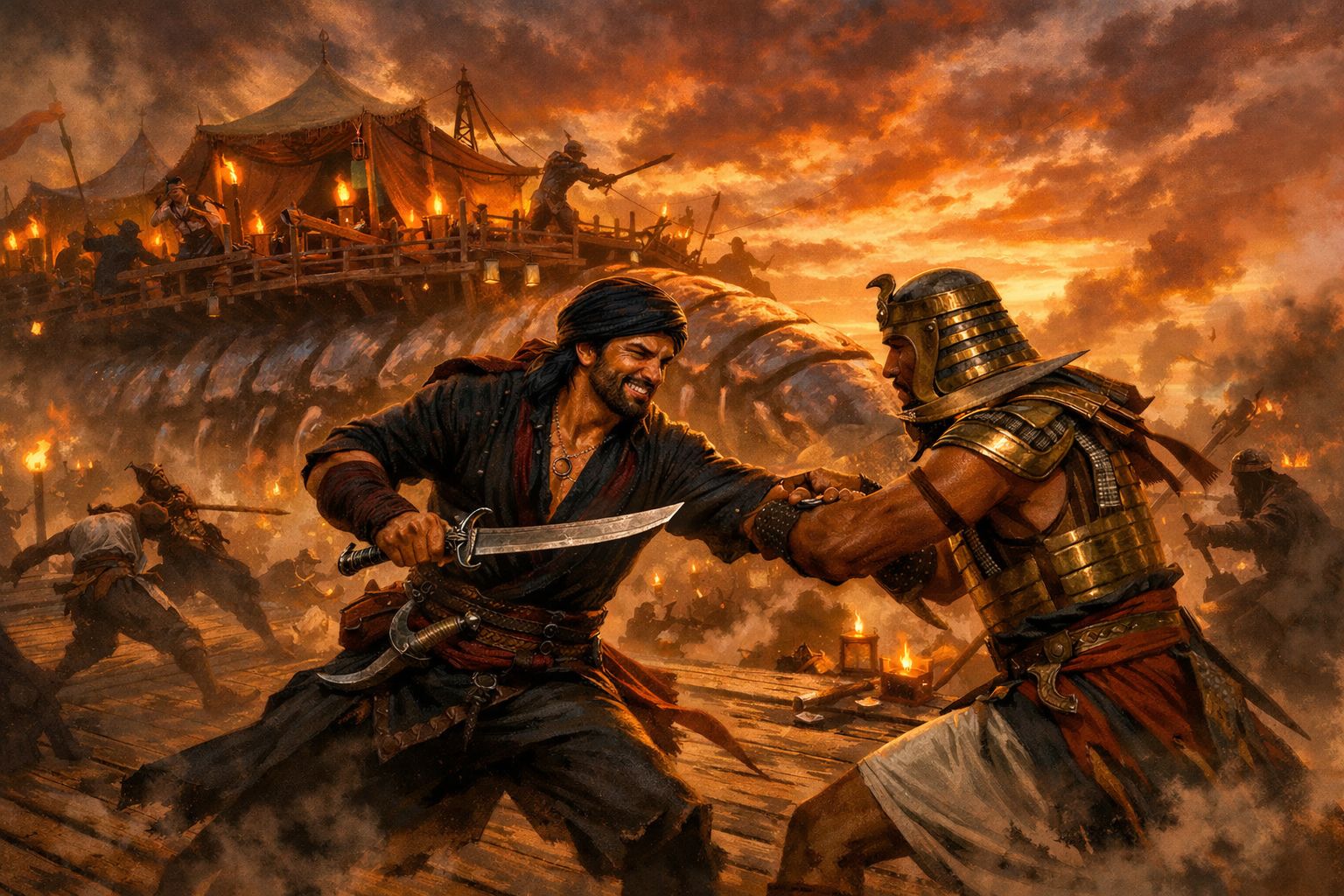
This is the first true open attack of the journey, and it should come at exactly the moment when relief begins to appear.
The Dunewind Tribe is finally heading into the deep desert, beyond the reach of Lumekhet patrols and settled authority. That should create a real sense of release. The players should feel that perhaps the worst is behind them.
Then the dust cloud appears.
That contrast matters. The attack should feel like Lumekhet making one last desperate grab before losing them.
Purpose of the Scene
This scene exists to do several things at once.
- It gives the pursuit its final violent expression before the caravan disappears into harsher country.
- It lets the crew fight alongside the Tazulmar in a way that feels communal rather than detached.
- It gives Thaleia a moment of earned usefulness that matters to the tribe.
- It also imposes a real cost, and that cost should land hard.
This is not a triumphant victory scene. It is survival under pressure.
The Calm Before the Strike
The first day into the edge of the deep desert should begin with real relief.
The ground is harsher. The familiar routes of Lumekhet are beginning to fall away. The caravan is preparing to leave behind towns, fields and the last easy reaches of pursuit. People should breathe a little easier. Voices rise slightly. Shoulders loosen. Even the work of travel may feel lighter for a few hours.
Then, before sunset, scouts spot a dust cloud approaching fast.
Do not delay this too long. Once the cloud is seen, the mood should turn at once.
The Caravan Prepares
The Dunewind Tribe should react with practiced speed.
- Warriors mount camels.
- Fires are put out.
- Loose goods are secured as well as time allows.
- The Shar'zul are drawn into a tighter formation.
- Children are hidden in tents at the center of the platforms, shielded by crates, bundled goods and whatever else can make fragile cover in a moving village.
This moment should help show the tribe as competent under pressure. There is fear, but not confusion. Everyone knows enough of what to do that the caravan can close into a defensive formation quickly.
The crew should also be pulled into the preparation. There should be no sense of standing back and watching the Tazulmar handle their own fight. By now, this is their fight too.
The Attack
The scouts do not parley. They sweep in and attack immediately.
That matters. There is no demand, no warning and no attempt to negotiate surrender. They have come this far, taken losses and know this is likely their last chance before the deep desert swallows the trail.
The clash should feel fast, dusty and chaotic. Riders striking in and wheeling away. Camels screaming. The Shar'zul shifting under impact and noise. Missiles, blades and sudden close violence all mixed together.
Do not over organize the battlefield. Do not make maps of the action. This is not meant to feel clean. Turn it into a collection of intense moments in a storm of confusion.
How the Crew Can Matter
This scene should offer many kinds of contribution.
- Ground fighting against scouts who break through or dismount.
- Defense of the Shar'zul platforms against enemies trying to climb aboard.
- Missile support from elevated positions.
- Protection of children, wounded and noncombatants in the center.
- Healing under pressure.
- Command, communication and keeping a section of the defense from collapsing.
The important thing is variety. The battle should feel like a living crisis where different strengths matter.
Vezhur’s Panic
By then the battle had dissolved into fragments, dust, shouting, a glimpse of steel, a body falling, the platform pitching underfoot. Thaleia did not understand at first why Vezhur’s movements had changed so badly. Then she saw the empty handler’s seat at the base of the great Shar'zul’s neck, the reins trailing loose against chitin and wood, and felt the whole platform lurch again as the beast began to stampede.
She moved at once.
She shoved past two fighters locked together near the tents, ducked under a swinging arm and scrambled forward as the platform bucked beneath her. Somewhere behind her someone shouted, but she never heard the words. She reached the front and threw herself into the handler’s place just as Vezhur surged sideways again.
With one hand she caught the reins attached to the antennae. With the other she dragged out her notebook and began frantically leafing through it.
Ink blurred in the dust. Her own hurried notes stared back at her, fragments about temperament, antennae pressure, steadying corrections. She kept one eye on the page and one on the panicked sweep of chitin in front of her.
“Not single pressure,” she muttered. “Paired correction. Gods, not that much...”
She pulled.
Wrong.
Vezhur shrilled and lurched harder, and Thaleia slammed shoulder first into the side post. The notebook nearly flew from her hand.
“Fine,” she snapped breathlessly. “Not that.”
She flipped a page, found the line she needed and tried again, more carefully this time, less like forcing and more like guiding. The response changed. Not calm, but less wild. One stride hit straighter. Then another.
Then she heard a shout from the side.
She looked over and saw Sareth’s handler riding close enough to be visible through the dust, waving at her with furious urgency.
“Both hands!” he shouted. “Use both hands!”
Thaleia stared at him for one heartbeat, then jammed the notebook between her knees, seized the reins properly with both hands and worked from memory.
This time it held.
Vezhur still trembled and shuddered with panic, but his steps began to obey shape instead of terror. The platform’s violent rocking eased. Around them the battle still raged, but the second disaster had been stopped.
Thaleia kept both hands on the reins, hair torn loose across her face, riding the skittish Shar'zul through fear by notes, nerve and sheer refusal to fail.

During the fighting, Vezhur, the skittish Shar'zul, loses his handler, who is injured and falls to the ground, unconscious.
That is the trigger for disaster.
He begins to panic and stampede, threatening to break formation and turn one whole section of the caravan into chaos. This is especially dangerous because this is also the Shar'zul carrying the player group.
This is where Thaleia gets her moment.
Because she is Thaleia, she has been paying attention. She has been taking notes. She has been observing how the beasts are guided, steadied and read. In the middle of battle, that unlikely preparation becomes exactly what is needed.
She manages to regain control of Vezhur.
Do not make this feel easy or comedic. It should feel tense, precarious and just barely successful. But if she does succeed, it matters enormously. She prevents collapse, saves lives and proves herself to the Tazulmar in a language they fully understand.
This should earn her real respect.
The End of the Fight
Eventually, the scout force is broken.
Some are killed. Some fall back. Some may try to flee and be ridden down or vanish into the failing light. The important thing is that the attack ends with the caravan still intact enough to move.
But the cost is high.
One Shar'zul is dead.
That Shar'zul is old Jahrak.
This should land heavily. He is not a lost asset. He is a dead elder, companion and bearer of homes and memories. The grief around him should be immediate and raw.
Several Tazulmar are dead as well, including some the crew has come to know. That matters too. Let the losses be personal. This is not faceless attrition. People who laughed at meals, carried water, traded stories or simply became familiar are now gone.
Aftermath and Immediate Response
Miraz and Sada should move at once.
There is no luxury of extended mourning here, not yet.
- People are counted.
- The wounded are sorted and cared for.
- The dead are collected and brought for later burial.
- Useful goods are stripped from dead Jahrak and moved to the surviving Shar'zul.
- Families are redistributed.
- Children are accounted for.
- The dead are acknowledged, but not yet properly mourned.
This should feel harsh, but necessary. The caravan cannot remain still. The attack itself proves that.
The tribe survives by moving.
The Final Departure
Once the wounded are stabilized and the necessary transfers are made, the caravan leaves as quickly as it can.
That departure should feel diminished. Heavier. More crowded. More grieving.
But also more resolved.
After this, there should be no remaining doubt. The settled world behind them is death. The deep desert is no longer simply the next stage of the route. It is the only place left to go.
Key Impression
This battle should end with survival, not victory.
The hunters have made their last reach and failed. But they have taken blood and one of the great Shar'zul with them.
The caravan enters the deep desert wounded, grieving and with one Shar'zul gone, carrying the dead behind them and the only hope of safety ahead.
Old Jahrak lay on the sand like a fallen wall, one great plated side dark with blood. Around him the dead were being gathered, sorted first by the brutal arithmetic of necessity, ours, theirs, wounded, living, lost goods, salvage. Miraz and Sada moved through it all with faces turned to stone, already reshaping the broken caravan into something that could still move.
Junia knelt beside Vezhur’s fallen handler, hands slick with blood and dust. The spear had gone through the upper arm, leaving a ragged ruin of flesh that looked worse each time the light touched it. The man was pale with pain, jaw clenched so hard the muscles stood out in his face, but he had not once cried out.
“Hold still,” Junia said, pressing fresh cloth against the wound.
He let out one harsh breath that might have been a laugh.
“I am being very still.”
She shot him a look, then went back to work. Nearby, Sareth’s handler stood watching, one hand still on his own beast’s reins, not trusting the world enough yet to let go of anything that mattered.
Thaleia stood a little apart, dust streaked, hair half torn loose, notebook still tucked under one arm as if she had not yet realized she was holding it.
Vezhur’s handler looked up at her through pain and exhaustion.
“You held him,” he said.
Thaleia blinked once. “Barely.”
“You held him,” he repeated.
The other handler gave a short nod.
“That was rider’s work.”
Thaleia looked from one to the other, not quite understanding, about to start an apology.
Vezhur’s handler managed the ghost of a smile.
“You are Shar’tzam now,” he said. “A rider. Only the Sulmar stands higher in the tribe.”
For once, Thaleia had no words ready. She only stared, stunned, as if all her notes had failed to prepare her for the fact that she had crossed some line she had not known was there.
A little way off, Ayesha was helping move the dead.
Not gracefully. Not ceremonially. Just with the blunt economy the work demanded, lifting an arm here, a shoulder there, guiding bodies into rows so the living could count them properly before the light failed. She looked up and found Nephyla standing uselessly still, staring as if the dead themselves had accused her.
“Help,” Ayesha said.
Nephyla looked at her, shocked.
Ayesha did not soften.
“They died because you are here,” she said. “The least you can do is carry.”
For a heartbeat, it seemed Nephyla might recoil, or flare into outrage, or retreat into the brittle shell of what she used to be.
Instead she went pale, then stepped forward.
She did not argue. She bent, clumsy and stiff, and took hold of a dead woman under the shoulders while Ayesha lifted the legs. Together they carried her to the line of bodies and laid her down among the others. Nephyla’s face looked wrong, stripped bare of habit, disgust, grief, guilt and disbelief all fighting for space at once.
Not far from them, Nasheem found the Tazulmar woman who had saved his life on the platform. She was wiping her knife on a dead scout’s cloak with the practical calm of someone too tired for ceremony.
“You arrived at the right moment,” he said.
She glanced up at him.
“You lasted long enough for me to do so.”
“That sounded dangerously like a compliment.”
“It was.” She sheathed the knife and gave him a tired, grim little smile. “You held the platform almost alone. I would not have liked to lose it.”
Then she walked on, because there was too much left to do for either of them to linger in gratitude.
The light sank lower. The dead were counted. The wounded were bound. Goods were stripped from old Jahrak and moved in silence to the surviving Shar’zul. There was no cheer in any of it, no sense that the caravan had won anything worth naming. They had survived. That was all.
And as the tribe bent beneath grief and labor, preparing to move again into the deep desert, even victory felt like one more burden to carry.
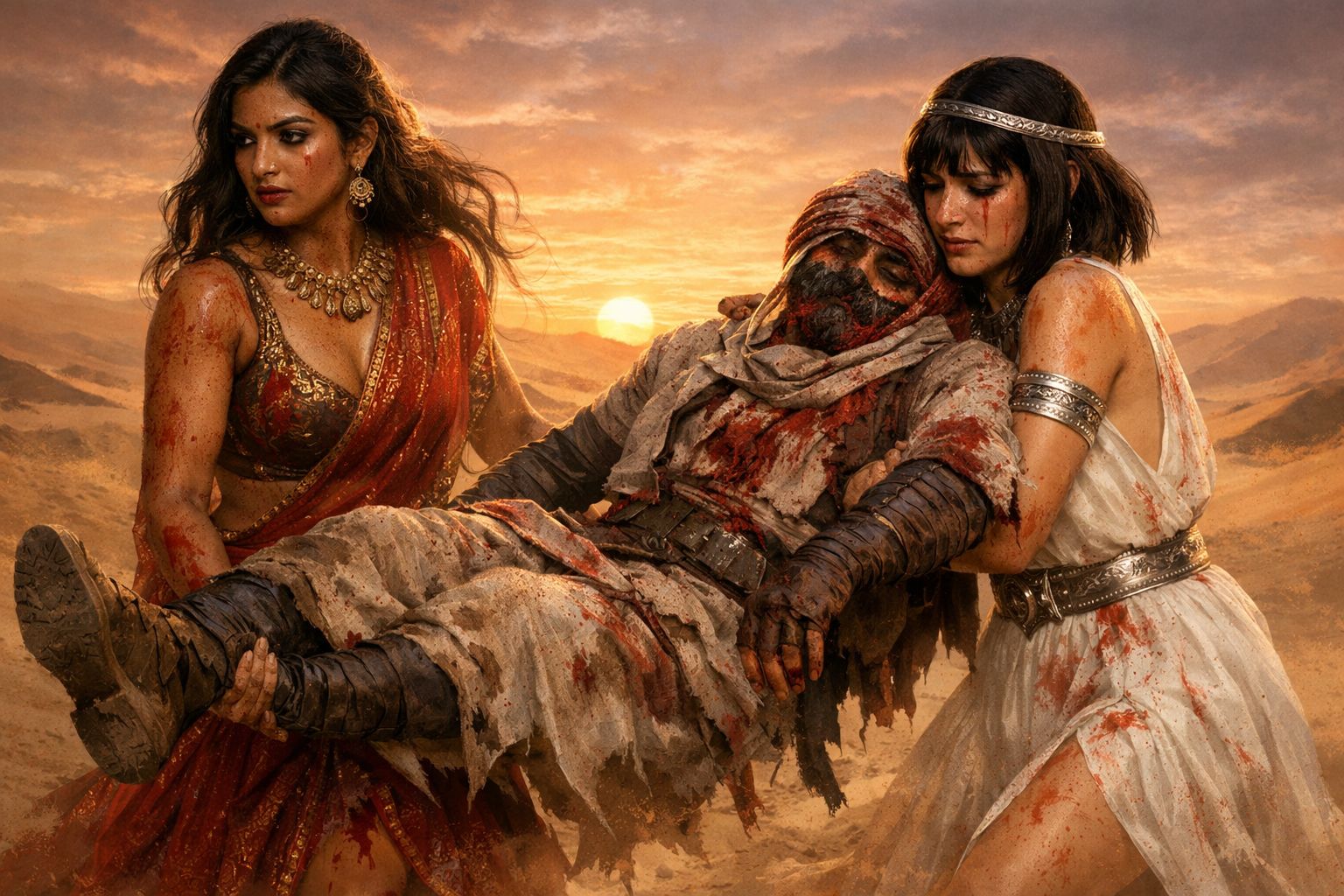
Act Summary
Lumekhet begins as a court intrigue arc and ends as a flight into exile. The crew arrives in Oshiren seeking the Waverider’s trail and finds instead a kingdom where theology, politics and personal survival are inseparable. What begins as formal access to divine power quickly becomes entanglement in a live struggle between Ka-Ra and Ka-Iah, then collapses into arrest, rescue, pursuit and overland escape.
Lumekhet as a Place
Lumekhet should remain in memory as a kingdom where beauty, theology and cruelty cannot be separated. Life and death are not background beliefs there, but the structure on which politics, hierarchy and fear all rest. The crew leaves with the understanding that Lumekhet’s sacred order produces both wonder and horror from the same source, and that its rulers and priesthood draw power from making that order feel inevitable.
Nephyla
Nephyla is the central lasting consequence of the arc. She is no longer Ka-Iah, the Moon-Goddess Queen, and she cannot return to the life that formed her. What remains is a damaged, difficult and deeply unprepared person whose fall from godhood has only begun. She is still abrasive, entitled and often infuriating, but she is no longer distant or abstract. She has become legible. The crew now carries not just a rescued ruler, but a wounded exile whose old identity has been broken and whose new one is only beginning to form.
The Dunewind Tribe
The Dunewind Tribe should remain in memory as more than transport. They are now part of the emotional and social fabric of the journey. Their rhythms, their practical intelligence, their closeness to one another and their bond with the Shar'zul should all feel real to the players. By the end of the act, their losses matter personally. The caravan has become a living society the crew has traveled with, depended on and bled beside.
The Hunt
The hunt is one of the defining pressures of the arc. It should leave behind the sense that pursuit can shape a journey long before open battle begins. Bureaucracy, rumor, false trails, refusal, questions asked too carefully and distant riders all become parts of the same tightening pattern. By the time the caravan reaches the deep desert, the settled world behind them should feel spoiled as refuge. Safety no longer lies in towns, roads or negotiation. It lies only in distance, hardship and the hope that the land itself can become a shield.
The Hollow
The Hollow thread leaves a quieter but deeply unsettling mark. Isetnefer should remain in memory not as a dramatic reveal, but as a wrongness that was visible only in fragments until it was too late. That gives Lumekhet another kind of horror, one rooted not in spectacle, but in absence. The sacred order of life and death does not merely oppress. It can fail. That realization should linger.
Thaleia and the Others
Thaleia emerges from the act more deeply attached to the journey and more fully proven than before. Her place beside the crew is stronger, and her moment with Vezhur should leave behind real earned respect from the Tazulmar.
Meyrha’s vision adds a note of inevitability to the arc, one more reminder that warning and understanding rarely arrive at the same moment.
If Ivy is present, Lumekhet also gives her a spiritually unsettling landscape, one that confirms the kingdom’s theology in motion while making the Hollow’s emptiness feel even more disturbing.
What the Crew Carries Forward
The practical result is clear. The crew leaves with the route onward toward Ssar'et. But the emotional result matters more. They leave carrying exile, grief, debt and blood already spilled for Nephyla’s survival. They leave with the knowledge that the Waverider’s trail has split between sea and land in ways that matter emotionally as well as geographically. And they leave with the sense that what they rescued was not simply a person, but a living consequence of Lumekhet itself.
Ending Note
Lumekhet should end with wounded forward motion. The crew is no longer simply following a ship. They are carrying one fallen goddess, the losses of a caravan and the long shadow of a sacred kingdom into the deep desert.
The sun was lowering behind Lumekhet when Nasheem, Ayesha and Nephyla stood together on the platform atop Vezhur. The great Shar'zul moved with a steadier rhythm now, though each step still carried a faint reminder of the panic that had nearly broken him. Behind them, far back across the waste and the fading gold, the last shape of Lumekhet lay half swallowed by distance. Ahead was the deep desert, harsher and emptier, but beyond the reach of those who had hunted them.
For a while none of them spoke. The wind moved hot across the platform and tugged at cloth and hair. Below, the Dunewind Tribe was quieter than before. One Shar'zul fewer. More crowded, but fewer voices at the meal. The dead still traveled with them, waiting for burial.
At last Nephyla said, “I feel misplaced in the world.”
Ayesha turned her head slightly, but did not interrupt.
Nephyla kept her eyes on the horizon.
“There is too much I do not know. Small things. Stupid things. Things children know.” Her mouth tightened. “I find it deeply annoying.”
Nasheem looked at her, then away again, leaving the answer to Ayesha.
Ayesha rested one hand on the rail.
“You can be annoying for us as well,” she said, calm and dry enough that the words might have stung from anyone else. “But if we all make an effort to be patient, we will teach you what you need to know.”
Nephyla gave a short nod.
“Good,” she said at once, as if Ayesha had merely confirmed an arrangement already decided.
But the hard line of her face betrayed her. Beneath the stiffness, beneath the old reflex of command, there was unmistakable relief.
Ayesha saw it and, wisely, said nothing.
The silence that followed was softer than the one before. Not easy. Never that. But changed.
Then Nasheem narrowed his eyes and pointed toward a dune some distance off to their left.
“Look.”
Silhouetted against the burning edge of the setting sun stood a woman in a long flowing dress.
For one jarring instant, her shadow seemed to stretch toward them across the sand.
Nasheem frowned.
“Is that Isetnefer?”
Ayesha stared at the figure, her expression going still.
“It could be a mirage.”
Nasheem’s hand shifted toward the weapons at his side.
“Should I go after her?”
Nephyla answered at once.
“No. It is a trap.”
Nasheem glanced at her.
“How can you know that?”
Nephyla looked him straight in the eyes.
“With Hollows,” she said, flat and certain, “it is always a trap.”
For a few breaths none of them moved.
Then the light shifted.
The dune stood empty.
No figure. No flowing dress. Nothing but sand, shadow and the last red edge of the sun sinking toward the horizon.
Vezhur walked on into the deep desert, and none of them spoke again for a long time.