Dunewind Tribe
The Dunewind Tribe is a small Tazulmar caravan tribe of about sixty people who survive by crossing the deep desert where almost no one else can. Their life is built around movement, trade and hard earned knowledge passed down through memory, custom and the rhythms of the road. They carry goods, messages and stories between distant places, living not in one settlement but in the shifting space between oases, camps and sacred halts.
At the heart of the tribe are their three Shar'zul, without which their way of life would be impossible. These great desert beasts carry the tribe's tents, trade goods, water and children, and shape the practical rhythm of every day. The Dunewind are not wealthy in the settled sense, but they endure through discipline, mutual dependence and the value of what only they can do: move through the Great Desert, survive it and turn that survival into trade.
Caravan Members
The Dunewind Tribe caravan is not a faceless procession but a moving community, full of people with roles, grudges, habits, desires and long-practiced ways of living together in too little space. Most of them are not plot critical, but they matter because they make the caravan feel real. Some can become friends, some irritations, some sources of help, gossip or danger, and a few may matter much more once the road begins to turn against the crew.
Do not introduce all of these people at once. The caravan should feel populated, not overwhelming. Let many of them first appear only as names, faces or small passing details, and only bring a handful into real focus based on what is useful for the scene, the crew and the direction the journey is taking. Some should remain background texture, some should become familiar presences and a few may grow into genuinely important personalities over time.
Miraz Khalim, Sulmar
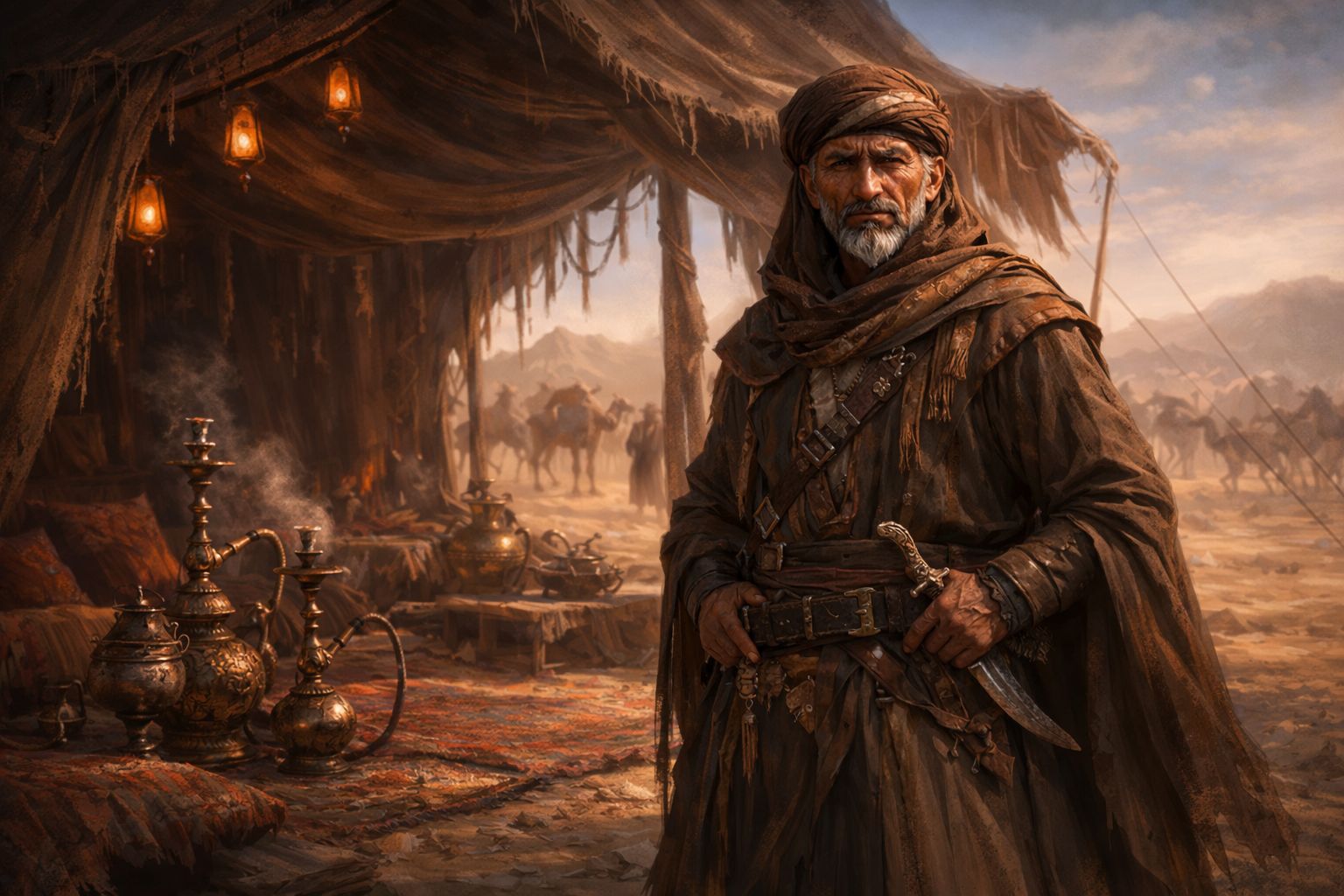
Miraz Khalim is the practical leader of this branch of the Dunewind Tribe caravan, a lean man in his late fifties with sun dark skin, a white streak in his beard and a voice that rarely needs raising. He is patient, steady and very hard to rattle. He treats the Shar'zul with the same seriousness he treats people, laying a hand on chitin or shoulder with equal calm. Miraz is hospitable to guests, but never casual about them. He does not waste words, does not show panic and does not make promises lightly.
Miraz is the father of Sada and one of the few people Rashad truly listens to without arguing. He values Zahra’s instinct even when he distrusts her mysticism, and he keeps Jalir on a short leash without ever humiliating him. Toward the crew, Miraz begins formal and measured. Respect from him has to be earned, but once earned it is solid. He is useful as the final word on caravan decisions, the man who decides whether the caravan takes a risk, offers protection or cuts losses.
Sada bint Miraz, Quartermaster
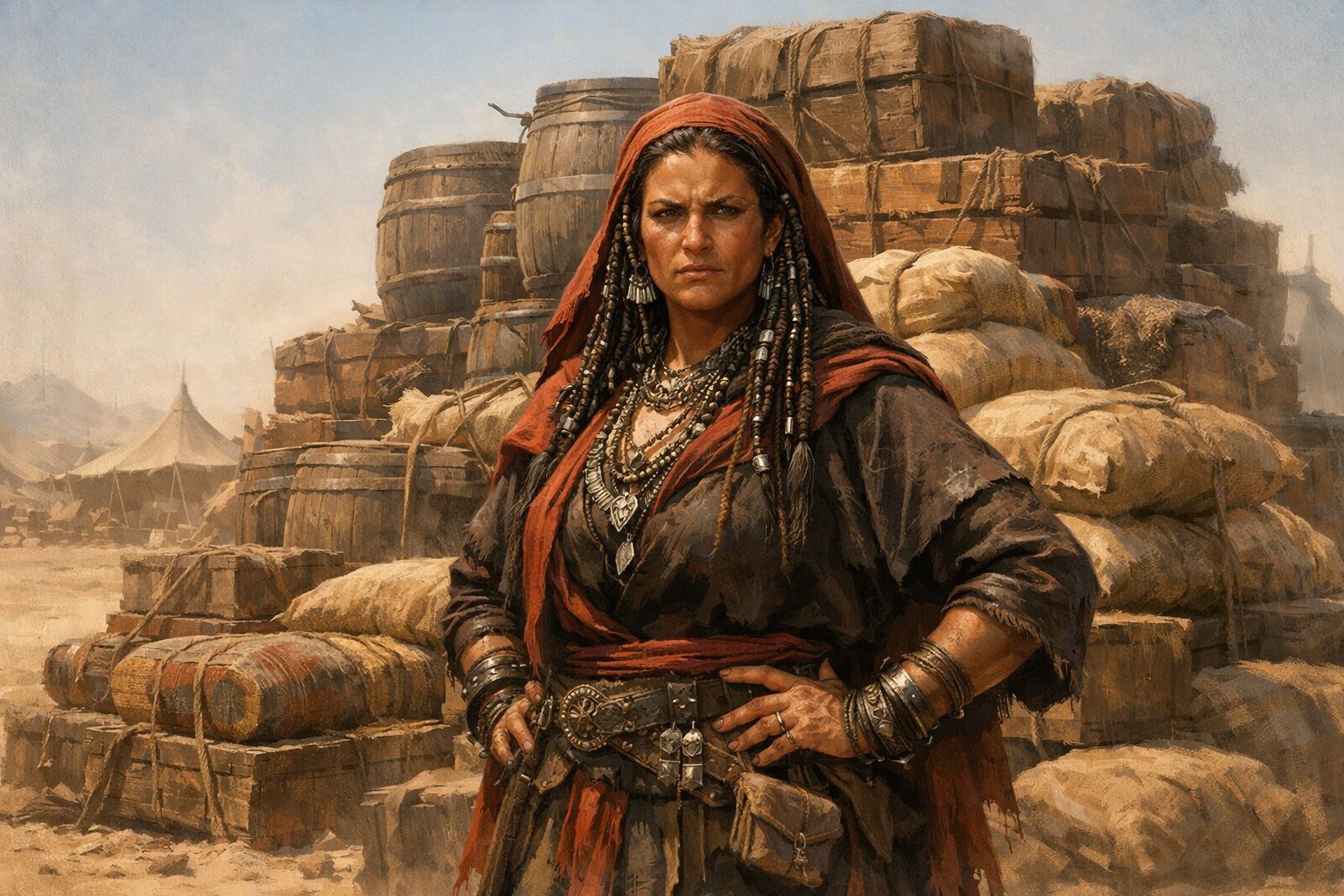
Sada is Miraz’s eldest daughter and the person who actually keeps the caravan functioning. She tracks water, food, sleeping space, trade goods, repairs and grudges with equal efficiency. She is in her forties, broad shouldered, stern faced and entirely immune to charm used for logistical advantage. Guests usually meet her first when they are told where to sleep, what they may touch and exactly how little water they are allowed to waste.
Sada is protective of her father without being sentimental about it, and she and Rashad argue constantly in the familiar way of people who trust each other completely. She sees Nahla as half useful and half exhausting, and regards Jalir as one more task to be managed. Toward the crew, she is initially the face of hard practicality. She can be used to create friction, especially around privacy, resources and caravan discipline, but also to show real approval when someone adapts well.
Rashad Year-Without-Rain, Shar'zul Master
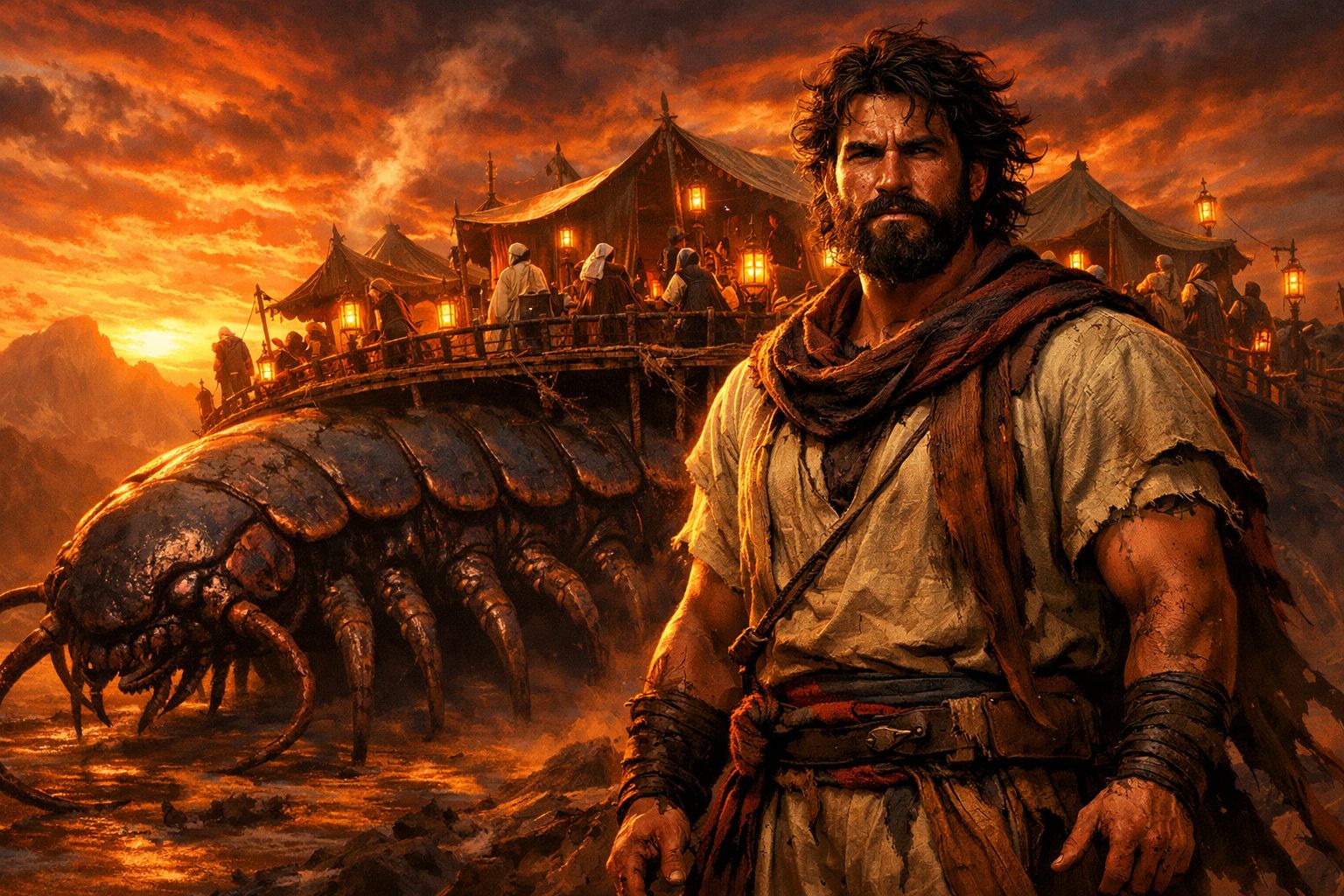
Rashad is the caravan’s chief handler of the Shar'zul, a broad shouldered man with scarred forearms, missing two fingers and the patient temper of someone who works daily with huge, dangerous creatures. He knows every harness knot, every limp, every hiss of irritation and every sign that a beast is about to turn foul. With people he is gruff, dry humored and slow to trust. With Shar'zul he becomes almost gentle.
Rashad works closely with Sada and often clashes with her over weight, timing and what the beasts can safely bear. He has a quiet friendship with Mira, who treats both him and the Shar'zul when needed. He has little patience for aristocratic airs, which makes him a good foil for Nephyla. Toward the crew, he respects practical competence above all else. He is useful in any scene involving caravan movement, beast trouble, sudden danger or the physical realities of travel.
Zahra al Duneveil, Dahrim
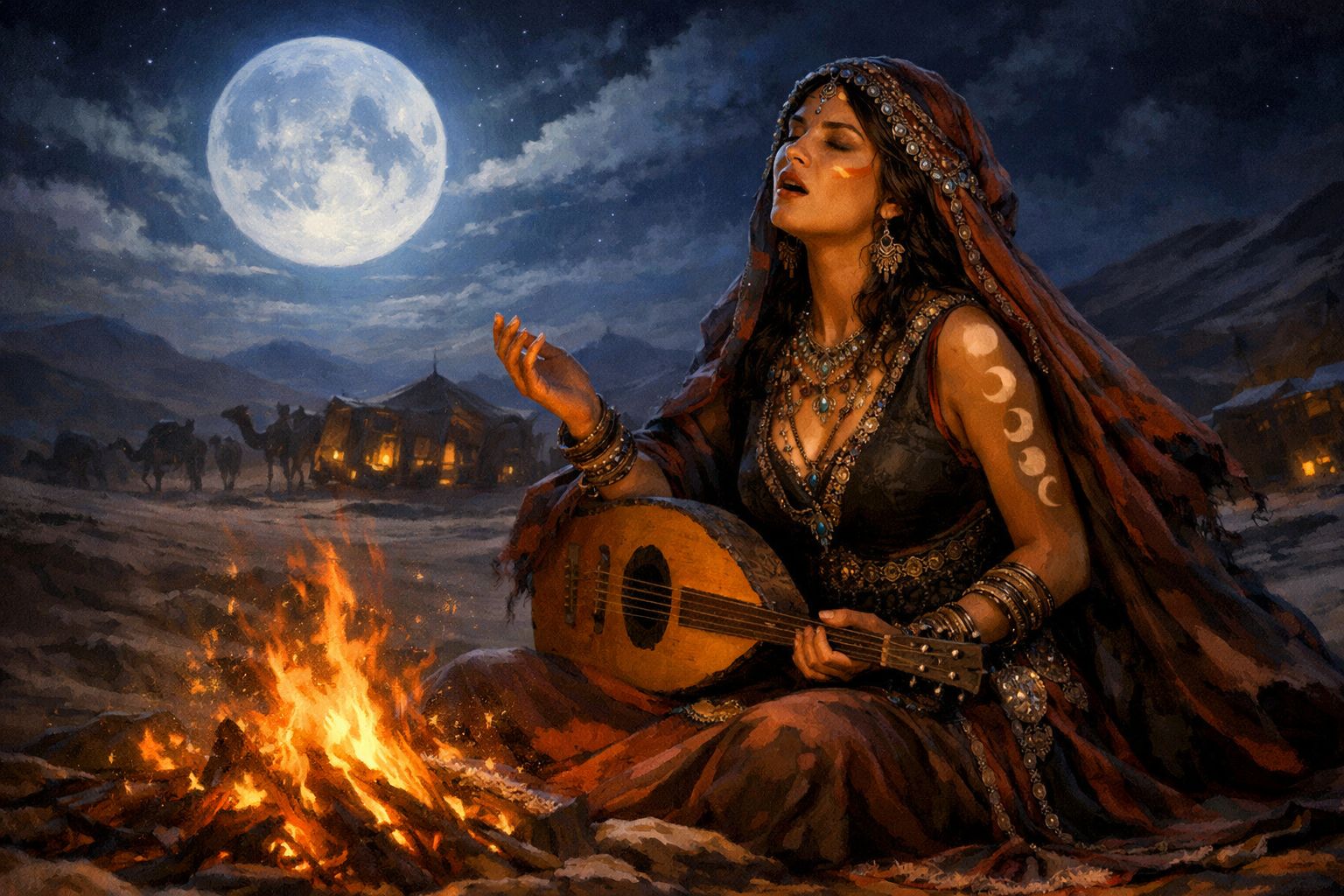
Zahra is one of the caravan’s singers, memory keepers and spiritual voices, a woman in her thirties with ochre paint on her cheeks, moon tattoos winding down one arm and eyes that always seem to be listening to something just beyond the obvious. She sings route songs, mourning songs, trade songs and old stories that seem older than the tribe itself. She is warm in company, unsettling in solitude and impossible to pin down fully.
Zahra and Old Samir bicker affectionately over stories and precedence, each accusing the other of embellishment while both do exactly that. Miraz values her but does not always like the truths she chooses to speak aloud. Children adore her. Some adults are wary of her. Toward the crew, Zahra is one of the first to treat them as people instead of cargo. She is useful for cultural exposition, mood, myth and for those moments when the caravan seems to know more than it should.
Old Samir of the Long Song, Storykeeper
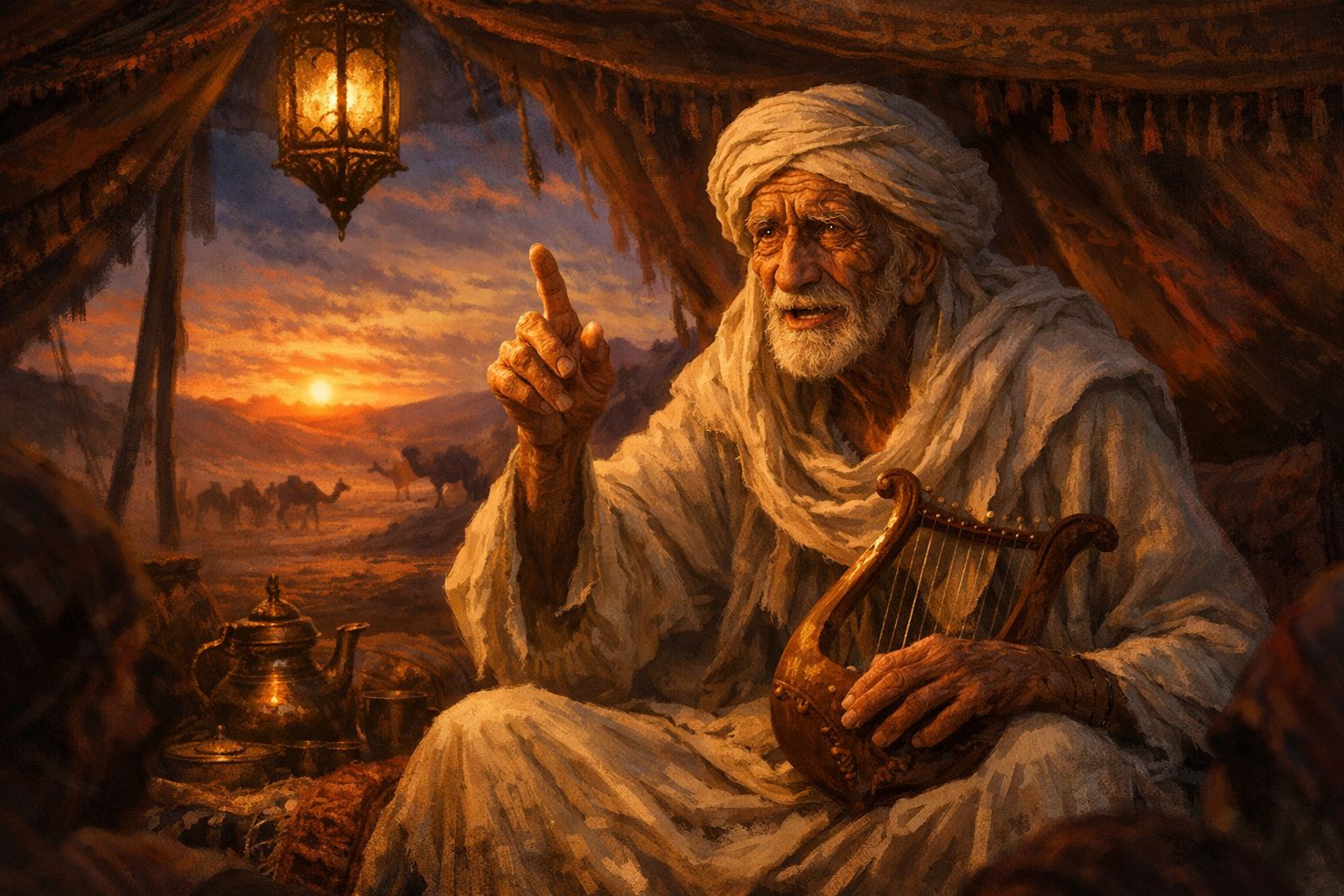
Samir is ancient by caravan standards, all wrinkles, dry wit and careful memory, wrapped in faded pale cloth with a small harp never far from reach. He remembers routes, births, deaths, feuds, marriages, wells, betrayals and songs going back farther than anyone can comfortably verify. He appears half asleep until someone gets a story wrong, then becomes suddenly sharp enough to cut leather.
Samir enjoys deflating younger people, especially Jalir and Nahla, and has a friendly rivalry with Zahra about truth versus beauty in storytelling. He has known Miraz since youth and can needle him in ways no one else dares. Toward the crew, Samir is likely to be one of the easiest points of connection if they are willing to sit, listen and trade stories of their own. He is useful for oral history, worldbuilding and as a continuity anchor in the caravan.
Tarek Sandnose, Camel Scout
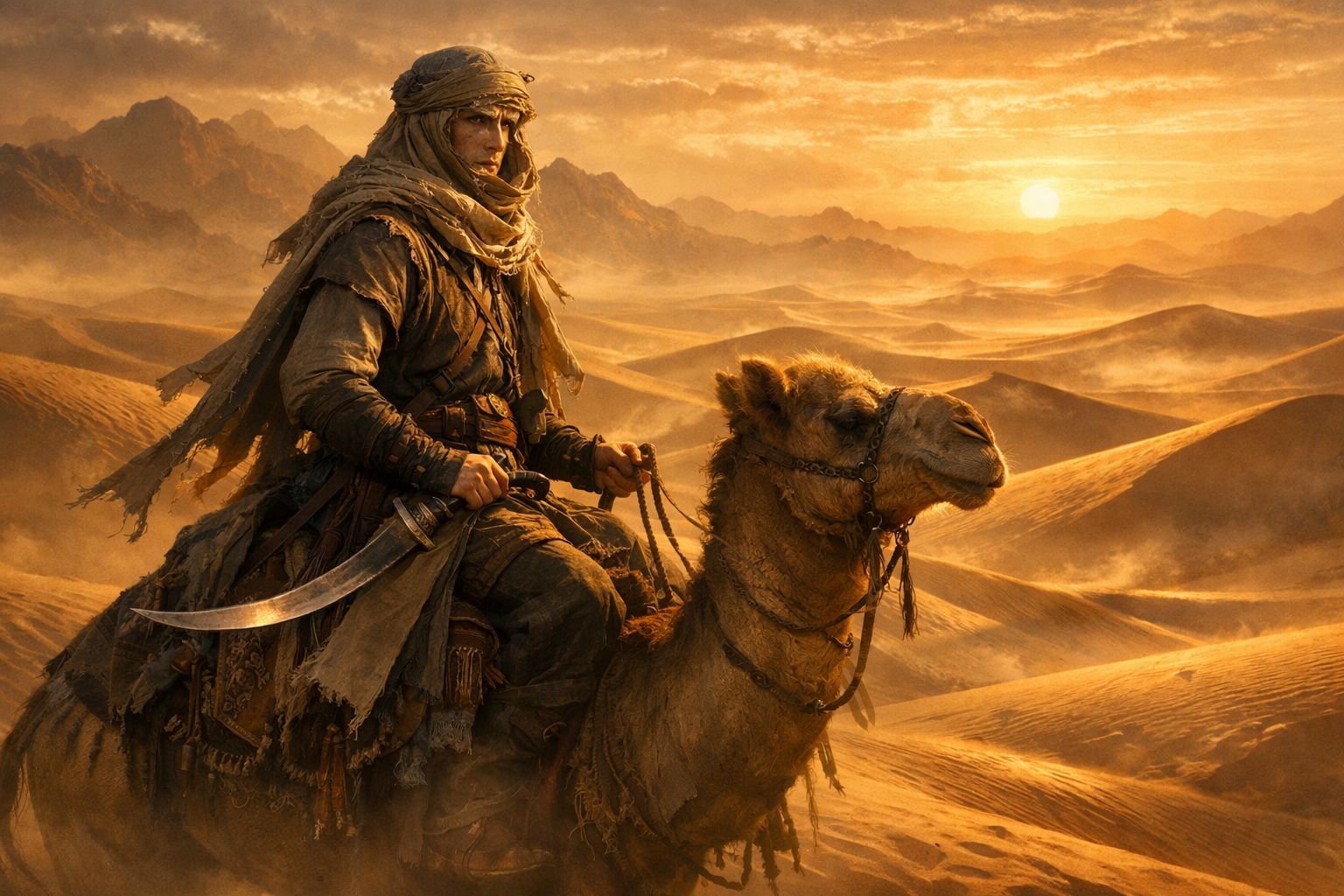
Tarek is a rangy scout in his twenties with a crooked nose, pale eyebrows bleached by the sun and the kind of stillness that makes people forget he is nearby. He rides far ahead of the caravan on a bad tempered camel named Thorn and returns with news of wells, tracks, dust plumes, ruins and trouble. He is not sociable, but not hostile. He simply prefers distance, and he says only what needs saying.
Tarek respects Miraz and Rashad, ignores Jalir’s attempts at camaraderie and has a low key mutual attraction with Farah that neither of them is foolish enough to indulge lightly. Toward the crew, Tarek is often the last to trust and the first to notice danger around them. He is useful for foreshadowing, warnings, route knowledge and scenes where danger reaches the caravan before the main body sees it.
Mira Bone-Needle, Healer and Midwife
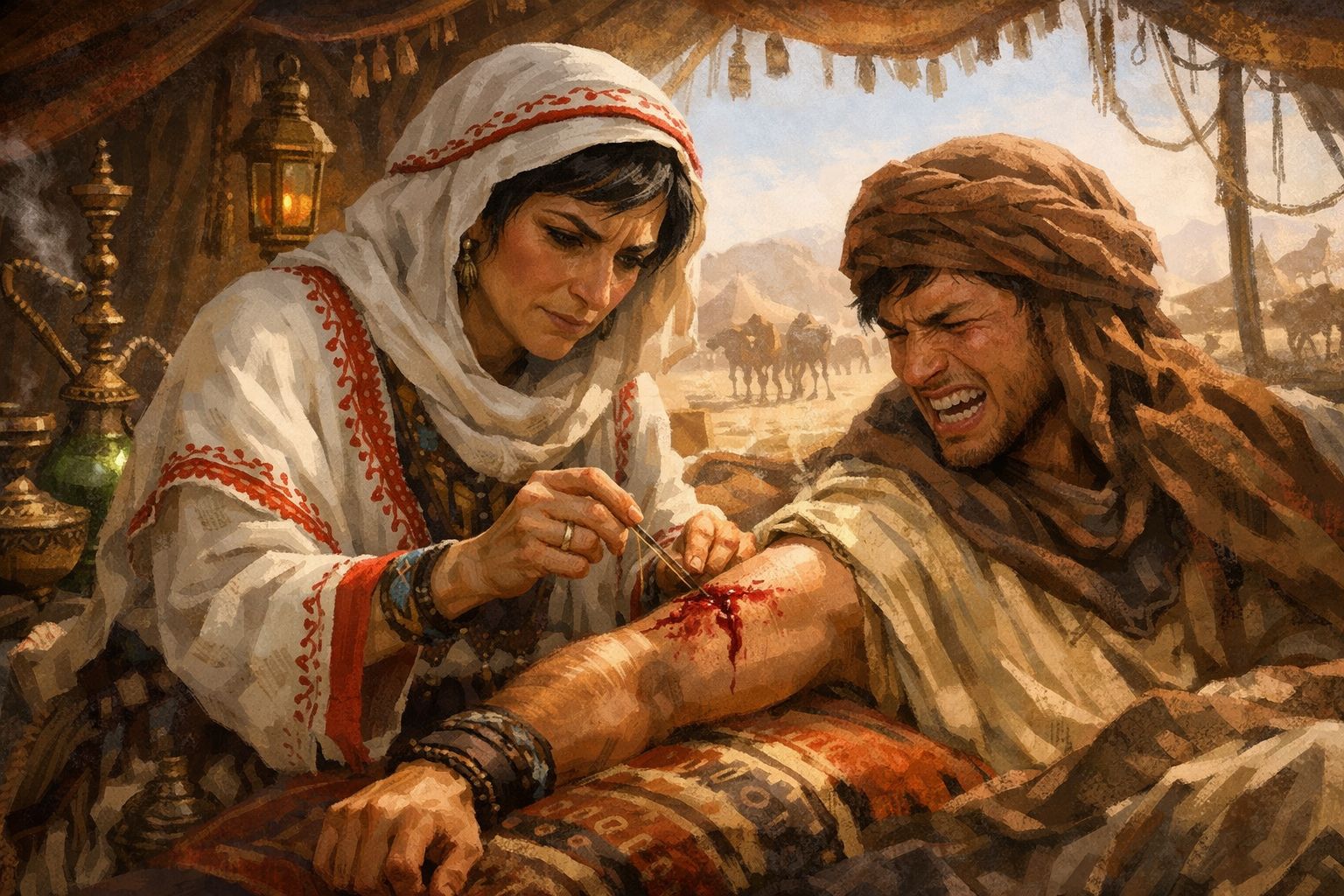
Mira is the caravan’s healer, midwife and general answer to the fact that bodies keep failing in inconvenient ways. She is middle aged, sharp eyed and perpetually busy with fever, stitching, births, sprains, bites, rashes and men too proud to admit they need help. She speaks of wounds, bowels and blood with total lack of embarrassment and sees modesty as a nuisance to be worked around rather than respected.
Mira and Junia should get along well if you want a bridge into caravan life through competence. She has a longstanding practical friendship with Rashad and a slightly exasperated fondness for Hadi, who is always underfoot. She is useful whenever you want to normalize the caravan’s lack of privacy, to compare healing traditions or to put Nephyla in uncomfortable contact with ordinary care.
Farah Ash-Marked, Widow of the Dunes
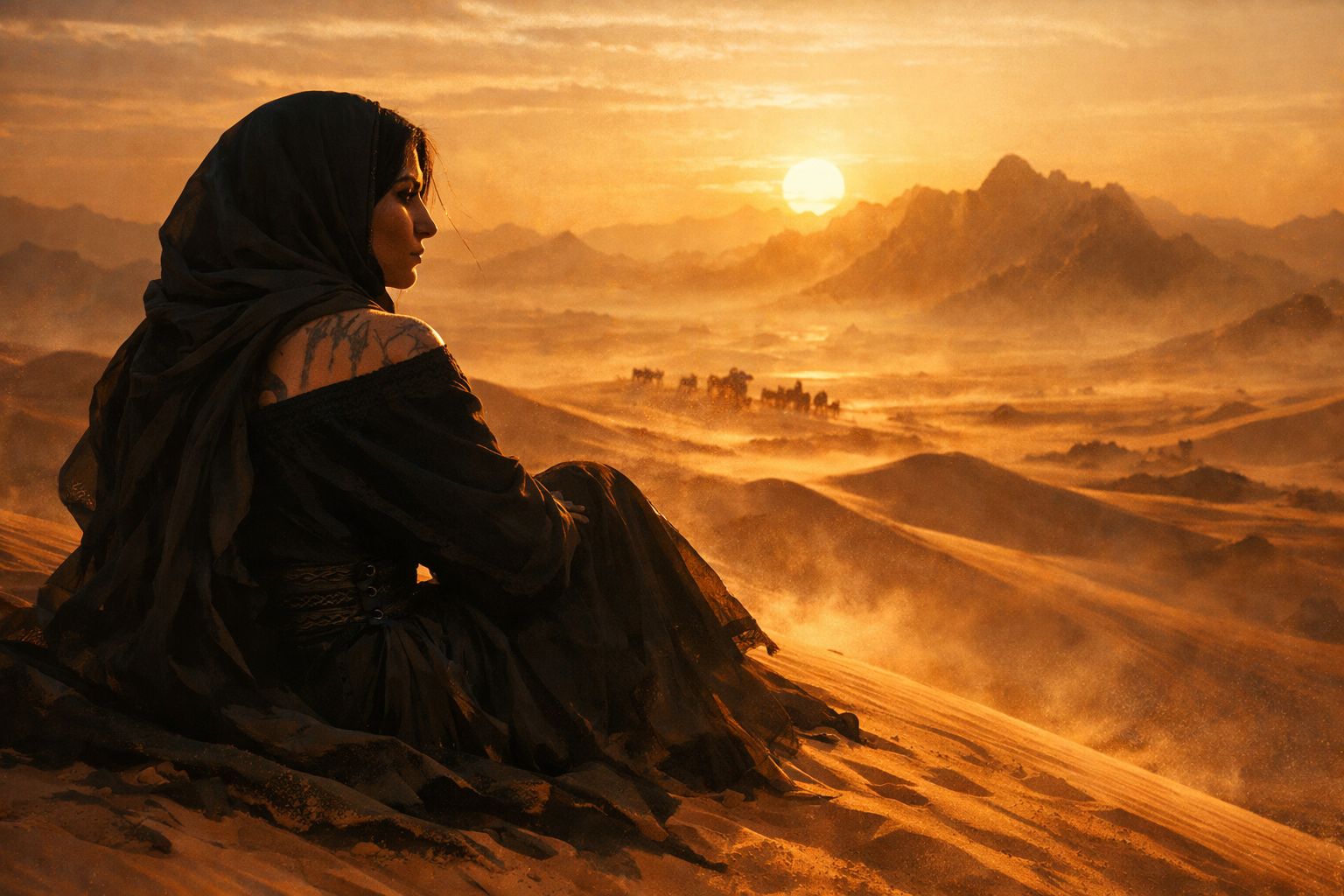
Farah is a widow in her thirties whose husband died in a sandstorm two years earlier. She now runs her own small knot of relatives and dependents within the larger caravan. She is quiet, self possessed and hard to read, with ash tattoos across her shoulders marking mourning and endurance. She rarely speaks without purpose and never speaks to fill silence.
Farah has a quiet authority that does not rely on formal rank. Miraz respects her judgment. Tarek trusts her more than most. Zahra leaves her alone when others do not. Toward the crew, Farah is often a better entry point for serious or grief marked scenes than the more colorful caravan figures. She is useful when you need emotional ballast, a sober perspective or a woman who sees through Nephyla’s pride without being impressed by it.
Nahla Three-Moon, Trader
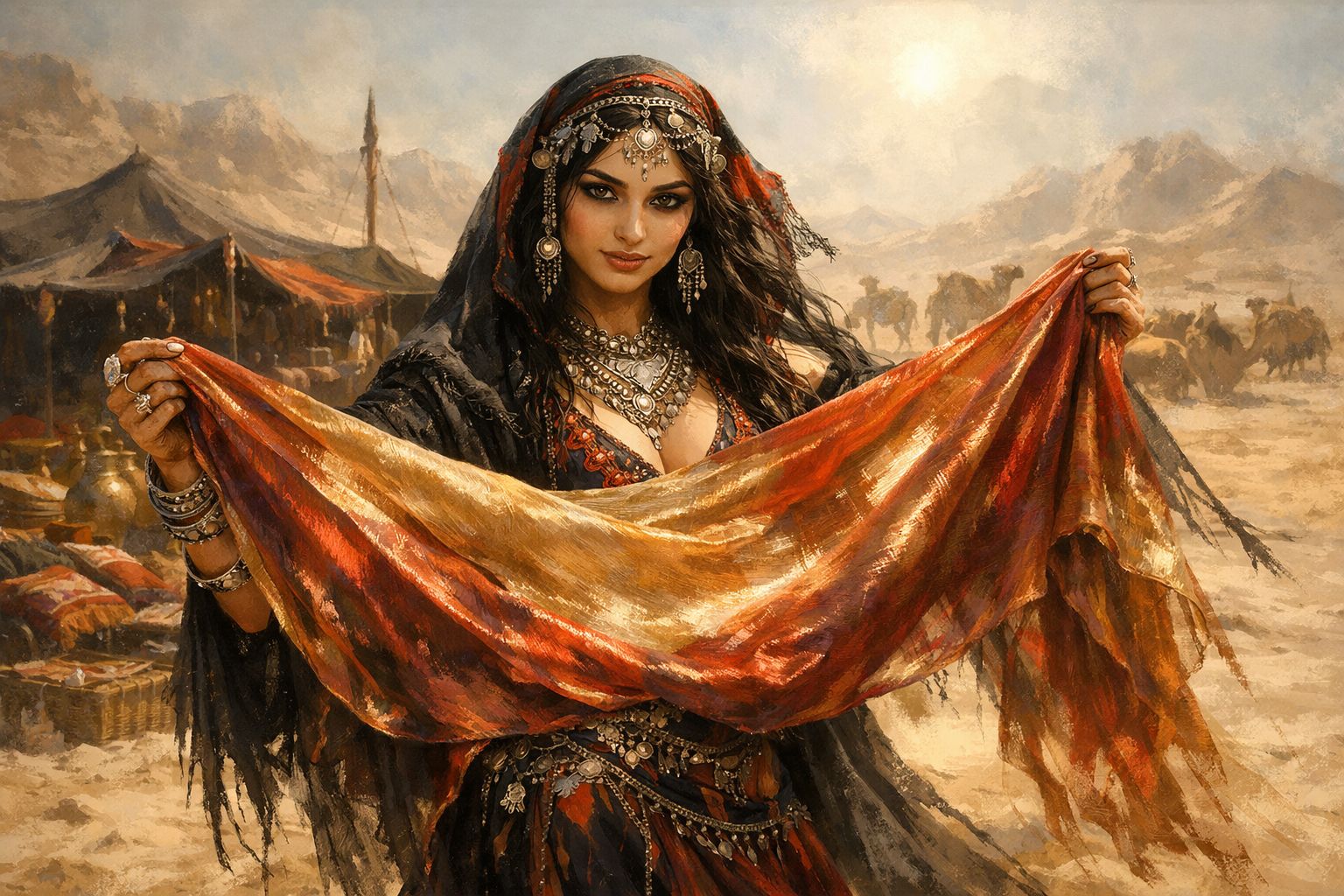
Nahla is a young trader born of one of the great intertribal feasts, and she wears that fact like a medal. She is quick tongued, shamelessly curious and always alert to what can be sold, swapped, exaggerated or beautified. Beetle shell dyes, amber beads, veils, dried fruit, charms, gossip, all of it passes through her hands eventually. She is not a cheat exactly, but she is delighted by any bargain where both sides walk away thinking they won.
Nahla flirts freely, laughs easily and collects secrets because she finds them entertaining. Sada distrusts her methods but values her profits. Jalir is hopelessly smitten with her whenever she bothers to notice. She treats the crew as a source of novelty, stories and opportunities. She is useful whenever you want rumor, social energy, small temptations, accidental insults or a fast bridge between the caravan and outsiders at market stops.
Jalir Dust-Laugh, Young Warrior
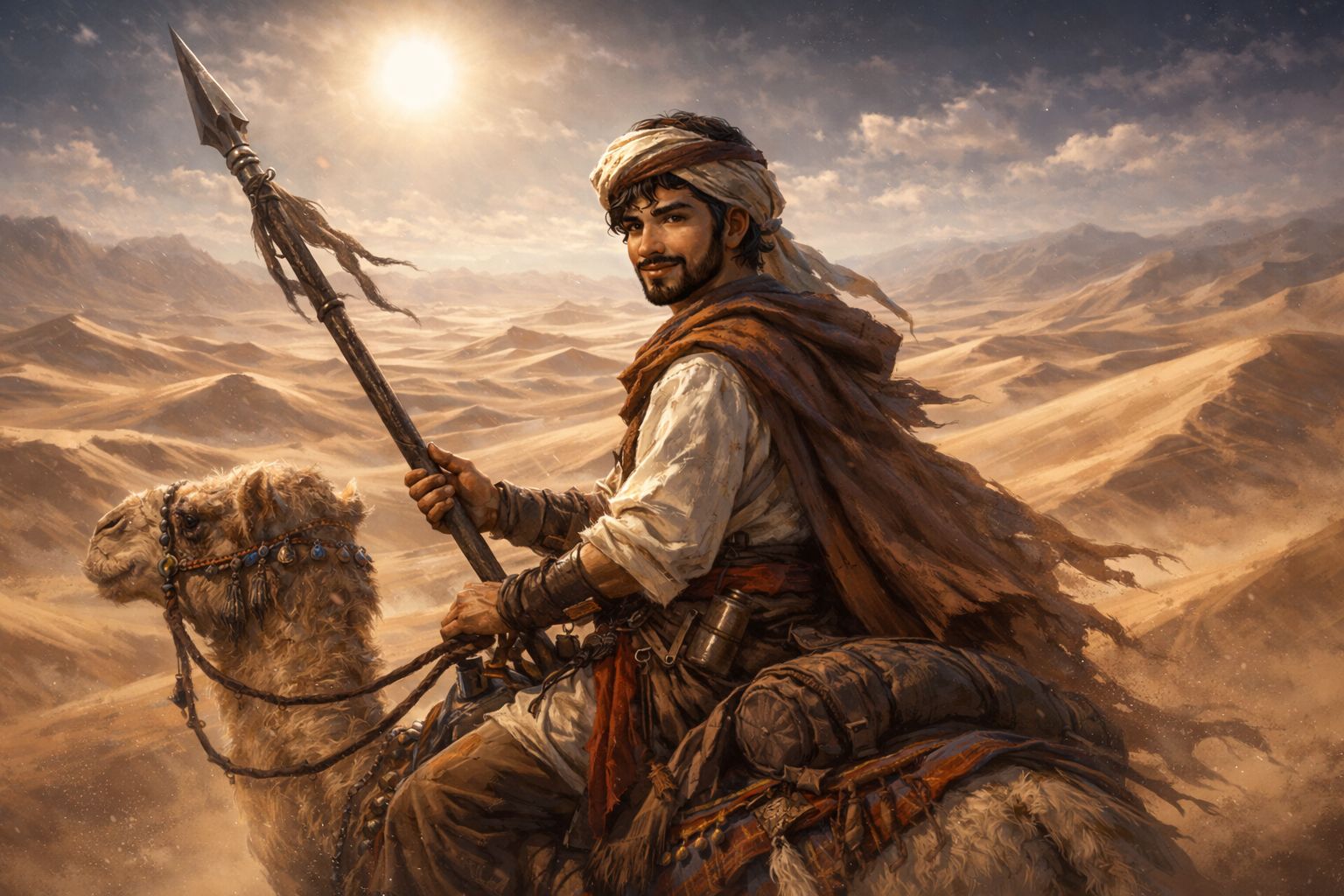
Jalir is a handsome fool in his late teens or early twenties, eager to prove himself, eager to flirt and not nearly as subtle as he thinks. He is fast with a spear, good with a knife and very proud of his camel handling. He is also one of the first to show obvious interest in outsiders, especially anyone who looks glamorous, dangerous or forbidden.
Jalir is tolerated by Miraz, mocked by Nahla and periodically corrected by Rashad. Sada treats him like one more repair problem. Toward the crew, he can attach himself quickly, especially to those who fight well or tell exciting stories. He is useful as comic relief, youthful energy, a lens on younger Tazulmar attitudes and as the kind of person who may get charmed by Isetnefer later.
Laleh Soft-Step, Weaver and Tent Keeper
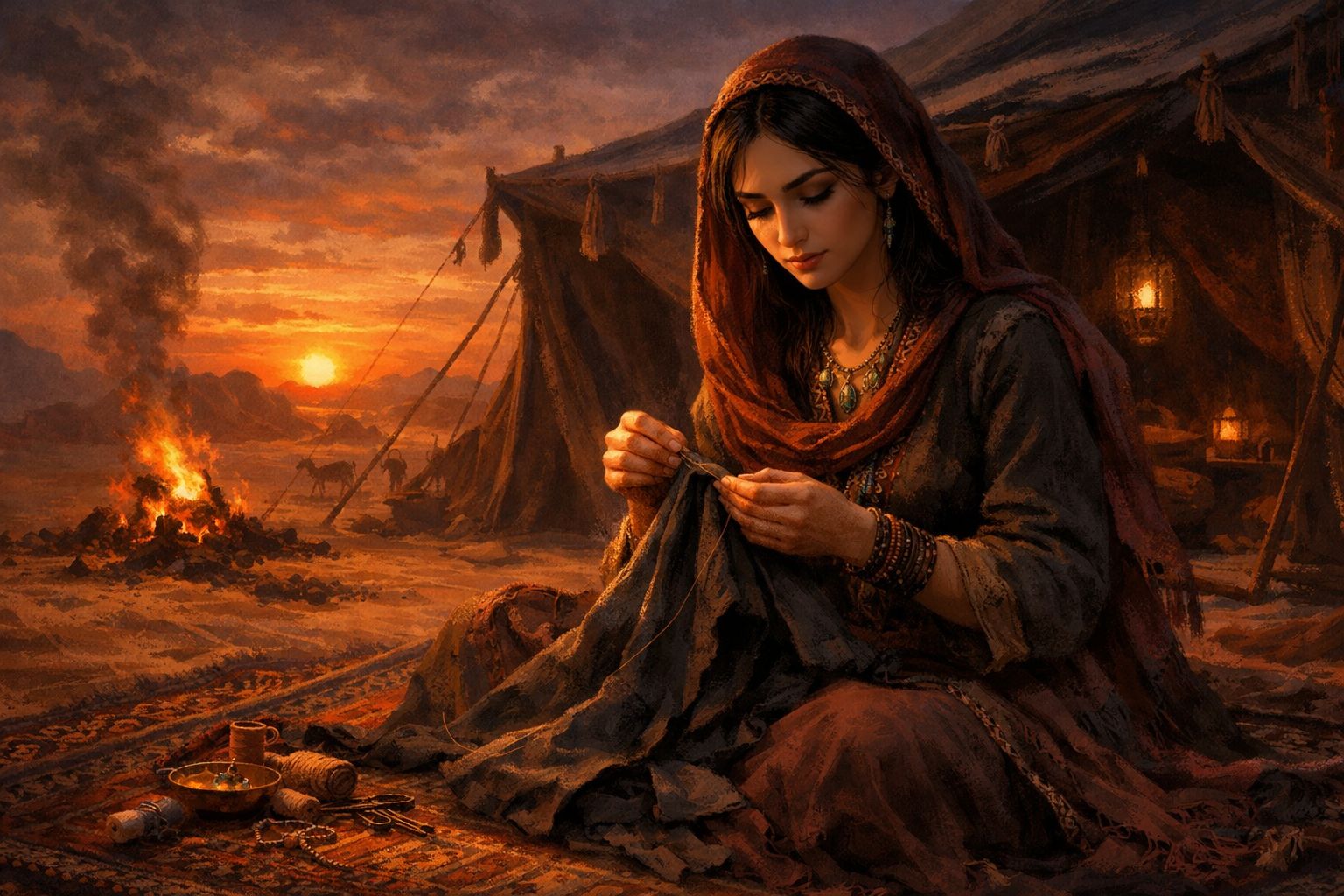
Laleh is a woman in her late twenties who oversees tent cloth, repairs, bedding and all the endless quiet work that keeps a moving people from becoming a ragged one. She is slight, dark eyed and soft spoken, with a habit of noticing holes in both canvas and conversation. Her fingers are always busy, whether with thread, beadwork or someone else's torn sleeve. Laleh is kind without being weak and practical without being hard.
She tends to know who is sleeping beside whom, who is quarreling and who is pretending not to be in love. Toward the crew, she is one of the first to make life easier in small ways, adjusting sleeping space, finding spare cloth and quietly smoothing the worst discomforts of caravan intimacy. She is useful whenever you want domestic texture, gossip that is gentle rather than sharp or a quiet observer who notices changes in mood before others do.
Qamar ibn Sadeq, Guard Captain
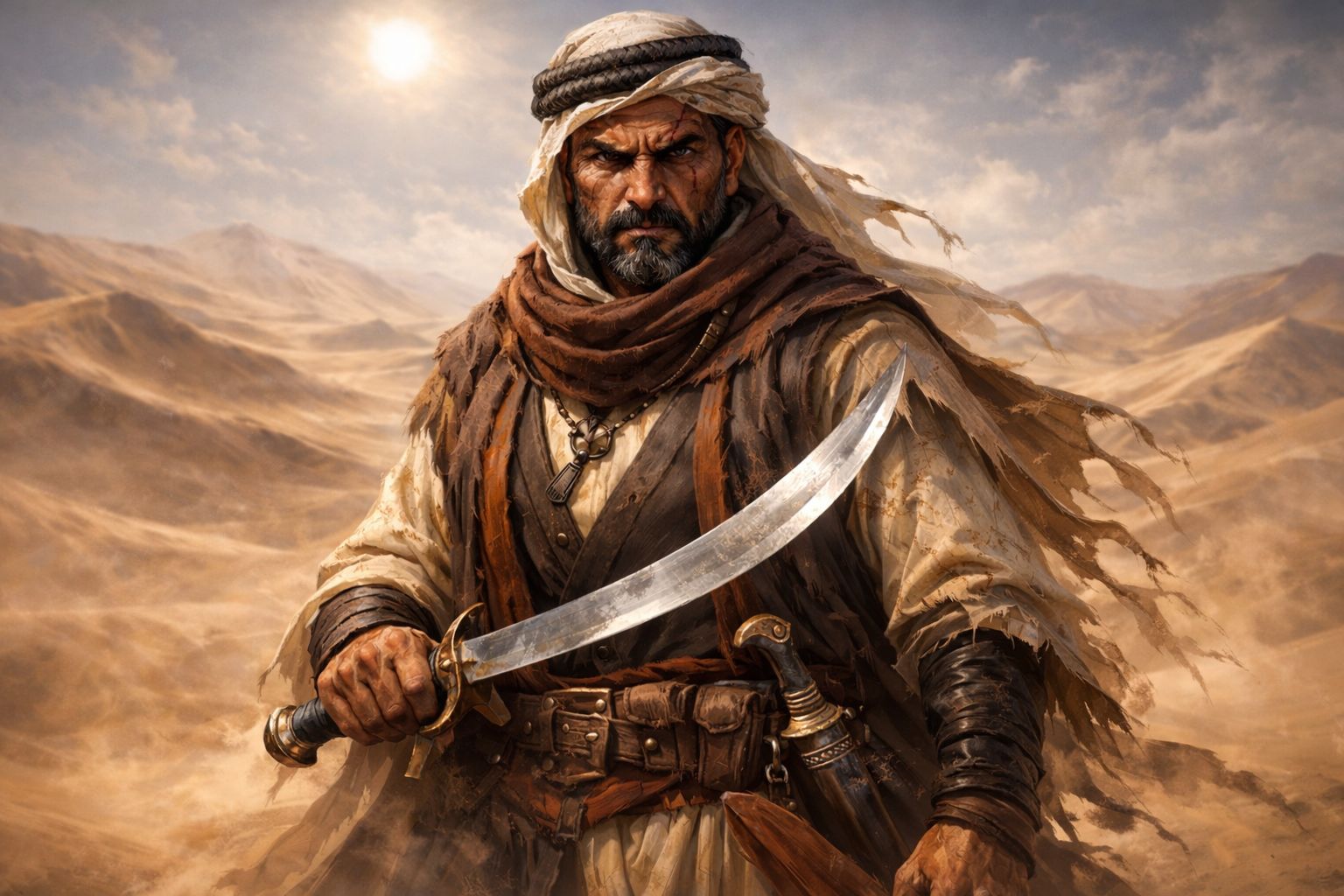
Qamar commands the caravan's regular fighting men, though the title sounds grander than the reality. He is in his forties, broad chested and weathered, with a split eyebrow and the tired patience of a man who has had to stop the same kind of stupidity many times before. He does not posture and does not romanticize danger. He drills watch rotations, checks spear points and assumes trouble will come eventually.
He respects Miraz, tolerates Jalir and distrusts outsiders until proven wrong. Toward the crew, Qamar is polite but guarded. Toward Nephyla, he is particularly wary, not because he doubts her danger, but because he understands too well what happens when powerful people bring pursuit with them. He is useful for scenes about security, suspicion and the practical cost of sheltering fugitives.
Khalida Reed-Braids, Water Keeper
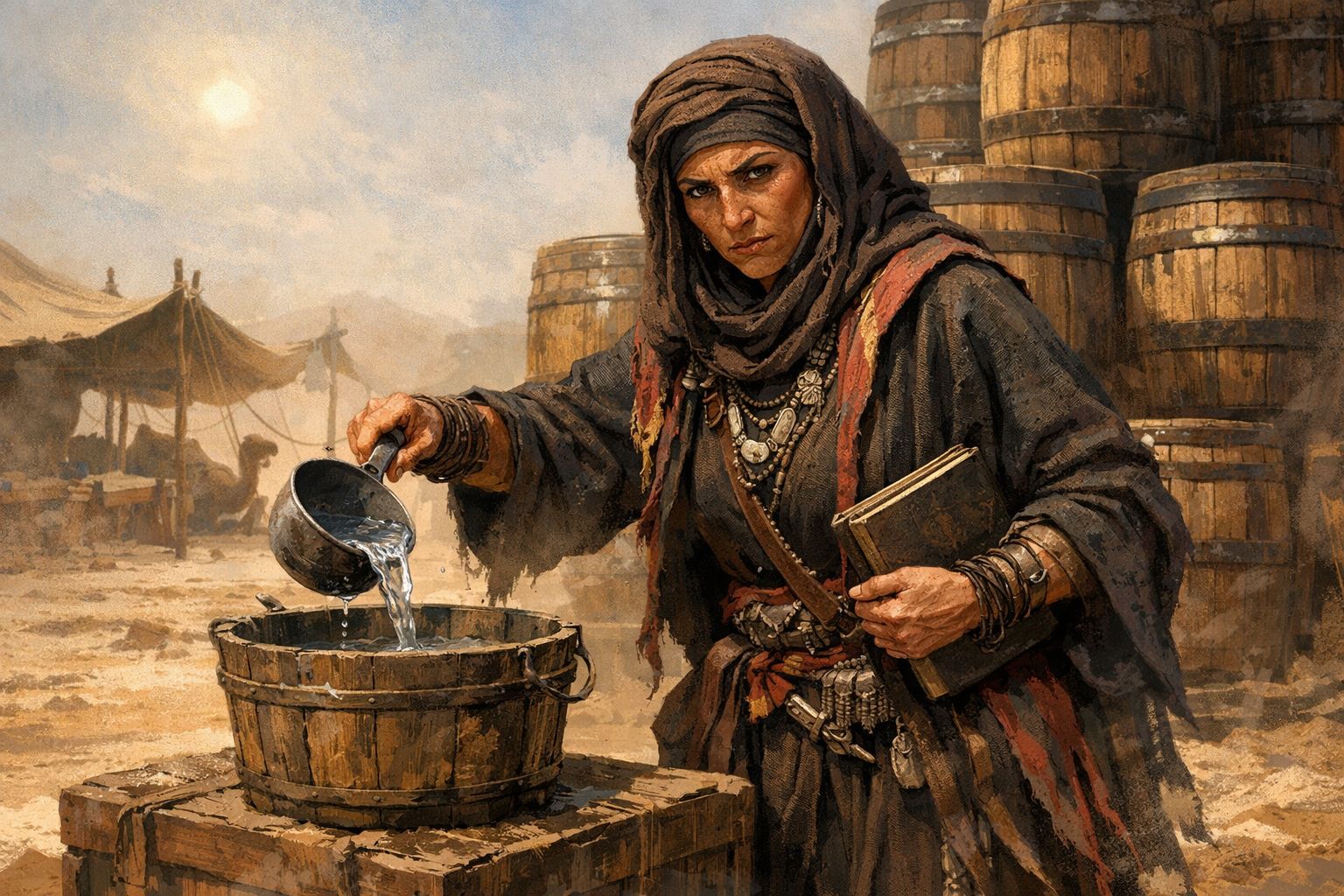
Khalida is responsible for the tracking, measuring and guarding of water stores, which means she is feared in small domestic ways by almost everyone. She is in her forties, severe, spare and deeply unimpressed by thirst dramatics. She can tell at a glance who has been careless with rationing and who has secretly washed more than they should. Khalida is not cruel. She is simply devoted to the truth that sentiment does not fill a skin.
Toward outsiders, she is often the clearest expression of Tazulmar discipline. She is useful in any scene where the stakes of the desert need to feel real, especially if the crew or Nephyla still carries habits from a more abundant world.
Parvin Salt-Hair, Elder Aunt
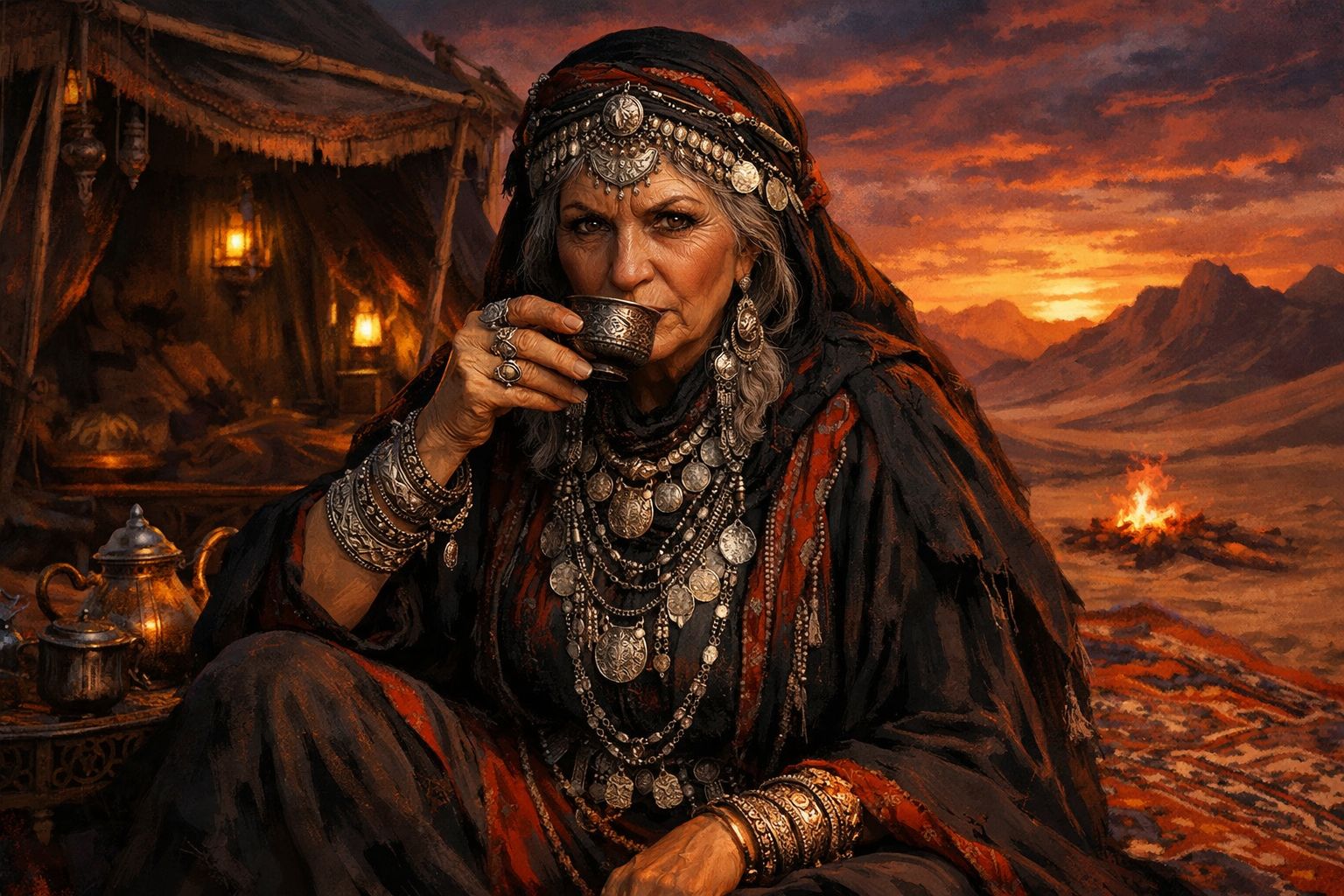
Parvin is one of those women who have never held formal authority and yet somehow outrank half the caravan anyway. She is in her sixties, sharp tongued, silver haired and impossible to deceive in any way that matters. People bring her disputes because she remembers who owed what to whom fifteen years ago and because she is less interested in fairness than in ending nonsense efficiently.
Parvin has little patience for aristocrats, performers or self pity, which makes her an excellent person to place near Nephyla. She is useful whenever you need old memory, social pressure or someone who can puncture grandeur without ever becoming crude.
Little Hadi, Drum Child
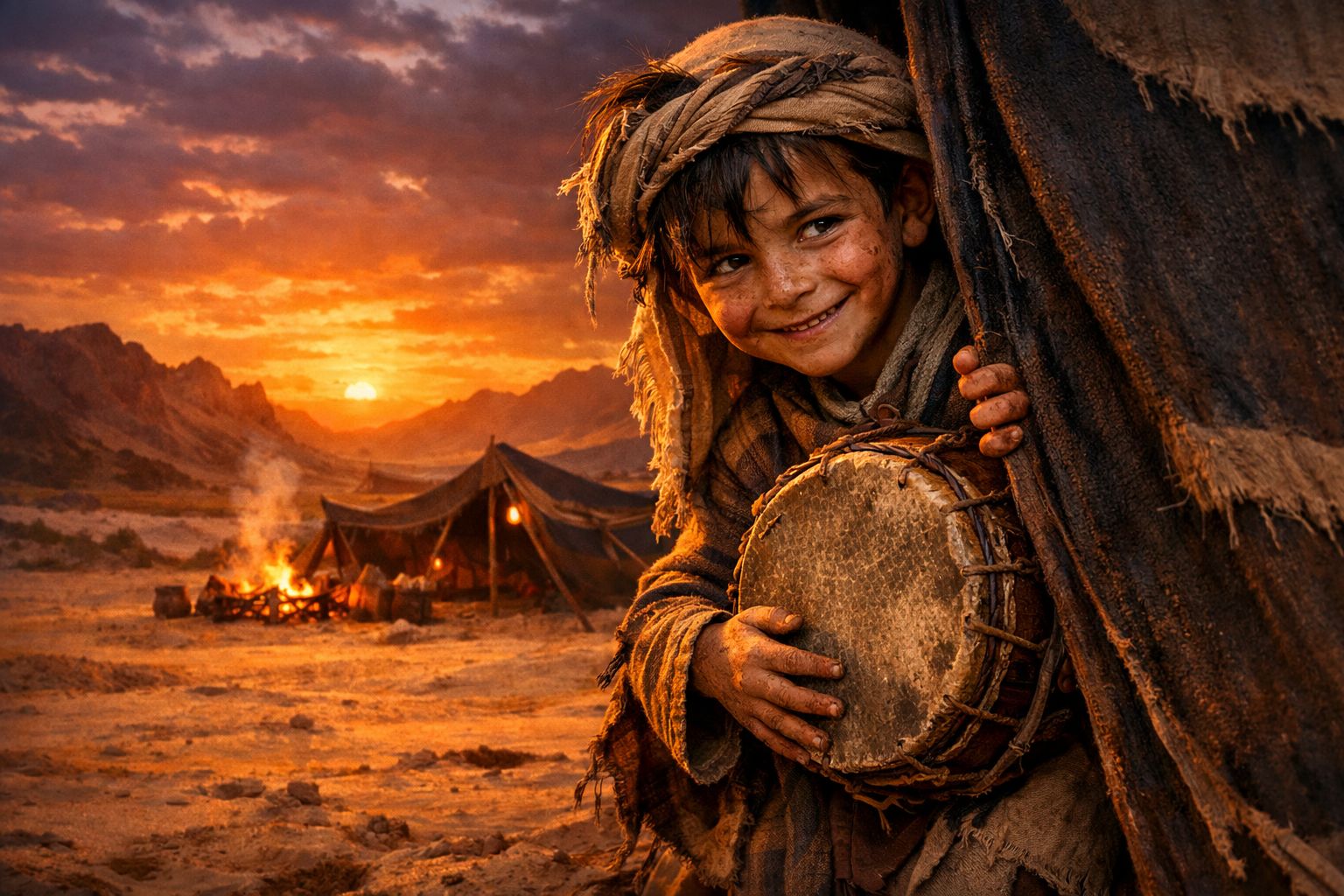
Hadi is nine, barefoot most of the time and always where he should not be. He carries a small lizard hide drum nearly as large as his chest and believes himself already a musician of enormous importance. He asks unbearable questions, repeats things adults thought he was not listening to and appears at exactly the wrong time with exactly the right information. He is an orphan, which makes the entire tribe his parents.
Everyone in the caravan is exasperated by him, which means everyone is also protective of him. Samir encourages him too much, Mira patches him up too often and Sada is forever sending him away from dangerous places he returns to moments later. He is useful for comic relief, accidental revelations and scenes that remind everyone the caravan is a living society, not just a vehicle for the plot.
Danya Sun-Bitten, Potter and Mother of Four
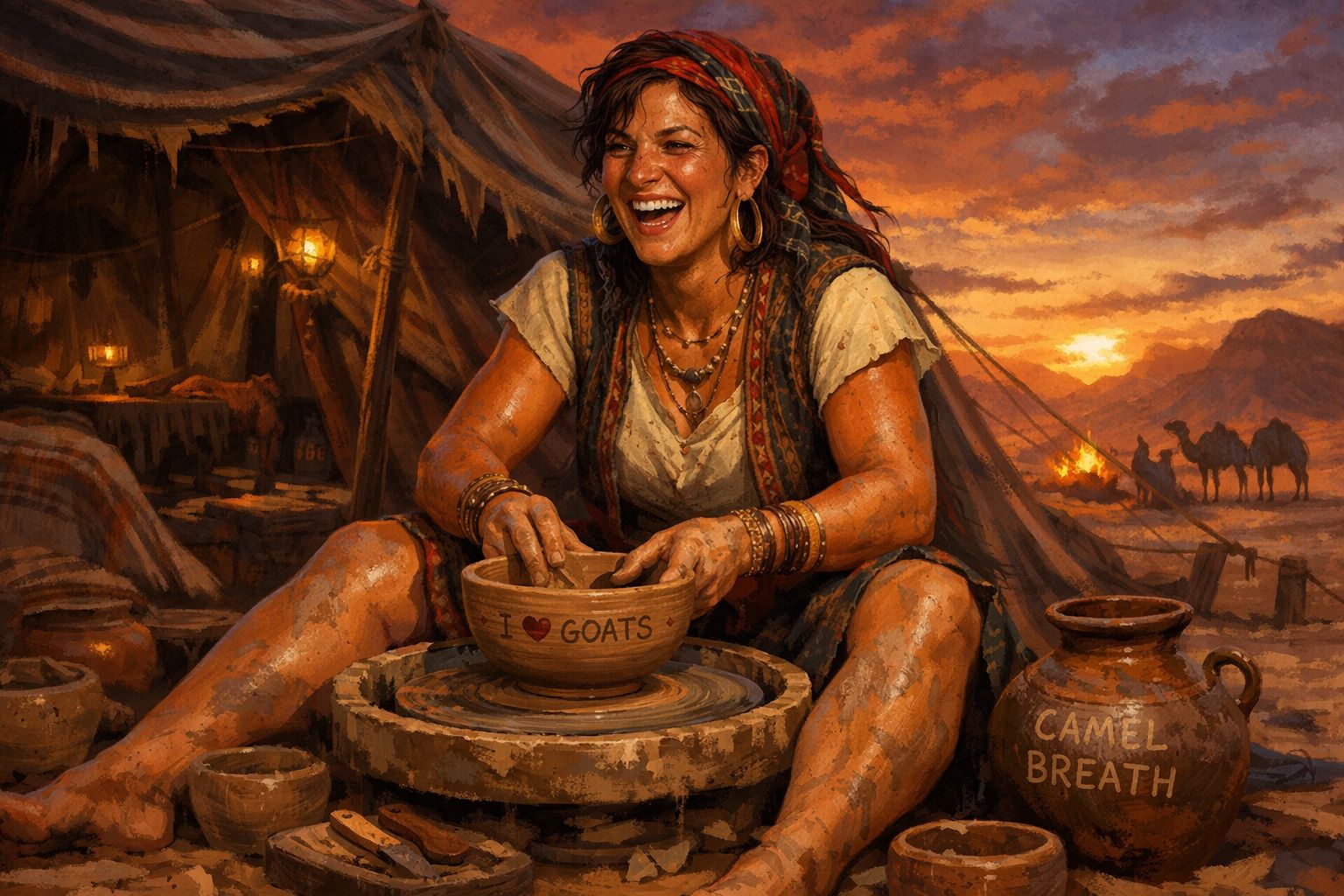
Danya is a potter whose kiln travels in pieces and whose temper does not. She is in her thirties, loud, sun browned and impossible to ignore, with strong arms and a laugh that carries across half the camp. Her pottery is coarse, durable and often decorated with little jokes or sharp little insults scratched into the clay. She has four children, one absent husband who scouts with another branch of the tribe and very firm opinions about everyone else's life.
Danya is one of the people most likely to make outsiders feel included by sheer force of personality. She feeds first, questions second and judges constantly. She is useful whenever you want warmth, noise, domestic pressure or someone blunt enough to cut through tension with either comfort or offense.
Rafiq al Saffron, Perfumer and Would-Be Seducer
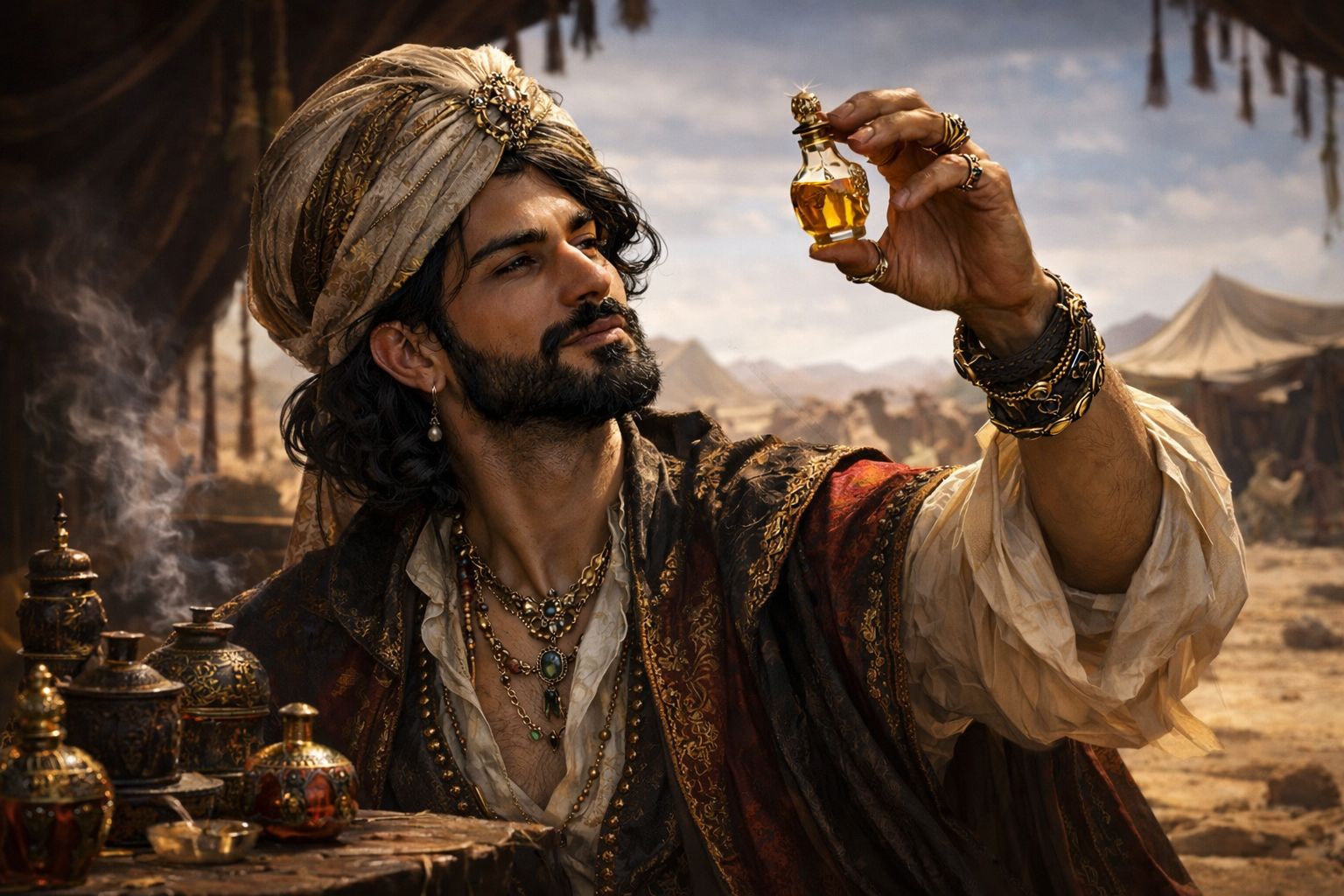
Rafiq is beautiful, vain and fully aware of both facts. He is a perfumer and trader in oils, powders and incense, always carrying the scents of amber, saffron or smoked flowers around him like an invisible cloak. He is in his early thirties, quick with compliments and quicker with mirrors. Rafiq likes attention, likes novelty and likes people who resist him just enough to make success feel earned. He is not a fool, but he often behaves like one where desire is concerned.
Toward the crew, he is likely to take immediate interest in anyone striking, melancholy or difficult, and toward Nephyla he is wise enough to admire from a distance. He is useful as a likely love seeker, as a source of cosmetic and social detail and as a man whose flirtation is usually harmless until it is not.
Sereh of the Blue Veil, Young Widow
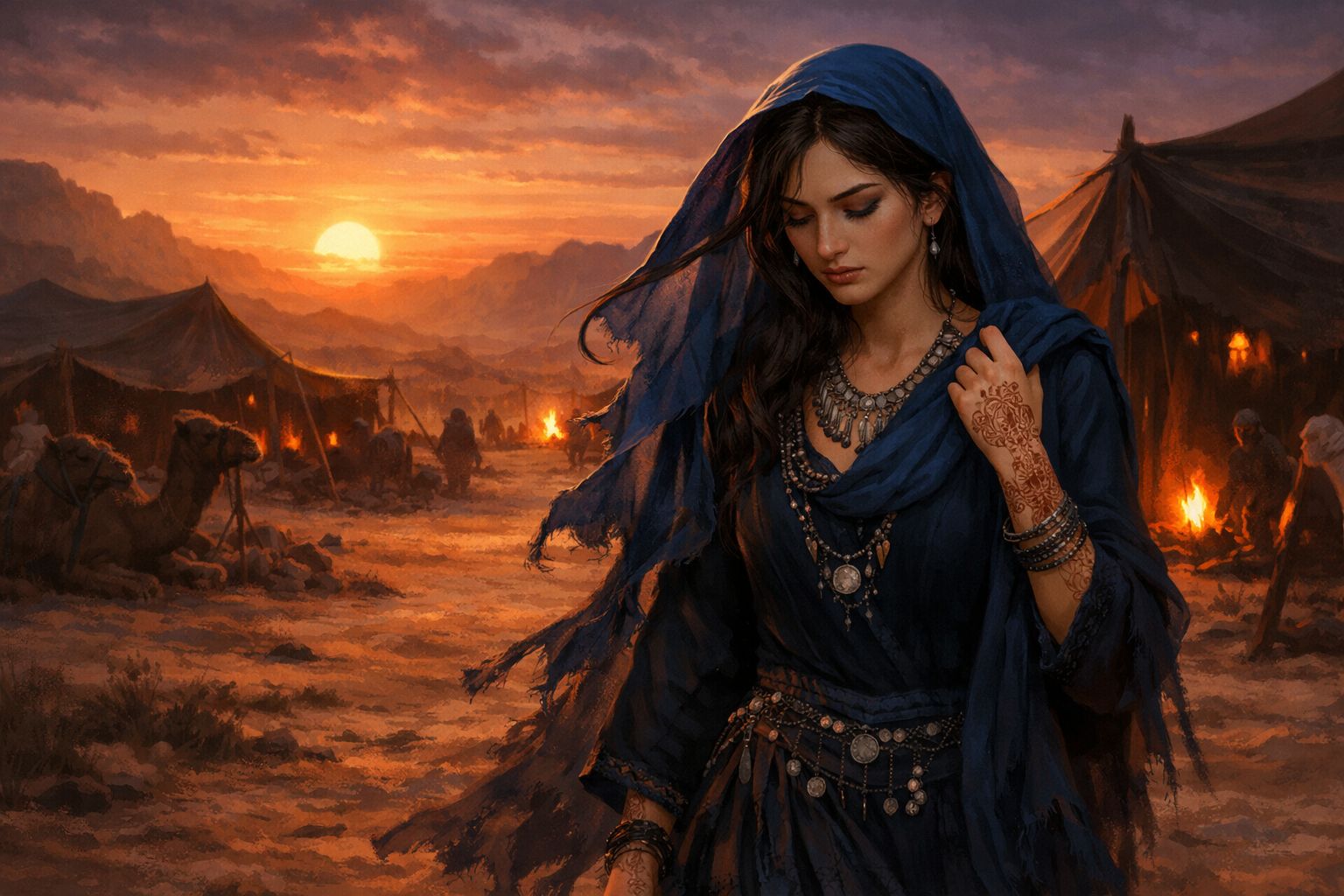
Sereh is a young widow in her mid twenties who lost her husband to a fever rather than violence, which somehow made the loss seem more unfair to everyone around her. She wears a blue veil for mourning but not always correctly, which older women notice and forgive. She is gentle, attractive and clearly lonely, though she tries not to let loneliness shape her choices. That does not always work.
Sereh is one of the more likely people to be drawn toward outsiders or strangers from other tribes, not out of rebellion, but because her life has already broken once and the old shape no longer fits her. She is useful as a potential love seeker, as someone who might be embarrassed by her own desire and as a contrast to more shameless caravan figures. She could also become vulnerable to the wrong sort of charm if handled carelessly.
Hamid Crooked-Tooth, Leatherworker
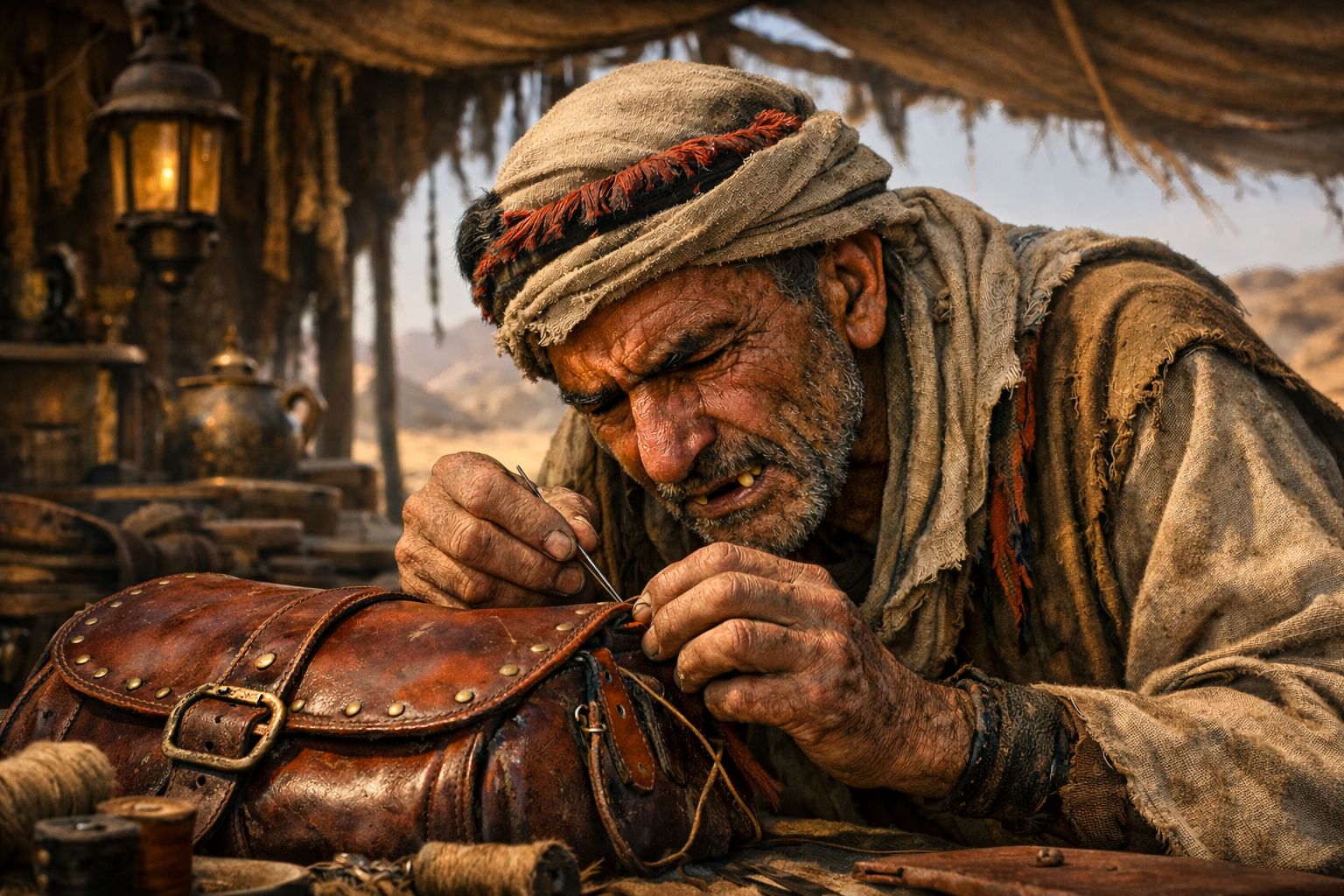
Hamid makes harness, water skins, sandals and all the other leather things no one notices until they fail. He is wiry, middle aged and permanently unimpressed, with one broken tooth and a stare that makes younger people feel as though they have already disappointed him. In truth, Hamid is kinder than he looks. He just believes in competence more than manners. He works closely with Rashad and often complains that the Shar'zul ruin good leather faster than humans ruin good sense.
Toward the crew, Hamid is one of the best people to use if you want the caravan to feel materially real. He talks about stitching, wear, rot, sand damage and all the details that keep movement possible. He is useful in grounding scenes and in giving practical opinions no one asked for but everyone probably needed.
Nisrine Laughing-Eyes, Dancer and Matchmaker

Nisrine is a dancer by reputation and a matchmaker by habit, though she would insist both are arts and neither should be insulted by being called a hobby. She is in her late twenties, bright eyed, agile and incurably interested in who wants whom. She performs at evening gatherings, knows how to make old songs feel young and has a talent for nudging people toward one another while pretending innocence. Nisrine is not malicious, but she is absolutely capable of making social life more complicated for her own amusement.
Toward the crew, she is likely to take immediate interest in awkward chemistry, hidden longing or anyone who thinks they are being subtle. She is useful as a love seeker herself, as an instigator of romance or embarrassment and as someone who can make the caravan feel lively rather than merely hardy.
Yusef Hollow-Reed, Flute Player
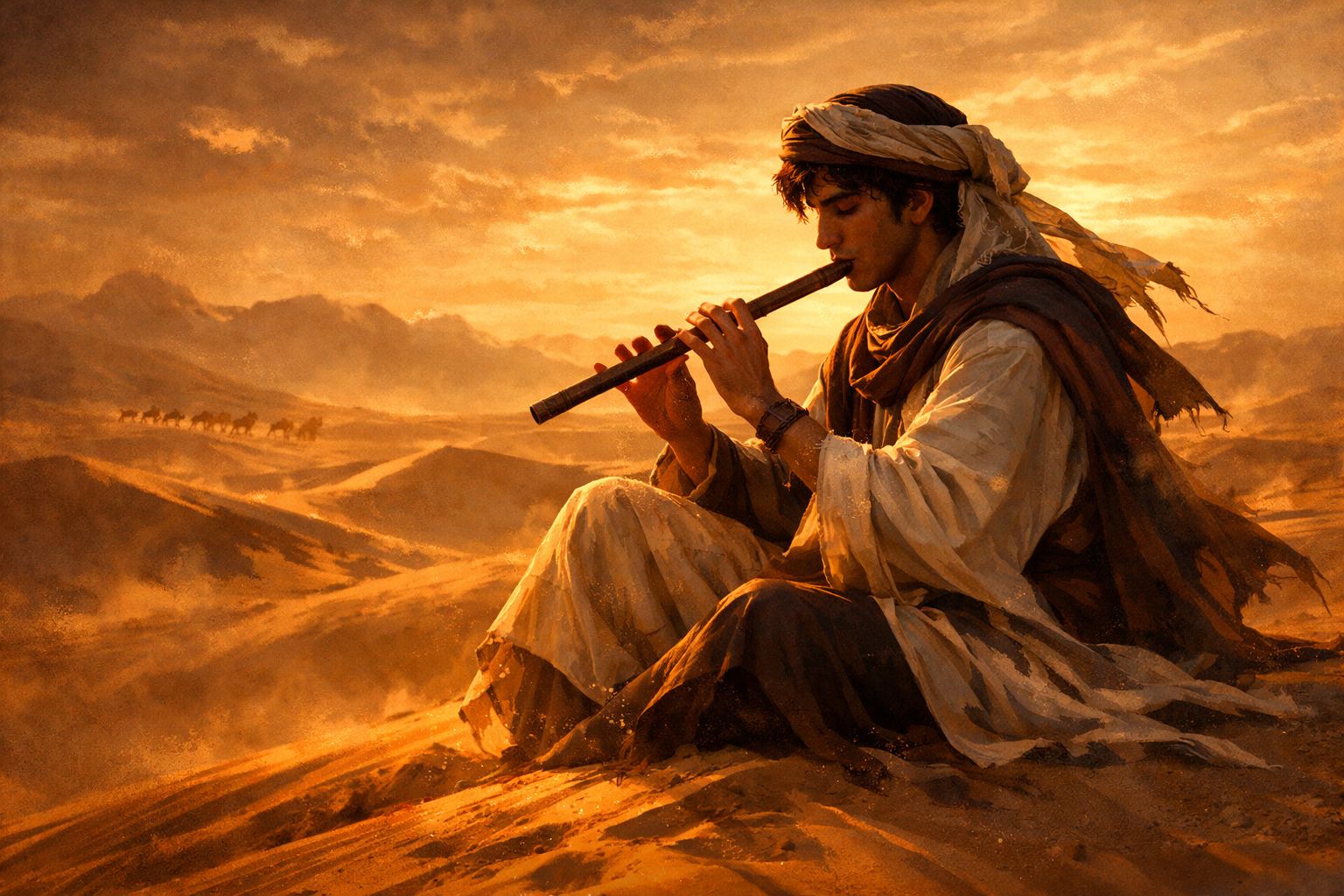
Yusef is a quiet musician in his early twenties whose flute playing has a way of making the desert feel larger. He is thin, long fingered and shy in speech, especially around strangers, but bolder through music than through words. He is one of the gentler souls in the caravan and one of the easiest to overlook at first. That makes him dangerous in a different way, because people tend to speak freely around him and then forget he heard.
Yusef is one of the most likely victims for Isetnefer if you want the loss to feel tragic and intimate rather than merely foolish. He is susceptible not because he is vain or reckless, but because he is lonely, dreamy and inclined to mistake being truly seen for safety. If used that way, his disappearance should hurt.
Azim and Azhar, Twin Drovers
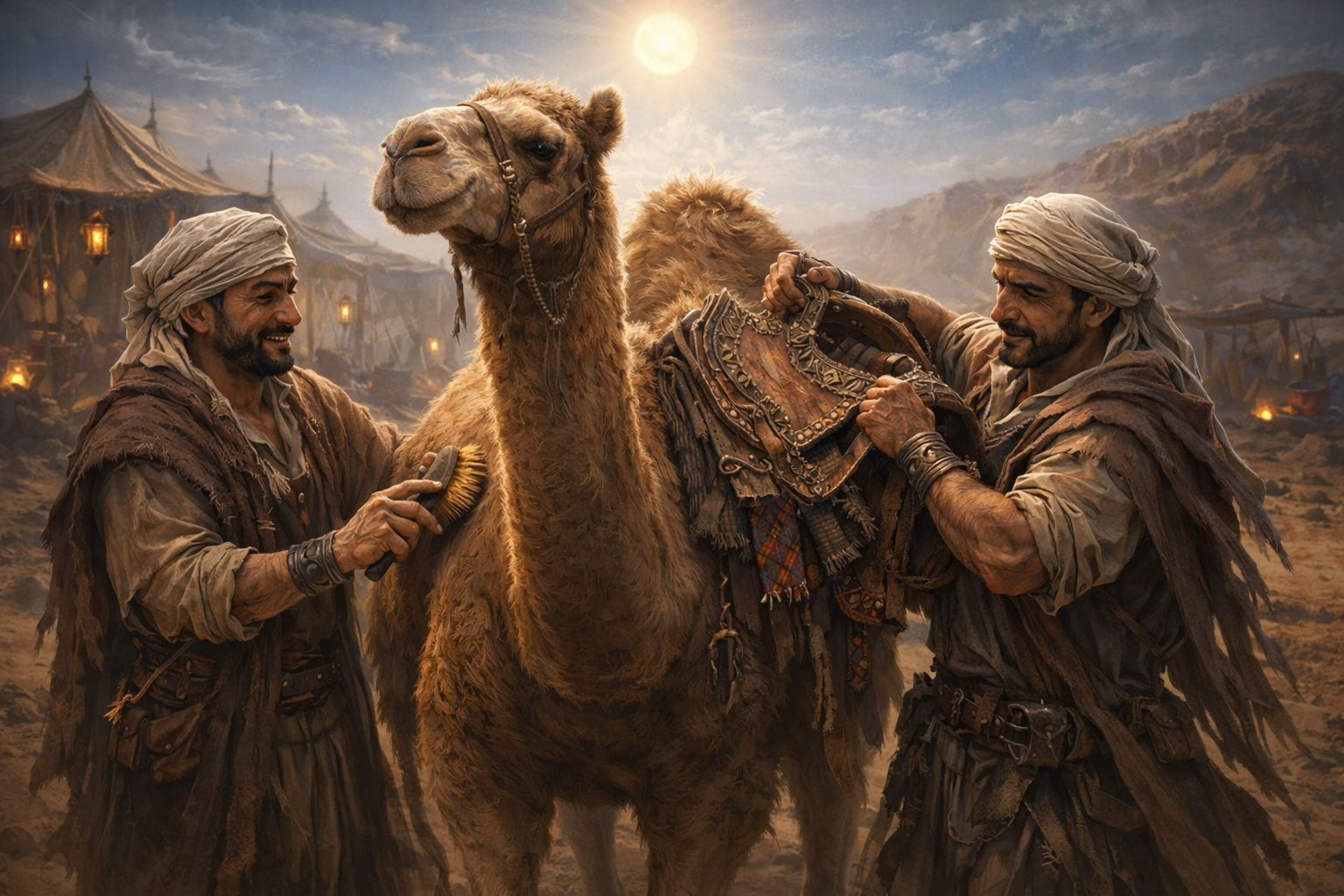
Azim and Azhar are identical twin brothers in their early thirties who manage one of the smaller beast groups and spend most of their waking hours arguing about things no one else can tell apart. Both are sun dark, broad shouldered and perpetually dusty, with the same laugh and the same infuriating habit of finishing one another's thoughts badly.
They are not deep thinkers, but they are dependable, brave and very good with difficult animals. They also compete over attention with exhausting regularity, especially where attractive outsiders are involved. They are useful for caravan energy, comic friction and as a pair of very visible love seekers who make subtler desire look subtler by comparison.