The Tikirri Crusade
| Story |
|---|
| The air along the Line of Fire stank of oil, smoke, and rot. |
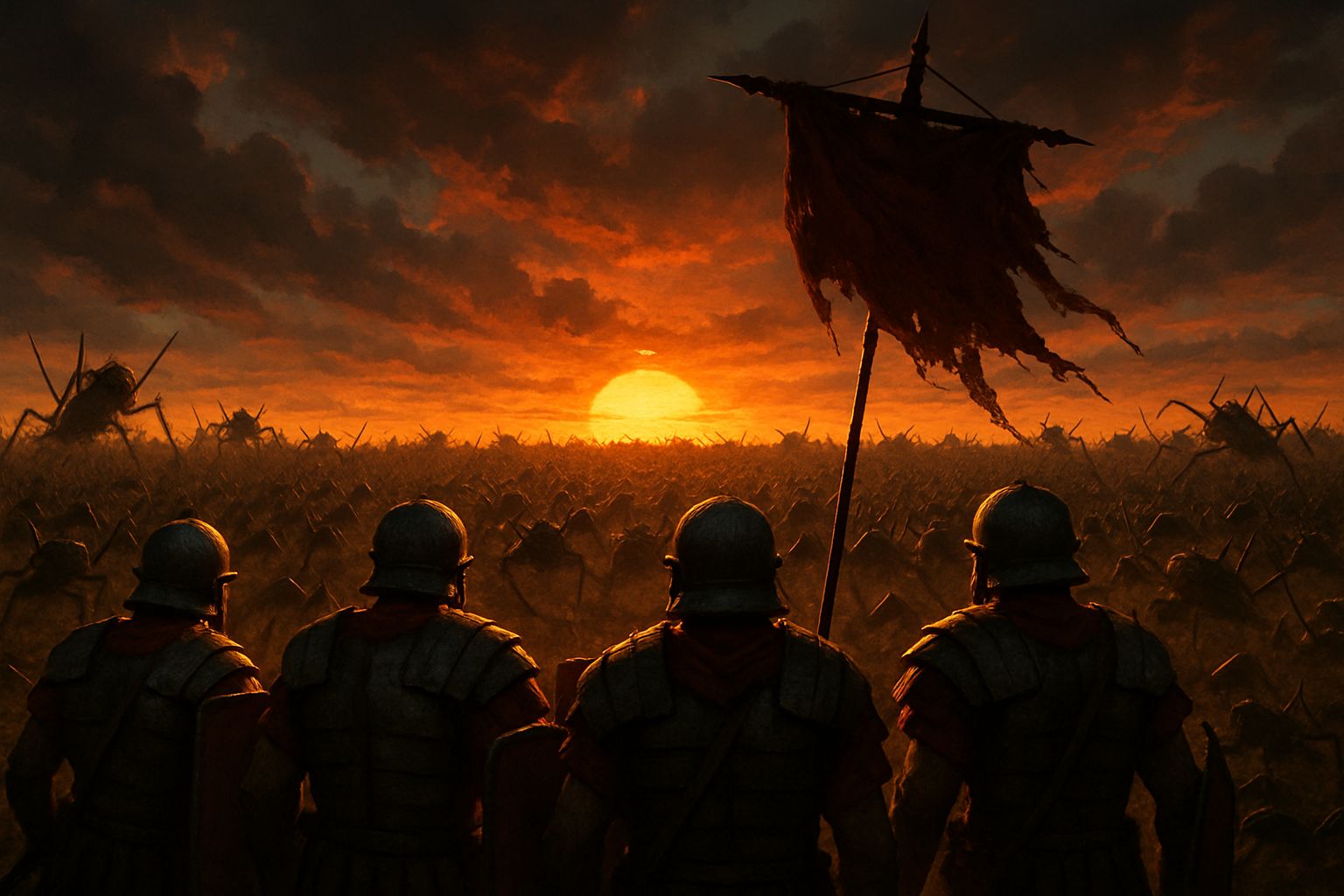
| At dawn, the sky was still pale enough to see the Resin Fields stretch to the horizon, a black, uneven sea that seamed to breathe. Somewhere beneath it, the swarm waited. The officers said it would come at dusk. The soldiers said it never really left. |
| Centurion Varrix counted what remained of his cohort. Sixty men. Once, there had been six hundred. The rest were out there now, buried in the resin, or walking within it. |
| The engineers worked in silence, rebuilding what they could. The last trebuchet stood tilted, one arm broken by powerful mandibles. The alchemists’ fire had run dry two days ago; now they filled their jars with pitch and prayer. |
| The horses refused to go near the front. They screamed when the wind shifted, their eyes rolling white, the smell of the swarm driving them mad. The riders fought on foot, blades dull, faces hidden behind masks of vinegar-soaked cloth. |
| By noon, the drumming began. Not from men. From the ground. A deep, hollow rhythm that made the air vibrate in their lungs. The veterans stopped talking. They had learned what it meant: the next wave was close. |
| When the first chitter rose from the field, Varrix looked to the man beside him. “Hold until night,” he said. It was a lie, but all orders were now. |
| The resin split open like fruit. Black shapes poured out, not running, not flying, but swarming, a tide with too many legs and no eyes. The first volley of bolts struck true, snapping through shells and limbs, but for each creature that fell, five more climbed over it. |
| The Legion’s line held for minutes that felt like years. Men fought knee-deep in corpses, steel slipping in blood and bile. They shouted the names of gods who had stopped answering weeks ago. |
| When the left flank broke, it was quiet at first, a soft tearing sound, then silence, then screaming. |
| Varrix tried to rally them. He raised the old banner of the Empire, its cloth stiff with soot and dried gore. “For the Legion!” he roared. |
| The words carried only a little way before the swarm drowned them out. |
| By dusk, the drums had stopped. The Resin Fields stretched farther north. |
| That night, a scout found Varrix’s banner half-buried in the new resin, still upright, its fabric pulsing faintly with breath. No one could tell where the men had fallen. The resin had taken their shapes. |
Description
For ages, the hive of the Tikirri had known only the sealed peace of the crater. The Queen’s will was law, the sky her shell, and all beyond the rim a myth. The Queen had once declared that the crater was the whole of creation, its rim the many legs of the sky. Now, she understands the lie of her own divinity, but hunger has no patience for faith. The hive has grown too vast. The crater is full. Every tunnel is crowded. Every brood chamber bursting with larvae. Every sound in the hive is hunger. The Queen’s dreams grow restless.
When her scouts return with tales of the outer world, soft-bodied creatures, sprawling lands, endless food, her decision is immediate and absolute. The world beyond the rim is no longer myth. It is prey.
The Stirring of the Hive
The Queen’s will spreads through the hive like a storm through water. The Tikirri awaken in unison, their minds trembling with a single command: Expand.
The builders reinforce the tunnels and bridges. The warriors molt, their shells hardening into black chitin. Brood vats overflow with larvae bred only for battle. For three seasons, the crater rings with the sound of marching mandibles and the hiss of resin forges.
The Kratik-Warriors are multiplied a hundredfold, shaped into new forms: winged scouts, burrowing sappers, and colossal siege-breeders that spit burning resin. The Tikren-Farmers breed food-beasts and fungus to march with the army, while the Tzikk-Workers craft resin nests to be carried and planted wherever conquest demands.
When the crater can no longer contain them, the Queen releases her will in a single pulse that cracks the air. The Rim opens like a wound. The swarm flows outward.
The First Wave
The neighboring lands never stood a chance. Zarhalem fell first, their streets choked with resin and bone. Lumekhet’s sand legions crumble before an enemy that tunnels beneath their walls. The Desert Rim becomes a hive of its own, a wasteland of black spires and humming birthing pits. Even Tekrissal, once of her own breed, falls within a month, its chambers converted into nurseries.
Only Ssar’et stands for a time. Its lizard knights fight with unmatched ferocity, cutting through waves of Tikirri as the air fills with poison and dust. But numbers are beyond courage, and they cannot hold much longer.
The Northern Advance
Once the south is consumed, the swarm turns north.
Elarune’s primal forests boil with movement; the canopy screams beneath the sound of wings. The Twin Cities, unprepared for war on this scale, are devoured within weeks. Mataraaj’s legions break in confusion, crushed between heat and hunger.
Zanakwe and Zverilov, knowing their jungle better than any, fight like cornered beasts. They burn entire provinces to ash, sacrificing land to starve the swarm. For now, they hold, but only barely.
The Western Front
In desperation, Grashkaar, Estoria, and the Steppe Orc tribes form an alliance unlike any before. Orcish cavalry ride alongside human militias, their war drums echoing across the plains. They win ground, but at a terrible cost. For every Tikirri slain, a dozen more emerge from the south.
The Empire, once mighty, draws a line with its legions at the western edge of the Desert Rim. There, at the Line of Fire, they dig in and prepare their stand. Fortresses of rock and wood stretch from the sea to the sand, war machines standing among corpses of humans and insects alike. The Emperor himself decrees: “If we fall, the world falls.”
No one believes it will hold.
The Panic of Nations
Beyond the front, the rest of Heroica trembles. Rumors spread faster than armies, of black storms, of cities cocooned in living resin, of people who vanish into the forests and are found in pieces.
The northern kingdoms call for unity, but none trust each other. The old grudges of race, faith, and empire are too deep. Merchant princes hoard ships, not soldiers. Temples pray for deliverance from gods who do not answer.
Refugees flood the roads, spreading famine and disease. In some cities, panic turns inward, witch hunts, purges, and riots erupt as fear devours reason. Others simply wait, hoping the swarm will never come that far.
The Hive Ascendant
The Queen of the Tikirri no longer dreams. She does not need to. Her will stretches across continents, her mind flowing through every soldier, worker, and egg.
New hives rise in the conquered lands, spires of black resin, glowing faintly in the night. Rivers run red with soil and blood. Forests grow silent, their roots fed with the dead.
The hive spreads without mercy, but not without purpose. Wherever the swarm passes, life reorganizes itself. New fungus, new insects, new harmony, all serving one mind. Every conquest is a hymn. Every corpse, an offering. The world is not dying. It is changing.
The Age of Resin
Scholars who survive call it the Resin Age. Trade collapses. Magic weakens. Faith fractures. The air hums with the endless rhythm of the hive. The Tikirri do not kill for cruelty, they are simply fulfilling nature’s will as they understand it.
To them, the outside world was chaos. Now, at last, it is ordered.
The Queen rests at the center of her new world, vast beyond imagining, her consciousness spread through the soil and sky. To the Tikirri, this is not conquest. It is perfection.
Tone and Themes
The Tikirri Crusade is a story of unity turned monstrous, the purity of a single will consuming the fractured ambitions of mankind. It is Heroica’s apocalypse not by fire or faith, but by hunger and order.
It explores the terror of harmony, the loss of individuality beneath a divine purpose, and the collapse of nations too proud to unite until it is too late.
The world may burn, but the hive will thrive. And in the silence that follows, the green and the chitin will whisper as one:
“The world was too small. We made it one.”