The Forest Awakens
| Story |
|---|
| The first vines came in silence. |
| They crept over the city walls at night, thin as fingers, glistening with dew. The guards didn’t see them. By morning, they had coiled around the statues in the temple square, their tips pressed against the stone faces as if listening. |
| The priests ordered them cut down. The gardeners burned the roots. By dusk, they were back. |
| On the third night, the high priest dreamt of a voice moving through leaves. It spoke in a language that wasn’t sound, only rhythm, the slow heartbeat of the earth itself. He woke with soil in his mouth and the taste of blood on his tongue. |
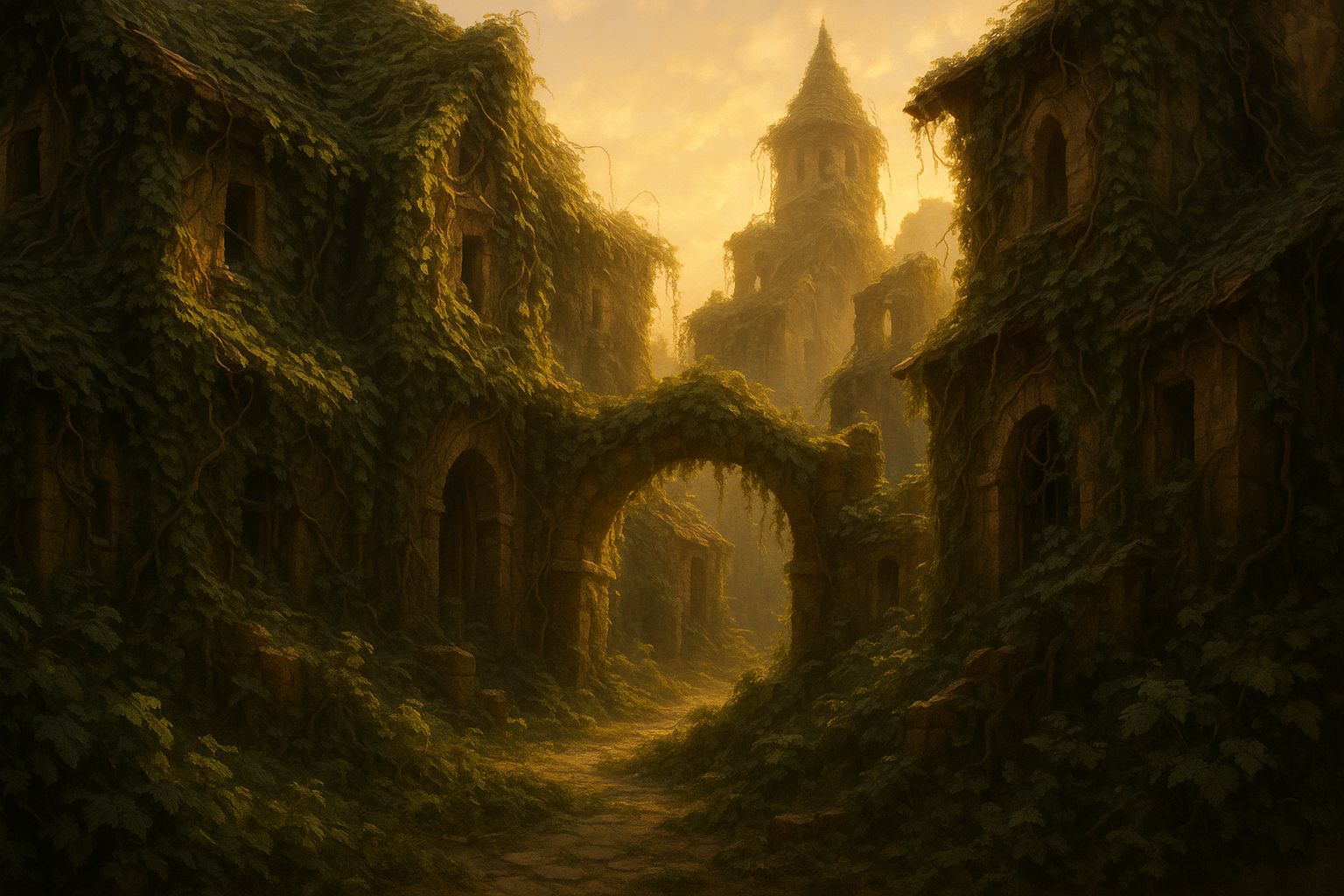
| By the next dawn, the temple gardens had turned black. Every flower bled a thin red sap. People coughed from the spores, until they coughed blood and their lungs filled with fungi. When the priests tried to flee, the gates refused to open. The vines had sealed them shut, binding wood and iron into one living knot. |
| Acolytes whispered prayers, but the air was thick, listening. Somewhere beyond the walls, the jungle was breathing, its exhalations a soft green mist that shimmered in the light. |
| By noon, the vines began to bloom, white flowers in the shape of human eyes. They looked toward the sun, then toward the city. |
| The last thing the guards saw before the walls disappeared under a curtain of roots was the high priest standing in the temple doorway, his arms open wide. |
| “Forgive us,” he said. “We made you wait too long.” |
| The vines reached him first. |
| By the following week, the city had vanished from the map. Travelers who passed the area spoke of a forest growing where stone had once stood, its canopy unbroken, its air warm and wet as breath. They said that if you listened closely, you could still hear the bells ringing somewhere deep within, slow and patient, as if the forest were counting time in heartbeats. |
Description
Something ancient has stirred. What began as blood rites in the jungles of Zanakwe has become a contagion of awareness spreading through root and vine. The jungle remembers now, and it thirsts.
The ritual that was meant to strengthen Zanakwe’s bond with the land has gone terribly right. The forests have awakened, their will shaped by the blood that fed them: not calm or wise, but hungry, vengeful, and red. The first priests thought they had created a god. What they made instead was a mind that spanned every tree and root, a will that breathes through the canopy and speaks in rustling leaves.
Now the wilderness thinks. And it remembers every drop of blood spilled into its soil.
The Birth of a Green Mind
It began in Zanakwe’s sacred groves, where the high magi bled prisoners upon the roots of the oldest trees, seeking to awaken “the living covenant.” The first to hear the whisper of the new forest thought it a miracle, a slow, deep voice, unintelligible to human minds, calling through sap and wind. They were wrong.
The forest had listened, and learned.
The forest did not speak to them, it spoke through them. Its first prophets were found days later, their bodies split with vines, their mouths still chanting in green tongues. From that moment, the jungle began to spread, not as growth, but as conquest.
The sentient jungle crept outward, slow, patient, unstoppable, its advance as patient as rot. New trees sprouted in the ash, their roots slowly crushing temples and cities. The air grew thick with insects and spores, the rivers turned to silt, and the cries of unseen beasts echoed for miles.
Those who lingered too long near the border began to change. They moved slower. Their eyes grew glassy, their veins green. Eventually, they walked into the forest and did not return.
The Expanding Green
From Zanakwe, the awakening spread into southern Montosho and Yelthara. Hunters vanished. Villages were swallowed whole. Great stone ziggurats stood half-eaten by vines.
The jungle now moves with purpose. It devours farmland, roads, and cities. Not blindly, but strategically, as if it understands what threatens it. Scouts claim that the trees rearrange themselves overnight, closing paths that once led through. The air hums with intent.
Refugees flee by the tens of thousands, bringing with them stories of whispering roots and trees that drink blood from the ground. Some are welcomed, but most are not. The world already has too many mouths to feed, and desperate nations enslave the survivors or drive them back toward the green tide.
The Spreading Curse
The contagion does not stay in the south. Across the seas and mountains, other forests begin to stir. The jungles of Mataraaj now pulse with faint awareness, their vines twitching at the sound of axes. In the Empire’s temperate woods, foresters whisper that the trees watch them work. Draknir’s pine steppes groan like sleeping beasts.
The contagion of thought reaches even the cold forests of Para Omros, Tir Albireth, and Morvelyn, and strange signs are appearing. Moss grows where none should, roots creep beneath the foundations of temples, and at night, the forests breathe mist that tastes of iron.
Scholars argue whether this is one vast mind stretching across continents or many, each born of the same tainted seed. Either way, the green is rising, and it does not care for borders.
The War Against the World
Armies have been raised to fight the forests. Alchemists craft burning oils to drive back the vines. For a while, it works. Then the forest learns. The next time, the trees no longer burn; they explode in showers of thorns.
Some turn to diplomacy, offering blood, prayer, or worship. The forest accepts all, and keeps taking.
In Zanakwe’s ruins, great temples are now living things. The vines pulse with sap and hum with ancient voices. The few who dare to enter speak of hearing their own names whispered by the leaves.
As faith falters and armies fall, the world turns to belief, or madness.
Faith and Fear
Cults have formed, both for and against the new green. Some see the awakening as divine justice, nature reclaiming what was stolen. Some sacrifice willingly to feed the forest.
Others, such as the Order of the Axeborn, declare that humanity must burn every tree before it is too late. Their crusades leave trails of ash across half the continent, but wherever they burn, new life grows faster, thicker, stronger.
Priests claim the gods no longer answer prayers made under open sky. In cities ringed with walls of stone and salt, temples fill with fear. Some say the gods themselves are turning green.
The Fading Age of Man
Travelers whisper that the forests now hum at night, a low song that seeps into dreams. People wake with soil under their nails and the taste of leaves in their mouths. The land itself feels alive in ways it never should be.
Panic spreads faster than the vines. Trade routes close, nations turn inward, and the old cities begin to starve. Some scholars claim this is not an invasion, but a correction, the world reclaiming balance after ages of human greed.
Whether they are right or not no longer matters.
The age of mankind is ending. The world remembers now, and it thirsts. Perhaps only one god will remain - and it will be green.
Tone and Themes
The Forest Awakens is not a story of nature’s beauty, but of its vengeance. It is Heroica at its most primal, a world that has grown weary of human presence and decided to live without them.
It explores the collapse of civilization before an enemy that cannot be reasoned with, a reminder that the earth remembers every sin carved into its skin.
In this version of Heroica, man is not the master of the world, but the infestation it seeks to cure.