Necromancers
| Story |
|---|
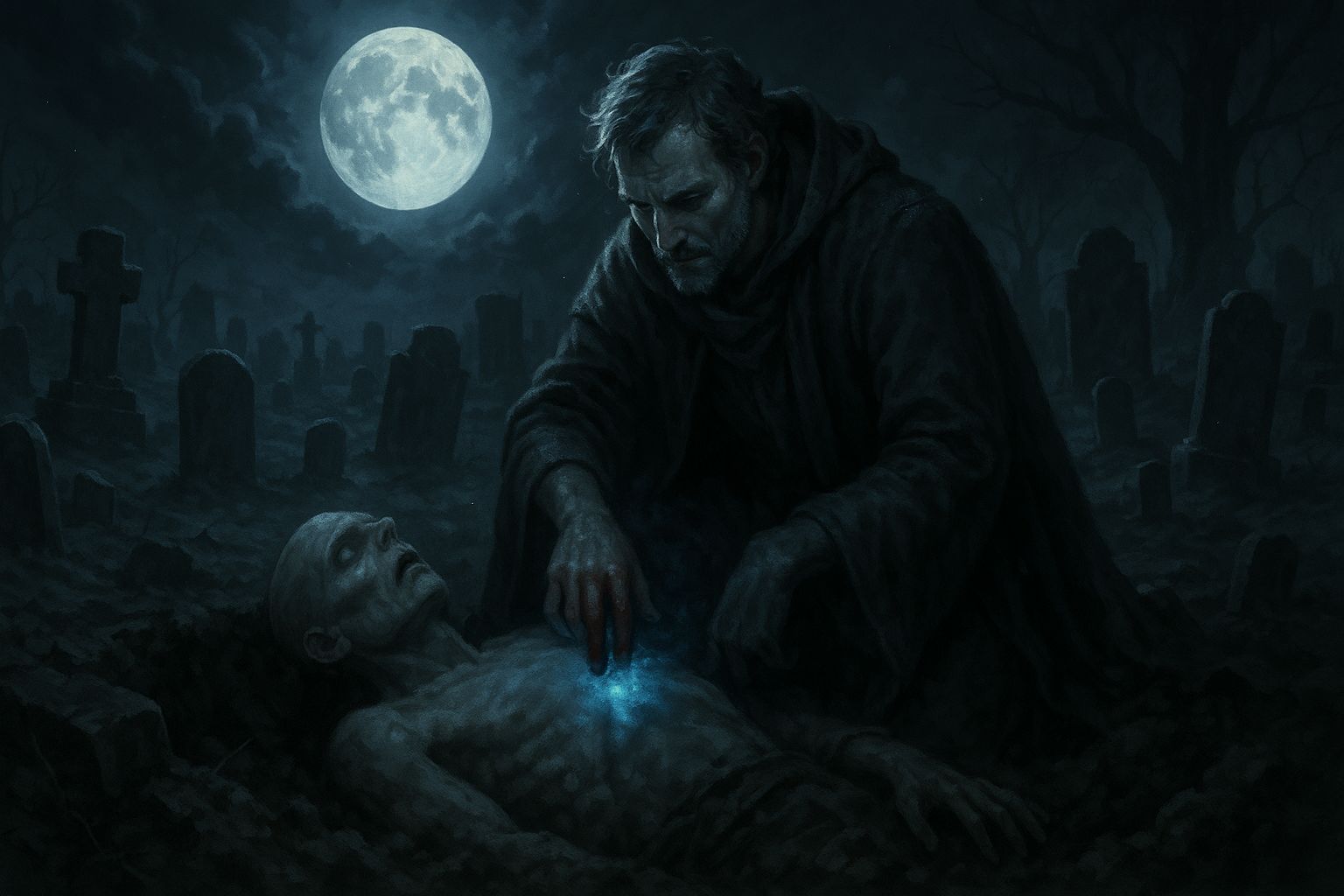
| The graveyard was quiet except for the slow sound of earth shifting. Moonlight spilled over broken stones and the figure kneeling among them. His hands were black up to the wrists, his lips moving in careful rhythm, voice low and measured. |
| Before him lay a corpse, pale beneath the soil. |
| "Come," he whispered. "You are not done." |
| The air grew colder. Frost gathered on his skin. The smell of iron filled the night. For a heartbeat, nothing happened. Then the corpse shuddered, its mouth opening in a soundless gasp. A faint light glimmered within its chest-blue, flickering, desperate. |
| The necromancer smiled. "Breathe," he said. |
| The light flared once and went out. The corpse went still again. |
| He sighed, reached into the open grave, and pressed his bloodied hand against the body's heart. "Once more." |
| When the second light came, it stayed. The corpse's eyes opened, dull and empty, but alive enough to hear. |
| "Dig," the necromancer said. |
| The dead obeyed. |
| Story |
|---|
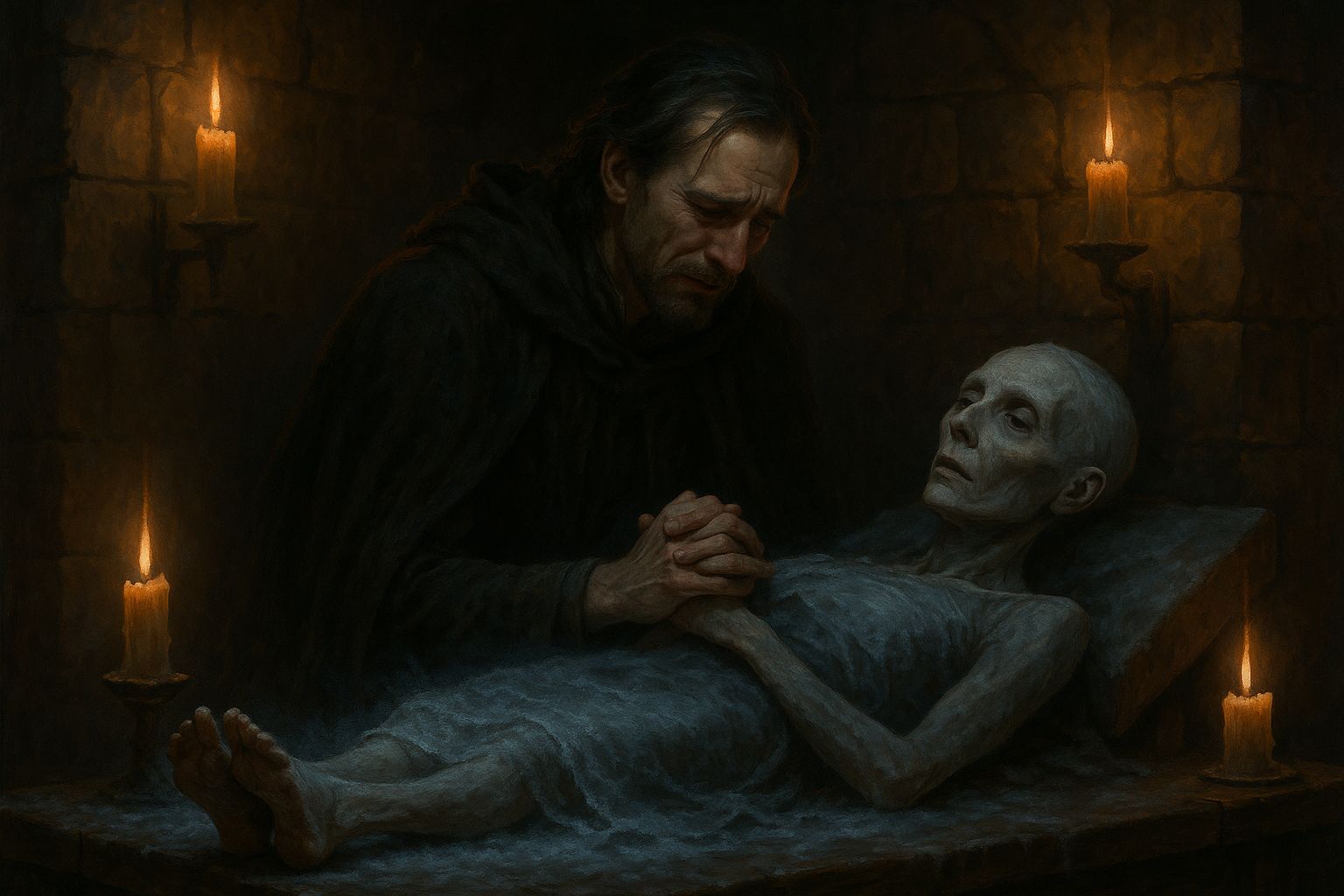
| The cellar was cold, the kind of cold that never left the bones. Candles guttered low in their sconces, shadows trembling with each breath. The necromancer sat beside the table, hands folded, watching the body before him. |
| It had been his wife once. |
| Her hair was gone now, her skin gray and thin as parchment. The line of her jaw was still beautiful in its way, sharp as he remembered, but the eyes were empty. He had replaced them twice already. Eyes decayed quickly. |
| He drew a slow breath and began the words again. The language rasped like knives across stone, each syllable heavy with memory. The air thickened, and the candlelight dimmed until the room seemed submerged. |
| For a moment, nothing. Then her fingers twitched. |
| He froze. |
| The movement came again, faint, deliberate. Her chest rose, then fell. The sound she made was small, like the sigh of wind through dead leaves. He reached for her hand. It was cold, rigid, but it moved. |
| "I'm here," he whispered. "Do you hear me?" |
| Her lips parted. A sound came out, dry, broken. "Cold." |
| He wept. Years of study, hundreds of nights, and now, this. He would warm her. He would fix her. |
| He did not notice the frost spreading across the table, or the way her pupils did not follow his face, but something behind him. |
| When he looked up again, her lips had closed, her expression soft and distant. |
| "Don't go," he pleaded. |
| She smiled faintly, and for an instant he thought it was love. But then her voice came, hollow and flat. |
| "I never left. You just forgot where I was." |
| The candles went out. |
| In the dark, he could still feel her hand in his, growing colder by the breath. He did not let go. He whispered her name until the sun rose, though by then he no longer remembered which one of them was breathing. |
The Takers of Breath
Necromancers are those who refuse the boundary between life and death. They study the passage of souls, the decay of flesh, and the shadow that lingers between both. To them, death is not an end, but a tool, a cycle to be turned backward.
Their craft draws from the power that clings to what has died, the last echoes of thought, the residue of soul, the hunger that follows endings. Through blood, bone, and unholy words, they bind that energy, shaping it into motion, memory, or obedience.
Necromancers are feared not just for raising corpses, but for disturbing the natural rhythm of the world. Each act of resurrection tears at the veil separating the living from what waits beyond.
Flesh and Spirit
A necromancer's art is twofold: mastery over flesh and mastery over spirit.
Some specialize in the body, crafting servants from corpses, stitching together flesh with threads of shadow and command. These creations are not truly alive, they move because something has been forced inside them, some spark stolen or broken.
Others work with souls. They trap wandering spirits, binding them into objects, symbols, or even living hosts. The most dangerous attempt to speak directly with the dead, demanding secrets or service. Such acts are never without consequence, for every soul remembers pain, and every spirit hates to be held.
No soul is taken willingly, no corpse rises without cost.
The Price of Defiance
Necromancy is the deliberate act of breaking the world's order. Life resists it. The dead resist it more.
Each ritual exacts a toll. Flesh blackens, hair falls away, the body stiffens like the dead it commands. The necromancer's breath grows cold, their pulse slower, until life and death blur.
Their dreams fill with whispering voices, the countless dead clawing for attention. At first, they can be ignored. Later, they cannot. The line between self and the countless others frays, until the necromancer cannot tell whose memories they carry.
The greatest among them do not die at all. They simply stop changing, trapped between breath and stillness, unable to decay. Some call it immortality. Others, a prison.
The Dead Made Useful
Necromancers often begin with noble intent. A healer who seeks to spare a loved one, a scholar who wishes to learn from those who came before, a warrior who refuses to let comrades rot in the mud.
But what begins in grief ends in obsession. Once the veil is pierced, death is never silent again. The necromancer learns that the dead will answer any call, if one is willing to pay the price. And once the dead answer, they never stop listening.
In time, compassion curdles into curiosity, and curiosity into hunger. The line between saving life and controlling it disappears entirely.
The World's Judgment
Of all the arcane paths, necromancy is the most reviled. Temples see it as blasphemy, kings as threat, peasants as nightmare. Armies burn the homes of suspected necromancers, burying their ashes under salt.
And yet, even the righteous call upon them in secret. Plagues, curses, and wars breed desperate needs. When death runs rampant, the necromancer's art becomes temptation itself, a power to command the very thing that terrifies all others.
Every great nation whispers the same lie: we have no necromancers. But the dead know better.
The Shadow of the Grave
Necromancers claim not all death is equal. Some corpses still hum faintly with energy, some souls linger willingly. There are whispered techniques to ease the passage, to borrow death's strength without defiling it. But even these "gentle" arts are shunned, for once a soul is called, it never truly rests again.
Most necromancers work alone, though in dark corners of the world, orders devoted to the mastery of death persist. They meet beneath graveyards and catacombs, trading secrets in silence, their eyes gleaming faintly like candlelight on bone.
It is said their meetings are attended by both the living and the dead. It is also said that if two necromancers meet, one must die, for death will not share its servants.
Theories and Terrors
Scholars argue whether necromancy draws power from the dead, or whether it creates its own dead. Every time a necromancer calls a soul back, something else goes missing, a spark stolen from somewhere else in the weave of life.
Others believe that death itself is aware, that it feels each intrusion and remembers each name that trespasses against it. Those who practice too long may find death waiting, not as an end, but as a teacher.
The oldest necromancers whisper that death is not an absence, but a presence, vast and endless, and that by calling to it, they have merely drawn its attention.
Possible Secrets
The Dead Remember
Every corpse raised retains fragments of its life, shadows of memory, echoes of thought. The more often a necromancer raises the same body, the clearer those fragments become. In time, the dead remember who they were and what was done to them. When that happens, they turn.
The Living Anchor
Some necromancers use the living as conduits for their power, forcing death to flow through them. Such anchors live shorter lives, their bodies wasting away as though rotting from the inside. The strongest necromancers hide their anchors among their servants, keeping them docile through enchantment or love.
The Hunger of the Grave
Every act of necromancy leaves behind residue, a pull toward cold and silence. Over years, it grows stronger. At last, the necromancer feels it inside their bones, an ache to join what they command. The only way to resist is to feed others to it.
The False Soul
A soul can be faked. With the right symbols and enough blood, a necromancer can craft a spirit that never lived, obedient and blank. These false souls are flawless servants, but when they are destroyed, they scream in confusion, as if realizing, too late, that they exist.
The Grave Net
Legends tell of a necromancer who bound an entire battlefield's dead into one mind, creating a single will from thousands of corpses. Some claim this entity still exists beneath the earth, dreaming the war forever, waiting for a master to call it awake.
Adventure Hooks
The Bone Orchard
A series of murders leaves the victims perfectly preserved, eyes open, faces serene. The local graveyard shows signs of disturbance, but no one has seen the dead rise. When the adventurers investigate, they discover a necromancer who has perfected a new art, binding souls not into bodies, but into the roots of the trees above their graves.
The Silent Siege
A fortress holds out against invasion far longer than it should. Scouts report the defenders never sleep and the fallen never rot. The truth is grim, the city's ruler has bound his soldiers' souls to their armor, turning them into a tireless army. But now they fight on without orders, defending the city even from its own people.
The Last Apprentice
A dying necromancer begs the adventurers to destroy his work before it consumes him. His tower is filled with failed experiments, half-living things that whisper in familiar voices. The deeper the party goes, the more they realize the necromancer may already be dead and simply hasn't noticed.
The Plague Shepherd
A mysterious figure walks through a city stricken by disease. Wherever they pass, the dying rise and follow in silence, leaving empty houses behind. The adventurers must decide whether to stop the necromancer or follow and learn where the procession leads.
The Nameless Crypt
An ancient tomb stands untouched in the mountains. Inside, the dead whisper ceaselessly, begging to be released. Local priests claim it was sealed by the first necromancer to trap a greater evil. Breaking the seal might free something far worse, or something that remembers the truth about death itself.
The Crown of Bone
A warlord wears a crown carved from a saint's skull, granting him the power to speak with the spirits of his enemies. His victories grow uncanny, he always knows when and where to strike. But the saint's soul still lingers within the crown, and it begins whispering to anyone who dares take it.
The Mourner's Bell
Each night, a bell tolls from an abandoned chapel, and one villager dies before dawn. The locals believe it marks the work of a necromancer, but when the adventurers investigate, they find the bell tolls itself, each sound a call to someone the bell remembers.