Pygmys
| Story |
|---|
| The rain drummed steady on the canopy, a thousand drops lost before they touched the ground. I crouched with my father in the shadows of the roots, basket on my back, his hand light on my shoulder. |
| He raised one finger. I stilled my breath. Through the leaves I saw them, two men in iron helms, clumsy and loud, hacking at vines with blades that shone like water. They cursed the mud and struck at insects as if the jungle itself were their enemy. |
| My father pressed a dart into my hand. "Now you learn." |
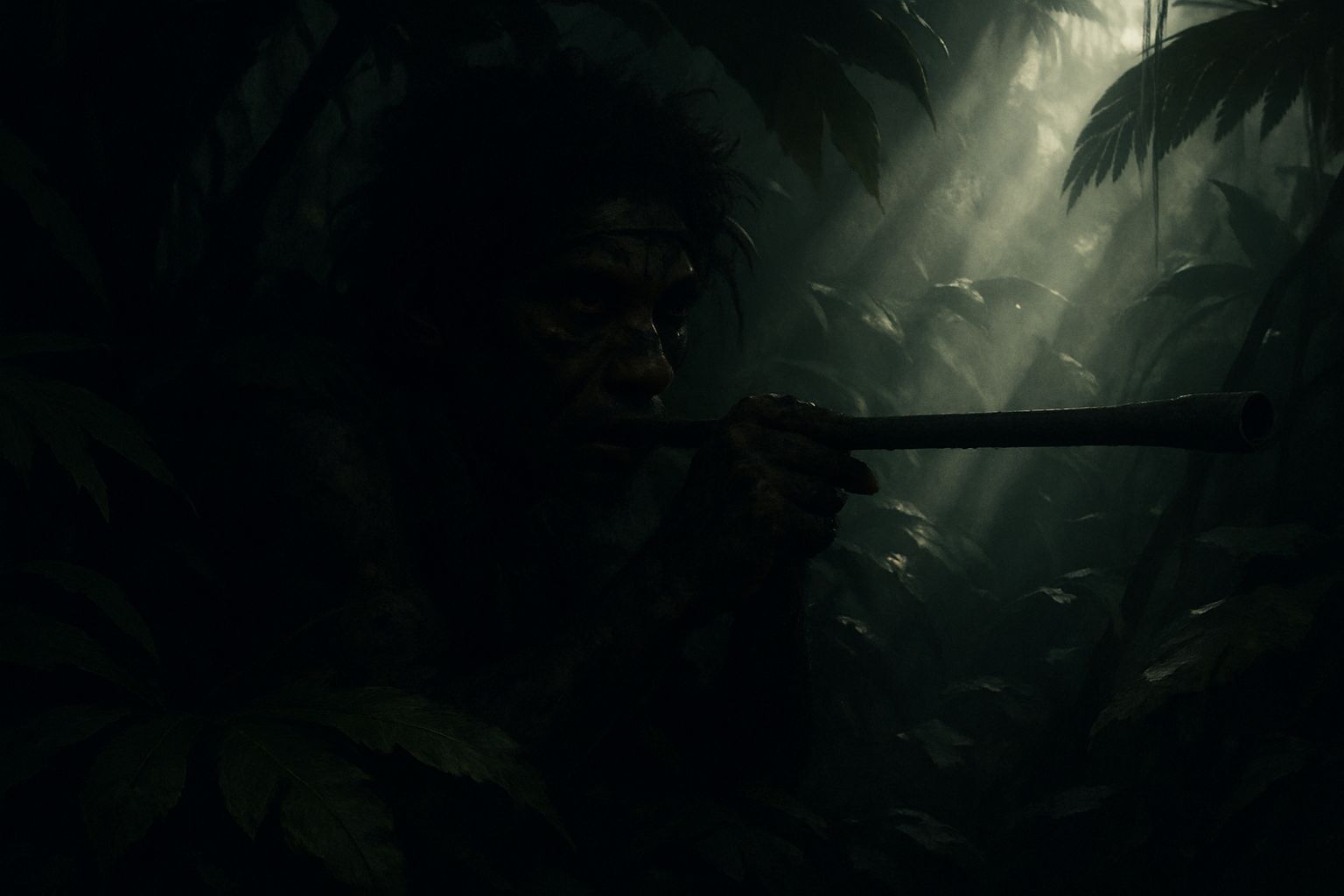
| I lifted the blowpipe. My heart beat loud in my ears, but my breath was steady. One puff. The dart flew. The man laughed, swatted at his arm, then staggered. His laughter broke into choking silence. |
| We did not stay to watch him fall. My father guided me away, soft as the mist. "You are Nazhira's child now," he whispered. "The jungle listens when you breathe." |
| Story |
|---|
| The village stirred with the first light. Smoke rose thin from the cooking fires, and the scent of roasted roots drifted through the damp air. Children laughed as they chased one another across the walkways between huts, their feet sure on the swaying planks. |
| At the edge of the clearing, the women returned with baskets heavy with fruit and herbs. They shared handfuls with the little ones before sorting the rest for the day's meal. Across the way, hunters crouched in silence, shaping darts and testing the balance of their blowpipes. No words passed between them, only the rhythm of practice, of duty repeated a hundred times. |
| At dusk, drums began, low and steady. Faces were painted with streaks of clay, white for purity, green for growth. The whole village gathered as the shaman raised the bowl of dark brew. One by one they drank, and soon their voices joined together in song, rising into the canopy. |
| The jungle hummed with insects, yet it felt as if the forest itself listened. In that moment, every man, woman, and child was bound to each other, and to the goddess they called Mother. |
| Info |
|---|
| To most outsiders, the Children of Nazhira are little more than whispers in the jungle. Traders speak of painted pygmy hunters who melt into the trees, striking with darts that kill before a scream can rise. Soldiers of the Empire call them ghosts, too small and quick to fight in open battle, and too cunning to catch alive. |
| Tales told in frontier taverns claim they worship serpents with blood rites, that they drink venom and dance with spirits until they lose their minds. Some swear they build shrines from the bones of captives. Others insist they are no more than savages, too primitive to matter, though no expedition sent into their lands has ever returned whole. |
The Children of Nazhira are small folk, seldom more than four and a half feet tall, with lean, wiry builds suited to life in the dense jungle. Their skin ranges from deep bronze to dark umber, often glistening with the oils of crushed herbs used to ward off insects. Many decorate their bodies with painted patterns of clay, ash, and leaf pigment-greens, blacks, and reds that help them vanish into the foliage.
Hair is usually worn short, bound in knots, or shaved into simple patterns. Some weave in feathers, beads, or cords of dyed fiber, while hunters sometimes wear necklaces of bone or teeth from their prey. Scarring is also a form of adornment: the Mark of the Coil, a ritual scar on the shoulder, is given in marriage exchanges, while jagged scars across arms or chest may honor survival through venom rites.
Their eyes are sharp and restless, quick to flick from shadow to shadow, trained from childhood to detect the smallest movement. Outsiders often mistake them for children at first glance, until they meet the calm, unreadable stillness that marks an adult of Nazhira's tribes.
Personality and Disposition
Within their own villages, the Children are lively and communal. They laugh easily, sing during daily tasks, and share food freely, for survival depends on cooperation. Among kin, they show affection through touch and gift-giving, a basket of fruit or a well-shaped dart offered as tokens of care.
Toward outsiders, however, they present masks of silence. They speak little, move little, and reveal nothing of their thoughts. To strangers they can seem eerie, even inhuman, as if the jungle itself were watching through their eyes. What to them is caution and discipline appears to others as menace.
They respect patience, cunning, and skill more than brute strength or bold words. The hunter who waits hours for the perfect shot is admired more than the warrior who charges openly. Even their games and dances echo this preference, hiding, sudden leaps, feints, and unexpected bursts of movement.
Way of Life
The Children live simply, by the standards of the Empire or the coastal kingdoms. They are hunter-gatherers, relying on the bounty of the jungle rather than farming. Men hunt with blowpipes, spears, and snares, while women forage for roots, fruits, and herbs. Both roles are honored equally, for one cannot thrive without the other.
Villages, called Tzanu ("nests"), are small, rarely more than fifty souls. They build stilted huts of wood and reed above the damp ground. The jungle is both home and wall, its density serving as their best defense.
They move every few years when hunting thins, soil exhausts, or spirits demand it. These migrations are treated as rebirths, with rituals marking the leaving of an old home and the sanctifying of the new.
Values and Beliefs
To the Children, survival itself is sacred. To walk unseen, to strike without warning, to hear the voices of the spirits, these are not tricks, but holy gifts from Nazhira, the serpent goddess who shed her first skin to give them form.
They believe every creature of the jungle is a god in flesh, from the smallest insect to the greatest jaguar. Yet they see themselves as the favored children of Nazhira, chosen for her venom and silence. Their values reflect this faith: cunning, adaptability, patience, and unity within the tribe.
Cowardice, waste, and needless cruelty are despised, but deception is not. To outwit an enemy is praiseworthy, for it echoes Nazhira's strike.
Relations with Outsiders
The Children of Nazhira have endured only hardship from strangers. The Itzalcoa hunted them for sacrifices. The Empire and its colonies sought to enslave them. Traders came seeking exotic goods, but only brought greed and disease.
Because of this, they greet outsiders with suspicion at best, and violence at worst. Their ambushes are infamous: a jungle traveler may hear nothing but insects, feel a sting like a biting gnat, then collapse as venom spreads. Survivors are deliberately left alive, their tales spreading fear far more effectively than slaughter.
Among outsiders, stories abound of "ghost tribes" or "venom children," half myth, half truth. To those who dwell in the stone cities, the Children are little more than shadows, seen only when it is already too late.
Identity
Despite this fearsome reputation, the Children do not see themselves as cruel. To them, they are simply protecting their nests, living as Nazhira taught them. They are not conquerors, nor slavers, nor builders of empires. They are the coil of the serpent in the undergrowth-small, silent, but deadly if disturbed.
They take pride in their difference. Where outsiders see poverty, they see freedom from hunger. Where outsiders see savagery, they see balance. To be a Child of Nazhira is to know the jungle as family, and to walk in step with gods that outsiders will never understand.
Possible Secrets
Shared Origin Myth with Others
Old stories claim the Children once lived alongside the Itzalcoa before a great schism. If true, their hatred of each other is less ancient than they believe.
Blood of Outsiders
Though they claim purity as Nazhira's chosen, some tribes carry bloodlines from escaped slaves, castaways, or even Empire deserters who were absorbed into the nests. These lines are quietly hidden.
Venom's Gift
Over generations, many Children have developed partial immunity to their own poisons. This makes them uniquely able to handle venoms fatal to others.
Unseen Trade
Though they despise outsiders, a few tribes secretly trade jungle herbs and rare toxins to smugglers or renegades, gaining tools and metal in return.
Chosen Children
Each generation, a handful of infants are born with pale, scale-like markings on their skin. These children are believed to be direct gifts of Nazhira, but their true role is uncertain.
Death Without Shedding
Their funeral rites always place the dead in the trees, to return to Nazhira. But in times of war, bodies are sometimes left unburied, forbidden to rejoin her coil. The Children never speak of this dishonor.
Adventure Hooks
The First Contact
An Empire explorer is determined to make peaceful contact with the Children, believing trade is possible. The players must guide or protect them, while the Children see this as a test of whether strangers can be trusted at all.
The Coil of Nazhira
Several tribes unite into a war-host to strike against slavers cutting into their lands. The players are asked to guide, aid, or sabotage this elusive jungle force before the conflict spreads.
The Stranger's Child
A child from an outsider village has been found and adopted by the Children. Now both communities claim them, and the players must untangle whether the child belongs to blood or to those who raised them.
The Stolen Bride
During a marriage exchange, the spouse-to-be flees rather than accept the pact. This breach threatens peace between villages, and the players are caught in the hunt.
The Healer's Debt
The Children capture a wounded player or ally but choose to heal them instead of killing them. Now the tribe demands repayment, sending the group on a task deep in the jungle.
The Trial of Silence
A Tlamaz invites the players to join a ritual hunt to prove themselves before Nazhira. Failure could mean exile or worse, while success might grant rare allies in the jungle.