Insectoids
| Story |
|---|
| The morning haze clung to the crater floor, thin mist rising from Ikrenn Lake. In the soft light, the hive was already awake. |
| From the tunnels beneath the spire, Tzikk-workers streamed in endless lines, their mandibles clattering faint greetings as they carried resin blocks to the Builders. The Builders, heavy-limbed and deliberate, set their chisel-claws to work, shaping a new archway of hardened secretion that gleamed like amber in the dawn. |
| Beyond the lake, the Tikren-farmers moved in silence across the patterned fields. With hooked forelimbs, they clipped fungus and carried chitterbeasts in wicker cages of resin. A hundred irrigation channels trickled with the lake's poisoned water, glinting like veins across the soil. |
| At the crater rim, the Kratik-warriors stood in formation, their shells black and gleaming, their antennae lifted to taste the air. No enemy was near, but still they waited, still they watched, still they kept the boundary of the world. |
| And within the spire, in the resin-lit chambers above all others, the Queen stirred. A wave of her scent rolled through the hive, subtle and binding. Instantly the noise ceased. Every claw paused, every mandible stilled. For a breath, the hive was silent. |
| Then the work resumed, louder than before, each Tikirri certain in its purpose, as limbs of a single body, as pieces of a perfect whole. |
| To them, this was not toil. It was life. It was the world. |
| Story |
|---|
| The Kratik-warrior on the rim was first to scent it. A stench unlike resin, unlike fungus, unlike anything of the hive. It was sour, sharp, alien. A demon. |
| He clattered his mandibles, and the signal passed along the rim. Within heartbeats, others gathered, shells rattling, antennae quivering. Below, the fields fell still. Farmers crouched low, Builders froze mid-strike, even Workers set their burdens down. All eyes turned toward the rim. |
| The creature stumbled over the rocks, two-legged, flesh soft and pale beneath the burning sun. It breathed too loud, too wet, as if choking on its own air. It carried metal in its hands, hacked wood on its back, its body wrapped in fibers like shed skin. Every movement was clumsy. Wrong. |
| The hive recoiled in revulsion. Here was a body without shell, without place, without purpose. No caste, no Queen, no order-only chaos given shape. To the Tikirri it was not a being, but a wound, a flaw in the world. |
| The Queen's scent filled the air, sharp as blood. Judgment was given: Destroy it. |
| The warriors surged forward, their mandibles grinding in chorus. The outsider raised its metal, shouting sounds no ear could make sense of, words flapping empty in the air. The Tikirri did not hear language. They heard only noise. |
| When the warrior struck, the demon's bones snapped like dry twigs. Its flesh tore like fungus-stalks in harvest. The hive descended, tearing, dragging, carrying the broken thing down toward the spire. |
| Later, in the Queen's chamber, she tasted its blood. A hiss rippled through the hive as her judgment spread. Foul. Wrong. Demon. |
| The carcass was carried to the lake, cast into the poisoned waters. Bubbles rose, burst, and were gone. |
| The hive returned to work, chittering softly, the order restored. But every Tikirri who had seen the outsider would never forget its hideous softness, its purposeless cries. To them, it was proof beyond doubt: beyond the rim lay only corruption. |
| Info |
|---|
| Most who live beyond the crater have never heard of the Tikirri at all. At best, they know only fragments-half-mad tales from wanderers who staggered out of the mountains, raving of chittering demons and black towers that pierce the clouds. |
| No scholar has returned with proof, no army has marched into the crater and lived to tell of it. To most, the Tikirri are nothing more than nightmares-a rumor, a ghost story told around fires in the desert night. Yet when the wind carries a strange clicking echo through the canyons, even the boldest fall silent, listening, and wondering if the stories are true. |
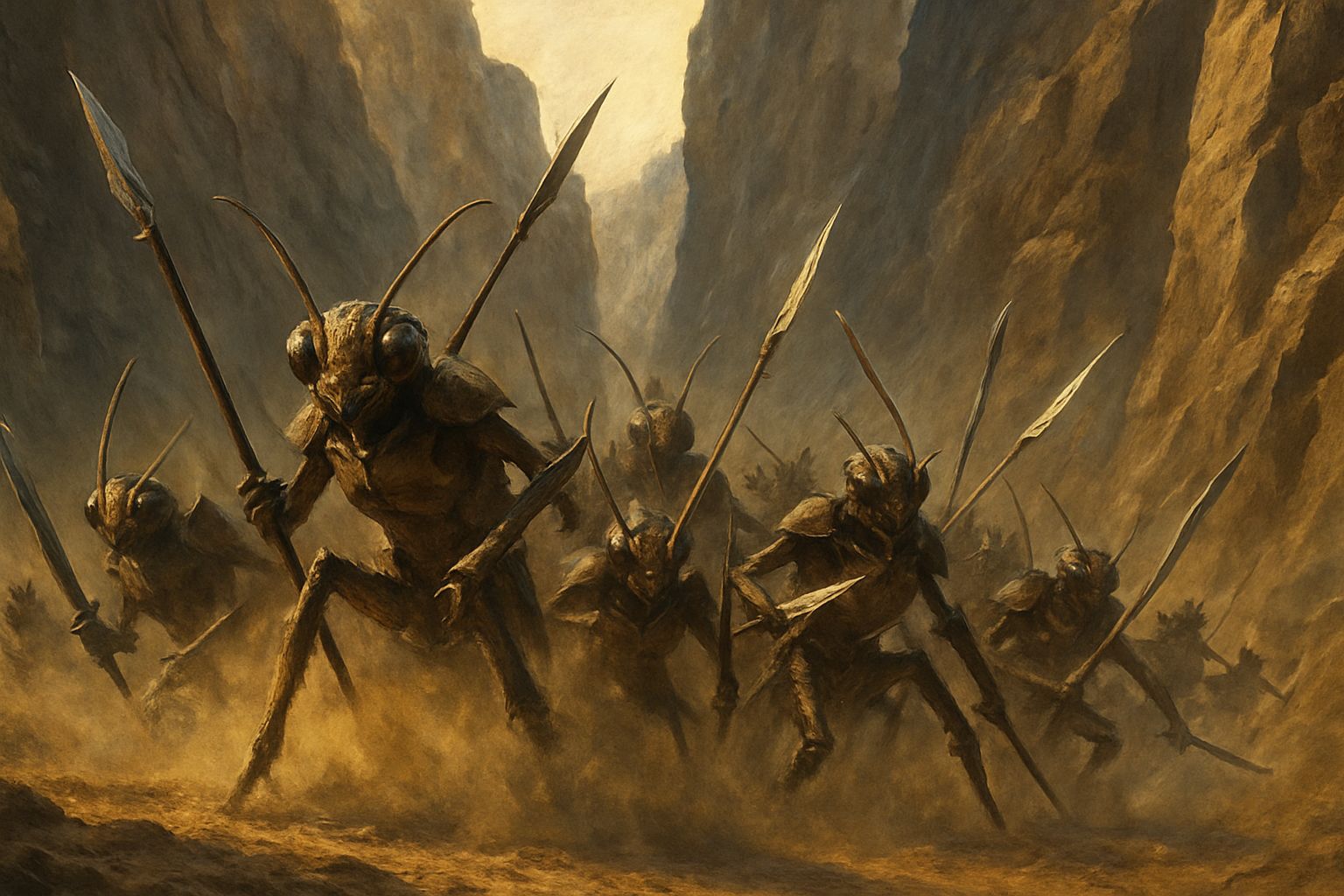
The Tikirri are an insectoid people who dwell in the vast meteor crater that they believe is the whole world. Their lives are bound in service to their Queen, their bodies shaped by caste, and their thoughts tied together by pheromones that reinforce unity. To outsiders they are monsters, but to themselves they are perfection, every limb and mandible serving its purpose.
Appearance
The Tikirri share traits across their castes despite their differences in form. All possess segmented shells of black, crimson, or mottled brown, often streaked with a faint iridescence. Their mandibles never rest, grinding or flexing even in silence. Compound eyes shimmer green, gold, or violet, each facet reflecting a fragment of the world. Antennae sweep constantly through the air, tasting vibrations and scents. Most have six limbs, though some castes bear extra pairs adapted for claws, climbing, or heavy labor. Even at rest, their movements are precise, deliberate, and unnervingly synchronized.
Castes and Forms
The Taka-Queen
- Size: Enormous, larger than any other caste, her bulk sprawling across chambers in the central spire. -Form: Her abdomen is swollen and ridged, pulsing with the life of countless eggs. Her head is crowned with branching horns of hardened chitin.
- Function: She is both goddess and monarch, her pheromones binding the hive into one will. Without her, the hive would collapse.
Ikra-Princesses
- Size: Smaller than the Queen but larger than most others, with swollen abdomens.
- Form: Their shells are smoother, with pale, translucent plates over their egg-filled bodies.
- Function: They lay eggs, sustaining the hive. Should one molt toward becoming a Queen, she is slain before she can rise.
Ekrit-Princes
- Size: Slender, short-lived.
- Form: Pale chitin and delicate wings, often weak and brittle.
- Function: Their only role is to fertilize the princesses. Afterward, they wither and die or are killed.
Kratik-Warriors
- Size: Towering, armored, and broad, often standing twice the height of a man.
- Form: Thick, jagged chitin like living plate armor, mandibles large enough to crush shields, claws for tearing.
- Function: Guardians of the rim, shock troops of the hive, relentless and fearless in battle.
Tikren-Farmers
- Size: Small, thin-bodied.
- Form: Many-armed, with nimble limbs and sharp mandibles suited for cutting fungus and tending livestock.
- Function: They grow fungus in damp burrows, herd insectile beasts, and irrigate the fertile lands around the crater's lake.
Kretik-Builders
- Size: Mid-sized but powerful, with broad forelimbs.
- Form: Equipped with resin-secreting glands, their claws are shaped like chisels and hammers.
- Function: They build towers, resin bridges, and chambers, reshaping stone and secretion into hive structures.
Tzikk-Workers
- Size: Smallest of all castes.
- Form: Lightly armored, with versatile limbs and small mandibles.
- Function: They do the endless daily work-carrying burdens, tending eggs, cleaning resin halls, serving larger castes.
Culture and Belief
The World is the Crater: The Tikirri believe the rim is the world's edge, and beyond lies only void and demons.
The Queen as Goddess: She is the center of all life, the heart of the hive. Her word is absolute law, her scent binds their loyalty.
The Sacred Spire: The black shard of meteor at the crater's heart is holy. It is said to be the crown of the Queen, and within it lies the essence of the hive's creation.
The Lake of Blood: The crater's circular lake is sacred, believed to be the Queen's blood spilled when she fell from the sky. Its waters are poisonous to outsiders but life-giving to the Tikirri.
Behavior
Collective Thought: While not truly a hive mind, pheromones and instinct bind the Tikirri into seamless coordination.
Xenophobia: Outsiders are always treated as Takkar-demons, abominations that must be destroyed.
Ritual Feasting: When a foreigner is slain, the Queen alone tastes the flesh to judge it. If deemed strong, it is fed to the warriors; if foul, it is burned or drowned.
Not of This World
Some believe that the Tikirri are not native to Heroica at all. The black spire at the crater's heart is no mere stone, but the remnant of a fallen star, and from it the first Queen crawled. If this is true, then the Tikirri are children of the void, their hive a colony seeded from beyond the skies.
This origin explains their alien nature. Their mandibles cannot shape human words, nor do they seem to grasp the concept of spoken language. Instead, they communicate through clicks, rattles, and pheromone scents carried on the air. To outsiders, their voices sound like the clatter of stones, the hiss of sand, or the rustle of beetles in a field. Only the Queen's voice carries deeper resonance, but even she speaks in a language no human tongue can mirror.
To the Tikirri, this is natural. To everyone else, it is proof that they are not merely strangers, but something entirely other.
In the Eyes of Outsiders
Few who see the Tikirri survive. To humans, they are nightmares: clicking shells, faceless eyes, and endless numbers. Those who stumble into the crater rarely live to tell the tale. Tales of the hive spread through rumors only, half-mad stories of a world of chitin hidden in the mountains.
Stories of the Tikirri spread like smoke, thin and shifting, always changing. Some wanderers insist they are men with beetle heads, living in towers of bone. Others claim to have seen black shells glinting under moonlight, standing as tall as houses, their eyes glowing like green lanterns. Caravan guards whisper that the clicking sound of their jaws can drive a man mad if heard too long. None of these tales are consistent, but all share the same refrain: if you hear the rattling in the mountains, turn back, for it means the demons are near.
Possible Secrets
The Spire's Whisper
The black spire at the crater's center hums faintly at night, a sound only the Queen and her closest attendants can hear. Some whisper that it guides the hive's growth and that the Queen's power does not come from herself, but from the alien shard buried within. If the spire were ever broken, the hive might collapse.
A Forgotten Tongue
Though their mandibles cannot shape human words, carvings deep in the spire show symbols not unlike those of ancient human scripts. This hints that the Tikirri may once have communicated in ways beyond clicks and pheromones, or perhaps were shaped by older hands.
The Lost Queens
The Tikirri insist there is only ever one Queen. Yet in the resin archives of the Builders are hushed records of more than one Queen living at the same time. The hive slaughtered itself until only one remained, and that truth has been buried ever since.
The Mutated Brood
Every generation, a handful of young emerge malformed-bearing wings, unusual shells, or oddly-shaped eyes. These are quietly culled, but some whisper that they are echoes of the Tikirri's true form before the crater bound them.
Adventure Hooks
The Lost Scout
A party of explorers stumbles back from the crater, wounded and half-mad, claiming one of their own still lives as a captive inside. The Tikirri are said to keep captives alive for days before judgment, time may yet remain to save them.
The Silent March
Travelers whisper of long processions of Tikirri Workers carrying unknown cargo through mountain passes under the cover of night. Whatever they are building is outside the crater, and growing larger with each passing week.
The Disguised Demon
A wandering priest insists he has proof that the Tikirri are not demons, but a people with reason and order. He seeks brave escorts to approach the crater rim with him, to prove peace is possible. But the moment the hive sees outsiders, they swarm.
The Vanished Caravan
A trade caravan never arrived at its destination. Scouts later find its wagons perfectly dismantled and stacked in the desert, goods sorted into neat piles-but no trace of the traders. The signs of mandible scoring point toward the Tikirri.