Hollows
| Story |
|---|
| Yari saw him first as a shimmer, just a shape in the rippling air. But he didn't fade like a mirage. He walked closer, each step exact, without hurry, without pause. |
| The stranger said nothing, only sat at the fire uninvited. His presence was quietly wrong, too still, too smooth. His eyes looked normal, but felt like they were watching from somewhere else. |
| Yari's donkey bolted as soon as the man sat down. |
| "You're far from the rivers," Yari said. |
| The man smiled, slow and pleasant. "I go where people are." |
| They spoke a little. The words were normal. The man's voice was calm, pleasant even. But it hung in the air too long. Yari didn't want to talk, but couldn't stop. Something about the man held him, like a hook beneath the skin. He felt seen, but not understood. |
| Then the man asked, softly: |
| "Do you dream?" |
| Yari's mouth went dry. The fire crackled. |
| The man stood. Walked a few steps into the dark. |
| Yari hesitated only a moment. Then stood. Left his water, his satchel, his tools. All of it. |
| He followed. |
| The sands swallowed their footprints behind them. |
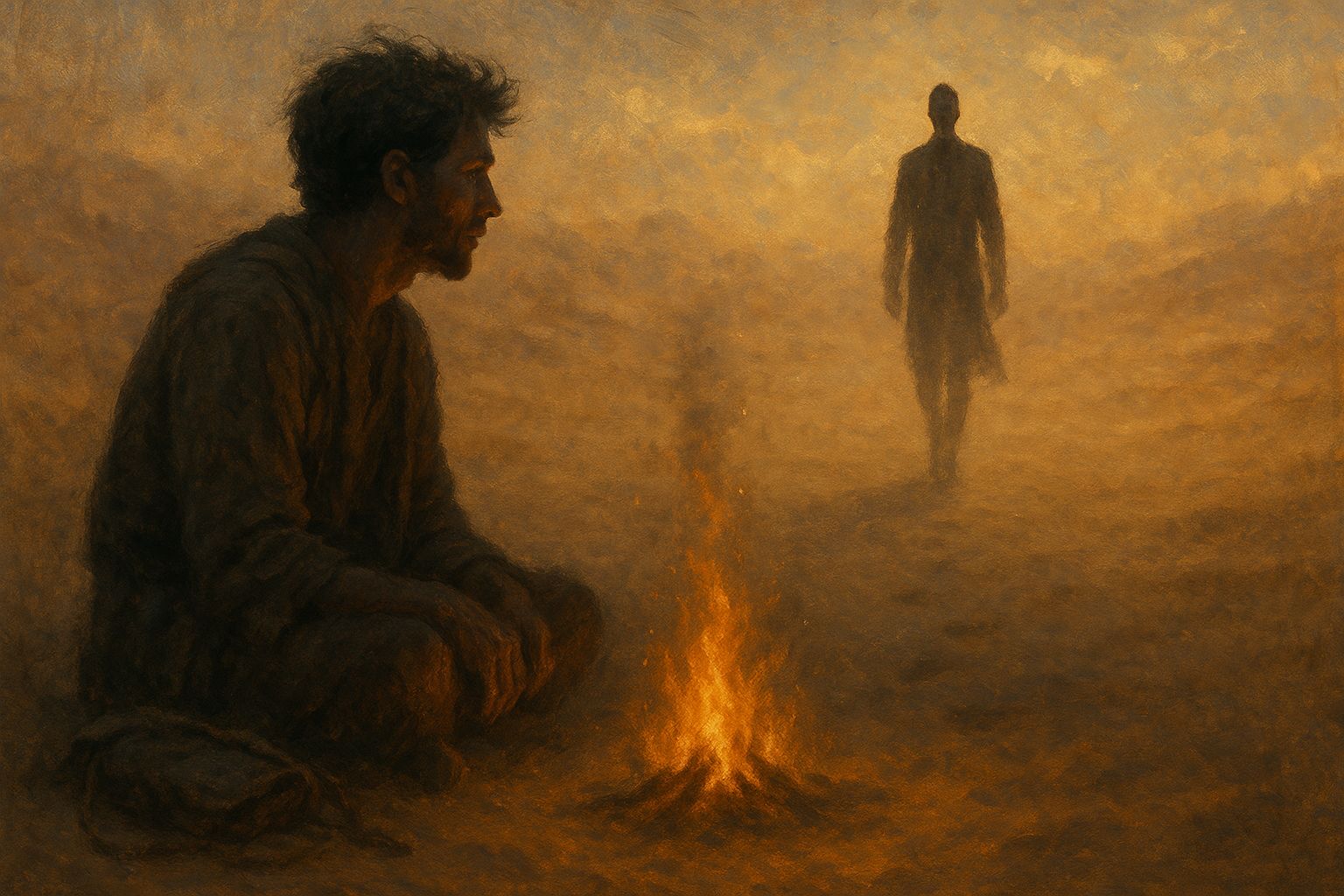
"Those who have crossed With direct eyes, to death's other Kingdom Remember us-if at all-not as lost Violent souls, but only As the hollow men" - T S Eliot
In the land of Lumekhet, where every birth is a divine exchange and every soul rides the eternal cycle of sun and moon, there is a rare and terrifying failure of the cosmic rhythm.
When a child is born and no soul has been carried east by the full moon, when no spirit awaits the body prepared for it, a Hollow is born instead.
Nature of the Hollow
A Hollow is not possessed, not cursed, not dead. It is empty. Alive in flesh, but absent in essence. No soul animates its heart. There is no spark behind the eyes-only a deep, still absence that others sense but cannot name.
In childhood, Hollows are often quiet, eerie, and still. They do not cry like other children. They do not laugh, unless they learn to mimic it. Yet others are drawn to them, inexplicably, teachers, caretakers, even animals, until they flinch away. There is something magnetic in the Hollow, like the pull of a pit. A silence that asks to be filled.
They are not emotionless, but their emotions are shallow, alien, and often revolve around control, dominance, and cruelty. Many show early signs of sadism, pulling the wings off insects, inflicting pain on animals, manipulating siblings into harm. They rarely do so in anger or impulse. They do it with calculated intent. To feel something. Or to see if others will feel it for them.
Around the age when normal children begin to dream of futures and love and purpose, Hollows turn inward. They begin to feel a rising hunger, a black urge with no language. This is when most leave. Not in anger or rebellion, but in quiet finality. They disappear one night, without a sound, and are often not seen again for years.
Those who stay grow increasingly dangerous. They learn to wear masks. Some even marry, or become priests. But always the same pattern follows, someone is found hurt, broken, or dead. And the Hollow is gone again.
Wandering Hollows are a dark undercurrent in the stories of Lumekhet. They appear in villages before storms, offer help that turns into harm, speak truths no stranger should know. They move across the land like whispers, appearing in border camps, bandit bands, or wandering merchant caravans.
They seldom travel together. But when they do, there is no leader. They do not speak to one another as normal people do. Instead, they seem to act on a shared, wordless consensus-drifting into alignment with eerie precision, like carrion birds circling the same corpse.
There are tales of Hollow gatherings in the salt flats, or deep beneath the basalt mountains, in tombs long forgotten. These stories say they speak in dead languages, perform rites that twist fate, or play cruel games with captured souls. None can confirm them.
Signs of the Hollow
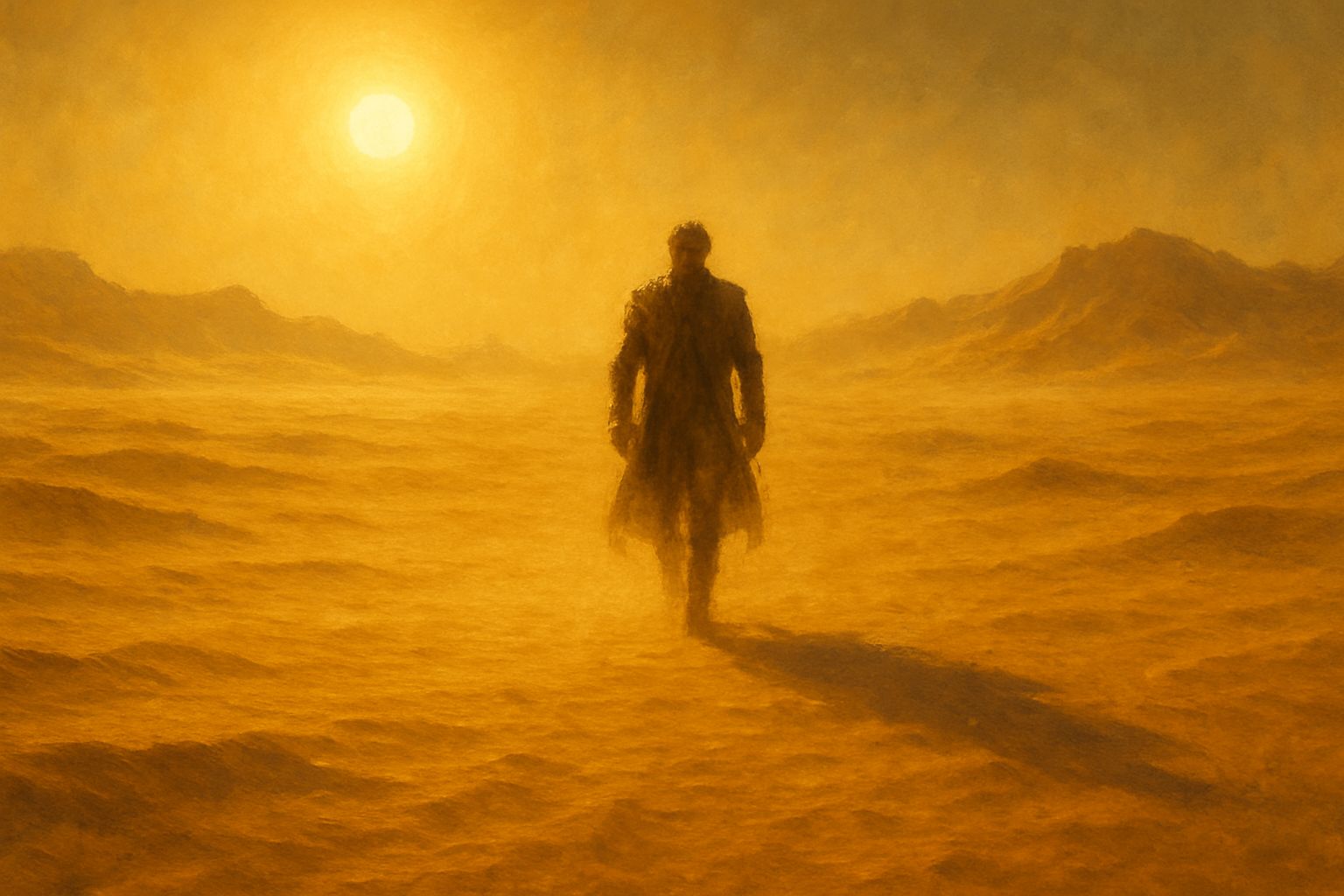
They always seem slightly elsewhere, a delay in the eyes, a stillness too perfect, a response too quick. Witnesses often say they only noticed them when they were already too close.
They have no dreams. Or, if they do, they are not theirs.
Their presence lingers. After they leave a place, people find things out of place, dead birds on windowsills, or unfamiliar thoughts in their heads.
They do not die easily. Not because they are invulnerable, but because they move first. They always move first.
Cultural Response
Lumekhet villagers hang moon-charms over cradles and insist on birth under the open sky to "call the soul down". Midwives watch newborns for signs, breath held too long, eyes that don't blink, silence where there should be wailing. If they suspect a Hollow, many lie. Few want to be the one to name it. Some are smothered in secret.
Yet still, some survive.
And when the sun sets on a road between villages, and a stranger walks into camp with a smile too sharp and questions too precise, some whisper, "Don't speak your name to them. Don't tell them your dreams."
They might be Hollow.
And a Hollow never forgets what you give them.
Possible Secrets
The First Hollow Was a God
Ancient fragments hidden beneath the Temple of Dawn describe a time when the cycle first began, and speak of a being born without a soul, before the Moon knew how to guide the dead. This being had no place in the pattern and instead shaped its own. It may still exist, walking unseen.
Hollow Possession Is a Lie
The common belief is that Hollows are vulnerable to possession by restless spirits. Some heretical scholars claim the opposite: that Hollows are not possessed but are vessels, made to contain fragments of something older, darker, and deliberate.
A Hollow Leads a Pilgrimage
A charismatic Hollow has gathered a following among the poor and grieving, preaching that the cycle is broken and that only the Hollowborn will remain when the rivers run dry. The priesthood believes it's madness. Others believe it's prophecy.
The Hollowbirth Moon
Records show that an unusually high number of Hollows were born during a specific lunar event centuries ago, a lunar eclipse. The next such convergence is approaching. The temples deny it has any significance.
There Is a City of Hollows
Whispers tell of a place beyond the basalt cliffs where no sunlight reaches, a place where Hollowborn gather without judgment. Some say it is carved from black glass. Others say it's not a city at all, but a body, sleeping and waiting for them to return.
One of the Twin Thrones Is Hollow
A dangerous rumor passes among the Moon Priests: that Ka-Ra was born without a soul. That he was filled with something else, light, yes, but not the kind the cycle allows. If true, then the Sun-God is not part of the cycle, but an intruder in it.
Adventure Hooks
The Hollow in the Market
Someone in the city's central market has been sowing discord, starting fights, driving animals mad, and vanishing before guards arrive. Witnesses describe a charismatic young man with calm eyes and a strange voice. The city's priestess hires the players to find and quietly remove him before unrest spreads.
A Birth Without Crying
A woman gives birth in the eastern sanctuaries, but the child makes no sound. The priests are hesitant to act. The mother begs the players to help her escape into the desert before the child is taken.
The Disappearance at Nightfall
A small village near the river reports that people are vanishing in the night, leaving no trace. Every witness claims to have last seen a quiet stranger visiting just before each disappearance, always different, always alone. The party is hired to travel there and find the pattern before more vanish.
The Unwanted Guest
A powerful noble prepares for her son's wedding. A mysterious guest has arrived claiming to be a forgotten cousin. He's charming, unnervingly polite, and completely unknown to anyone. She hires the players to discreetly investigate his background, but warns them not to speak to him too long.
The Caravan's Shadow
A merchant caravan went missing in the desert. Weeks later, it returns-one wagon lighter, and no one speaking of what happened. One of the survivors sends a hidden message to the Moon Priests: "One of them is not the same." The players are sent to uncover the truth.
The Imitator
A Hollow has learned to mimic a recently deceased scribe so perfectly that even his family believes he's returned early. The priests suspect the truth and hire the party to test the Hollow without revealing their intent. If the Hollow finds out, he may vanish, or retaliate.