Waverider Story - Campaign - Author's Notes
Para Omros
If the inqusition had ruled a country.
| Story |
|---|
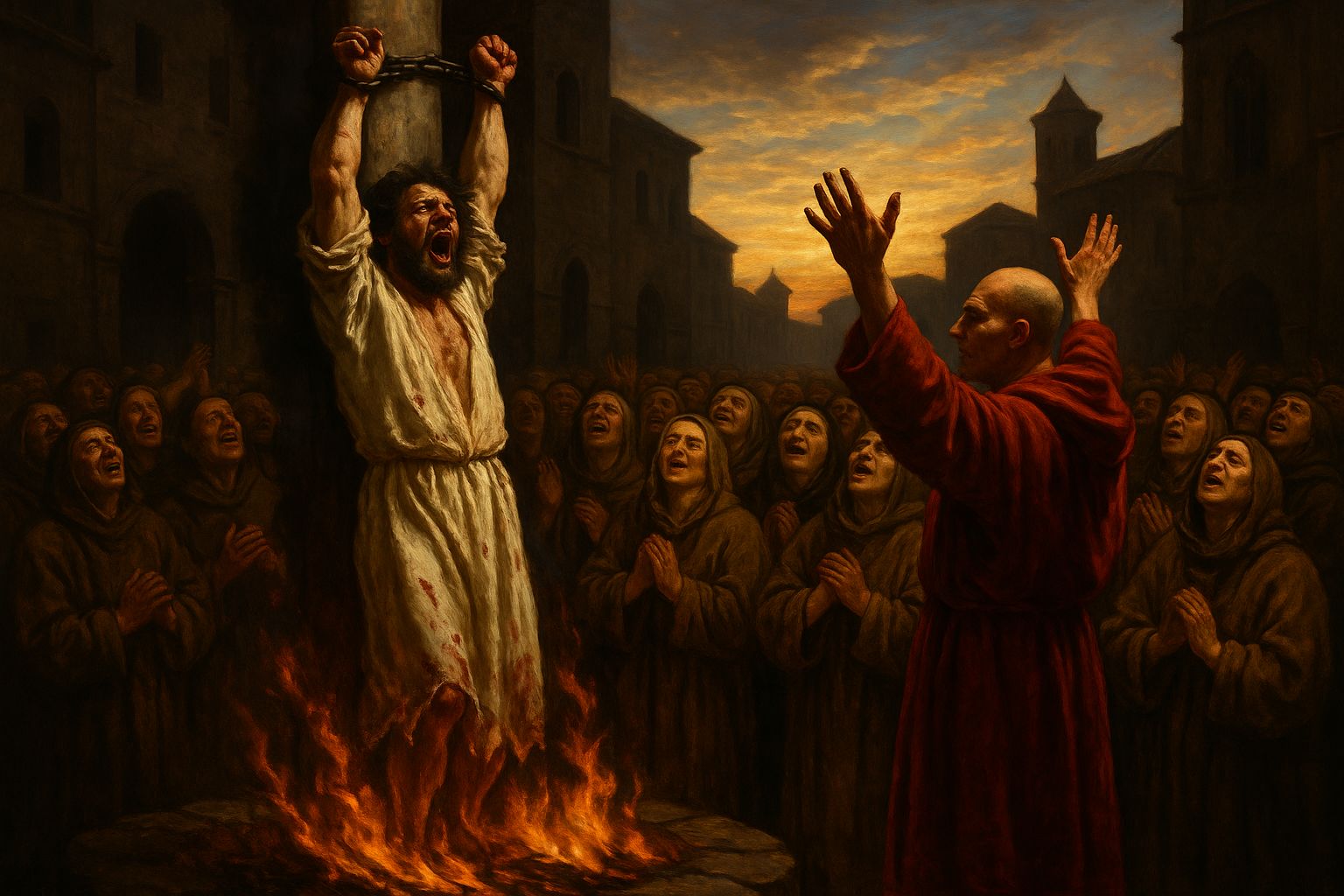
| They came at dawn, as they always did. Hooded, silent, save for the scrape of iron-shod boots across the stone streets. The people of Ashveil had already gathered in the square, packed shoulder to shoulder in the cold gray light, faces aflame with reverence and religious fervor. |
| At the center of the square stood the Pyre Throne, a pillar of charred stone, stained black with the ashes of hundreds. Today, it was already prepared. The ropes were stained, the iron shackles still steaming from the last judgment. Nearby, a tall bronze kettle burned low, filled with sacred oil that spat and hissed in the wind. |
| The Flamewardens emerged first, crimson cloaks streaked with soot, helmets wrought in the shape of burning coals. Behind them came the Penitent Choir, barefoot children with shaved heads and stitched lips, carrying holy banners and ringing dull iron bells in slow rhythm. |
| And then came the heretics. |
| Six of them. Eyes swollen from questioning. Tongues torn. One limped, dragging a broken leg. Another had no ears. They wore white, the color of guilt, so that the blood would be more visible when the flame kissed them. |
| The Flamefather ascended the dais. He was ancient, thin as a rod, robed in black linen inscribed with verses of the Codex Omrosi. His voice, though thin, carried across the square like a knife. |
| "These souls refused the Light. They whispered in darkness. They consorted with filth. They dared question the one mercy offered to man: obedience." |
| He turned slowly, arms raised. |
| "Burn the sin, cleanse the soul. Let Omros be praised." |
| And the crowd, on cue, began to chant. |
| "Mercy is fire. Mercy is pain. Mercy is Omros. Omros is all." |
| The heretics were dragged forward. Chained to the pillar. The youngest of the Penitent Choir, a boy of ten with no tongue, offered the Blessing of the Flame, a silent prayer, arms trembling as he tipped the bronze kettle. |
| The burning oil lazily flowed in channels carved in a spiral pattern around the pillar. getting closer to the heretics, until the very rock they stood on started to flow with burning oil. |
| The heretics screamed. |
| The crowd chanted louder, swaying, eyes open in holy fervor, tears running freely, not for the dying, but in awe of the holy act. |
| "Mercy is fire. Mercy is pain. Mercy is Omros. Omros is all." |
| One of the heretics, a woman, managed to speak before the flames took her throat. |
| "Mercy...?" |
| But no one listened. |
| Her words were lost in the roar of fire and the blind devotion of a thousand voices. |
Description
The Faith of Omros
Omros is believed to be the One True Flame, the creator of all existence, who forged humanity from pure light and placed them above all others. All other gods are considered false idols and demons wearing masks. Worshiping or even speaking of other deities is a capital offense.
Religious doctrine teaches that Omros demands purity, discipline, and complete submission to his will, which is interpreted and enforced by the Hierophant Supreme, Omros's chosen on earth. The priesthood teaches that the soul must be constantly purified through prayer and obedience, and only through total devotion can one approach the divine.
Daily Life and Society
Life in the Hierophate is bleak and rigid. Citizens are expected to pray at dawn, midday, dusk, and midnight, each session lasting an hour. On holy days, which occur multiple times per month, these sessions are longer and sometimes involve fasting, self-flagellation, or silent vigils.
Children are separated from their families at age seven to be raised by the Church, until their 13th birthday. This period is called "The second birth". They undergo religious indoctrination, physical hardening, and moral conditioning. Emotional expression is discouraged. Laughter and affection are seen as distractions from faith. One of the tenets of the religion is "There is no love except for the love of God".
Clothing is uniform by class and gender. All garments are gray or black bulky robes, without embroidery or decoration. Jewelry is forbidden. Food is bland and strictly regulated-salt is a rare luxury used only in sacred rites. Alcohol, sweets, and spices are banned.
No music is allowed other than somber religious chants sung in ancient tongues. Art is limited to stark religious iconography and is used as teaching tools rather than expression. Festivals are replaced by mass ceremonies of prayer and repentance.
The Law and Punishment
The Para Omros' laws are drawn directly from the Codex Omrosi, a sacred book said to have been burned into stone by Omros himself. Even minor transgressions are punished brutally to deter sin and impurity. Failure to punish a sin is seen as a greater sin than the sin itself.
Common punishments include:
- Maiming (removal of fingers, tongues, or eyes for blasphemy or sedition).
- Being tied with thick ropes soaked in oil or grease, which are then set on fire. Those who survive are horribly scarred, in the patterns of the ropes.
- Public burnings for heresy or apostasy.
- Impalement for demon worship, interracial unions, or aiding non-humans. The impalement is especially brutal, as it is a combination of crucifixion and impalement, where the victim is hung by the arms, preventing a quick impalement.
- Branding for first offenses, such as wearing colored clothing or missing prayer sessions.
The clergy operate secret tribunals called Mercy Courts, where the accused are presumed guilty and often tortured into confession.
The Clergy and Government
The ruling priesthood is a rigid caste. At the top sits the Hierophant Supreme, a living god-king figure said to commune directly with Omros in nightly visions. Beneath him are the Flame Cardinals, Purity Inquisitors, and Penitent Scribes, each with specific roles in governance, law enforcement, and spiritual maintenance.
Secular roles such as farming, construction, and blacksmithing are carried out by the Lowly, the citizen class. There is a strict caste system, your role is decided by the priesthood during The Second Birth. These workers are monitored constantly by robed Watchers, who ensure piety and report any lapses to the nearest inquisitor.
Relations with Non-Humans
Non-humans are universally seen as abominations, thought to be servants of evil. Elves are seducers, dwarves hoarders, and orcs agents of bloodlust, and so on.
Foreigners who are not human and not converted are either expelled or burned.
Slavery
Para Omros does not have slaves, as that would put some people in a position of power not suitable for a follower of Omros. It would not be sufficiently humble.
Notable Locations
The Pit of Light: A chasm of fire into which the dead are thrown, believed to lead to Omros's judgment seat.
The Hall of Tongues: A tower where the tongues of heretics are nailed to the walls as warning.
Possible Secrets
The Hierophant Has Never Spoken to Omros
Despite claiming divine visions, the Sovereign Hierophant has never once received a message. The entire line of Hierophants has faked communion to maintain control.
Secret Libraries Exist
Beneath the ash fields of Ashveil, forbidden books from the old pantheons are hidden. A secret order of monks studies them in silence, preserving them for the right moment.
The Choir Is Possessed
The Penitent Choir's eerie synchronicity isn't training, it's due to a bound spirit that moves through their bodies like a puppet string.
The True Prophet Was Killed
History says the founder of the faith was the first to speak to Omros. In truth, she was murdered by her second-in-command, who then claimed her revelations as his own.
The Watchers Trade in Sins
Some Watchers secretly sell indulgences, letting wealthy citizens commit hidden sins in exchange for bribes or favors.
One City Has Fallen Silent
A coastal town has completely cut contact. Scouts report that the Flamewardens sent there never returned, and the town appears... peaceful.
The High Flamefather Is a Heretic
He has been secretly reading the Codex of Cinders, a banned text that suggests Omros's light must be balanced by a necessary darkness.
The Children Are Vanishing
Children taken into the Church's care sometimes disappear. The official word is illness. The truth is that a secret cabal is conducting "soul-cleansing" experiments.
Adventure Hooks
Burn the Heretic
The party is ordered to escort a prisoner, an old woman accused of heresy, to a distant pyre-site for execution. Along the way, they begin to question whether she is truly guilty, and she begins whispering things she should not know.
The Pilgrimage Test
As a condition for safe passage, the party must join a public pilgrimage and pass its trials of pain and purity. Failing means public punishment. Succeeding might be worse.
The Flame Judges You
A member of the party is mistaken for a wanted heretic and dragged before a Flame Court. To save them, the rest must either find the true heretic, or fake one fast.
Choir of the Bound
A ghostly wailing is rising from an isolated monastery, and several children from nearby towns have vanished. The Church hires the party to "investigate", but insists on watching every step.
The Trial of Fire
To gain access to a sealed temple, the players must undergo the Trial of Fire, a literal walk through blessed flame. Survival is not guaranteed. Cheating it risks worse than death.
The Burning Ship
A ship drifts into harbor, its crew burned alive in place, their mouths sealed with holy wax. No one knows where it came from. The party is sent to tow it in and uncover its origins.
The False Prophet
A charismatic preacher has begun gathering a following in a poor district, preaching obedience, but not to Omros. The Church wants the party to destroy him, but the man seems gentle and his followers fervent.
The Inquisitor's Shadow
The party is shadowed by a masked inquisitor who never speaks and never leaves. At night, they see his shadow outside their tents. No one hired him, but no one dares confront him.
Excommunication
A foreign spy within the Church has fallen from favor and is to be erased. If the party wants the information or help they were promised, they must break him out before the bell tolls.