Waverider Story - Campaign - Author's Notes
Olydrian Isles
Ancient Greece.
| Story |
|---|
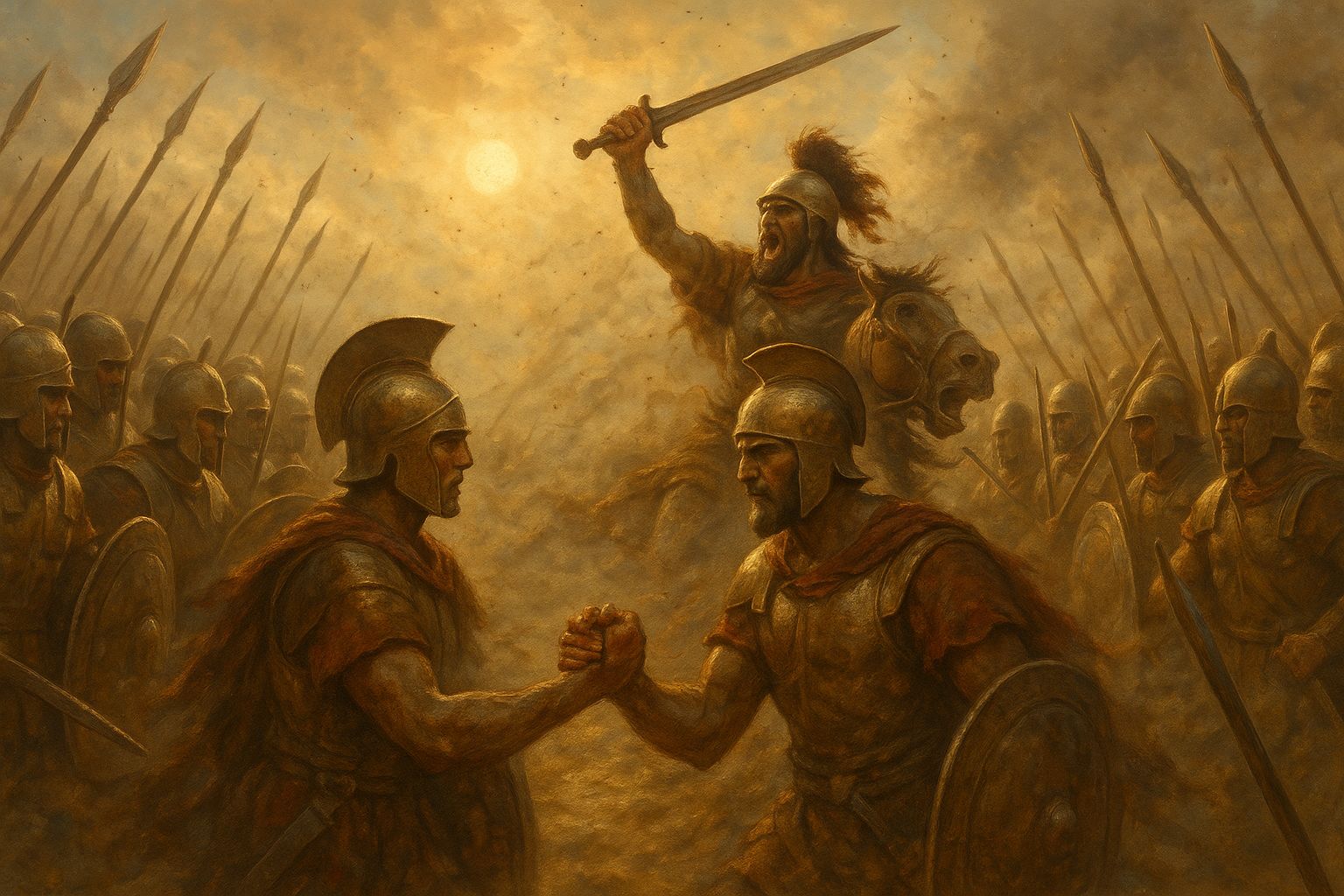
| The plain of Lathoros burned with heat, dust rising in choking clouds as the spears of Theron clashed against the shields of Lysara. The ground was slick with blood, and the cries of the wounded drowned even the drums. I was in the phalanx, shoulder to shoulder, pushing, gasping, feeling the press of men as if the world itself was crushing us flat. |
| Then a voice tore through the din. A rider, bloodied and wild-eyed, galloped between the lines, shouting words that froze every blade mid-swing. "Imperial sails! Imperial sails at Myrake's Bay!" |
| For a heartbeat no one moved. Then, as if by command, the killing stopped. I found myself staring at the Lysaran before me, his spear lifted for the thrust. He looked back, lowered his weapon, and offered me his hand. We clasped it, still panting, still spattered with each other's blood. Around us the lines broke, not in rout but in sudden truce. |
| The generals shouted new orders. Form ranks. Turn south. We marched side by side, enemies no longer, and by sunset we saw the Empire's fleet churning into the shallows. The ground shook as their soldiers hit the sand, but it was we who struck first. Theron's spears and Lysara's shields together, a wall of bronze and fury. |
| The sea itself seemed to boil with battle. By nightfall the Empire's fleet was ash upon the tide, their dead strewn across the shore. That day the bards named forever: the Day of Ashen Spears, when Olydrian blood spilled upon Olydrian soil turned to brotherhood, and the Isles stood as one. |
| Story |
|---|
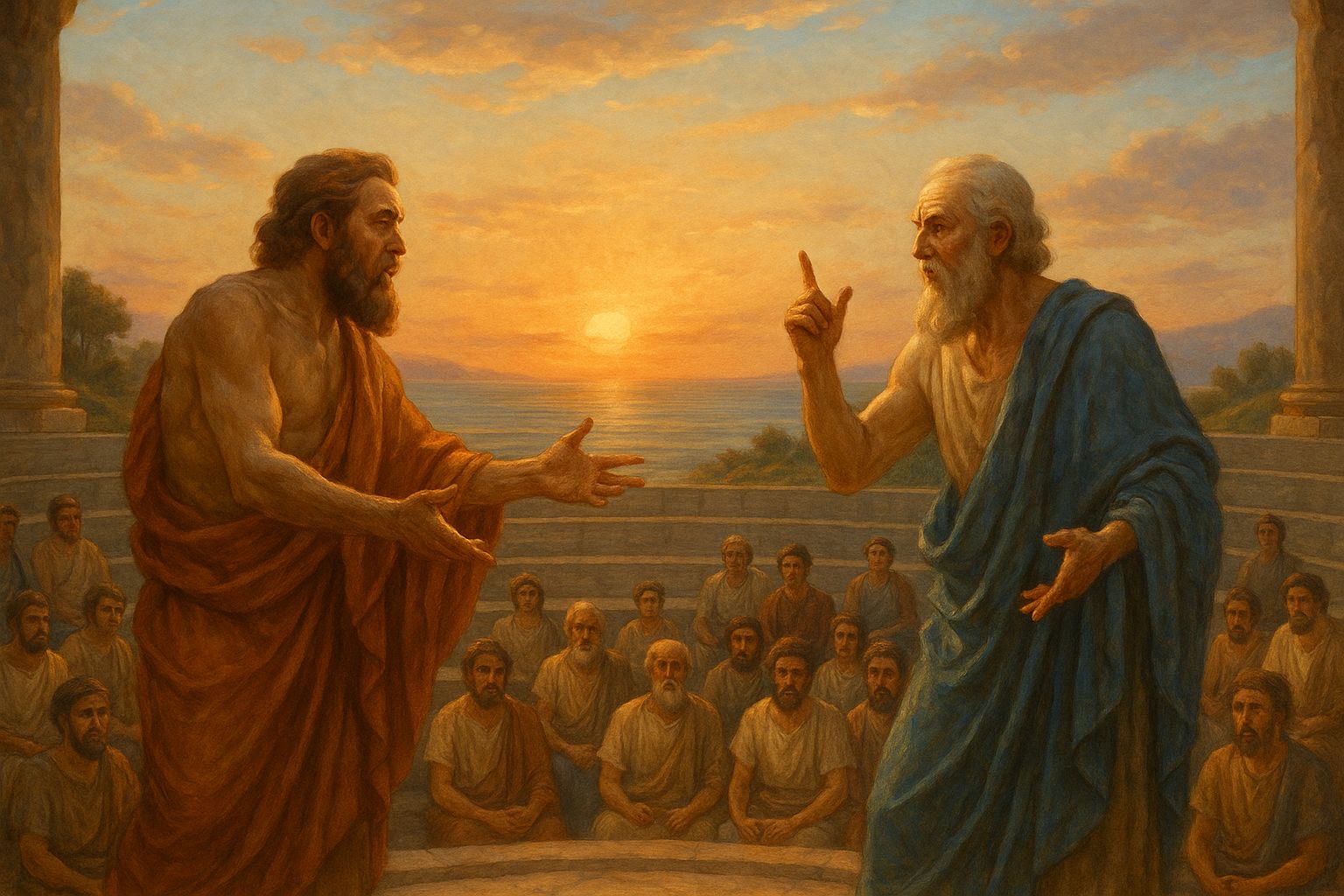
| The amphitheater was already full when I arrived, the marble benches rising like waves around the speaking floor. No swords, no shields, no armor - yet the air was heavier than any battlefield. Two men faced each other: Demetrios of the Olive School and Calliros the Silver-Tongued, their robes gleaming in the torchlight. |
| The matter seemed small at first - a dispute over the rights of pearl-divers from Myrake who wished to settle in Lysara. But in Lysara no question is small, for every argument touches on law, honor, and the will of Thaleia herself. |
| Demetrios spoke first, voice steady as a hammer's ring. "They are not citizens. To grant them homes is to break the walls of our city and let strangers rule within." His words fell like stones, simple and solid. |
| Calliros smiled, lifting his hand as though conducting a choir. "Are we not all descended from wanderers? Did not the goddess herself come as a stranger, bearing wisdom in her mouth and a dagger hidden in her sleeve? To deny them is to deny the very gift of Thaleia." His words rippled like water, twisting around Demetrios' stones until the crowd stirred and murmured. |
| The debate surged back and forth. Each phrase was an arrow, each pause a shield. I saw sweat bead on foreheads as men and women leaned forward, weighing every syllable. At last, the crowd's voices rose in thunder, echoing from the marble walls - not votes cast in silence, but a chorus of acclaim. |
| Calliros had won. He bowed not to Demetrios, but to the people, and his rival returned the bow with dignity. For here, defeat is no disgrace. To argue, to be heard, and to submit to the will of the people - that is the honor of Lysara. |
Description
The Olydrian Isles are a scattered chain of rocky islands, rising like broken teeth from the western sea. Some are large enough to hold several cities, while others are little more than jagged cliffs crowned with a single citadel. Their soil is thin, their hills steep and volcanic, so the Olydrians turned to the sea, where their strength became unmatched.
Where the Empire embodies land power, the Olydrians embodies sea power. Unlike most sailors who cling to the coasts, the Olydrians are masters of the open sea. Their navigators read the stars, the flight of seabirds and the color of the water, guiding fleets far beyond sight of land. Their long, sleek galleys and swift triremes are the terror of pirates and the pride of mercantile convoys. When they appear on the horizon, they bring either wealth or ruin.
Each city is an independent state, ruled in its own way by councils, tyrants or archons, and each fiercely proud of its traditions. Rivalries between them are constant, and wars not uncommon, yet when an outside foe appears they unite with terrifying speed. The famous Day of Ashen Spears is still celebrated, when the armies of Theron and Lysara halted their own battle to join forces and annihilate the Great Empire's fleet as it made landfall at Myrake's Bay.
The Olydrian pantheon is vast and quarrelsome, but each city favors its own patron deity, who embodies its character and guides its fortunes. Temples gleam like lighthouses on every promontory, and the people live in constant awareness that the gods might walk among them in disguise.
Shared Culture
- Architecture: Whitewashed stone houses with painted doors and colored roofs; temples always crowned with tall columns visible from the sea, doubling as navigation markers.
- Hospitality: Strangers are treated with respect, since any unknown sailor might be a god in disguise. Even enemies are given food and water before hostilities resume.
- Feasting and Song: Music and shared meals are central to civic life. Every city holds at least one public feast each month where all classes attend.
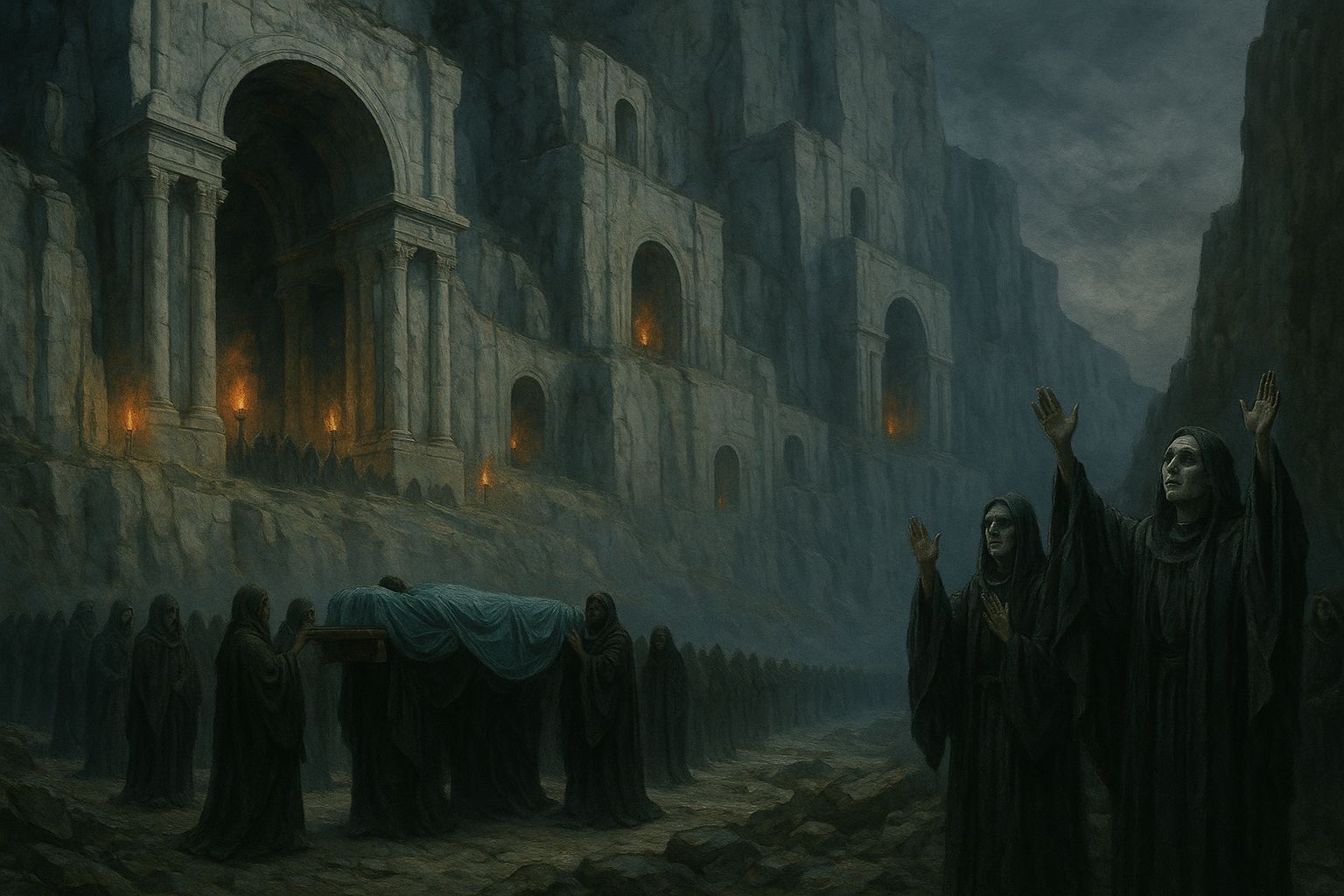
- Funerary Customs: The dead are cremated or entombed facing the sea, so they may sail with their ancestors into the horizon.
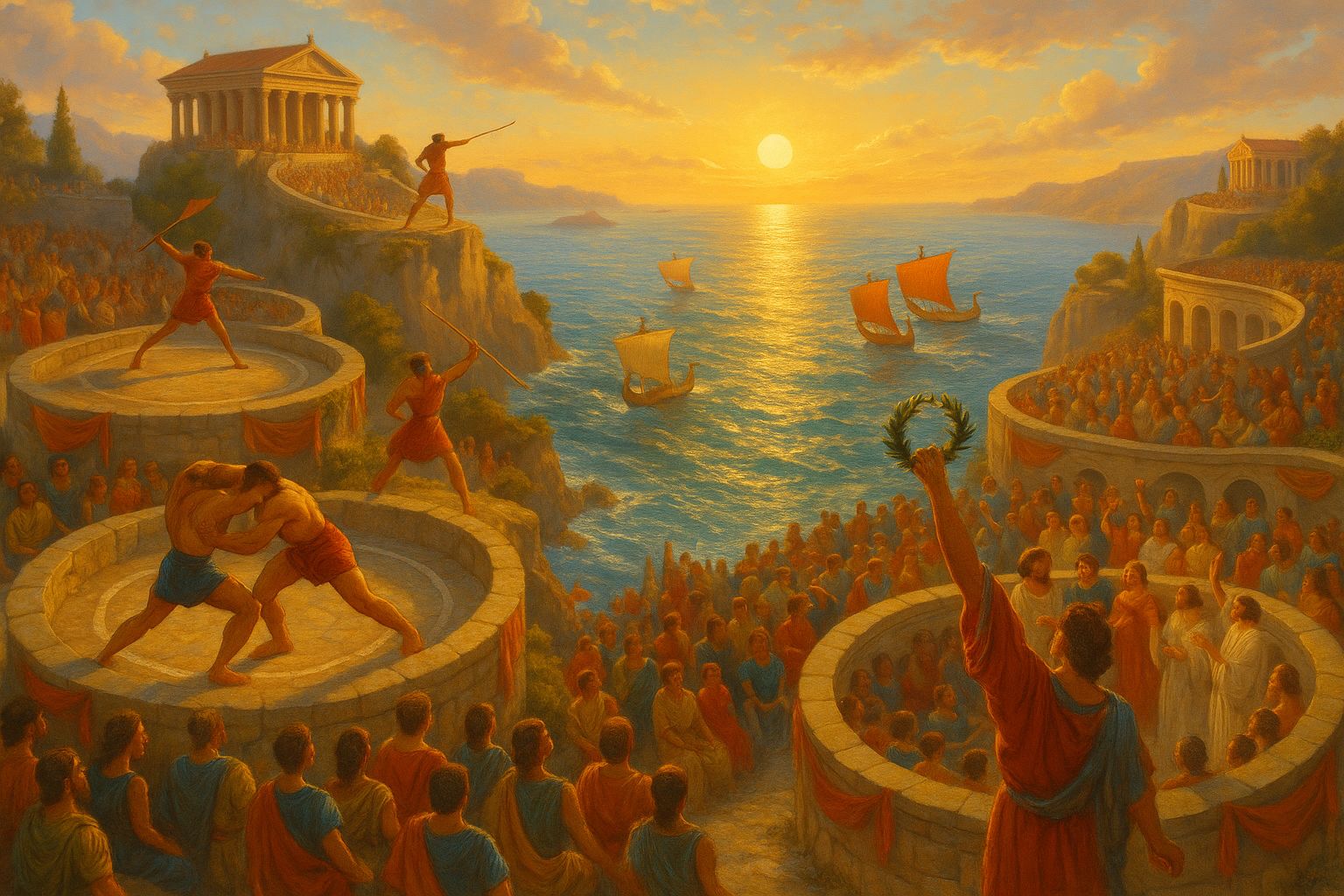
- Athletics and Contests: Strength and skill are valued everywhere; festivals often feature wrestling, boat races, or spear throwing.
- Common Law of the Isles: Though each city governs itself, all recognize certain sacred laws: no ship may be attacked within sight of a temple, envoys may not be harmed, and murder during festival days is considered an offense to all twelve gods.
The Games
Every second year, the Olydrian Isles set aside their quarrels for the Great Games at the Steps of Glory. From every city come champions, athletes, singers, poets, craftsmen, debaters, mathematicians, to test their skill before the gods and the watching crowds. On the cliffs above the harbor harbor, wrestling matches are fought, spear throwers hurl for distance, and rowers drive sleek galleys against the tide. In the amphitheaters, choirs from Aeryne clash with the philosophers of Lysara in contests of voice and wit, while the forges of Erythros and the vineyards of Zarynthos compete for honor through craft and taste.
Victory is glory not just for the champion, but for their city. Wreaths of laurel are placed upon the victors, and their names are sung across the Isles. Rivalries are fierce, but for the span of the Games no blood is spilled, and no army sails. For a few days, the Olydrians remember that they are one people, bound by sea, gods, and contest.
The games are more than just competition, they show devotion to perfection, and thus to the gods.
The Twelve Cities
Theron
Martial and disciplined, famed for its hoplites and iron-fanged war galleys. Every citizen, even women, trains with spear and shield; war is seen as the truest form of honor. Children are judged not by lineage but by their prowess in the training field. Governance: A single strategos rules as warlord until death or defeat, replaced by the strongest commander. Patron: Veyros, Lord of War.
Lysara
Center of poets and philosophers, with amphitheaters carved into cliffs. Debates in the amphitheater settle disputes, sometimes lasting days. Even slaves are permitted to speak in public forums if their arguments hold merit. Governance: A senate of philosophers and orators decides policy, guided by rhetoric and logic. Patron: Thaleia, Muse of Wisdom.
Myrake
Built among shallow lagoons, its houses on stone pillars, famed for pearls and salt. Festivals are tied to the tides; marriages, coronations, and battles only begin on an incoming tide. Sailors refuse to eat the first fish caught each day, offering it back to the sea. Governance: The wealthiest pearl-diving families form an oligarchy, jealously guarding power. Patron: Pelath, Keeper of Tides.
Erythros
On volcanic slopes, its smiths turn the red dust into bronze wonders. Only men are allowed to be smiths, and they call themselves "Husbands of Kharneia", while women handle most other work. Governance: A priestess of Kharneia, believed to carry the goddess's fire, serves as high ruler. Patron: Kharneia, Lady of the Forge.
Kalynth
A bustling hub of merchants, its docks filled with foreign sails. Politics are openly bought and sold; council seats often go to the highest bidder. The coins minted here are the currency used across the isles, stamped with Ormenos' changing face. Governance: Open plutocracy: only those who can pay a fee are permitted to vote, and one can buy as many votes as one can afford. They don't have any taxes, instead, the state is founded by this fee. Patron: Ormenos, Lord of Coin.
Phorakos
Boldest of explorers, its fleets push past the horizon into unknown seas. Youths must voyage alone into the open sea as a rite of passage. Their libraries are filled with maps, half of which chart unknown or imagined lands. Governance: An open democracy where every free citizen can speak in the assembly. Patron: Nyros, the Wanderer.
Zarynthos
Blessed with groves and vineyards, its bounty is unmatched. Vintners are revered as priests, for tending vines is itself an act of worship, and their wines have unmatched quality. Festivals last for days, fueled by endless wine, song, and ecstatic dance. Governance: The people elect their leader by acclaim during revels, the loudest cheers deciding. Patron: Enyra, Lady of the Vine.
Drakonos
Shrouded in volcanic smoke, its oracles whisper doom and fire. Public assemblies are held in cavernous halls warmed by hot springs. Once a year, livestock are driven into ash pits as offerings to the god. Governance: Citizens vote only after consulting the oracle's riddles, making decision slow and cryptic. Patron: Phyros, the Flame-Tongued.
Aeryne
The city of art, where theaters and choruses echo across the sea. Their cliffside homes are painted in bright colors so that the city gleams like a mosaic when seen from the sea. Councils are held in open-air amphitheaters, where debates are accompanied by music to stir the crowd's mood. Governance: An elected senate. Patron: Meliane, Voice of the Waves.
Kythera
A fortress carved into sheer cliffs, its harbor shielded like a blade behind stone. Every wall and tower is dedicated to the god, built as both defense and shrine. Betrayal is punished by entombment in the city's cliff walls. Governance: Rule belongs to the Stone Assembly, where only landowners may vote. Patron: Doryas, Shield of Stone.
Ostranos
Known for its healers and sacred baths, where even princes travel for cures. Sacred springs are guarded by priestesses who administer cures. Festivals feature processions of serpents, symbolizing rebirth and recovery, and it is believed that each festival is the optimal time to cure specific illnesses. Governance: A high priestess of Irythe serves as matron-ruler, believed to be chosen by the goddess. Patron: Irythe, Bringer of Health.
Xanthros
Keeper of the dead, its tombs rise like palaces of silence. Families spend fortunes building tombs, more lavish than their own homes. Funerals are grand processions, ending with the dead entombed in cliffside vaults. Governance: A hereditary line of death-priests holds power, each sworn to serve until entombed alive after 12 years. Patron: Erethus, Lord of the Deep.
Religion
The Olydrian pantheon is vast, but the Twelve Patrons dominate worship, each tied to a city. Myths speak of their squabbles, rivalries and unions, mirroring the lives of mortals. Priests claim the gods themselves embody the spirit of the Isles, and if ever the Olydrians falter in unity, the sea will swallow them.
Festivals and sacrifices are constant: bulls drowned for Pelath, wine poured into the fire for Phyros, garlands set adrift for Meliane. Olydrians believe the gods walk among them in disguise, and so every stranger may be divine.
Slavery
Unlike the Great Empire, the Olydrian cities hold no arenas of blood. Gladiatorial games are seen as primitive and wasteful, robbing the sea of strong arms that could row or fight for the fleet. Slaves are common in the Isles, yet they are treated with a measure of care; a dead slave is a loss, but a contented one can be worked hard and trusted at the oar. Many rowers are bound men, but they are fed, housed, and taken care of. Cruelty exists, but it is frowned upon, for the Olydrians pride themselves on their civilized ideals.
Relations with the Empire
The Great Empire and the Olydrian Isles stand as opposites, land and sea, empire and city, iron and bronze. The Empire scorns the Olydrians as fractured and weak, a squabbling chain of islanders who cannot even rule themselves. Yet it is Olydrian triremes that rule the open sea, and even the Empire's admirals whisper that no fleet can match them once the sails of the Isles appear on the horizon.
Skirmishes are constant. Imperial legions seek to secure coastal towns, but Olydrian raids strike supply lines and harbors, vanishing before the legions can march. The Isles themselves are too rocky and fortified to conquer easily, yet too valuable to ignore, for whoever commands their fleets commands the sea.
Neither side trusts the other. To the Empire, the Olydrians are dangerous pirates with too much pride. To the Olydrians, the Empire is a lumbering beast that covets what it cannot master. War has been declared and abandoned many times, but the tension never fades, always waiting for one spark to set sea and land ablaze.
Possible Secrets
Theron (Veyros)
- The war god Veyros has not answered prayers in a generation; priests fake omens to keep the people united.
- Beneath the training grounds lies a hidden arsenal of weapons from meteoric iron, forged by the best smiths of Erythros.
Lysara (Thaleia)
- A forgotten oracle once declared that Lysara would birth the next tyrant of the Isles.
- A school of rhetoric practices dangerous word-magic that can sway crowds beyond mortal means.
Myrake (Pelath)
- The priests of Pelath drown prisoners in secret, claiming their souls appease the tides.
- The pearl-divers have discovered black pearls that whisper in dreams.
Erythros (Kharneia)
- The volcano is worshipped because it is said to hide an ancient forge of the gods themselves.
- The ruling smiths have been secretly trading weapons to pirates.
Kalynth (Ormenos)
- The vaults beneath the temple of Ormenos contain debts owed by every city of the Isles.
- Kalynth's merchants secretly fund wars between other cities to keep them weak.
Phorakos (Nyros)
- Explorers have returned with maps of lands that do not exist - or that vanish between voyages.
- Nyros' lantern of starlight is said to still burn in a hidden shrine on the farthest isle.
Zarynthos (Enyra)
- During their revels, some worshippers drink blood as well as wine.
- Revelers vanish during festivals, said to be taken as "lovers" by Enyra herself.
Drakonos (Phyros)
- The oracles of Drakonos are drugged to speak, but some whisper they channel no god, only madness.
- The Council of Ash keeps a prophecy locked away: the Isles will burn when united under a single ruler.
Aeryne (Meliane)
- Meliane's voice is said to be that of a drowned queen, still crying out from the deep.
- A secret society of singers weaves coded messages into their hymns, swaying politics.
Kythera (Doryas)
- The walls are said to be unbreakable because they were built with stones stolen from a god's temple.
- Doryas' priests keep records of every oath sworn, and blackmail the powerful with broken promises.
Ostranos (Irythe)
- The sacred springs are tainted by volcanic gases; some cures are lies, and the priests know it.
- It is rumored that the priestesses also provide other "services" in the privacy of the bath chambers.
Xanthros (Erethus)
- The tombs are not empty: the dead rise within them, bound to ancient pacts.
- The paper boats floated each year during the ritual of Rememberance of the Sea sometimes return - bearing strange gifts.
Adventure Hooks
The Broken Pact
An old treaty of unity between the cities is stolen from a temple archive. Without it, suspicion grows, and war between rival cities looms unless the heroes can recover or forge a replacement before the Empire takes advantage.
The Phantom Fleet
Sailors whisper of an Olydrian fleet seen on the horizon, though every city swears it is not theirs. The ships bear strange black sails and do not answer hails. Are olydrian renegades creating a pirate fleet?
The Thirteenth City
A half-drowned ruin has risen from the waves after an earthquake. Priests argue whether it is the cursed Thirteenth City, and expeditions are being raised to plunder its treasures, or destroy it before its secrets spread.
Blood on the Tide
During a festival meant to honor all twelve gods, the sacrifices vanish from the altars overnight. Rumors spread that one city has stolen them to insult the others, and only swift action can prevent the festival from turning into civil war.
Chains Beneath the Oars
Rumors spread of a slave revolt brewing in the galleys of the Olydrian fleets. If true, it could cripple their naval supremacy at the worst possible time. The adventurers must decide whether to stop the uprising, aid it, or exploit the chaos.
The Singing Storm
A storm at sea carries voices within its thunder, echoing the hymns of Meliane. Ships vanish into its heart, and the priests of Aeryne demand volunteers to enter the storm and discover its source.
The Smuggler's Pact
Imperial merchants are secretly trading in Olydrian harbors despite the war. Do the adventurers expose them, or profit from the forbidden trade?
The Turned Admiral
An Olydrian admiral is suspected of taking bribes from the Empire. Proof must be found before his betrayal shatters the fleet.
The Silent Outpost
A coastal watchtower meant to track Imperial fleets has gone silent. Scouts sent to investigate have not returned.
The Envoy's Blade
The Empire sends an envoy under flag of peace, but intelligence suggests his mission is to assassinate one of the city rulers during talks.
The False Fleet
The Empire spreads rumors of a massive invasion to draw Olydrian fleets away from the true target. Can the adventurers uncover which coast is really at risk?