Campaign: Caerduin
Act Synopsis
Arrival in Ardwych
The Blue Marlin arrives in Ardwych carrying aid. The reception is immediate and emotional. Hungry people crowd the docks in gratitude, but the situation is not yet total collapse. Ardwych is strained, not broken. Authority still functions, and suspicion runs just beneath the surface. The crew quickly understands that food is power here, and that everyone is watching where it goes.
The Braigh Accusation
Members of Clan Braigh arrive soon after, accusing Ardwych of blocking supplies needed for the upper river and growing rich by reselling them. They go further, claiming Ardwych has begun collaborating with the Empire. Tensions flare, a brief scuffle breaks out, and the Braigh representatives retreat onto the Blue Marlin. The only part of these claims actually true is that Ardwych want the food for their own stock, and that it is more needed upriver, but the players don't know that.
The crew is forced into an early choice. Unload supplies in Ardwych or cast off and continue upriver to Braigh. Neutrality is not an option. Mention of the Waverider changes the tone. The Braigh know her and confirm that Eira mac Braigh, of their clan, served aboard and visited home while the ship was here.
Consequences of the Choice
If the crew stays in Ardwych, they are welcomed but watched. No one here knows more about the Waverider. They will eventually need to go upriver anyway and will be met with suspicion for siding with Ardwych.
If they go directly to Braigh, they are received as heroes, though the resentment from Ardwych lingers but is mostly directed toward Braigh rather than the crew.
In Braigh, there is a brief respite. Supplies are unloaded, questions are answered, and the crew hears stories of Eira, Ulfar, and Captain Solonex. No destination is given, but they are directed toward Eira’s family living between Braigh and Cailoch. They also learn that High Chieftain Ciaran mac Braigh is once again gathering forces for a renewed strike against the Empire.
The Raid from Cailoch
News of the supplies spreads quickly. Clan Cailoch launches a raid, driven by hunger and desperation. Before fighting begins, they issue a demand to hand over the food. This is a key trust moment.
The crew can help repel the raiders, earning Braigh’s loyalty through blood, or attempt to broker a desperate agreement. The supplies are insufficient to truly help both sides, and any compromise is bitter and temporary. Either path builds trust in Braigh if handled with care.
Imperial Sabotage Revealed
Through surrendered Cailoch or negotiation, the crew learns of imperial commandos operating in Caerduin. These teams have burned fields in Cailoch and are believed to be roaming the land, though their current destination is unknown.
On the journey toward Eira’s family, the crew encounters one such team. If accompanied by a skilled scout or seer, they gain the advantage. Otherwise, they are ambushed. Surviving commandos confirm that multiple such teams are active across Caerduin, deliberately worsening the famine.
Eira’s Family and the Trail Forward
Eira’s family welcomes the crew as friends. Here, bonds are warm and sincere. The crew gains further personal insight into the Waverider’s journey and the ports she visited. Most importantly, they receive the next destination.
They are also entrusted with a message for Eamon mac Braigh, Eira’s brother, operating as a spy and saboteur in Albirica under the alias Ivar Strongbow, posing as a Draknir trader.
From here, the crew’s path is clear. Caerduin has shown them the cost of hunger, the fragility of unity, and the depth of imperial interference. The trail of the Waverider continues, and so does the war beneath the war.
Alternate Entry
If the crew arrives in Caerduin before Ardenvale, the famine is more severe. Local leaders beg them to sail south to Millford to secure supplies as quickly as possible. Payment is offered in silver, friendship, and non food goods. They will end up here again later, but after the Ardenvale arc, to complete this arc.
Core Themes
- Hunger shapes every interaction.
- Starvation turns clans against one another.
- Friendship, once earned, is absolute.
- Religion permeates daily life and justifies both courage and betrayal.
- The Empire is not merely winning battles. It is engineering collapse.
Arrival in Ardwych
| Story |
|---|
| The Blue Marlin entered Ardwych on a gray morning, mist clinging low to the river like breath held too long. The docks were crowded before the gangplank was even lowered. Not with guards or soldiers, but with people. Thin faces. Wrapped cloaks. Hands already outstretched, not begging, not yet, but hopeful in a way that bordered on fear. |
| They did not shout. That was the first thing that stood out. Gratitude moved through the crowd in murmurs and nods, in quick signs made to gods and ancestors, in hands pressed briefly to chests before reaching for ropes to steady the ship. Hunger had not broken Ardwych, but it had taught it restraint. |
| The town rose behind the docks in layered stone and timber, sturdy and well kept. Storehouses stood solid and locked. Warehouses bore fresh markings. Coin still moved here. Traders argued prices near the quays, their voices sharp, their clothes worn but clean. Smoke rose from bakeries and smithies alike. Ardwych was not poor. It was bracing itself. |
| A horn sounded once, short and controlled. The crowd parted, not eagerly, but with the practiced motion of people used to authority. |
| Maeven mac Ardwych stepped forward, flanked by two guards with spears held upright. She was broad shouldered, gray braided into her dark hair, a torque of worked bronze heavy at her throat. Her eyes went first to the cargo hold, then to the crew, weighing both. |
| “You are welcome in Ardwych,” she said. Her voice carried easily without shouting. “And you are expected.” |
| A ripple moved through the crowd at that. Not surprise. Confirmation. |
| Maeven gestured toward the riverbank. “The docks are yours for unloading. The grain will be counted and distributed under watch. There will be food for those who need it. There will be order.” |
| Her gaze sharpened slightly. “And there will be questions.” |
| She did not look at the crowd when she said it. She looked past them, to the streets beyond, to the upper windows and shadowed alleys. |
| “Word travels fast in lean times,” she continued. “So does fear. We have eyes in Ardwych that are not ours. People who listen too closely. People who ask the wrong kind of questions.” |
| One of the guards shifted his grip. A man near the edge of the crowd lowered his head too quickly. |
| Maeven’s expression did not change. “You will find us grateful,” she said. “You will also find us careful.” |
| Behind her, a pair of children watched the ship with open awe, licking crumbs from their fingers. Nearby, a merchant argued loudly over the weight of a sack, silver changing hands even as a woman farther down the dock crossed herself and whispered a prayer to Morrinya. |
| Food was here. Just enough. |
| And everyone in Ardwych knew exactly how quickly it could be gone. |
Purpose of the Scene
This scene establishes Caerduin’s tone immediately. Ardwych is hungry but functional, tense but orderly. The goal is to show that famine is approaching, not yet arrived, and that everyone knows exactly how close they are to the edge. Food is scarce, not absent. Authority still exists, but it is brittle.
This is not a refugee camp. It is a town tightening its grip on itself.
First Impressions to Emphasize
Make it clear that Ardwych is economically intact. Storehouses are solid. Coin still circulates. Crafts continue. This reinforces that any hoarding or redistribution is a choice, not the result of collapse.
At the same time, underline restraint. People do not rush the ship. They do not shout. Gratitude is controlled. Hope is present, but fear is closer. Hunger has not turned into panic yet, but it has shaped behavior.
Let the players feel watched. Every movement of cargo is noticed. Every decision about unloading carries weight.
Maeven mac Ardwych
Maeven mac Ardwych represents local authority. She should feel competent, calm, and pragmatic. She is not hostile, but she is cautious. She welcomes the crew because she must, and because aid matters, but she assumes scrutiny is necessary.
Her warning about spies should not sound dramatic. It should sound routine. This tells the players that imperial presence is expected, not exceptional, and that paranoia is a survival trait rather than hysteria.
She should never accuse the crew directly. Suspicion exists, but trust is still possible.
Religion in the Background
Religion should appear as habit rather than ceremony. Quick signs to gods. Quiet prayers. Invocations made without pause or explanation. This reinforces that faith is woven into daily life, especially under strain.
Use Morrinya here as a quiet presence. Protection, caution, and secrets fit the moment. Brennos should remain distant for now, associated more with violence and later choices.
Setting Up the Next Beat
End this section with tension unresolved. The aid has arrived, but distribution has not begun. Gratitude exists, but suspicion lingers. The town is holding its breath.
This is the moment where the Braigh accusation will land. The players should feel that whatever choice they make next will be noticed and remembered.
Ardwych is not asking for help.
It is waiting to see what kind of help the crew will be.
The Braigh Accusation
| Story |
|---|
| They came from the upper streets, not the river. |
| A knot of men and women pushed through the gathered crowd with no patience for order. Cloaks hung loose on their frames. Belts were pulled tight against shrinking waists. Their faces were sharp with hunger and fury in equal measure. Clan Braigh colors marked their shoulders and throats, faded by travel and wear. |
| They did not wait to be acknowledged. |
| “Look at them,” shouted the woman in front, her voice hoarse but strong. “Counting sacks while their kin scrape bark from trees.” |
| A man beside her pointed toward the storehouses. “Listening too much to Morrinya, that is your sin. Whispering and hoarding, turning from blood and bond.” |
| Murmurs rippled through the dockside. |
| “Morrinya has her place,” the woman went on. “In war. In knives for enemies. Not for kinsmen. Brennos demands strength shared, not hidden behind locks.” |
| Someone laughed nervously. Someone else spat. |
| “You sit on grain while the high chieftain gathers fighting men,” another Braigh called. “You starve the river to feed your ledgers. Or worse.” His eyes flicked toward the guards. “You trade silence with the Empire and call it caution.” |
| The Braigh pushed on until they reached the gangway of the Blue Marlin. Their desperation was plain now. Not raiders. Not envoys. People who had come to bargain with nothing left to offer but accusation and blood. |
| A turnip arced through the air. |
| It struck the shoulder of the lead woman, fell to the stone quay, and burst apart, pulp scattering across the ground and falling into the river. |
| For a heartbeat, no one moved. |
| Then voices rose all at once. Anger from the Braigh at the insult. Anger from Ardwych at the accusations. Anger from both at the waste. |
| Steel flashed. A guard’s spear dipped. A Braigh man’s sword came halfway free of its sheath. |
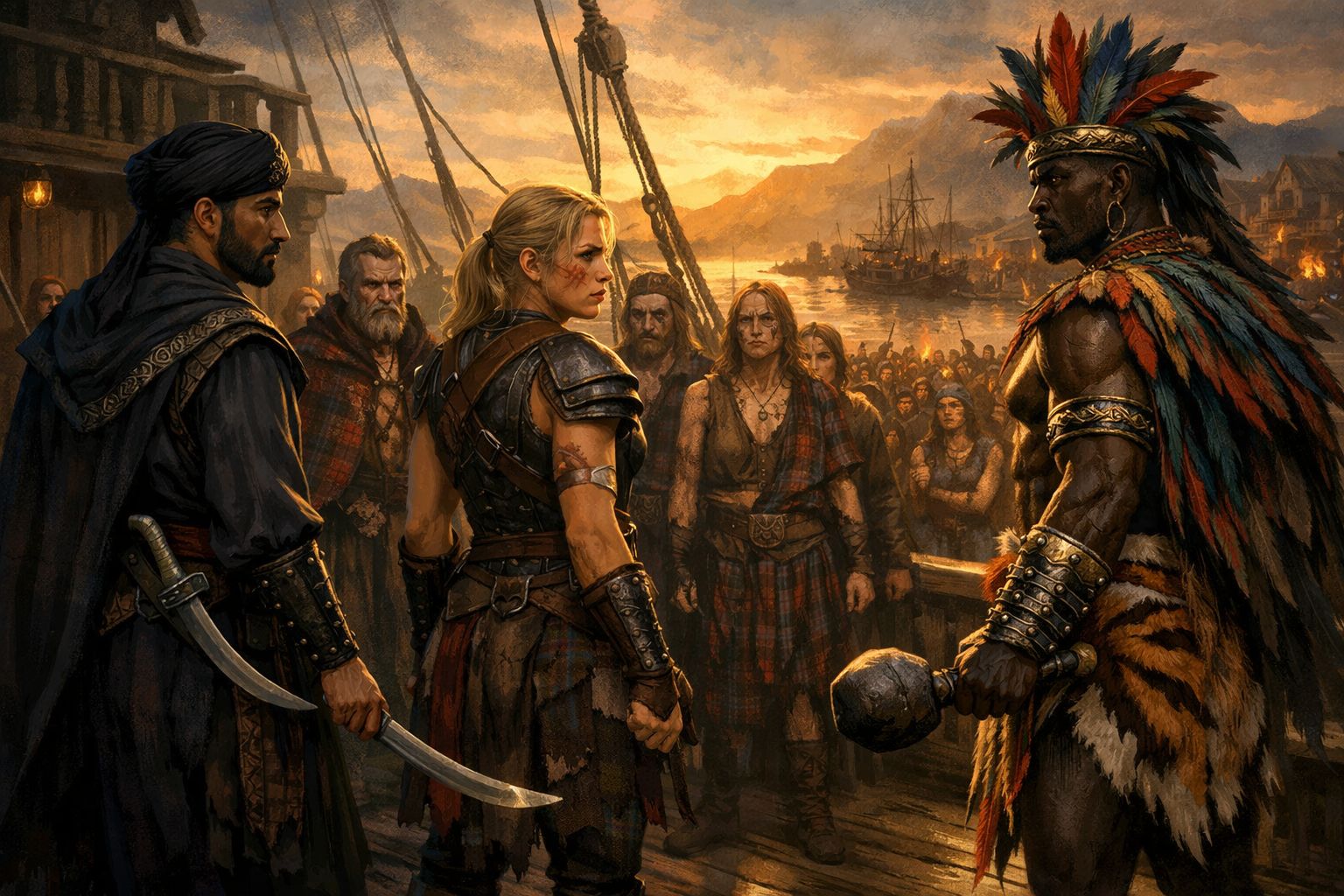
| Outnumbered and snarling, the Braigh retreated up the gangway, boots thudding hard on the wood. They turned there, backs to the river, eyes wild, blades now fully drawn. |
| No one followed. |
| The dock held its breath. Ardwych guards blocked the crowd. The Braigh stood tight together. The Blue Marlin gangway loomed between them like a line no one dared cross. |
| On deck, the crew closed in instinctively, forming a loose ring around the intruders, hands on hilts. No orders were given. No threats spoken. Just waiting. |
| The lead Braigh woman looked past the blades, straight at the captain. |
| “We need to talk,” she said. |
Purpose of the Scene
This scene exists to force alignment, not action. The tension is real, but the danger is not yet immediate. No one wants blood spilled here. What matters is who the crew listens to first, and who they are seen listening to.
This is the moment where the crew ceases to be neutral carriers of aid and becomes a political actor within Caerduin.
The Braigh Delegation
The Braigh group consists of half a dozen clansfolk, all travel worn and hungry. Give them names and faces to humanize them.
They are not here to fight. They are here because they are running out of options.
Riona mac Braigh
The lead speaker is Riona mac Braigh sharp tongued and proud despite her condition. She believes deeply in Brennos as a god of shared strength and open kinship, but still respects Morrinya when that is appropriate. Her anger is ideological as much as personal.
Cormac mac Braigh
Beside her is Cormac mac Braigh, older, quieter, with a limp earned in the Brannoc fighting. He watches reactions more than he speaks.
Talan mac Braigh
A younger man, Talan mac Braigh stands close, jaw tight, hand never far from his sword. He is angry enough to make mistakes, and Riona knows it.
Aedhan mac Braigh
A broad shouldered man in his early thirties, Aedhan mac Braigh, once a smith’s apprentice before the famine closed the forges. His hands are scarred and permanently blackened despite weeks on the road. He speaks little, but when he does it is blunt and practical.
Lirien mac Braigh
Lirien mac Braigh is a young woman with braided hair and a priest’s ash mark faintly visible on her brow. She is not a full druid, but serves as a speaker for rites and oaths when no elder is present. Lirien invokes Morrinya without shame, arguing that cunning and survival are not betrayal. She often acts as a bridge between Riona’s anger and Cormac’s caution.
Branoc mac Braigh
Thin to the point of gauntness, Branoc mac Braigh walks with a spear he uses more as a walking staff than a weapon. He is barely of fighting age and carries himself with brittle bravado. He idolizes Eira mac Braigh and knows every exaggerated story of her time aboard the Waverider. If her name is spoken, he is the first to react, and the loudest to defend the crew.
Tone and Pacing
Once the Braigh retreat up the gangway, slow everything down. Weapons are drawn, but no one advances. Guards hold the crowd back. The crew forms a loose ring, but no blows are exchanged.
Make it clear that time exists here. Shouting dies down. Breathing steadies. This is not a sudden ambush or a ticking clock. It is a pressure cooker, not an explosion.
Encourage table discussion. Let the players speak among themselves without interruption. NPCs should wait unless addressed.
The Core Choice
The choice is simple, but not clean.
Unload the supplies in Ardwych now, accepting local authority and immediate need.
Or cast off and take the supplies upriver to Braigh, accepting the risk of being seen as taking sides.
Make it explicit that neutrality is no longer possible. Doing nothing defaults to Ardwych, because the ship is already here.
Using the Waverider and Eira
If the crew mentions the Waverider or Eira mac Braigh by name, the Braigh reaction changes immediately.
Riona will recognize Eira at once. Her tone softens. Suspicion turns into urgency rather than accusation.
Cormac will confirm that Eira returned home briefly with the Waverider and is known and respected.
This information is a lever. The Braigh will use it if needed.
They will offer what they know. Eira’s family lives upriver. The Waverider continued north. The crew will be welcomed in Braigh if they come.
Do not volunteer this information immediately unless the players give them an opening. Let it emerge naturally through conversation.
Authority and Restraint
Maeven mac Ardwych does not intervene directly in this moment. Her guards maintain order, but she allows the confrontation to play out, under her close watch. This should read as deliberate restraint, not weakness. She represents the law, and has no intention to steal the supplies.
Ardwych does not need the food enough to make it worth a fight. Make this consideration clear, but let the players draw the conclusion.
She is watching what the crew does, and so is everyone else waiting in the harbor.
Ending the Scene
End the scene once the crew commits to a course of action, or clearly postpones the decision to speak further. Do not resolve consequences here.
This scene is about pressure, not payoff.
Consequences of the Choice
This section defines social consequences, not immediate plot outcomes. Nothing explodes. No one attacks the crew. What changes is how people look at them, speak to them, and what information they are willing to share.
Stress to the table through play that Caerduin remembers choices. Not loudly. Not cleanly. But persistently.
If the Crew Stays in Ardwych
Choosing to unload in Ardwych aligns the crew with stability and law, even if that law is strained.
The Braigh reaction is controlled resentment. Riona mac Braigh will not threaten them again, but she will be cold and distant. Cormac mac Braigh will acknowledge the choice with a nod and nothing more. Talan mac Braigh will have to be reined in by the others to keep his anger in check.
Braigh clansfolk will not interfere with the unloading. They understand that the Blue Marlin is not bound by Caerduin clan obligations. However, they will remember who was fed first.
In Ardwych, the crew is treated politely and professionally. Maeven mac Ardwych honors her word. Unloading proceeds under watch. There is no attempt to seize more than agreed. The town sees the crew as outsiders who respected local authority.
Although the docks are busy, the need does not feel immediate. The grain is not handed out on the quay. It is weighed, marked, and carried inland under guard to stone warehouses that are already partly stocked. Doors are locked. Tallies are updated. The people watching do not protest, but they do watch every sack disappear inside. Ardwych is not starving yet. It is preparing. That preparation is calm, deliberate, and unsettling. The town is choosing to endure longer rather than share sooner, and everyone present understands what that choice implies for those upriver.
Information dries up quickly.
No one in Ardwych knows anything meaningful about the Waverider beyond rumor. They can confirm that she unloaded supplies, continued upriver, and that she later passed back downriver weeks afterward, lighter than when she arrived. No names. No destinations. No stories worth chasing.
The crew will need to travel upriver anyway if they want to continue the trail. When they do, Braigh settlements will be suspicious and slow to trust, though not hostile.
If the Crew Sides with Braigh
Choosing to cast off and head upriver immediately creates noise, but little lasting damage in Ardwych.
The crowd on the docks boos and shouts as the ship departs. A few curses are thrown. A few fists shake in the air. Then people turn back to the work in front of them. Ardwych’s anger redirects itself quickly toward Braigh rather than the crew.
From Ardwych’s perspective, the Blue Marlin is still a trader. Traders follow opportunity. Maeven mac Ardwych does not pursue or retaliate. To do so would discourage much needed trade. She will remember the choice, but she will not frame it as betrayal.
Along the river, the tone shifts.
Braigh clansfolk treat the crew with open gratitude. Word travels ahead of the ship. Fires are lit on the banks. People gather despite hunger and exhaustion. The crew is spoken of as those who chose kin over caution.
During the journey upriver, Branoc mac Braigh attaches himself to the crew as a guide and eager storyteller. He shares exaggerated, affectionate stories of Eira mac Braigh, Ulfar, and Captain Solonex. These tales are unreliable but emotionally sincere, painting the Waverider crew as brave, strange, and deeply human.
This is the first time the Waverider’s presence in Caerduin feels personal rather than abstract.
What Does Not Happen
- Things do not escalate into open conflict.
- No guards pursue the ship.
- No clan attacks the docks.
- No authority declares the crew enemies.
Caerduin does not punish immediately. It watches.
The real consequences come later, in trust earned or withheld, and in who answers questions when the crew starts asking them.
End this section with motion. The river narrowing. The shore growing rougher. The sense that the crew has crossed from managed tension into lived scarcity.
Arrival in Braigh
| Story |
|---|
| They saw the ship before the crew saw the village. |
| Smoke rose first, thin and steady, then the clustered roofs of Braigh appeared along the riverbank, low and tight against the hills. By the time the Blue Marlin eased toward the docks, people were already gathering. Not running. Waiting. Word had traveled faster than hunger. |
| Caelin Durnach was the first to set foot on the planks. |
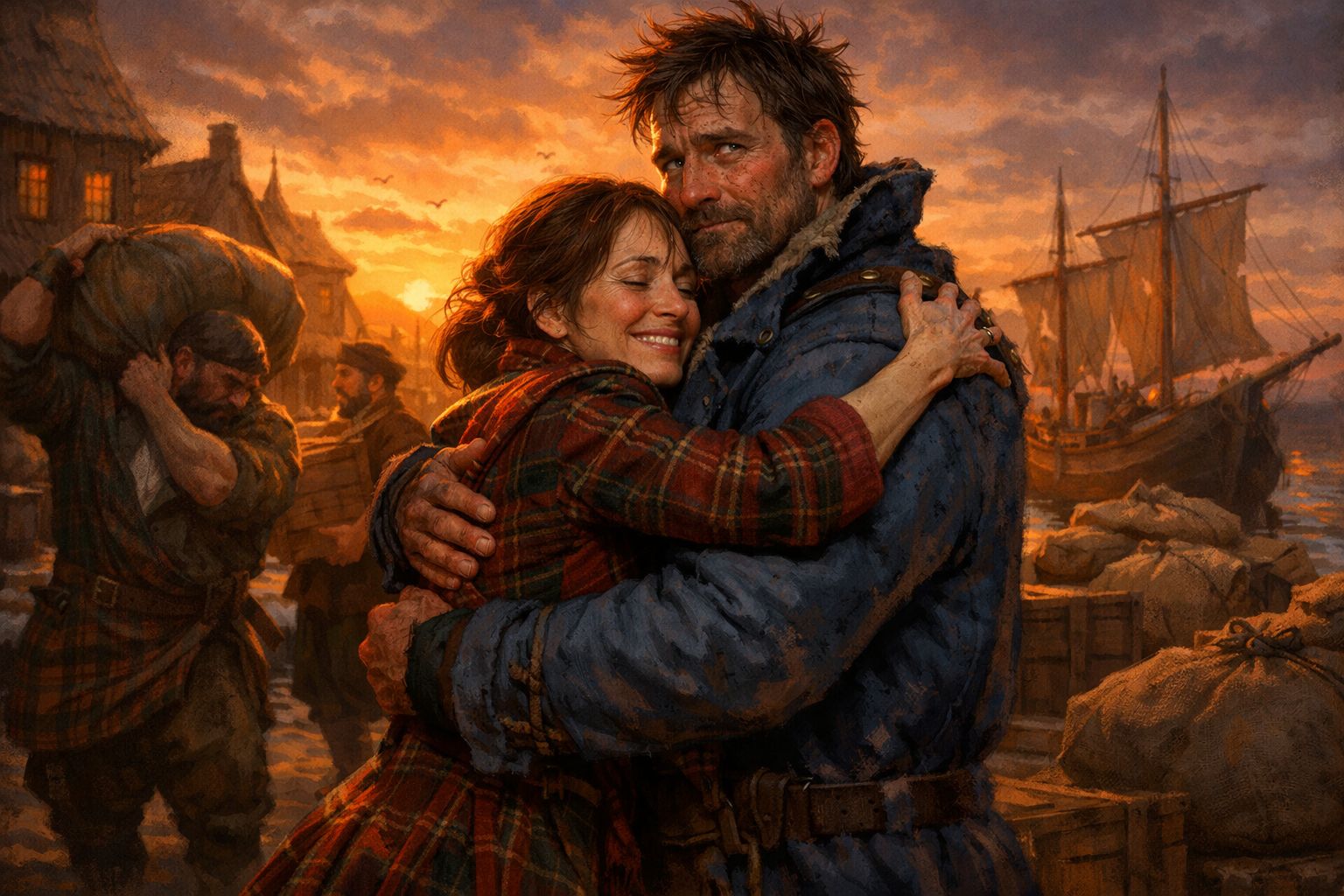
| She stopped short, breath catching, as if the river itself had struck her. This land had been in her bones once. The hills. The air. The way people watched ships not with wonder, but calculation. Hands closed around her forearms, rough and warm, holding her in place. |
| “Welcome home,” someone said, meaning it, even though they had never seen her before. |
| Another voice followed, broken with relief. “Brennos keep your strength.” |
| A third, softer. “Morrinya hide you from knives.” |
| Caelin nodded, jaw tight, unable to answer without risking the crack in her voice. She had run this river before, when it was dangerous but alive. Seeing it like this hurt in a way she had not prepared for. |
| Junia Favora came next, her gaze already moving. She saw the signs immediately. People standing too still. Belts pulled in tight. Skin clean but stretched thin over bone. Hunger, yes, but not collapse. Not yet. This was a place holding itself together by discipline and prayer rather than abundance. |
| Children clustered behind the adults, eyes fixed on the crates and barrels. One girl reached out and brushed her fingers along the wood, then pulled her hand back sharply, as if afraid the food might vanish under her touch. |
| Scarnax followed, solid and unmistakable, his presence filling the dock without effort. For a moment there was hesitation. Then someone stepped forward and took his wrist in both hands, bowing their head. |
| “Thank you,” the man said simply. |
| Another clasped Scarnax’s arm, voice rough. “You are a true friend.” |
| Scarnax inclined his head in return, expression unreadable, accepting gratitude he understood too well and never sought. |
| Blessings came thick and unfiltered. |
| “Brennos guard you.” |
| “Morrinya warms you.” |
| Some people laughed as they spoke, relief spilling out of them in sudden bursts. Others cried openly, pressing foreheads briefly to unfamiliar shoulders before pulling back, embarrassed and grateful all at once. Gratitude here was not polite. It was urgent. |
| When someone spoke the name Waverider, the mood shifted. |
| A pair of Braigh warriors straightened instantly, pride flaring bright enough to cut through the fatigue. One laughed loud and sharp and clapped Caelin on the back hard enough to stagger her. |
| “Eira mac Braigh,” he said, voice thick with pride. “One of our greatest.” |
| “On the greatest journey ever,” the other added, throwing his arms around Scarnax without hesitation. “We knew she would carry our name far.” |
| Stories erupted, overlapping and contradictory. Eira standing beside Captain Solonex like she had always belonged there. Eira laughing at storms. Eira coming home for a week and leaving again without looking back. The crew were pulled into it, claimed by association, woven into the tale whether they liked it or not. |
| The unloading began without a single shouted order. |
| Sacks were weighed. Barrels rolled into the open square. Names were called. Portions measured. Elders watched the scales with hawk eyes. No one pushed. No one took more than their share. Kinship mattered here, perhaps more than fullness. |
| For a brief moment, it almost felt like relief. |
| Then a voice cut across the square from the edge of the village, sharp and carrying, edged with desperation rather than bravado. |
| “We are allies! Share, or fight!” |
Purpose
This scene is about relief followed by unease. Let the players feel welcomed, valued, and briefly safe before that safety is challenged. Gratitude should be intense and personal, but not chaotic.
Running the Scene
Keep the tone warm but strained. People are kind, not relaxed. Let NPCs approach individually rather than as a crowd. Handshakes, embraces, blessings. Short conversations that trail off as people are pulled away to unloading and distribution.
Use this time to seed names, faces, and relationships. Elders overseeing the scales. Children watching the food. Warriors trading stories about Eira mac Braigh. Do not rush it.
There is time here. Roughly an hour. Enough for the crew to talk, ask questions, and get a sense of Braigh before the situation shifts.
A Trace of the Waverider
By asking around, they will eventually find out that Eira's family lives on a large farmstead, about halfway between Braigh and Cailoch, and that the Waverider crew stayed there for a week. They ought to know more.
Pacing Toward the Raid
Do not signal the raid too early. Let the sense of relief settle first. Only when the players have started to believe this is a pause should the challenge from Cailoch break it.
The arrival of the raiders should feel like an intrusion into something fragile, not a continuation of chaos.
The Raid from Cailoch
| Story |
|---|
| The challenge came from the edge of the village, where the river bent and the ground rose unevenly toward the scrub and stone beyond. |
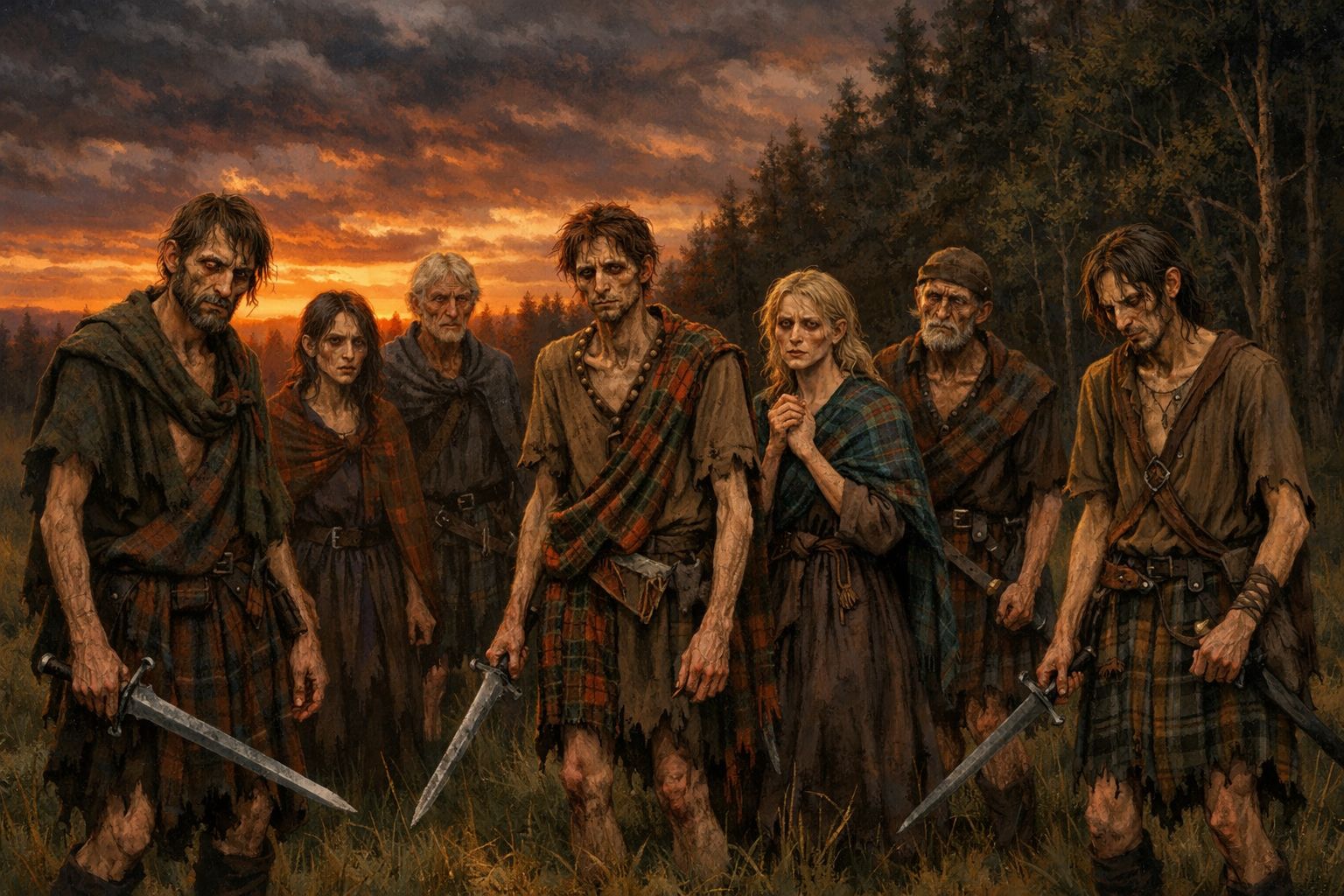
| A line of figures stood there, not charging, not hiding. Just standing. Too thin for armor to sit right. Spears held more like walking staffs than weapons. Clan Cailoch colors hung faded and patched across their shoulders. |
| Their leader stepped forward, a man named Fionn mac Cailoch, his hair bound back with a strip of cloth that had once been bright. His voice carried without shouting. |
| “Braigh,” he called. “We come as allies, not thieves.” |
| The square stirred. Hands tightened on spear shafts. Someone muttered a curse. Someone else crossed themselves and whispered Morrinya’s name. |
| Fionn spread his hands, palms out. “We bled together at Brannoc. We buried our dead side by side. Morrinya walked with us then, hiding us from blades and fire alike.” |
| He took a step closer, careful, deliberate. “Do not tell us now that her protection ends at your gates.” |
| Murmurs rippled through the crowd. Some angry. Some uncertain. |
| “You speak of kinship,” Fionn went on, his voice roughening. “Then show it. Show the unflinching kinship of Brennos. Share what has come. Not because we demand it, but because hunger does not care whose banner hangs above the door.” |
| Braigh warriors began to gather at the edges of the square, forming a loose line without being told. Riona mac Braigh stood among them, jaw set. Branoc’s knuckles were white around his spear. |
| The Braigh chieftain stepped forward, tall despite the hollowness in his frame. He looked over the Cailoch line and snorted. |
| “You look like a sorry army of stick men,” he called out. |
| A few Braigh laughed, sharp and brittle. |
| Fionn did not bristle. He nodded once. |
| “Don’t we all?” he replied. “That is exactly why it is an obligation to share equally.” |
| The laughter faltered. |
| Some in the crowd murmured assent. Quiet words passed between neighbors. Others shook their heads, voices rising in protest. |
| “Our children first.” |
| “We barely have enough as it is.” |
| “They chose to come armed.” |
| “They chose to ask.” |
| The air grew thick, heavy with breath held too long. No one advanced. No one lowered their weapons either. |
| Two starving clans stood facing one another, bound by memory, faith, and the knowledge that if this broke the wrong way, it would never truly mend. |
| The moment hung there, waiting to see who would speak next. |
Purpose of the Scene
This scene exists to mirror and escalate the earlier dockside accusation. Clan Braigh now stands where Ardwych stood before. Accused of hoarding. Accused of abandoning kin. Accused of choosing survival over obligation.
Make sure this parallel is felt. The words are different. The gods invoked are the same. Hunger has simply moved upriver.
Reading the Situation
Clan Cailoch is desperate, not reckless.
Their force is visibly smaller and weaker than Braigh’s. Too few bodies. Too thin. Too poorly armed. This is not an army expecting victory. It is a clan that has run out of time and is willing to risk humiliation or death because waiting guarantees starvation.
Fionn mac Cailoch knows they cannot win a straight fight. The challenge is ritualized bravado, a demand to be acknowledged, and a public appeal to shared values. Fighting is a last resort, not the goal.
Braigh knows this as well.
Braigh warriors gather because they must. Kinship demands presence. But their heart is not in killing starving allies. Their chief’s insult is posturing, not intent. If blades are drawn, it will be out of momentum rather than conviction.
Make the Accusation Hit
Be explicit through NPC reactions that the charge against Braigh is painfully familiar.
Braigh elders mutter that Ardwych said the same things.
Someone says, quietly, “This is what we accused them of.”
Let that land.
This is not hypocrisy as failure. It is the same impossible math repeating itself.
The Stakes Right Now
The need is immediate on both sides.
Cailoch will not last long without food. Neither will Braigh, and sharing weakens their position and risks future raids. No one here believes this solves the famine. It only delays the next crisis.
Emphasize that there is no long term solution present in this scene. Only damage control.
The Role of the Blue Marlin
The Blue Marlin holds the supplies. That matters.
Neither clan can force the crew’s hand without crossing a line that would shatter future trust. This makes the crew central to the outcome whether they want to be or not.
Braigh looks to the crew because they chose Braigh earlier. Cailoch looks to the crew because outsiders are the only ones who can break the deadlock without shaming either clan completely.
Make eye contact matter. Let silence fall until the crew speaks.
If the crew remains silent and does not intervene, the standoff breaks on its own. Tension tightens until a shove or shouted insult sparks movement, and blades are drawn almost by reflex. The fight is brief and uneven. Clan Cailoch is quickly overwhelmed, a few wounded on both sides before surrender is called. No massacre follows, but the damage is done. Cailoch leaves hungry, humiliated, and bitter. Braigh wins without satisfaction. The crew is remembered as having stood aside when kinship was tested, a choice that will be noted by both clans even if no one names it aloud.
Possible Paths Forward
There are two main outcomes. Neither is clean.
If a fight breaks out, it will be brief. Clan Cailoch is outnumbered and exhausted. Braigh will win quickly, and Cailoch will surrender once blood is spilled. The crew can still intervene during the clash, limiting violence or halting it early. A fight can still end in sharing if reason is argued fast enough.
If sharing is agreed to, it resolves the immediate crisis. Both clans eat. No one wins. Braigh accepts this because they know it is right, even though it creates new risks and future resentment.
In both cases, stress that this is not resolution. It is first aid, not a cure.
Reputation and Alignment
If the crew fully backs Braigh in a fight, Clan Cailoch will remember them as enemies. This does not mean immediate retaliation, but trust is gone.
If the crew argues for restraint, mediation, or sharing, Clan Cailoch will see them as allies who listened.
In either case, Braigh will continue to see the crew as friendly. Gratitude may cool or complicate, but trust remains.
Ending the Scene
End this interaction once a direction is chosen and enacted. Do not linger on aftermath yet.
This scene is about who the crew stands with when kinship is tested by hunger.
Imperial Sabotage Revealed
This section reframes the famine. What looked like clan failure and internal fracture is revealed as deliberate interference. The Empire is not merely benefiting from hunger. It is manufacturing it.
This is not meant to shock. It is meant to confirm suspicion and turn anger outward without relieving internal guilt. Caerduin is still complicit in its own suffering. The Empire is simply ensuring it never recovers.
How the Information Emerges
The information comes from Clan Cailoch.
If relations are good, it is given quietly as a warning. A Cailoch elder or Fionn mac Cailoch himself talks to the crew and Braigh, and speaks plainly. Fields burned at night. A granary nearly lost. Tracks that do not match clan boots. Fires that start too cleanly.
If relations are poor, it is shouted across the square as accusation and plea at once. “They burn our fields while you argue over sacks.” It is still true. The tone is the only difference.
Either way, the facts are limited. Crops destroyed. Cattle killed. Bridges weakened. No clear count. No certainty if this is one group or many. No one knows where they are now, only that they move and strike quickly.
Make it clear this knowledge is incomplete and frightening because of that.
Setting Up the Encounter
When the crew departs toward Eira mac Braigh’s family, roughly a day’s travel from Braigh, the land should show signs of interference. Charred fence posts. A burned field scraped bare. A bridge recently repaired too hastily.
This is where the Empire stops being abstract.
The commandos are nearby. Watching. Moving with purpose.
The Ambush or the Advantage
If the party includes a scout such as Shaedra or Ileena, or a seer such as Meyrha, they notice signs in time. Broken branches that do not match herd movement. Smoke masked poorly. A silence where birds should be.
In that case, the crew gets the drop. The commandos are caught off balance and the fight is brief and decisive.
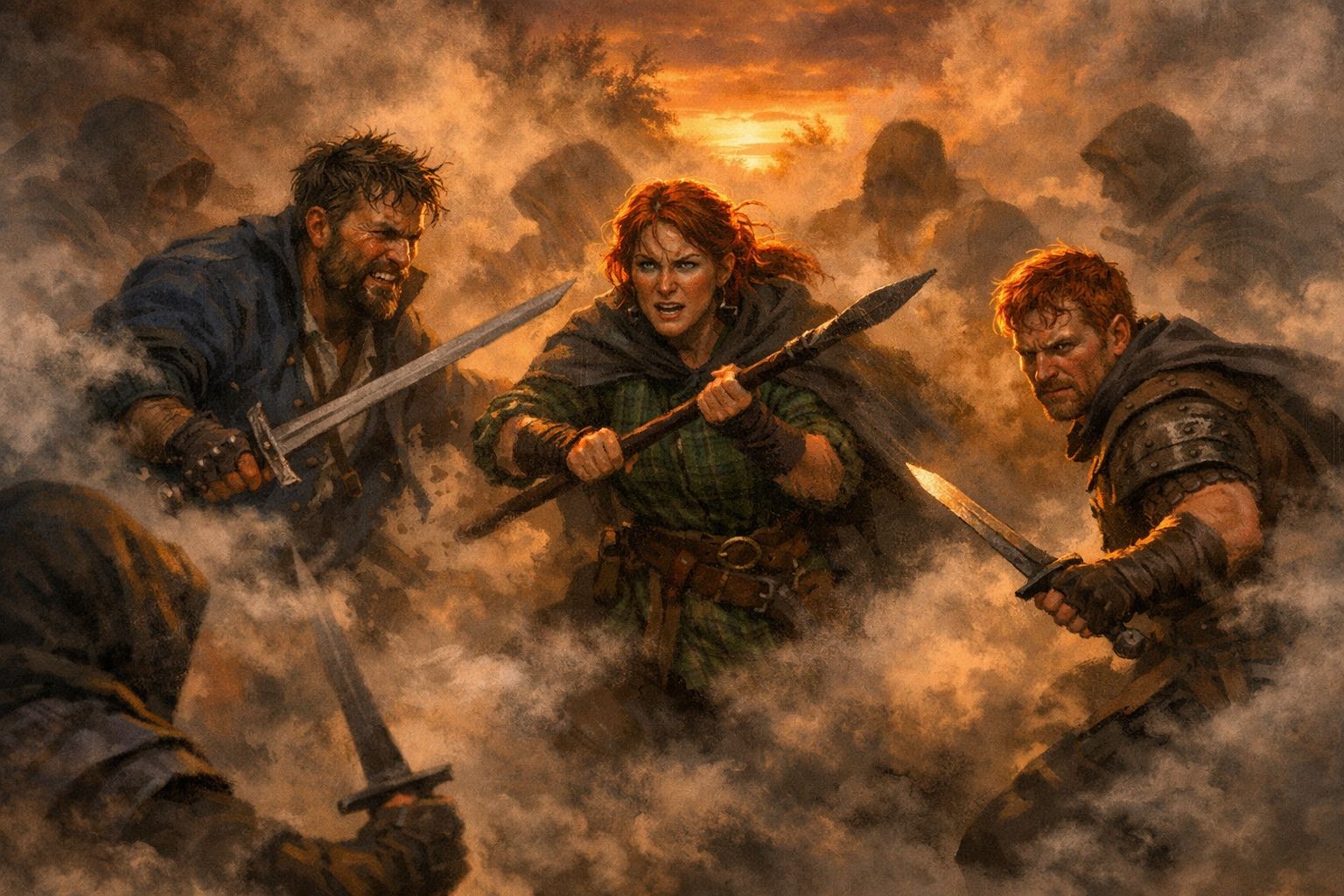
If the party lacks those advantages, the commandos ambush them. Arrows from concealment. Fire thrown to split the group and create concealing smoke. Shouted orders in practiced cadence.
This opening should feel confusing and dangerous. The commandos are professionals. They know how to strike first.
Even so, they have underestimated the crew. Once the players recover, the balance turns. The fight becomes winnable, but only after a moment of genuine pressure.
The Commandos
These are not legionnaires in formation and not shock troops. They wear light leather armor meant to move quietly and be discarded if needed. Their weapons are practical and portable. Bows for ambush and harassment. Short swords for quick kills and withdrawal. No shields. They carry little that marks them as imperial beyond discipline and habit. Their strength is not in standing ground but in choosing when and where violence happens. They avoid fair fights, rely on surprise, and disengage the moment control slips. They are here to burn, poison, and vanish, not to conquer ground. If forced into open combat, their confidence cracks quickly, because this is not the war they are trained to fight.
These are imperial professionals. Not fanatics. Not heroes. They are here to do a job.
When they realize they cannot win, they surrender. They do not fight to the last. They value survival over glory. This doesn't mean they surrender easily, thigh will put up a good fight before surrender.
If captured, they brag.
They boast about how many teams there are. About how wide the operation is. About how the fields will keep burning whether this team lives or dies. This is not interrogation information. It is intimidation and pride mixed together.
Let it be ugly and matter of fact.
Aftermath and Consequences
If the captured commandos are brought to Eira’s family or back to Braigh, they are taken into custody without ceremony. The intent is exchange.
If the Empire agrees to exchange prisoners, it becomes another quiet transaction in a dirty war. If the Empire refuses, the commandos are hanged as spies.
End this section with the understanding that what the crew has uncovered is not an isolated crime. It is policy.
Eira’s Family
| Story |
|---|
| The house stood a little apart from the river, low and broad shouldered, built to keep warmth in rather than to impress. Smoke curled lazily from the chimney, and light spilled through narrow windows as evening settled in. |
| They sat close around the table. Too close, really, knees brushing, elbows knocking now and then, but no one minded. The meal was simple. Bread torn by hand. Stew stretched thin but carefully seasoned. The last of the crew’s dried provisions folded in without comment. The wine was local and rough, poured generously from a clay jug that had seen better years. |
| Eira’s mother, Mairead mac Braigh, listened more than she spoke at first. Her hands stayed busy, refilling bowls, topping cups, touching shoulders in passing as if to reassure herself everyone was still there. Her father, Ronan mac Braigh, leaned back on his stool and laughed easily, the sound carrying a mixture of pride and worry he did not bother to hide. |
| “You always knew she wouldn’t stay,” Ronan said, lifting his cup toward Caelin. “From the time she could walk, she watched the horizon like it owed her something.” |
| Caelin smiled into her drink. “Ileena told me she talked about home more than she admitted,” she said. “Usually at night. Usually when she thought no one was listening.” |
| Mairead nodded, eyes soft. “That sounds like her.” |
| Scarnax spoke little, but when he did, it mattered. He told them about the way Eira saved Ulfar, about how she laughed after storms, about how she stood on deck like the world could not push her anywhere she did not choose to go. Ronan listened with fierce attention, committing every word to memory. |
| Amaxia added color where Scarnax was spare. Stories of narrow escapes. Of arguments shouted over wind and rain. Of Eira throwing herself into work when others hesitated, then pretending it had been nothing at all. Each story was met with laughter, then quiet, then another cup poured. |
| Ayesha filled in the spaces between. She spoke of the Waverider herself, of Captain Solonex’s habits, of Ulfar’s stubborn kindness, of how the crew became a family not by design but by necessity. She spoke carefully, knowing what mattered was not accuracy but truth. |
| “Eira always said the ship was honest,” Mairead said softly. “That you could not lie to the sea for long.” |
| The wine flowed more freely as the night deepened. Voices grew warmer. Laughter came quicker. Someone spilled a cup and no one cared. Ronan grew louder with each story, interrupting himself to add details that had nothing to do with the tale at hand. Mairead laughed at him and poured anyway. |
| By the end of the evening, cheeks were flushed and words slightly slurred. The worries of the river and the famine did not vanish, but they loosened their grip for a while. For a few hours, the world shrank to a table, shared food, and the comfort of knowing that wherever Eira mac Braigh was now, she had been remembered properly. |
| When they finally rose, unsteady and smiling, the fire burned low and the house felt fuller than it had in a long time. |
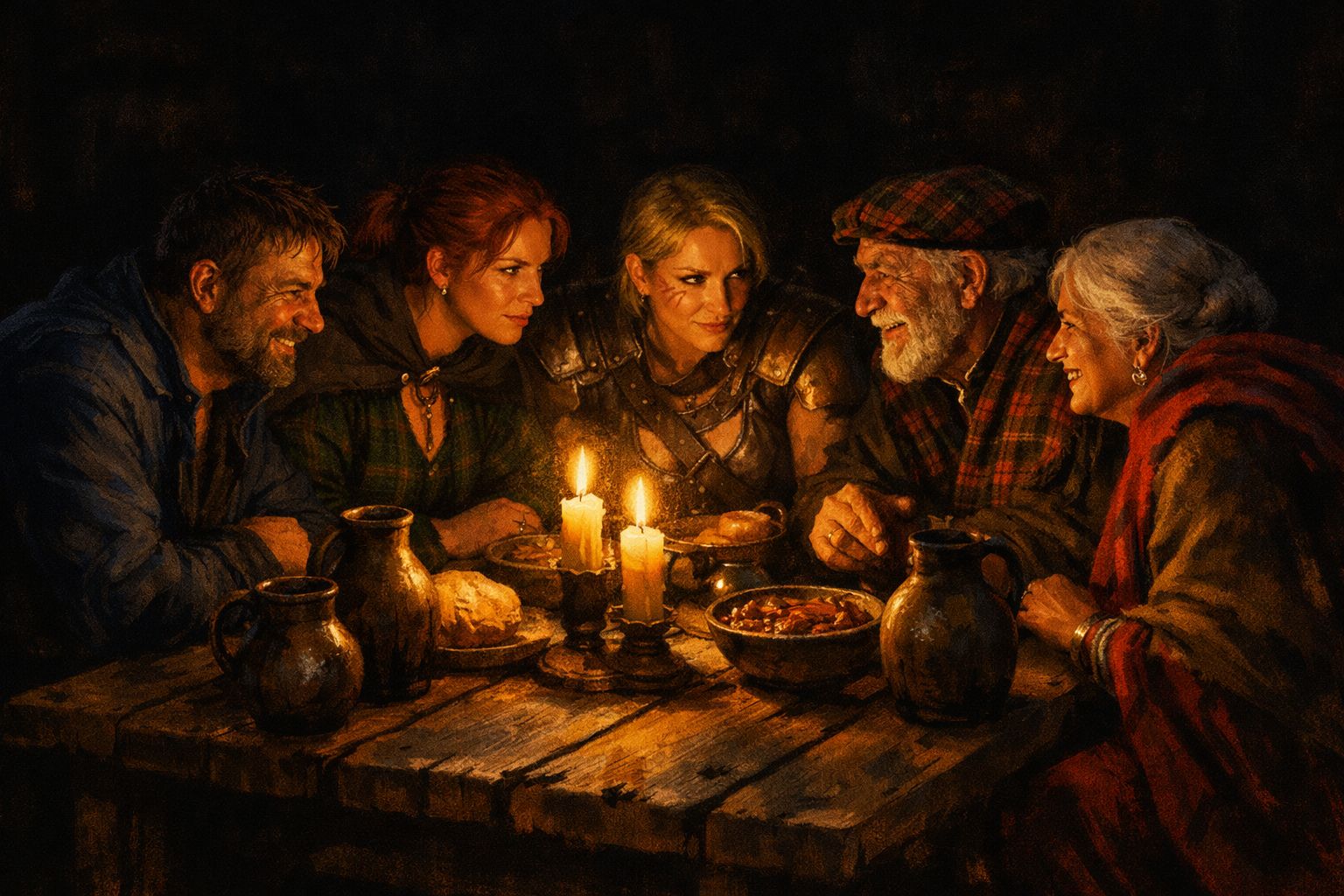
This scene is a pressure release and an anchor. After hunger, accusation, and violence, this is a moment of calm human connection. It exists to deepen emotional investment, not to create urgency. Let it breathe.
The goal is to turn the Waverider from a trail to follow into a group of people the players care about, and to let Caerduin speak in its own voice rather than through conflict.
Tone and Pacing
Play this slowly. Lower voices. Softer light. Let laughter come easily and pauses linger. This is one of the few places in the Caerduin arc where no one is posturing or demanding anything.
Encourage players to talk in character. This is a safe place to ask questions, reflect, and connect. Do not interrupt unless they ask for guidance or information.
Alcohol matters here. As the evening goes on and the wine flows, loosen tongues. Stories become warmer and less guarded. Small contradictions are fine. Memory is imperfect and affectionate.
Eira’s Family
Mairead mac Braigh and Ronan mac Braigh should feel generous despite scarcity. They offer what they have without hesitation. This reinforces how kinship works in Caerduin and why its betrayal hurts so deeply elsewhere.
They know Eira as a daughter and as a force of nature. Proud, stubborn, restless. They do not idolize her, but they miss her fiercely. Let their stories contrast gently with the larger than life rumors the crew has heard elsewhere.
Information About the Waverider
The family confirms destinations the crew already knows, reinforcing that the path they are on is the right one. They also provide the next destination, Albirica, clearly and without drama.
Encourage the Game Master to draw on previously established Waverider stories from places the crew has already visited or heard about. The implication should be that the crew is walking in the ship’s wake, arriving shortly after echoes have faded.
These stories should emphasize personality over plot. Arguments. Small kindnesses. Irritations. Who drank too much. Who stayed up too late. Who watched the horizon.
State of Caerduin and the War
This is the best place to talk about the larger picture without speeches.
Through conversation, the crew can learn about the famine as an imperial weapon. Blockades. Burned fields. Sabotage. How strength has been drained from the land not through defeat, but through exhaustion.
They also learn about High Chieftain Ciaran mac Braigh. His failed uprising. The hope it briefly brought. The cost it exacted. And that he is trying again, gathering men who are thinner, fewer, and more desperate than before.
Do not frame this as optimism. Frame it as inevitability. Caerduin resists because it must, not because it expects to win.
The Message for Eamon mac Braigh
Eamon mac Braigh is Eira’s older brother. He operates inside Albirica as a spy and saboteur under the alias Ivar Strongbow, posing as a Draknir trader. His work is quiet and logistical. Intelligence, disruption, and supply interference rather than open violence.
How the Request Is Made
The request comes late in the evening, after trust has settled. Mairead and Ronan mac Braigh explain without drama that they have not heard from Eamon in some time. If the crew is traveling toward Albirica or its trade routes, they ask if a message can be carried.
Not a letter. A phrase. Something harmless on the surface that Eamon will recognize.
What the Message Is
The message is deliberately mundane. A trade saying, a family reference, or a comment about roads or wine. Its meaning is not explained in detail. Only that Eamon will understand it and know the crew can be trusted.
What This Means
Accepting the message deepens the crew’s involvement in Caerduin’s hidden war and ties the Albirica arc to people they have met. Refusing is understood, but cools the warmth slightly.
What This Scene Should Not Do
Do not introduce new threats. Do not escalate tension. Do not force decisions.
This is not a planning meeting or a briefing. It is a family table, and information comes because people talk when they feel safe.
Closing the Scene
End the evening gently. Laughter softening into tired smiles. Words slurring slightly. Promises made without formality.
The next morning, the return trip to Braigh is uneventful. No ambushes. No omens. Just road, and time to think.
That quiet matters. It lets what was said settle before the next hard choice arrives.
Return to Braigh
| Story |
|---|
| The river carried them back to Braigh under a quieter sky. The village looked the same as they had left it, but the edge had dulled. People moved more easily. Voices carried without snapping. Whatever anger had been coiled there earlier had loosened, if only a little. |
| Word of their return spread quickly. |
| Hands were raised in greeting. Nods given with familiarity rather than caution. Someone called Caelin’s name from across the square, not as a test, but as recognition. She felt it settle in her chest, heavy and steady. This was the kind of welcome you did not earn quickly, and never lightly. |
| The Braigh chieftain, Darragh mac Braigh, was waiting near the longhouse. He was a broad man made thinner by the season, but his grip was still iron strong. He did not bother with formality. He stepped forward and pulled Caelin into a rough embrace, then did the same to Scarnax with a bark of laughter, slapping his back hard enough to rattle armor. |
| “You are golden to us,” Darragh said, his voice low and sincere. “Not coin gold. Blood gold. The kind that holds.” |
| He looked at each of them in turn. Amaxia. Ayesha. Scarnax again, meeting his eyes this time. “If you are ever in trouble, you call on Braigh. We remember our friends.” |
| Caelin nodded, swallowing. She knew what that promise meant here. How rarely it was given. How long it lasted. For a moment, she could not trust her voice. |
| Darragh’s tone softened then, not withdrawing the warmth, just tempering it. “But be careful where you say such things. The Empire has long ears. Ciaran mac Braigh is counted among their greatest enemies, and with him, all of us.” |
| He shrugged, almost apologetic. “That is the price of standing where we stand.” |
| Ayesha smiled and raised her cup. Scarnax inclined his head, solemn. Amaxia laughed and clapped Darragh on the shoulder as if they had known each other for years. |
| For a moment, standing there among them, it felt simple. Not easy. Not safe. But real. |
| Braigh had chosen them. |
| And that meant something that could not be taken back. |
This scene cements trust. It is the payoff for siding with Braigh and for treating the famine and clan conflict with care. The warmth here should feel earned, not automatic.
Running the Interaction
Play Darragh mac Braigh as open and sincere. This is not political flattery. This is a genuine promise of mutual aid. In Caerduin terms, being called “golden” is a serious bond, closer to kinship than alliance.
Let Caelin feel the weight of it. This is a promise she understands culturally and emotionally. Other crew members should feel welcomed, but Caelin should recognize the depth of what is being offered.
The warning about the Empire should be calm and practical, not fearful. It reinforces that Braigh lives with danger as a constant, not a crisis.
Aftermath and Departure
Do not escalate further here. Let the scene end on warmth and belonging.
From this point on, the crew’s departure from Caerduin is uneventful. No ambushes. No omens. No last minute complications. The land recedes behind them, and the weight of what they have seen is left to settle during the journey out.
That quiet exit matters. It marks the end of this part of the arc and prepares the table for what comes next.
Act Summary
This act establishes Caerduin as a land being hollowed out rather than conquered. Hunger, not defeat, is the primary weapon shaping every choice. Clan loyalty, religion, and pride still function, but they are strained, bent, and increasingly weaponized by desperation.
Caerduin is not collapsing loudly. It is being exhausted deliberately.
What the Players Experience
The crew enters Caerduin as bearers of aid and immediately learns that food is power. Every sack changes relationships. Every decision about distribution creates enemies and allies in equal measure.
They are forced into alignment early, choosing between local authority and upriver kinship, and learn that neutrality is often just another name for siding with the nearest stability.
Through Braigh and Cailoch, they see how hunger turns shared faith and shared history into accusations. The same gods are invoked on both sides. The same words are used. Only the targets change.
What the Players Learn About the World
The players learn that the famine is not accidental. It is engineered. The Empire is actively sabotaging Caerduin’s ability to feed itself through covert teams burning crops, killing livestock, and destabilizing infrastructure.
They also learn that Caerduin bears its own responsibility. Hoarding, suspicion, and fractured kinship deepen the damage. The Empire exploits weaknesses that already exist.
They gain a clearer picture of the wider war. Blockade, sabotage, exhaustion, and delay are more effective than open conquest.
Key Relationships Formed
Clan Braigh becomes a true ally. Trust is given openly and personally, not as a transaction. The crew earns a reputation that carries weight in Caerduin culture.
Clan Cailoch becomes a mirror. Depending on the crew’s actions, they are either allies or remembered enemies, but never caricatures. They may be enemies out of desperation, but never out of malice. Their desperation underscores that suffering here is shared.
Eira mac Braigh becomes real. Through family and rumor, she is no longer a name on a trail, but a person shaped by this land.
Eamon mac Braigh is introduced as a living thread into Albirica, tying Caerduin’s suffering directly to the Empire’s interior.
The Role of Religion
Religion in this act is not doctrine. It is language. Brennos and Morrinya are invoked to justify sharing and withholding, violence and restraint. Faith does not provide answers. It provides reasons.
This reinforces that belief in Caerduin is a tool for survival as much as a source of meaning.
The Mood Going Forward
The mood at the end of this act should be heavy, sober, and resolute.
There is warmth here. Friendship. Loyalty. But it exists under pressure, and everyone knows it can break.
The crew leaves Caerduin knowing that what they have seen is not the worst yet. Hunger will deepen. Resistance will harden. The Empire will continue working quietly.
They have a trail of the Waverider to follow, and they are following it through a war that is being fought by starving people, in the spaces between battles.