Waverider Story - Campaign - Author's Notes
Ashkar
They believe this is hell, and it's their duty to suffer.
| Story |
|---|
| "You ask how it began? You dare to speak his name without bleeding first? Fine. Listen. But know that truth is a thorn you swallow, not a tale you wear like silk." |
| It was the season when the air turned sour, when the rot spread faster than the healers could cut. Children died screaming. Men boiled in their skins. The trees dripped poison like the jungle was weeping for our sins. |
| We were a people without shape then. Without purpose. We drank, we rutted, we killed because it was easier than looking at the sky and seeing no stars. |
| But then... he came. |
| From the deep. Where light does not go and even spirits forget themselves. |
| He was no man. No beast. Just... pain made flesh. |
| Naked. Starved. Skin cracked like baked earth. But standing. Always standing. |
| His chest, understand me, it bore a wound like an eye, jagged and watching. But it didn't bleed. It wept. Thick and slow, like sap from a cursed tree. |
| He didn't speak for days. Just sat at the edge of the fire-ring, unmoving. Children threw stones at him. He didn't flinch. Women cried, he didn't blink. |
| And then, when the sun rose blood-colored, he opened his mouth... and bees came out. Black jungle bees, fat with venom. They stung the chief's sons until they howled for their mothers. |
| And then, only then, did he speak. |
| "This is not your home. |
| This is the pit. |
| You are not born. You are cast down." |
| "Your skin is your sin. And your suffering is the ladder." |
| He stood. Took a vine, one of the cursed ones, the ones with hooked thorns. Wrapped it around his throat like a necklace. Then picked up a coal and held it in his palm until the stink of his flesh made us gag. |
| No scream. No tear. Just this... peace. |
| And I, we, fell to our knees. We knew, in our marrow, what he was. Not a prophet. Not a man. A mirror. |
| He didn't stay. He walked into the jungle and never looked back. But we followed. Some say we died there. Maybe they're right. |
| But I'd rather be dead and clean than alive and asleep. |
| "Now... if you believe any of this matters, come with me. There's a path. It bleeds. But it leads somewhere." |
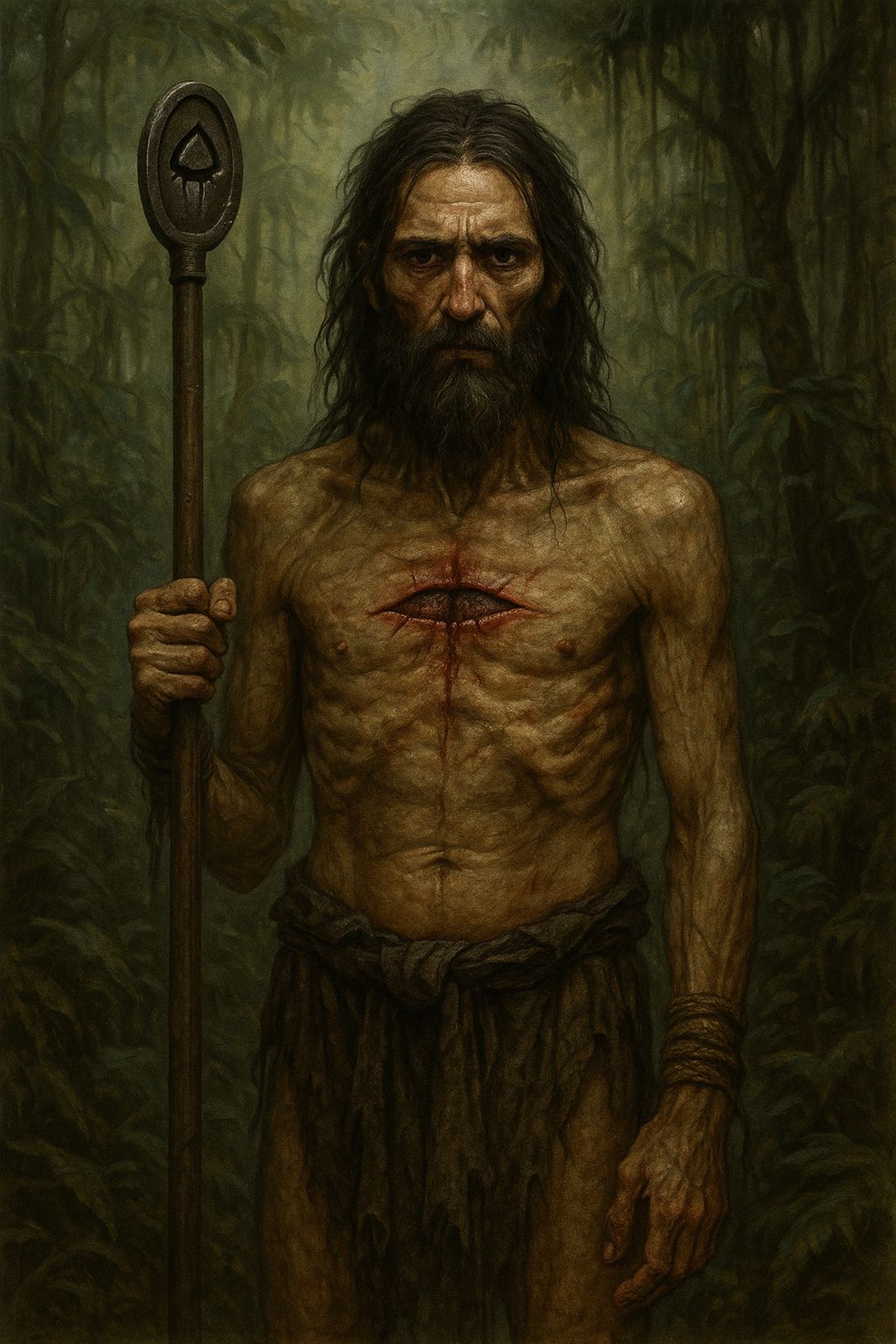
Description
In the choking green vastness of the Jharat Jungle lies Ashkar, a nation unlike any other. Its people live by a single, unshakable truth: this world is Naraka, the lowest of realms, a purgatorial hell for the wicked. Life is a sentence for sins committed in earlier lives. The Ashkari believe they are reincarnated sinners, murderers, betrayers, tyrants, whose former lives warranted punishment in this brutal, sweltering world. Redemption can only be earned through suffering, penance, and the denial of earthly pleasure.
Religion
The Ashkari don't have any gods as such, just a belief that sins are punished in the next life, and virtues rewarded. As such, they believe that they have a duty to suffer, in order to be reborn into a better life next time. The suffering can be both physical and mental. However ending one's life prematurely is considered the greatest of all sins, a attempt to cheat themselves out of their deserved.punishment.
Central to Ashkari belief is The Doctrine of the Fallen Soul, said to be revealed by the prophet-ascetic Ishamael the Penitent, who emerged naked and fasting from the jungle centuries ago. He taught that joy is a poison that binds the soul to Naraka. Only by embracing misery, pain, and humility can one escape the cycle and ascend to a purer realm in the next life.
Key Tenets:
- Suffering purifies. Pain, toil, and hardship are sacred acts of spiritual cleansing.
- Pleasure is a sin. Comfort, indulgence, and ease are seen as regressions, risking further punishment in the next life.
- The jungle is the crucible. Its venom, rot, and beasts are tools of divine justice, to be feared, but also respected and embraced.
Daily Life in Ashkar
Ashkari society is marked by ritualized suffering. Daily life includes acts of self-denial and controlled pain, fasting, flagellation, endurance walks through biting insects, and meditative exposure to heat, thorns, and leeches.
Children are taught early to resist comfort. Toys are forbidden. Discipline is constant, but always framed as compassion, an act of love that frees the soul.
Their architecture reflects their beliefs: houses are built without walls or roofs, exposing the people to rain and heat. Comfort is actively avoided.
They do not wear jewellery or similar adornments, except for a traditional ring, with a barb used to scratch and cause pain. Their clothes are rough and uncomfortable, and often stained by their blood. Brands or scarrification in the shape of an eye or a flame is common, symbolizing seeing the path of suffering.
Governance - The Hierarchy of Ash
The Dominion is loosely ruled by a caste of monk-judges known as the Sorrowbound, individuals revered for their endurance and piety. They wear robes of coarse vine-fiber, their skin often scarred with ritual burns and insect bites. They speak little, fast often, and deliver harsh justice, not out of cruelty, but divine obligation. For them, the ritual punishments are a forgiving of sins.
Beneath them are the Marked, those who have been ritually scarred to signify a public sin. They often perform the hardest and most agonizing labor - harvesting stinging vines, draining swamp-leeches, or clearing sacred fire-pits.
However, there is no ruler as such, they are all simply following the words of the religions leaders out of religious belief, the the leaders do not give advice outside of religion and penance.
Status is not sought, if anything it is avoided, as it is seen as pride, and a step away from he path of suffering. There is some acceptable status in having visible scars and performing feats of suffering, though.
Ashkar is one of the few countires which doesn't have slavery, as it goes against their idea of not making things pleasant for themselves. Likewise, they aren't of much interest to slavers, both due to their location and due to their typically very bad health.
The Outside World
Ashkar is a country placed out of reach for most other countries, outside the normal trade routes, and the only ones to have some limited trade with them are Ozukari and Mantaraaj. Outsiders are viewed as ignorant, and doomed to a worse next life, and while they don't proselytize, they will advise outsiders to adapt their way of life.
Possible Secrets
Ishamael Was Not the First
Fragments of stone hidden in the Stillhold archives speak of earlier prophets, now erased, who preached forgiveness and healing instead of suffering. Ishamael may have overthrown them.
Ishamael Never Left
The jungle cults claim that Ishamael did not die or transcend. He was imprisoned beneath Kesh Hollow by his own disciples when he tried to change the doctrine, whispering now through dreams, warning of what his teachings have become.
Suffering Feeds Something
Certain glyphs in ancient shrines suggest that pain, ritual, and blood sacrifice might empower something buried beneath the jungle, a god, a forgotten demon, or an entity that hungers for despair.
There is a Way Out, but it is Forbidden
Lost tablets from the Temple of the Hollow Flame speak of a ritual that releases the soul completely, skipping the cycle of rebirth. The Sorrowbound suppress it, fearing mass exodus and collapse of their power.
The Sorrowbound are Not All Believers
Some among the ruling monks know the truth, that the doctrine is useful for control. They live in secret luxury, their scars cosmetic, their penance performed.
The Thornpath is Rigged
Some "successful" Penitents are chosen in advance to ascend and given secret protections, rare herbs, hidden path clearings, to inspire belief and loyalty from the masses.
The Lanterns of Woe are Listening
The iron ember-cages placed outside homes may not be ritual symbols alone, some are enchanted soul-wards, designed to eavesdrop on dreams, confessions, or even thoughts. The Sorrowbound knows more than they admit.
Adventure Hooks
The Brand That Won't Heal
A foreign traveler received the Tearbrand symbol during a ritual and now it won't stop burning. The Sorrowbound say it's a sign of unconfessed sin, but the traveler insists they've done nothing wrong. They beg the players to find the truth, or remove the brand.
Path of Thorns Pilgrimage
A Penitent has asked the party to protect them on their walk through the jungle toward Thornmere, where they hope to complete the Thornpath ritual. The way is dangerous, beasts, poison plants, and zealots who believe the Penitent should not reach it.
The Censer Craze
A new style of Lantern of Woe is being sold across border towns, sleek, beautifully crafted, with glowing crystal embers that never die. But they're not blessed by the Sorrowbound, and locals are falling into strange waking trances. The players are asked to destroy or trace their origin.
The Festival of Shattered Masks
The Ashkari celebrate a night of identity-loss where all wear wooden masks, commit acts of mock-sin, and then burn their masks at dawn to symbolically release guilt. This year, someone doesn't remove their mask, and continues their ritual sinning after the fire.
Child of Thorns
A child born during a jungle storm carries the Thornpath spiral naturally on their skin. Locals call it a miracle, the Sorrowbound call it an omen. The players are caught between a town that wants to protect the child and the monks who want to take them away.
The Weight of the Marked
A caravan of Marked penitents is moving slowly through the jungle to a distant shrine. They are weak, sick and nearly dying, but refuse aid, seeing their suffering as sacred. A rival group wants the players to stop the march for "compassion's sake". Others want it protected at all costs.