Campaign: Mire of Vines
Act Synopsis
This act begins immediately after the crew leaves the Children of Nazhira behind and enters the Mire of Vines. The crew has helped the Children, but help has not become friendship. The Children remain hidden in the forest, and their last message still stands in the bow stem of the skiff: the water may carry the crew onward, but the banks are closed.
The Lutharil Approach
The Lutharil approach once the river broadens into the true Mire. They are cautious but not hostile. They know the crew helped the Children, that the Children chose warning instead of death and that the Blue Marlin is following the old trail of the Waverider. They can confirm that the Waverider came through the Mire and traded with them, but they will not give everything they know for nothing.
They have a problem that only land dwellers can solve.
The Sreli Colony
A group of Sreli have entered the Mire and begun founding a colony on a large island. The Sreli have cleared ground, raised banners, placed religious symbols and begun building a bridge between the two dry parts of the island. The Lutharil first tried to approach them. The Sreli killed those who came close. The Lutharil then spoke to the salt water merfolk, whom they call the big water family, and learned enough to understand what kind of enemy had arrived.
The Threat
The Sreli cannot be allowed to settle. If they establish a colony, the Lutharil will be hunted in their own water. The Children of Nazhira will be pressured from one side by Srel and from the other by the swamp colony. In time, the Sreli will push north into Itzalcoa and tighten their hold on the jungle.
The Lutharil cannot attack the camp directly. The Sreli island is too dry, too raised and too far from deep water in the places that matter. In water, the Lutharil are sudden death. On land, they are as helpless as a fish out of water.
The crew must remove the Sreli from the island.
The Tactical Problem
The act is a tactical sandbox. The crew can scout the island, question the Lutharil, study the Sreli and devise their own plan. A direct assault against the full camp is a bad idea. The Sreli outnumber them, trained and fanatical. However, the island offers many tactical possibilities: narrow channels, reed beds, half cleared jungle, cliffs, flooded roots, guarded boats, supplies, banners, religious symbols and the half finished bridge.
The key to victory is not simply understanding the terrain. The crew must understand the Sreli.
The Sreli Mindset
The Sreli are young warriors sent to prove themselves and spread their faith. They are not inexperienced in violence, but their experience comes mostly from lopsided raids against villages, captives and weaker enemies. They are confident, brave and dangerous. They are also volatile, competitive and deeply vulnerable to shame. They do not frighten easily, but they cannot ignore public humiliation.
They are trying to become worthy in the eyes of each other and their god.
The Act Sticks
Each Sreli warrior wears a necklace of act sticks. Each notch marks an act of devotion, which in practice means a killing offered to their god. A stick holds up to twelve notches. More sticks mean more visible devotion, though act count alone does not make a leader. Strength, confidence, personal status, family standing and the ability to dominate other men also matter.
False acts are blasphemy. A man who carves an unearned notch or replaces a stolen stick becomes an enemy to be killed, and killing him becomes a legitimate act.
Unstable Leadership
The current leader sits on a wobbly throne. He has enough acts, enough force and enough authority to command the colony group, but several rivals watch him closely. Every insult to the camp becomes a test of his leadership. Every cautious decision risks looking like weakness. Every reckless decision risks disaster.
The Lutharil As A Trap
The Lutharil are a trap the crew can aim. If the crew can bring the Sreli close enough to water, the Lutharil become sudden death. They strike like pike fish from the reeds: sudden, fast and nasty. A spear comes from beneath dark water. A wounded man vanishes. The ripples close. They do not fight formation battles and they do not hold ground.
They are not an army. They are the teeth in the water.
The Lutharil Reward
After the Sreli are dealt with, the Lutharil honor the crew with a small gathering in the shallow water. They give gifts, share memories of the Waverider and provide the next clue. They remember a woman from the Waverider, though some call her Venene rather than Venera. She said the ship was going to her home. She longed for it and feared it.
The crew can compare this with the Waverider manifest and identify her as Venera Sorn of Freevalor.
The Return Ambush
On the return journey to the Blue Marlin, the crew encounters another Sreli force returning to the colony with supplies. They are part of the original expedition, sent back to fetch what the first group needed once the camp site had been chosen. The fight turns dangerous. The Sreli have two boats, more bodies and the crew is tired.
Then darts begin striking from the jungle.
The Children Answer
The Children of Nazhira have watched. They waited until the crew truly needed help, then repaid the debt with exact violence. They kill the Sreli who matter most in the moment, then vanish without a word. When the crew tries to communicate or approach the bank, a single dart strikes the bow stem.
The message is clear.
The crew helped them. They helped the crew.
The forest is still closed.
Entering The Mire
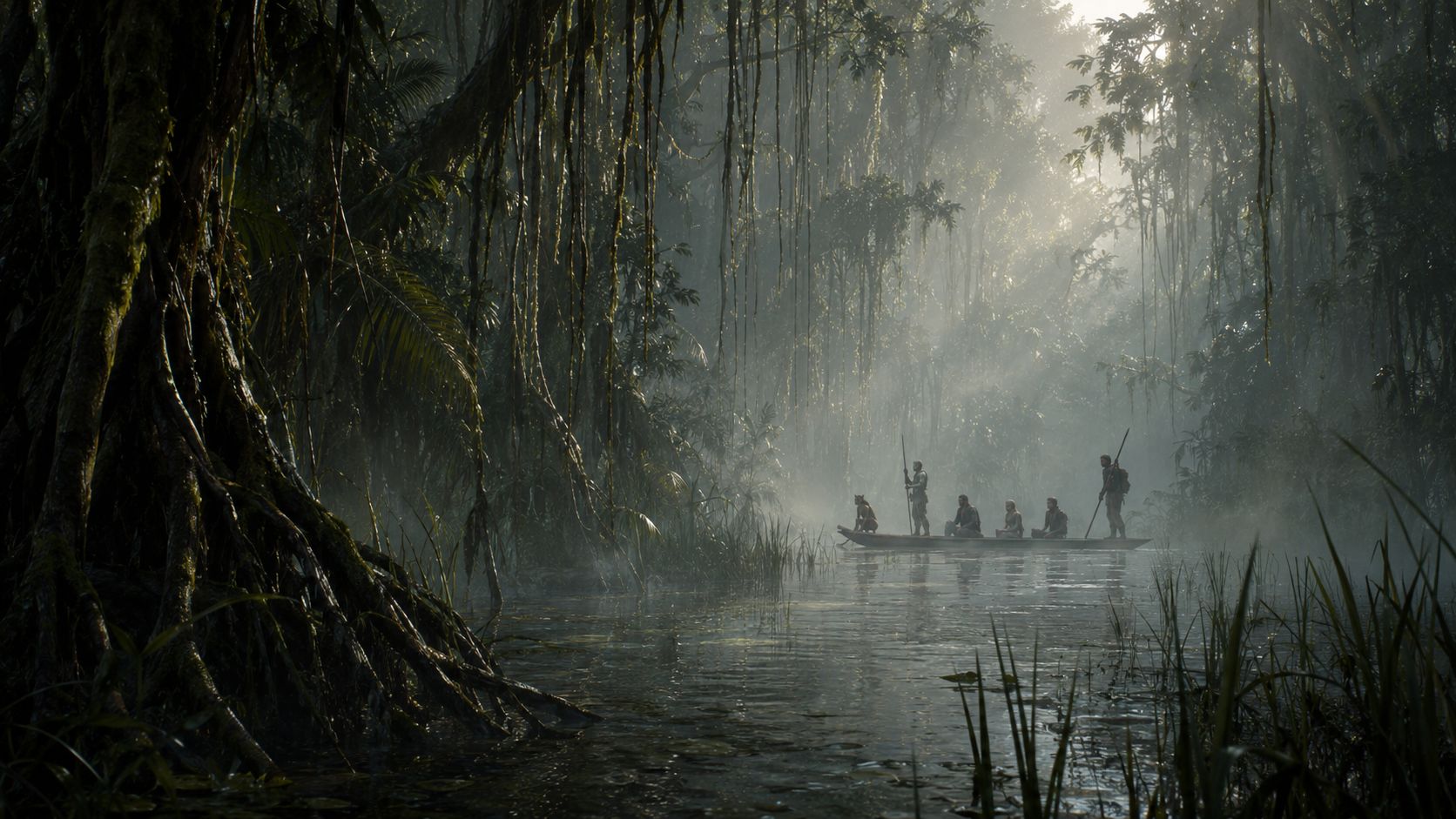
The river changes gradually.
The strong current of the Tarnixian slows. The banks lose meaning. What looked like shore becomes drowned root. What looked like open water becomes a dead end choked with vines. Branches hang so low that the crew must duck beneath them. Insects gather in clouds above the water. The air becomes wet enough to drink.
The jungle no longer stands beside the river. It enters it.
The skiff moves through dark water where roots rise like fingers from below. Pale flowers float in mats. Tiny frogs cling to the stems of reeds, their throats pulsing silently. Long vines trail down and vanish beneath the surface. Something large moves somewhere nearby, not close enough to see and not far enough to ignore.
The First Lutharil Approach
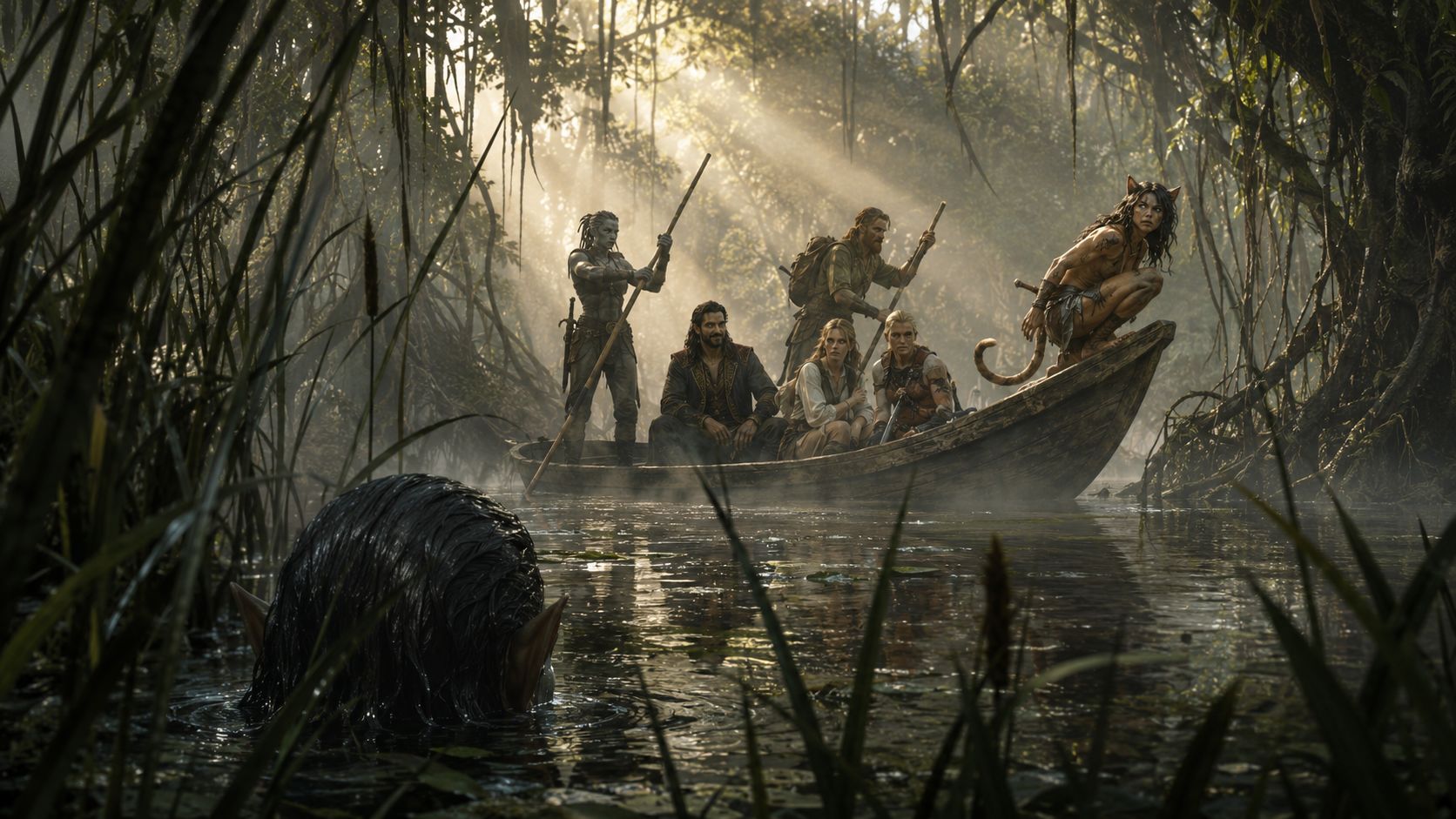
The first signs are beneath the water.
A pale shape follows below the surface, just behind the skiff. Then another. The shapes never come close enough to strike. They remain at the edge of visibility, where water turns green and black. When the crew stops rowing, the shapes stop. When the crew moves, they move.
If the crew calls out calmly and keeps weapons lowered, the Lutharil eventually rise beyond easy reach of spear or blade. If the crew behaves aggressively, the Lutharil keep their distance and answer only after the skiff has been surrounded from below.
The first speaker is Varith, an elder of the Selen Kalaren. His skin is pale green, his hair dark with woven strands of water weed and his shoulders marked with old scars from crocodile teeth. He speaks slowly, as if choosing words that will not sink.
Beside him is Mirael, younger and sharper, with luminous eyes that never stop moving. She has watched the crew since the river narrowed and knows more than she first admits.
Tharil stays mostly beneath the water. He is Mirael's brother and one of the kalaren's best hunters. He surfaces rarely, speaks little and watches weapons.
Varith knows the Children of Nazhira have warned the crew. He does not ask what happened. He says only that the Children said what they had to say.
If the crew asks whether the Lutharil are friends of the Children, Varith answers carefully.
"The little forest teeth are not friends. Not enemies. They bite those who forget where they swim."
The Lutharil have seen enough of the crew to consider speaking. They saw the skiff leave the forest alive. They know the Children could have killed them and did not. That does not make the crew trusted. It makes them interesting.
The Waverider Mention
If the crew explains that they are searching for the Waverider, the Lutharil recognize the name only vaguely. They do not care much for ship names. They remember faces, voices, trades and mistakes.
Mirael remembers "the people from the big boat." Varith remembers Serithil, the elf who traveled with them and sang the greeting song properly. Tharil remembers that the strangers paid before asking. Another Lutharil, Sirae, remembers a woman with a scarred face who watched the trees as if she expected them to accuse her. Breen remembers trading fermented rootweed brew for another strong drink, then trying both with a little man from the big boat. After that, he remembers very little.
The Lutharil can confirm that the Waverider came. They traded metal, glass and colored beads for fish oil, swamp amber and knowledge of the outer channels. The Waverider did not take. It gave and went.
That matters.
However, Varith does not not yet reveal where the Waverider went after leaving the Mire. He says the swamp has a wound, and they need land feet before they open old water memories.
The Bargain
The Lutharil do not frame the request as hiring the crew. Their thinking is more reciprocal. The Waverider gave before asking. The Blue Marlin helped the Children before asking. Now the Lutharil ask before giving.
They explain the problem in fragments, with different Lutharil adding pieces.
A group of dry killers has taken an island deeper in the Mire. They call themselves Sreli.
The Lutharil first tried to speak. The Sreli killed those who approached and left the mutilated bodies where the water could see them.
The salt water merfolk, the big water family beyond the river mouth, recognized the description and told the Lutharil about the Sreli.
The Sreli are building a place, not merely camping.
They have banners, religious signs, axes, tools and boats.
They are waiting for more of their people.
The Children of Nazhira were approached for help, but the Children do not come to talk. The Lutharil understand this. The Children defend their own shadows. They do not gather councils.
The Sreli island is too dry for the Lutharil to attack. The Sreli know the water is dangerous and avoid it when they can. If the Sreli can be brought to the channels, reed beds or flooded edges, the Lutharil can kill them.
Varith makes the trade clear.
"Give the swamp back its island. We will give you the memory of the old ship."
Named Lutharil
- Varith is the elder speaker of the Selen Kalaren. He is old enough to be cautious without being passive. He draws the first mud map and handles the bargain. He respects careful speech and dislikes being rushed.
- Mirael is a watcher and scout. She has seen the Sreli camp more often than anyone else who still lives. She can answer practical questions about patrols, boats, guards and routines. She is sharp, impatient and sometimes too direct.
- Tharil is Mirael's brother and a hunter. He speaks little, but he can guide the crew through channels and show where Lutharil can wait unseen. He thinks in ambushes rather than explanations.
- Sirae is a grieving mother whose daughter Lethai was killed when the Lutharil first approached the Sreli. She does not join the planning at first. After victory, she gives the crew a personal gift.
- Kaelen is a young Lutharil who wants revenge more than caution allows. He can become useful if handled well, but if the crew encourages him too much, he risks acting early and spoiling part of the plan.
Briefing
| Story |
|---|
| Varith drew the island with two fingers in the mud. |
| The map lasted five breaths before water seeped through it and blurred the southern edge. |
| Nasheem leaned closer. "Is that intentional?" |
| "The island changes," Varith said. "The mud is honest." |
| Mirael placed shells where the ground rose. "Near Back. Far Back. Dry enough for fools to believe in it." |
| Tharil crouched half in the water and laid fish bones through the mud, thin and white. "Channels. Deep enough for us. Too deep for them when frightened." |
| Amaxia studied the bones. "Can you strike here?" |
| "If they stand close," Tharil said. |
| Grishna watched the map vanish by inches. "Then we make them stand close." |
| Sirae pressed black seeds into the mud around the camp. "Guards. Boats. Banner." |
| At the word "banner," Ileena's ears lifted. |
| Nasheem smiled. "Ah. Something important enough to chase." |
| Varith looked up from the drowning map. "Do not fight them where they are strong. Make them angry. Make them proud. Make them hurry." |
| The last line of the island disappeared under brown water. |
| Gastved nodded once. "So the plan is to trust the mud." |
| "No," Grishna said. "The plan is to make the Sreli forget it." |
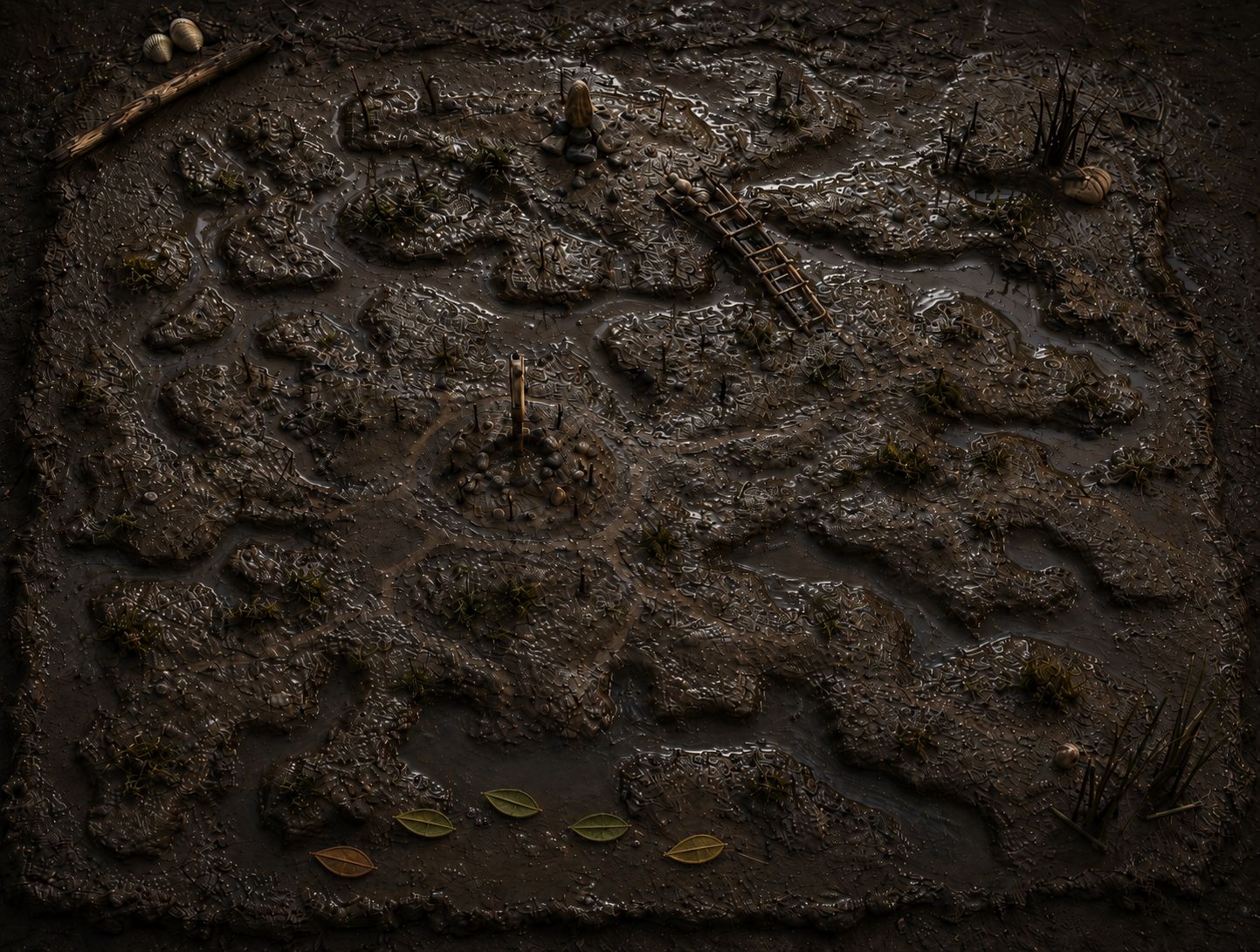
The briefing happens in shallow water, on a muddy bank beside a leaning tree.
Varith draws the island with his fingers, but the map keeps trying to disappear as water seeps through the mud. Mirael places shells to mark high ground. Tharil uses fish bones to mark channels where Lutharil can strike. Sirae places black seeds where Sreli have been seen guarding.
The map is crude, but useful.
It shows a large island with two raised dry areas. The Lutharil call them the Near Back and the Far Back, because to them they are the backs of something sleeping beneath the water.
The Near Back holds the main Sreli camp.
The Far Back holds cut timber, stored tools, a half cleared ritual place and the start of expansion.
Between them lies a narrow dark channel filled with roots, reeds and hidden depth. The Sreli have begun building a bridge across it, but the work has stopped because Lutharil attacks made the channel deadly. The bridge is half finished, unstable and watched.
The boats are not at the camp. They are kept in a narrow inland channel south of the Near Back, guarded day and night. The channel is deep enough for Lutharil attack, but the Sreli have cleared the banks, placed spear guards and keep the boats pulled partly onto mud shelves.
A low cliff rises on the northern side of the Near Back. It is not tall, but steep enough that climbing it quietly is difficult. From the top, a watcher can see much of the western water.
The eastern side is reed field and flooded grass, good for concealment but slow for land movement.
The southern side has the boat channel.
The western side is tangled jungle with fallen trees, roots, mud pockets and narrow dry paths. This is the best land approach, but it is also where the Sreli patrol most often.
The Island
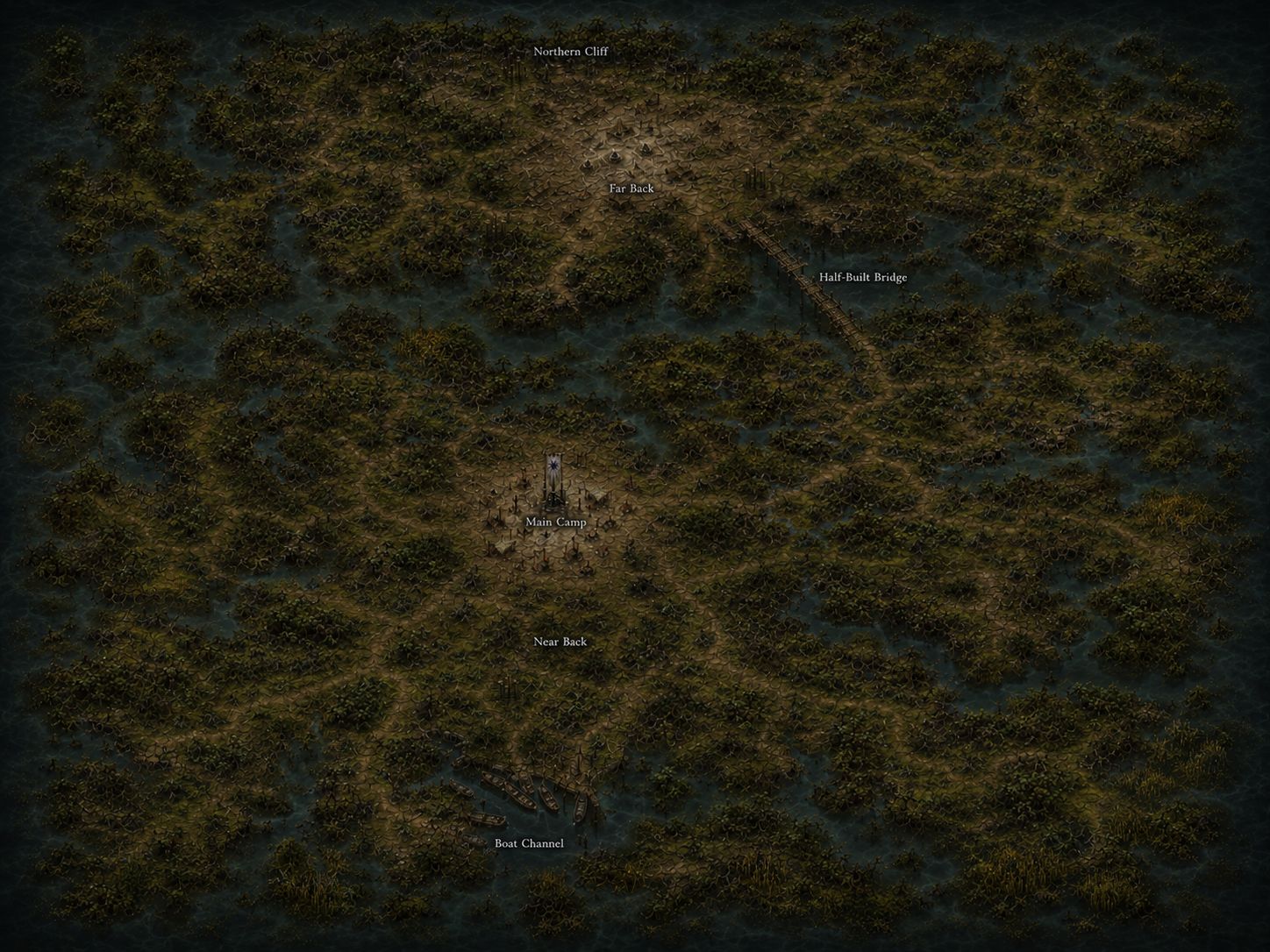
The island should feel like a place the swamp has not decided to release.
It is not clean land. It is raised mud, roots, old stone, thick grass and half drowned jungle. Water seeps through everything. Some places look dry until stepped on. Some pools are shallow enough to wade, then drop suddenly into black depth. Vines hang low. Reeds scrape against clothing. Mosquitoes gather wherever blood is drawn.
The Sreli have harmed the place just by trying to make it orderly.
Trees have been cut. Paths have been hacked open. Shrubs have been dragged aside and dumped into water. The main camp is not fortified, and that absence should be obvious. There is no palisade. No serious wall. No ditch. No attempt to hide. The Sreli have raised banners instead.
The message is simple. They believe they are the wall.
The Main Camp
The main camp sits on the highest part of the Near Back. It consists of open shelters, weapon racks, cooking pits, drying lines, a command shelter, a central banner and several religious symbols made from ash, bone, red cloth and carved wood.
The shelters are practical but arrogant. They are open to the air. Weapons hang in plain sight. Spears are planted upright. Shields lean where everyone can see them. Banners are raised high enough to be visible from the channels.
The central banner is white cloth with a blue sun, stained with ash and blood. Around it are smaller religious markers: carved symbols of the Ashen Dawn, bundles of burned reeds, bone charms and a low altar stone darkened by blood offerings. The altar is not a priest's altar. The fighters maintain it themselves.
The Sreli do not have a priest with them. This makes the camp worse, not better. Every man carries the faith. Every man judges the others. Every man believes he can recognize devotion and blasphemy.
The Far Back
The second raised part of the island shows the colony's future.
Timber has been cut and stacked. Posts have been stripped. Tools are stored beneath a stretched hide. A patch of ground has been cleared for another shrine or meeting place. The Sreli have begun marking the island not as camp territory, but as claimed land.
The bridge begins here and reaches partway over the channel toward the Near Back. It is made of lashed logs, cut planks and thick rope. It is wide enough for one or two men abreast. It is not finished. Several sections are unstable. The Lutharil have already attacked workers here, so the Sreli no longer work without guards.
This is one of the most important tactical locations in the arc.
The bridge shows that the Sreli recognize the danger, but do not accept it as a real barrier. To them, the water is an inconvenience. The bridge is paused while they wait for reinforcements, not abandoned.
The Boat Channel
The Sreli boats are kept in a narrow channel south of the main camp. They are small river craft, heavy canoes and flat bottomed supply boats. Some were brought by the Sreli, some crudely built on site.
The boats are guarded because the Sreli understand that without them, the colony group becomes trapped.
The channel is deep, dark and dangerous. The Lutharil can strike here, but not freely. The Sreli have cleared brush from the banks, placed watchers and tied rattling shells to low lines near and in the water. A careless Lutharil approach can be heard. A careful one can still kill.
Sabotaging the boats is possible, but difficult. It gives the Sreli a reason to move toward water, but it also alerts them that their retreat is threatened.
The Sreli
There are roughly thirty Sreli on the island. Adjust upward or downward depending on the active player crew and how many fighters are present. The important point is that an open fight against the full camp is not viable. The crew can fight parts of the force. They cannot simply storm the island and win by strength.
Most of the Sreli are young men, old enough to have fought and killed, young enough to believe every victory was proof of destiny. They have fought real fights, but those fights were mostly raids, massacres and punitive attacks against enemies who were surprised, outmatched or unarmed. They know blood. They do not know pressure.
They are trained. They know spears, blades, shields and group movement. They can form a line, guard a path and pursue with discipline when commanded. They are not rabble.
They are also not veterans of hard campaigns against equal enemies. When hit from an unseen angle, they become angry before they become careful. When mocked, they answer. When shamed, they must recover status. When isolated, they often escalate rather than withdraw.
Their courage is real. Their judgment is brittle.
The Act Sticks
Each Sreli wears a necklace of small sticks. Each stick can hold twelve notches. Each notch represents an act of devotion, which means a kill offered to the faith. The formal phrase is "act of devotion." In speech, they usually say "act."
The sticks are not rank. A man with many acts has status, but leadership also depends on strength, charisma, lineage, confidence, ruthlessness and the ability to dominate other men.
The sticks are a sacred record.
If a stick is stolen, the acts are not erased from history, but they are no longer carried before the god or before other men. The victim has been socially and spiritually wounded. He cannot simply carve a replacement. That would be cheating. Worse, it would be blasphemy.
Carving an unearned notch or replacing a stolen stick dishonestly makes the offender legitimate prey. Killing such a man is itself a valid act.
This is not merely a rule. It is an explosive pressure point.
The crew can discover the meaning through scouting.
- They may see Sreli touching their necklaces before prayer.
- They may see a young man mocked for having few acts.
- They may see a dispute where one warrior accuses another of exaggerating a kill. The camp becomes instantly cold. Hands move toward weapons. The accusation is withdrawn only after Kharvek intervenes.
- They may find a warning display near the camp edge, where snapped sticks hang from a branch beside old bloodstains. Lutharil cannot explain the exact meaning, but they know the Sreli treat the sticks with great seriousness.
If the crew understands the act sticks, they gain a powerful lever. Stealing a banner insults the colony. Stealing religious symbols insults the faith. Stealing a man's acts attacks his status, his devotion and his future at once.
Leadership
| Story |
|---|
| Ileena watched from a tree that smelled of rot, flowers and old rain. |
| Below her, the Sreli camp burned with little fires. Men moved between them with spears in hand, too loud for hunters, too restless for soldiers. Their white banner hung above the mud, the blue sun stained brown at the edges. |
| Kharvek stood beneath it. |
| He did not sit. Ileena liked that. Sitting made throats easy. |
| A younger Sreli stepped into the firelight. Mavrek. Ileena knew him by the way his hand kept touching the stick at his neck, as if counting made him taller. |
| "We wait again?" Mavrek said. "For fish ghosts? For shadows in reeds? The island is ours because we stand on it. We should burn the banks and drag the water until they come up dead." |
| Some of the others looked at Kharvek. |
| That was the real spear. Not the words. The looking. |
| Kharvek turned his head slowly. |
| "How many acts do you carry, Mavrek?" |
| Mavrek's mouth tightened. |
| "Enough." |
| Kharvek stepped closer. The fire put red light in the cuts across his arms. |
| "Enough for hunger. Not enough for counsel." |
| A few men shifted. No one laughed. Not yet. |
| Mavrek lifted his chin. "Caution is not devotion." |
| "No," Kharvek said. "Caution is how devotion lives long enough to become many acts." |
| He reached out, not touching Mavrek's necklace, only pointing at it. |
| "One stick nearly full. Nearly. You speak as if twelve notches make a prophet before the twelfth is cut." |
| Mavrek's face changed. Ileena saw it clearly from above. Anger first. Then shame. Then the worse thing, fear that others had seen the shame. |
| Kharvek let them see it. |
| "You want water?" he said. "Go alone. Step into the reeds and show us how brave a man can be while drowning. If you return, I will listen." |
| The camp went quiet. |
| Mavrek looked toward the dark channel. He did not move. |
| Kharvek turned away from him before Mavrek could answer. |
| "Watch the boats. Double the lines. No one goes near the reeds without three shields." |
| That was when Ileena understood. |
| Kharvek was not afraid of the water. He was afraid of being seen fearing it. |
| She slipped one claw into the bark and smiled. |
| Useful. |
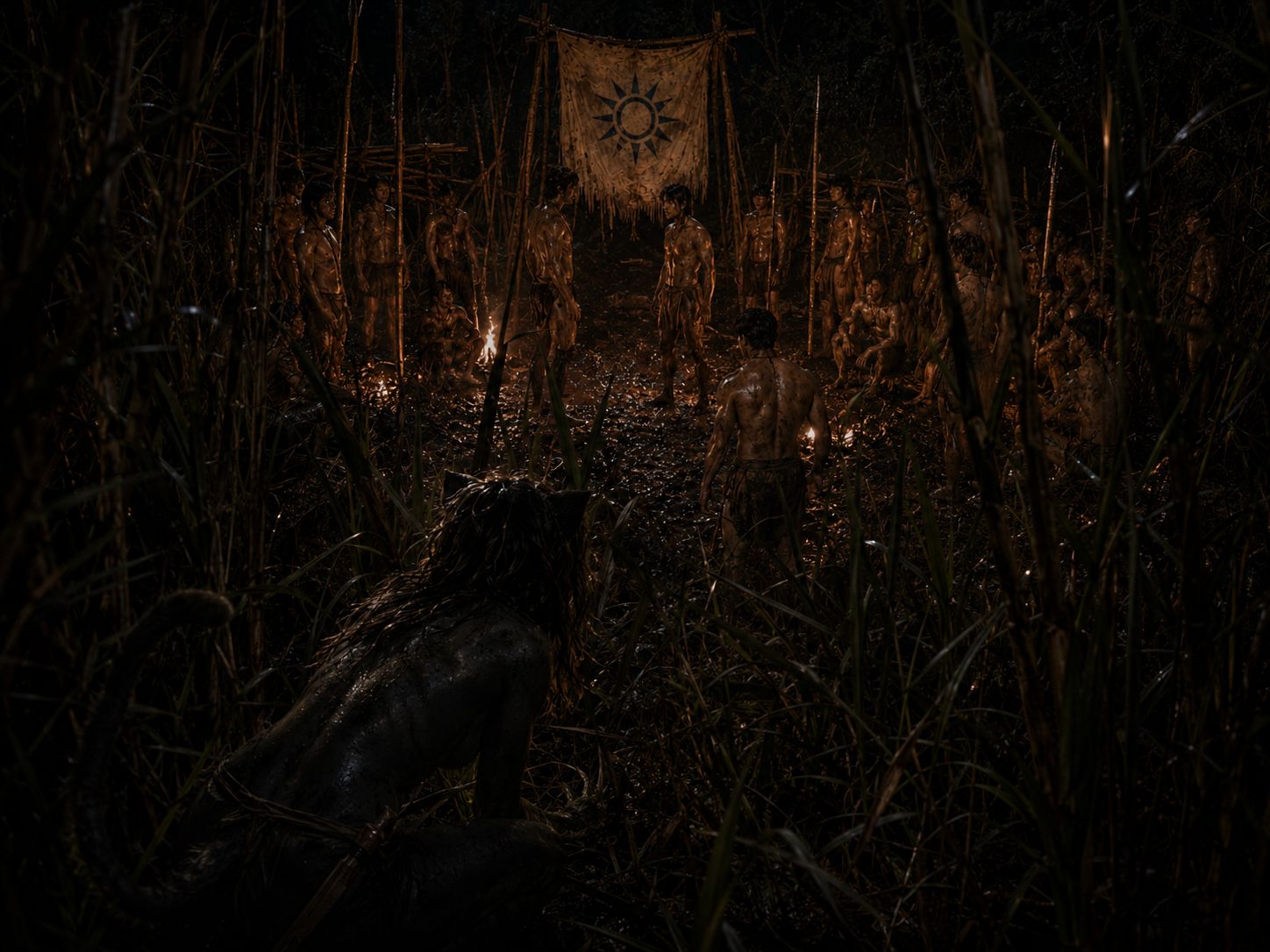
The current leader is Kharvek of the Ashen Hand. He is broad, intense and controlled by effort rather than nature. He has many acts, but not enough to make challenge unthinkable. His strength, voice and willingness to punish hesitation keep him in command.
Kharvek understands more than the others. He knows the water is dangerous. He knows the bridge cannot be finished without reinforcements. He knows the Lutharil are not animals. He does not say these things too clearly, because caution spoken too openly becomes weakness.
He sits on a wobbly throne.
His main rivals are three men.
Vorrak is physically stronger and more reckless. He has fewer acts than Kharvek, but more raw force. He thinks the camp has become too cautious and wants a violent answer to every Lutharil attack.
Sethran has more acts than most and speaks in religious terms whenever he undermines someone. He is not as strong as Kharvek or Vorrak, but he is clever, devout and dangerous because he can turn tactical caution into spiritual accusation.
Mavrek is younger, hungry and desperate to rise. His act necklace has one stick nearly full. He wants the last notch badly enough to make foolish choices if given a chance to seem brave.
None of them openly rebel. They do not need to. Every disagreement is a test. Every danger is watched. Every pause has witnesses.
Sreli Behavior
The Sreli do not scare easily. Fear is not the correct bait.
- They can be provoked by shame, insult, blasphemy, stolen status and public challenge. They are most vulnerable when the thing they need to recover is visible to others.
- They do not rush blindly into water. They know the water is dangerous. They avoid deep channels, reed beds and root shadows unless they believe the need is worth the risk.
- They respond strongly to threats against banners, religious markers and act sticks.
- They respond badly to mockery from enemies who seem weaker.
- They are tempted by wounded prey, especially if witnesses are present.
- They compete over dangerous tasks.
- They distrust caution when rivals are watching.
- They respect strength, but they confuse restraint with weakness.
- They are most dangerous when they remain together on dry ground.
- They are most vulnerable when they are split into recovery parties, patrols, bridge guards or boat guards.
Lutharil Capabilities
The Lutharil are deadly in water.
They move silently beneath reeds, roots and floating vegetation. They can hold position just below the surface. They strike upward or sideways with bone tipped spears, knives and snares. Their strongest attacks happen at the moment an enemy steps too close to water, crosses a weak bridge, wades through reeds or leans over a bank.
- They do not fight like soldiers.
- They strike, vanish and strike again. A spear enters from below. A leg is cut. A man is pulled under. A shield turns toward one ripple, and the next attack comes from the other side. They do not hold a line. They do not stand and trade blows.
- They can help the crew by marking safe routes, hiding in channels, cutting ropes from below, pulling enemies off balance, attacking boats, striking isolated targets and creating terror near water.
- They cannot attack the main camp.
- They cannot chase enemies across dry ground.
- They cannot rescue a crew member deep on the island unless the crew gets that person to water.
- They cannot make the Sreli move. The crew must do that.
Scouting The Island
This section should be open.
The crew can scout from water with Lutharil help, from the western jungle, from the low northern cliff or from the reed fields. Each route gives different information.
- From the water, they can study boats, channels and bridge guards. This is safer with Lutharil help, but the Sreli have placed simple alarms near the boat channel.
- From the western jungle, they can observe patrols, camp discipline and the main banner. This route is useful for understanding Sreli behavior.
- From the northern cliff, they can see the main camp layout, but climbing and moving quietly is difficult.
- From the reed fields, they can approach the Far Back and bridge area, but movement is slow and the risk of leaving signs is high.
The Game Master should give information based on observation, not lecture.
Show the act sticks. Show the competition. Show the unfinished bridge. Show the guarded boats. Show the banners. Show the absence of a wall. Show young men trying to act like legends in a place that is eating their confidence one bite at a time.
What The Crew Can Learn
- They can learn that the camp has around thirty Sreli.
- They can learn that the main camp is open and arrogant, not fortified.
- They can learn that the Sreli avoid certain water edges.
- They can learn that the bridge work stopped after attacks.
- They can learn that the boats are guarded in a narrow channel.
- They can learn that the central banner and religious symbols matter.
- They can learn that act sticks are sacred and tied to status.
- They can learn that Kharvek leads, but his authority is watched by rivals.
- They can learn that Mavrek is reckless and hungry for status.
- They can learn that Vorrak pushes for bold action.
- They can learn that Sethran uses religious shame as a weapon.
- They can learn that the Sreli are waiting for reinforcements.
- They can learn that the Sreli expect to bring more people once the island is secure.
- They can learn that the long term plan is expansion: first the Mire, then pressure on the Children of Nazhira, then north toward Itzalcoa.
Running the Scenario
How To Help The Players Without Solving It
If the players miss the importance of shame, use observed behavior.
- A young Sreli hesitates near a reed bed after hearing movement. Another laughs at him. The first becomes furious, steps closer than he should and throws a spear into the reeds.
- A guard returns from the bridge early and is mocked for letting fish frighten him.
- Two Sreli argue over whether a kill counted as an act. The argument becomes dangerous instantly.
- Kharvek orders caution near the water, but Sethran phrases the need for action as devotion. Kharvek's jaw tightens because he cannot simply ignore the challenge.
- If the players miss the act sticks, let them see one handled.
- A young warrior kneels before the ash marker, touches each notch and whispers a phrase over it. Another watches, counting silently.
- If the players miss the bridge's importance, let Mirael say that the Sreli curse the channel every morning. They have crossed deserts, rivers and jungle, but the little strip of black water stopped them.
- If the players miss the Lutharil role, Tharil can demonstrate by killing a large swamp fish from below. One moment the water is still. The next, the spear strikes, the fish thrashes and vanishes beneath the reeds.
Possible Player Plans
Do not present these as solutions to the players. They are Game Master preparation.
- The crew may try to steal a banner or religious symbol and draw a recovery party toward the bridge or reed field. This is likely to work if the insult is visible enough.
- The crew may try to steal act sticks from a sleeping Sreli, patrol victim or isolated guard. This creates a personal crisis, especially if the stolen acts belong to Mavrek, Sethran or Kharvek.
- The crew may attack the boat guards and damage the boats. This threatens Sreli retreat and brings more fighters toward the channel.
- The crew may sabotage the bridge, then provoke the Sreli into trying to cross or defend it.
- The crew may fake Children of Nazhira involvement. This can unsettle the Sreli, but fear alone will not drive them into the trap. It works best as pressure combined with shame.
- The crew may isolate patrols and reduce numbers before provoking the camp. This is effective, but if done too openly, Kharvek tightens discipline.
- The crew may launch a direct night raid. It can work if limited to a specific target. It should fail badly if treated as an attempt to wipe the camp in one strike.
- The crew may attempt parley. The Sreli attack or try to seize them. This is not a talking enemy in this moment.
What Success Looks Like
The crew does not need to kill every Sreli on the island. Success means breaking the colony.
If the boats are destroyed, the bridge is ruined, the banner is taken, several leaders are dead or humiliated and enough Sreli are killed in water that the survivors cannot hold the camp, the colony collapses. The remaining Sreli flee, surrender to panic or retreat into the Mire where the Lutharil hunt them down over the following days.
The Lutharil do not need the crew to win a battle for them. They need the crew to make the island stop being dry ground ruled by Sreli confidence.
The Battle
| Story |
|---|
| The first Sreli died without shouting. |
| Gastved's snare took his ankle and snapped him sideways into the mud. Before he could rise, Amaxia drove her spear down once, clean and hard. |
| The second turned to attack. |
| Ileena dropped from the branch above him. |
| The rest of the patrol froze for one heartbeat too long. |
| Nasheem stepped into view on the dry path, curved sword loose in his hand. |
| "Good evening," he said. |
| The Sreli answered with spears. |
| Grishna threw a severed act stick into the mud between them. |
| That stopped them better than a wall. |
| One of the Sreli stared at it, then at the blood on Grishna's hand. |
| "You took that?" |
| "No," Grishna said. "I found it on a man who no longer needed to count." |
| The patrol charged. |
| Nasheem turned and ran. |
| Not far. Just far enough. |
| Amaxia fell back beside him, making the retreat look too fast, too clumsy, too frightened. Ileena flashed once between trees, limping on purpose, blood from someone else painted down her thigh. |
| Behind them, the Sreli came hard through the hacked path, angry now, status burning hotter than caution. They saw backs. They saw blood. They saw the stolen act sticks swinging from Grishna's belt. |
| They did not see the mud darken ahead. |
| Nasheem reached the fallen log first and vaulted it. |
| Amaxia followed. |
| Grishna stopped on the far side, turned and smiled without warmth. |
| The lead Sreli leapt after her. |
| His foot punched through grass into water. |
| For one instant he stood waist deep, confused. |
| Then the reeds opened. |
| A pale hand caught his throat from below. A bone spear slid upward beneath his ribs. He vanished so quickly that his shout became bubbles. |
| The others tried to stop. |
| Too late. |
| The whole edge of the path came alive. Water broke under them. Spears rose. Knives flashed between roots. One Sreli swung wildly at a ripple, then screamed as something took his leg. Another raised his shield toward Amaxia and never saw the shape behind him. He vanished beneath the water. The bubbles stopped a moment later. |
| The patrol broke apart. |
| That killed them faster. |
| Nasheem watched one man stagger back toward dry ground. Gastved's second snare caught him under the knee and dropped him into the flooded grass. The water took him before he could scream twice. |
| Then there were no Sreli left standing. |
| Only ripples. |
| Only reeds bending back into place. |
| Only Ileena, crouched on the log, licking blood from her wrist with thoughtful disappointment. |
| "Fast," she said. |
| Amaxia looked at the water. |
| "Good." |
| Nasheem adjusted his sleeve as if the retreat had been entirely dignified. |
| "I believe we were convincing." |

The battle should not have a fixed sequence. It should unfold from the players' plan.
Use these principles:
- The Sreli do not abandon the main camp for nothing.
- The Sreli do not walk into deep water blindly.
- The Sreli respond quickly to shame.
- Rivals make the leader's choices harder.
- Small Sreli groups can be beaten.
- The full Sreli force on dry ground is too much.
- The Lutharil kill well near water, but only if the crew creates opportunity.
If the players create a good plan, reward it. Let the trap work. Let the Lutharil be terrifying. Let the Sreli make the wrong choice for reasons that are emotionally and culturally right.
If the players create a weak plan, do not save them immediately. The Sreli are dangerous. They push hard, regroup and punish mistakes. The Lutharil can create openings, but not miracles.
If the players improvise halfway through, follow the logic of terrain and pride.
The best version of the fight has several phases, though the order can change.
- First, the crew creates insult or pressure.
- Second, the Sreli send a party to answer.
- Third, the crew draws that party toward water.
- Fourth, the Lutharil strike.
- Fifth, the camp reacts and the leader must choose whether to escalate.
- Sixth, the crew uses the reaction to divide the Sreli further.
- Seventh, the fight reaches a collapse point at the bridge, boat channel or reed field.
The Lutharil Strike
When the Lutharil attack, make the imagery consistent.
- No battle cries.
- No heroic charges.
- No visible line.
- A ripple.
- A spear.
- A scream cut short.
- A body dragged beneath reeds.
- A shield spinning empty on the water.
- A hand breaking the surface once, then gone.
- A Sreli stabbing wildly into water where nothing remains.
The Lutharil should feel like the swamp has grown teeth.
Possible Climactic Locations
The bridge is the cleanest climax. The Sreli try to recover a stolen symbol, defend the expansion route or chase the crew across it. The bridge becomes crowded, unstable and surrounded by Lutharil. A plank breaks. A Sreli falls through. The water answers.
The boat channel is a harsher climax. The Sreli rush to protect or launch boats, but the cleared banks do not protect them once the crew disrupts the guards. Lutharil cut mooring ropes, drag men from mud shelves and strike at anyone trying to push boats free.
The reed field is a stealthier climax. The crew uses grass, water channels and false movement to split the Sreli. This works well for players who prefer ambush and misdirection.
The main camp should rarely be the climax unless the players have already shattered Sreli cohesion. Fighting there is dangerous, but after the leader falls, rivals split or the act sticks are defiled, the camp can become chaos.
The Collapse Point
The battle ends when the Sreli no longer believe the island can be held.
This does not require every Sreli to die. The collapse can happen when Kharvek falls, the boats are destroyed, the bridge breaks, too many act sticks are lost, a rival turns on another rival or the surviving Sreli realize every path back to safety touches water.
Once that point arrives, stop treating the Sreli as a unified force. Some flee. Some try to reach boats. Some make doomed stands around banners or religious markers. Some turn on one another, accusing rivals of cowardice or blasphemy.
This is where the Lutharil become most terrifying, because fleeing Sreli stop thinking like soldiers and start moving like prey.
Kharvek's End
Kharvek does not need to die in a prescribed way. He should fall if the plan creates the right moment.
If he survives too long, he can attempt to gather a disciplined retreat toward the boats. That gives the crew a final chance to stop the colony from escaping intact.
Do not make Kharvek a fool. He is arrogant, but not stupid. He should realize the trap eventually. The problem is that realization comes after pride, rivals and damage have already narrowed his choices.
Rival Reactions
Vorrak pushes for violence. If baited, he leads or demands a recovery party. He is useful as the first major Sreli to overcommit.
Sethran frames hesitation as spiritual weakness. If religious symbols or act sticks are taken, he makes caution almost impossible. He can be the voice that forces Kharvek's hand.
Mavrek is the easiest to bait. If his act sticks are stolen, he becomes reckless. If someone mocks his unfinished count, he pursues beyond sense.
These rivals allow the Game Master to make Sreli reactions dynamic. The camp does not move as one perfect machine. It moves as a violent faith community full of ambitious young men watching each other for weakness.
If The Crew Fails
Failure should not necessarily end the campaign. It should change the cost. Do not forget that the Sreli are on an island and cannot defeat the Lutharil in the water, so failure can turn the conflict into a long siege, with the Lutharil and the crew carefully taking them apart one by one.
If the crew withdraws after doing little damage, the Lutharil become colder. They may still give a partial Waverider memory if the crew took real risk, but not full trust and not the deeper memory they are holding back.
If the crew kills some Sreli but leaves the boats and camp intact, the colony survives. The Sreli become more cautious, fortify the dry ground, wait for reinforcements and force the Lutharil out of nearby channels..
If the crew attacks directly and loses, capture is possible but should be used carefully. The Sreli may intend to turn prisoners into acts or use them as proof before reinforcements arrive. This becomes an escape scenario, but it changes the tone sharply.
If a Lutharil dies because of a reckless plan, the aftermath should matter. The Lutharil do not rage openly. They grow quiet. That is worse.
If The Crew Succeeds
Success means the colony group is broken.
The Sreli leader and most fighters are dead, scattered or dragged into the water. The boats are destroyed, captured or rendered unusable. The banners are torn down. Religious symbols are broken or sunk. The bridge remains half finished, now hanging over the dark channel like a failed boast.
The Lutharil do not cheer at once. They surface slowly. They count their own. They look at the island. Some touch the water where dead kin were thrown days earlier.
Then the mood changes. The swamp has its island back.
The Celebration
| Story |
|---|
| The Lutharil celebration begins quietly. |
| No drums sound. No one shouts victory across the water. The Lutharil surface one by one around the broken island, pale faces appearing between reeds, roots and drifting flowers. Some carry spears. Some carry wounded kin. Some carry nothing at all. |
| The Sreli banners are gone. The half-built bridge hangs broken over the dark channel. Pieces of boat drift among the reeds. The white cloth with the blue sun lies in the mud, where swamp water slowly drinks the ash and blood from it. |
| Varith rises near the skiff, water running from his dark hair and old crocodile scars. |
| "The island breathes again," he says. |
| Nasheem stands carefully in the skiff, trying not to look too pleased with the victory. |
| Grishna notices. |
| "Do not grin." |
| "I am not grinning." |
| "You are showing teeth." |
| Ileena crouches near the bow, taking bites from a Sreli heart while she sniffs the air. "Swamp smells happier." |
| Amaxia looks toward the ruined bridge. "It smells like blood." |
| "Yes," Ileena says. "Happier." |
| Junia gives her a tired look, then turns back to binding a cut along Gastved's arm. Gastved watches the water with the calm focus of a tracker who still expects danger to move. |
| Mirael surfaces beside Varith. Her sharp eyes move across the crew, judging them again. This time, the judgment is different. |
| "You brought land feet," she says. "You made the dry killers touch water." |
| Tharil appears behind her, only his head and spear above the surface. |
| "The water answered." |
| The Lutharil dip beneath the surface. For a moment, the channel is empty. |
| Then pale lights begin moving below, green and blue and silver, like stars under dark water. The Lutharil rise carrying reed bowls filled with swamp pearls, beetle shells, pale flowers and curls of amber taken from drowned roots. |
| They place the bowls in the shallows before the island. |
| Sirae speaks softly. |
| "For those the dry killers left where water could see." |
| Other voices answer from the reeds. |
| "For those who sank." |
| "For those who did not come home." |
| "For those whose names are still held." |
| The water goes still. |
| Only then does the celebration begin. |
| The Lutharil do not dance on land. They move in the water. Bodies slip beneath the surface, circle, rise and vanish. Spears strike the river in rhythm. Tails flash pale below the green. Their song is low and layered, like currents crossing in the dark. |
| It is not exactly joyful. It carries grief first, then anger, then relief. |
| When the song fades, Varith lifts one hand. |
| Mirael dives. |
| For a while, she is gone. |
| Then she returns with a small wrapped bundle of reed and fish skin. She carries it carefully, with both hands. |
| The Lutharil nearby grow still. |
| Mirael rests the bundle across the edge of the skiff. |
| "This belonged to Kelaen," she says. |
| Varith looks toward the broken island. |
| "He was the first to swim close when the dry killers came. He thought they were lost. He thought words could turn them back." |
| Tharil's jaw tightens. |
| "They killed him before he finished speaking." |
| No one in the skiff answers at once. |
| Junia lowers her eyes. Gastved looks toward the water where the first bodies must have been left. Ileena's ears flatten. Amaxia's expression hardens, not in anger this time, but respect. |
| Mirael unwraps the bundle. |
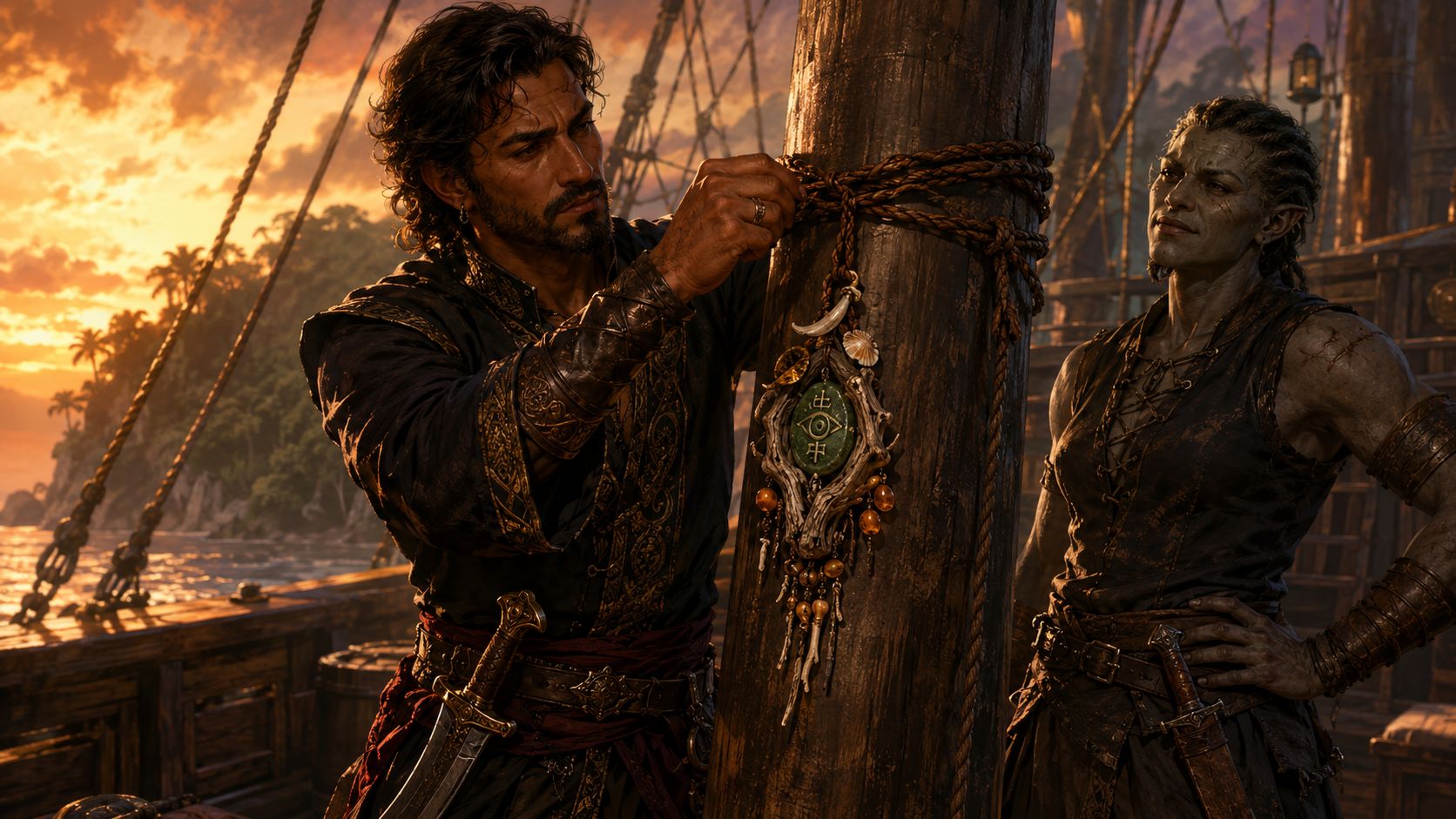
| Inside is a small hanging charm made from carved root, pale shell, swamp amber and braided water weed. Tiny bones and seed pods hang from it on thin cords. At the center is a smooth green stone etched with a simple shape: a small float surrounded by watching eyes. |
| The charm is worn smooth in places, handled often. |
| Varith touches it with two fingers. |
| "Kelaen tied this to his reed float when he crossed dark water," he says. "He said a float should know it is being watched kindly." |
| Mirael looks at the crew. |
| "He had land dreams. He liked those who came from beyond the water. He thought the world was larger than fear." |
| Her voice tightens. |
| "He was wrong about the Sreli." |
| Then she pushes the charm toward Nasheem. |
| "But not wrong about everyone." |
| Nasheem takes it carefully. |
| For once, he does not answer at once. |
| He bows his head, and there is no performance in it. Grishna watches the charm as if she understands the weight of something carried after death. Junia wipes mud from her fingers before touching one of the shell beads. |
| Ileena leans closer and looks closely. |
| "It remembers him," she says. |
| Mirael studies her, then nods once. |
| "Yes." |
| Varith's voice lowers. |
| "Tie it where your boat can watch the water. Let it watch over your passage. Let it see places Kelaen did not reach." |
| Nasheem closes his hand around the charm. |
| "We will carry it well." |
| Mirael's eyes sharpen again, but not cruelly. |
| "Do more than carry it. Come back from where you go." |
| Then Varith's expression grows serious. |
| "Now," he says, "we open the old water memory." |

The Lutharil celebration takes place at dusk in shallow water near floating platforms and root shelves. It is not a land feast. The crew sits on low platforms, fallen logs, the skiff or raised roots while the Lutharil gather around them in the water.
Bioluminescent fungi glow on floating bark. Reed lamps drift in bowls. Fish, river crab, swamp fruit and bitter fermented drink are shared. The songs remain low, layered and restrained.
The Lutharil are grateful, but they do not become loud friends. They simply let the crew sit close enough to be honored.
The Gift
The gift is not payment. The payment is the old water memory of the Waverider. The gift is a personal sign of trust.
After the first songs, Mirael brings a wrapped charm made from carved root, pale shell, swamp amber, braided water weed, tiny bones and seed pods. At the center is a smooth green stone etched with a small reed float surrounded by watching eyes.
The charm belonged to Kelaen, one of the first Lutharil killed by the Sreli. He used to tie it to his reed float when crossing dangerous water.
Mirael gives it to a crew member who carried the emotional center of the battle. If no one stands out, she gives it to who she considers the leader.
Varith tells them to tie it where their boat can see water, let it watch over their passage and let it see places Kelaen did not reach.
Mirael adds that they should do more than carry it. They should come back from where they go.
Do not overexplain the gift. Let it land quietly.
Waverider Memories
After the gifts, the Lutharil begin sharing memories.
No single Lutharil knows everything. The Waverider made an impression, and fragments come from several voices.
- Varith remembers Serithil the elf guide singing correctly and waiting without impatience.
- Mirael remembers a small mirror traded by the Waverider, "light that does not die."
- Tharil remembers that the Waverider had no nets ready, no hooks hidden and no fire.
- Breen remembers a man who made jokes because silence frightened him. This was probably Severin or Gato, though the Lutharil do not know which.
The important parts, however, are:
- Sirae remembers the scarred woman. She does not quite remember the name. "Venene," she says. Your dry names do not swim well."
- Shaad says the name sounded like a rope under stress.
- Maren remembers that she stood with one hand near her sword even when no one threatened her.
- Tirren remembers that she asked whether the swamp remembers faces.
- Haliba says "She said they would go to her home. She wanted it. She feared it. Both tastes were in her voice." This is the clue.
The Lutharil do not know Freevalor. They do not know Harrowcrest. They know only that the woman from the Waverider spoke of home as something behind her and ahead of her at the same time.
The crew can compare this with the Waverider manifest and identify her as Venera Sorn, first officer of the Waverider, from Freevalor.
Do not make the clue too hard. The challenge was earning the information, not solving a puzzle after the fact.
If The Crew Needs Help With The Clue
If the players do not immediately connect Venene to Venera, let a NPC crew member suggest they consult the manifest. The name does not need to match perfectly. The home does.
If they still struggle, another Lutharil remembers "Free something." Not clearly. "Free water. Free stone. Free valley." This should be enough when paired with the manifest.
More Waverider Stories
The Lutharil can offer small moments that deepen the Waverider without becoming exposition.
- They remember that the Waverider paid first.
- They remember that Serithil warned the crew not to speak too quickly.
- They remember that Venera, or Venene, as they remember her, disliked waiting, but waited anyway.
- They remember that one of the Waverider crew laughed when a Lutharil child tried to bite a silver coin.
- They remember that the fat man said, "We try to leave the water calm."
- They remember that the Waverider left without asking for more than was agreed.
This matters because it shows why the Lutharil remember them kindly. The Waverider behaved properly in a place where improper behavior gets people killed.
Insight Into The Children
The Lutharil can also speak about the Children of Nazhira. They do not pretend to understand them fully.
- Varith says the Children do not speak because speech makes paths. A path can be followed. The Children prefer no path.
- Mirael says the Children are not cruel for sport. They are cruel with purpose.
- Tharil says the Children warned the crew generously. If they meant death, no dart would have struck wood.
The Lutharil can explain that the Children and Lutharil sometimes exchange gifts, but never safely. A basket of dried fish left near a root. A necklace of snake fangs found later. No meeting. No bargaining. No trust, but a pattern.
This prepares the later dart intervention without making it predictable.
Returning To The Ship
The crew leaves the Lutharil with the next destination: Freevalor, following the clue through Venera Sorn.
The journey back through the Mire should begin calmer. The Lutharil guide them through channels they did not see before. The water feels less hostile, not because it is safe, but because they are no longer entirely uninvited.
They leave the Mire, and are once again on the river.
Then the Sreli supply group appears.
The Second Sreli Group
This group was moving toward the island colony with supplies and reinforcements. They do not yet know the camp has been destroyed unless the crew allowed someone to escape. Even if they know something is wrong, they do not know the full truth.
They have two boats, more fighters than the crew has in the skiff and supplies lashed under wet hides. They are tired from travel but still dangerous.
The fight should begin as a boat to boat encounter.
The Sreli recognize outsiders, and they intercept and attack immediately. They are in hostile territory, waiting for trouble and not inclined to talk.
The river it too narrow to outmanouver them. The crew should have to fight.
This scene should feel dangerous because of numbers and fatigue. The Sreli are not as tactically trapped as the island camp was. They are on water, but in boats, with enough spears and shields to make boarding hard. The Lutharil are not present this far downriver. The crew may assume they are alone.
The Sreli try to hook the skiff, surround it, throw spears and force a boarding.
Let the crew act. Let them kill some attackers. Let them make choices.
Then let the numbers begin to tell.
Make the fight seem hopeless:
- A Sreli boat cuts off retreat.
- Another hooks the stern.
- A rower is wounded.
- A spear strikes the rail.
- A Sreli officer points and begins organizing a coordinated push.
- The Sreli prepares to attack from both sides.
This is when the first dart strikes.
The Children Intervene
Darts from the shore take out key attackers. The shooters can not be seen, but their darts are undeniable.
The Children do not shoot wildly. They choose targets that matter. Their violence is not a storm. It is punctuation.
The Sreli panic only after they understand they are being killed from a forest they cannot reach. Some try to shield themselves. Some stab toward the banks. Some shout that the little forest children have come. The crew still needs to finish the fight or escape. The Children do not do everything.
Once the Sreli break, die or flee, the water grows still.
The Dart Message
If the crew calls out thanks, no one answers.
If they move toward the bank, a single dart strikes the bow stem.
Not a person. Not a warning near a person. The bow stem.
The same language as before.
| Story |
|---|
| The first Sreli reached the skiff with both hands on the gunwale. |
| Amaxia drove her spear into his chest and shoved him back, but another came behind him, then another. The two supply boats scraped against the skiff, pinning it between them. Shields rose on both sides. Spears stabbed. The skiff rocked so hard that Junia fell and slammed her head against the bottom. |
| "Too many," Gastved said. |
| Nasheem cut at a spear shaft, then ducked as another blade passed over his head. |
| "I had noticed." |
| Grishna caught a Sreli wrist, broke it against the gunwale and kicked the man backward. He fell, but there was already another climbing over him. |
| Ileena crouched at the bow, blood on her mouth, ears flat, ready to jump into the attacking boat. |
| The Sreli shouted and pushed forward. |
| The first dart struck a Sreli in the throat. |
| Then the forest began to speak. |
| Darts came from leaves, branches and hanging vines. Silent. Precise. One Sreli fell backward into his own boat. Another clutched his cheek and vanished from sight. A third raised his shield toward the skiff and took a dart behind the ear. |
| The Sreli froze. |
| That was enough. |
| Amaxia rose first and drove them back. Grishna followed, blade low and ugly. Ileena sprang despite Junia's protest, landed on the nearest boat and sent one Sreli screaming over the far side. Nasheem cut the rope holding the two boats tight against the skiff, then kicked one away with everything he had left. |
| The pressure broke. |
| The first boat drifted loose, its fighters spilling into the channel. The second turned sideways, its surviving fighters stumbling over bodies and shields as more darts struck from the shore. |
| Then the channel was quiet. |
| No Children of Nazhira showed themselves. Only the darts remained, sunk into dead men. |
| Nasheem breathed hard and called a careful greeting toward the trees. |
| A single dart embedded itself in the bow stem. |
| Grishna pulled it free and turned it between her fingers. |
| "Violence is a language," she said, admiring the dart. "And the Children of Nazhira are the poets." |
| Nasheem stared at her for a heartbeat, then pushed himself upright. |
| "Then let us answer politely." |
| He caught the first supply boat with the skiff hook and shoved it toward the shore. Amaxia helped him push the second until the current took it. Slowly, both Sreli boats bumped against roots and mud below the silent trees. A generous reading would call it an offering. |
| For a long moment, nothing happened. |
| Then a cry came from the shore. High. Brief. Almost swallowed by insects. |
| Nasheem looked toward the trees. |
| "Was that thanks?" |
| Grishna listened. "Maybe bird," she said. |

The crew should leave. If they insist on approaching, another dart strikes the bow stem. If they keep insisting, the Children begin placing darts closer to hands, ropes and oars. The mercy is narrowing.
No conversation happens.
The arc ends with the crew carrying the clue to Freevalor, the memory of the Lutharil celebration and the knowledge that the Children of Nazhira have answered them without ever welcoming them.
Act Summary
Waverider Clue
The crew leaves the Mire with a clear Waverider lead. The Lutharil remember the old ship through fragments: proper gifts, careful manners, Serithil's greeting song and a scarred woman whose name they misremember as "Venene."
The crew can identify her as Venera Sorn, first officer of the Waverider. Her words point toward her hometown, Harrowcrest in Freevalor.
Respect From The Lutharil
The Lutharil do not become friends, but they give respect. The crew proved useful, brave and careful enough to be trusted with old water memory.
Kelaen's protective charm makes that respect personal. It is not payment. It is a dead Lutharil's hope carried forward by people who still travel into danger.
Message From The Children
The Children of Nazhira send their own message. They do not appear, speak or open the forest, but their darts save the crew when the Sreli nearly overwhelm the skiff.
Blow Against The Sreli
The Sreli colony is broken. This matters beyond the tactical victory.
For many aboard the Blue Marlin, the Sreli are tied to old wounds, massacres, revenge and Amazireth. Striking a strong blow here does not heal those wounds, but it gives them weight and consequence.
Final Takeaway
The crew leaves with a new direction, Lutharil respect, a protective gift and the knowledge that even the hidden Children chose to answer.
| Story |
|---|
| Nasheem tied the charm high on the mast, just below the lowest yard. |
| It was small against the Blue Marlin. Carved root, pale shell, swamp amber, braided weed, tiny bones and the smooth green stone marked with a little float surrounded by watching eyes. The wind turned it gently as he worked the knots tight. |
| Grishna came up behind him without hurry. |
| Nasheem glanced down. "Too high?" |
| "No." |
| "Too visible?" |
| "No." |
| "Too sentimental?" |
| Grishna looked at the charm. |
| "Yes." |
| Nasheem smiled. |
| "But good," she said. |
| He tightened the last knot and stepped back. The charm swung once, catching the sun. For a moment, it looked less like something taken from the Mire and more like something waiting for the horizon. |
| "Kelaen will see the world," Grishna said. |
| Nasheem's smile faded into something quieter. |
| "Yes," he said. "He will." |
| The sails filled above them, canvas snapping once before it bellied with wind. The Blue Marlin leaned forward, leaving the green mouth of the Tarnaxian behind. |
| Nasheem looked toward the open water. |
| "Now," he said, "we visit Venera's home." |