Campaign: Children of Nazhira
Act Synopsis
The River Approach
The Blue Marlin reaches the Tarnixian River and sends a skiff upriver toward the Mire of Vines. The journey begins quietly. The river is narrow, green and watchful, but nothing openly threatens them. After the haunted weight of Sylvaranith, the silence feels almost like relief.
That relief ends at the edge of the Mire.
The Broken Camp
The crew discovers a small camp of the Children of Nazhira. The people there have been slaughtered, including men, women and children. Among the dead hunters lie symbolically broken blowpipes, a deliberate insult meant to say that their fangs have been snapped and their power broken.
The attack was not random. The attackers moved with purpose, killed those they did not need and dragged captives into the jungle. The trail is easy enough to follow.
The Itzalcoa Hunters
The crew follows the trail and catches up with an Itzalcoa hunting party led by a priest. The Itzalcoa have come seeking sacrifices and are dragging several captives deeper into the jungle.
The crew has a chance to scout, prepare and strike before the captives are taken beyond reach. The strength of the hunting party is meant to be adjusted to match the crew, but the fight is meant to be sharp, brutal and winnable through good action.
The Captives Strike Back
Once the fight begins, the captives are not passive. When opportunities appear, they act quickly and violently. A loosened rope becomes a garrote. A broken stick becomes a knife. A fallen enemy is finished before he can rise.
They are terrified and wounded, but this is their land. Even in chains, they have been waiting for a chance.
The Vanishing
When the Itzalcoa are dead or driven off, the freed captives do not stay to talk. They cut bonds, gather what they can and disappear into the jungle with unsettling speed. There is no proper farewell, no explanation and no offer of alliance.
The crew has saved them, but saving them does not make the crew welcome.
Back to the River
The crew must return to the skiff. If they delay, pursue the captives or push deeper into the jungle, subtle warnings begin to appear. Totems, marks and small placed signs guide them away from the trees and back toward the water.
The Children of Nazhira are not attacking them. They are correcting their path.
The Dart Warning
As the skiff continues upriver, blowpipe darts strike the bow stem from several unseen directions. There are no visible attackers and no apparent misses. The message is clear. The Children could have killed them, but chose not to.
The crew helped their people, so they are allowed to pass on the water. The banks are not theirs. The jungle is not open to them.
If the crew attempts to communicate or approach the bank, another barrage hits the bow stem. The answer has already been given.
If the Crew Insists
If the crew stays on the river and keeps away from the banks, they move toward the Mire of Vines. If they hesitate, drift too close to shore or attempt to force contact with the Children, the skiff is suddenly shoved forward from below with alarming force.
For a moment, it feels like an attack. Then the crew sees shapes beneath the water. Freshwater merfolk, the Lutharil, are pushing the skiff away from the bank and into safer water.
When one of them finally speaks, the explanation is simple.
"They have said what they had to say. They will not talk more."
If the Crew Continues
If the crew accepts the warning and continues into the Mire without trying to force contact with the Children, the Lutharil approach on their own terms.
They have watched the exchange from beneath the water. They saw the massacre, the rescue, the fleeing captives and the warning at the bow stem. To them, the situation is clear enough. The Children have spared the crew, but the jungle banks are closed.
The first Lutharil contact is cautious and distant. A pale shape follows beneath the surface. Then another. At last, one rises beyond easy reach of spear or blade and speaks from the water.
Into the Mire of Vines
The act ends with the crew forced away from the jungle banks and into the strange waters of the Mire of Vines. The Children of Nazhira remain unseen, dangerous and unresolved. The Itzalcoa threat has been introduced. The Lutharil have made first contact in a way that feels more like intervention than welcome.
The crew has crossed a boundary without fully understanding it.
The next act belongs to the Mire.
The River Approach
| Story |
|---|
| The Tarnixian River had become a punishment by the fourth day. |
| Not storm, hunger or attack. Nothing so honest. Just water, heat and time. |
| The river lay broad and shallow beneath the skiff, brown-green and lazy, moving as if it had forgotten why rivers moved at all. Jungle pressed close on both sides. Roots coiled through the mud like knuckled fingers. Vines hung in thick ropes. Huge leaves held the sun and breathed it back down until the air became something to push through rather than breathe. |
| Insects found them no matter what they did. |
| They crawled beneath collars, landed on wrists and eyelids and gathered wherever sweat had made skin tempting. Junia had given up counting bites. She sat with her satchel between her knees, mixing another smear of bitter paste with the patience of someone who had already explained that scratching would only make things worse. |
| Amaxia scratched anyway. Junia looked up. Amaxia stopped. |
| "I was killing it," Amaxia said. |
| "You missed," Junia replied, and dabbed paste onto the red mark before Amaxia could object. |
| Grishna snorted from the middle of the skiff. "Stop wasting movement." |
| Amaxia gave her a flat look. "I will remember that when the insects carry you away." |
| "They will choose you first. Softer meat." |
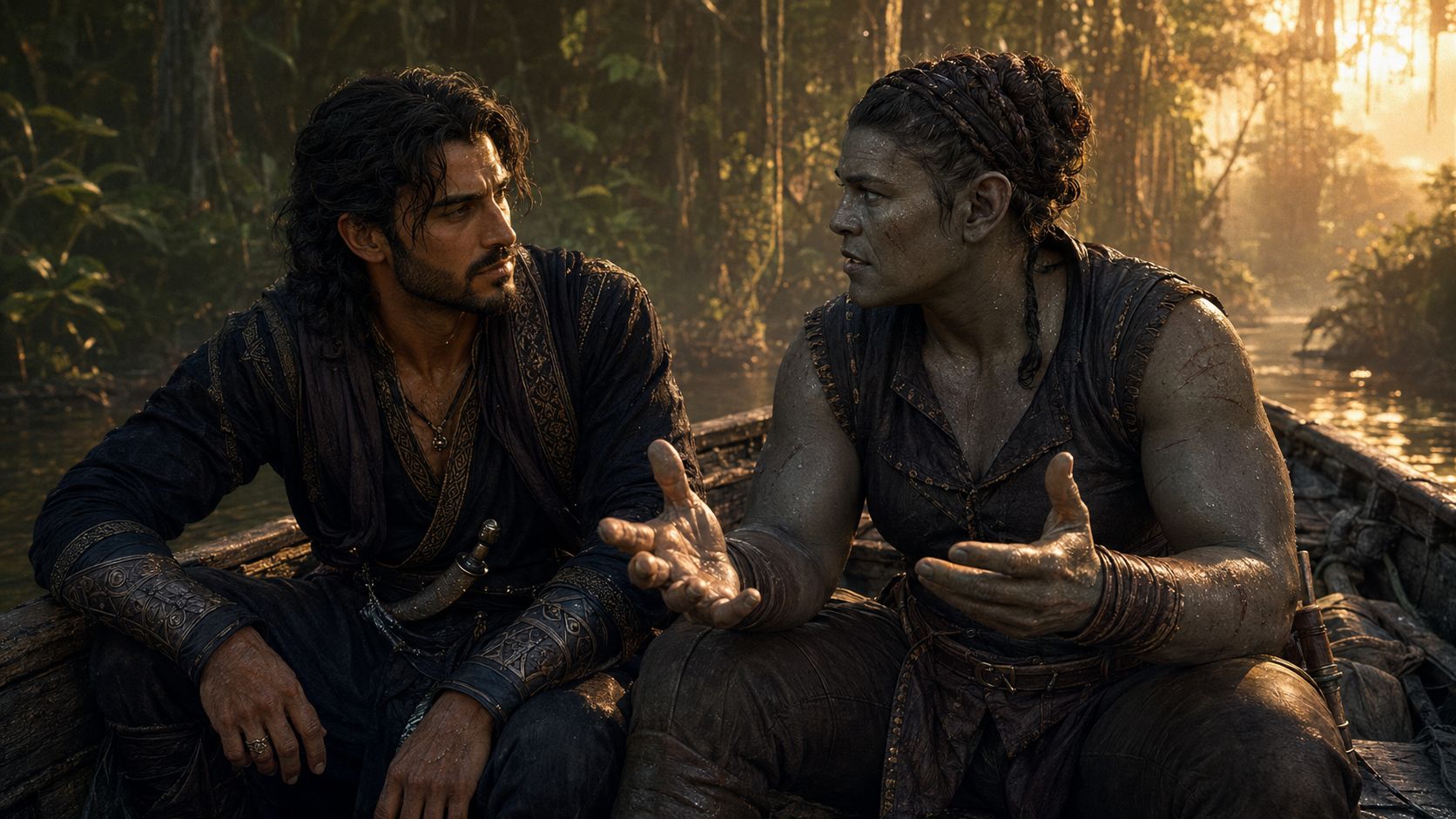
| Nasheem sat near the stern with one hand resting on the tiller, his shirt clinging to him and his dark hair escaping in damp strands. Even his dignity looked overheated. |
| "I begin to suspect," he said, "that the Waverider came this way because every other direction had already refused them." |
| Gastved sat near the bow, motionless except for the slow movement of his eyes. Sweat ran through his beard. He had said little all morning, which meant he had disliked the river honestly rather than theatrically. |
| "Bad place to leave tracks," he said. |
| Nasheem glanced at him. "You have said that every morning." |
| "It is true every morning." |
| "It may still be a dead end," Amaxia said. She shifted her spear so the blade did not catch in the overhanging reeds. "Four days. No village. No marker. No wreckage. No sign that a ship passed here." |
| "The Waverider could not come this far," Grishna said. |
| "The Waverider had boats," Nasheem said. "Skiffs. Shore craft. People foolish enough to use them." |
| "That sounds familiar," Junia murmured. |
| Ileena had said nothing for almost an hour. |
| She crouched at the front of the skiff, bare feet balanced on the wood, tail low, ears turned toward the jungle. During the first two days she had complained often and cheerfully. The skiff was too slow. The river smelled dull. The insects tasted bad. The others moved like tired pigs. By the third day she had grown quieter, not from fatigue, but from attention. Now she watched the banks as if the trees were speaking too softly for anyone else to hear. |
| A dragonfly settled on her shoulder. She ignored it. |
| Gastved noticed her stillness. His hand moved to the knife at his belt without haste. |
| Nasheem straightened. "Ileena." She lifted one hand. The oars slowed. |
| For a few breaths, the river made all the sound. Water lapped against the hull. Insects whined. Somewhere deep in the trees, a bird gave a single broken cry and fell silent. |
| Ileena drew air through her nose. Then again. Her face changed. |
| "Dead," she said. |
| Amaxia's grip tightened on her spear. "Animal?" |
| Ileena did not answer at once. She leaned forward, nostrils flaring, eyes narrowing toward the bend ahead. Then a small shrug. |
| Junia closed her satchel. |
| Gastved rose into a crouch, careful not to rock the skiff. "How old?" |
| "Not old." Ileena's voice had lost all playfulness. "Not fresh." |
| Nasheem looked toward the bend. The river curved left there, slow and wide, with reeds gathered thick along the inside bank. Beyond them, the jungle opened slightly, though from where they sat it was impossible to see why. |
| They let the current take them the last stretch. |
| The skiff drifted around the bend, reeds whispering along the hull. At first there was only more river, more jungle, more brown water shining under the weight of the sun. Then the trees drew back on the right bank, revealing a strip of trampled mud above a shallow landing. |
| A camp stood there. |
| Low shelters of leaves and woven branches leaned beneath the trees. A small firepit sat cold in the center. Thin poles had been driven into the ground to hold drying lines. A few baskets lay overturned near the water. Nothing moved. |
| Nasheem raised one hand, and the skiff slowed. |
| No one spoke. |
| The camp should have sounded like people. Even sleeping people made small noises. A cough. A shift of weight. A child complaining. A cook stirring ash. This place gave them only flies. |
| Then the smell reached the others. |
| Amaxia stood, spear ready now, all boredom burned away. |
| Gastved looked from the landing to the tree line. "There was trouble here." |
| Ileena's ears flattened. "Yes." |
| The skiff slid closer. Details separated from the shade. A hand in the mud near the firepit. A leg beneath a collapsed shelter. A small body half hidden beside a basket. Dark stains where the ground had been churned by feet, dragged heels and something heavier than sleep. |
| Junia whispered something under her breath, not quite a prayer. |
| Grishna stepped over a coil of rope and took position near the bow. "Shore is quiet." |
| Amaxia looked toward the trees. "Then we make it less quiet carefully." |
| The keel touched mud with a soft scrape. |
| For a moment none of them moved. The river pressed gently against the stern, trying to push them onward as if the camp were none of their concern. |
| Nasheem drew his sword. |
| "Junia stays between us," he said. "Ileena, eyes in the trees. Gastved, ground. Grishna, Amaxia, with me, weapons ready." |
| Ileena stepped out first, landing in the mud without a sound. |
| Amaxia followed, spear lowered. |
| Then Nasheem, Grishna, Gastved and Junia climbed from the skiff and set foot on the bank. |
| The flies rose to meet them. |
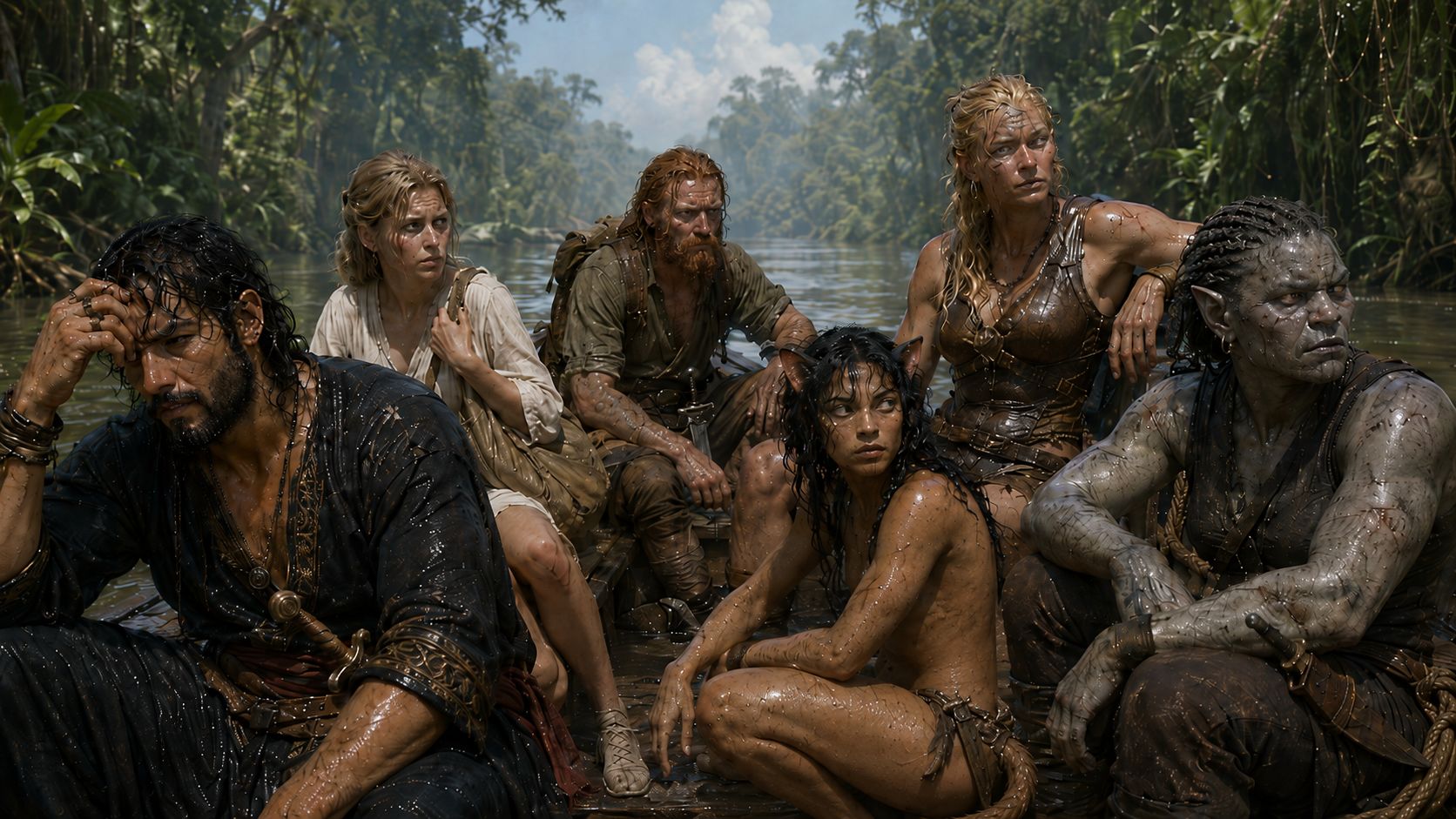
The trip up the Tarnixian River is mainly a transition scene. Do not spend much time on it unless the players engage with the mood, argue about the route or try to search for signs along the banks. The important point is that the journey feels long, uncomfortable and strangely empty.
The river is broad, shallow and slow, with thick jungle pressing close on both sides. The water is muddy green, the air is humid and still, and the heat settles over the skiff like a wet cloth. Rain falls often, sometimes as brief warm showers, sometimes as heavy downpours that blur the banks and turn everything slick, but never refreshing.
No people are seen along the river. There are no fishing boats, no smoke columns, no huts, no voices from the shore. The jungle is alive with birds, insects and distant animal calls, but the absence of people becomes increasingly noticeable.
Moving upstream takes effort. The current is lazy, but constant, and the crew must row, pole and occasionally drag the skiff through shallower stretches. Progress is slow enough to become frustrating. Insects are everywhere, biting through cloth, gathering around sweat and making rest difficult.
Use the trip to make the crew tired, bored and ready for something to happen. At first, the lack of people feels like ordinary wilderness. By the fourth day, it starts to feel wrong, and the possibility that the Tarnixian is a dead end becomes reasonable.
That is when they notice the camp.
The Broken Camp
| Story |
|---|
| The flies rose in a black cloud. |
| For one moment, that was all Junia could see. Flies, heat and the small clearing beyond them. Then the shapes became bodies. |
| Amaxia stopped first. |
| "Gods," she said, and the word came out flat. |
| The camp had not been destroyed. That made it worse. The shelters still stood. Baskets lay beside sleeping mats. A little cooking fire had gone cold with food still blackening on the stones. Someone had been working a strip of cane into shape and never finished. |
| A child lay beside the firepit. |
| Junia took one step forward, then stopped. Her hand tightened around the strap of her satchel until the leather creaked. |
| "No," she whispered, though no one had asked her anything. |
| Nasheem moved past her slowly, sword lowered now. The dead were small people, painted in greens and blacks, their limbs thin and wiry, their faces still marked with the sharp unreadable calm of the jungle even in death. |
| "Dwarves?" he asked, sounding unsure. |
| Junia swallowed. "No. Human. Small, but human." |
| Near the edge of the clearing, two hunters lay on their backs. |
| Across each chest rested a broken blowpipe. |
| Grishna crouched beside one of them, not touching it. Her face hardened. |
| "This was a message." |
| Ileena stood very still. |
| The smell no longer seemed to bother her. Her ears had flattened, and her eyes moved from body to body, shelter to shelter, tree to tree. |
| "Some are missing," she said. |
| Gastved looked toward the jungle. |
| No one spoke after that. The camp behind them was dead. The trail ahead was not. |
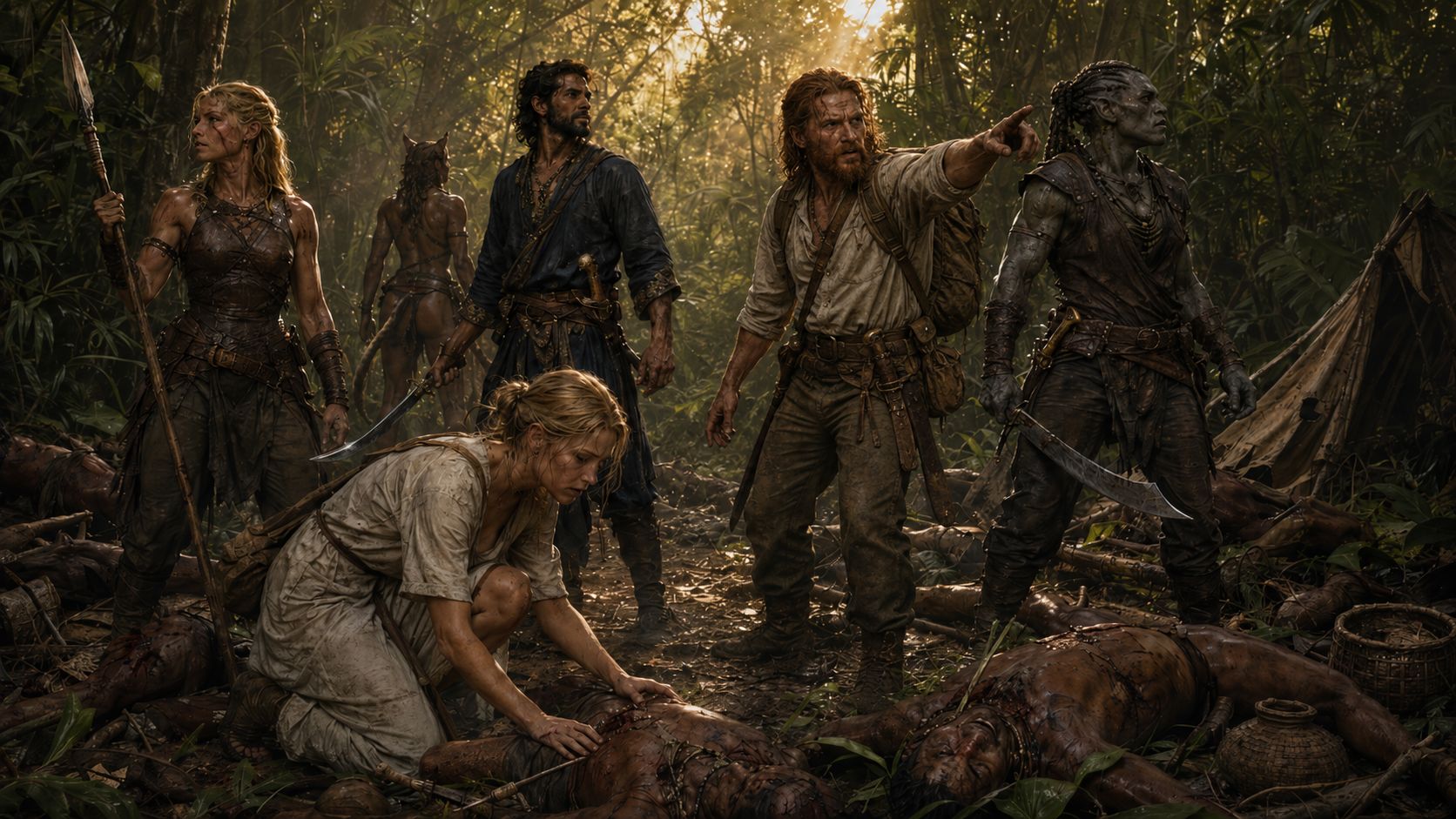
The camp belongs to the Children of Nazhira. It is small, temporary and mostly civilian. There are low shelters, cooking stones, drying lines, baskets, sleeping mats and simple tools. This was not a war camp. It was a family camp with hunters present to protect it.
First Impression
The attack was swift and brutal. The attackers reached the camp before the people there could scatter properly. There are signs of sudden movement, overturned baskets, half prepared food, dropped tools and bodies cut down near the places where they were working, resting or trying to flee.
No one was spared. Men, women and children were killed. Do not dwell on gore, but make the completeness of the killing clear. The attackers were not confused, panicked or defending themselves. They came to kill everyone they did not intend to take.
The Attackers
The attackers took no casualties at the camp. There are no unfamiliar bodies, no signs of wounded enemies being carried away and no evidence that the defenders managed to turn the fight. A few hunters tried to resist, but they were overwhelmed quickly.
The attack was organized. The attackers struck from more than one direction, drove people inward and cut down anyone trying to break away. They knew what they were doing.
The Broken Blowpipes
The hunters are marked differently from the rest of the dead. Their blowpipes have been broken and placed across their bodies.
This is deliberate symbolism, not battlefield damage. The message is contempt. The attackers are saying that the hunters' fangs have been broken, their power mocked and their protection made meaningless.
This detail also makes the attack feel personal. The attackers understood enough about the Children of Nazhira to insult them properly.
The Missing Prisoners
Several people are missing. The signs are clear enough around the edge of the camp. Captives were bound, dragged or forced into the forest. Some went unwillingly, some stumbled and some were carried for short distances before being forced onward again.
The trail leads away from the river and into the jungle.
The Trail
The attackers did not bother hiding their own tracks. They had prisoners, they were moving quickly and they did not expect pursuit from the camp.
If the group includes an experienced tracker, they notice something more important. Some of the prisoners appear to be making the trail easier to follow. A heel digs too deeply where it should not. A snapped twig points outward. A smear of blood is placed higher than a dragging wound would naturally leave it. Small signs repeat often enough to become deliberate.
The prisoners are not helpless. Even while bound and dragged away, they are leaving a path for anyone skilled enough to read it.
Purpose of the Scene
The camp establishes three things quickly.
- The Itzalcoa are cruel and organized.
- The Children of Nazhira are victims here, but not passive ones.
- The trail is urgent enough to follow immediately.
The Itzalcoa Hunters
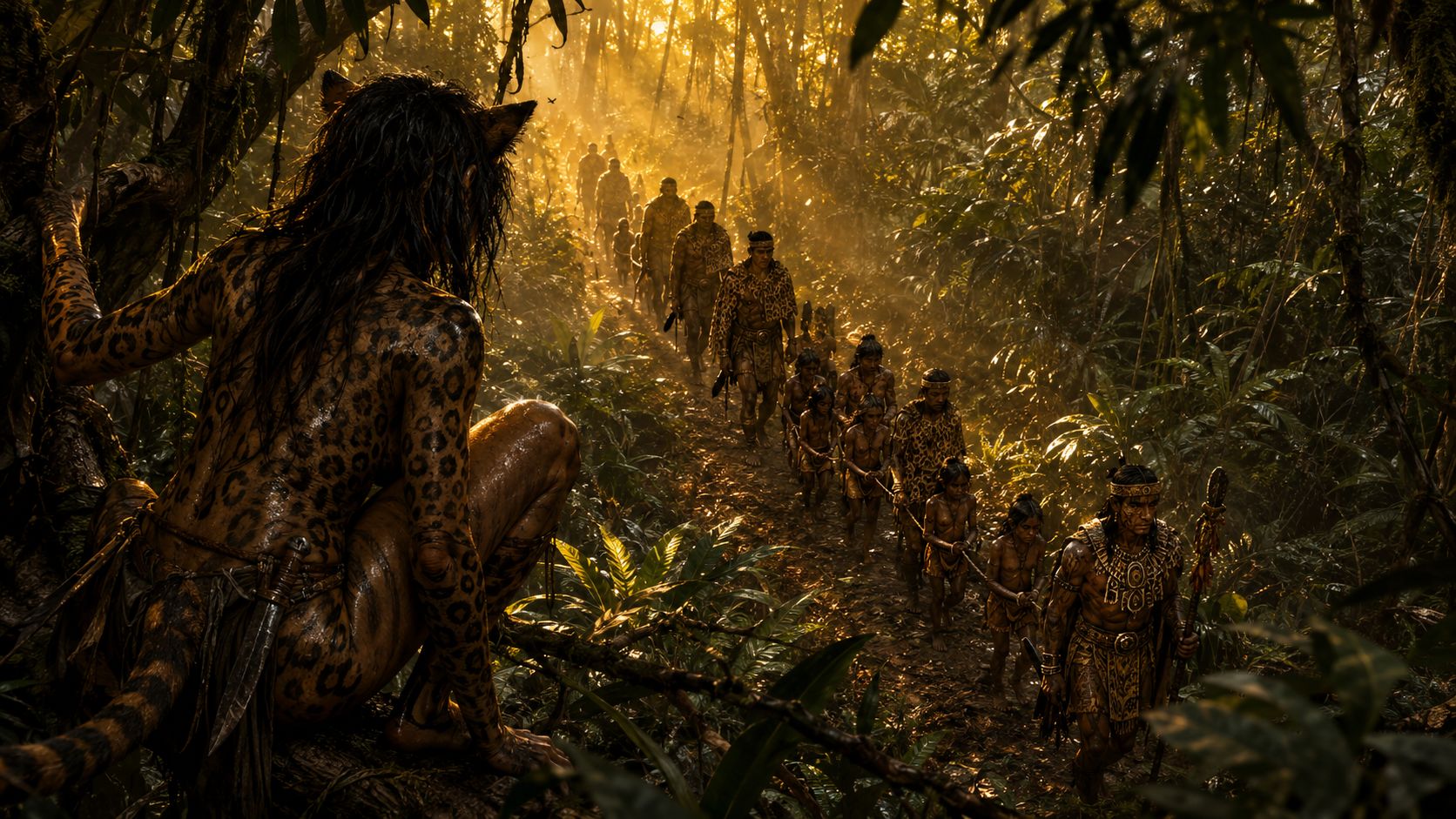
The trail from the broken camp leads to an Itzalcoa hunting party moving deeper into the jungle. They are not marching like soldiers on a road. They move as raiders, spread out enough to watch the trees, close enough to control the prisoners and confident enough that they do not expect serious pursuit.
Their purpose is not conquest. They are hunting for sacrifices.
The Leader
The party is led by Priest Yoltzin, a minor Cohuatzin priest attached to the raid. He has no special powers and does not fight like a magician. He is ordinary rank-and-file clergy, and his authority comes from religion, fear and the confidence of the warriors around him.
Yoltzin interprets the raid as holy work. He is there to judge the captives, keep the warriors focused and make sure the prisoners reach Itzalcoa alive. If a fight breaks out, he gives orders, calls out omens, threatens failure before the Cruel Ones and may try to have captives killed rather than freed if the raid turns against him.
The Hunters
The Itzalcoa hunters are hard, disciplined and visually striking. They wear jaguar pelts over their shoulders, eagle feathers tied into their hair, painted faces and ornaments of bone, shell, feather and dark polished stone. Their bodies are marked with ash, ochre and blood-red pigment. They do not look like bandits. They look like warriors carrying out a sacred duty.
Their main weapons are clubs edged with obsidian, spears, knives and short throwing weapons. The clubs are especially important. They can be used bluntly to break bones, stun victims and take captives alive, or turned so the obsidian edge or spike cuts deep when killing becomes necessary.
Some carry shields of hide and woven reed. Others carry coils of maguey fiber rope for binding prisoners. They know jungle movement well enough to travel quickly, but they are not at home here in the same way the Children of Nazhira are.
Strength of the Party
The hunting party should be slightly stronger than the crew in a straight fight.
This is deliberate. The encounter works best if the crew cannot simply overwhelm the Itzalcoa in the first exchange. The captives need room to matter. Their actions during the fight should create openings, shift the balance and make the rescue feel like a sudden reversal rather than a simple cleanup.
Do not make the fight unwinnable. Make it dangerous enough that the crew benefits from scouting, ambush, surprise and the captives acting at the right moment.
The Captives
The prisoners are Children of Nazhira taken from the camp. They are men, women and children. Their hands are bound in front of them. Their feet are also bound with short cords, forcing them to take small steps. They can shuffle, stumble and lurch forward, but they cannot run.
They are bound together in a single line. A main rope links them by the wrists. An Itzalcoa hunter holds the rope at the front of the line, and another controls it from the rear. They jerk the rope whenever the captives slow down, stumble or drift out of formation.
The captives look exhausted, frightened and injured, but not broken. They watch everything. Their eyes move from knife to hand to root to shadow. They are waiting for a mistake. Even the children are ready, if the opportunity arises.
Running the Encounter
The crew can follow the trail and catch up before the hunting party reaches safer ground. Give them a chance to observe before acting. They can count enemies, identify the priest, note the prisoner line and choose how to strike.
The Itzalcoa are alert, but not expecting a rescue attempt from outsiders. They believe the camp is dead and the jungle behind them belongs to fear. They talk, bark orders and move with careless confidence.
The moment the crew creates chaos, the captives begin looking for chances to act. If the crew is hesitant to attack, let them notice details of preparation. A sharp stick hidden in a hand, a rope binding discreetly loosened, glances at the Itzalcoa weapons.
The Captives Strikes Back
| Story |
|---|
| Gastved touched the vine once, then stepped away. |
| The Itzalcoa hunter did not see it. |
| He came along the trail with his obsidian club low and his eyes on the prisoner line. His foot passed the mark Gastved had scratched into the mud. The branch snapped loose and smashed into his face. |
| The hunter hit the ground hard and did not rise. |
| Amaxia's spear drove through the leaves into another hunter's side. |
| Nasheem rose from the green with his sword already moving, cutting across the back of another hunter before the man could turn. Grishna came through the brush like a thrown stone and smashed her shoulder into a shield, driving the Itzalcoa sideways into a tree. |
| For one heartbeat, every Itzalcoa looked toward the ambush. |
| That was the mistake. |
| The captive line changed shape. |
| One of the bound captives twisted his wrists, and something thin and pale slid into his hand. Not a knife. A sharpened splinter of cane, hidden against his palm since the camp. He drove it upward into the throat of the Itzalcoa holding the front rope, once, twice, fast and deep, his face empty of everything but work. |
| The hunter dropped the rope and fell choking. |
| At the rear, two captives moved together without a word. One stumbled deliberately into the guard behind them. The other looped the binding rope over the man's head and pulled. The first captive dropped his weight. The second braced both feet in the mud. |
| The Itzalcoa clawed at the rope. |
| Neither captive let go. |
| A few paces away, a woman with blood down one side of her face waited until a hunter stepped too close to the prisoner line. Her bound feet left the ground together. Both heels smashed into his knee. |
| The joint bent wrong. |
| He screamed and fell. |
| Before he could rise, a child no older than eight threw himself forward with a stone gripped in both hands. The rock came down on the hunter's head with a wet crack. |
| Once. |
| Then again. |
| Junia froze. |
| Ileena did not. She was already moving, low and quick, eyes bright. |
| "They were prepared," Gastved said. |
| Another captive caught a falling knife between bound hands. Another dragged a loosened rope under an Itzalcoa's feet as Amaxia drove him back. None of it looked brave. None of it looked wild. |
| Yoltzin shouted an order, voice cracking through the trees, but the line had already broken. The prisoners were no longer cargo. They were hands, teeth, knees, rope and stone. |
| And the jungle was taking back what had been stolen. |
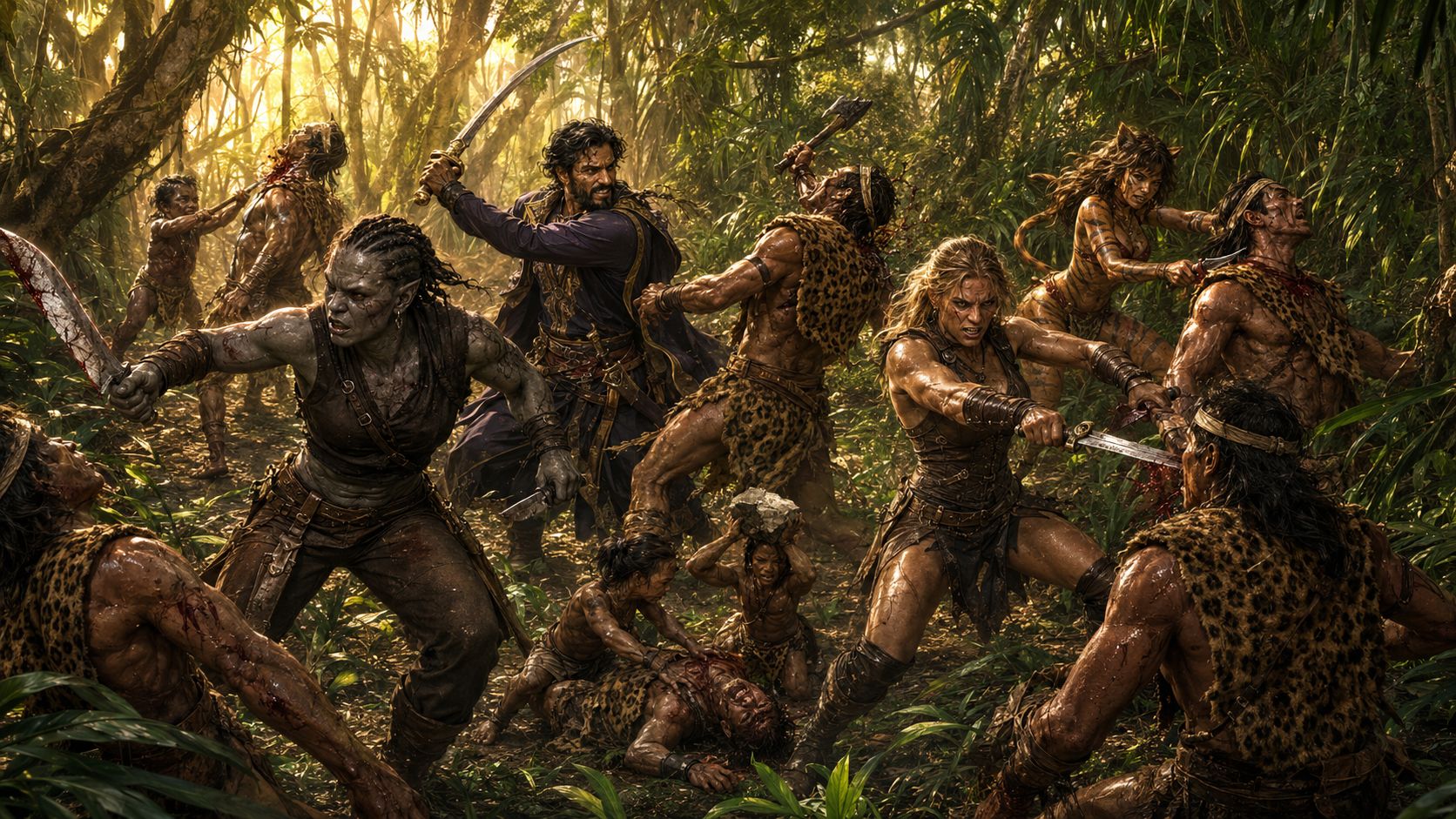
The captives are not passive victims waiting to be saved. They are frightened, injured and bound, but they are still Children of Nazhira. They have been watching the hunters, testing their bindings and waiting for a moment when the hunters' attention breaks.
It is likely that they saw the crew before the Itzalcoa did. They may have noticed movement in the trees, the silence before the ambush, a branch moved where no wind touched it, a bird going silent at the wrong moment or a shape waiting too still among the leaves. They do not react openly. They keep their heads down and let the Itzalcoa believe they are beaten.
The Opening
Once the crew strikes, the captives act almost immediately. The first few moments of chaos matter most. Yoltzin and the hunters turn toward the ambush, taking their attention off the captives.
That is when the prisoner line comes alive.
The Prisoner Line Breaks
The captives use whatever they have. A hidden splinter becomes a stabbing weapon. Binding rope becomes a garrote. Bound feet become a way to kick out a knee. A stone becomes enough to finish a fallen enemy.
Their actions are brutal, close and efficient. They do not fight like soldiers. They fight like people who have spent the entire march preparing for one chance.
Running the Moment
Use the captives to shift the fight, not replace the crew's action. The crew creates the opening. The captives exploit it.
This makes the encounter feel like a rescue and a reversal at the same time. The crew saves them, but the captives also save themselves. Once the Itzalcoa lose control of the prisoner line, the fight should turn quickly against them.
The Vanishing
| Story |
|---|
| The last Itzalcoa fell with his face in the mud. |
| For a few breaths, nothing moved except leaves, flies and blood in the rain-soft earth. |
| Nasheem turned toward the captives. "You are safe now." |
| They did not answer. |
| One of the Nazhira women had already taken a knife from a dead hunter. She cut the rope at her wrists, passed the blade sideways without looking and stepped away before the severed fibers hit the ground. |
| Another captive caught it. Cut. Passed. |
| No one spoke. |
| A child slipped free of the ankle cord, took one club from the mud and vanished between two leaves broad enough to hide nothing at all. |
| Junia took half a step after him. "Wait. I need to look at your wounds." |
| The woman with blood on her face glanced at her once. |
| Not fear. Not gratitude. Not refusal. |
| Just a look. |
| Then she was gone. |
| The others followed without signal. One bent to take a dagger. Another pulled a strip of cloth from an Itzalcoa belt. Two lifted a wounded man between them and disappeared with him into green shadow so dense it seemed to close around them like water. |
| Amaxia stared at the place where they had been. "How did they do that?" |
| Ileena's tail flicked once. |
| "Good jungle," she said. |
Once the Itzalcoa are dead, routed or no longer in control, the captives leave almost immediately. They do not gather around the crew, ask questions or offer thanks. They do not even speak to each other.
They act with quiet coordination, as if the decision was made long before the fight began.
Cutting Free
The first priority is removing the remaining ropes. One captive finds a knife, sharp stone or fallen obsidian shard and cuts their own bindings. The tool passes from hand to hand without comment. Wrists are freed. Ankle cords are cut. The main rope binding the prisoner line is discarded in the mud.
The process is quick, practiced and almost silent.
Gathering What They Need
Before leaving, the captives take what is useful. They may gather knives, rope, dart cases, food pouches, water skins, strips of cloth, a fallen blowpipe or anything else that helps them survive the jungle.
They do not loot for treasure. They take tools, weapons, medicine and things that can be carried without slowing them down. They do not search extensively, they have already watched and decided what is useful, so the entire looting takes less than a minute.
Wounded captives are helped without discussion. If someone cannot move alone, two others support them. If a child slows, an adult gathers them up and keeps moving.
No Conversation
The captives do not explain themselves. They do not answer questions. They do not thank the crew, threaten them or invite them to follow. This is not rudeness. It is survival.
The crew helped them, but they remain outsiders. The captives owe them nothing more than not attacking them.
If the crew tries to speak, the captives may glance at them, pause for a heartbeat or simply keep moving. Do not turn this into a negotiation scene.
Not even a whispered instruction passes between themselves.
No Trail
When the captives enter the jungle, they disappear completely.
Even an experienced tracker finds almost nothing. Bent leaves lift back into place. Mud is stepped on where roots hide prints. Blood is wiped against bark, then smeared away by rain and shadow. The captives leave fewer signs than should be possible for wounded people, children and adults moving together.
The point is that this is their land, and the crew is not meant to follow.
Purpose of the Scene
This moment reinforces that the Children of Nazhira are not helpless victims and not new allies. They were captured, rescued and freed, but they remain dangerous, secretive and completely at home in the jungle.
The crew saved their lives.
That does not make the crew welcome.
Back to the River
Once the captives vanish, there is nothing meaningful to follow. Even an experienced tracker finds almost no trail. The Children of Nazhira have disappeared into terrain they know intimately, and the crew is not meant to pursue them.
No Trail Forward
The captives leave behind cut ropes, dead Itzalcoa and a few signs of sudden passage, but those signs end quickly. Bent leaves rise back into place. Mud prints vanish among roots. Blood traces are broken, wiped away or hidden where rain and shadow make them useless.
If the crew spends time searching, make it clear that the trail is gone. This is not a failed roll that can be solved by trying harder. The Children have chosen to leave no path.
Hints to Leave
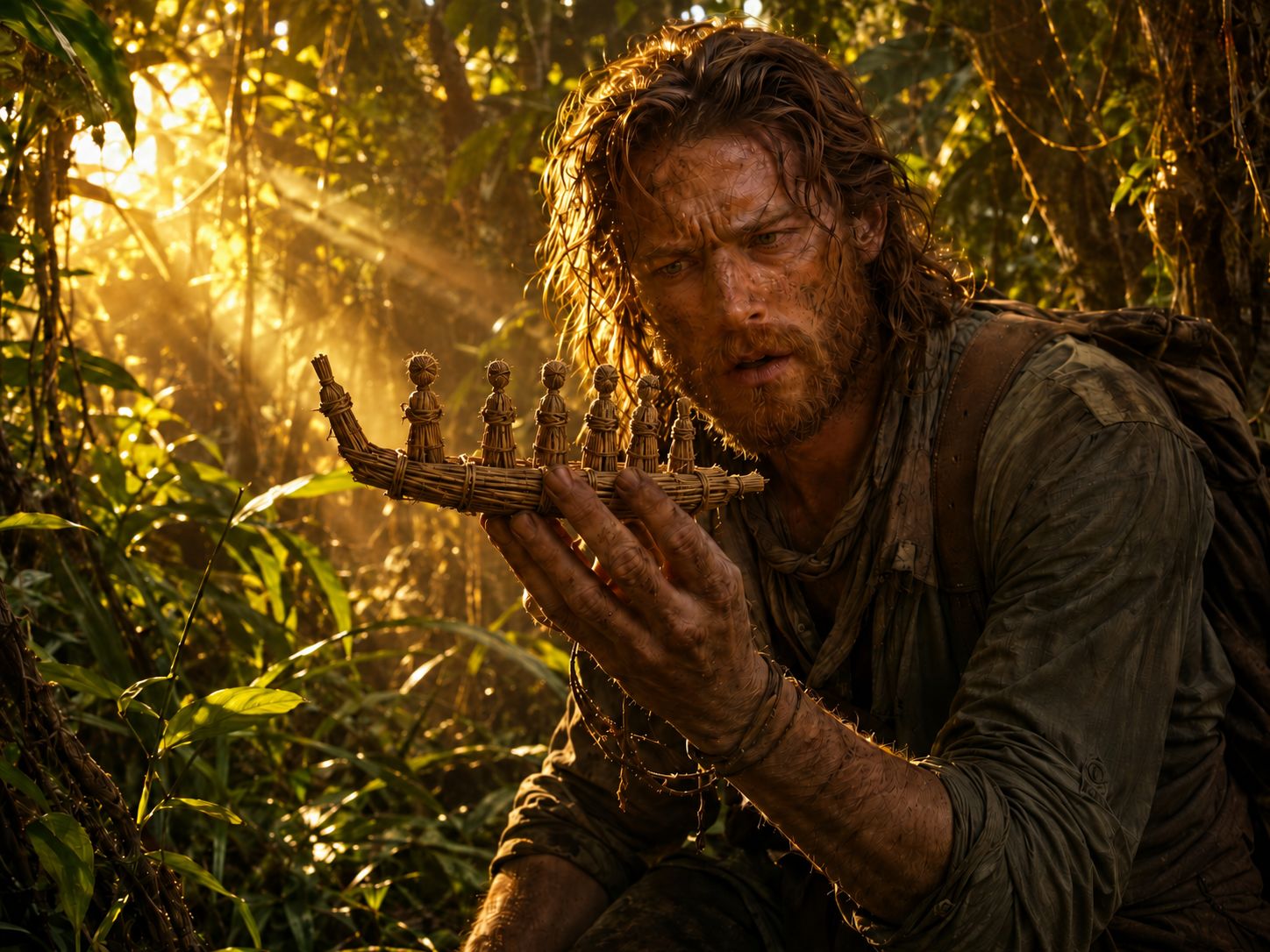
If the crew lingers, the jungle begins to correct them.
Small signs appear where they were not a moment earlier. A simple totem of tied reeds hangs from a branch facing the river. A broken twig points back toward the water. A strip of bark is peeled from a tree at eye level, showing a clean pale mark like an arrow. A small bundle of feathers and vine is placed on the trail behind them.
No one is seen placing these signs.
The message is not hostile yet, but it is firm. Leave the trees. Return to the river.
The Return
The walk back to the skiff is simple and uneventful. No attack comes. No voice calls from the jungle. Nothing follows openly.
That quiet is part of the warning. The crew is being allowed to leave. They should take the offer.
The Dart Warning
| Story |
|---|
| The skiff slid free of the mud. |
| Nasheem pushed them off with the oar, and the river took the hull one slow handspan at a time. Behind them, the jungle closed over the trail as if nothing had ever passed there. |
| A sound cut the air. |
| Not a shout. Not a branch. |
| A breath through reeds. |
| Darts struck the bow stem in a sudden dry cluster, from several directions. |
| Junia dropped flat. Amaxia pulled her down with one hand and raised her spear with the other. Gastved twisted sideways, eyes searching the banks. Ileena vanished almost completely below the gunwale, ears flat, teeth showing. Nasheem threw himself low as another dart struck the bow stem in front of him. |
| Grishna did not move. |
| She sat in the center of the skiff, one hand on her blade, watching the bow stem. |
| No more darts came. |
| "Stay down," Amaxia hissed. |
| Grishna shook her head once. "No." |
| Nasheem looked at her. |
| She pointed at the darts. Every one stood buried in the wood. None had struck flesh. None had missed the skiff. None had come from a place anyone could see. |
| "That is not an attack," Grishna said. "That is a message." |
| Junia lifted her head carefully. "A message?" |
| "They could have killed us." Grishna's voice stayed flat. "All of us. We could have done nothing." |
| The skiff went quiet. |
| Even Ileena stopped searching the leaves. |
| Nasheem looked at the bow stem, then at the dark wall of jungle on both banks. Slowly, he rose. His sword remained lowered. |
| "We understand," he called. |
| The jungle gave no answer. |
| Nasheem turned once, speaking to every tree and no one. |
| "We will leave your forest. We will keep to the water. We helped because people were taken, not because this place is ours. We hear you." |
| The river pulled at the skiff. |
| No more darts followed. |

As the skiff leaves the bank, blowpipe darts strike the bow stem from several unseen directions. None hit the crew. None miss the skiff. The Children of Nazhira are showing control, not starting a fight.
This is the final message from the forest.
The crew helped their people, so the Children allow them to leave alive. That mercy does not grant access, friendship or permission to remain. The forest is closed to them. The river is the only acceptable path.
Do not make this feel like an invitation to negotiate. The darts are an ultimatum.
What the Warning Means
The Children are saying three things at once.
- They saw the rescue.
- They could kill the crew if they chose.
- They have chosen not to, as long as the crew leaves the forest and keeps to the water.
No one appears. No voice answers. No further explanation is given. Even if the crew calls out respectfully, the forest remains silent. If they try to push the issue, the response becomes more forceful.
If the Crew Leaves
If the crew accepts the message, stays in the skiff and continues upriver, nothing attacks them. The Children remain unseen. The forest watches them go.
As the river begins to change into the outer waters of the Mire of Vines, the Lutharil approach in calmer circumstances. First there are shapes beneath the surface, following at a distance. Then one or more freshwater merfolk rise where the water is deep enough to give them safety.
They do not greet the crew warmly. They are cautious witnesses who have seen what happened and understand the boundary the Children just enforced.
This ends the act on controlled tension rather than panic. The crew has obeyed, and the Mire now answers.
If the Crew Insists
If the crew tries to return to shore, follow the vanished captives, search for the shooters or force contact with the Children, the forest does not become a battle map. There are no visible targets. The Children do not step out to fight fairly.
A second barrage hits the bow stem, with the same restrained precision as the first. If the crew still refuses to leave, the Lutharil intervene from below.
The skiff suddenly surges forward as if caught by a hidden current. Oars jerk in the crew's hands. The hull shifts hard away from the bank. Shapes move beneath the surface, pale and fast, pushing the skiff out into safer water and away from the forest edge.
For a moment, it should feel like an attack from below. Then it becomes clear that the freshwater merfolk are not trying to capsize the skiff. They are forcing it out of danger before the Children decide mercy has expired.
Once the skiff is clear, the Lutharil rise and speak.
"They have said what they had to say. They will not talk more."
This version makes first contact rougher. The Lutharil are still not enemies, but they are not gentle guides either. They are enforcing the rules of the place because the crew failed to understand them quickly enough.
Ending the Act
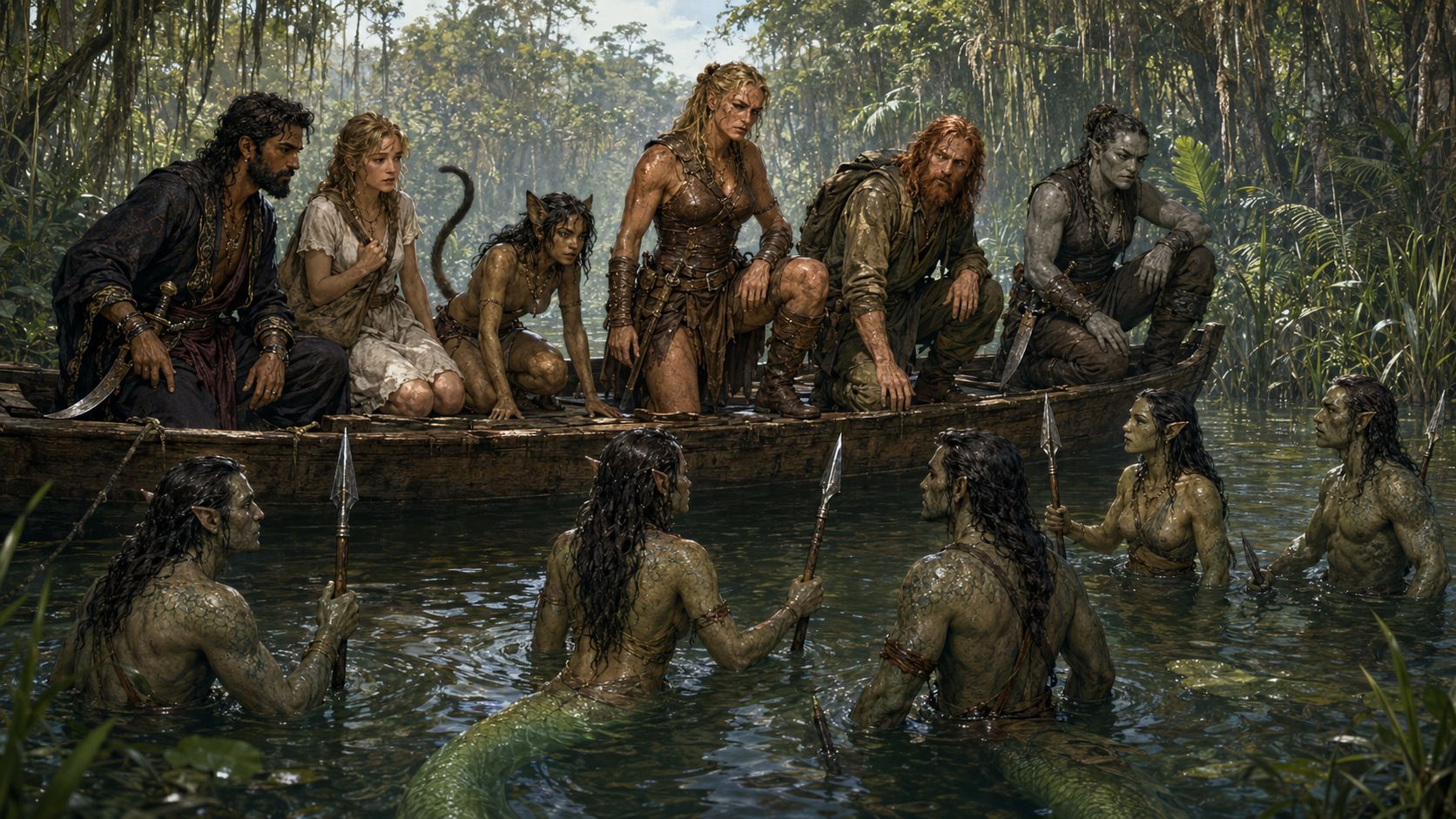
Either path ends with the Lutharil speaking to the crew for the first time.
The Children of Nazhira remain unseen and unresolved behind them. The Itzalcoa threat has been introduced. The crew has learned that rescue does not mean welcome, and that the river is now carrying them into someone else's world.
The next act begins in the Mire of Vines.
Act Summary
This is a short transition act. The crew does not find a new clue about the Waverider, and the mystery does not advance through information. Instead, the act moves the crew physically and tonally from the river approach into the Mire of Vines.
The purpose is to make the passage feel contested. The Tarnixian River is not empty wilderness. It is a border between powers the crew does not yet understand.
The Children of Nazhira
The crew makes contact with the Children of Nazhira, but not through conversation. They find their slaughtered camp, rescue captured survivors and learn immediately that rescue does not mean welcome.
The Children remain silent, disciplined and unseen. They vanish without gratitude or explanation, then warn the crew away from the forest with darts placed precisely into the bow stem of the skiff. The message is clear: the crew helped, so they are allowed to leave, but the forest is not theirs.
The Itzalcoa Foreshadowing
The Itzalcoa are introduced as a deeper threat. Their hunting party shows that they raid for captives, not plunder, and that their violence is ritualized through sacrifice, priestly authority and contempt for those they hunt.
This is not the full Itzalcoa arc. It is a first glimpse. The crew sees enough to understand that something cruel and organized exists farther inland, and that the Children of Nazhira are not only dangerous predators in the jungle but also prey to something worse.
The Lutharil
The act ends when the crew first meets the freshwater merfolk, though they do not yet understand who or what they are. If the crew respects the Children’s warning and continues upriver, the Lutharil approach later under calmer circumstances as the river opens into the Mire of Vines.
If the crew refuses the warning or tries to force contact with the Children, the Lutharil intervene from below, pushing the skiff away from the forest before the Children’s mercy ends.
Either way, the first words from the Lutharil mark the end of the act.
Direction Forward
The crew leaves the forest behind without a Waverider clue, but they are still moving forward. The river carries them into the Mire of Vines, toward new territory, new witnesses and a people who may understand the waters ahead.
The Children of Nazhira remain behind them, unseen and unresolved.
The next act begins in the Mire of Vines.
| Story |
|---|
| The skiff continued upstream. |
| The darts still stood in the bow stem, thin and dark, their feathered ends trembling in the dull jungle breeze. Behind them, the forest remained a wall of green shadow. Nothing moved. Nothing called after them. |
| Ileena crawled forward on hands and knees and sniffed the first dart. |
| "Hm." |
| Junia looked up sharply. "Do not touch that." |
| Ileena already had two fingers around the shaft. |
| "Ileena!" |
| The catling paused. |
| Junia pointed at the dart. "Carefully. It is probably poisoned." |
| Ileena pulled it free with a slow twist. "Smells wrong." |
| "That is not comforting." |
| "Like bitter sap. Wet stone. Angry frog." |
| Junia closed her eyes. "Put it down." |
| Ileena placed the dart on the boards with great care, then leaned toward the next one. |
| "Do not taste it," Junia said. |
| "I was not going to." |
| Amaxia looked at her. |
| Ileena's ears flicked. "Not much." |
| Nasheem sat near the stern, one hand still resting on his lowered sword. His eyes stayed on the forest until the bend of the river began to take it from them. |
| "Well," he said. "Our little hosts do not seem overwhelmed with gratitude." |
| Grishna looked at him from the middle of the skiff. |
| "You saw what they did to people they hated." |
| Nasheem glanced at her. "I did." |
| "Then you know this was not that." |
| He looked at the darts. "A dozen poisoned darts in the bow of our boat does not feel like gratitude." |
| "It was." |
| Junia stared at her. |
| Ileena pulled another dart free. "She is right." |
| Nasheem raised one brow. |
| Ileena set the dart beside the first. "They did not put them in our throats." |
| Amaxia muttered, "That is one way to measure manners." |
| Grishna ignored them. |
| "They do not want us here," she said. "They said it clearly. They said it without wasting breath. They also said they know what we did. They could have answered with death. They chose warning." |
| Nasheem looked at the dark points laid out on the boards. Each one could have found a throat, a hand, an eye or the soft place under the ribs. Instead, they had struck wood. |
| "That is a hard kind of grace," he said. |
| "Most real kinds are." |
| Junia wrapped the darts in cloth with great care before Ileena could touch them again. "I still prefer fewer poisoned messages." |
| "That is because you listen with your ears," Grishna said. |
| Nasheem smiled faintly. "I have fought enough men to understand violence." |
| Grishna shook her head. "You understand fighting. Honor. Insult. This was older than that. Cleaner." |
| The skiff moved on. |
| "They aimed," Grishna said. "They chose. They warned. Then they stopped. That is a full sentence." |
| Nasheem looked at the water ahead. |
| "Then I hope I answered in a language they understood." |
| Grishna watched the forest vanish behind the bend. |
| "You did. We are still alive." |