The Expanding Silence
| Story |
|---|
| I tell it the same way every time, because if I change it, it feels like lying. |
| We were five. That part never changes. Five scholars, assigned to me by the Collegium, instruments signed out in my name, permits bearing my seal. I was the senior. The responsibility was mine, whether the dead zone agrees with such things or not. |
| We chose the ridge because I chose it. |
| It was high enough, I said. Well beyond the last verified boundary. Clear sightlines across the valley where the land had already gone black. I told them we would be safe there. I told them the expansion had never jumped that far in a single movement. I believed it. |
| Necropolis lay far off, a dark suggestion on the horizon, not visible so much as implied by the absence around it. Below us, the dead zone spread like spilled ink. No birds crossed it. No insects drifted over it. Sound seemed to die early there, as if it could not find purchase. |
| We worked methodically. Stakes placed at measured intervals. Chalk lines drawn and redrawn when the wind smeared them. Angles measured with brass arcs. Soil samples sealed. Light refraction logged. We took readings at dawn, at noon, and again as the sun began to fall. |
| One of the juniors joked that perhaps it had finally decided to stop. I did not rebuke him. That is another mark against me. I should have shut that down immediately. |
| As the sun set, I ordered the instruments packed. Lenses wrapped. Inks sealed. I said we would continue in the morning. I remember the certainty in my voice. Authority, I thought, would steady them. |
| We ate in near silence. Rations taste different when everyone is pretending not to listen to the quiet. I made the final notes myself, marking the boundary exactly as it had been at dusk. A clean line. Stable. |
| I told them to sleep. We would need clear minds tomorrow. |
| We laid our bedrolls around the fire. The fire burned normally. That reassured them. It reassured me. I let it. |
| I fell asleep thinking that I had done my duty. |
| I woke before dawn. |
| The first thing I saw was the ground. |
| A black line cut through the camp in a straight path. It did not curve. It did not hesitate. It passed through the fire pit, through the chalk markings, through the place where our instruments had stood. |
| On one side, soil. Pebbles. Ash. |
| On the other, nothing. Not emptiness. Absence. |
| I sat up and understood immediately what had happened. That understanding was worse than confusion would have been. |
| Three bedrolls were on the wrong side. |
| Master Coriel was simply gone. No body. No trace. His pack lay open at the edge, half of it missing, as if the world had decided where it ended and removed the rest. |
| Lysa’s instruments were still there, but she was gone. |
| Helvion’s bedroll lay across the line, and looked untouched. It was empty. |
| Only two of us were left. Myself and Aven. He was awake, sitting rigid, staring at the line as if waiting for it to finish the job. |
| I wanted to call their names. I did not. Leaders do not indulge in gestures that change nothing. |
| We did not cross the line. I ordered us away from it. My voice worked. That felt obscene. |
| When the sun rose, it revealed nothing new. The dead zone had not crept. It had not advanced evenly. It had made a decision sometime in the night and carried it out without sound. |
| Our best minds were gone. The data I had insisted we stay for was now meaningless. |
| We left before noon. |
| Every report I have written since carries my signature. Every map I mark reminds me that lines are promises we make to ourselves, not to the world. |
| People ask me if there is a pattern. If the expansion can be predicted. If the Empire has time. |
| I tell them what I know. |
| The dead zone does not move like a force. It moves like judgment. |
| And if you are responsible for others, it will wait until you are asleep to collect its due. |
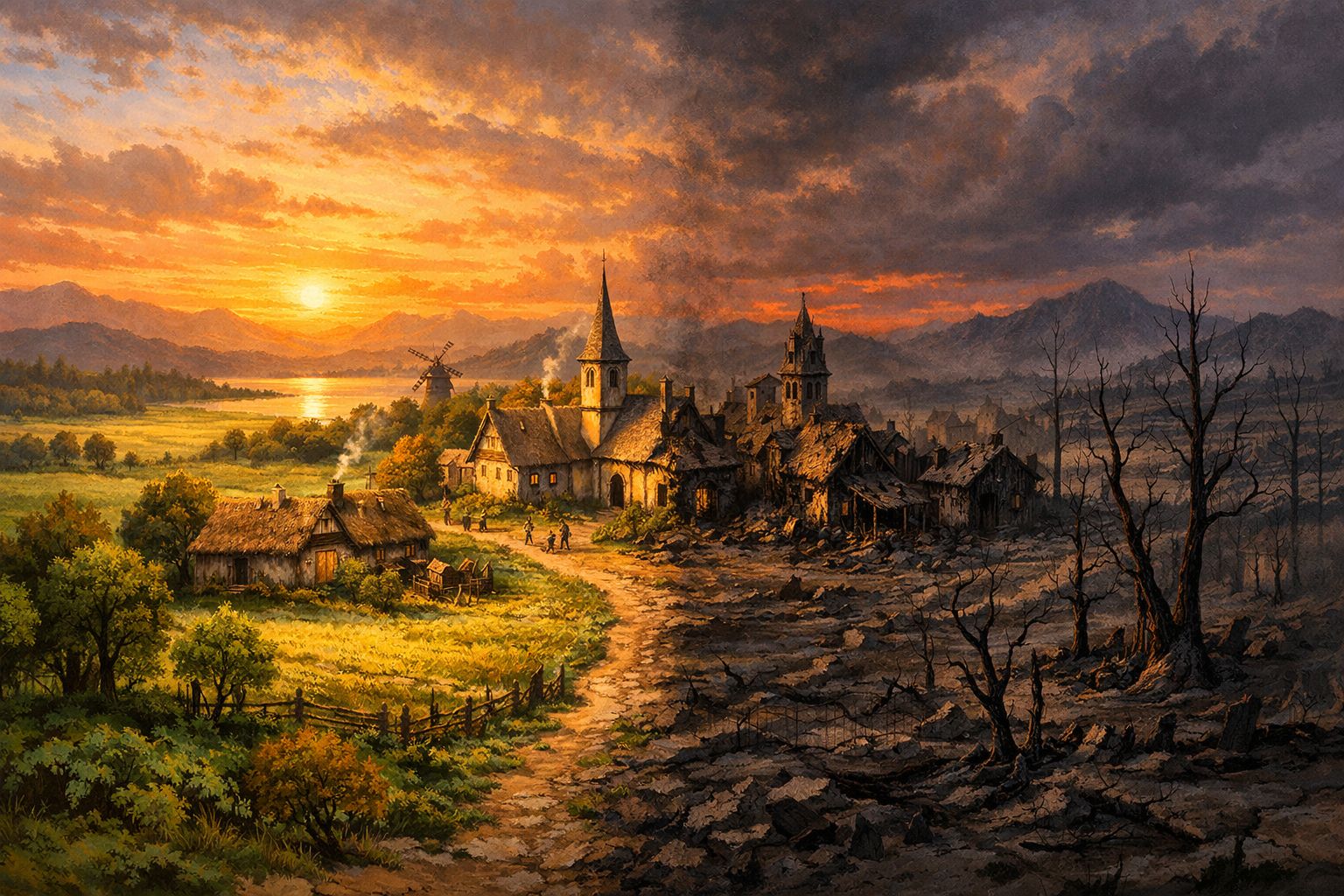
Description
The dead zone surrounding Necropolis is no longer stable.
What was once a grim but contained scar on the world has begun to grow. Not in a clean circle. Not at a steady pace. It sleeps for weeks, then surges overnight. It creeps for days, then halts without warning. There is no pattern anyone can prove, no rhythm that holds.
It has not slowed.
No one knows why. A lot think they know, there are theories aplenty.
Every theory fails at the same point: evidence. Priests argue divine judgement. Scholars argue arcane saturation. Generals whisper about ancient weapons. Cult leaders claim prophecy. None can explain why one valley survives while a city dies, or why the ground can remain quiet for a month and then turn barren in a single night.
What is certain is this: the silence is spreading.
The Lands Already Lost
The dead zone has consumed a swath of the Empire’s heartland.
Solcanum fell first, its academies and archives swallowed before evacuation could begin.
Domessia followed, its granaries rotting in place, crops standing untouched but lifeless.
Illaricum and Brasiccae vanished within the same season, their roads ending abruptly in ash grey soil where nothing grows and nothing rots.
Bravona’s walls still stand, intact and empty, its gates frozen open as if the city simply stopped breathing.
Portus Sellantria and Portus Navairon were lost at sea level. Harbors went quiet. Ships moored at the docks remain where they were left, sails slack, crews gone or never found.
Dexarta, Altaria, Trinacora, and Divessum are now names spoken in past tense.
This is not borderland. This is core territory. Administrative centers. Trade hubs. Breadbasket regions. The Empire has lost more than land. It has lost legitimacy.
Panic in the Empire
The Empire is bleeding people.
Refugees pour out of threatened regions in waves, overwhelming cities that were never meant to house them. Camps sprawl outside walls. Food prices surge. Old class lines dissolve under pressure, then reform harder than before.
Imperial officials issue reassurances they do not believe. Edicts contradict one another. Maps are revised weekly, sometimes daily.
The legions are stretched thin. Some are deployed to maintain order in cities choking on displaced citizens. Others are sent abroad to conquer new lands far away. None can stop the dead zone. They can only react to it.
Desperation breeds aggression. The Empire begins pushing outward, not for glory, but for survival. Far lands are no longer ambitions. They are lifeboats.
The World Takes Notice
The Empire’s weakness does not go unnoticed.
Rival powers circle like scavengers, testing borders, probing alliances, offering aid with strings attached. Treaties are reinterpreted. Old grudges resurface. What was once unthinkable becomes merely risky.
Ardenvale watches closely, its councils negotiating with Caerduin for land.
Freevalor fortifies passes and ports, trying to stop the tide of refugees. At the same time, they are looking for somewhere to go.
Morvelyn debates evacuation plans for cities that were never meant to be abandoned.
Even distant nations feel the pressure. The question is not whether the dead zone will reach them, but when it does. That uncertainty is enough.
Borders close. Armies mobilize. Remote regions that once lived in obscurity find themselves suddenly valuable, fought over not for what they are, but for what they might become: somewhere safe.
Flight and Conquest
The roads fill.
Refugees flee the expanding silence, carrying what they can, abandoning what they must. Some are turned away at borders and forced to camp in no man’s land. Others are absorbed, resented, exploited.
Armies move in the same direction, not always separately. A column of soldiers and a column of civilians may follow the same road for different reasons, one seeking safety, the other seeking territory to secure that safety by force.
Occupation becomes normalized. Temporary measures harden into permanent control. The language of emergency justifies acts that would have sparked war only a decade earlier.
Everyone is running from something. Many are running toward someone else’s home.
Cult of the End
Where certainty dies, belief rushes in.
Doomsday cults spread faster than the dead zone itself. Each claims to know the truth. Some preach final judgement. Others promise rebirth through annihilation. A few insist the gods are returning and must be met with blood.
Some cults sacrifice themselves, marching into the dead zone in ritual processions, convinced their deaths will halt the spread.
Others sacrifice outsiders, captives, or refugees, believing the silence demands payment.
Authorities suppress them when they can. Often they cannot. Sometimes they choose not to, hoping belief will burn itself out faster than panic.
It rarely does.
A World Out of Balance
This is not the end of the world.
It is worse.
The world continues, unevenly, unjustly, under a shadow that grows without explanation. Every decision is made with the same unspoken question beneath it: what if it reaches us next?
Power consolidates. Compassion erodes. Long plans are abandoned in favor of short survival.
No one knows when the expansion will stop. No one knows if it ever will.
Tone and Themes
Anxiety without resolution. Collapse without climax. The fear of an approaching end that refuses to arrive cleanly.
Themes
- Uncertainty as a Weapon. Not knowing is more destabilizing than invasion.
- The Fragility of Order. Empires fall apart long before they fall down.
- Survival Over Morality. Emergency justifies everything.
- Faith in the Absence of Truth. Belief rushes to fill any void.
- The Slow End. The world does not break. It thins.
- The dead zone does not announce itself. It simply arrives.
And the world moves, because standing still is no longer an option.