Ghosts
| Story |
|---|
| The inn’s fire had burned low, the last embers glowing red in the hearth. Jorren sat with his cup, half asleep, when he heard the boards creak above. He frowned. All the guests had gone to bed hours ago. |
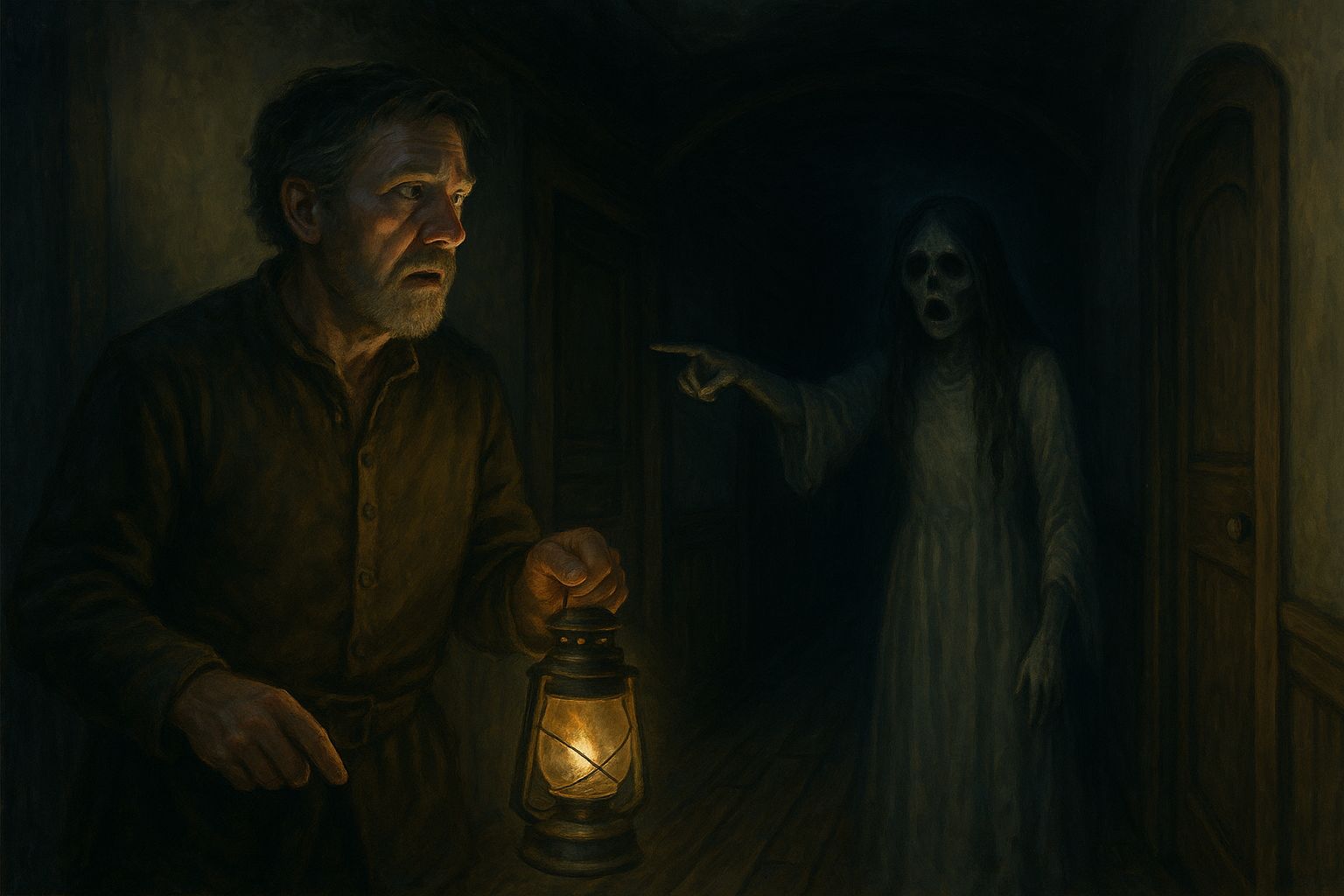
| He rose and climbed the stairs, lantern in hand. The hall was dark, but at the far end he saw a figure. A woman in a white dress stood before one of the doors, her head bowed, long hair covering her face. |
| “Can I help you, mistress?” Jorren asked. |
| The woman did not answer. She raised one hand, pointing at the door. Her finger shook. |
| Jorren felt his throat dry. That was the merchant’s room, the one who had boasted all night of his profits and the gold hidden in his packs. Jorren opened his mouth to speak, but the woman lifted her head. Her eyes were hollow sockets, her mouth a dark wound. The lantern sputtered. |
| When he looked again, the hall was empty. |
| At dawn the inn awoke to shouts. The merchant was dead, his door unbarred from within, his chest emptied of all coin. No tracks were found. Some swore the man’s greed had called her. Others whispered that the ghost had been his wife, left to starve when he took a younger bride. |
| No one stayed in that room again. |
Ghosts are the spirits of the dead who have not passed fully into the next world. They remain tethered to the living by grief, rage, love, or unfinished business. To some, they appear only as drifting mists, cold and formless. To others, they are nearly indistinguishable from the living, speaking, moving and weeping with a frightening familiarity. They may whisper in dreams, shatter pottery in anger, or silently watch from the shadows of their old homes.
Why a person lingers after death and what form it takes is not fully understood. Some claim it is shaped by cultural belief, the spirit becoming what its people expect it to be. Others say it depends on the manner of death, or on the interference of gods who refuse to accept a soul. Learned priests and magicians argue endlessly, but no single answer has ever explained the many different forms ghosts take.
What is certain is that ghosts cannot be harmed by mortal weapons. They are immaterial, untouched by steel or arrow. To deal with them, there are only two paths: to drive them away through exorcism, using sacred rites and charms, or to uncover what holds them here and resolve it, allowing them to finally rest.
Kinds of Ghosts
Ghosts vary as much as the lives they once lived. Some are dangerous, some are merely tragic, and some few are even helpful.
The Drifting Dead
Aimless spirits, wandering without purpose. They may hum songs of their youth or mutter to unseen companions. They are usually harmless, but prolonged exposure to them can bring melancholy or madness.
Shades
Dark outlines of once-living figures. They cling to the place of death, appearing at twilight or near graveyards. Shades are silent and cold, sometimes freezing water or wilting plants with their presence.
Poltergeists
Spirits of sudden death, furious and restless. They hurl objects, slam doors, and rattle shutters. They thrive on fear and may grow more violent if resisted.
Wraiths
Vengeful spirits with purpose. A wraith will seek out those who wronged them in life, pursuing them across years and distances until either vengeance is satisfied or it is banished.
Echoes
Poor souls, stuck in a final moment. They endlessly relive a final moment: the scream of a fall, the sound of weeping, the clash of battle. They cannot be spoken with or altered, though some argue they hold messages for those who can interpret them.
Guides
Rare and precious, these spirits linger not out of rage but devotion. They protect their descendants, warn travelers, or fulfill oaths sworn in life. Many families whisper prayers of thanks to unseen ancestors who are said to still walk beside them.
Phantoms
Illusory spirits that may appear beautiful or horrifying, luring mortals to follow them. Some say these are not truly ghosts at all, but tricks of darker powers using the image of the dead.
Hungry Ghosts
Spirits that consume. They may drain warmth, vitality, or even memory from those nearby. Legends warn that such ghosts grow hungrier with every moon.
Cultural views
Different peoples interpret ghosts in their own ways, shaping how they deal with them.
Elarune
In the long dark winters, the dead are believed to walk freely among the living. Ancestors are welcomed with food and drink left by the hearth. To see a ghost is not always feared; it may mean one’s forebears watch with pride. Only violent or hateful spirits are shunned.
The Empire
Ghosts are treated as a disruption of order. Priests of the state conduct public exorcisms, often turning them into spectacles. The appearance of a ghost is taken as a sign of failure in burial rites or as an ill omen for rebellion. Families accused of harboring spirits may be punished, so many secretly hire magicians to cleanse their homes.
Tazulmar
Spirits that linger are seen as souls rejected by the burning sun. To encounter a ghost is to know that the dead was unworthy of the afterlife, and thus cursed. People avoid their shade at all costs, often breaking camp to get away from them.
The Jungle Tribes
Ghosts are considered part of the natural world. Ancestors are honored, and hostile spirits are treated like predators, something to be placated or avoided. Hunters leave offerings of meat and drink at shrines to keep the ghosts from interfering with the hunt.
The Scholars
To those who study death, ghosts are proof of the soul’s persistence. Some magicians argue that the restless dead can be harnessed for knowledge or power. Others believe every ghost represents a flaw in the world, a soul trapped by cosmic imbalance.
Living With Ghosts
Some villages learn to live with their spirits. Families pass down rituals to soothe their presence, or even treat certain ghosts as guardians. Others curse the day they were first haunted and dedicate their lives to cleansing the land. For adventurers, ghosts are both peril and mystery. A spirit might seek revenge, or it might reveal a treasure long hidden.
To banish a ghost is no simple matter. Exorcism requires rare herbs, sacred chants, or relics of the dead. To free one through understanding requires courage and compassion: to face the memory of how they died, to right old wrongs, or to fulfill promises left unfinished. Those who succeed are said to feel a sudden warmth, as though sunlight passed over them, before the ghost fades forever.