Elves
| Story |
|---|
| The first time I stayed among the elves, I nearly starved. |
| They gave me a chamber in their hall, all hung with silver lamps and walls carved like living leaves. The bed was softer than anything I had known. But no one brought food. When I asked, they blinked at me as if I had spoken nonsense. Only after three days did I realize the truth: I was meant to take it from the kitchens myself. The elves were too lost in their work to think of such matters. |
| I remember one in particular, a woman called Thaenyr. She was painting a single tree upon a scroll of silk, and for hours she traced only the curve of its roots. When I returned the next day, she had not moved. When I returned a month later, she was still there, her brush poised, the trunk now spreading only a finger’s width higher. She did not look tired. She did not look hungry. She looked as though she and the tree were one. |
| When at last she noticed me, she smiled as if I had been gone only a moment. “Do you see it now?” she asked. And though I saw only a painted tree, for an instant it seemed to breathe, and the scent of green earth filled the air. |
| That night, I dreamed of roots winding around my heart. |
| Story |
|---|
| They took my son when he was scarcely forty years old, still a child among our kind. The humans raided the coast, and though we fought, they dragged him away in chains. I followed, unseen, across river and plain, until the trail ended in the city of stone. |
| I learned that he had been taken to the arena. A boy forced to fight beasts with trembling hands, a bronze collar around his neck, his cries drowned by the crowd’s cheers. The beasts savaged him, and he bled like fire until there was nothing left. I was too late. |
| That day I swore that the slaver who stole him would die by my hand. |
| I went into the forest and made it my prison. For a hundred years I trained my body. For a hundred more I learned every poison and blade. For yet another hundred after that I studied silence itself, until even the owls did not hear me pass. The years came and went, but my oath did not. |
| At last I returned. I traced the old roads, the forgotten paths, and I came again to the city of stone. The streets had changed, the walls rebuilt, the houses shifted like leaves in the wind. I asked of the slaver. No one knew the name. I searched the records. Dust filled my mouth. He had died two centuries past, rotted into the ground, his bones as common as any farmer’s. |
| I stood in front of the arena where my son had bled. The stones were still stained with dried blood. The crowd still roared for fresh blood. And I knew then that my vengeance had outlived its prey. |
| Now I walk the world with a blade no longer aimed at one man, but at an empire. The slaver is gone, but his kind still live. And so my oath remains. |
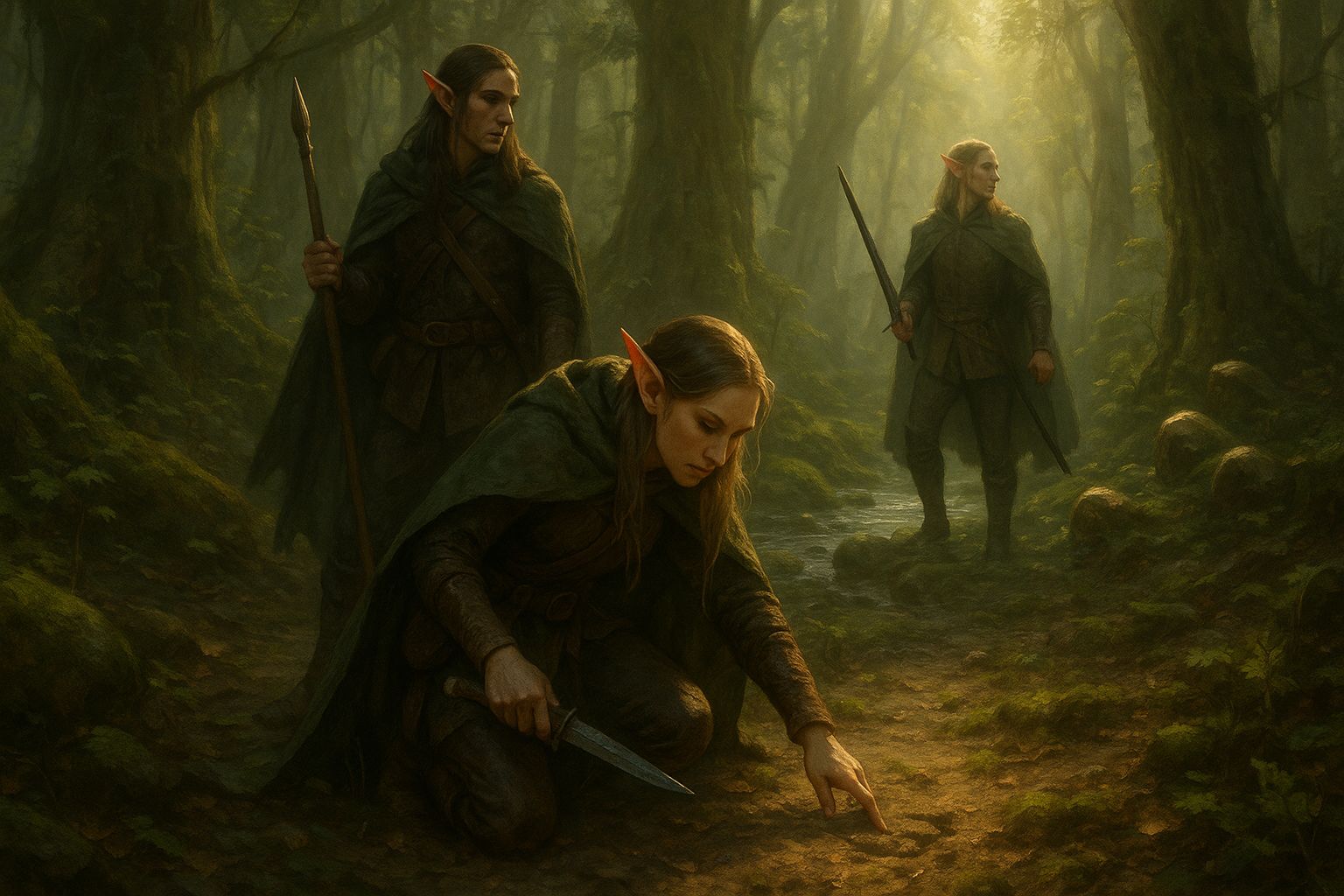
The elves are a people apart. They resemble slender humans with long ears and carry an aura that makes mortals feel they are not wholly anchored in the world. They move lightly, tire slowly, and care little for heat or frost. They seem to slip through time as well as space, for they age only when their will to live weakens, or the world forces it upon them through accident, violence, or disease.
Origin and Nature
It is said they came after the world was made, stepping in from another place. Because of this they never truly belong. The land resists them. Bronze wounds fester in them, the metal seeming to pin them to a world that will not heal them. Even the touch of bronze is unpleasant to them.
Their lives stretch into centuries, even millennia for those who hide from the world. Time does not weigh upon them as it does mortals. They can vanish into a single craft or study for lifetimes, until the world changes around them without their notice. When they notice, many of them feel that the world is no longer for them, lose their interest in life, and begin to age.
Strengths and Weaknesses
Elves are not strong in body. They disdain the chaos of battle and rarely take up arms as soldiers. Yet those who give themselves to killing can train for centuries, honing their patience into something terrifying. Few things are more dangerous than an elf who has decided to end a life. Forced into open conflict, they excel in ambush, sabotage, and misdirection, vanishing into woods and shadows until the enemy is worn thin.
Society
Their cultures differ greatly, from wandering bands who live lightly in forest glades, to marble cities where every building is a monument to centuries of art. Some keep slaves, not from cruelty but from a refusal to spend their immortal hours on what they consider petty tasks. Such slaves are usually left to govern themselves so long as they provide food, clothing, and labor. In other elven realms, slavery is an abomination, and mortals are welcomed as partners in art, ritual, or trade.
Elven society knows no division between male and female. Their rarity of children makes each birth a festival, the infant regarded as a treasure by the entire community. Lovers are rare, as the long obsessions of the elves leave little room for bonds of passion, it it seldom last berore their obsessions lead them apart again.
Magic
Their weak tie to the world limits them. While human mages might twist the world with will alone, elves must entreat, cajole, and shape it through ritual. Circles of stone, hours of chant, nights of dance, only then does the world consent to yield. Yet their patience makes them masters of ritual craft, building workings that may endure for centuries.
The Alien Mind
To mortals, elves seem strange not only in body but in thought. Their span of attention can stretch across generations, yet they may ignore what happens in the moment before their eyes. They remember the smallest detail of a song sung three hundred years ago, but forget to eat for days. Their priorities are not those of mortals: beauty, craft, and obsession matter more than gold or glory.
Those who spend time with elves often feel unsettled, sensing both the grace and the distance of a people not wholly of this world.