Karuun Rebellion of Southern Montosho
Shaka Zulu, but jungle tribes against the Great Empire.
| Story |
|---|
| They dragged me through the roots and vines until my knees bled. My wrists were bound with cords that cut like teeth. Every step deeper into the jungle was darker, hotter, and filled with eyes that glowed in the firelight. |
| The village was nothing like the forts. No walls of stone, no order. Huts rose on stilts like spiders, smoke curling from their roofs. Painted faces surrounded me, gleaming with sweat, their bodies streaked in red and yellow. They said nothing. They only watched. |
| A woman stood at the center, draped in feathers and beads. Her eyes were black as river mud. She shook a rattle of bone, each clack loud as thunder in my ears. |
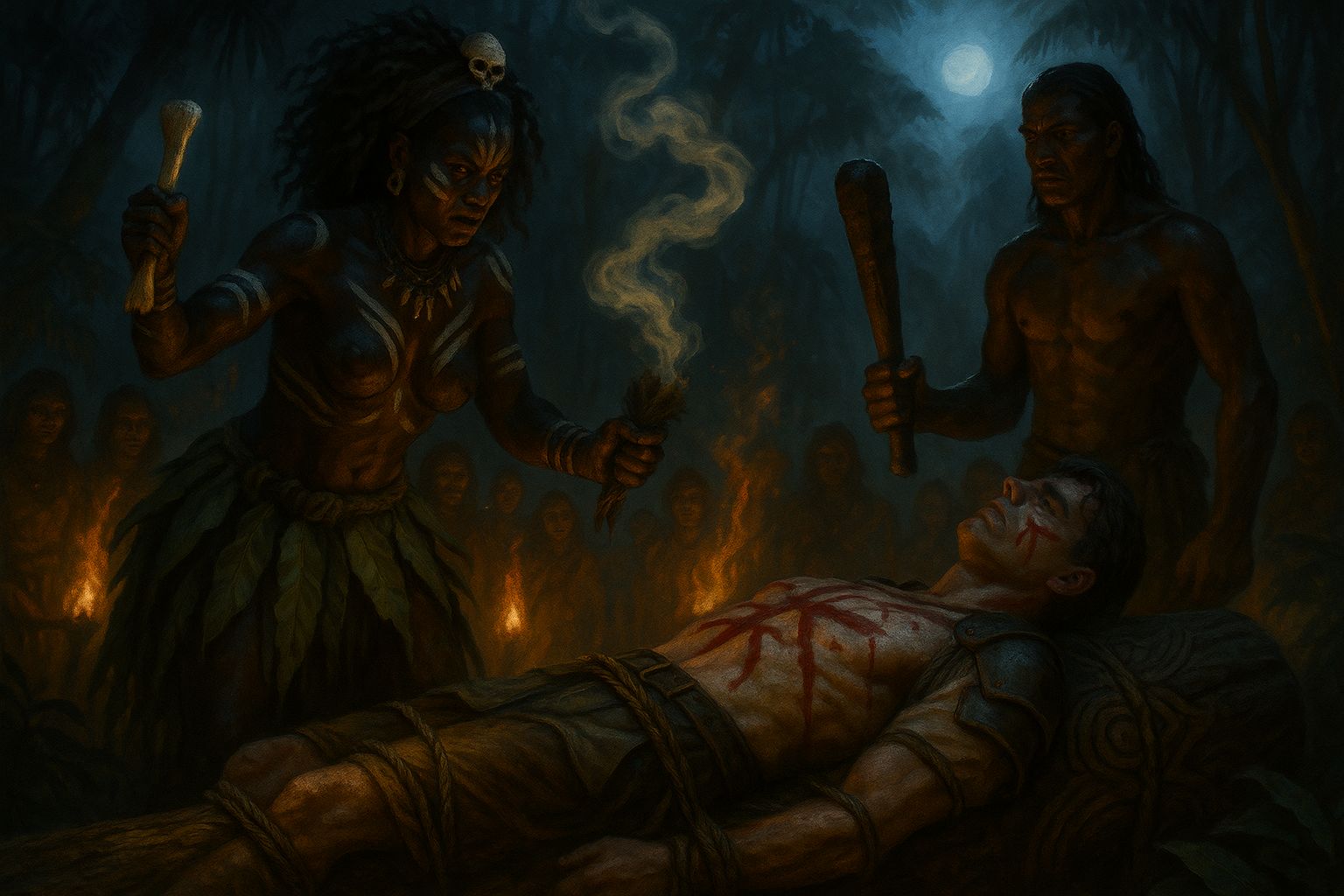
| They pinned me down across a carved log. The warriors pushed thorns into my flesh, one after another, each prick burning like fire. They smeared me with blood, not mine but some beast’s, painting symbols I could not understand. The crowd began to chant, low and guttural, and I felt my heart trying to leap out of my chest. |
| The shaman leaned close, her breath thick with smoke. She whispered words I half understood: slave… forever… mine. |
| Then the blow came, swift and final, and all sound rushed away. But I could still hear them. Even in death, I could still hear them chanting, binding me. I tried to rise, but the darkness held me fast. |
| And then I knew. They had not only killed me. They had taken me. My body lay broken, but my spirit was chained, dragged into the service of the jungle. |
| Story |
|---|
| The river mist clung to our skin as we crouched beneath the roots, bows ready. The empire’s barge drifted slow against the current, its torches wavering in the haze. We heard the soldiers laughing, drunk, careless. They thought the jungle asleep. |
| Then Karuun rose. |
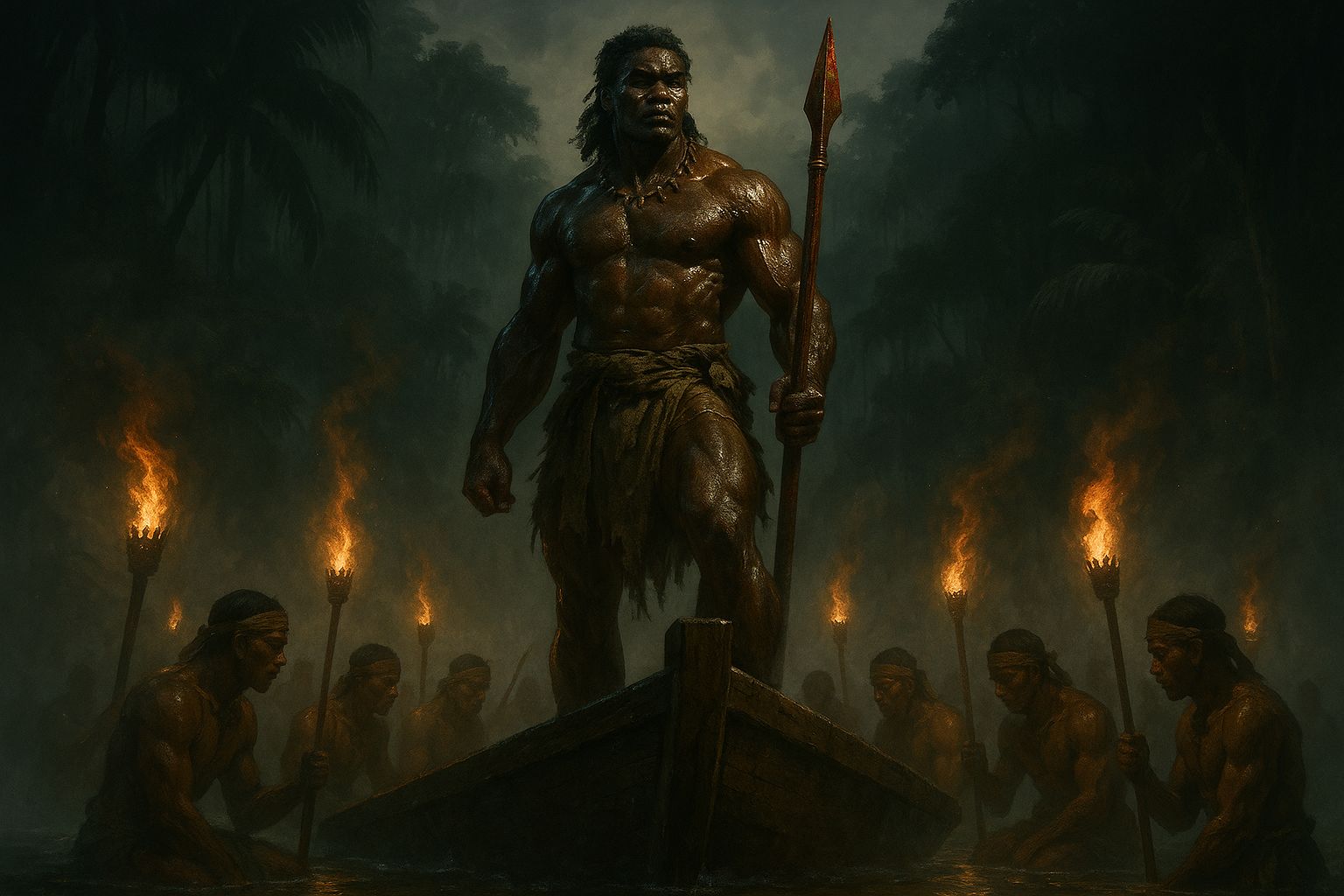
| He wore nothing but a dark cloth at his waist, his body glistening with sweat. Even hunched, he seemed larger than any man, a shadow pulled from the heart of the forest. He looked at us, eyes catching the torchlight, and we felt our hands tighten on our weapons without him speaking a word. |
| He slipped into the water, soundless. We followed. |
| When the first arrow flew, it struck the helmsman in the throat. Karuun was already climbing the hull, his spear flashing as he vaulted aboard. The barge erupted in panic. Soldiers stumbled, shouting, hacking wildly into the mist, but he was everywhere. His roar shook them, and we answered it, springing from the river like spirits of vengeance. |
| The fight was over before it began. Not one imperial lived to see another dawn. |
| Afterward we dragged their bodies to the shore. Karuun stood above them, blood dripping from his spear, his chest rising like the breath of the jungle itself. We gathered around him, kneeling, as he pressed his hand to the earth. |
| “The river drinks their blood,” he said, voice low, steady. “Their spirits serve us now. The jungle grows stronger.” |
| And in that moment, I believed he was no man at all. Not hunter’s son, not rebel chief. He was the jungle, risen in flesh. The Panther who would devour the empire. |
| Story |
|---|
| The air was thick with the stench of manatee oil, sweat and fear. The walls of the station groaned with the press of bodies, soldiers and slaves crammed together in every corner. Fires smoked in iron braziers, kept burning day and night, but their light only deepened the shadows. |
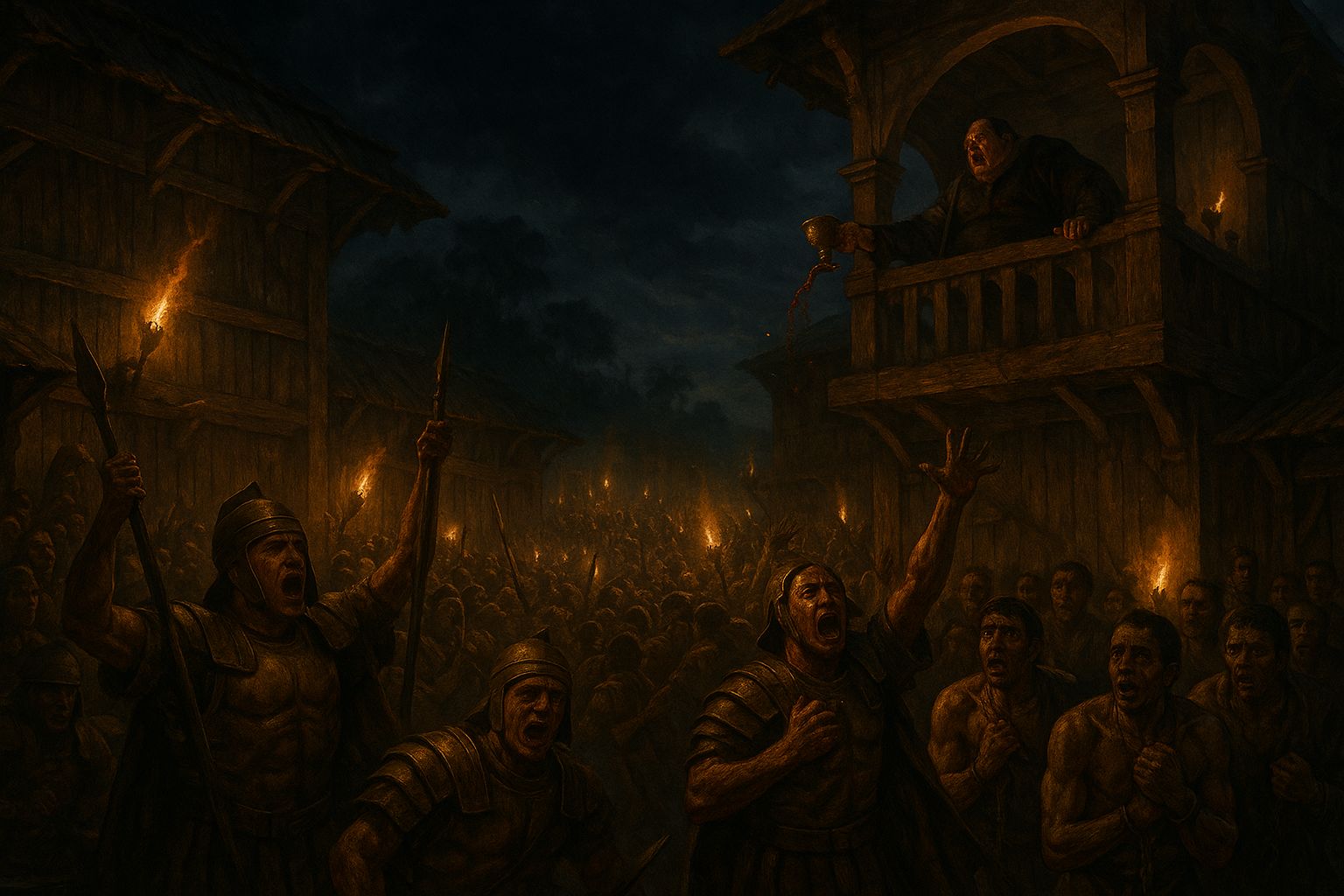
| Governor Serathin Varro stood on the balcony above the yard, his hand trembling as he clutched a goblet. Below him, two legionaries argued over rations, voices sharp and ragged. Another broke down in tears when told his brother’s patrol had not returned. No one dared leave the palisade at night, yet even here, behind sharpened stakes, the jungle whispered. |
| Then came the drums. |
| Faint at first, then louder, beating from somewhere beyond the mangroves. The slaves froze, eyes wide. A child whimpered. The soldiers cursed and clutched their spears, though none could see an enemy. The rhythm quickened, echoing like a heartbeat inside the chest. |
| Varro’s goblet slipped from his hand, splashing wine across the boards. He barked for silence, but the order broke into shouting, men demanding reinforcements, some calling to burn the slaves before they rose against them. Others swore they saw painted figures moving among the trees, though the torches showed nothing. |
| The panic spread faster than fire. By the time the drums ceased, the station was a hive of screams, the men not knowing whether to man the walls, flee to the river, or turn their blades against their own slaves. |
| When dawn came, no attack had fallen. But the jungle had won another night, and the empire had lost more of itself. |
Description
The Jungle Rebellion of Montosho
History and Present Conflict
The southern half of Montosho has always been viewed by the Great Empire as a land to be plundered. Elephants slain for ivory, manatees butchered for lamp oil, hardwoods cut into planks, beasts dragged screaming into cages for the arenas, and human beings shackled in chains to be sold in distant markets. For centuries the empire thrived off the bleeding jungle, while its tribes remained divided, sometimes even turning against one another for scraps of imperial favor.
That changed with the rise of Karuun the Panther, a man of no lineage or tribe, once thought little more than a hunter’s son. Through cunning, daring raids, and sheer strength of will, he showed the tribes that the empire could bleed. When his victories mounted, the villages began flocking to him. Those who resisted were broken and absorbed. Now the jungle tribes stand as one, and under his leadership they have become the nightmare of every imperial soldier stationed along the Yanduril and Oruvek rivers.
The War
The jungle is death to legions. In the heat and choking air, armor rots, boots sink into mire, and rigid formations collapse into tangled columns. Karuun’s rebels vanish into the foliage, strike like shadows, and leave mutilated corpses behind to terrorize the survivors.
The empire holds only a few fortified stations along the rivers. Most outposts have been abandoned, their survivors retreating to the overcrowded delta forts of Rasshuri and Tavarek, where manatees are still slaughtered. Here, fear festers. Every slave chained to a post might be a rebel sympathizer. Every shadow in the mangroves might hold a bowstring drawn back. Imperial officers debate exterminating the slave population to prevent uprising, yet fear the loss of their only remaining labor.
Meanwhile, Karuun himself still fights in the front ranks. His presence inspires his warriors, and terrifies the empire, who whisper that he cannot be killed, that the jungle spirits themselves guard his life.
The Question of Succession
The strength of the rebellion lies in Karuun himself. His victories, his presence, and the fear his name carries have bound the once-fractured jungle tribes into one. Yet this unity is fragile. There is no council of chiefs to guide them, no chosen heir to step forward. The people follow Karuun because he is Karuun.
Whispers grow in the empire’s forts that his death would shatter the uprising. Without him, the tribes may fall back into feuding, their cult of devotion splintering into rival claims. Even his closest lieutenants, fierce as they are, command loyalty only because they stand in his shadow.
The shamans speak of Karuun as touched by the spirits, perhaps even chosen as their vessel. But the spirits have named no second vessel. Should the Panther fall, the rebellion may collapse into blood and chaos, leaving the empire to sweep in and reclaim the rivers.
For now, every raid, every ambush, every victory builds his legend higher. But behind that legend looms the same question in every whispered prayer: what happens when Karuun dies?
A few also whisper: "What happens if Karuun wins? Will he rule as a liberator, or as the next conqueror?".
The Empire’s Assassins
The Great Empire has not been blind to Karuun’s growing legend. Twice they have sent blades in secret, men trained in silence and poison. Both attempts failed before they ever reached him.
The problem is not skill, but skin. The assassins of the empire are pale, bred in marble cities and stone barracks, and they stand out like ghosts beneath the canopy. Their speech, their bearing, even their scent betrays them. The jungle tribes know every tree and every shadow, and strangers are seen long before they can strike. One band of assassins was caught within a day, stripped, bound, and delivered to Karuun alive. Their bodies were later found hanging from the branches over the Yanduril, tongues cut out, eyes wide in terror.
The empire has begun seeking allies among the few tribes still outside Karuun’s rule, hoping to buy killers who can pass unseen. Yet even these tribes hesitate. For Karuun is not just a man now, but a living spirit of the jungle, and to turn against him is to draw the wrath of both people and spirits alike.
So the assassins wait in barracks and forts, their orders sealed, while the emperor rages that his enemies still draw breath.
Culture and Warfare
The rebels fight with weapons suited to the green labyrinth: short bows tipped with poison, short, wide-bladed spears, and small round shields of boiled hide. Their bodies are painted in brilliant reds, yellows, and whites during peacetime, but when war calls, they strip down to dark loincloths, their painted bodies wiped clean, their dark bodies vanishing into the shadows.
Captured imperials are not only killed, but publicly broken. The tribes believe the souls of the slain become enslaved in the afterlife, serving as guardians against hostile spirits. Torture is not cruelty alone, but a ritual to weaken and bind the spirit of the enemy.
Belief
The Montoshan religion binds the living with the dead. Ancestor spirits dwell close to the hearth, while jungle spirits roam in the wild, both revered and feared. Shamans, always women, commune with these unseen forces, offering chants, blood, and herbs. In their cosmology, every slain enemy adds a spirit to their invisible retinue of guardians, enslaved to defend the tribe.
The duality of rule is clear: chiefs and warriors hold sway beyond the palisade, while the shamans govern the inner life of the village. One without the other is powerless.
Society
Men hunt, raid, and fight. Women keep the villages, tend crops and animals, and practice the mysteries of healing and spirit-lore. Relationships are fluid and fleeting, children raised by the village as a whole. A child belongs to the hearth, not to the womb that bore it.
The many villages are hidden deep in the forest, often shifting location when threatened. Some known villages include:
- Zaruvek, the largest rebel stronghold, where Karuun is said to keep his war-council.
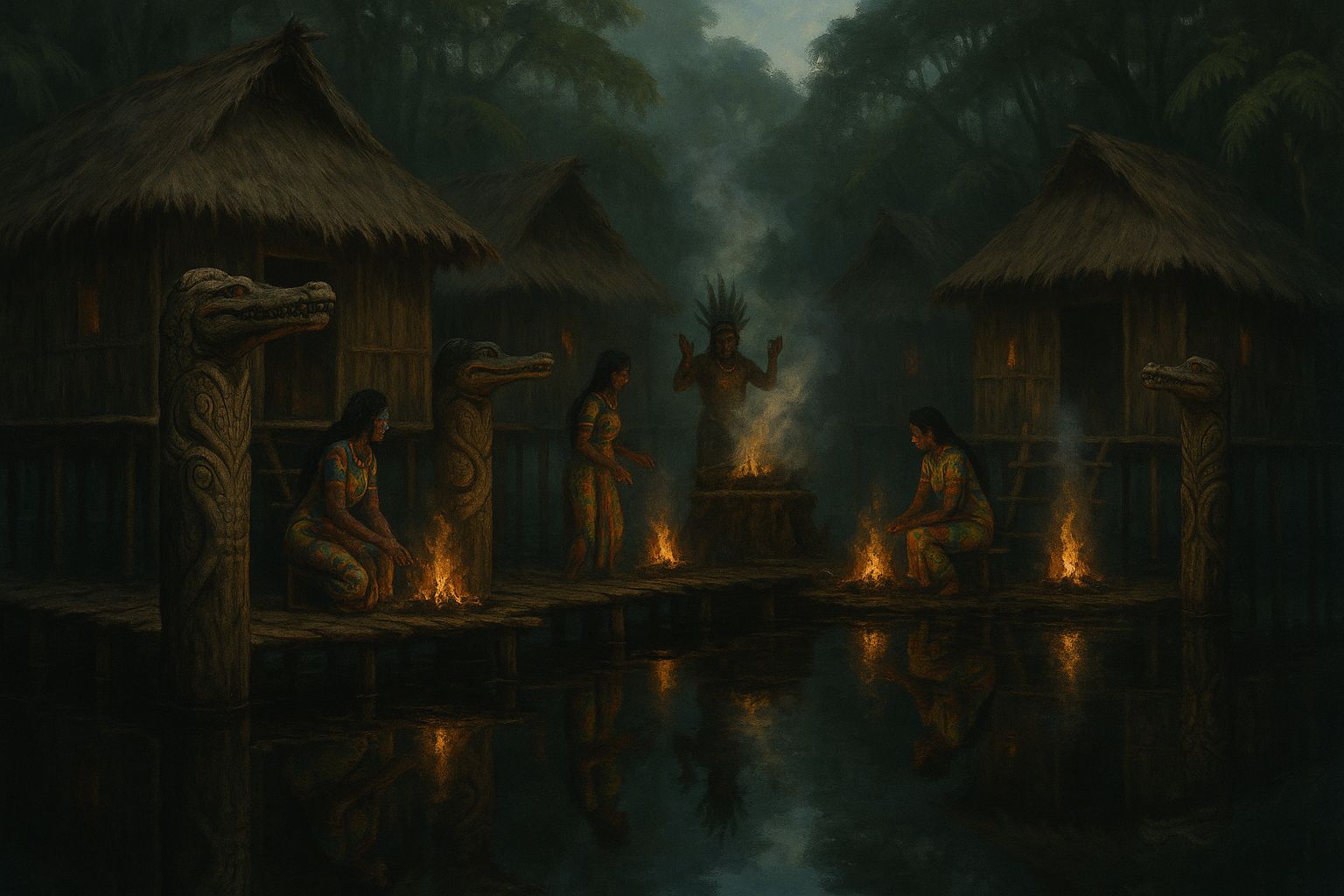
- Ishmara, a lakeside settlement, guarded by crocodile totems, where shamans gather for rituals.
- Varidru, a riverside fishing village, notorious for ambushing imperial barges.
- Kuzhuru, a hidden camp built high in the trees, said to house the fiercest poison-makers.
Major Empire Stations
The empire has many stations, but most in the jungle are now abandoned.
- Velthar Station, once a stronghold, now abandoned to the jungle.
- Dravess, an abandoned timber-cutting station along the Oruvek, its walls rotting in the damp.
- Kavros, known for its ivory stockpiles, raided twice by Karuun’s men.
- Lomarek, a manatee-hunting post deep in the delta, overcrowded and disease-ridden.
- Orvannis, positioned at a river fork, still clinging on with a strong garrison.
- Tirshava, slave depot, infamous for brutal overseers.
- Marothis, the empire’s last stone-built bastion in the region, now an overcrowded refuge.
- Ostrivar, a small trading pier, now used only to ferry oil out of the delta.
The delta is still full of small manatee rending plants, operating under constant threat of attack, to provide the empire with necessary lamp oil.