Drowned Marshes
A cold, wet backwater of reeds, peat smoke and tired little villages that survive by fishing, cutting fuel and enduring
| Story |
|---|
| Marn Zeller came in on a brown tide that moved like it had weight. The fog kept the shore hidden until the channel was already under his keel, marked by a line of stakes topped with tight reed twists. No flags. No lanterns. Just markers that appeared when he needed them. |
| The village called Reedmouth sat on stilts and patched embankments, roofs dark with peat smoke. A dock of old timbers waited, bowed and slick. Two men stood at the end. One caught Marn’s line with a boat hook. The other watched Marn’s hands. |
| "Oil, salt, needles," Marn called. "And cloth." |
| "Tie there," the hook man said. |
| Marn stepped onto the dock. Water dripped from somewhere above though the sky had cleared. He followed plankwalks past net racks and fish strips. He saw children in the way movement vanished between posts, a braid tip here, an eye there, then nothing. A dog lay under a house and did not lift its head. |
| Reeve Hessa Tern waited under a low shelter beside a peat fire that smoked more than it burned. She was small, wrapped in a reed cape, eyes steady. |
| "You are late," she said. |
| "The fog wanted company," Marn replied. |
| He opened his pack and laid out his goods one by one, careful to show empty palms between items. Hessa looked without touching. A woman stepped forward, tested a needle against leather, nodded once and stepped back. No comment, just acceptance. |
| "What do you take," Marn asked. |
| "Peat bricks. Smoked eel. Rush matting," Hessa said. "Honey, if you pay what it is worth." |
| A boy brought a jar sealed with wax and set it down like it might bite him. The wax bore a simple reed knot mark. Marn turned the jar in his hands, then glanced up. |
| Hessa named her price. It was high enough that bargaining should have been the next step. Her face did not change. Marn nodded instead. |
| They weighed salt on a stone scale mended with wire. Oil was measured into clay jugs with carved notches. The whole exchange happened in low voices, as if volume itself was a waste. |
| When it was done, Hessa placed a thin braided cord on top of his bundle. |
| "For mooring," she said. |
| "I have rope," Marn started. |
| "This holds in our mud," Hessa replied, and that ended it. |
| Back at the dock, nobody waved. They did not turn away either. They simply watched as he pushed off, the stake markers guiding him out, each appearing just in time. |
| Only when Reedmouth was a gray smudge behind him did Marn realize he had been holding his breath. |
| He did not open the honey until another coastline was in sight. The seal was intact. The reed knot mark looked the same. |
| He put the jar away and kept both hands on the tiller. |
Description
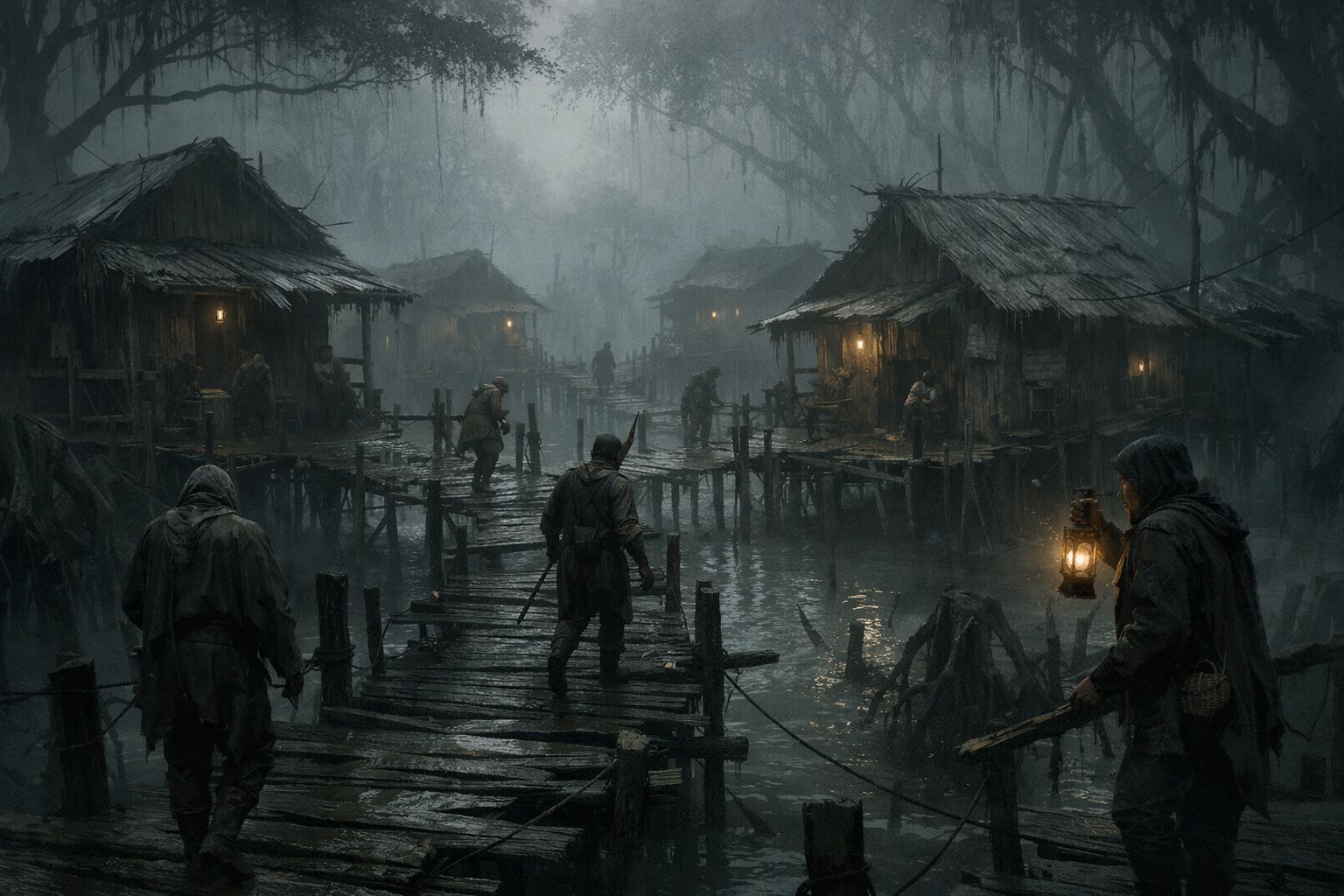
From a distance the marsh looks like a flat bruise on the horizon, gray water under gray sky with reed beds swaying like hair. The air is always damp. Fog is common even in fair weather and it turns sound strange. Voices carry in odd directions. Footsteps vanish into moss. Firelight looks weak, swallowed by mist and drizzle.
When you approach a village you notice what is missing as much as what is there. There are few bright colors. There is little music. Dogs rarely bark. People do not rush to the shore to greet boats. They watch from doorways and behind screens of hanging reeds, then return to their work as if you are a passing storm.
Land And Weather
The Drowned Marshes are a wide low country where the boundary between land and water shifts by the week. Some stretches are open pools and black channels. Others are mats of floating grass that look solid until they are not. Willow copses cling to the higher ground. Stunted alder and twisted pine grow where the soil has enough teeth to hold roots.
Rain is frequent. Cold rain in the long season, warm rain in the short one. Even on clear days there is a clammy film in the air. The ground never truly dries. The safest paths are not roads but raised lines of packed peat and old timber, maintained by whoever still has the energy to do it. Most travel happens by pole boat, flat skiffs pushed through channels that locals learn by memory.
Settlements And Architecture
Villages are built on stilts, on crude embankments or on the few natural ridges that rise above the floodline. Houses lean. Not because they are abandoned, but because the ground is always moving and repairs are constant. Walls are wattle and mud, patched so many times the original weave is hard to see. Roofs are thick thatch stained dark from peat smoke and damp.
Plankwalks link door to door, slick with algae and worn to a shallow curve. At the edge of most villages sits a drying rack forest of poles where eel, fish and strips of swamp goat hang in the wind. The village center is usually a wider platform, part dock, part meeting place, with a low shelter where a fire can be kept alive even in rain.
People And Daily Life
The marsh folk are practical, underfed by choice as much as by circumstance, lean in the way that comes from hauling nets and cutting peat since childhood. Clothing is layered and ugly on purpose, heavy wool, oilcloth, stitched reed capes, boots that are always damp. Jewelry is rare, usually a carved bone charm or a bead of amber fished from silt. A smile is not withheld out of malice. It is rationed because life here teaches caution.
Food is eel, pike, carp and marsh crab. There are bitter greens, onions, hardy roots and fungus breads baked over peat. Swamp honey exists but it is a luxury and usually traded away. Fuel is peat and driftwood. Iron is precious. Nails are saved, straightened and reused until they become too short to hold.
People speak softly. Not in whispers, just low. It is a habit that makes the villages feel subdued even when nothing is wrong. Outsiders often mistake it for fear. Locals will tell you it is respect for neighbors in thin walled homes and a preference for not drawing attention to oneself.
Authority And Custom
Most villages have a reeve or alder, a working leader rather than a noble.
Justice is simple. Theft is punished with restitution, hard labor or exile to another village that might accept you. Violence inside the community is treated harshly because everyone lives close and grudges poison small places fast. Oaths matter. Written contracts are rare. A handshake witnessed by the right people carries weight.
The marsh folk have a deep suspicion of strangers who ask too many questions, take too many notes or wander off paths without permission. They have seen too many travelers treat the marsh like an empty place, then complain when it bites back.
Trade And Travel
What the Drowned Marshes export is unimpressive but necessary: peat fuel, smoked eel, salted fish, rush mats, waterproofed rope, medicinal herbs like marsh sage and feverleaf, dyes pulled from bog flowers. What they import is grain, lamp oil, clean cloth, iron tools, needles and salt in bulk.
Travel is slow. A guide is worth more than a map. People suitable as guides have the title Poler. Polers know channels, tides and which docks are safe after dark.
Religion And Superstition
Faith here is small scale and local. Shrines are simple, a skull nailed above a door to ward off sickness, a bowl of coins sunk at a channel bend for safe passage, reeds braided into protective knots. The most common prayers are practical: for dry firewood, for nets that hold, for fever to pass, for a child to reach adulthood.
The marsh is full of folk warnings. Do not whistle at night. Do not follow lights across open water. Do not step off the plankwalk unless someone tells you where to put your foot. These are not presented as mystical laws. They are survival rules wrapped in story so children remember them.
How To Present It At The Table
Lean into drabness without melodrama. Keep the villages lived in, not gothic ruins. Give the players constant small inconveniences: wet boots, smoke that stings eyes, soup that tastes of river mud and herbs, a bed that never feels dry. Let kindness exist, but make it cautious and conditional. A bowl of hot eel stew offered without warmth in the voice. A blanket thrown over a stranger’s shoulders with a muttered, "Do not catch your death here."
Let the place feel poor and tired, then show competence. Nets are well made. Boats are repaired quickly. People know how to move in fog. They are not helpless. They are enduring.
What Outsiders Say
In ports the Drowned Marshes are dismissed as a misery land where nothing grows and everyone smells like peat. Traders call marsh folk tight fisted and suspicious. Sailors insist the fog steals time and direction. None of these stories are entirely fair, but they are common.
What is true, from an outsider’s perspective, is simple. The Drowned Marshes are not welcoming, not rich, not easy. They are a place that survives by keeping its life small and its problems quiet.