Trapper Gastved
Gastved moved through the winter forest without hurry, because there was no need for it. Snow lay deep between the trunks, clean and unbroken except where animals had passed, and he read those signs the way others read maps. The wind slid low and steady from the north, cold but honest. He paused once, turned his face to it, felt how it pressed against his cheek, then nodded as if something had been confirmed.
He chose a stand of spruce along a shallow rise, where the ground held firm and the trees broke the worst of the wind. With an axe, a knife, and a length of rope, he set to work. One tree leaned where he wanted it, braced against another. Branches were cut and layered, angled to shed snow rather than catch it. He packed the gaps with moss and needles, pressing them in with gloved hands until the shelter breathed but did not leak heat. A thick bed of spruce boughs went down last, enough to keep the cold from clawing up from the ground. It was not a cabin. It did not need to be. It was dry, quiet, and knew its place.
He built the fire a short distance from the opening, low and careful. He listened as much as he looked, feeding it until the sound was right. Not snapping. Not whining. Just a steady, patient burn. Satisfied, he rose and walked the line he had already marked in his mind.
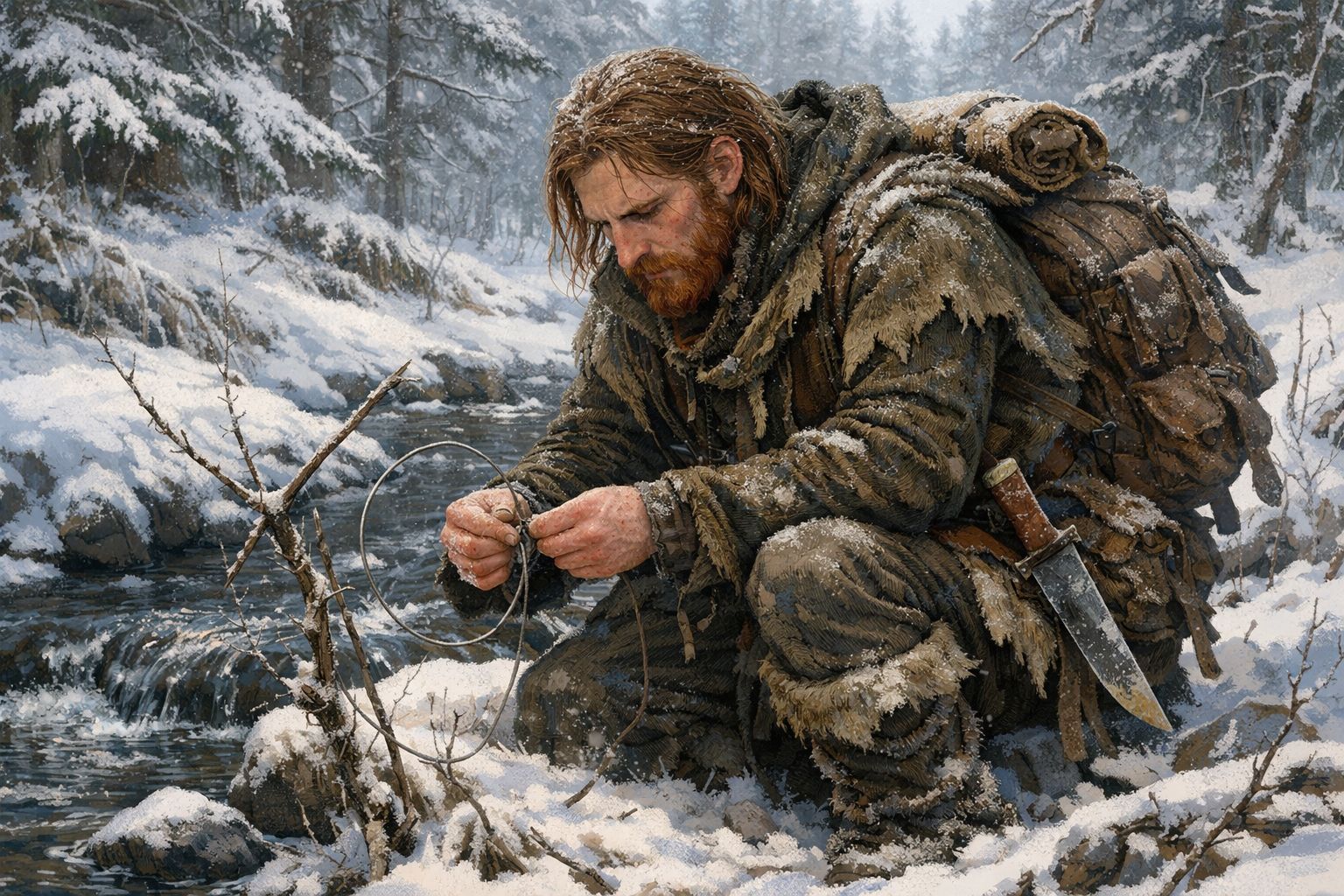
The trap lay along a narrow run where the snow dipped and tracks crossed again and again. The wire was tight. A hare hung still, caught clean, the body already cooling. Gastved knelt, checked it once, then nodded. He murmured a brief thanks, more habit than prayer, reset the trap without thought, and turned back.
By the time the meat was dressed and cooking, the shelter held warmth well enough to take the edge off the night. Fat hissed softly over the fire. The smell was plain and good. He ate slowly, seated on a log, boots turned toward the flames, steam rising from his breath and the food alike. Outside, the forest creaked and shifted under frost and weight, but inside the circle of light there was heat, shelter, and meat enough.
Gastved leaned back against the spruce, comfortable, eyes half closed, listening to the fire tell him that everything was as it should be.
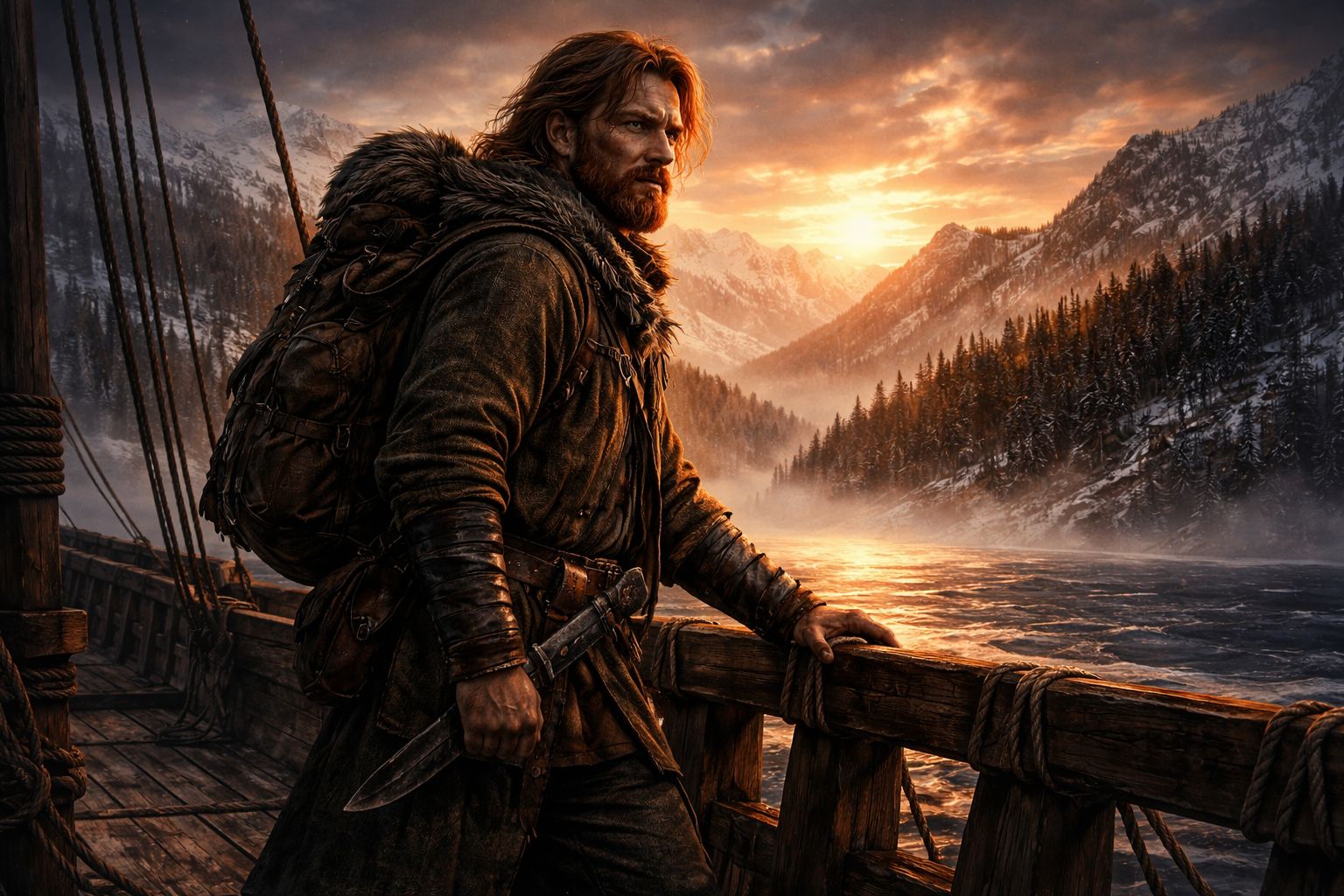
Background
Gastved was born into contradiction.
His mother, Elyra, came from Para Omros, where faith was law and law was punishment. Her back bore the scars of rope burns and ritual fire, layered into patterns she never spoke of unless the night was very quiet. When Draknir raiders took her, she expected worse. Instead, she found air, food, and a world where obedience was not enforced by pain.
She was taken as a slave wife by Björn Strongaxe. It was not a gentle beginning, but it became something else. A year later, Björn took a stand in front of his own kin at the Althing to argue for freeing her, and after that, she was free. She took the Strongaxe name. She learned the rites of Keldrakka and Thunrath, and though she never lost her fear of priests or chanting, she learned to sleep without listening for footsteps.
Gastved was born as Gauti Strongaxe, and grew up hearing two kinds of silence. The heavy silence of fear from his mother, and the patient silence of the forest from his father. He learned early which one kept him alive.
He was never loud. Never boastful. Even as a boy, he listened more than he spoke, watched more than he acted. When others practiced with axe and shield, he followed tracks. When others trained for war, he learned where animals crossed streams and where snow collapsed under weight.
The forest taught him faster than any man could.
Becoming Gastved
The nickname came in his teens.
A winter hunt went wrong. A blizzard rolled in early, swallowing sound and sight. Three hunters vanished. The clan prepared for burial songs.
Gastved came back alone three days later, dragging two of them alive on a sled he had built from branches, rope, and a broken shield rim. He wore a wolf pelt none of them recognized. When asked how he survived, he only shrugged and said the forest had not wanted him dead.
After that, people only saw him when he wanted to be seen.
Trappers began saying that Gastved walked like a ghost through trees. Hunters swore they heard him breathing behind them without ever seeing him. Children said he talked to animals. He never corrected them.
They started calling him Gastved, the forest ghost, and he didn't discourage it.
The name stuck.
Gastved no longer uses the name Gauti outside of formal clan matters. Among hunters, sailors, and strangers, he answers only to Gastved.
Skills and Craft
Gastved is a smith by trade, though he never calls himself one.
He works iron the way he works wood. Quietly. Without flourish. His blades are plain but sharp and strong, his fittings functional, his repairs invisible once done. Nails that never loosen. Hinges that never squeak. Tools that feel better in the hand than they look on the rack.
His true mastery is trapping and survival.
He understands animals as systems rather than creatures. Hunger, movement, habit, fear. He can set a snare for a mouse or a deadfall for a bear with equal care. He wastes nothing. Every trap is built to kill clean or not at all.
Among the Strongaxe, in the mead hall, it became a running joke that you could strip him naked in winter, give him a knife, and come back to find a cabin, smoked meat, and pelts drying by the fire. Gastved never joined the laughter. He did not think it was funny. He thought it was obvious.
He is not strong. He is hard. Cold does not slow him. Hunger sharpens him. Pain is something he acknowledges and works around.
The Feud and the Fall
The feud began with love, as they often do.
Stein Strongaxe, his cousin, had a married woman from the Frostvein family as his lover. When she became pregnant, words were exchanged. Words became fists. Fists became blades.
Stein killed two men. The families demanded blood. Holmgång was refused, first by one side, then the other. Pride hardened. Raids followed. Children were hidden. Fires were set in the night.
The feud lasted ten years.
Gastved avoided it as much as he could. He hunted farther out. Stayed away longer. He did not believe more blood would fix what had already been broken.
It did not matter.
One winter raid ended it. The Strongaxe were wiped out to the last hearth. Women, elders, children. No duels. No honor. Just fire and steel, a longhouse with barred doors burned.
Gastved was hunting when it happened.
When he returned, there was nothing left to bury.
Exile and the Hunt
With the clan dead, the feud had only one direction left.
The Frostvein family declared him blood owed. A bounty was placed. Hunters were sent.
Gastved did not answer the challenge. To fight openly would have been suicide. So he vanished into the wilderness. He led his pursuers into marsh and snow and broken ground. He never fought fair. He never fought at all, if he could help it.
Several hunters did not return.
One did, limping, frostbitten, babbling about traps under the snow and shadows that watched.
The bounty was raised.
That was when the Blue Marlin found him. Or more accurately, when he allowed himself to be found.
The crew saved him during an ambush that would have ended badly. Gastved did not ask for revenge. He asked for passage.
As the last living Strongaxe except for his uncle Ulfar, who had joined the Waverider years earlier, he claimed the right to bind himself elsewhere. The crew accepted.
Life aboard the Blue Marlin
Gastved keeps to the edges of the ship when he can. He sleeps lightly. He prefers the smell of tar and rope to incense or perfume.
As a smith, he is indispensable. He works closely with Galenor and Nera, translating ideas into metal, solving problems without argument. He does not care who gets credit.
As a wilderness expert, he complements Ileena rather than overlapping her. Where she moves and kills, he prepares and waits. Where she reads motion, he reads absence. Cold climates, long journeys, supply planning. When Gastved says they have enough food, the crew believes him. It might not be tasty, but they will not starve.
He speaks little. When he does, people listen. He has no interest in persuasion. He simply states what is likely to happen.
He does not drink much. He does not gamble. He watches storms.
Beliefs and Hatreds
Gastved considers himself fully Draknir.
Any suggestion otherwise is met with quiet fury. His mother chose Draknir. Bled for it. He will not let her be reduced to an origin story.
Para Omros, however, is another matter.
He hates it with a depth that never flares, never cools. A cold, steady loathing. He has seen what it does to minds. He has seen the way fear settles into bone.
He does not speak of this unless asked. When he does, his voice does not change.
He has no gods he favors openly, but those who know him suspect Neruvahl hears his prayers more often than he admits. Not for comfort. For endurance.
Relationships
He is closest to Ileena and Shaedra, bound by shared understanding of land and instinct rather than words.
He spends long hours with Galenor and Nera, working iron, adjusting designs, fixing what breaks.
He respects the crew collectively, but he does not seek leadership or command. He follows plans that make sense. He questions those that do not.
Trust, once given, is absolute.
On Revenge
Gastved does not seek vengeance.
He hates the family that destroyed his own. He does not forgive them. He also acknowledges that the feud could easily have ended with the roles reversed, and that both sides played their part in escalating it. Blood spilled thirsts for more blood, but he does not believe more blood will restore anything worth having.
If they come for him again, he will survive. If they do not, he will let the feud die with the dead.
To him, survival is not cowardice. It is refusal.
Roleplaying Notes
Gastved speaks little and never in haste. He listens fully, thinks things through, and when he speaks it is to add something necessary, not to fill silence. He avoids open conflict, does not posture or threaten, and treats violence as a tool of last resort. When it happens, it is quick, deliberate, and without emotion.
He moves with quiet efficiency, always repairing, observing, or preparing. Nature is a system to him, not poetry. Loyalty, once given, is absolute. Mentions of Para Omros make him go cold and still, and on revenge he is immovable. More blood solves nothing. Survival does.