Fun to Be Bad
| Story |
|---|
| The merchant was dead when the Blue Marlin reached the cove. |
| His ship had burned to the waterline. Crates floated in the shallows. Bound sailors knelt on the beach, guarded by three nervous pirates. |
| Captain Scarnax looked at the wreck. |
| "You burned the ship." |
| "It fought," one pirate said. |
| "It floated," Scarnax said. "Those are not the same thing." |
| Behind him, Amaxia laughed softly. Nasheem waited with one hand near his knife. Shaedra watched from the rocks, arrow loose against the string. |
| The pirates noticed too late that they were being counted. |
| One bound sailor found his voice. "Please. We can pay. My master has friends in Estoria." |
| Scarnax crouched before him. The sailor was young, sunburned and shaking. A slave brand marked his shoulder. |
| "Your master is dead," Scarnax said. |
| The boy swallowed. "Then I am free?" |
| Scarnax smiled, not kindly. "Not yet." |
| The hope in the boy's face changed shape. |
| Scarnax stood. "You get a tenth of the cargo for finding it. Another tenth if you help load. The prisoners are mine." |
| "We captured them." |
| "And then waited on a beach with no ship and no plan. I am correcting that mistake." |
| The pirate looked at the Blue Marlin beyond the reef and lowered his eyes. |
| "As you say, captain." |
| Caelin took command of the loading. The boy watched as his ropes were cut and replaced with lighter cord. Not cruel. Practical. That frightened him more. |
| "What happens to us?" |
| "You work. You eat. You obey. If you are useful, you live better than before. If you are loyal, one day you may stand where my crew stands now." |
| "And if I refuse?" |
| Amaxia smiled. |
| Scarnax did not. |
| "Then you learn that freedom is not something the sea gives away because a better monster killed the first one." |
Description
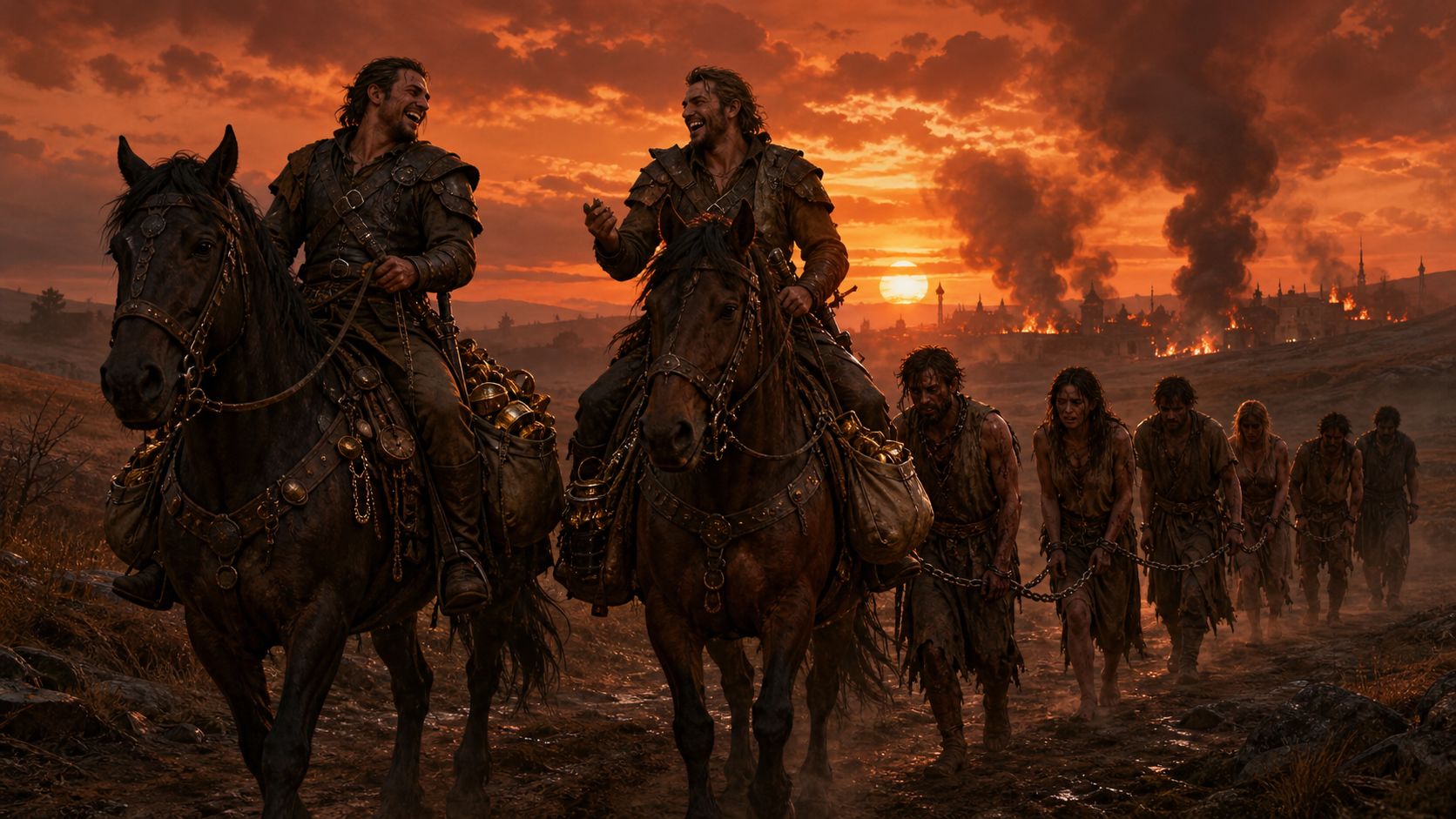
This flavor package shifts Heroica from dark adventure into villain centered adventure. The players are not bright champions standing against a cruel world. They are part of that cruelty. Not its worst expression, perhaps, but certainly not its cure. They are pirates, opportunists, mercenaries, slavers, spies, oathbreakers, smugglers or noble predators who move through a world already built on exploitation and decide to take their share.
This does not mean the campaign becomes random sadism. That would get boring quickly, and worse, it would flatten the setting. The players should still have enemies. They should still hate tyrants, fight monsters of power, betray worse villains and sometimes help people. The difference is motive. They do not rescue captives because slavery is wrong. They rescue captives because those captives are valuable, skilled, beautiful, useful, politically important or because freeing them damages an enemy.
Heroica already asks how every culture is bad. This package asks what happens when the player characters are no exception.
The Core Shift
In a normal Heroica campaign, the world is dark so the players can push against it. In It's Fun to Be Bad, the world is dark and the players learn to thrive in it.
The crew does not stand outside the systems of power. They enter them. They buy favors. They threaten witnesses. They take hostages. They accept bribes. They keep useful captives. They may still have standards, but those standards are personal rather than heroic. They might refuse pointless cruelty, protect their own, punish betrayal and despise waste, while still owning people, robbing the weak and killing when profit demands it.
The important distinction is that they are protagonists, not heroes. The story follows them because they are interesting, competent and dangerous, not because they are morally right.
Not Atrocity Tourism
The tone should never become "how horrible can we be tonight." That is not drama. That is just escalation without meaning.
Villain centered play works best when evil is treated as structure, temptation and consequence. A captain who takes slaves because the ship needs labor creates tension. A noble who spares an enemy because ransom is worth more than revenge creates tension. A sorcerer who saves a village only because it hides a relic creates tension. The fun comes from being ruthless, clever and self serving in a world where that actually works.
The Game Master should avoid lingering on suffering for shock value. A dark choice should be clear enough to matter, but not described in indulgent detail. Focus on bargains, fear, loyalty, leverage, reputation and the cost of being feared. The players should feel the pleasure of power, but also the burden of maintaining it.
The Player Characters' Code
Bad people are more interesting when they have rules.
Before the campaign begins, each player should define what their character will not do. These limits do not need to be noble. They can be personal, hypocritical or strange. A pirate may kill merchants but never children. A slaver may keep captives but never break families apart. An assassin may murder for coin but refuse torture. A noble may exploit peasants but protect anyone under their banner. A priest may commit horrors for their god but never lie.
These limits are not there to make the characters secretly good. They are there to give them shape. A villain without limits is predictable. A villain with principles becomes playable.
The Game Master should then build pressure around those lines. Not constantly, and not as a trick, but enough that the players understand who they are when profit, safety and pride all point in the wrong direction.
Slaves, Servants and Captive Crew
This package can radically change how rescued NPCs join the Blue Marlin.
In the standard campaign, freed slaves can become crew because the Blue Marlin represents safety and dignity. In this version, the ship may simply change ownership. Nera is not rescued from Varro Licentius into freedom. She is taken from a bad master by a more useful one. Silvio might be bought, stolen or claimed. Ormun might be transferred as payment. Cassandra might bargain for a better chain rather than no chain at all.
This can create strong drama, but it needs careful handling.
The goal should be development, not permanent degradation. Captive NPCs should have agency, memory and personality. They should make choices inside their limited power. They should bargain, manipulate, earn trust, hide talents, lie when needed and slowly change their position. Over time, some may become trusted servants, then valued specialists, then free companions. Others may remain resentful. Some may escape. Some may betray the crew and be completely justified in doing so.
Freedom becomes something earned, negotiated, granted, stolen or taken by force. That makes it more dramatic, but also more dangerous as a theme.
Respect Is Not Kindness
A useful tone for this package is "cruel but not stupid."
The crew may own people, but they should quickly learn that brutalizing skilled captives is wasteful. A terrified healer works badly. A starving sailor climbs poorly. A humiliated diplomat remembers every insult. The smartest villains understand that comfort can be a leash, gratitude can be cultivated and status can be given in small measures without surrendering control.
This creates a different kind of ship culture. The Blue Marlin may be harsh, but it is not chaotic. Food is regular. Work is organized. Punishment is predictable. Advancement is possible. A captive who proves useful can gain privileges. A servant who saves the ship may be rewarded. A slave who becomes indispensable may become too valuable to treat casually.
That does not make the arrangement good. It makes it stable, and stability can be more unsettling than open cruelty.
Fighting Worse Monsters
The players will still fight villains. In fact, they should fight many of the same enemies as in the standard campaign.
The difference is framing.
They do not oppose Praxon because he is cruel. They oppose him because he controls Ironspire and they want his position, his money or Cassandra. They do not strike against the Empire because slavery is evil. They strike because the Empire is a rival predator whose laws threaten their freedom. They do not sabotage Srel because massacre is wrong. They do it because the Sreli are dangerous, arrogant and vulnerable to a well timed knife.
This makes the world more cynical, but not less active. Bad people fight each other constantly. Sometimes the result helps the innocent. Sometimes it only changes which banner flies over the cage.
The Game Master should let accidental good happen without pretending it was intended.
Reputation as Currency
In this package, reputation matters more than virtue.
The crew should become known for specific patterns. Perhaps they keep bargains once paid. Perhaps they never abandon their own. Perhaps they are merciless to mutineers but generous to informants. Perhaps they buy slaves with rare skills and later free those who prove loyal. Perhaps they destroy anyone who cheats them, even across years and oceans.
Let NPCs respond to this. Merchants may fear them but still trade because they are reliable. Slaves may dread being taken by them but also know their ship feeds its people. Warlords may prefer negotiation because betrayal carries a memorable price. Enemies may spread atrocity stories, some true, some exaggerated, some invented because fear is useful.
The crew's name should become a tool. Doors open because people are afraid. Others close for the same reason.
Table Limits and Expectations
This package requires a direct conversation before play begins. Not a vague warning. A real agreement.
The Game Master should define what themes are allowed, what themes are off screen and what themes are not part of the game at all. Slavery, coercion, torture, sexual violence, cruelty to children and humiliation can destroy a table if handled carelessly. Some groups may want none of these in player hands. Some may allow them only as background. Some may allow hard topics but fade out before detail. The agreement matters more than the setting.
Player characters can be bad without every kind of evil being available for play.
The Game Master should also make clear that "my character would do it" is not enough. The comfort of the table is more important than fictional consistency. When something crosses a line, the game pauses, adjusts and continues without argument.
The best version of this package is not careless. It is disciplined.
Practical Safety Tools
Establish hard limits before the first session. These are subjects that do not appear, not even as threats.
Establish soft limits as subjects that may exist but stay vague, off screen or quickly faded out.
Use a simple stop signal at the table. Anyone can use it. No explanation required.
Let players revise limits later. People often discover discomfort only once play begins.
Avoid making player characters perform cruelty to progress the plot. Offer ruthless options, but do not make the game depend on crossing a boundary.
Do not punish a player for choosing restraint. In a villain campaign, restraint should be a valid form of power.
Campaign Adjustments
The Waverider campaign still works under this package, but its emotional spine changes.
Curio Maximus does not hire the Blue Marlin because they are good people. He hires them because they are fast, discreet and deniable. He wants truth, not morality. If they rob tombs, bribe officials or leave bodies behind, that is acceptable as long as they return with answers.
The Waverider itself becomes an interesting contrast. Perhaps Solonex and his crew were better people. Perhaps they were simply another powerful ship with better public manners. The more the players hear stories of the Waverider helping others, the more they must decide whether they admire that, resent it or see it as weakness.
Each crew recruitment changes tone. New NPCs may join out of debt, fear, ambition or calculation rather than gratitude. Some may hope to reform the ship from within. Some may be corrupted by it. Some may decide this is the best life Heroica is likely to offer them.
The campaign becomes less about saving people and more about building a power of their own.
The Temptation of Improvement
One useful long arc is to let the crew begin as openly bad, then slowly become more complicated.
Not redeemed. That is too easy.
Instead, let them discover that competence requires trust. Trust requires restraint. Restraint creates loyalty. Loyalty creates a crew. A crew is not just property. It is a living thing with memory and judgment.
A captain may begin by owning people and end by realizing that free specialists fight harder. A thief may begin by exploiting fear and end by preferring admiration. A mercenary may begin by selling violence and end by choosing enemies because some clients are too disgusting to serve. These changes should emerge from play, not from lectures.
The Game Master should not force redemption. The players may prefer to remain villains. That is valid. But the door to becoming something stranger than villains should remain open.
Consequences
The world should not morally correct the players every session. Heroica is not fair enough for that. Sometimes bad actions should work. Sometimes cruelty should be profitable. Sometimes betrayal should be the right tactical choice.
But consequences should accumulate.
Captives remember. Enemies seek revenge. Former allies grow afraid. Ports deny docking. Priests curse names. Bounties spread. Crew members who are treated poorly become unreliable. A slave freed by an enemy may know the ship's layout. A spared foe may become useful. A murdered witness may have had a brother in the next city.
Villain play becomes dull if nothing pushes back. The Game Master should not punish evil because it is evil. The Game Master should make evil social, practical and political. Every act creates a trail.
Tone and Themes
It's Fun to Be Bad is a campaign of power, appetite and consequence. It makes Heroica darker by removing the comforting idea that the protagonists are naturally better than the world around them.
The tone should be sharp, stylish and dangerous. Let the players enjoy being feared. Let them make ruthless bargains. Let them take what others would beg for. Let them laugh when the plan works and the richer villain realizes too late that he was not the predator in the room.
But keep the weight.
Chains are still chains when the player characters hold them. Mercy is still mercy when it serves ambition. A rescued slave is still a person if the crew calls them cargo. The world may reward power, but it remembers how that power was used.
This flavor package asks a simple question.
In a world where almost everyone with power is bad, what kind of bad will the players choose to be?