Changelings
The inn was quiet that night. Too quiet.
Old Merrel leaned close to me over his mug, his voice a whisper. “Did you see the tanner’s boy today? Yesterday he had a scar on his cheek. Today, nothing. Skin smooth as a babe’s. You tell me that’s natural?”
At the next table, a woman crossed herself and muttered, “I heard him stammer at the creed. Missed half the words. My grandmother told me that’s how you spot one of them.”
The innkeeper spat into the hearth. “I’ll tell you how you spot them. Salt. They choke on it. Give him a spoonful and see if he swallows.”
The talk grew louder, every tale darker than the last. One man swore changelings bled black, another that they couldn’t stand before a mirror, another that they ate the children they copied. None of them had proof, but every face around the fire nodded as if it were gospel.
By the time the tanner’s boy himself came in, smiling shyly, the room was full of hard stares. A dozen hands seized him, and shoved a large spoon of salt into his mouth. He choked on it, clearly proof of a changeling. They dragged him out into the night, his cries lost in the rush of angry voices.
I did nothing. None of us did. We all told ourselves it was better this way. Better to burn one than to risk a town of impostors.
I only wanted bread.
The market was crowded, and I clutched my father’s coin tight. The baker smiled when he saw me, but when I reached for the loaf with my left hand, his face changed. He froze, staring as if I had done something obscene.
“Left hand,” he muttered. “Did you see? Devil’s hand.”
The woman behind me gasped. “I knew it. My grandmother always said left-handed ones are changelings, mirror-born.” An old man pushed closer, swearing he had seen my scar fade, though I never bore one. Their whispers wrapped around me like a storm.
Someone shouted, “Salt him!” A pouch was thrust into my hand. I choked on the sharp grains, coughing from the dry bite in my throat. That was all they needed.
Rough hands seized me. I cried out for my father, but he was nowhere in the crowd. They dragged me into the square, shouting “Monster! Impostor! Thief of flesh!” I tried to explain, but no one listened. To them, I was already lost.
The ropes cut my wrists. The pyre grew high. I begged the gods, any gods, to let someone see the truth, that I was only a boy, no more than twelve summers, guilty of nothing but being born different.
No answer came. Only the roar of flames, the taste of smoke, and the faces of my neighbors watching me burn.
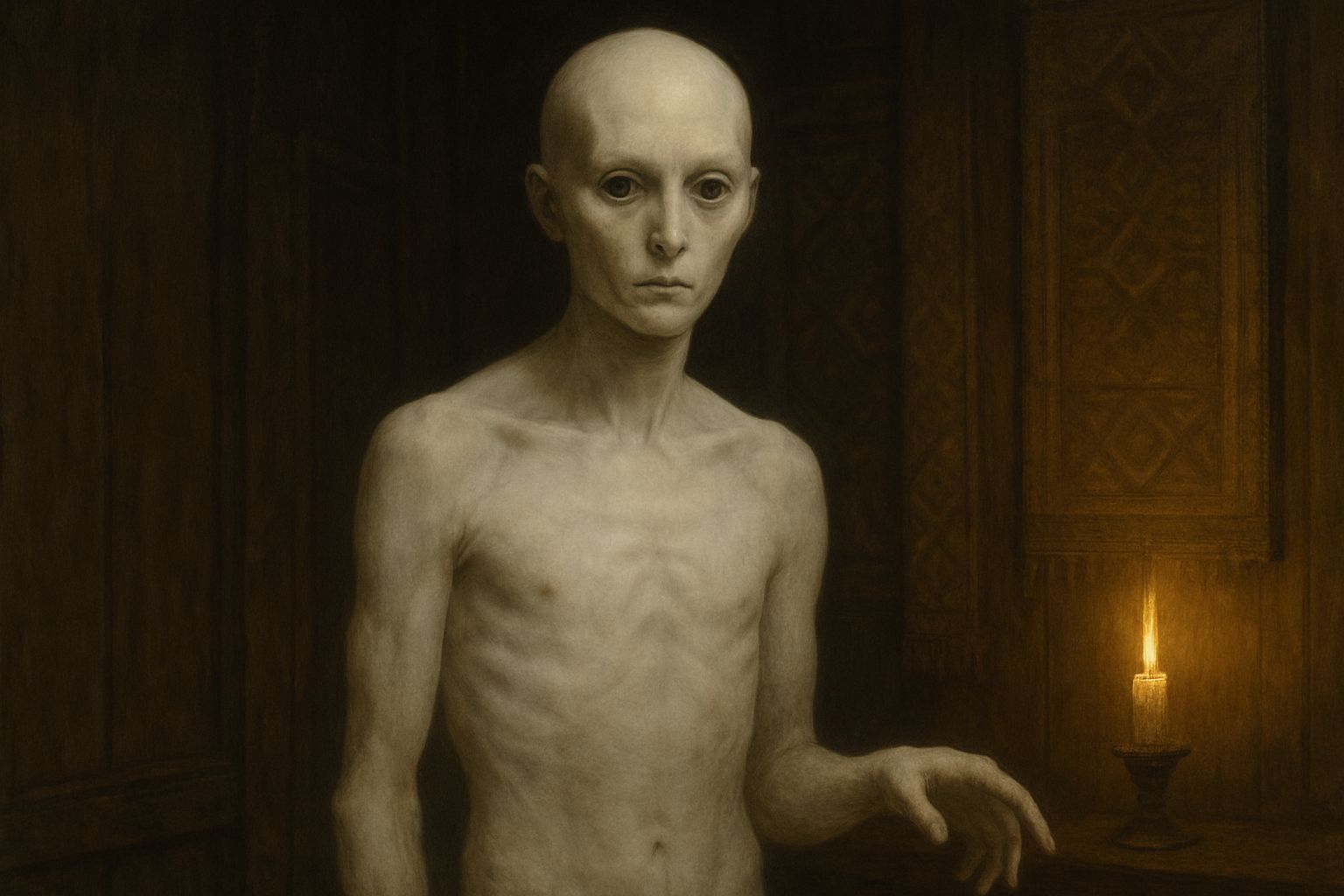
Changelings are a hidden people, scattered among human and nonhuman lands alike. Their gift of changing form is slow, deliberate, and requires study, but it has led to endless suspicion. To common folk, the very idea that a neighbor might not be who they seem is terrifying. For this reason, changelings are feared, hated, and hunted.
Despite the terror they inspire, changelings are no different in nature from humans. They laugh, love, quarrel, and dream as anyone else. Yet suspicion is a heavy burden, and many live isolated or in wandering bands, trusting few outsiders. Some hide openly, taking the guise of commoners for years at a time. Others embrace secrecy, passing from one mask to another without a true name.
Beliefs
There are many folk lore myths about changelings. These are untrue, but widely accepted.
- Left handed people are changelings, being mirror images of humanity.
- Changelings eat the person they copy to steal their form.
- Changelings cannot eat salt.
- Changelings have a low pain threshold.
- Changelings have blood that never clots.
- A changeling submerged in water will eventually reveal their true form.
- Changelings will not pray to the gods, for their false souls may be burned away.
- Changelings will not keep a dog or horse, since animals sense what they are.
- A changeling who looks into a mirror sees only their true face.
- A changeling can instantly recognize another changeling.
Truth
Changelings are, in most respects, as human as any other folk. They have children, families, and cultures of their own, though these must remain hidden. Their transformation is slow and taxing, taking hours and concentration. Copying a stranger without study is impossible. They bleed red, they eat the same food as others, and they die the same deaths.
For all the hatred directed at them, changelings harbor no grand conspiracy. They only wish to live, to avoid the flames of the next inquisition, and to pass on their gift to another generation.
Religion
Changelings hold to no temples of stone, for stone lasts too long and invites discovery. Their faith is a quiet one, spoken in whispers, shared in circles of firelight, or carried in memory from parent to child. To them, divinity is not fixed. Just as they wear many faces, so too do the gods shift, change, and reveal themselves in many guises.
They believe the world is a mask, every river, tree, and mountain a face the divine has chosen to wear. Some say there is only one god, the Shifting One, who moves through all appearances. Others say the gods themselves are changelings, and that every god in every faith is just another form of the same truth.
Core Beliefs
Truth of Masks: All things wear a mask, and what lies beneath can never be fully known. To live well is to accept the mask and still show kindness.
Sacred Transformation: Their gift of change is holy, a shard of the divine given to their people alone. Changing form is not just survival, it is prayer.
Cycles of Self: Life is not a straight path but a circle of faces. One soul may live many lives, not through reincarnation, but by wearing new masks across time.
The Hidden God: Changelings believe the divine walks among mortals unseen. Every beggar or merchant could be the Hidden God, testing whether mortals treat strangers with mercy or cruelty.
Practices
Veil Offerings: Before a change, some carve or weave a small mask and burn it in fire or water, a gift to the Shifting One.
The Sharing of Names: When trust is deep, changelings share not only their current name but every name and face they have ever worn. To betray that confidence is the gravest sin.
Night Vigils: During certain moon phases, groups gather in silence and sit masked, speaking only when moved by inspiration. The masks are then broken, a reminder that no shape is forever.
View of Other Faiths
They rarely dismiss the religions of others. Instead, they see them as glimpses of the same shifting divinity. A changeling might pray alongside humans to the sun god, then with elves to the star spirits, and see no contradiction. To outsiders this looks like deception, but to a changeling it is natural, each god is but another mask.
Origins
Long ago, the changelings say, they were as any other folk. They had one face, one life, and no more. But when the world was young and the gods walked openly, there was one deity who loved disguise above all. This was the Shifting One, a trickster and wanderer, who wore the shape of beast and bird, man and woman, river and flame.
The Shifting One sought companions who could follow them in their wanderings, but none of the peoples could change swiftly enough. So the god touched a small tribe of humans, breathing into them a fragment of their own power. These became the first changelings, gifted with the ability to take on new faces.
Other stories are told:
- Some say the first changelings were children stolen from their cradles by fae, left with the power to change so they would never be claimed by either world fully.
- Others claim a curse. That a king once begged the gods for immortality, and was instead given endless masks. His descendants carry the gift, but no true face of their own.
- Human folk whisper a darker tale: that the first changelings were traitors who sold themselves to demons, trading their souls for the ability to wear any guise. This is told to frighten children into distrusting strangers.
The Nature of the Gift
The ability is neither quick nor simple. A changeling cannot slip from one face to another in the blink of an eye. Flesh must be coaxed, bones reshaped, muscles pulled into new form. It is a slow rite of will and patience, often taking half a night. The closer a changeling has studied a person, the more perfect the change. Without study, the change becomes guesswork, often flawed in detail.
The Changeling’s True Form
Most folk never see a changeling’s natural shape, for they keep it hidden as carefully as their names. Those who have claim it is unsettling, not monstrous, but strange in ways that make the skin crawl.
The natural form is slight, hairless, and pale as milk. The skin has a faint translucence, so that in strong light veins show beneath. The face seems unfinished, as though the sculptor stopped too soon. The eyes are large and gray, with little distinction between iris and pupil, and the lips are thin and colorless. The nose and ears are small, almost childlike, lending them an uncanny softness.
Their bodies are wiry, neither strong nor frail, with long fingers that seem made for shaping and grasping. When they speak in this form, their voices are flat and low, as if lacking the resonance of a settled face. They are not beautiful, nor ugly, but ghostly, an outline of a person, rather than a person themselves.
Many changelings find their true form uncomfortable to wear, not because it causes pain, but because of how others react. A glimpse of it is often enough to stir whispers of witchcraft and possession. Even among themselves, changelings sometimes prefer to meet in borrowed guises, for it feels safer to look through masks than to face the unfinished truth.
Among their own kind, however, the natural face holds deep meaning. To reveal it is to bare one’s soul, to admit trust, to say, this is who I was before the masks. Some lovers never show each other their true forms. Others do so only once, as a vow.
Religious interpretation of the True Form
To outsiders, the changeling’s natural shape looks unfinished, eerie, like a sketch not yet painted. But to the changelings, it is sacred. They call it the First Face, the shape given to them when the Shifting One first breathed the gift of change into their blood.
Sacred View
In their religion, the First Face is not a curse, but the root of all other masks. Every transformation begins and ends there. To show one’s First Face is to strip away every disguise and stand as one truly is before the divine. Some believe that when they die, the Shifting One greets them not in any of their worn guises, but in the First Face, and weighs their life by what they did behind the masks.
Rituals
- The Unmasking: Once in a lifetime, usually at the turning of adulthood, a changeling will reveal their First Face to their closest kin or companions. It is both an act of trust and a spiritual offering, saying, see me as I was made.
- Silent Vigils: Some sects fast and keep their First Face for a full cycle of the moon, refusing the comfort of borrowed guises. This is seen as purification, a reminder of humility.
- Burials: The dead are always returned to their First Face before burial, for only that shape is thought to be recognized by the Shifting One in the beyond.
Divergent Views
Not all changelings feel comfort in the First Face. Some see it as a mark of exile, a reminder that they are not like other folk and will never be accepted. For these, wearing a mask is a kind of freedom, and they avoid their natural form as much as possible.
Others, more mystical, say the unfinished look is proof of their divine kinship, that mortals are fixed, but changelings remain clay in the hands of the Shifting One, able to take on infinite faces because they themselves are unbound.
Similarities with N'gazama
Their religions has some striking similarities with the beliefs in N'gazama.
One theory claims both traditions are remnants of an ancient, forgotten cult that predated the division of peoples. Perhaps long ago, before empires rose, a single faith of the Masked World was known, and only the changelings and N’gazama preserved its fragments.
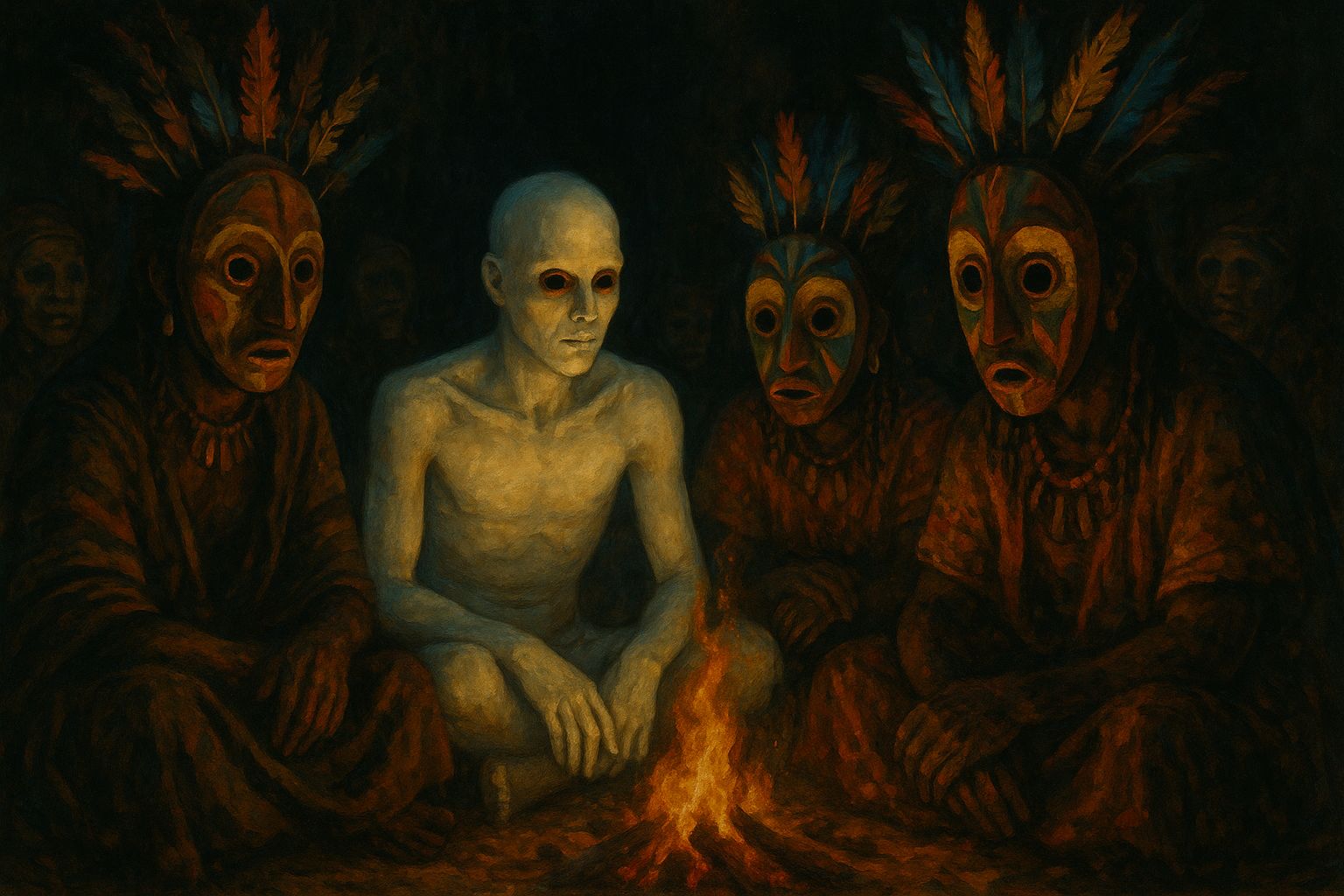
I wandered for many months before the jungle took me. The trees of N’gazama rose so high they seemed to wear the sky itself as a mask, and the air was thick with voices that were not my own. I had thought myself skilled at hiding, but here the spirits watched every step.
The people who found me wore painted masks of wood and feather. They did not ask my name. They only said, “The forest already knows who you are.”
At night, around their fire, they told me the stories of the world. That the river wears the mask of water to hide its teeth, that the storm is the mask of a hunter-god, that even silence wears a mask, which breaks when you speak.
I told them of my own people, how we too wear many faces, how the gods shift through every form, and how we call this the Truth of Masks. They listened, their eyes bright behind painted wood, and one elder laughed softly. “Then perhaps you are not strangers after all. Perhaps you are kin who forgot the forest.”
For a time, I almost believed it. Their masks were carved of wood and mine of flesh, but when we sat together, I felt less alone than I ever had.
When I left, they gave me a mask of their own making. “So you will never walk bare before the spirits,” they said. I keep it still, though I have worn a hundred faces since.
Sometimes I wonder if the Shifting One and the Masked Spirits are the same, two guises of one wandering god. If so, then perhaps I was never meant to be alone. Perhaps the world itself is our kin, all of us masks worn by the same hidden face.
Culture
Wherever they live, changelings mirror the customs around them, though not always with true conviction.
Persecution
Throughout history, changelings have been persecuted. Sometimes more, sometimes less, but it has never stopped.
The most infamous was the Pale Hunt.
The Pale Hunt
In the age when the Great Empire was at its height, the court of Emperor Kaedros III turned its eye to the changelings. A famine had swept through the provinces, and whispers spread that it was caused not by poor harvests but by hidden saboteurs. Priests claimed that the gods themselves had revealed the truth: changelings walked among the people, stealing faces, poisoning wells, and plotting to unseat the rightful rulers.
Thus began the Pale Hunt, the most merciless inquisition ever waged against them.
The Methods of the Pale Hunt
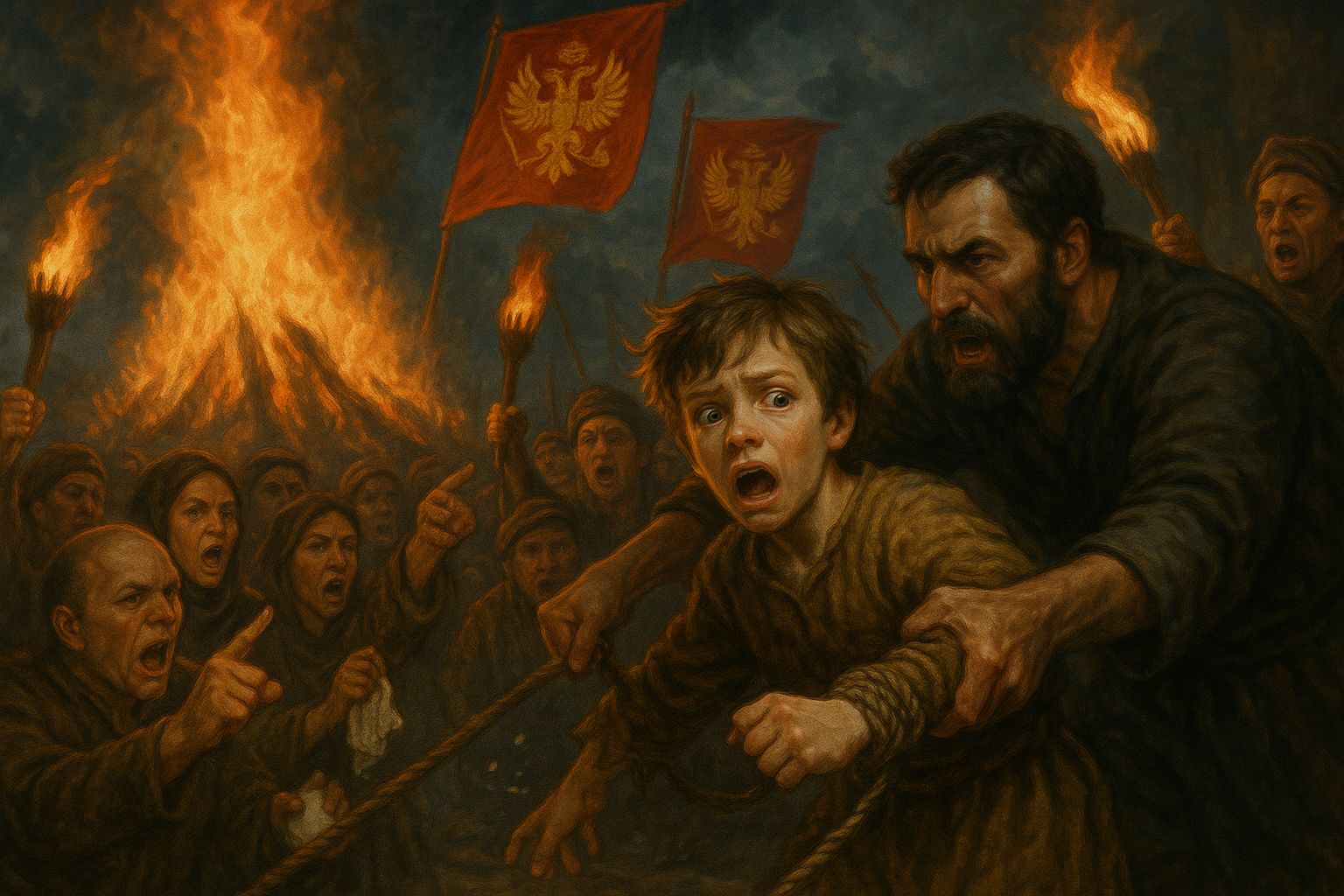
Imperial inquisitors traveled province by province, demanding every town prove its purity. Folk were ordered to recite oaths of lineage under the eye of priests, for it was said a changeling could not remember prayers older than their current face. Salt was forced into mouths to see who would choke. Those suspected were bound, cut, and tortured, for it was believed a changeling’s pain would unmask them.
Entire villages were burned for harboring the accused. Families were torn apart when a child was born left-handed, neighbors betrayed one another to save themselves, and desperate folk tried to prove loyalty by dragging suspected changelings before the pyres.
The Black Ledger
The chief inquisitor, Lord Veynar, kept a book called the Black Ledger, listing every supposed changeling slain. By the end of his campaign the number filled hundreds of pages. It is said he even executed members of the imperial court, claiming their sudden aging or youthful vigor betrayed them as impostors.
Aftermath
When Kaedros died, his successor ended the Pale Hunt, but the damage was done. Whole generations of changelings had been slaughtered. Survivors fled deep into the shadows of the Empire, or out into the wilderness beyond. Even today, the word “changeling” calls up the memory of smoke and screams for both sides, one of humanity’s most shameful purges, and one of the changelings’ deepest scars.
Among changelings, mothers still whisper to their children: Trust no torch in the night, for the Pale Hunt may rise again.
I still smell the smoke when I close my eyes.
We lived in a little town on the borderlands, no more than fifty souls. My father was a miller, my mother baked bread for the village feast days. We hid what we were. We never changed except in secret, when the shutters were drawn, when no one watched. We thought ourselves safe.
Then the inquisitors came. Their banners showed the white flame of purity, but their hands dripped red. They asked questions no one could answer rightly, what prayers your grandmother had sung, how many scars you bore, why you looked younger than last year. When my sister faltered, they said it was proof. They dragged her into the square.
The others looked away. Some spat on us. One neighbor I had played with as a child held the torch. My sister never screamed as the fire took her. She just looked at me, calm, as if she knew it would be my turn next.
That night my parents pushed me toward the river. “Run,” they said. “Wear another face. Forget us.” I never saw them again.
I lived by the banks for months, half starved, changing from one borrowed face to another. Once I looked back and saw the town in the distance, only ash and ruin left, even the church burned. The inquisitors had found too many suspects. Better, they thought, to burn all.
Now I walk the Empire with many names, never staying too long, never letting myself grow roots. But when I meet another of my kind, and see in their eyes the same smoke and the same loss, I know we carry our dead with us.
The Pale Hunt may have ended, but it never left us.
Possible Secrets
The Silent Lineage
The Great Empire never truly ended the Pale Hunt. A secret order of inquisitors still exists, keeping a hidden ledger of suspected changeling bloodlines. They pass the knowledge from one generation to the next, quietly watching, ready to burn again when the time is right.
The Shifting One’s Bargain
Changelings believe their gift came from the Shifting One, but hidden texts suggest it was a bargain. The god demanded something in return, perhaps the souls of unborn children, or perhaps a promise that changelings would never have a land of their own, or even to use them as an army in a future holy war.
The Mask of Unity
Deep in Necropolis lies a relic known as the Mask of Unity. Legends say it can merge a group of changelings into one being, combining their memories and faces into a single immortal form. Most changelings believe it a cursed lie, but some cults seek it still.
The Emperor’s Double
Whispers claim one of the emperors of the Great Empire was a changeling who replaced the true ruler. If true, then whole decades of imperial history were shaped by a hidden impostor. Some noble lines may still descend from that false emperor’s blood.
The Unfinished Truth
Some changeling mystics whisper that their “First Face” is not their true form at all, but only a mask burned onto them by the Shifting One. Their real, hidden essence lies deeper still, something formless, a shadow that even they cannot look upon.
The Salt Curse
The folk tale about changelings choking on salt is false, except in certain bloodlines. A rare family of changelings truly cannot swallow salt, marked by some forgotten pact or curse. They are both feared and hunted by their own kind.
The Child Taken Twice
Occasionally, a changeling child is born who cannot change. To most outsiders, they look like pale, ghostly humans. In truth, these children often become seers, able to glimpse the true faces of gods and mortals alike. Many vanish before adulthood, stolen by cults or emperors.
Adventure Hooks
The Vanished Villager
A farmer has disappeared, and the locals blame a changeling for taking his face. The adventurers are called to investigate, only to find the missing man alive, but the villagers refuse to believe he is who he claims to be. Can the heroes save him from the pyre?
A Mask in the Market
A party member notices someone in the crowd who looks exactly like them, down to the smallest detail. The lookalike vanishes into the streets. Chasing them leads to a frightened changeling who has been watching the adventurers for weeks.
The False Priest
A temple’s priest is accused of being a changeling impostor. The clergy demand a trial by ordeal with fire and salt. The adventurers must uncover the truth before an innocent is executed, or a changeling spy is unmasked.
The Band of Faces
In a lawless borderland, a group of changelings has formed a hidden mercenary company, each one adopting the face of a different famous outlaw or knight. The adventurers might be hired to hunt them, or to work with them.
The Ashes of the Pale Hunt
The ruins of a village burned during the Pale Hunt still lie blackened and silent. Travelers who pass through at night swear they see pale figures wandering the ash. Is it ghosts, changelings, or something far worse hiding in the ruins?
The Child’s Shadow
A child has been born in a noble house with pale skin and strange gray eyes. The court whispers it is a changeling. The adventurers must protect the family from a mob, or discover why the child seems to shift in subtle ways when no one is watching.
The Traveling Troupe
A band of entertainers passes through the region. Unknown to all but themselves, the troupe is made up entirely of changelings, wearing dazzling faces to charm audiences. Trouble comes when one of their masks is recognized as a missing noble.
The Disguise Broken
During a banquet, a guest collapses mid-toast, their features melting back into the pale First Face. Panic erupts in the hall. Was this changeling plotting murder, or simply trying to live unnoticed?