Campaign: Tekrissal
Act Synopsis
Tekrissal is a horror arc built around forced movement, fractured survival and the slow discovery of a brutal history. The crew enters expecting danger and some chance of control. Instead, the city breaks them apart, forces them into bad choices and reveals, piece by piece, that the ruin is not simply haunted by death, but by the collapse of an entire order. The emotional shape of the act is pressure first, understanding second, and only at the end the bitter realization that none of this was truly necessary. Tekrissal also serves as a strong spotlight arc for Thaleia, Ivy, Nera and Pelonias.
Foreshadowing
As the crew approaches landfall, Meyrha is struck by a vision. She sees emptiness which is not empty, things gone which are not gone, a lost crown, a split and a unification, a split and death, and a riddle not needing an answer.
This vision should remain obscure at first, but it later resolves into the shape of the arc. The city seems abandoned but is still inhabited. Its people are dead but linger in the spirit world. The crown is the dead queen whose hive remains after her loss. The split and unification reflect the crew being broken apart and then brought back together. The split and death also reflect the queen leaving Tikirri and dying here. The final riddle is that the city never truly held the answer they thought it did.
Arrival
The crew comes to Tekrissal because Teren Morvail's journal made it clear that the Waverider continued here after Tikirri, and because Morvail believed the dead city was tied to the hidden world below the crater. Tekrissal is the next undeniable step on the Waverider trail, and the place most likely to explain why Solonex thought it mattered. Teren's journal is their first real bridge between the crater and the city.
Thaleia will want to be part of the team for this mission, and she will not take no for an answer. This is cutting edge science on an unexplored topic, she will not miss that opportunity.
The city should immediately feel grand, dead and wrong. It is still recognizably the work of a wealthy and sophisticated human civilization, but it is now occupied by hive-beasts, the broken remains of the rogue queen's failed hive. The core truth of Tekrissal is already present in the setting: a queen-to-be fled from the crater, overran the city, then sickened and died, after which the hive collapsed into hunger and madness. The ruins still hold the aftermath of that fall.
Early Ruins
The crew enters a grand dead city and quickly learns that Tekrissal is not another Tikirri. The insectoids here are not one functioning hive. They are fractured remnants. They hold different sectors, clash with each other and behave more like broken descendants of a lost order than a unified enemy. This should be visible early. Some groups avoid others. Some fight over ground or prey. Some are territorial in ways that no longer make full sense. This teaches the players almost immediately that the queen's death shattered whatever order once held this place together. The hive-beasts of Tekrissal are not a civilization, they are animals, but still deadly.
A minor confrontation happens here, enough to let the crew feel that they came prepared and can handle the ruins if they are careful. In the aftermath of that first clash, they also find a small but unmistakable Waverider trace, a dropped piece of equipment that confirms Solonex and his people truly passed through this city.
Thaleia's Discovery
After observation and examination of one of the dead insectoids, Thaleia identifies a gland whose scent marks the creature as belonging to a particular group. She realizes that this pheromonal signature can be used. If harvested and applied, it may let the crew pass through some sectors as something less immediately hostile. This is not a universal disguise. Tekrissal's insectoids are too fractured for that. A scent that helps with one group may make the crew more suspicious to another. But it gives them a real edge and makes Thaleia operationally invaluable rather than merely informative.
Middle Arc Pressure
This advantage lets the crew move more deeply through the city than they otherwise could, but it never makes the ruins safe. The city remains full of broken broods, unstable territorial behavior and sudden violence. Fights between insect groups create both openings and disasters. The place can be navigated, but never comfortably. The crew should feel that every gain is temporary and every route is only conditionally safe.
The Disaster
While exploring, the crew is ambushed. In the chaos, the floor gives way and the player group is dropped into the lower passages of Tekrissal. The crew left above is forced to retreat under pressure, but shouts that they will bring help. From that point on, the act divides into the down team and the up team.
If the Named Up Team Crew Are Player Characters
If Nera, Ivy or Pelonias are being played by players in this arc, keep them with the down team as usual. Do not split them away just to preserve the rescue sequence. Instead, adjust the off-screen rescue by either removing the problem they would have solved or assigning that role to another crew member.
In practice, this is simple. If Nera is not available, someone else can come up with a rough but workable way to copy the map, or the map can be simpler and easier to remember. If Ivy is not available, the rescue team can find the down team through more ordinary means. If Pelonias is not available, another practical or disciplined crew member can guide the rescue once the route is known.
The important thing is not that these exact characters solve those exact problems. The important thing is that the up team still gets a moment of competence, loyalty and urgency. If a player is already using one of those named characters in the down team, simply shift the spotlight to someone else and let the rescue still work.
The Down Team
Once the upper crew has been driven off, the insects begin probing the collapse site. The down team cannot safely stay where it is. It also becomes clear very quickly that the way out is not back, but through. The lower city becomes a forced maze. There are many apparent choices, but the structure of the act carries the players through the same essential beats of information and pressure no matter which turns they take. Let them feel lost and as if they have choices, never show that they are actually on a rail.
This lower section slows the pace just enough to let the history come in. Here the crew finds the deeper truths of Tekrissal, not because they chose scholarship, but because those truths are embedded in the only route forward. They get fragments of the city's fall, signs of the queen's presence, evidence of ritual resistance and hints that the hive here was broken by her death. The lower city is where Tekrissal stops being merely dangerous and becomes tragic.
There are also close calls that are more about pressure than full encounters. The down team should feel hunted, but not constantly fighting. At one point they glimpse a faint multicolored light. This is Ivy passing near them through the spirit world, though they do not understand that yet.
Eventually they lose the benefit of distance and secrecy. They make contact with more insectoids, are forced into a renewed flight and are finally cornered in the dead queen's chamber. At that point things look hopeless. The crew has learned much, survived much and reached the truth of the city, but survival alone no longer seems enough.
The Up Team
While the down team is trapped below, the up team scrambles to save them. This part happens mostly off-screen, but it should still be real, concrete and driven by character. The upper crew falls back to the ship, gathers more hands and returns in force. The rescue effort is a showcase of loyalty, friendship and the lengths the Blue Marlin crew will go for each other.
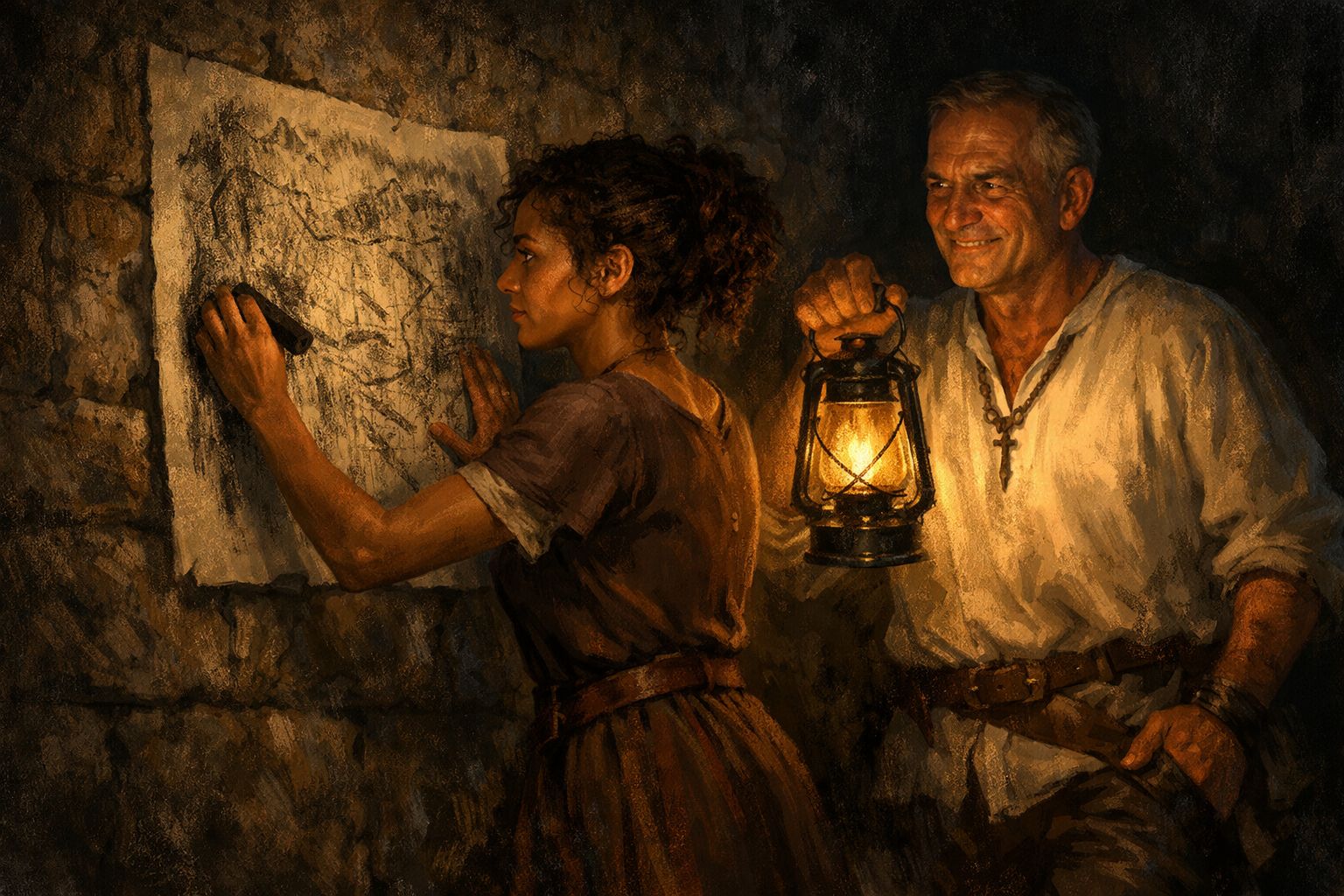
They cannot use the same route as before because insect activity has intensified there. Instead they find a map carved into stone. It is too complex to memorize and would take too long to copy normally. Nera quickly solves the problem by making a rubbing with paper and charcoal, turning an impossible fixed clue into something portable.
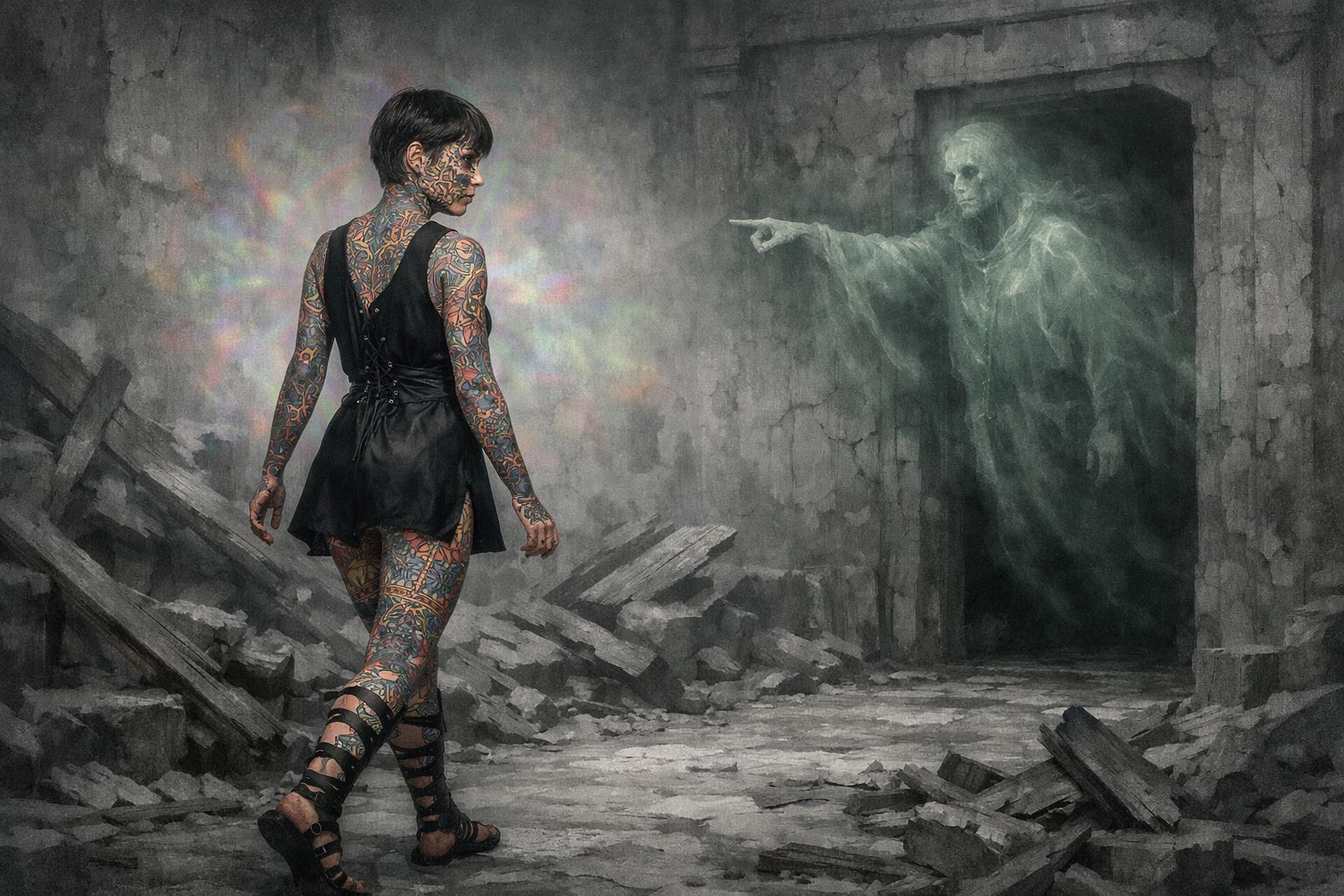
Even with the map, they cannot simply search everything. The city is too large and there are too many possible routes. Ivy then offers to enter the spirit world. In Tekrissal the spirit world is not empty the way Tikirri felt empty. Tekrissal was a living human city until hundreds of years ago, and that has left a scar. The spirits here are bitter, fragmented, frightened and confused. What they know is incomplete and damaged, but it is enough to help. Ivy finds traces of the dead city's grief and terror, gains some broken guidance and locates the down team. When she passes near them in the spirit world, that is the faint light they see below. She also comes away with pieces of the city's history, not as a clean explanation, but as emotional and spiritual fragments.
With map and direction finally aligned, Pelonias leads the rescue team through the ruins.
Reunion and Final Battle
The up team arrives behind the insects just as the down team is preparing for a final stand in the dead queen's chamber. This should feel earned. The players have already survived the lower city and reached the truth of the ruin. The rescue does not solve the arc for them. It turns an almost-certain death into a winnable battle.
A brutal fight follows. The insectoids are dangerous, but now they are pressured from both sides. Surrounded and denied momentum, they finally break.
Information Gained
By the time the crew escapes the lower city, they understand the essential truth of Tekrissal. The queen's hive failed because the queen died. The city's last defenders did not win through simple valor, but through a desperate ritual that cost many lives to cast and many more lives to deliver near enough to the queen for it to matter. The victory was real, but ruinous. Tekrissal was not saved. It was only avenged too late.
The act should also leave behind a more painful realization. The city held history, warning and tragedy, but not the decisive answer they hoped for. The deeper riddle did not need solving here. Tekrissal mattered, but not in the way they imagined when they came.
Time to Leave
By the end of the reunion and final fight, the city is no longer quiet ruin. It is alive with insect movement. More broods are stirring, sectors are becoming unsafe and staying longer would be suicidal. The crew should feel very strongly that their time in Tekrissal is over. If the players do not reach that conclusion themselves, let several crew members say it plainly. The city has yielded what it will yield. The next step must come from outside it, in the nearby ports, of which there are only a few, and the stories that a ship like the Waverider would have left behind.
Exit
On the way out, the crew finds a cairn they missed on the way in. It once had a red flag on a stick, but the pole has tipped, the cloth has faded and is covered in desert dust. Inside the cairn is a bottle containing a message. The only reason they notice the cairn is that the bottle catches sunlight and they see the glint. The note warns anyone following not to proceed further upstream and states that the next safe port is Oshiren in Lumekhet. It is signed "Capt S V, Waverider."
This gives the act its final sting. After everything they suffered and learned, the Waverider's actual message is not "go deeper," but "do not." The city mattered, but only as one more place where the crew had to bleed before being told to move on.
Optional Guest Player Session
Tekrissal is also a good place to bring in a guest group of players for a single session, if the Game Master wants to. The structure of the arc supports it naturally. Once the main crew is split, the player group becomes the down team while the guest group becomes the up team, scrambling across the ruins to organize a rescue.
If this option is used, the guest players take the roles of the up team. That gives them a clear purpose, a self-contained objective and an immediate emotional stake. They are not there to solve the whole arc or replace the main group. Their job is to survive the retreat, gather help, find the route back in and reach the trapped crew before it is too late.
If guest players are used, keep their role focused and urgent. They should feel that they are racing against time through a city that is becoming more dangerous by the moment. Their session should end with the breakthrough into the dead queen's chamber and the reunion with the down team, turning a hopeless last stand into a winnable fight. That gives them a complete and satisfying arc of their own while still feeding directly back into the main story.
Foreshadowing
The first ruins came slowly out of the haze, not all at once but piece by piece, pale against the coast like bones showing through skin. Meyrha stood at the rail with one hand resting on the weathered wood, watching the broken city take shape. Wind moved softly at her veil. The sea hissed along the hull.
Then she saw the first stone face.
It was vast and worn and staring out over the water with blind empty eyes.
A sound rolled through her, low and distant, like thunder from beneath the earth.
Then came the light.
The deck vanished.
She stood in emptiness which was not empty.
It stretched in every direction, hollow and open, yet crowded with what was gone. Not bodies. Not voices. Only the shape of absence, thick as fog, heavy as grief. Things gone which were not gone.
Then a crown, lost.
Not held. Not worn. Not found. Only the place where it should have been, and the certainty that it was no longer there.
The world broke.
A split and a unification.
Hands reaching across distance. Paths torn apart. Threads drawn together again.
Then another split.
A severing. A leaving. A death.
Blackness moved where the crown had been.
And somewhere beyond all of it, quiet as breath on the back of her neck, came the last thing.
A riddle not needing an answer.
That frightened her most.
Then the thunder reached a crescendo, abruptly stopped, and the vision shattered into blackness.
When she opened her eyes, the sky was above her and her head rested in Junia's lap. Her skin was damp and cold. Junia was wiping her forehead with a wet cloth, calm and careful, as if this were something ordinary enough to be managed by steady hands.
"There you are," Junia murmured.
Meyrha tried to move, but her limbs felt too heavy. A shadow shifted beside them. Ormun had come up and now knelt nearby, holding another wet cloth in both hands. His large face was drawn tight with worry as he watched Junia tend to her.
"She is awake?" he asked, softly enough that his deep voice barely carried.
Junia gave the smallest nod and took the cloth from him. "Easy now," she said to Meyrha. "Do not get up yet."
Meyrha turned her face slightly toward the shore.
The ruins were still there. The stone face was still watching.
And though the vision was gone, it had left something behind, like the taste of metal or the echo of distant thunder that had not truly stopped.
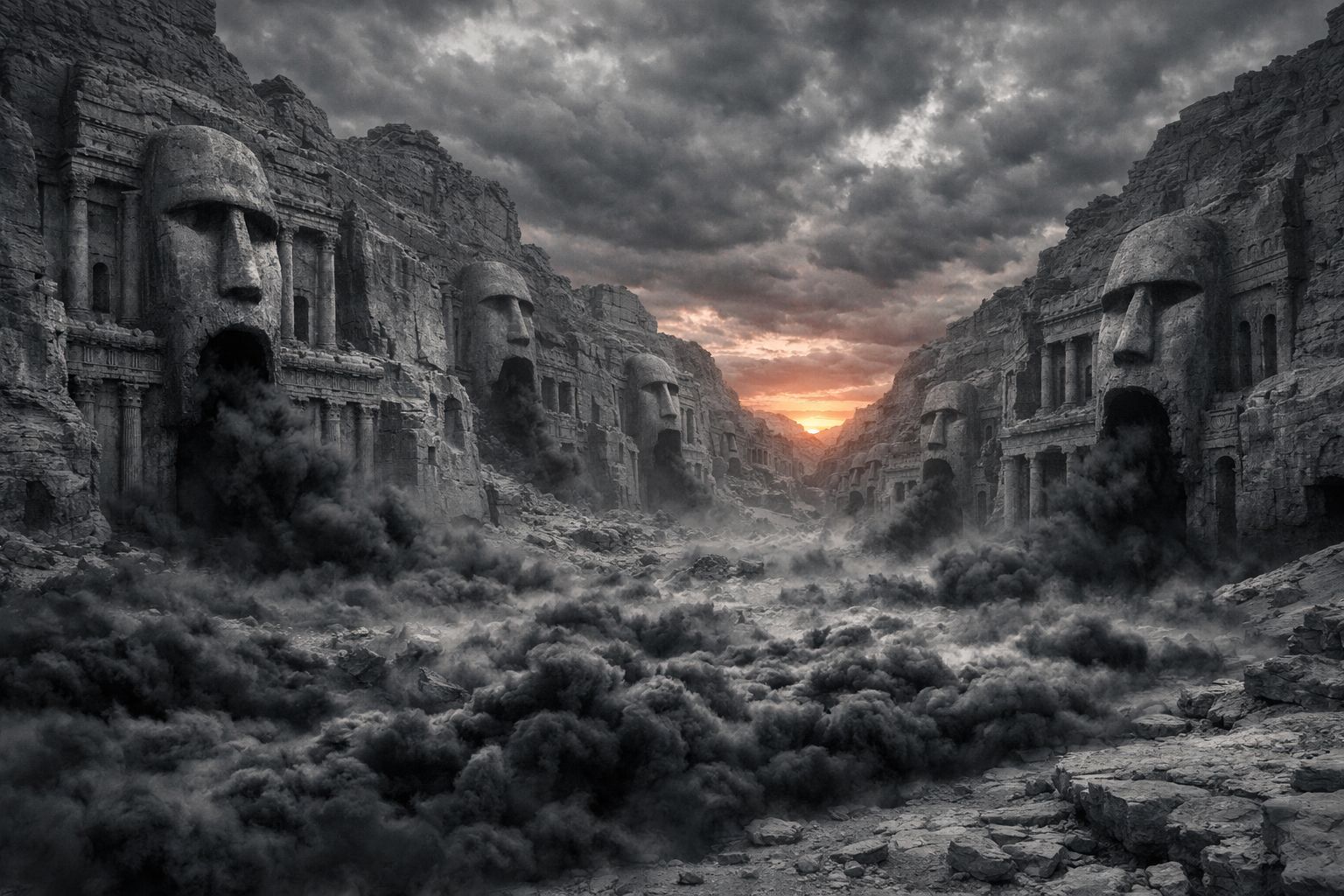
As the first ruins of Tekrissal come into sight, Meyrha is struck by another vision and collapses on deck. The moment should feel sudden and severe, tied directly to the first sight of the dead city rather than coming with any warning.
In the vision, she sees emptiness which is not empty, things gone which are not gone, a lost crown, a split and a unification, a split and death, and a riddle not needing an answer.
At first, this should remain obscure. It is not there to explain the arc in advance, only to cast a shadow over it. As the act unfolds, however, the meaning becomes clearer.
- The city seems abandoned but is still inhabited.
- Its people are dead, but remain in the spirit world.
- The lost crown is the dead queen, whose hive endures after her loss.
- The split and unification reflect the crew being broken apart and then brought back together.
- The split and death also reflect the queen leaving Tikirri and dying here.
- The final riddle is that Tekrissal never truly held the answer the crew thought they had come to find, and that they never needed to go inside.
Arrival
The Blue Marlin slipped into the canyon on a slow tide, its hull moving through still water darkened by the shadow of stone. On either side the walls rose in great rose-red sweeps, cut and carved by hands long dead into forms too large to belong to ordinary people. Facades towered above the ship, whole palaces hewn into the cliff face. Giant calm faces looked down from the rock, worn by wind and years until they seemed less like sculptures than memories the stone had refused to surrender.
Nasheem stood near the rail with one hand resting on the wood, all his usual ease still present in the set of his shoulders, though something in him had tightened all the same. Ivy stood a little apart, wrapped in herself as she often was, her eyes moving from one black opening in the cliff to the next. Thaleia had no such restraint. She had leaned so far forward that she looked on the verge of climbing into the canyon itself if the ship would only let her.
"This is extraordinary," she said, voice almost breathless. "Do you see the scale of it? The faces, the symmetry, the way the facades are worked into the natural wall instead of merely laid over it. There must be whole districts carved back into the stone. Temples, tombs, archives, perhaps cisterns, lower passages, ritual spaces, layers upon layers"
Nasheem kept his eyes on the cliffs. "It looks," he said slowly, "like the kind of place where djinns would live."
Thaleia gave him a quick glance, distracted rather than dismissive. "Djinns do not carve urban complexes into canyon walls."
"No," Nasheem said. "But if they did, I imagine this is exactly what it would look like."
Ivy had said nothing yet. The wind touched the loose edge of her wrap and stirred a strand of dark hair against her cheek. She was staring at one of the higher openings now, not with curiosity like Thaleia, but with the wary stillness of someone listening for something under a noise no one else could hear.
"It feels wrong," she said quietly.
Thaleia turned toward her. "Wrong how?"
Ivy took a moment before answering. "Like something whose purpose has been perverted."
That drew even Thaleia silent for a breath.
The ship moved deeper between the red walls. More openings appeared, some square and dark, others framed by columns or carved with shapes too weathered to read from the water. A broken giant face jutted from the stone ahead, half its features gone, the rest watching the ship pass with one blind eye.
Then Thaleia went rigid.
She pointed upward so suddenly that both the others followed the line of her hand at once. "There," she said. "Did you see that?"
Nasheem narrowed his eyes. "See what?"
"In that opening. Something moved."
For a heartbeat no one spoke.
Nasheem kept staring at the dark mouth in the cliff. "I hope not," he muttered.
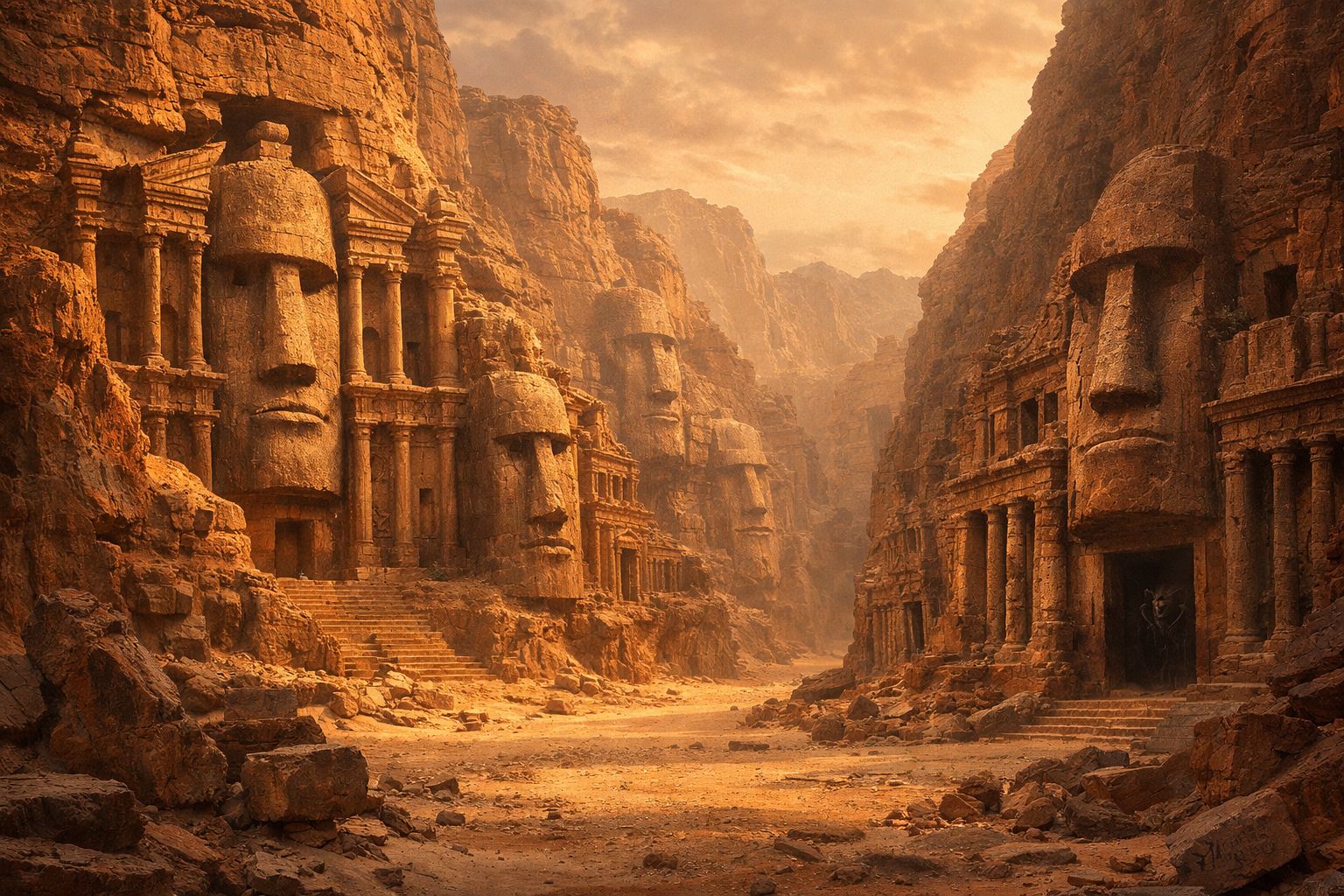
The first view of Tekrissal should be breathtaking. The canyon, the carved facades and the giant stone faces are enough to carry the moment on their own. What matters is that the city immediately feels grand, ancient and deeply wrong.
The Outer Ruins
The outer parts of Tekrissal should seem unnervingly quiet. There are no swarming masses of insectoids here. If any are seen at all, they should be few and smaller than those deeper in the city. This helps the crew enter with caution, but not yet with full panic.
The Game Master should understand what the players do not yet know. The broken hive still pulls inward toward the center, where the queen once was. The stronger and more dominant groups hold closer to that heart, and competition for those inner areas is part of what keeps the outer city thinner and less active. The creatures found farther out are the lesser remnants, pushed outward by rivalry and collapse.
No Visible Explanation
At this stage, there should be no obvious sign explaining what happened here. The city is ruined and occupied, but the cause of its fall is not yet readable on first sight. The players should feel the scale of the place and the wrongness of it, but not yet understand its history.
That is important. Tekrissal should first present itself as a mystery of grandeur and unease. The truth of the city belongs deeper in.
Early Ruins
They moved through Tekrissal in the shadow of stone faces too large to belong to any living city. The canyon held its own silence, broken only by the scrape of boots on grit, the whisper of cloth against carved walls and the faint dry stirring of wind through openings high above. Even the air felt old. Not merely dusty, but stale with the memory of heat, blood and things that had no right to linger.
Gastved raised one hand and the others stopped at once.
Ahead, beyond a cracked arch and a fallen column half buried in sand, movement slid through the street below. At first it was only shape and glint, too low and too fast to read properly. Then one of the creatures came clear, all hard shell, angled limbs and hooked motion, larger than any sane mind wanted to accept. Another came after it. Then three more from the far side.
They hit each other without warning.
There was no challenge, no display, no hesitation. One leapt and clamped its jaws into another's side while a second drove in low, limbs scrabbling against stone as it tried to tear open the softer joints beneath the shell. A third crashed into both of them and sent them skidding in a spray of dust and broken chitin. The sound was hideous in the narrow street, all dry cracking, scraping limbs and sudden wet ruptures when a strike found something vulnerable.
Amaxia's grip tightened on her weapon. "So much for one hive."
Thaleia was already leaning forward, eyes wide and burning with horrified fascination. "No," she whispered. "No, this is wrong. Look at them. They are not moving like the Tikirri. There is no pattern to it. No shared purpose. No coordination." Her voice quickened as the idea took hold. "They are broken. The structure is gone. The castes remain, but whatever bound them together does not."
Another insectoid lost a limb and kept fighting.
Gastved watched the street, expression flat and hard. "Useful to know."
Thaleia had already pulled her notebook free.
She braced it against a broken section of wall and began sketching in quick, urgent strokes, trying to catch the shape of a forelimb, the angle of a head, the way one of the creatures recoiled when another's scent or presence crossed some invisible boundary.
Then Ileena's hand came down on the back of her head and shoved her back into cover.
Thaleia gave a muffled protest. "I was drawing."
"Yes," Ileena said. "I saw."
She crouched beside her, ears angled toward the fight below, voice low and sharp. "Those things are killing each other. That means they would also kill you, if you were kind enough to stand up and show them where you are."
Thaleia opened her mouth, closed it again, then muttered, "I know that."
Ileena peered over the edge for one heartbeat more, then sank back down. "Good. Keep knowing it."
Nasheem, a little farther back in the shelter of a carved recess, glanced once toward the fighting street and then toward the deeper shadow of a nearby facade cut into the rock. "Move," he said quietly. "While they are busy."
That needed no argument.
They slipped away from the overlook and crossed a patch of open ground one by one, keeping low and close to the stone. The facade ahead had once been magnificent. Even now, weathered and broken, its entrance was framed by columns carved with spiraling patterns and old figures half worn away by time. Inside, the air was cooler. Their footsteps stirred dust that had lain untouched for years.
For a moment they let themselves breathe.
The wall carvings within were finer still, close-work now instead of grand outer display. Rows of human figures in old dress. Ritual scenes. Geometric borders. A procession of crowned forms with hands raised toward some lost significance. Thaleia moved nearer at once, not recklessly this time, but with the hungry attention of someone standing before a locked door and seeing the keyhole at last.
"These are better preserved," she murmured. "There may be sequence here. A record. If we can identify what order these panels were meant to be read in, then"
A sound came from the entrance.
Not loud. Just one dry scrape, then another, like claws testing stone.
Everyone froze.
Gastved turned first, already shifting his weight. Amaxia moved with him, shoulders low, weapon ready. Nasheem's hand went to his curved blade. Ileena's eyes had gone wide and still.
Another scrape.
Then a shape slid into the doorway.
A single insectoid entered, silhouetted for a moment against the red light outside before it stepped fully into the gloom. Its limbs clicked softly against the floor as it crossed the threshold, head turning in small sharp motions as if tasting the air.
No one breathed.
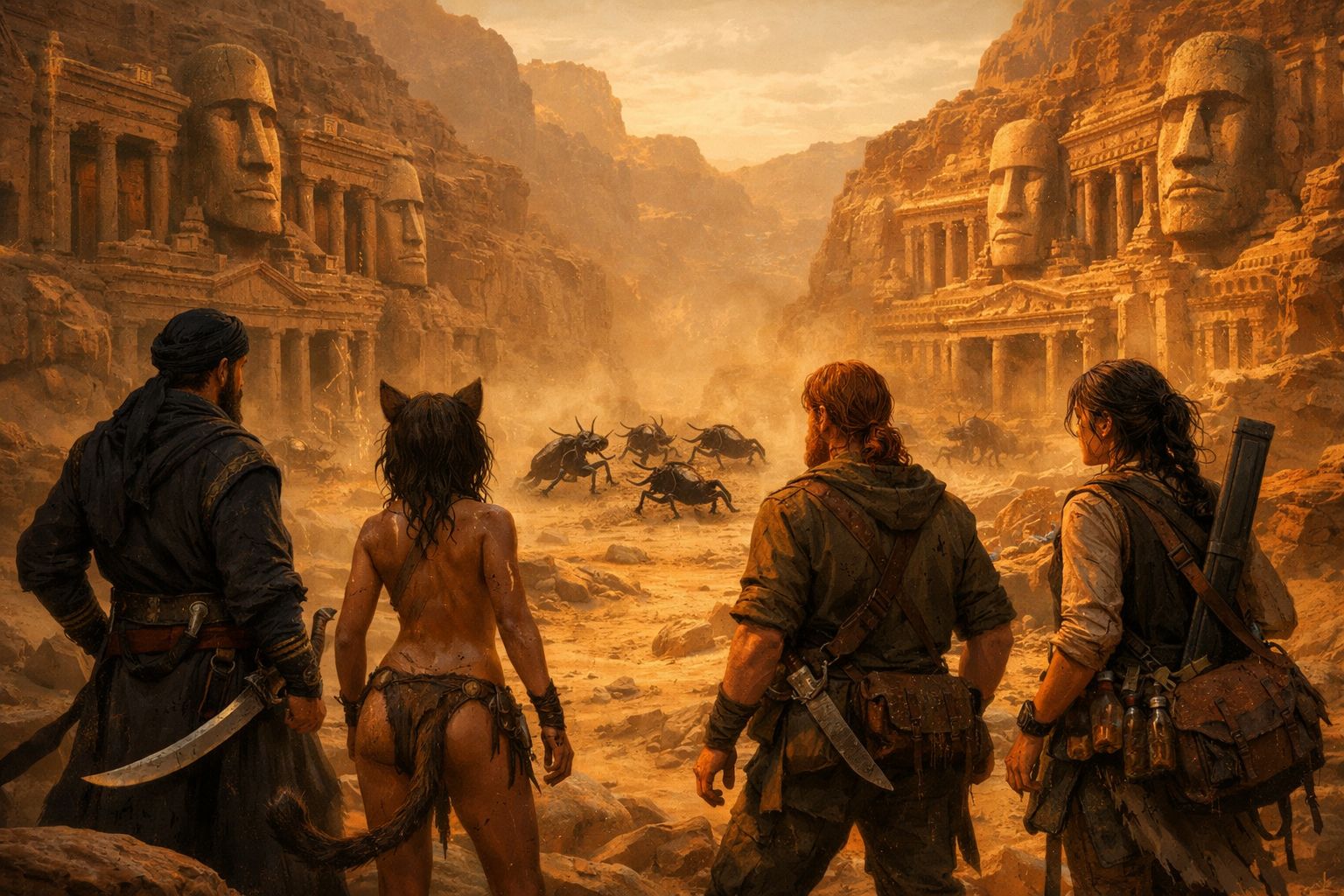
This section exists to establish the basic reality of Tekrissal before the arc becomes more dangerous. The players should come away with a clear first impression of the insectoids and of the city itself. At this stage, the ruins should feel threatening, but not yet overwhelming.
There are three things this section needs to achieve. The crew must see that insectoids move openly through the ruins. They must understand that these creatures are not coordinated and do not possess the frightening intelligence of Tikirri. And they must face, or at least closely observe, one dead insectoid so that Thaleia can begin her analysis.
The Insects in the Outer Ruins
The outer ruins should show insect activity early. The players do not need a full battle to understand that Tekrissal is occupied. They should see insectoids moving through streets, across facades and between broken chambers.
These creatures should not behave like a functioning hive. They do not patrol with order, do not communicate in any visible structured way and do not move with shared purpose. Some wander alone. Some skitter through ruins and vanish. Some simply lurk in one place until something disturbs them.
At times, the players should witness insectoids fighting each other. These encounters should be fast, ugly and senseless. The creatures attack with the same viciousness they would use on the crew. This helps establish a key truth early. Tekrissal is not inhabited by one living, intelligent hive. It is occupied by broken remnants that no longer truly belong together.
The First Ambush
At a suitable point, once the players have had time to observe the ruins and grow used to the idea of insect activity, a single insectoid should ambush the team.
This should be a sharp and ugly first contact. The creature should look fast, dangerous and unnatural enough to make a strong impression. Jaws, claws and carapace should all suggest that this is something capable of killing a person very quickly if it catches them badly.
Even so, the fight itself should be easy. The purpose is not to seriously endanger the crew yet. The purpose is to let them test themselves against one of these creatures and come away feeling that, while Tekrissal is dangerous, it is still ground they can manage if they stay careful. Show the insectoid as a dangerous weapon wielded without finesse, plan or tactics.
That early confidence is important, because the arc will later take it away.
Thaleia's Opportunity
This section also exists to give Thaleia access to a dead insectoid. Once the creature is killed, she can begin examining it and noticing the differences between the broken groups in Tekrissal. That observation will later lead to her discovery of the pheromonal markers.
If the players avoid killing the ambushing insect and instead escape, do not force another identical fight. Simply let Thaleia examine an insectoid corpse left behind after one of the insect-on-insect battles. The exact source of the body is not important. What matters is that she gets the chance to study one.
The Intended Takeaway
By the end of this part, the players should understand the essential first truths of Tekrissal.
- There are insectoids throughout the ruins.
- They are not intelligent in the way the Tikirri insectoids are intelligent.
- They are dangerous, but at this stage still manageable.
And the crew is not yet in the worst of the city.
Thaleia's Discovery
Thaleia knelt beside the dead insectoid as if it were a gift rather than a danger finally laid still. The thing lay half on its side where it had fallen, limbs twisted, shell cracked in two places from the fight. Dark fluid had already begun to thicken in the heat. Nasheem stood a little back with one hand over his mouth and nose, while Ileena crouched opposite Thaleia with the easy alertness of a cat watching someone open a trap.
Thaleia leaned in close, studying the joints, the mouthparts, the layered shell, already half lost in thought. Her fingers hovered over the body without touching at first, tracing shapes in the air as if she were sketching it in her mind.
Then she paused.
Her head tilted slightly.
She breathed in once, then again, more carefully.
Ileena saw the change in her at once. "What?"
Thaleia lifted a hand for silence and bent closer still, nose almost to the broken shell. She inhaled again, slow and focused, and her eyes sharpened.
"Can you smell that?" she asked.
Ileena sniffed the air. "Dead bug," she said. Then she wrinkled her nose. "And something sharp. Acrid."
"Yes," Thaleia said.
She leaned in again, following the scent across the carapace, then suddenly snatched up her knife and drove the point into a seam in the shell.
Nasheem flinched. "Oh, no."
Thaleia did not answer. She was already cutting, quick and intent, prying apart plates, widening the opening with a wet crack that made Nasheem bend in despite himself, take one look, and recoil at once.
"I regret this already," he muttered, turning his face away.
Ileena, by contrast, only shifted closer. "Looking for the heart?"
"No," Thaleia said absently. "For this."
She thrust one hand deep into the opened body, felt around for a moment, then gave a short triumphant sound and pulled something free. It was a gland, slick and dark and bulging, roughly the size of a man's head. As it came out, the acrid smell thickened instantly.
Thaleia held it up like a trophy. "There."
Ileena leaned in and sniffed it, then jerked her face back with a grimace. "Yes. That is it."
Thaleia's face lit with sudden fierce delight. "Of course it is. Of course." She looked from the gland to the corpse and back again, mind racing faster than her words could keep pace. "This is how they know each other. Not by sight alone. Not by sound. By scent. By chemical markers." She looked up at them, almost glowing. "If we smear ourselves with some of this, they will not read us as enemies."
Nasheem slowly turned back, though he still kept as much distance as dignity allowed. "We did see them killing each other."
Thaleia flicked that aside with a small impatient wave. "Yes, yes, obviously. But that only means the system is fractured." She looked back down at the gland with renewed satisfaction. "At least some of them will read us as friendlies."
Before either of the others could object, she plunged her hand into the mess and began smearing the foul substance across her sleeve and the front of her coat.
Nasheem stared at her in disbelief.
Ileena watched with mounting admiration.
Thaleia, meanwhile, looked as pleased as if the dead insectoid had just answered a question no one else in the world had been clever enough to ask.
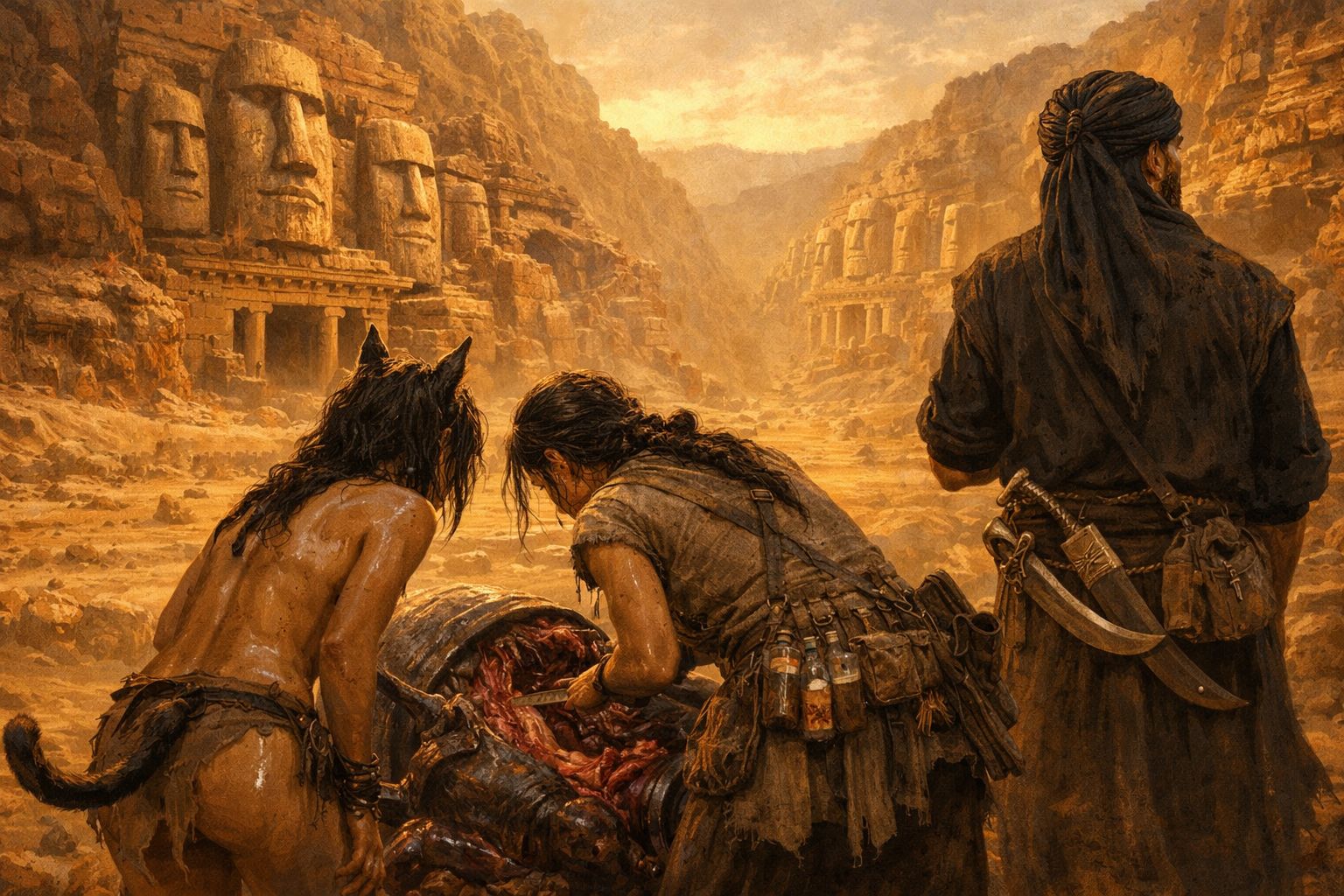
By examining a dead insectoid, Thaleia identifies a large gland that produces the sharp acrid smell she noticed on the body. She quickly realizes that this scent is not incidental. It is how these creatures identify their own kind, or at least how they sort one group from another.
That gives the crew a real edge. By smearing themselves with the contents of the gland, they can pass more safely through the territory of that specific insect group. The effect will work well enough to matter. The insects may hesitate, ignore them at a distance or treat them as something familiar enough not to attack.
A Narrow Advantage
This is not a universal answer. Tekrissal's insectoids are fractured into different groups, and each group should have its own scent identity. A gland taken from one brood helps only against that brood. To another group, that same scent may mean nothing, or worse, mark the crew as a rival.
That is important for the structure of the arc. From this point on, encounters with insectoids are no longer just a question of danger. They are also a question of recognition. Friendly or not becomes part of the tension every time the crew sees movement in the ruins.
How to Use It
The Game Master should treat this as a strong but unstable tool. It gives the crew a way to move deeper into the city without turning the ruins safe. It also helps reinforce the idea that Tekrissal is not one hive, but a broken landscape of competing remnants.
Used well, this lets the crew pass through some sectors, avoid some fights and make difficult choices about which scent they want to wear and where they dare to go.
Rescue Mechanism
This discovery is also a useful safety valve for the Game Master. If a fight begins to go badly and the crew needs a way out, a second insect group can arrive and attack the first one instead, treating the crew as near enough to friendly not to strike at once.
This should not feel clean or comfortable. It is not rescue in any human sense. It is one brood tearing into another while the crew happens, for a few moments, to smell less wrong than the enemy in front of them. Even so, it can be used to break a losing fight, create chaos and give the crew a narrow chance to escape.
Middle Arc Pressure
This section is mostly about moving through Tekrissal, looking, listening and slowly letting the city get under the crew's skin. It should feel tense, but not actively punishing. The players should believe that caution, numbers and Thaleia's discovery are enough to keep the situation under control. That belief is important, because the disaster works best if it comes after the crew has begun to trust their footing.
The ruins should feel dangerous in a steady background way rather than through constant attacks. Strange noises in distant chambers. Movement glimpsed across facades. Signs that insectoids have passed through recently. Occasional moments where the crew freezes and waits while something skitters or clicks beyond sight. The city should never feel safe, but it should feel survivable.
The Mood of This Section
The right tone here is nervous exploration. The crew is not relaxed, but they are functioning. They move carefully, test routes, watch crossings and use the pheromone trick where needed. There should be enough pressure to keep everyone alert, but not enough to make them feel that disaster is already upon them.
This is where Tekrissal should feel large. Let the crew pass through streets, carved halls, shallow courtyards, broken facades and old chambers whose purpose is not yet entirely clear. The city should feel layered and old, with the human grandeur still visible beneath the later infestation.
Small Clues and Teasers
This section should also feed the players small fragments of information without revealing the whole truth too early. The clues here should be suggestive, not decisive.
Let them find signs of past struggle, but not yet enough to understand it. Scorch marks whose cause is unclear. Old carvings that show processions, crowns or ritual scenes without obvious explanation. Broken chambers where human architecture has been overgrown or defaced by later insect occupation. Dead insectoids in strange places. Perhaps an old tool, a fragment of worked ornament or another small trace that confirms people once lived richly here and died badly.
The important thing is that these details keep the players curious. Each one should hint that the city has a story, but none should yet explain that story fully. Tekrissal should still feel like a puzzle whose edges are only beginning to show.
Controlled Confidence
This is the part where the crew should start to feel that they can manage the ruins. They have numbers. They have caution. They have Thaleia's scent trick. They have already seen that the insectoids are dangerous, but fractured. If the players want to search side chambers, inspect carvings or test routes, let them do it.
That freedom matters. The more the crew feels they are exploring on their own terms, the more effective the disaster will be when the city proves otherwise.
This does not mean the place should become comfortable. Keep the pressure present in small ways. A wrong turn that leads too close to movement. A scent marker that works on one group but makes another react badly. A ruined street that seems quiet until something crosses it in the distance. Enough to keep everyone uneasy, but not enough to make them pull back.
The Purpose of the Section
The main purpose here is to lull the crew into a false sense of control. Not safety, but control. They should believe that Tekrissal is dangerous but navigable, strange but readable, threatening but still within the range of their choices.
That is exactly the state you want before the disaster. When the floor gives way and the team is split, the city should feel as though it has suddenly revealed its true nature. Everything before that exists to make the loss of control land harder.
What the Crew Should Feel Before the Disaster
By the end of this section, the crew should feel three things.
- They have begun to understand how to move through Tekrissal.
- They have found just enough clues to want to keep going.
- And they believe, wrongly, that the worst danger can be managed if they stay careful.
That is the ideal moment to break them apart.
The Disaster
The ruin had once been ceremonial.
Even broken by time, enough remained to show it. The outer chamber was lined with worn pillars and damaged wall carvings, figures in robes, raised hands, crowns and flames, their meaning half preserved and half clawed away. Thaleia stood close to the wall, absorbed in it all.
"This is deliberate damage," she murmured. "Not collapse. Not weather. The faces first, then the crowns. That suggests either iconoclasm or deliberate symbolic"
A dry scraping sound came from the entrance.
Gastved turned first. Nasheem followed at once, hand on his blade. Ileena, crouched near the doorway, went perfectly still.
Then the insectoids came.
One slipped through low and fast, then another behind it, then more, too many to count in the first rush, shells glinting as they shoved and scrambled over one another into the ruin.
Nasheem did not hesitate. "Back. Inner room. Hold the door."
Gastved grabbed Thaleia by the arm and pulled her into motion. Ileena was already retreating, light on her feet, eyes tracking every angle. They ran deeper into the ruin toward a narrower doorway where they might have had a chance.
Then the floor broke.
A sharp crack split the air. Stone gave way beneath them and dropped. Dust burst upward. Thaleia cried out as she vanished. Gastved went with her. Nasheem had only time to throw up an arm before he too disappeared into the collapse.
Ileena sprang aside on instinct, twisting clear and skidding hard against the wall. She caught herself, spun, and looked down through the dust.
Below, amid broken slabs and rubble, she could see the others sprawled in the dark.
"Are you alive?" she shouted.
Nasheem coughed, then looked up. "Bruised. Not dead."
Gastved pushed himself onto one knee. Thaleia was moving too, shaken but conscious.
Ileena glanced back toward the entrance.
The insectoids were already pouring into the chamber, far too many to fight.
She looked down again. "There are too many."
Nasheem answered at once. "Then run. Bring help."
Something hard flashed across her face, then she nodded.
"I'll come back."
The first insectoid lunged. Ileena ducked under it, slipped past another and vaulted a fallen block in one fluid motion. By the time the rest surged after her, she was already gone into the ruins.
Below, Nasheem looked once at the jagged opening above.
Then he turned toward the dark ahead.
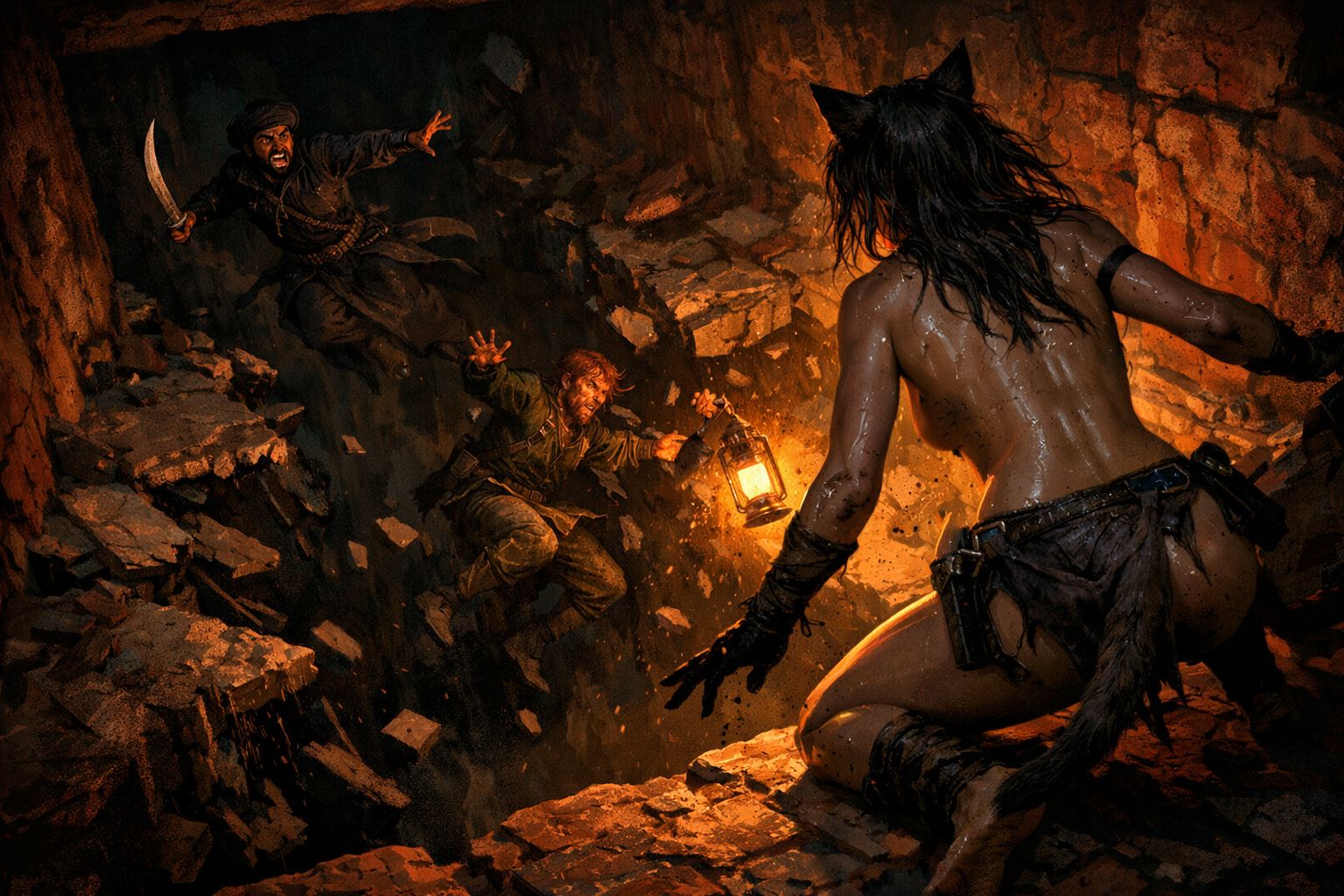
At the right moment, the crew is cornered by insectoids inside one of the ruins and forced into a panicked retreat. This should not feel like a calm tactical withdrawal. It is a scramble under pressure, with the team trying to reach an inner room or defensible doorway before the insects overwhelm them.
As they retreat, the floor gives way beneath them. The player group falls into the lower passages of Tekrissal, bruised, shaken and abruptly cut off from the surface. One NPC member of the team is the only one who does not fall. That survivor is left above while the insects surge into the chamber.
The insectoids do not immediately pursue downward in force. Instead they gather around the broken opening, probing, clustering and focusing on the collapse itself. That gives the surviving NPC just enough time to understand the situation and escape. There is no realistic way to rescue the fallen crew on the spot. The only viable choice is to run for help.
Practical Effect
From this point on, the act is divided into two parts. The fallen player group becomes the down team. The surviving crew above, along with the rest of the Blue Marlin force, becomes the up team.
Play should stay focused on the down team. The up team still acts, but mostly off-screen, to be revealed later through the rescue and through later retelling. Their role is real, but the immediate experience of the arc belongs to those trapped below.
The Down Team
The down team is the heart of the Tekrissal arc. This is where the act changes from tense ruin exploration into horror, forced movement and sad discovery. From this point on, the crew is no longer choosing how deeply to involve themselves. The city has taken that choice away. They are below, cut off, hunted and with no realistic route back except forward.
This section should feel very different from the outer ruins. Above, Tekrissal felt large, uncanny and dangerous, but still manageable. Below, it feels close, buried and wrong. The city is no longer a dead wonder. It is a wound.
Immediate Aftermath
Once the upper crew has been driven off, the insects begin to gather around the collapse site. They do not commit to a full descent at once, but they probe, scrape and test the broken opening. The noise of claws against stone, the shifting of dust, the occasional glimpse of a limb or head in the crack above should make it clear that staying where they are is not an option.
The down team gets a brief moment to gather themselves, assess injuries and understand the basic shape of the disaster. Bruises, cuts and shaken nerves are likely, but no one should be crippled by the fall unless the Game Master wants to make a later burden out of it. The important thing is not injury, but separation.
Very quickly, the crew should understand one central truth. The way out is not back. The collapse site is too exposed, too unstable and too closely watched. If they want to survive, they must move deeper and try to find another path through the lower city.
That realization should come early and cleanly. Do not let the players waste too much time trying to solve the hole. The city has already answered that question for them.
The Lower City
The lower city should feel like a second Tekrissal, more intimate and more terrible than the one above. This is where the buried truth of the ruin lives.
Here the architecture changes. The grand facades and open streets give way to lower chambers, half buried halls, cracked ceremonial rooms, old corridors, sunken shrines and places where human construction has been invaded, altered and overgrown by later hive presence. The players should feel that they are no longer in the public face of the city. They are in its wound, its underbelly and eventually its grave.
This is also where Tekrissal becomes tragic. Above, the city is eerie. Below, it is sad.
Structure of the Forced Maze
The lower city should function like a forced maze. The players are allowed, and encouraged, to make choices. There should be side passages, branching halls, collapsed routes, tempting openings and moments where it genuinely feels as though several paths lie before them.
In truth, all of those routes should bend back toward the same essential beats. The point is not to create a genuine navigation puzzle. The point is to create the feeling of disorientation, uncertainty and agency while making sure the arc still lands where it must.
The Game Master should never reveal this structure. Each apparent choice should have its own flavor, its own local danger or its own emotional tone. One route may feel narrow and oppressive. Another ceremonial and exposed. Another choked with resin and old death. The players should feel that they are choosing how they suffer and what they pass through, even if the broader path still converges.
This is important. They should feel lost, but not railroaded.
The Rhythm of the Section
This part works best with an alternating rhythm.
- First, movement and uncertainty.
- Then a quieter pocket where the crew can observe and think.
- Then a sign of danger.
- Then another push onward.
That rhythm lets the lower city breathe. If the players are under constant attack, the history cannot land. If they are too safe for too long, the horror softens. The right feeling is that of being hunted in a place large enough to briefly hide in, but not large enough to ever truly escape.
The History Embedded in the Route
The down team does not uncover Tekrissal's history by deciding to investigate it. They uncover it because the only road forward runs straight through the city's scars. The revelations should come in a fixed sequence, each tied to a specific place, each adding one more piece of the truth.
That sequence should carry the history. Not as a lecture, but as a descent through the city's wound.
The Half-buried Ceremonial Hall
The walls still show processions, crowned rulers and ritual scenes, enough to establish that this was once a place of human power, religion and dignity. The carvings are damaged, but not by time alone. Faces have been struck away, crowns defaced and sacred symbols broken. This is the first sign that the city was not merely abandoned. It was violated.
The Repurposed Sanctum
Human architecture has been overtaken by hive growth. Resin, shell fragments and old insect structures have been layered over carved stone and altar-work. Here it becomes clear that the queen did not simply send raiders into the city. She occupied it, bent it to her own use and turned its sacred spaces into the center of her hive.
The Defensive Choke Point
This is where the city's last stand becomes unmistakable. Barricades of broken stone and carved furniture have been piled across a narrow approach. Arrowheads, shattered spear shafts and insect remains still lie among the rubble. The walls are scarred by desperate fighting at close quarters. This is not ritual yet. This is the plain evidence that Tekrissal tried to defend itself room by room, holding ground until it could no longer hold.
The Chamber of Organized Resistance
The floor is marked with ritual lines, scorched circles and the remains of deliberate preparations. There are human bones here, but not the scattered dead of slaughter. These people died in position, as part of an act they meant to complete. This is where the down team understands that Tekrissal's last defenders did not simply fight. They prepared a desperate ritual.
Ivy's Light
They moved quickly through the corridor, feet scraping softly over dust and broken grit, every sound swallowed and returned by the stone around them. The passage opened briefly into a small chamber, low roofed and close, its walls scarred by old damage and later hive growth. Nasheem led, Gastved just behind him, Thaleia already turning her head from side to side as if even now the room might contain one more clue worth dying for.
Then the light came.
It slipped across the chamber in silence, not cast from any flame or lantern, but moving of its own accord, a brief wash of shifting colors like oil on water, like stained glass seen through running tears. It touched the far wall, bent strangely and was gone.
Gastved stopped dead. "What was that?"
Thaleia stared after it, wide-eyed. "It could be residue. Some lingering aftereffect of the ritual. If what they unleashed altered more than flesh, if it affected the fabric of magic or ambient structures of perception, then"
Nasheem caught her by the arm and pulled her forward. "Then it is a sign."
"A sign of what?"
"That it is time to leave," he said.
And this time even Thaleia did not argue.
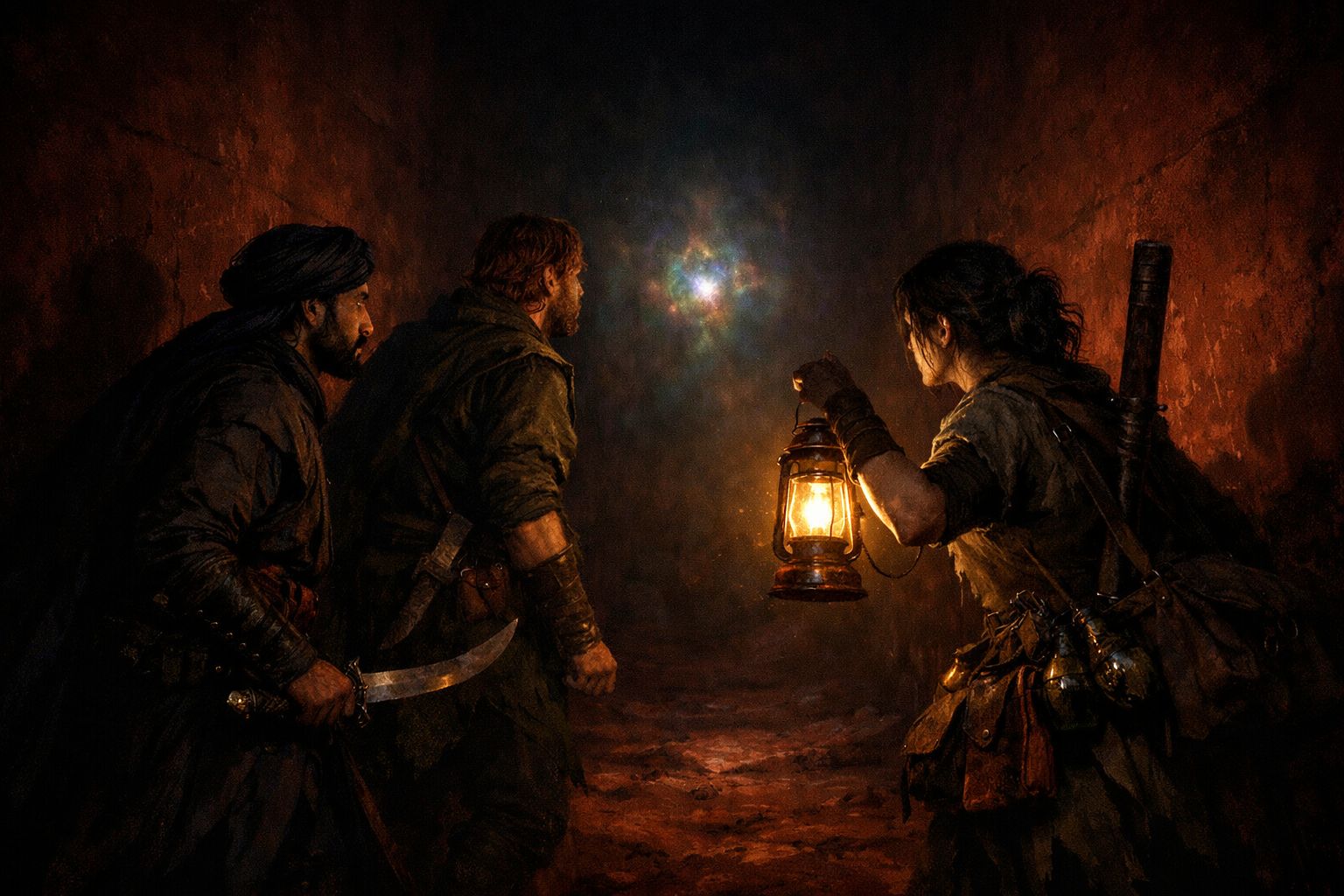
At one point, the down team sees a faint multicolored light passing by them.
It should not behave like ordinary light. It moves strangely, briefly, almost like color passing through water or glass rather than fire or lantern. It should feel beautiful and wrong in equal measure.
The crew does not understand what this is at the time. Later it will be clear that this was Ivy passing near them through the spirit world as part of the off-screen rescue effort.
In the moment, it should simply feel like one more mystery of the lower city. Something seen, then gone, with no explanation.
That moment matters because it is the first real sign that the up team has not forgotten them, even if they do not yet know it.
The Contaminated Royal Passage
This is where the ritual's true effect becomes clearer. The stone is stained, not with ordinary burn marks, but with streaking discoloration and blackened residue that looks as though something spread through the place rather than struck it in one instant. Insect remains lie here in unnatural poses, not hacked apart, but collapsed where they stood. Some are twisted, some half fused to old resin, some look as though they tried to keep moving after something inside them had already begun to fail. This is where it becomes clear that the ritual did not kill the queen cleanly. It poisoned, infected or blighted her. Whatever the defenders unleashed made her sick, and that sickness spread outward through parts of the hive before death finally came.
Old Hive Sector
This is deeper below, where the insect order is still visible in dead form. The layout is too structured to be accidental. Different castes clearly once moved here with purpose. But now it has all fallen apart. The place is broken, abandoned by intelligence and reduced to instinct. Here the players understand that the hive in Tekrissal once had true structure, and that something shattered it.
The Approach to the Dead Queen's Chamber
The whole lower city begins to feel as though it bends toward this place. The architecture is more violently altered. The old human grandeur and the later hive occupation are both present, but both are damaged. This is where the final shape of the tragedy comes clear. Tekrissal was not simply destroyed. It was conquered, resisted at terrible cost, and then left to rot after the queen's death broke the hive that had consumed it.
What They Should Learn Below
By the time the down team reaches the deeper sections, they should have absorbed several truths.
- This city once had a living ceremonial and political center.
- The insect presence here was once more ordered than it is now.
- The queen mattered. Her presence shaped this place.
- The defenders did not merely die fighting. They attempted something deliberate and terrible in return.
- The hive here did not simply fade. Something broke it.
These truths should come in fragments, not all at once. The lower city should feel like a history assembled under duress.
Pressure Without Full Combat
Most of this section should not be built around repeated full encounters. The down team should feel hunted, but not constantly fighting.
Use signs of proximity. Clicking in the walls. Shapes crossing far corridors. A chamber the crew has just left suddenly filling with movement behind them. The scent of one brood becoming wrong in a new sector. The sound of claws above, below or behind stone. The feeling that the lower city is not empty, only temporarily not attacking.
These moments matter because they keep tension alive without exhausting the players or flattening the rhythm.
The lower city should feel like a place where danger passes close again and again, sometimes noticing them, sometimes not quite.
Close Calls
There should be several close calls in this section, but they should not all work the same way.
- One might be avoided because the brood scent works.
- One might be survived because the insects are distracted by each other.
- One might be escaped only by silence, darkness or luck.
- One might force the crew to abandon a route they wanted to take.
The point is not variety for its own sake. The point is to make the city feel unstable and only partially readable. The crew has tools, but never certainty.
The City Tightens
As the crew goes deeper, the benefits of distance and secrecy begin to fail.
Their scent marker becomes less useful, or useful only in narrower ways. The routes become more contested. The brood divisions remain real, but the lower city is closer to the old center, where more dangerous remnants remain. The players should begin to feel that what helped them above is no longer enough below.
This is where movement becomes more urgent. There is less room to linger, less time to study, less ability to retreat.
The city starts to close its hand.
Renewed Contact
Eventually the crew makes contact with insectoids again in a way that cannot be quietly avoided.
This should not be a long stand. It should be a renewed flight. The moment when the lower section changes from hunted tension to active pursuit.
The crew has now seen enough and survived enough that this flight feels heavier than the first one. They are not panicking blindly. They are exhausted, informed and running anyway.
That contrast matters. The city has taught them what it is. Now it tries to kill them with that knowledge still in their heads.
The Dead Queen's Chamber
All roads in the lower city should eventually lead toward the dead queen's chamber.
This is the climax of the down team's route, both physically and emotionally. It is not just a place where they get trapped. It is the place where the essential truth of Tekrissal comes into focus.
The chamber should feel like a center corrupted twice over. First by the queen's occupation, then by her death. Human grandeur should still be visible beneath hive alteration, ritual damage and long decay. This is where the city, the hive and the failed resistance all meet.
By the time the crew reaches it, they should understand enough to feel the weight of the place even before the final battle begins.
Hopelessness at the End
They ran with the sound of the city breaking behind them.
The corridor spat them out into a vast chamber all at once, and for a heartbeat all three of them faltered. After the close dark of the lower passages, the space felt enormous. The ceiling vanished upward into shadow. Broken pillars rose like the trunks of a dead forest. Old human stonework still showed through the ruin, carved borders, half-buried reliefs, traces of ceremony and grandeur, but all of it had been overrun long ago by resin, shell growth and the warped remains of hive-work.
And at the center of it stood the queen.
Thaleia stopped dead.
Nasheem caught himself a step farther on and turned, blade half raised, expecting movement, some final horror rising to meet them. Gastved lifted his weapon too, breath hard in his throat.
But nothing moved.
The queen towered above them, vast and hollow, a thing once terrible and now emptied out. What remained was an immense shell, split and dried and sagging in places where time or violence had opened it. It still held the shape of power, enough to freeze the eye, but the life had long since gone from it. It was not a living ruler. It was a corpse so old and ruinous it had become architecture.
Thaleia took one step toward it in naked disbelief. "By all gods..."
She moved closer, eyes burning, already trying to read the thing, the fissures, the discoloration, the collapsed sections near the thorax, the way old ritual damage and later decay had layered over one another. "It is only the shell," she breathed. "The body within is gone, but look at the structure, the size, the distortion around the central cavity, if I can just examine..."
Nasheem's voice cracked across the chamber like a whip.
"Later."
Thaleia turned, startled.
He was looking back toward the passage they had just burst from. The sound was unmistakable now. Claws. Many of them. Dry, rapid, multiplying, filling the corridors behind them.
"We have company," he said.
Gastved had already crossed to a fallen section of stone where the chamber narrowed slightly near the entrance. He crouched there, peering into the dark approach, measuring distance and movement. What he saw made his face go hard.
"There are lots of them."
Nasheem moved to join him, planting himself where the broken stone would force the first rush into a tighter line. "How many?"
Gastved did not look away from the darkness.
"Too many."
Behind them, Thaleia had turned in a full circle, scanning the chamber with growing alarm. The queen's shell dominated the center, and the rest was broken grandeur and dead hive-growth, but no obvious way out. No side door. No hidden passage. No salvation tucked into the architecture.
Her voice caught. "There are no other exits."
Nasheem's jaw tightened, but his expression did not change. He took his place at the line and raised his blade.
"Then we fight like djinns," he said sternly. "And take many of them with us. There is no dishonor in losing a good fight."
The first shapes burst into the chamber moments later.
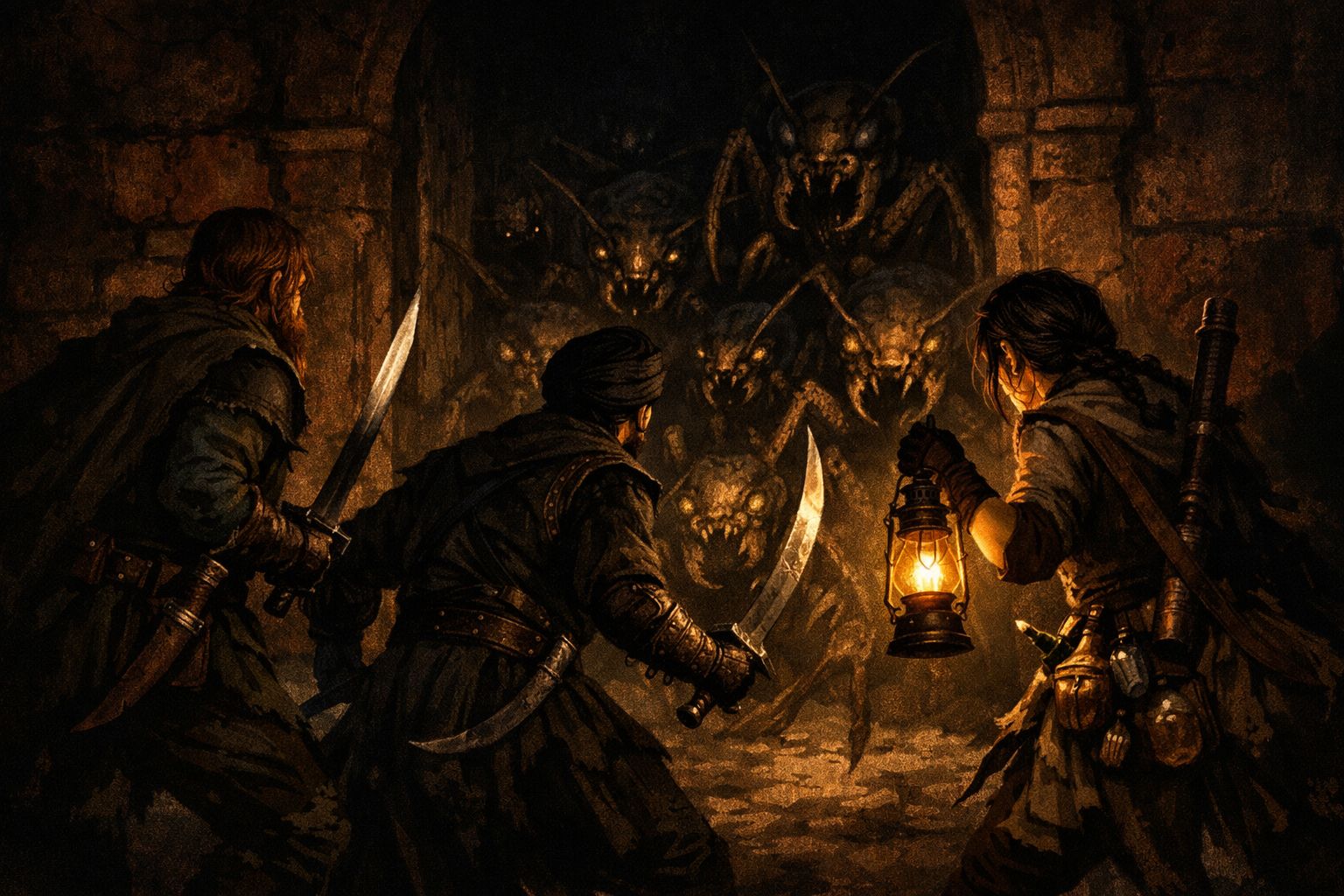
The down team reaches the dead queen's chamber under pressure, with insectoids closing in and no good way forward. This is where things should finally look hopeless.
That hopelessness must feel earned. The players have already survived the lower city, already learned what they came to learn and already pushed themselves through fear and uncertainty. They have not been careless. They have simply run out of room.
That is what makes the up team's later arrival satisfying. The players did not fail. They reached the end of what survival alone could accomplish.
Practical Goals of the Section
By the end of the down team sequence, the players should have experienced several things.
- They should feel that Tekrissal trapped them and forced them through its buried truth.
- They should understand the city as tragic rather than merely dangerous.
- They should have learned enough of the fall to make the dead queen's chamber meaningful.
- They should feel hunted, tired and increasingly cut off.
And when the final corner comes, they should believe that they have reached the limit of what they can do alone.
That is the point where the act is ready for reunion, rescue and final battle.
The Up Team
The up team happens mostly off-screen. It is not meant to split active play away from the down team, but to exist as a parallel thread of loyalty, urgency and problem solving that can later be revealed in pieces.
How to Present It
The best way to handle the up team is through a series of short flavor stories, told afterward once the crew has survived and had time to speak about what happened above.
This approach keeps the horror and isolation of the down team intact while still letting the rescue feel real, earned and full of character. The players should not watch the rescue unfold in detail while trapped below. They should experience only its distant signs, then later hear how hard the crew fought to come back for them.
If Named Up Team Crew Are Player Characters
If any of the named crew who solve key problems in the up team are being played by players in this arc, simply keep them with the down team and shift their role above to someone else. Do not bend the structure to force those characters upstairs.
Replace the missing contribution with another suitable crew member, or simplify that particular obstacle if needed. The important thing is not that Nera, Ivy or Pelonias specifically solve those exact problems. The important thing is that the up team still feels capable, desperate and determined, and that someone gets a moment to shine as the one who helps bring the trapped crew home.
Getting to the Ship
Ileena came back through Tekrissal like something the city had failed to catch.
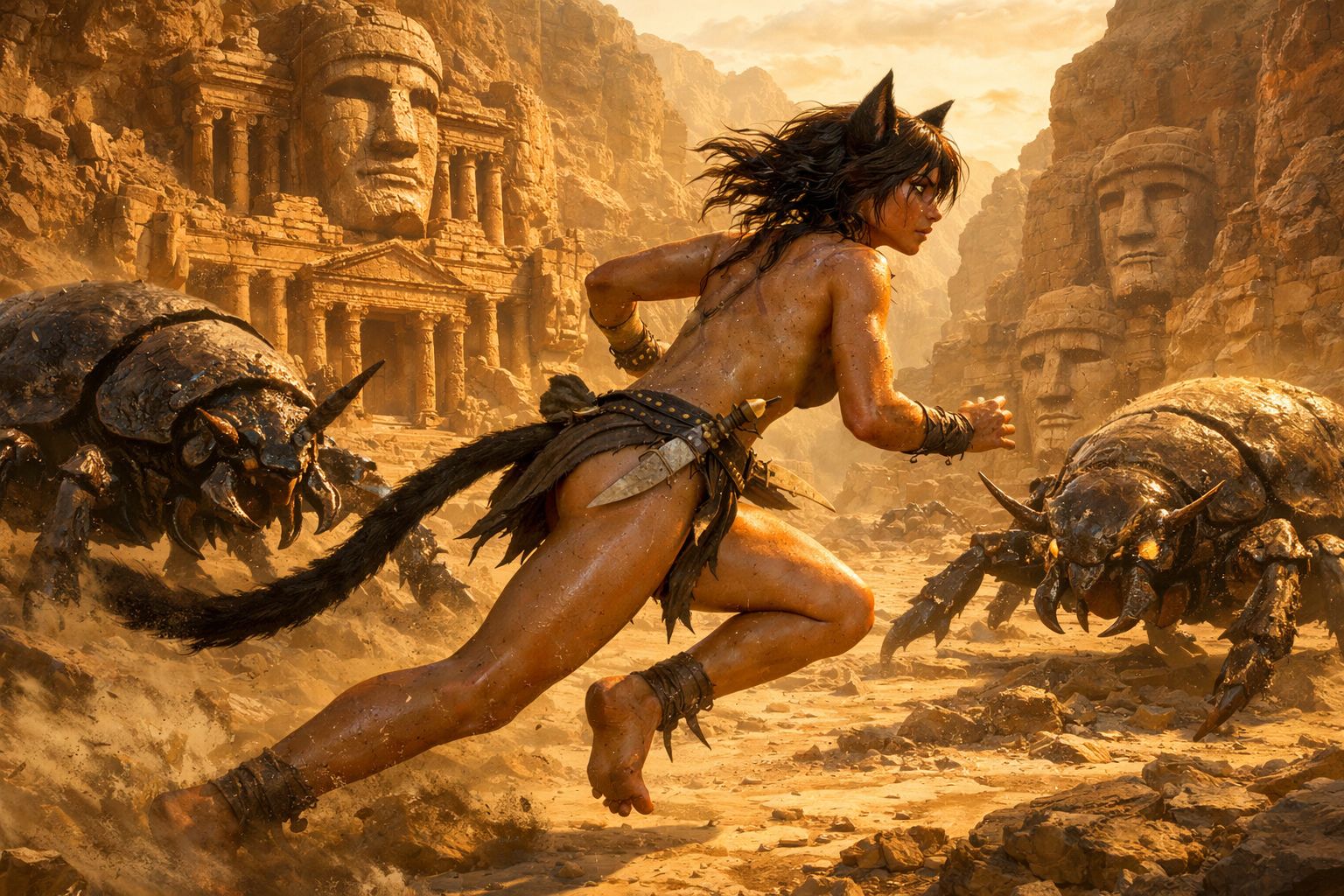
She did not hide. There was no point now. She ran flat out through dead streets and broken chambers, a pale blur slipping past carved walls and red stone, feet barely seeming to touch the ground. Once an insectoid dropped from a ledge ahead of her and she changed direction without breaking stride, one hand on the wall, body twisting through a gap that should not have been wide enough to take her. Another lunged from a dark opening and she vaulted a fallen block, landed light and kept going. Behind her the city clattered and scraped and woke in ugly pieces, but Ileena was already somewhere else.
By the time she reached the Blue Marlin she did not look tired. She looked furious.
Scarnax had just stepped onto the deck from the gangplank when she came over the rail in a single fluid motion and landed hard enough to make the nearest sailor flinch. Dust streaked her legs. One sleeve was torn. Her eyes were too bright.
Scarnax had seen enough bad landfalls to know the difference between excitement and disaster. He crossed the deck at once.
"What happened?"
"The floor broke," Ileena said. Her voice was flat with speed held under control. "Nasheem, Gastved and Thaleia fell through. The bugs boxed them in. I could not stay."
For the smallest fraction of a second something hard passed over Scarnax's face. Then it was gone, buried under command.
"They were alive when you left?"
"Bruised. Angry. Trapped." Ileena's tail lashed once behind her. "There were too many of the insects. They are still there."
Nera had been at the edge of the deck near Galenor's workbench, half hidden among tools and gear as usual, listening without seeming to. At those words she was moving before anyone called her. She came straight across the planks, thin shoulders set hard, eyes sharper than Scarnax was used to seeing on her.
"I am coming."
Scarnax turned toward her. "No."
"Yes." There was nothing hesitant in her now. "You do not get to tell me no on this." Her voice was quiet, but it did not shake. "They saved me from a dead city. I am not staying on the ship while they die in one."
That stopped the deck for a breath.
Scarnax looked at her for a long moment. Then he nodded once, not indulgent, not gentle, simply accepting what she had made unavoidable.
"You will come," he said. "And so will everyone else."
He turned his head sharply. "Caelin."
The boatswain was already moving, because of course she was. She did not ask questions first. She never did when Scarnax used that tone. She planted her hands on her hips, drew breath like a stormfront and let her voice crack across the deck.
"All hands! Gear up! Marines armed, lanterns checked, ropes, water, tools, now, move!"
The ship came alive at once.
Sailors ran. Weapons were snatched from pegs. Belts were buckled. Junia appeared with bandages and satchels. Galenor started grabbing pry bars and hammers while still asking no one in particular what kind of idiot built a city over hollow stone. Nera vanished once and reappeared with her tools already stuffed into a satchel. Ileena stood in the middle of the motion like a drawn knife, watching all of it with a terrible impatience.
Scarnax buckled on his blade and looked once toward the dead city beyond the canyon.
Then he looked back at his crew.
"We go in force," he said. "We bring them home."
The First Problem
They reached the ruin at a run, breath steaming in the cooler shade beneath the stone, only to stop all at once at the edge of the broken entrance.
Below and around the collapse, the ruin was alive with insectoids.
They moved over walls, through doorways, across cracked floors and broken pillars, not in any neat pattern but in restless, ugly swarms of local purpose. Some clustered around the hole where the down team had fallen. Others moved through side chambers and over the roofline, crossing and recrossing each other in ways that made the whole ruin seem infested rather than merely occupied.
Skarnulf stood with his weapon in hand, staring down into the movement. His face did not change, but his voice came flat and certain.
"Too many."
No one argued.
Pelonias narrowed his eyes, studying the ruin, then the line of facades beyond it. "Then we do not go in there," he said. "A city like this has more than one way down."
Ileena was already moving again, leading them at a quick crouched pace through the next row of carved chambers. The first ruin they entered gave them nothing but broken walls, old carvings and a collapsed inner floor that led nowhere useful. The second had more promise. A stairway once descended there, but the lower half had fallen away into darkness and rubble.
Then, in the third ruin, they found it.
The chamber had once been some kind of public room or waystation, though time and damage had stripped most of its purpose away. One wall still held a carved plan of the lower city, cut directly into the stone. Lines, chambers, branching passages, old stairs and connecting routes spread across it in a complexity that made the eye slide off unless it fixed itself carefully and followed one path at a time. Not far from the wall, a stairway still led downward into shadow.
Pelonias stepped close at once, one hand rising unconsciously as if to trace the routes in the air. "Yes," he murmured. "Yes, this will do." Then he frowned. "But not from memory. There is too much of it. I could use it if I had it in hand, but I cannot hold all this in my head."
Nera stepped forward before anyone else could answer.
She had already opened her tool satchel. From it she drew a sheet of paper, a scrap of cloth and a piece of charcoal worn smooth from use. She knelt at the foot of the carved wall, looking up at the map with quick measuring eyes.
Scarnax glanced down at her. "No use. It would take hours to copy that."
Nera did not look up.
"No, it won't," she said.
She pressed the paper against the stone and began working the charcoal across it in fast, practiced strokes. Dark spread over the page, and beneath it the carved lines emerged cleanly, route by route, chamber by chamber, as the raised and recessed parts took the rubbing differently. Her hands moved with the neat certainty of someone who had already solved the problem before the others had finished describing it.
In less than a minute she peeled the sheet free, blew on it to remove loose charcoal dust and held it up.
There it was. Not perfect, not pretty, but more than enough.
She rose and handed it to Pelonias.
He stared at it, then let out a low whistle. "That," he said, "is very smart thinking."
Nera gave the smallest shrug, though she looked almost painfully pleased with the praise.
Pelonias spread the rubbing carefully and traced one route downward with a finger. "This gives us the lower roads. It gives us options." His brow tightened. "But it does not tell us where they are. And below this point, it is a rat's nest."
For a moment no one spoke.
Then Ivy stepped forward from the back of the group.
She had been quiet since they entered the city again, quieter even than usual, her eyes not on the stone map but somewhere beyond it, as though listening to a second conversation under the first. Now she looked from Pelonias to Scarnax, and there was something steady in her face that had not been there before.
"I can help with that," she said.
Finding the Lost Team
Ivy lowered herself to the cold floor of the chamber with more care than grace. The stone still held the day's heat in its deeper skin, but the surface was chill, and the dark around them seemed to breathe in shallow, watchful ways. The others had given her space. Not much. Just enough. Pelonias crouched over Nera's rubbing of the map. Scarnax stood with his arms folded, looking at the carved lines as though force of will alone might make them answer. Nera hovered nearby, trying not to pace and failing by inches.
Ivy folded her legs beneath her, set her hands on her knees and tried to steady her breathing.
She hated doing this with people watching.
Not because they judged her. The Blue Marlin crew were better than that. But because going into trance always meant leaving herself half undefended, and too much of her had once been undefended in the wrong hands. Even now, even here, that old instinct pulled tight inside her.
She closed her eyes.
The chamber around her dimmed behind her lids. Breath in. Breath out. She followed the old half-remembered path as best she could, not with the certainty of a trained shaman, but with the stubbornness of someone who had once been meant for this and never entirely stopped being meant for it. The spirit world was always dangerous. More so for her, because she was not fully trained and did not always know how to cross cleanly or return empty. That uncertainty was simply part of her gift.
Then the world turned.
Tekrissal rose around her in shades of black, white and ash gray, the spirit world reflecting the waking place not as it was, but as its inner truth. The same chamber stood around her, but now it looked drained, thin and dust-choked, like a memory worn too long at the edges. In the spirit world there were no true colors in the land itself, only in the spirits.
She rose and ran.
The stairs went down through ruin and dust. Corridors bent and doubled back, a maze of exhausted grandeur and spiritual rot. Tekrissal in this form was not empty the way Tikirri had been. Tikirri had felt horrifying because almost nothing lived here on the spirit side except one overwhelming alien darkness. Tekrissal was different. This city had held human life within the reach of memory, and the spirit world remembered that. It was crowded with absence.
She found the first spirits in a low chamber whose walls had once held carvings. They drifted there like faded lanterns, thin human shapes with weak color bleeding through gray, too tired even to be frightened properly. One turned its face toward her as she approached, and she felt that old terrible uncertainty every time she met the dead: Are you truly what you seem, or something older wearing a borrowed face? The spirit world did not forgive carelessness, and spirits were no more infallible than the living.
"Did you see living people?" Ivy asked, her voice sounding wrong in that place, as if it belonged to somebody standing farther away.
The spirit blinked, slow and dim, and lifted one hand.
It pointed.
That was all.
Ivy did not argue. She ran where it indicated, down another stair, through another broken hall, past chambers that seemed to breathe old grief into the dust.
More spirits appeared. A woman with one arm folded strangely against her chest. An old man whose face kept blurring at the edges as though memory itself could not hold him. A child crouched in a corner beside a wall that no longer existed in the waking world. All of them faded. All of them tired. All of them carrying that weak gray cast over the remnants of their own colors. And every time she asked, they only pointed.
Deeper.
She followed.
At last she came to the place where the city still remembered the ritual most strongly.
It was a chamber in the spirit world and more than a chamber, a wound where the stone and shadow seemed stained by the memory of what had been done there. The dead wandered in circles, confused and unfixed, their auras weak and color-starved. Some looked up as she entered. Some did not seem to know she was there at all.
One of them reached toward her, fingers trembling.
"Did it work?" the spirit asked, voice thin and frayed with repetition. "Is the queen dead?"
Another turned with hollow urgency. "Did we hold? Did it work?"
Ivy swallowed. "I do not know," she said. "I need to find living people. They passed through here. Did you see where they went?"
The first spirit stared at her as if the question belonged to some stranger world. Then its hand rose and pointed, not back the way she had come, but onward.
"To the queen," it whispered.
Then, after a long moment, it turned its head toward a distant dark and something in the chamber shifted just enough for her to understand that they meant an exit, a path, a direction away from here.
Ivy went.
She ran harder now, following the shape of the city as it bent toward one last center. As she did, another thought pressed in on her, almost beneath notice at first. She had seen only human dead. Human sorrow. Human fragments. No insect spirits. None. Not one shell-backed remnant drifting in the dust. That absence clung to her almost as much as the spirits themselves.
Then, all at once, she saw them.
Not dead spirits. Living ones.
They moved through the spirit world as reflections of themselves. The corridor around them was gray, but they carried their own colors with them, brighter than the dead, more whole, more anchored to flesh. Nasheem. Gastved. Thaleia. Their living bodies were elsewhere, in the flesh world, but their spiritual shapes cast through enough for her to recognize.
They could not truly see her. Not here, not like this.
And yet something in them reacted.
Nasheem's head turned sharply, as if he had heard a voice behind him. Gastved slowed for half a breath, staring into empty air with the look of a man sensing danger where there should have been none. Thaleia, of course, actually stepped toward the place where Ivy stood, eyes narrowed with startled curiosity.
Ivy did not stop.
She had what she needed.
She tore herself back the way she had come, up through the dust and sorrow and half-spoken memories of Tekrissal, back through the path she had forced open for herself, back toward the living. As she passed the spirits she had met earlier, she felt them tug at her, felt loneliness, but she didn't stop.
The chamber hit her like a blast of stale air.
She snapped awake with a hard breath, swaying where she sat. For a moment the world sat badly on her, too bright, too solid, too loud. The shift always did that. She shut her eyes once, opened them again and dragged her hand across her face as if wiping spirit dust away.
Then she reached out, snatched the rubbing from Pelonias's hands and jabbed a finger at one branching section of the map.
"There," she said.
For one stunned heartbeat no one moved.
Then the room broke into a cheer sharp enough to sound almost like fear turning into relief.
Pelonias straightened, map in hand, eyes suddenly alight with purpose.
"Follow me," he said.
Reunion and Final Battle
The first insectoid came through low, fast and silent except for the dry scrape of its limbs on stone.
Nasheem met it with steel and knocked it sideways, but another was already behind it, and another behind that, black shapes pushing into the broken doorway with the blind certainty of things that had no fear and no thought beyond forward motion. Gastved drove his blade down into a seam in one shell, yanked it free and kicked the body aside, only to have the next creature surge over it. Thaleia, pale and breathing hard, had long since stopped being a scholar and become simply another pair of desperate hands, striking where she could, retreating where she had to, knowing all the while that knowledge had run out and only survival remained.
They were losing.
Not because they had failed. Not because they had fought badly. There were simply too many of them, and the chamber offered no miracle, only a little stone, a little space and the empty shell of the dead queen watching over another ending.
Then the roar came.
It was not insect sound. Not claw on stone, not the hideous dry snapping of jaws.
It was Ormun.
For one split second even the insectoids seemed to freeze, as though the sheer force of the sound had reached some dim broken place in them and told them the world had changed.
Then Ormun hit them.
He came through the doorway like a collapsing wall, enormous shoulders driving into the first rank hard enough to throw one insectoid bodily into another. Stone rang under the impact. One shell cracked with a sharp report. Another creature vanished under his weight as he charged straight into them with a bellow that shook dust from the ceiling.
Mbaru was right behind him, all speed and violence, spear punching past Ormun's shoulder into a weak joint with such force that the insectoid folded around it. He tore the weapon free in the same motion and drove on, face set in the grim focus of a man who had already decided that whatever stood here was going to die.
Amaxia came with him, lower and tighter, shield and blade working together in short brutal movements. She did not roar. She did not need to. She simply hit the line where it was weakest and made it weaker, smashing one creature back off balance and opening another from throat seam to belly before it even understood she was there.
For one stunned heartbeat Nasheem could only stare.
Then he laughed once, sharp and wild.
"About time," he snapped, and stepped into the renewed line.
Gastved did not waste breath on words. He shifted half a step, making room. Thaleia, eyes wide with something perilously close to hysterical relief, stumbled back just enough to stop being in everyone's way and start stabbing again where openings appeared.
Now they were six.
And behind the first wave of rescuers came the rest.
Shapes flooded through the chamber entrance and around its edges. Scarnax with blade drawn and command already in his voice. Skarnulf grim and steady. Nera, relieved but tense. Ileena somewhere in the motion like a thrown knife. Others too, hitting the rear of the insectoid mass from behind just as the creatures were still trying to understand the catastrophe that had erupted through the front.
That ended it.
The insectoids had numbers and claws and killing momentum, but no tactics, no discipline and no answer to being crushed between two concentrated lines of furious people. They turned when attacked from behind, exposing themselves to the front. They surged forward to escape the front, exposing themselves to the rear. They collided with one another, clawed over one another and died one by one under blade, spear and brute force.
It was over quickly. Not cleanly, not quietly, but quickly.
One last insectoid tried to scramble over the bodies of its own kind toward the queen's shell. Mbaru's spear took it through the thorax and nailed it to the stone. After that, there was only panting, the stink of ruptured chitin and the sudden ringing silence that follows a fight stopped too fast to feel real.
Then Junia's voice cut through it at once.
"Anybody hurt?"
It came sharp and urgent from somewhere just beyond the clustered bodies, already moving, already counting.
Several voices answered at once.
"No one hurt here."
"We are good."
"Just scratches."
Junia, of course, did not sound convinced by any of them.
Scarnax stepped over a dead insectoid and turned in a quick sweep, taking in the survivors, the chamber and the dark approaches beyond. His relief was there and gone in an instant, locked down under the harder thing that always followed.
"Move!" he barked. "We are not staying here."
He looked toward Pelonias, who still held Nera's rubbing map in one hand, now smudged and crumpled but intact.
"Pelonias, lead the way."
Pelonias gave a quick nod and said "Follow!"
Scarnax lifted his blade toward the exit.
"To the ship!"
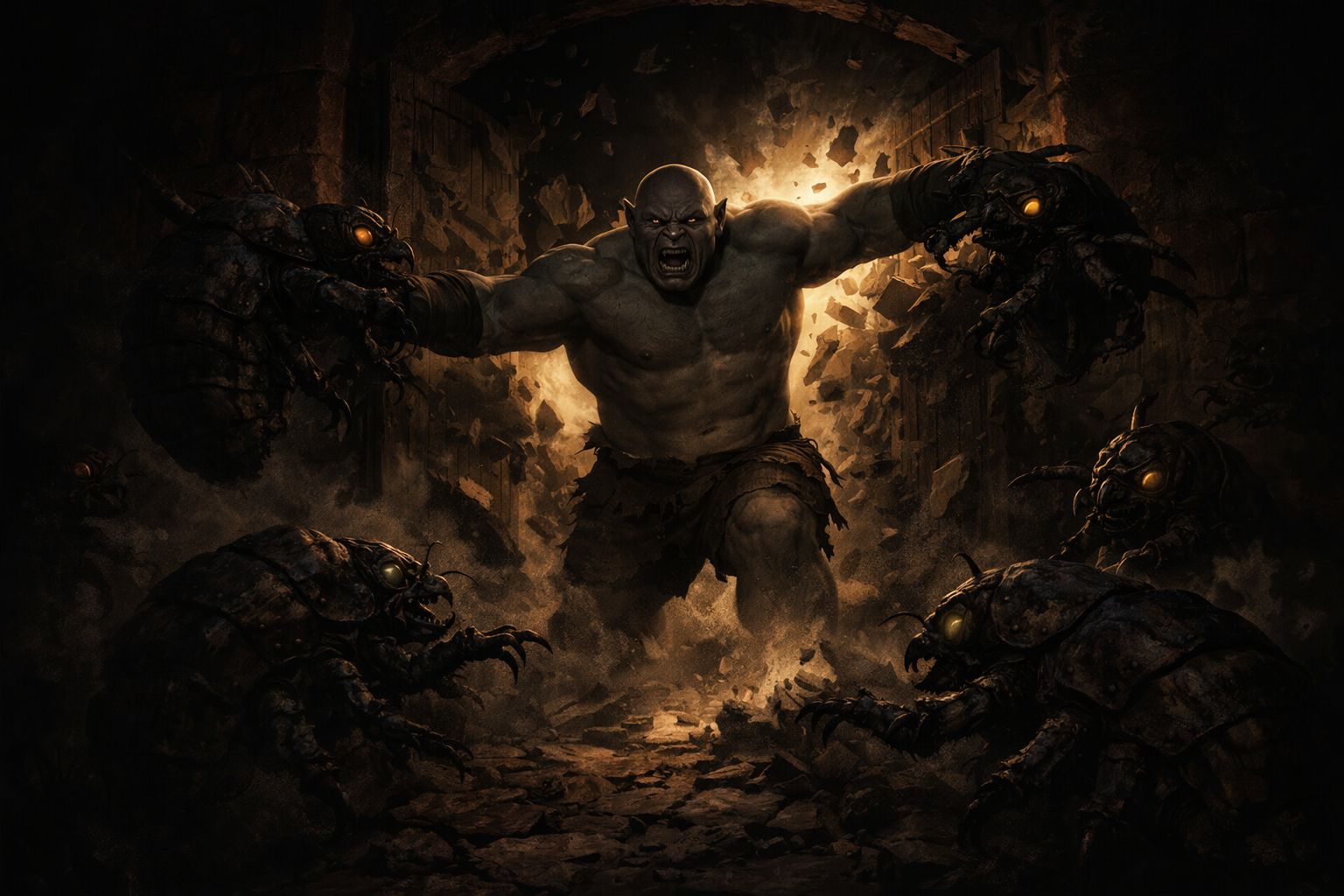
The reunion should begin in the mood of a final last stand. The down team has reached the point where survival no longer seems realistically possible. They have fought, run, learned and endured, and now they are cornered in the dead queen's chamber with too many insectoids closing in. The feeling should be grim, not panicked. This is not chaos anymore. It is the hard stillness of people preparing to die well because they see no other choice.
Then the rescue team bursts in and breaks that mood apart.
The change should be immediate and overwhelming. Not just tactical relief, but emotional relief. Their people came back for them. They did not flee, regroup and decide it was too dangerous. They came back into the dead city, through all that danger, to pull them out. That should be the heart of the moment.
The Emotional Tone After the Rescue
Once the fight ends, let the emotional weight land for a brief moment. The important thing here is not celebration, but fierce relief and the intensity of friendship. They are alive. They found each other. The worst fear, that the others would never come, is gone.
This is a good place for quick exchanges, urgent checking of wounds and the kind of rough immediate closeness that comes after surviving something terrible together. Junia calling out for injuries is exactly right. Let the crew answer, let the relief breathe for a heartbeat, and let the players feel that the Blue Marlin is more than a ship. It is a group of people who will go into hell for each other.
Do not linger too long, though. The scene should give them relief, not rest.
The Countdown to Leave
Even in the middle of reunion, the danger is not over. The noise of the fight, the movement of so many people and the disturbance around the dead queen's chamber should make it clear that more insectoids will be converging on the area.
The players should understand that they have won this fight, but they have no chance of holding this place. The rescue is not an end. It is a narrow window.
This should create a second emotional layer beneath the relief. The crew has each other again, but they only keep each other if they move now.
Scarnax or another steady voice should cut through any drift toward standing still and make that plain. The right tone is not panic, but urgency. There is no time to process this properly here. Home first. Feelings later.
The Escape Through the Ruins
The trip back to the ship should feel hectic and dangerous, but it should not become another battle sequence. The crew is now moving through a city that is far more active than before. Insectoids are stirring in large numbers. The ruins should feel alive with motion, scraping sounds, glimpses of movement, shifting shapes on distant walls and the sense that the whole city is drawing inward toward the disturbance.
That said, do not turn this into a chain of fights. The players have already had their climax. The return should be about pressure, speed and the fear of being caught, not about grinding through more combat.
Use movement and proximity. Insectoids crossing a corridor ahead just after the crew chooses another route. Shapes clinging to facades above them. A passage they used earlier now crawling with movement. The sound of claws behind a wall they are hurrying past. A ruined chamber that must be crossed quickly while something skitters in the dark above.
This keeps the escape dangerous without draining the energy that the reunion just created.
How to Handle the Return
Pelonias can lead with the rubbing map, choosing the fastest workable route out. The rest of the crew should fall naturally into roles. Scouts watching crossings. Strong fighters covering the center. Junia checking those who are limping or bleeding while they move. Scarnax keeping everyone from bunching up or freezing at bad moments.
The important thing is that the escape feels disciplined under pressure. The crew is not wandering. They are driving themselves out through a city that is waking around them.
The Intended Feeling
By the end of this section, the players should feel three things at once.
- First, intense relief. Their people came back for them.
- Second, urgency. They are not safe yet, and the city is closing in.
- Third, forward motion. The only correct choice now is to get out, get to the ship and leave Tekrissal behind before it can take more from them.
That combination is what gives this part its proper energy. The reunion is the emotional release. The escape is the final tightening of the rope before they finally break free.
Time to Leave
The deck of the Blue Marlin was crowded and quieter than it should have been.
No one had gone below willingly. Not yet. The canyon walls loomed dark around them, and farther inland, beyond broken stone and distance, the dead city seemed to stir in ways none of them liked. Even from here they could see movement now and then, small black shifts across the red rock, too many to count, too many to trust the eye on.
Nasheem stood with one hand on the rail, looking back toward the ruins with a face gone harder than usual.
"The whole city is crawling with them now," he said. "Going back in would be madness."
Ileena, crouched barefoot on a coil of rope with her arms draped over her knees, flicked an ear and glanced toward the canyon. "I might get in."
Scarnax turned his head toward her. "The key word there is might."
Ileena's tail gave one irritated lash.
"And might," Scarnax went on, "is not good enough."
Caelin stood a little apart from the cluster, arms folded hard across her chest, still streaked with dust and old insect blood. Her voice came clipped and flat, the way it did when fear had already passed through her and been hammered into discipline.
"We got lucky once," she said. "That is all. Now they know we are there. Before, it was a sneaking job. If we go in now, it will not be that. It will be a straight fight against the things that wiped out a city."
Thaleia, who had somehow found the strength to sit upright with her notebook in her lap despite everything, stared toward Tekrissal with a mind that clearly still refused to stop.
"It looks," she said quietly, "like ants pouring out of a broken nest."
Scarnax scratched at his beard, eyes still on the city.
"...Or hornets," he said.
That won no argument.
For a little while the deck was silent except for the creak of rope and the hush of water against the hull. The choice was already made in most of them. No one wanted to say it first. Or rather, no one wanted to be the one who admitted that Tekrissal had taken all it was going to take and would give no more.
At last Scarnax drew in a breath and let it out slow.
"We cannot go in again," he said. "We will have to trust that the trail can be picked up somewhere else."
Ayesha, standing near the quarterdeck steps with her hands folded into her sleeves, gave a small nod. Her face was composed again now, all the urgency filed back into elegance.
"A ship like the Waverider does not vanish cleanly," she said. "Not from memory. Not from rumor. Not from the minds of people who saw her. We will find the wake she left behind."
Pelonias, still holding Nera's rubbing as if he disliked being far from a map for even one moment, lifted a hand in agreement.
"And there are not so many ports she could have sailed for from here," he added. "Not if her captain had any sense."
That drew the ghost of a smile from Nasheem.
Scarnax looked from one face to another, measuring the crew, the ship and the dead city together. Then he nodded once.
"So be it," he said. "We leave."
At this point, it should be clear that going back into Tekrissal is not a real option. The rescue, the final fight and the growing activity in the ruins should all have shown the same thing. The city is awake now. It is no longer a place of scattered dangers and careful movement. It is crawling with insectoids, stirred up by blood, noise and intrusion, searching through the ruins for soft flesh.
The players do not need to be forced away from the idea immediately if they are still emotionally attached to the city or the mystery. But the Game Master should make the reality plain. This is not caution speaking. It is simple survival.
How to Make It Clear
If the players hesitate or talk as though another expedition might still be possible, let a few level-headed crew members say so directly. Caelin, Gastved, Pelonias, Ayesha and Junia are good choices for this.
They should frame it in practical terms. Before, Tekrissal was a stealth mission through a dangerous ruin. Now it would be a direct fight against a city-wide infestation. The crew survived once because they moved quietly, got lucky and were eventually rescued in force. None of that can be counted on a second time. The ruins are too active now, and the insectoids know there is prey there.
If the Players Still Push
If the players insist on trying to go back, make the danger unmistakable before they fully commit. As they approach, let them see insectoids emerging in large numbers. Not one or two. Not scattered movement. Masses, more than can be counted.
They should see them crawling over cliff walls, pouring from openings, crossing plazas and gathering in ruined streets. The image should leave no doubt. They are not heading into a hostile ruin anymore. They are heading toward a swarm, an army of broken hive-beasts stirred into collective motion.
At that point, make it plain in the fiction. This would not be an exploration. It would be a battle against overwhelming numbers, and almost certainly a massacre.
Closing the City
The purpose of this section is not to trap the players, but to close the ruined city honestly and push the story outward again. Tekrissal has yielded what it will yield. The only sensible path now is to leave and pick up the trail elsewhere.
Exit
The Blue Marlin drifted downriver in the slow red light of late day, the ruined heights of Tekrissal receding behind her one carved face at a time. No one watched the city with wonder now. Even from the ship it felt wrong, too still in some places, too full of movement in others. Black shapes crossed walls and openings far above the waterline. The dead city had not been left sleeping. It had been left hungry.
Most of the crew stayed on deck anyway.
No one seemed ready to go below and pretend this was over.
Shaedra stood near the rail, one hand resting on the weathered wood, her eyes sweeping the banks with the same hard patience she gave a forest edge before dusk. Pelonias lingered nearby with his map case at his side. Thaleia, wrapped in a blanket despite the heat still trapped in the stone of the canyon, sat on a coil of rope with a notebook in her lap, though she had written little for the last half hour. Ileena sprawled barefoot on the deck like some half tamed river thing, ears flicking at sounds no one else caught. Scarnax stood farther aft, silent, one hand on the tiller post, watching the river ahead.
Then Shaedra straightened.
"There," she said sharply, pointing toward the bank.
Heads turned at once.
At first there was only scrub, stone and the pale dust of the river's edge. Then sunlight struck something low to the ground and flashed.
Ileena came upright in one smooth motion, eyes narrowing. "Something moved."
Pelonias was already reaching for his looking glass. He snapped it open, raised it to his eye and held it there for a breath.
Then he lowered it sharply.
"It is a cairn," he said. "And some kind of flag, fallen over." His voice hardened. "Drop anchor."
The order moved through the ship at once. Sailors sprang to lines. The anchor splashed down. The Blue Marlin slowed and settled, drifting only a little before the chain took hold.
Scarnax was already moving for the boat. Ileena was faster and was over the side before anyone could tell her not to be. Thaleia, blanket forgotten, hurried after them with the brittle, exhausted determination of someone who had been disappointed too many times in one day to risk missing one thing more.
They went ashore together.
The bank was quiet. The river moved behind them with a low hush against stone. Up close, the cairn was nothing grand, just a deliberate pile of rocks beside a short pole that had toppled sideways into the dust.
Scarnax crouched first, studying the cloth still tied near the top.
"It is red wheft," he said. He touched the knot with two fingers, careful, respectful. "With a knot in it. A warning."
Ileena was already pulling stones away from the cairn one by one, quick and neat despite the impatience in her movements. She paused, blinked once, and reached deeper.
"There is something in it."
She drew out a bottle, stoppered and dusty. She lifted it to her nose and sniffed.
Thaleia had no patience left at all. She snatched the bottle from Ileena's hand almost before the last word was out, squinting at the dark shape inside.
"There is paper in it."
She worked the stopper loose with shaking fingers, turned the bottle and tapped it until the rolled message slid free into her hand. For a moment she only stared at it, as if afraid it might dissolve. Then she unrolled it.
Scarnax and Ileena watched her face.
Thaleia read silently at first, then aloud.
"'Do not proceed further upstream. Danger. The next safe port is Oshiren in Lumekhet. Signed Capt S V, Waverider.'"
For one heartbeat there was no sound but the river.
Then Scarnax swore, long and vivid and from deep enough in his soul that even Ileena looked impressed.
Thaleia actually laughed once, tired and sharp and disbelieving. "Yes," she said. "That seems fair."
Scarnax held out his hand. "Give it here."
She passed him the message at once. He rolled it carefully, slid it back into the bottle and stoppered it again. Then, with the same grave care, he reset the cairn stone by stone. When he took up the fallen pole, he planted it upright again and drove it deep into the bank, testing it twice to make sure it would hold.
Only when he was satisfied did he step back.
"Let us hope the next ship sees it," he said.
He looked once upstream, toward the dead city and the river that had led them into it.
Then he turned away.
"Back to the ship," he said. "We leave this place and we do not come back."
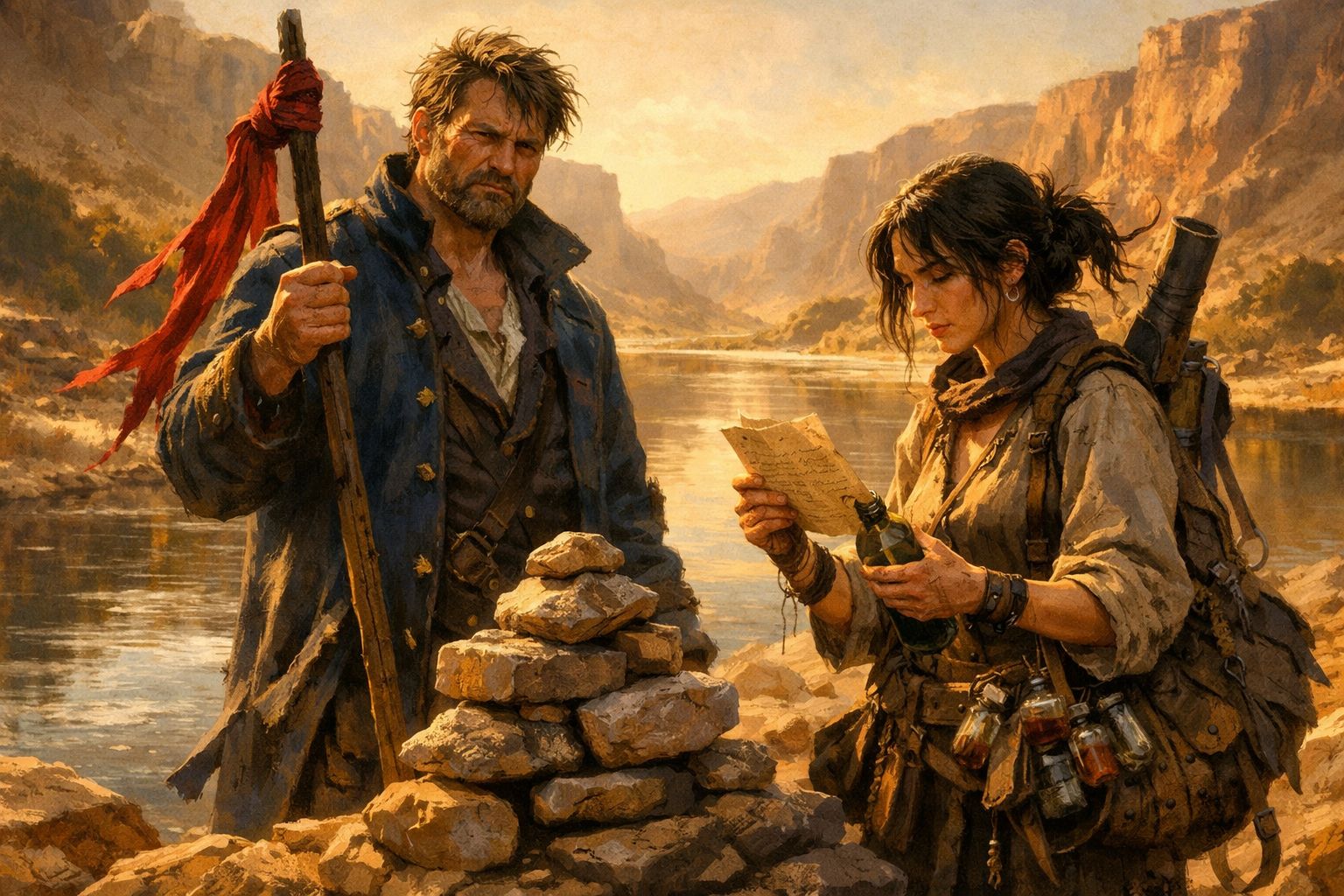
As the Blue Marlin leaves Tekrissal behind, the crew spots a glint on the riverbank. This is the bottle in the cairn catching the light. That detail matters. The warning was not originally meant to be found this way.
The cairn was clearly intended to be marked by a pole with a red wheft tied to it as a warning signal. That pole has fallen over, and the cloth is now half buried in dust and scrub. Because of that, the marker is only really noticeable from this direction, with the bottle's glass catching the light. Anyone heading upstream from below would be much more likely to miss it.
That fits the bitter logic of the scene. The warning was there, but time and chance made it far less visible than it was meant to be.
The Message
Inside the cairn is a bottle containing a short written note. The message reads:
"Do not proceed further upstream. Danger. The next safe port is Oshiren in Lumekhet. Signed Capt S V, Waverider."
This is the final sting of Tekrissal. After everything the crew has suffered and learned, the Waverider's message is not a clue urging them onward into the city, but a warning meant to stop them from repeating the same mistake.
What It Means
The message gives the crew two things at once.
First, it closes Tekrissal. The dead city has yielded what it will yield, and even Solonex's own warning says not to press farther.
Second, it opens the next stage cleanly. The next safe port is Oshiren in Lumekhet, and that is where the Waverider trail now leads.
Act Summary
Tekrissal has been a crucible for the crew, testing their ability to cooperate and to utilize their individual capabilities.
Tekrissal and Its Fall
The crew uncovers the truth of Tekrissal. It was not simply a dead city overrun by monsters, but a city conquered by a rogue queen from Tikirri. She occupied it, bent its sacred places into hive structures and brought a true insect order into its heart. The people of Tekrissal fought back first by force, then by desperate ritual. That ritual did not destroy the queen outright, but made her sick, and that sickness eventually spread through the hive until her death broke it. What remains now are the shattered remnants of that failed hive, dangerous, mindless and no longer truly one.
This also confirms the link between Tekrissal and Tikirri. The hidden civilization in the crater and the broken infestation in the dead city belong to the same larger history. Tekrissal is what happened when one part of that order broke away and carried itself into a human city.
The Crew's Loyalty
The rescue becomes one of the clearest demonstrations so far of what the Blue Marlin truly is. When part of the team is trapped below Tekrissal, the rest do not cut their losses or flee. They regroup, gather everyone they can and go back into the ruins to bring their people home.
That matters. Tekrissal does not just reveal the city's past. It reveals the crew's character. They are the kind of people who will go into a dead city full of insectoids for each other.
Who Proved Their Worth
Several crew members get strong moments here.
Thaleia proves that she is not just curious, but useful under pressure. Her examination of the insectoids gives the crew a real survival tool, and her hunger for knowledge helps make sense of what Tekrissal truly is.
Nera gets a practical and memorable moment when she solves the problem of the carved map by making a rubbing, turning a fixed clue into something portable and useful. She also showed that she remembers that she was once saved by the crew, and is willing to return the favor.
Ivy shows both courage and value by entering the spirit world in a place where the spirit world is bitter, broken and dangerous. Her search does not give clean answers, but it gives enough, and that is what saves the trapped crew.
Pelonias proves once again why he matters on this ship. Once the clues are gathered, he is the one who can actually turn them into a route and lead people through danger with confidence.
Together, these moments help show that the Blue Marlin is not held together by warriors alone.
The Waverider Trail
The crew confirms that the Waverider came to Tekrissal, and at the very end they recover the next real direction. Solonex's own warning tells them not to continue farther upstream and points them instead toward the next safe port.
That port is Oshiren in Lumekhet.
Tekrissal therefore ends with two truths at once. The crew learns what happened here, and they also learn that the Waverider had already decided this place was not where the deeper answer lay. The trail now moves onward.
Thaleia Stays With the Blue Marlin
For the moment, Thaleia remains with the Blue Marlin. She has proven too useful to leave behind, both through her knowledge and through her ability to turn observation into something the crew can actually act on. Just as importantly, Tekrissal is no place to leave her. Whatever comes later, for now she stays with the ship.
The coast of Tekrissal was fading into haze behind them, the red stone sinking slowly into distance until it looked less like a place and more like a wound closing over. The Blue Marlin had found her deeper water again, and with every pull of the current the mountains became smaller. No one on deck looked sorry to see that happen.
Ormun stood by the rail with his huge hands resting on the wood, calm now in the way he often was after violence, as though once danger had passed he simply folded back into gentleness. Nera sat cross-legged on a coil of rope nearby, turning a stub of charcoal between her fingers without noticing she was doing it. Ivy leaned beside her with one shoulder against the mast, looser than she had been in Tekrissal, though not by much. Nasheem stood a little apart, coat stirring in the wind, watching the vanishing coast with the thoughtful stillness that usually meant he was deciding whether to be charming, serious or both.
It was Ivy who spoke first.
"Your rubbing was brilliant," she said to Nera. "We would never have found them in time without it."
Nera looked down at once, as if praise was a thing that might strike if met directly. "No," she said. "That part was easy. You did the hard work." Her fingers tightened around the charcoal. "I would not have dared that."
Ivy gave a small shrug, though her eyes stayed on the horizon. "I am not sure daring had much to do with it."
Nasheem glanced toward her. "In the tunnels," he said, "we saw something. A faint light. Colors, but weak. It passed by and was gone again." He tilted his head. "Was that you?"
Ivy thought about it for a moment. "I do not know," she said. "Maybe. I saw you. Not clearly, not like in the flesh. But I saw you react to something."
Nasheem let out a soft breath through his nose. "Then it was probably you." He fell quiet for a heartbeat, then turned toward Ormun. "And you."
Ormun blinked. "Me?"
Nasheem pointed at him with mock severity. "You must learn how to stick to plans. You cannot simply decide to smash through a wall of horrors because it feels right. It is a team effort, not just you charging in like a heroic landslide."
Ormun laughed, deep and warm and entirely unashamed. "You did not complain when I arrived."
Nasheem held that look for a second longer, then reached out suddenly, caught Ormun's great hand in both of his and shook it hard.
"No," he said. "Nor will I complain now. You big brute smashing through those bugs was the most beautiful sight I have ever seen." His smile softened, but only a little. "But I would prefer not to have that sight followed by your death. We fight better as a team."
Ormun's ears reddened at once. For a man his size, his embarrassment always arrived with almost comical sincerity. He ducked his head slightly, smiling despite himself.
Nasheem released his hand and turned back toward the coast, where Tekrissal had nearly vanished into the light.
Behind his back, Ormun's face opened into a huge grin. He shook his head once, slow and helplessly pleased.
Nera looked up at that and smiled. Ivy saw it, and smiled too. They both knew the warning would change nothing. If the moment came again, Ormun would break the plan all over again and come through for them anyway.