Campaign: Kaelthir, the Shrouded Cradle
Act Synopsis
Kaelthir is a short threshold arc about awe, restraint and the danger of mistaking discovery for ownership. After the long chain of Lumekhet, Tazulmar and Ssar'et, this arc gives the crew a compact but memorable encounter with something far older and larger than their own mission. They do not enter Kaelthir. They reach its edge, uncover signs of desecration, make a choice and are judged by a dragon who has been watching them all along.
The Omen
The arc begins with a faint omen. Before the Blue Marlin reaches the river mouth, Meyrha suffers a small half-vision of mist, height and enormous shapes moving in a sacred place where no human voice belongs. The vision gives no clear information and no direction. It only establishes that something ahead is not merely dangerous, but forbidden.
The River Approach
The Blue Marlin cannot sail upriver, so the crew takes a skiff toward the Waterwall Falls. The journey is slow, humid and increasingly strange. The river narrows, the mist thickens and the sound of the falls grows until speech becomes difficult. Along the banks, they find signs that others came before them: old campsites, cut branches, rope marks, drag trails and the remains of practical work done by men who expected to return with cargo.
Gastved begins noticing symbols carved into stone and old wood. They are easy to miss, partly hidden by moss, spray and age, but to him they are unmistakably tied to dragon reverence. He cannot fully explain them, but he understands enough to become uneasy. This is not simply wilderness. It is a sacred boundary.
Further upriver, the crew finds enormous bones caught among rocks and half buried beneath shallow water. They are dinosaur bones washed down from Kaelthir, but no one in the known world has the knowledge to understand that. Gastved assumes they are dragon bones, and his reaction changes the mood of the journey. What might have been a curiosity becomes a grave.
This misunderstanding matters. The bones are not sacred because Gastved is factually correct. They are sacred because the place is sacred, because the bones came from beyond the Waterwall and because the crew is entering a mystery far outside ordinary understanding.
The Poachers at the Waterwall
At the base of the Waterwall Falls, the crew finds a poacher camp already established. The poachers have been there for days or weeks, cutting ivory-like fragments from the bones, sorting pieces for transport and building a crude route upward with ropes, ladders, stakes and narrow platforms. Their plan is simple: climb above the falls, find more bones, drop them down and collect them below.
The poachers are greedy, possessive and unlikeable, but not grand villains. Their leader, Harl Vennick, sees the bones as a fortune and resents the crew as rivals. His people have worked hard, taken risks and convinced themselves that discovery means ownership. They do not intend to share. If the crew challenges them, they become defensive and then hostile.
Gastved is furious. To him, this is desecration of dragon remains in a dragon shrine. Skarnulf, if present, is not pious in the same way, but his Draknir upbringing still makes the scene feel like an insult to something old and culturally sacred. The conflict is not about treasure. It is about whether the crew allows greed to carve up a holy threshold.
The Confrontation
The crew must decide how to remove the poachers. This is the main moment of player agency in the arc. The poachers have numbers, prepared ground and a camp built around the cliff face, making a direct fight dangerous but manageable. The ropes, ladders and platforms create verticality, hazards and opportunities for sabotage.
The crew can intimidate the poachers, trick them, sabotage their equipment, buy them off, provoke them into retreat or fight them outright. The method matters less than the choice to stop the desecration. This encounter gives the players something concrete to do before the dragon appears, and it makes Veyrath's later judgment feel earned rather than imposed.
Veyrath's Judgment
Once the poachers are gone, Veyrath appears. He has been watching, though he does not say so. His arrival is not gratitude and not rescue. It is judgment.
Gastved performs the proper ritual greeting, opening the door for the crew to survive the encounter. That is his purpose in the arc. He prevents immediate disaster, but he does not answer for them. Veyrath asks what they are doing in a sacred place not meant for humans, and the crew must answer.
If they answer with humility, truth and restraint, Veyrath orders them to leave, never return and never speak of what they have found. He does not explain Kaelthir. He does not invite them upward. He gives them only one warning for what lies ahead: "Trust the oracle. Fear the voice beneath her."
The Revelation
As the crew withdraws downriver, the mist above the Waterwall shifts. They see many enormous shapes watching from the top of the falls. Long necks, heavy bodies and vast silhouettes appear through the spray. The crew interprets them as dragons. Given everything they have just seen, that conclusion is natural.
The players and crew leave believing they may have found the dragon equivalent of a holy mountain, a hidden divine homeland where dragons gather beyond mortal reach. This belief is wrong, but it is a useful and powerful wrongness. The truth of Kaelthir remains untouched.
Meyrha's Vision
After the crew leaves Kaelthir's threshold, Meyrha is struck by a devastating vision. This is far worse than the earlier omen. It hits her with physical force, leaving her shaken, breathless and unable to control what she hears or sees.
She hears Samden calling for help. This contradicts what she believed before, because she thought Samden was dead. But the vision does not bring clean hope. Samden's voice is weak, submerged and interrupted by another presence using the same mouth. The vision flashes with black water, rot, bronze masks, red cord, whispering names and a voice beneath a voice.
When Meyrha returns to herself, she knows only one clear thing: she was wrong. Samden is not dead. He is something worse than dead, and his suffering points toward the Drowned Marshes.
Act Function
Kaelthir exists to foreshadow Drowned Marshes while giving the crew a short, playable encounter with wonder and restraint. It establishes that not every mystery is meant to be opened, not every sacred place is a destination and not every discovery belongs to the one who finds it.
The arc also gives Gastved the center stage without letting him take control of the story. It gives Skarnulf a culturally grounded reaction without making him suddenly devout. It lets the players act decisively against ordinary greed, then face a power that does not care about their victory, only their humility.
By the end, the crew carries three things away from the Waterwall: the belief that they have seen a hidden realm of dragons, Veyrath's warning about the oracle and the horror of Meyrha's vision. The next course is clear. The Blue Marlin must sail for the Drowned Marshes.
The Omen
The coast rose out of the morning haze while the crew gathered around breakfast. It was not much of a coast at first, only a dark line beneath a sky washed pale by heat, then cliffs and the mouth of a river. The Blue Marlin moved slowly under shortened sail, feeling her way toward the river mouth while Yasmira’s porridge steamed in bowls and sailors ate with one eye on the strange shore.
Meyrha came up after the others had already begun. Not late enough to make a scene. Late enough for Ivy to notice.
The nun’s blue veil was properly arranged, her robes smoothed, her hands steady around the wooden bowl she accepted. None of it hid the grayness beneath her eyes. She stood for a moment as if the deck had shifted under her, though the sea was calm.
Ivy left her own breakfast untouched and crossed to her. She did not touch Meyrha, only stood close enough that her voice could stay low.
"You did not sleep."
Meyrha looked at her, and for a heartbeat the calm mask almost held. Then her gaze drifted toward the coast.
"No," she said. "I saw mist. Something moving, enormous and slow. Not one shape. Many."
Ivy’s expression tightened. She turned and caught Scarnax’s eye across the deck.
The captain was speaking with Pelonias, but he stopped at once when he saw her face. He came over with his bowl still in one hand and a spoon in the other, frowning as if breakfast had personally betrayed him.
"What is it."
Meyrha breathed in slowly. "A place where voices do not belong. That is what I felt. Not silence. Judgment. As if the land itself had forbidden speech, and we were already guilty for thinking too loudly."
Scarnax scratched at the back of his head with the spoon, realized what he was doing and lowered it.
"That sounds bad."
"It was not bad," Meyrha said. "That was the worst of it. It was sacred."
Ivy looked past her toward the coast. The haze shifted, and for a moment the cliffs seemed taller than they had any right to be.
Scarnax followed her gaze. "Any idea what it means."
Meyrha’s mouth tightened into the smallest helpless smile.
"No."
Ivy folded her tattooed arms, quiet and troubled.
"We will find out," she said.
The River Approach
The Blue Marlin reaches the river mouth in late morning. From the deck, the river looks navigable at first: broad, slow, bright under the sun and framed by dense green banks. That impression fades as the ship edges closer. The water is clear enough to show the bottom, and the bottom is all stone. Pale shelves, submerged ridges and rounded rocks sit just beneath the surface. The channel is too shallow and too treacherous for the Blue Marlin.
Pelonias refuses to risk the hull. Even if the ship could be forced a little farther inland, getting her back out again would be worse. The Blue Marlin anchors near the coast, close enough to keep watch over the river mouth but far enough out to avoid the shifting stones. From here, the crew continues by skiff.
Meyrha’s Warning
As the landing group prepares to leave, Meyrha grows still. She does not suffer another full vision, but something in her changes when Gastved walks past the skiff. Her attention fixes on him with sudden certainty.
She tells Scarnax that Gastved must go.
She cannot explain it. She does not know whether he is needed for safety, knowledge or something else entirely. She only knows that leaving him behind would be a mistake. This should not feel like strategy. It is an instinct sharpened by prophecy, and it troubles her because she cannot understand it.
Gastved is eager, he has been on the ship and in cities for too long, and wants some wilderness. He can be confused, cautious or quietly honored, depending on how he has been treated by the crew so far. What matters is that he joins the river party.
The Skiff Journey
The trip from the river mouth to the Waterwall Falls takes two days upriver. The return journey takes another two days unless the crew has damaged the skiff, lost supplies or suffered some other complication. The river is broad enough that the banks rarely press close, but shallow enough to keep the journey physical. This is not a dangerous rapid, but it is slow work.
The water is startlingly clear. Stones can be seen several body lengths down where the river deepens, and in the shallows every pebble, root and darting fish is visible. The water is also warmer than expected, almost unpleasantly warm in some pools, as if it has carried heat down from somewhere inland.
The riverbed is rocky and uneven. Several times each day, the skiff scrapes bottom or reaches a stretch too shallow for rowing. The crew must climb out and pull it by hand, wading through knee deep or thigh deep water while the current presses against their legs. The work is tiring rather than perilous, but it makes the journey feel slow, wet and exposed.
Use this travel segment to build strangeness without forcing danger. The farther upriver they go, the less ordinary the place feels. Bird calls become sparse. Insects gather in curtains over the warmer pools. Mist sometimes lies low over the river even when the sun is bright. Sound carries oddly, with the slap of water against stone seeming too loud and voices seeming too small.
Travel Rhythm
The first day should still feel like exploration. The coast falls behind, the river opens ahead and the crew has time to talk, sweat, complain and watch the banks. The first signs of earlier human passage appear before evening, but they are easy to dismiss as old travel marks.
The first night is spent on a patch of higher ground above the riverbank. The camp should feel practical and uncomfortable. Damp gear. Warm stones. Mosquitoes. The distant, almost imagined sound of falling water. If anyone keeps watch, they see nothing threatening, but the darkness beyond the fire seems unusually still.
The second day becomes stranger. The river grows rockier. The mist thickens in patches. The distant roar of the Waterwall slowly becomes impossible to ignore. Conversation becomes less frequent because voices have to fight the water sound. By the final stretch, the falls are not yet visible, but they are present in everything: the air, the spray, the trembling surface of the river and the dull pressure in the ears.
Signs of Previous Visitors
Someone has come this way before. The signs begin subtly and become clearer as the crew travels upriver.
At first, they find small marks of passage: a broken branch above a shallow landing, a scrap of tarred cloth snagged on roots, a cut vine, a stone fire ring partly hidden by new growth. Later, the signs become more deliberate. Rope marks around trees. Drag trails in mud. Scratches on rock where something heavy was pulled or braced. A discarded wedge of split wood. A rusted nail. A place where brush was hacked aside rather than pushed through.
These traces are not ancient. They are recent enough to matter, but old enough that whoever left them has been here for days or weeks, not minutes. They suggest labor, repetition and confidence. These people did not simply pass through. They were working.
Gastved and Ileena are the best at finding these signs. Gastved reads travel marks, work sites and old camp traces with a trapper’s eye. Ileena notices disturbed scents, broken growth and the difference between animal movement and human carelessness. Other crew members can find the traces as well, but only when the signs are obvious or when they search carefully.
Do not reveal the poachers yet. Let the evidence establish expectation. The crew should understand that other people have already reached the river, worked along it and carried something heavy.
The Sacred Marks
As the crew moves deeper inland, carved symbols begin to appear on stone faces, exposed roots and old trees close to the river. They are easy to miss. Moss covers some. Spray has softened others. A few are nearly swallowed by bark growth. None look fresh.
At first glance, they might be mistaken for old traveler marks or half eroded decoration. Gastved recognizes that they are not. They belong to a tradition of dragon reverence, though not one he fully understands. They are not ordinary Draknir household signs or battlefield charms. They feel older, rougher and more absolute.
The symbols do not say "welcome." They do not function as directions. They mark boundary, reverence and warning. Gastved can identify themes connected to the Dragon Pantheon: the watcher’s eye, the coiled shape, the wing over the flame, the claw around the threshold. He cannot translate them cleanly, and that inability bothers him. He knows enough to know that he does not know enough.
This is the first point where Gastved’s presence matters openly. Without him, the crew can still notice carvings, but they are only strange marks. With him, they become a sign that the river is not merely remote wilderness. It is a sacred approach.
How Gastved Reacts
Gastved becomes increasingly uneasy. He does not need to panic, preach or demand that they turn back. His reaction is more useful if it is restrained. He studies the symbols too long. He stops touching the carvings once he understands what they might be. He grows quiet when the crew jokes. He asks others not to cut marked trees or camp too close to carved stones.
He can tell the crew that these signs are tied to dragon worship, but he cannot tell them exactly who made them, how old they are or what will happen if they are ignored. This uncertainty is important. He is not an expert unlocking a puzzle. He is a man who has realized they are walking through the outer edge of something holy.
The Bones in the Water

Further upriver, the crew finds the bones.
They are caught among rocks in a broad shallow bend where the current slows. Some lie under clear water, pale and huge beneath the rippling surface. Others protrude from gravel bars or sit wedged between stones. They are too large for any beast the crew knows. Vertebrae like millstones. Ribs like curved beams. A broken length of jaw half buried in silt. A long bone polished smooth by water, heavy enough that several strong crew members would struggle to lift it.
The truth is that these are dinosaur bones washed down from Kaelthir. No one in the known world has the framework to understand that. To the crew, there are only a few possible explanations, and the sacred marks have already shaped the obvious one.
Gastved concludes that they are dragon bones.
He is wrong, but the mistake should feel natural. Everything about the approach has prepared him for it: the symbols, the boundary, the scale of the remains and the fact that the bones have come from beyond the Waterwall. He is not making a foolish leap. He is interpreting the evidence through the only mythology large enough to hold it.
The Mood Shift
Once Gastved names them as dragon bones, the journey changes.
Until now, the crew has been exploring a strange river. After this, they are moving through what appears to be a grave. Jokes die faster. The splashing of feet in the water feels intrusive. Touching the bones becomes uncomfortable. Even characters who do not share Gastved’s beliefs can understand that they have found something old, rare and not meant to be treated casually.
This is also where the signs of previous visitors become uglier. If others came here and saw these bones, what did they do with them? Why were there drag marks? Why did they need ropes? The crew does not yet know, but the implication starts to form.
Handling the Discovery
Do not make the bones an investigation scene with a correct answer. The crew cannot identify them as dinosaurs, and the story gains nothing if they do. The useful truth is emotional and thematic: the bones came from beyond the falls, they are impossibly ancient, they have been carried into a marked sacred boundary and people have been harvesting them.
If the crew examines the bones, give physical details rather than explanation. The bones are dense, water worn and heavy. Some have tool marks where fragments have been cut or pried loose. A few smaller pieces are missing entirely. The cuts are recent compared to the age of the bones.
Gastved can become angry here, but not yet fully. This is the first wound. The poacher camp at the Waterwall is the open desecration.
Maintaining the Pace
The river approach should not become too long at the table. Its purpose is to build mood, establish physical effort, show evidence of previous visitors, give Gastved his first meaningful role and prepare the emotional impact of the poacher camp.
Use a few strong scenes rather than many small obstacles. The skiff scraping over stones. The first carved symbol. The first campsite. The night by the river. The bones in the clear warm water. The sound of the Waterwall growing until it fills the air.
By the time the crew nears the falls, they should already know three things.
Someone has been here before them.
The river leads into a place marked by dragon reverence.
Those people have been cutting pieces from what Gastved believes are dragon bones.
The Poachers at the Waterwall
The skiff came around the last bend with the river tugging at its hull, and the world opened.
For two days the Waterwall had been a sound before it was a place. A low mutter behind the river. A weight in the air. Then a roar. Now it stood before them, too large to belong to any ordinary landscape, a white sheet of water falling from the heights in one endless blow. It did not pour. It descended like the sky had split and was emptying itself into the earth.
The pool beneath it was wide and deep, held in a cradle of dark cliffs slick with spray. Mist rolled over the water in heavy bands, thick enough to hide the far shore in pieces. One moment the cliff face showed black and green through the veil. The next it vanished, swallowed by white breath. Pale rainbows trembled and died in the spray. The air was wet, cold and alive with thunder.
No one spoke at first.
Scarnax rested one hand on the side of the skiff, his eyes lifted toward the falling water. His hair and beard were already beaded with mist. Amaxia sat forward, spear across her knees, her gaze moving from ledge to ledge as if the cliffs themselves might attack. Grishna stared with her mouth slightly open, blunt wonder breaking through her usual steadiness.
Skarnulf was the first to move. Not much. Only a shift of his shoulders, a tightening in the jaw. The old Draknir part of him, buried under arena blood and sailor habits, had recognized something before he had decided what to call it.
Gastved did not move at all.
He sat near the bow, both hands on the wet wood, staring through the mist at the Waterwall. His face had gone hard and pale. The carved marks they had passed upriver, the bones in the shallows, the warm clear water falling down from hidden heights, all of it seemed to gather here. Not proof. Not answer. Something worse. Confirmation without understanding.
Then Grishna pointed.
"There."
At first Scarnax saw only mist and stone. Then the veil shifted.
On the far shore, close beside the fall where the spray struck hardest, stood a camp. Canvas lean-tos crouched under the cliff wall. Smoke struggled upward from a covered fire and was torn apart almost at once. Ropes had been stretched between stakes and trees. Bundles lay under tarred cloth. A crude rack held tools, poles and wet coils of line.
Three skiffs had been dragged above the waterline, their hulls turned toward the pool.
Men stood beside them.
They were small beneath the Waterwall. Ridiculously small. A handful of figures in patched coats, wrapped scarves and broad hats darkened by spray. One held a carpenter's axe. Another had a pole over his shoulder. Two more had stopped in the act of hauling something under a sheet. All of them were looking across the pool.
At the crew.
Amaxia’s fingers closed around her spear.
"We are seen."
"Yes," Scarnax said.
Skarnulf gave a low grunt. "Could turn back."
No one believed he meant it.
Gastved’s eyes had dropped from the Waterwall to the camp. His expression had changed. The awe was still there, but something colder had entered it.
Scarnax looked from the men on the shore to the ropes, the covered bundles and the waiting skiffs. Then he looked up once more at the impossible white height of the falls.
"Not charging in," he said. "Not here."
Amaxia glanced at him.
"Then what."
Scarnax picked up the oar and set it into the water.
"We talk."
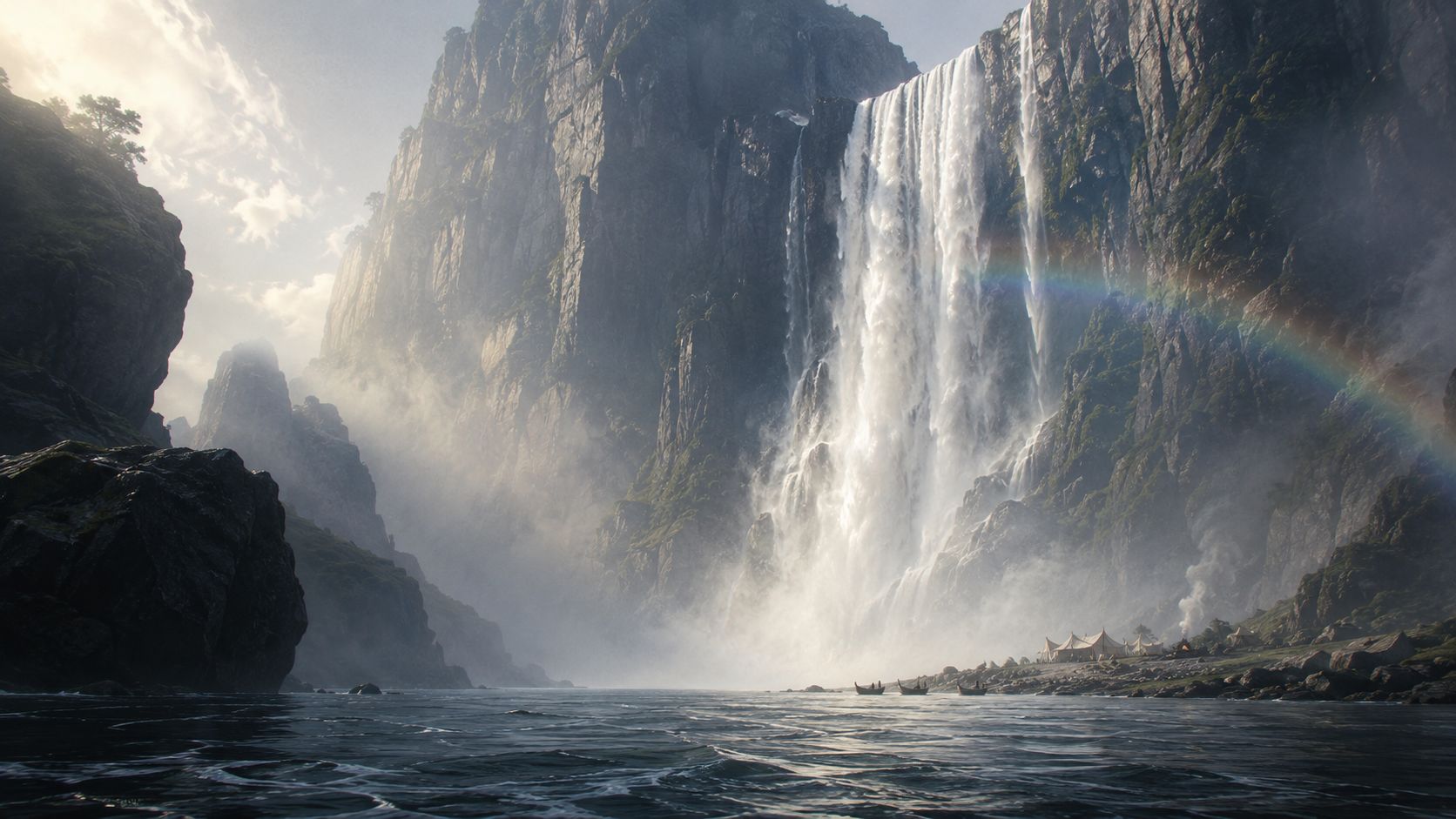
The fall basin should feel like a place too large for ordinary human concerns. The Waterwall dominates everything before the crew understands any detail. They hear it first, then feel it in the ribs, then see it through curtains of mist. Speech becomes difficult. Clothing and hair are soon wet. The skiff seems fragile on the wide pool, and everyone in it should feel exposed.
Do not describe the place as merely beautiful. It is beautiful, but beauty is not the point. The point is scale, pressure and intrusion. The cliffs rise like dark walls around the basin. The waterfall covers the far side in white force. Mist drifts low over the water and breaks the camp into partial glimpses: canvas, smoke, ropes, tools, skiffs and figures watching from shore.
The Mood
This is the first time the crew truly understands that the river was an approach, not just a route. The basin is the threshold. The carved symbols, the strange bones and the uneasy travel all gather here.
Play the mood as awe contaminated by human activity. The Waterwall itself is majestic, ancient and overwhelming. The poacher camp is small, ugly and practical. That contrast is the emotional center of the scene. The camp should not look like a villain fortress. It should look like workmen have set up in a cathedral and started cutting pieces from the altar.
The Poachers at a Distance
At first, the poachers are only shapes through spray. Let the crew see enough to understand that the camp is active, organized and not abandoned. Three skiffs are pulled above the waterline. Ropes have been tied around stakes and trees. Canvas shelters sit beneath the cliff. Smoke from a covered fire is torn apart by the mist. Tools hang from a crude rack. Bundles lie under tarred cloth.
The poachers have already seen the crew. This removes the option of simple observation from safety. They are being watched as they watch. The poachers do not attack at once, but they are alert. Some stand still. Some put down tools. Some reach for weapons without fully drawing them. The atmosphere is not battle yet. It is possession being challenged.
Gastved's Reaction
Gastved will react here. To him, the Waterwall confirms that the earlier marks were not random, and the camp feels wrong before he even understands the full extent of it. At first, keep him quiet. He studies the ropes, shelters and covered bundles with growing dread. His anger begins as restraint, not outburst, and it sharpens when he sees signs that bones have been cut, sorted or carried.
Gastved does not need to explain everything at once. A few short comments are enough. He might say that this is not a place for axes, that the marks upriver were warnings, or that whatever lies beyond the falls is not theirs to climb toward. His uncertainty matters. He knows enough to recognize desecration, but not enough to understand the whole place.
Other Crew Reactions
Other crew reactions depend on who is present. Practical sailors notice the prepared camp, the extra skiffs and the difficulty of retreat if the shore turns hostile. Fighters notice ledges, tools, hands near weapons and the awkward footing near the waterline. Spiritually sensitive characters feel the contrast between the majesty of the basin and the ugliness of the work site. Scouts or hunters can pick out smaller details through the mist, such as hidden figures, fresh drag marks, disturbed stones or something large beneath tarred cloth.
The key is that the Waterwall overwhelms everyone, but the camp focuses the scene. The crew does not need to share Gastved's beliefs to understand that something crude has been brought into a place that feels too large for it.
The Likely First Move
Because the crew has already been seen, the likely first step is contact. They can still choose how to approach: openly, cautiously, from the skiff, under weapons, with a shouted greeting or by landing at a distance. What they cannot easily do is pretend the camp is unaware of them.
Do not force immediate violence. Discourage it by showing that the poachers have numbers, prepared ground and better position.
Let the first exchange carry tension. The poachers are possessive rather than suicidal. They want to know who the crew are, what they have seen and whether they are rivals, authorities or an opportunity. They are prepared to defend the camp, but they would rather control the situation than start a fight under the Waterwall.
Game Master Guidance
Do not rush the confrontation. Let the basin breathe first. Give the players a moment to respond to the Waterwall before the camp fully resolves through the mist. The scene loses power if the poachers are described before the place itself has landed.
Keep the poachers human in scale. Their smallness matters. They are not grand enemies, just greedy men doing crude work in a place that makes them look absurd. That absurdity should not make them harmless. Small men with tools can still do terrible damage.
The desired first impression is simple: the crew has reached a place that demands silence, and someone else has already brought axes.
The skiff touched the far shore with a soft scrape of wood on wet stone.
No one climbed out quickly. The Waterwall thundered beside them, close enough now that every word had to be raised and every breath tasted of spray. Mist clung to faces, hair, leather and steel. The poachers stood in a loose line above the waterline, not charging, not smiling, hands near axes, knives and poles. Men used to hard work. Men used to watching one another for betrayal.
Scarnax stepped out first, boots sinking into slick gravel. He held his hands open, away from his sword.
"Good day," he called. "We are not here for trouble."
A tall man with a narrow face and a trimmed black beard came forward from the camp. His coat had once been good Estorian wool, now faded, patched and soaked through at the shoulders. A bronze coin hung from a cord around his neck, some luck charm rubbed smooth by fingers.
"That depends," the man said. His voice carried well despite the falls. "I am Lucian Serrus. This is our camp. Our find. Our work. You came far enough to see it, so now you can turn around and go back."
"Captain Scarnax," Scarnax said. "Blue Marlin."
Lucian’s eyes moved over him, then over the others as they came ashore. Amaxia with spear in hand. Skarnulf low and still, watching. Grishna broad and wet and frowning at the camp as if measuring what would break first. Junia stayed near the skiff, her satchel held tight beneath her cloak. Gastved came last, his eyes moving from the cliff to the covered bundles as if he had already begun to fear what lay beneath them.
The poachers did not move to attack. That made it worse. They were careful. Defensive. Possessive. They had already decided this place belonged to them.
Closer now, the crew could see what the mist had hidden.
Bones lay under canvas. Great pale lengths cut into smaller pieces. Chips and dust scattered across a work cloth. Two men had been sawing through a curved rib as thick as a mast spar, using a long saw that still rested in the cut. Another had sorted smaller fragments into crates padded with moss and rags. The bones looked less like remains now and more like cargo.
Gastved stopped breathing for a moment.
Then he leaned close to Scarnax, his voice barely audible beneath the roar.
"This is desecration."
Amaxia heard the tone if not the words. Her grip changed on the spear. Grishna saw it and shifted her stance at once, shoulders squaring, knife hand loose. Skarnulf did not look at Gastved. He looked at Lucian’s men and waited for the mistake.
Lucian noticed the change and lifted one hand.
"Easy. No one needs to be stupid. We found them. We cut them. We carry them out. That is all."
Grishna’s eyes moved past him, up the cliff beside the fall.
"There," she said.
Scarnax followed her gaze.
Ladders had been fixed into cracks in the rock, lashed with wet rope and iron spikes. Support lines climbed higher, vanishing into the mist. A crude winch had been bolted to a stone shelf above the camp. More ropes, more stakes, more tools. Not a quick theft. A route. A working road up the face of the Waterwall.
"They are not done here," Grishna said.
Lucian’s mouth tightened. "No. We are not."
Scarnax let the silence sit for a moment. Then he nodded once, as if the matter had been settled.
"Then we will leave you to it. We are looking for a ship. Waverider. Large vessel. Blue sails. White wave mark."
Lucian blinked, caught wrong footed by the change. "Saw her once in Estorio Ventura. Years ago. Everyone saw her. Biggest damned thing in the harbor. Never saw her after that."
"Then you have helped us more than you know," Scarnax said.
He turned away.
Gastved moved beside him, face hard and pale.
"We cannot let this continue."
Scarnax did not look back at the camp. "I know. I do not intend to let it continue."
For the first time since the bones in the river, Gastved smiled. It was not a happy smile.
Behind them, Skarnulf gave the smallest nod. Amaxia’s eyes measured the poachers, sharp and ready. Grishna rolled her shoulders once, as if settling a pack before a long climb.
Scarnax stepped back into the skiff.
"Talk is done," he said. "Now we think."

The Confrontation
This encounter is not about defeating an army. It is about forcing a camp of determined fortune seekers to accept that staying is more dangerous than leaving. The poachers are not soldiers, cultists or fanatics. They are rough Estorian luck seekers who have found what they believe is the fortune of their lives. They have endured the river, built a route up the cliff, cut bone from the basin and convinced themselves that the Waterwall now belongs to them because they reached it first.
Their goal is simple. Hold the site long enough to harvest as much as possible, then leave rich.
The crew’s goal is equally simple. Make sure they leave before they climb farther, cut more bones or reach what lies above the falls.
Who the Poachers Are
There are twenty-four poachers in the camp, all male. They are not trained warriors, but they are not harmless laborers either. Treat them like gold rush prospectors, dockside bruisers, debtors, deserters, gamblers, failed sailors and men used to hard work with axes, saws, ropes and knives. Several have been in brawls. A few have killed before. Most are brave when they stand in a group and much less brave when alone in the mist.
They are here because Lucian Serrus convinced them that the bones are worth a fortune in Estoria. Dragon bone, titan bone, holy bone, ancient ivory, it does not matter what name the buyers use. Rich collectors, alchemists, nobles and temple frauds will pay. The men believe this is their motherlode. Some have already spent their share in their own heads.
They are not evil masterminds. They are greedy men at the edge of something sacred, too invested to admit they are wrong.
Lucian Serrus
Lucian Serrus is the leader because he has the clearest head, the best claim to the original discovery and the strongest voice when the others argue. He is not a great fighter, but he is good at reading groups. He knows when to push, when to flatter and when to make a threat sound like common sense.
Lucian does not want to fight the crew unless he believes he can win cheaply. He sees Scarnax and the others as possible rivals first, not enemies. His preferred outcome is to make them leave, convince them there is nothing here for them or scare them away by showing numbers and prepared ground.
If the crew presses the issue openly, Lucian becomes colder. He reminds them that his camp has twenty-four men, boats, ropes, high ground and more hands than the skiff party can match. He does not need to shout. The numbers speak for him.
Why Persuasion Fails
Simple persuasion does not work. The poachers know the site is valuable, and they have already traveled too far to turn back because strangers tell them to. Appeals to sacredness fall flat. Some mock the idea, others grow uncomfortable, but none will abandon a fortune because Gastved calls it desecration.
Threats also fail at first. The poachers have numbers and a defended camp. If the crew stands in front of them and promises violence, Lucian reads it as bluster unless the crew has already demonstrated a real advantage. The poachers may back up, reach for weapons or spread out, but they do not simply flee.
Bribery has limited value. A small bribe insults them. A large bribe makes them suspect the bones are worth even more than they realized. Paying them to leave can work only if it is paired with fear, sabotage or proof that staying will cost more than leaving.
The Camp as Prepared Ground
The poacher camp is awkward to assault. The shore is wet and uneven. The falls make speech difficult. Mist cuts visibility. Ropes, stakes, ladders and winches clutter the ground. Tools lie everywhere, and almost any tool can become a weapon.
The poachers know the camp better than the crew does. They know which stones are slick, where ropes are anchored, which paths lead behind canvas and where the cliff gives partial cover. In an open fight, their advantage is numbers, familiarity and the ability to swarm.
A direct battle against all twenty-four is a bad idea. Make that clear through description. Men spread out. Others grab poles, hooks and axes. A few move toward the skiffs. Lucian sends men higher onto the ropes. The scene should tell the players that charging the whole camp head on will be costly.
They are close to completing the climb route. If not stopped, they will be above the Waterwall within a week.
How the Poachers Break
The poachers will not fight to the last man. Their courage depends on the belief that the group can protect the fortune. Once that belief breaks, they leave.
They begin to break when a few men die or vanish in ways that make the rest feel exposed. This is the key to the encounter. Killing three poachers in an open clash may make the others angry. Killing or disabling three in separate moments, without allowing the camp to strike back, terrifies them. It tells them that the basin itself has turned against them or that the crew can reach them whenever they choose.
Morale breaks faster if the losses feel unfair, unseen or impossible to answer. A man disappears while checking the upper rope. A watchman is found with his throat cut near the skiffs. A climber falls because a support line was severed. A man guarding the bone crates is knocked senseless without anyone seeing who did it. Suddenly twenty-four men are no longer twenty-four men. They are twenty-four isolated targets in mist and thunder.
Once the poachers believe staying means being hunted, Lucian loses control. Some demand withdrawal. Some accuse him of leading them into a cursed place. Some want revenge, but not enough to be next.
Ways the Crew Can Drive Them Out
The crew can solve the confrontation through violence, sabotage, intimidation after proof of danger or a combination of methods. The important thing is that the poachers must be made to feel that leaving is the only profitable choice left.
A stealth approach works best. Scouts, hunters and quiet fighters can move through mist, rocks and cliff shadows, taking isolated men, cutting ropes, spoiling equipment and spreading fear before the camp understands what is happening.
Sabotage is highly effective. Destroying winches, cutting climbing ropes, ruining ladders, damaging skiffs or dropping saws, axes and rope hooks into the deep pool attacks the poachers’ ability to continue. If they cannot climb, cut, carry or leave with their haul, their courage drops quickly.
Psychological pressure works after the crew has demonstrated power. Gastved’s warnings about desecration mean more once strange accidents begin happening. What sounded like superstition can become a terrifying explanation for why men are falling, ropes are snapping and tools are vanishing into mist.
Negotiation can work only after the poachers know they are losing. At that point, Lucian may accept terms that preserve his pride: they leave with personal gear but abandon the bones, they take their wounded and go, they keep one skiff if the others have been disabled or they swear never to return. He will phrase retreat as a practical decision, not surrender.
Escalation Stages
At first, the poachers are guarded and possessive. They watch the crew, keep weapons close and continue working if they think the crew has left.
After the first act of sabotage or violence, they become angry. Lucian tightens the camp, doubles watches and sends men in pairs. He still believes the situation can be controlled.
After the second or third serious loss, fear spreads. Men begin arguing. Work slows. Some refuse to climb. Others want to load the skiffs and leave before nightfall. Lucian can still hold them together, but only by promising that one more push will secure the fortune.
Once losses become clearly one sided, the camp fractures. The men no longer argue about ownership. They argue about survival. Lucian either orders withdrawal or is ignored when he refuses.
If the Crew Attacks Openly

An open attack is possible, but it should feel ugly and risky. The poachers fight with axes, knives, mallets, poles, saws, rope hooks and thrown stones. They are not elegant, but twenty-four desperate men can overwhelm better fighters if given space and time.
They try to surround isolated enemies, shove people into the water, trip them with ropes and drive them against rocks. Others try to get above the crew on ladders and ledges. They fight dirty because they are frightened and because no one is enforcing rules here.
They are still not warriors, and their main goal is to drive the crew away.
If the crew wins openly, the victory should be costly. Wounds, lost supplies, damaged gear, broken oars, a damaged skiff or a near drowning all fit the scene. This is not the preferred path, but it remains a valid one.
If the Crew Hunts Them
If the crew withdraws, circles back and begins taking the camp apart carefully, reward that plan. This is the smart approach.
Let the mist, thunder and cluttered camp become tools. The falls hide sound. Spray obscures sight. The poachers are tired, wet and overconfident. Men leave the main fire to piss, check ropes, guard skiffs, inspect bone crates, fetch tools or argue out of earshot. Those are openings.
Do not require the crew to kill everyone. Once the poachers have suffered enough isolated losses and enough practical damage, the camp becomes unstable. A few dead or missing men can matter more than a dozen casualties in battle if the survivors feel hunted.
If the Crew Withdraws Openly
If the crew rows away after the first meeting, Lucian assumes they were intimidated but not harmless. He posts more watches, keeps men in pairs and orders the most valuable cut pieces packed for removal. Work continues, but the camp becomes more nervous. This gives the crew opportunities to exploit fear, but fewer easy mistakes than before.
Lucian’s Retreat
When Lucian finally gives ground, he tries to preserve dignity.
He may say the site is cursed, that the haul they already gathered is enough, that the ropes are no longer safe or that returning later with more men is wiser. He avoids admitting fear. The other poachers do not care. Once the decision is made, they move quickly.
The retreat should be tense. The crew may need to decide whether the poachers are allowed to take anything. Personal gear is harmless. Bone fragments are not. If the crew demands the bones be left behind, some men argue, but very few are willing to die for crates once the camp has already broken.
Lucian remembers the crew. If he survives, he can become a future grudge, rumor source or small recurring problem. He is not important enough to hunt the crew across the world, but he might sell stories in Estoria about a sacred waterfall, dragon bones and the Blue Marlin.
Gastved’s Role
Gastved is not there to solve the encounter. He is there to define its moral meaning.
He can identify the desecration, warn the crew that the poachers must not climb higher and react strongly when bone fragments are treated as cargo. He can also help track movement, spot camp patterns and read practical signs around the basin. He is a trapper, not just a believer.
His anger should not make him stupid. He is a trapper, used to waiting for his prey to step in his traps. Once the crew chooses a careful approach, Gastved can embrace it. Desecration does not require a reckless charge. If anything, he may become colder and more patient once he understands that patience will end the desecration more effectively.
Game Master Guidance
The poachers should feel human, greedy and breakable. They are not monsters. They are men who made a choice, then kept making that choice because each step made the next one easier. That makes them more useful than simple villains.
Keep the encounter focused on pressure. The question is not "Can the crew defeat twenty-four-men?" The question is "How does the crew make twenty-four men decide this fortune is not worth dying for?"
Let smart plans work. Let fear matter. Let the environment matter. The Waterwall is not just scenery. It hides movement, swallows sound, makes footing dangerous and constantly reminds everyone that this place is larger than them.
Once the poachers leave, the basin should feel different, but not clean. The camp remains. The cut bones remain. The ropes up the cliff remain. The crew has stopped the desecration from continuing, but the wound has already been made.
Veyrath's Judgment
The last of the poacher skiffs vanished into the mist with the river pulling it away from the basin.
For a while, no one spoke.
The camp remained behind them in broken pieces. Canvas sagged under spray. A saw lay abandoned beside a half-covered rib. Rope ladders clung to the cliff wall like dead vines, shivering in the breath of the Waterwall. The place still looked occupied, but without men in it, the ugliness had changed. It felt less like work now and more like a wound left open.
Gastved stood near the covered bones, sword still in hand, his face wet with mist and something darker than anger. Skarnulf watched the cliff. Grishna watched the abandoned tools as if deciding what still needed breaking.
Scarnax looked from the camp to the ropes above them.
"Well," he said at last, though his voice sounded too small beneath the falls. "They are gone."
No one answered.
Then the light changed.
It was not cloud. It moved too quickly for that. A vast shadow passed over the basin, swallowing mist, cliff and water. The pool darkened beneath it. The roar of the Waterwall seemed to fall away, not because it grew quieter, but because something larger had claimed the air.
Amaxia looked up first.
Her spear lowered without her meaning to.
The dragon circled through the spray above them.
It was enormous beyond reason, at least twice the length of the Blue Marlin from prow to stern, with wings broad enough to turn the basin into night each time they passed before the sun. Its scales were dark bronze and deep green, slick with mist, each one catching pale light like wet metal. Its neck curved with terrible grace. Its head was long and crowned with backswept horns, and its eyes were bright, ancient and very still.
It descended without haste.
The air folded under it. Mist tore outward. The pool rippled in great circles. Then the dragon landed on the far side of the camp, claws closing around stone as if the cliff itself had offered purchase. It should have shaken the basin. It should have crashed like a falling tower.
Instead, it settled almost silently.
Gastved moved.
He drew himself straight, then turned his sword point down and drove the tip into the wet gravel before him. He sank to one knee, both hands resting on the pommel, head bowed.
For one heartbeat, the others stared at him.
Then Scarnax understood enough. He set his own blade point first into the ground and knelt. Skarnulf followed, slower but without hesitation. Amaxia planted the point of her spear, then lowered herself with the wary stiffness of someone who hated kneeling but understood survival. Grishna drove her knife into the mud before her and bowed her head. Junia knelt last, hands empty, eyes lowered.
The dragon watched them.
It took its time.
Its gaze moved from Scarnax to Amaxia, from Skarnulf to Grishna, from Junia to Gastved. It did not hurry. It did not need to. Each look felt like being weighed against something older than law, older than crowns, older than the names of nations.
At last, the dragon spoke.
The voice was calm. Almost lazy. It rolled through the basin beneath the thunder of the falls and made the water tremble.
"Why do humans stand at the edge of a sacred place."
Scarnax swallowed once. He kept his head bowed.
"We did not know what this place was," he said. "We came looking for a ship. The Waverider. We heard she passed this way."
The dragon’s eyes did not blink.
"We did not come to plunder," Scarnax continued. "We did not come to climb where we were not wanted."
The dragon turned its head slightly.
Its gaze moved to the camp. To the saws. To the cut bones. To the crates still half packed beneath tarred cloth. Then it looked back at them.
It asked nothing. It did not have to.
Gastved lifted his head, though not fully. His voice shook once before it steadied.
"We found them here," he said. "The other men. They were cutting the bones. Dragon bones. Taking them apart to sell for silver." His hands tightened on the sword hilt. "We drove them away."
The dragon looked at him for a long time.
"I know."
No gratitude followed. No praise. No warmth. Only the words, simple and absolute.
The dragon lowered its head until it was closer to them, though still far enough that a single breath could have covered them in flame. Its eye was larger than a shield.
"You will leave this place," it said. "You will not return. You will not speak of what you saw here. Not in taverns. Not in temples. Not to kings. Not to those who call themselves scholars. This threshold is not yours to name."
No threat was spoken. None was needed.
Scarnax bowed his head lower.
"Understood."
Gastved’s voice came after his, rough and quiet.
"By scale and flame, I hear."
The dragon studied him once more, then raised its head. Its wings opened, vast and dark, scattering mist across the camp in a cold wave. With a single smooth motion, it lifted from the stone. No struggle. No heaviness. A thing that large should have fought the air.
The air moved aside for it.
It rose through the spray, turning toward the heights.
Then its voice came down one last time.
"Trust the oracle. Fear the voice beneath her."
Junia looked up despite herself. Scarnax did too.
The dragon climbed toward the clouds, then seemed to change its mind.
It turned in the air with impossible ease and swept back down along the cliff face. Its jaws opened. Fire poured from them in a long, white-gold torrent.
The camp vanished inside the flame.
Canvas became ash. Ropes snapped and burned. Ladders fixed into the rock flared, blackened and fell in burning pieces. The winch split apart, its iron screaming as the wood around it burst. Saws, poles, crates and tarred cloth disappeared in heat so fierce the crew felt it across the wet shore.
The bones did not burn.
The tools did.
The dragon’s fire climbed the wall, following the poachers’ route upward, erasing every spike, every rope, every arrogant handhold driven into the sacred stone. Then the flame ended. Smoke rose into mist. The dragon passed through it, wings beating once, and vanished into the clouds above the Waterwall.
Silence did not return. The falls still thundered. The pool still breathed mist. Yet for a long moment, no one heard anything at all.
Then Grishna made a small sound.
At the top of the Waterwall, shapes stood in the spray.
Huge bodies. Long necks. Vast silhouettes behind the white curtain. One moved its head slowly. Another lowered itself as if looking down into the basin. More emerged through the mist until there were at least a dozen of them, watching from the hidden heights.
They were there only for a moment.
Then the mist closed.
The crew remained kneeling.
Even Skarnulf did not rise.
At last, Gastved pulled his sword from the gravel. His hands were shaking.
"We have stumbled onto the home of dragons," he said.
Scarnax stood slowly. His face was pale beneath the spray.
He looked at the ruined camp, the burned cliff wall and the place where the shapes had vanished above the falls.
"Then we leave," he said. "This place is not for us."

This encounter is not a negotiation, a combat scene or a reward scene. It is judgment. The crew has done the right thing by driving away the poachers, but that does not give them ownership, permission or safety. Veyrath is not grateful in any human sense. He is measuring whether they understand the difference between stopping desecration and claiming virtue.
At the table, the main Game Master task is restraint. Do not overexplain Veyrath. Do not explain Kaelthir. Do not confirm what the shapes above the falls truly are. The crew has reached a threshold, not an answer.
Gastved's Ritual
Gastved’s kneeling ritual is the crew’s best chance of surviving the first moment. He does not need to give a long explanation. The act itself matters: weapon planted point down, kneeling, head lowered, no challenge offered. Anyone who follows him is showing submission to sacred authority rather than surrender to an enemy.
If a crew member hesitates, give them the chance to read the room. Veyrath is not immediately attacking, but everything about him communicates that a wrong gesture has consequences. Let Gastved whisper a short warning if needed: "Kneel. Do not raise steel."
How Veyrath Reads Them
Veyrath already knows what happened. He has watched the camp, the poachers and the crew’s intervention. His questions are not requests for information. He is testing if they can be trusted.
Truth matters more than eloquence. The safest answer is plain: they did not know what this place was, they did not come to plunder and they stopped those who were doing so. Boasting weakens the answer. So does claiming reward or permission. Trying to bargain for access to Kaelthir is the wrong instinct.
The crew does not need to impress Veyrath. They only need to show that they understand they are trespassers who were useful once and must now leave.
The Warning
"Trust the oracle. Fear the voice beneath her." should land as something Veyrath gives because it matters, not because he is helping them as a friend. It is a warning from a being who has seen further than they have. Do not explain it here.
If Meyrha later hears the phrase or learns of it, let it connect to her then. In this scene, the warning can remain sharp, strange and unfinished.
Destroying the Camp
Veyrath destroys the camp to erase the route upward and remove the tools of desecration. This is not anger out of control. It is cleanup. The fire should feel precise, immense and effortless. Ropes burn. Ladders collapse. Stakes crack. Winches burst. Tools melt or vanish into flame. The cliff route is erased.
The bones should not be treated as fuel. That they survive the flame reinforces that Veyrath is not simply burning everything. He is removing human intrusion.
The Shapes Above the Falls
The silhouettes above the Waterwall are brief and ambiguous. Give enough detail for the crew to reach the wrong conclusion naturally: immense bodies, long necks, heads in the spray, watching forms half hidden by mist. Do not give details, just vague shapes. Do not let the players study them long enough to correct the misunderstanding.
The intended impression is that the crew has seen a hidden dragon homeland. This belief is wrong, but powerful. Let it stand.
The Return Downriver

The return trip should be quiet and uneventful except for one discovery.
As the skiff moves downriver, the crew eventually passes the remains of the poachers who fled earlier. Their skiffs are blackened wreckage against the stones. The bodies are charred, broken or half sunk in the shallows. Some gear has burned to slag. Some packs floated free and caught in reeds. There are no survivors.
Veyrath judged them too dangerous to leave alive. They had seen the threshold, harvested the bones and built a route toward what lies above. Let the moment be grim rather than triumphant. The crew drove them away, but Veyrath decided that away was not far enough.
Gastved can understand the logic and still be shaken by it. Other crew members may find the decision horrifying, practical or both. Do not turn this into a debate unless the players engage with it. The scene’s purpose is to show that Veyrath’s mercy has limits and that the crew survived because they acted with restraint.
Ending the Segment
The journey back to the Blue Marlin should feel subdued. No new threat is needed. The crew has seen something too large to process, received a warning they do not understand and witnessed what happens to those who treat sacred places as resources.
By the time they reach the ship, the river should feel different behind them. Not conquered. Not explored. Closed. They did not escape. They were allowed to leave.
Meyrha's Vision
The Blue Marlin had left the river behind, but the river had not left the ship.
Mist still clung to the rigging. Water dripped from ropes, sails and hair. The crew moved quietly, speaking only when work required it, as if the Waterwall’s thunder had followed them out to sea and settled somewhere inside their chests. Behind them, the coast of Kaelthir sank into haze. Ahead waited open water.
Meyrha stood near the rail, one hand resting on the wet wood, her blue veil stirring in the wind. She had not spoken since the skiff returned. Ormun had noticed. Cassandra had drifted to his side as if that had become the natural place for her to stand, and the two of them stayed nearby without crowding Meyrha.
"You should sit," Ormun said softly.
Meyrha turned her head a little. "Soon."
The word had barely left her mouth when her fingers clenched on the rail.
She made no cry. That was worse. Her whole body went rigid, her eyes widening as if something had struck her from within. Then her knees failed.
Ormun moved first.
He caught her before she hit the deck, one huge hand behind her shoulders, the other bracing her carefully as if she were made of glass. Cassandra dropped beside them at once, catching Meyrha’s veil before it tangled beneath her and placing one hand against her cheek.
"Meyrha," Cassandra said. "Can you hear me."
Meyrha’s eyes were open, but they were not seeing the deck.
Black water closed over her.
Not sea. Not river. Something thicker. Warmer. Wrong. It pressed into her ears, her mouth, her lungs, though she had no body with which to drown. Reeds dragged across her skin. Rot bloomed beneath the surface. Roots coiled like fingers around ankles she did not have.
Then a voice came through the dark.
"Meyrha."
She knew it before she understood it. Her heart jumped.
Samden.
Weak. Far away. Buried under water and mud and pain.
"Meyrha, help me."
The world tore sideways.
She saw his face. Shaved head, still eyes, sun darkened skin, wooden beads at his throat. Samden as he had been, steady as a mountain path. But the shadow behind him was wrong. It did not fall from him. It leaned toward him.
Then the shadow became his.
And the face was wrong.
An impossible black face with lips half open looked back from where Samden’s face had been, lips half open, expression almost human and not human at all. Black water dripping upward. Names whispered in a dozen voices, each one spoken as if it were being cut from a tongue.
Samden opened his mouth.
"Meyrha."
Another voice opened beneath it.
"Mine."
She saw black stone through reeds. An expressionless face turning toward her. Pale shapes behind glass, or perhaps only bubbles beneath water. Names whispered too close to her ear, each one cut apart before she could hold it.
Samden again, closer now, eyes wide with something she had never felt from him before.
Fear.
"Meyrha. I am not..."
The other voice swallowed the rest.
Rot pressed against her. Names slid past her, too wet to hold. One stayed. Broken. Garbled. Repeated by water and teeth.
"Rotmere."
Again.
"Rotmere."
Again, from Samden’s mouth and not his mouth.
"Rotmere."
Meyrha came back with a sound like drowning.
She arched in Ormun’s arms, coughing hard, though no water came from her lungs. Cassandra held her shoulders and spoke her name again and again, steady despite the fear in her face. Ormun sat on the deck with Meyrha gathered carefully against him, too frightened to move her and too gentle to hold her tightly.
"Meyrha," he said, low and helpless. "You are here. You are on the ship."
Her breath came in broken pulls. Her hands clutched at him, then at Cassandra’s wrist, searching for something real.
Cassandra leaned close. "You are safe. Breathe with me. Slowly."
Meyrha tried. Failed. Tried again.
The deck had gone quiet around them. No one asked questions yet. No one dared.
At last, Meyrha’s eyes focused and found Cassandra’s.
"I was wrong," she whispered.
Cassandra brushed wet hair from her face. "About what."
Meyrha’s mouth trembled.
"Samden."
Meyrha swallowed, and when she spoke again the words came out scraped raw.
"He is not dead."
For a heartbeat, hope moved across Cassandra’s face.
Meyrha saw it and flinched from it.
"No," she said. "No. Not hope. Worse." Her hand tightened until Cassandra winced, but did not pull away. "He is something worse than dead."
The wind moved across the deck. Far behind them, Kaelthir was gone into mist.
Meyrha sobbed, but the name remained, wet and rotting in the dark behind them.
"Rotmere," she whispered. "It is in the Drowned Marshes. It has to be."
She wept openly now. They had seen visions hurt her before, seen her pale, shaking and breathless, but never like this. This was not pain passing through her. This was something inside her cracking, held together only by loyalty to Samden.

This scene exists to break the quiet after Kaelthir and point the crew toward the Drowned Marshes. The Game Master should not explain what Meyrha saw, what has happened to Samden or what the fragments mean. That will become clear later.
For now, the crew needs only two pieces of information: Samden is in trouble, and the next destination is Rotmere.
How Hard It Hits
This vision is far worse than Meyrha’s earlier omens. Those hurt her. This nearly breaks her.
Show the difference physically and emotionally. She does not simply grow distant or pale. She collapses. She cannot control her breathing. She cannot immediately answer questions. When she returns, she is not merely shaken but close to emotional ruin, holding herself together only because Samden still needs her.
The crew have seen Meyrha suffer visions before. They have not seen this.
What to Reveal
Keep the content fragmented. Black water. Rot. Samden’s voice. A wrong face. A voice beneath his voice. A broken name repeated through the vision.
Do not turn the vision into a clean clue sequence. The players should understand the urgency, not the mechanism. They know Samden is not dead, or not simply dead. They know something has him. They know the word "Rotmere."
That is enough.
What Meyrha Knows
When Meyrha can speak, she is certain of only one thing: she was wrong about Samden.
He is not dead. He is suffering, trapped or changed in some terrible way. The word "Rotmere" is the only direction she can hold onto. She may not know exactly what waits there, but she knows the trail points to the Drowned Marshes.
Act Summary
Kaelthir is a short threshold arc, not a destination arc. The crew does not explore Kaelthir, conquer it or understand it. They reach the edge, witness enough to realize that the world is larger than their mission, make one meaningful choice against desecration and are ordered away by a power beyond negotiation.
What the Crew Takes Away
The crew leaves with the next port of call: Rotmere in the Drowned Marshes. Meyrha’s vision gives the lead, but not clean answers. Samden is not dead, or not simply dead, and something terrible has him. He has helped the crew many times from the shadows, and this changes the next arc from investigation into obligation. They owe him rescue, or at least the attempt.
They also leave with the memory of Kaelthir’s threshold. The Waterwall, the sacred marks, the vast bones, Veyrath and the shapes above the falls create the impression that they have glimpsed the hidden home of dragons. That belief is wrong, but it is the right wrong conclusion for them to carry. They have seen a place exceptional enough that even speaking of it feels dangerous.
Gastved and Draknir Reverence
For Gastved, this is not merely an encounter with a powerful creature. It is a religious experience. He has stood before a dragon in a sacred place, seen dragon bones desecrated and survived direct judgment from something close to divine. This should leave him shaken, humbled and changed.
If Skarnulf is present, the experience can matter to him as well, though differently. He does not need to become devout, but his Draknir upbringing gives the event weight. Seeing Veyrath is close to seeing a god. Even a cynical man can feel the ground move beneath old beliefs.
The Unresolved Warning
Veyrath’s final words complicate rather than clarify the ending: "Trust the oracle. Fear the voice beneath her."
After Meyrha’s vision, the warning becomes harder to interpret. It seems to point at her, but not cleanly. Is she the oracle? Is the voice beneath her Samden, the thing using him or something else waiting in the Drowned Marshes? The crew should not know yet. The phrase should remain sharp, troubling and unfinished.
By the end of the arc, the crew has not solved Kaelthir. They have been allowed to leave it. They carry awe, debt and dread with them, and the course is set for Rotmere.
The Blue Marlin followed the coast through a gray morning, her sails half filled by a wind that smelled of salt, mud and distant rot. Land held close on the port side, a long uneven line of reeds, low trees and dark water channels where the Drowned Marshes waited. No one on deck said much. After Kaelthir, even ordinary work seemed to happen more quietly.
Meyrha stood at the bow, both hands resting on the rail, her blue veil pulled tight by the wind. She looked forward as if the horizon had become a question she could not stop reading. Behind her, far enough to give her solitude but close enough to catch her if she swayed, Ormun and Cassandra stood together. Ormun’s great arms were folded across his chest, his face solemn and helpless in the way of someone strong enough to lift a cart but not strong enough to lift grief. Cassandra stood beside him, one hand near his sleeve, watching Meyrha with careful concern.
Ivy came up the deck without hurry. Her tattooed skin seemed muted beneath the gray light, all those colors held beneath shadow. She stopped beside Meyrha, not too close, and looked out toward the marsh coast.
"Are you well?" Ivy asked.
Meyrha gave a small, tired sound that might once have been a laugh.
"I do not know." Her fingers tightened on the rail. "I do not even know what I know anymore."
Ivy nodded slowly. "We who see beyond the world seldom see clearly."
Meyrha turned her head just enough to look at her. The wind tugged at her veil and showed the exhaustion beneath it.
"Usually it becomes clear later," she said. "After the danger. After the blood. After the thing I should have understood has already happened."
"That is still seeing," Ivy said.
"It is also failing."
Ivy did not answer at once. The ship creaked beneath them, and a gull circled once above the mast before turning back toward the coast.
"No," Ivy said at last. "It is being human while carrying something too large for one mind."
Meyrha looked forward again. The marshland ahead seemed to spread wider as they approached, low and dark and patient.
"I heard him," she said. "I thought I had mourned him. I thought that pain was finished. Now it has opened again, and there is something inside it."
"Samden."
Meyrha closed her eyes.
"Yes."
Behind them, Ormun shifted but did not come closer. Cassandra touched his arm, gently holding him where he was.
Ivy saw it, then looked back to Meyrha.
"You are not alone."
Meyrha breathed in, slowly, as if the air hurt.
"I know," she said. "That is the one thing keeping me moving."
