Srel Colony
Colonial genocice, orchestrated by the Empire.
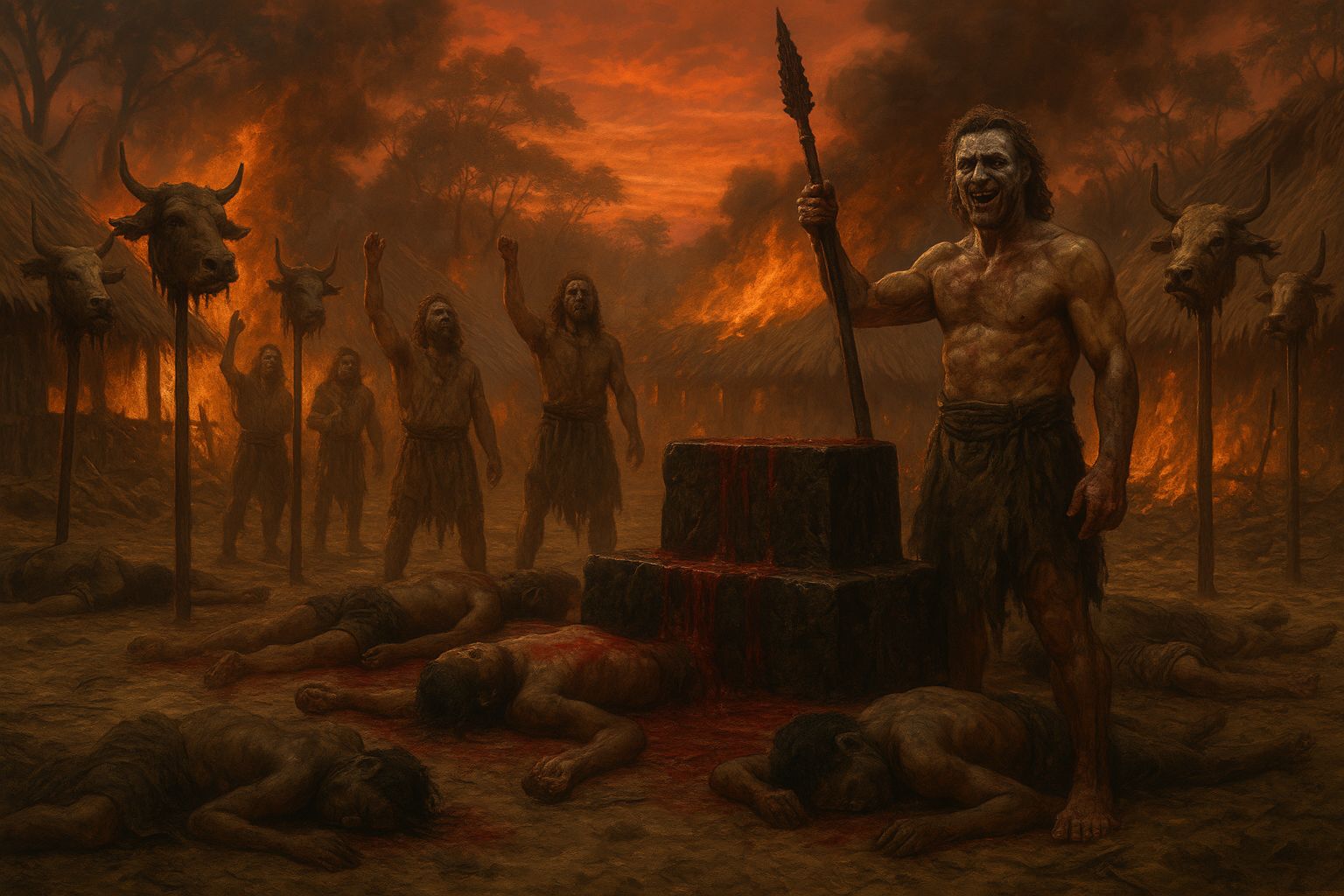
The air stank of ash and blood. Charred huts leaned like broken teeth, their roofs still smoldering. Bodies lay where they had fallen, not buried, not mourned, men with spears snapped in their hands, women clutching children who would never wake.
Across the village square, the Sreli had raised a circle of blackened spears. Atop each, the severed heads of oxen and goats stared with empty eyes, tongues hanging. Flies already swarmed. In the center stood the altar, a slab dark with blood that ran down its sides in rivulets, pooling with the rain.
The warriors who had done this still lingered. Their faces were streaked with white ash, their chests bare, their voices raised in low chanting as they cast the last of the dead into the fire. One of them, tall and scarred, turned from the flames and smiled when he saw the living watching.
“Behold,” he said, lifting his blood-soaked spear. “This is how the gods remember.”
I hid in the reeds while the smoke rolled over the river. The cries had stopped by then, but I still heard them in my bones. My mother had pushed me down into the mud, told me not to breathe, not to make a sound. I listened. I listened while the Sreli came.
They laughed when they found the goats, driving their spears through them for sport. They laughed louder when they dragged my sister from the hut, painting her face with ash before they cut her throat at the altar stone. They burned the huts with people still inside, and when the screams rose, they beat their drums to drown them out.
I saw the priest raise his hands, chanting to the smoke, and the warriors cheered. Then they took the babies, still screaming, still alive, and threw them into the fire. The smell will never leave me.
When they left, nothing stood. No voices, no village, only ash. I crawled out when night fell, shaking, alone. I was twelve rains, and the Sreli had already taught me what their gods demanded.
Description
Srel is a fledgling but brutal colony carved into the eastern reaches of the Yelthara Jungle. Its heart lies along the banks of the Tzolani River, a broad and murky waterway choked with vines and crocodiles. The Empire had long sought a foothold in Yelthara, but never had the resources to commit. Their solution was a cruel one.
A restless nomadic people, the Sreli, had caused endless trouble within the Empire’s heartlands. Rather than continue to suppress them, the Senate in Alborum declared the Tzolani basin part of the Empire’s eastern marches and “granted” it to the Sreli as their homeland, despite it never having belonged to neither Sreli nor Empire. The Sreli took this gift as divine sanction and crossed into Yelthara in great numbers.
The Sreli
The Sreli wasted no time. They began a campaign of extermination against the indigenous Yelthari tribes. Men, women, children, and even livestock were slaughtered without hesitation. Unlike the Empire, which often enslaved conquered peoples, the Sreli sought nothing less than erasure, even from history. In their words, the jungle must be “purged of ghosts” so that only the faithful remain.
Their capital, called Keralzh, is a fortified town of sharpened timber walls and blackstone altars, built at the junction where the Tzolani splits into three branches. From there, warbands ride out on wiry horses, carrying iron weapons stamped with Imperial markings. The Empire turns a blind eye to their atrocities, so long as the Sreli grow roots in the jungle.
Religion
The Sreli faith is not just belief, it is the core of their identity. They call it The Doctrine of Ashen Dawn, taught by wandering prophets who claim to hear the voices of gods hidden in the smoke of their sacrificial fires.
Cosmology
According to the Doctrine, they are the people chosen by the gods. One day, the Ashen Dawn will come: the sky will burn, rivers will boil, and the earth will collapse into fire. All false peoples will be consumed in battle. Only the Sreli, who prepare themselves through blood and struggle, and have the gods on their side, will survive to walk with the gods in a reborn world.
The gods they serve are not seen as merciful or kind, but as stern overseers:
- Zhorath the End-Bearer, the god of fire and endings, who will sweep the world clean.
- Kelna the Witness, goddess of silence and memory, who records every death to weigh the faithful.
- Druven the War-Caller, god of spears and storms, who trains the Sreli for the final battle.
- Veyra the Veil-Breaker, goddess of dreams and visions, who reveals fragments of the last war to chosen prophets.
Practices
The Sreli practice rituals that reinforce their place as the chosen.
- The Fires of Purge: after every battle, villages and bodies alike are burned, so that no ghost of the slain can linger to curse them.
- Blood Oaths: warriors cut their palms and mingle blood with their kin before battle, swearing to meet again when the Dawn comes.
- Dream Vigils: priests drink hallucinogenic brews and stare into smoke for hours, seeking visions of enemies who must be destroyed to hasten the Dawn.
- The Silence of Kelna: once a year, the entire people holds a three-day silence to honor the goddess who remembers every death.
Daily Life
Every Sreli is raised to believe they are already living in the shadow of the world’s end. Hardship is proof of divine favor, for it prepares them for survival. Mercy is seen as weakness. Even children are expected to kill their first captive animal or enemy before adulthood, offering its blood to Zhorath.
Prophecy and Leadership
The high priest, Veynar the Harbinger, is the most feared figure among the Sreli. He claims to dream nightly of the Ashen Dawn and reads omens in fire and ash. His word is law, even above the tribal warlords. He preaches that every tribe and people they exterminate is one step closer to the great ending, for the gods demand a world emptied of all but their faithful.
He is flanked by the Ash-Speakers, a circle of masked prophets who burn their faces with ritual scars to mark their visions. These prophets wander among the villages, calling out names of those they claim will betray the tribe or weaken the people. Such unfortunates are sacrificed in fire.
Holy Sites
- The Black Altar of Keralzh: a great block of volcanic stone, hauled from the mountains of the Empire and set at the colony’s heart. Here prisoners are burned alive during great feasts.
- The Ash Pits of Drevol: massive fire pits where bones and ashes of the slain are cast. The Sreli believe Kelna walks among the smoke at night, recording names.
- The Silent Glade: a jungle clearing forbidden to outsiders, where it is said Veyra herself revealed the Ashen Dawn to the first prophet.
Warfare
The Sreli fight with a sense of inevitability. To them, every skirmish is a rehearsal for the Ashen Dawn. Their style is brutal and direct:
- Extermination over conquest: they don’t enslave, they annihilate. They burn villages, salt fields, and kill livestock to erase entire bloodlines.
- Ash-born charges: warriors coat themselves in white ash before battle, believing Zhorath shields them from arrows and spears.
- Dream-guided raids: before campaigns, prophets declare which clan or village the gods demand destroyed. Even warlords obey, no matter if the target is weak or strong.
- The Spear of Druven: most Sreli favor long spears and barbed javelins, sacred to their war god. Spears are ritually burned at the tip before battle, “igniting” them with divine wrath.
Treatment of Prisoners
The Sreli see captives as offerings. They are not enslaved or ransomed, but taken back to altars for sacrifice. Two forms dominate:
- The Fire of Zhorath: burning alive, so that smoke carries the victim’s soul away.
- The Silence of Kelna: throats slit in silence, their names whispered to the goddess.
Most commonly, they don't take prisoners, they just kill them without ceremony at the site of the battle.
Symbols in War
- Ash Marks: each warrior daubs ash lines across their face. The number of lines reflects battles fought.
- Broken Spears: snapped shafts are planted in the earth after victory, forming a circle around burned ruins as a sign no life may return there.
- Ash Standards: banners of grey cloth dipped in blood and ash, carried by priests to call down divine attention.
Culture Under the Doctrine
Festivals
- The Night of Cinders: once a year, the tribe burns effigies of their enemies, chanting the names of whole peoples they have already destroyed. Children dance around the flames, throwing in bones of hunted beasts.
- The Red Feast: when a great victory is won, the tribe eats only red foods, blood stew, spiced peppers, crimson fruits, believing it brings them closer to the Ashen Dawn.
Marriage
Marriage among the Sreli is sealed with fire. The couple holds hands over burning coals, swearing that their bond will last until the Dawn. If one falters, the marriage is considered void. Children are considered gifts from Druven, destined to fight in the final war.
Rites of Passage
- The First Kill: At twelve, every Sreli child must kill an enemy and burn it at the altar. The enemy is restrained and can't defend themself. Without this they are not counted among the chosen.
- The First Battle: At sixteen, youths are sent in groups into the jungle. If they survive and return with the hand of an enemy, they are recognized as full warriors.
Relations
The Yelthari Resistance
The Yelthari tribes of the Tzolani basin are fierce hunters and ambushers, but they are not united. Each clan once fought for its own valley and riverbank, and by the time they formed a coalition, the Sreli had already burned half their villages. Now only two bastions remain.
Thirvash Hollow, a hidden valley near the cliffs of the southern coast, where the tribes of the Firehorn and the Chitlani have dug in, supplied quietly by Amazon traders.
Veyota Gorge, at the edge of Amazireth territory, where a mix of smaller clans and refugees hold fast. Here the Yelthari fight knowing the Amazons will not let the Sreli advance unchecked.
Despite centuries of bad blood with Amazireth, the tribes now accept Amazon warriors, steel, bows, and grain, for without them they would be finished.
Amazons of Amazireth
The Amazons have little love for the Empire and even less for its puppets. General Seryth of the Circle of Spears has allowed arms and a few companies of warriors to support the Yelthari, but Amazireth itself faces raids from the east and west and cannot risk full commitment. They will fight to keep the Sreli from crossing into their valleys, but beyond that they will not bleed too deeply for the tribes.
They know that the Sreli will not be satisfied with the Tzolani basin, and that they are next on the Sreli plan, so they are preparing for war.
The Children of Nazhira
The Yelthari begged the Children of Nazhira for aid, but the little hunters of the deep jungle refuse to move. The Nazhira whisper that the jungle itself will swallow the invaders in time. Until the Sreli trespass into their shadowed groves, the Children watch in silence, their blowpipes idle.
The Empire
In Alborum, the Senate views the Srel colony as an experiment. If the Sreli succeed in rooting themselves in Yelthara, they might serve as a loyal bulwark and trade partner, perhaps even a people to be absorbed once more into the Empire. For now, they are armed and supplied, but no legions march to aid them. The Empire prefers distance, so its hands remain unstained while the jungle burns.