N'gazama
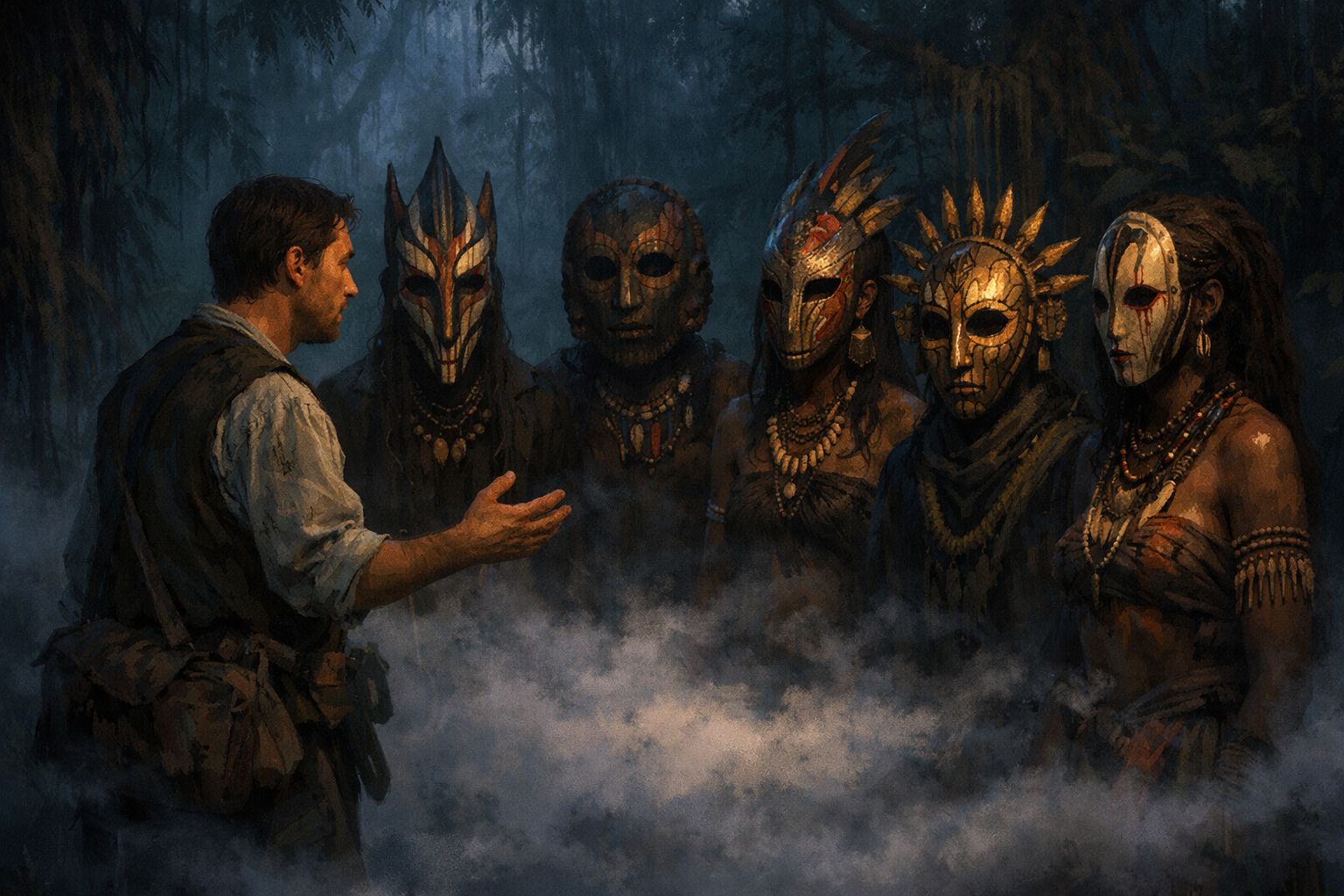
Edrin Vos found the N'gazama by following the river until the mist stopped feeling like weather and started feeling like company.
The village stood on posts above the bank, planks leading up through wet air. Lanterns burned behind reed screens, turning the fog pale gold. Figures moved without hurry.
Every face was a mask.
Edrin stopped at the foot of the plankway and lifted his hands. "I want shelter for the night. I can pay."
A tall woman stepped forward, her mask carved like a heron, long beak painted with a single dark line. She watched him for a slow moment.
"Trade is for morning," she said. "Need is for now."
A second figure appeared beside her and held out a cup. The drink was bitter, then sweet, then neither, as if it could not decide what it was. Warmth spread through Edrin’s chest too fast.
The heron mask pointed to a thin braid of fiber in the other figure’s hand. "Tie it on."
Edrin looped it around his wrist. The knot pressed against his skin like a small warning.
They let him up. A bowl of fish and root stew was set down. People sat nearby, masks turned toward him, not staring, not ignoring, simply present.
Trying to make it normal, Edrin asked, "How far to the next settlement upriver."
The heron mask answered, "Do not camp at the bend where the river goes quiet."
"Why," he asked.
A voice from behind a boar snout mask replied, "Because your dreams will walk."
No one smiled. No one explained.
At dawn the heron mask met him again at the plankway and tapped the knot on his wrist. "Do not untie it until you leave our water."
Edrin nodded, stepped back into his boat and pushed off. He looked over his shoulder once. The village was already fading into mist, pale masks moving between posts like shapes remembered wrong.
Description
N'gazama is a wet green land where mist never fully leaves. It clings to the canopy, pools in low valleys and drifts through villages at dawn and dusk like a slow tide. Travelers describe it as beautiful in a way that feels distant, as if the land is watching rather than welcoming.
The people of N'gazama are known for three things. Masks worn as daily custom, a quiet intensity that makes ordinary conversation feel slightly misaligned and a deep spiritual tradition that treats the world as crowded with unseen presences.
Land and Weather
N'gazama is jungle, marsh and river country. The ground is soft, the air is heavy and paths change with the season. Rain comes often, sometimes as a steady whisper for days, sometimes as a sudden downpour that turns trails into streams.
Mist is the constant. It rises from warm earth and wet leaves, rolls off the rivers and gathers in pockets where the sun should burn it away. In the interior it can become thick enough to shorten sight to a few paces, turning travel into slow counting and careful listening.
Settlements
Villages are built on higher ground, on ridges, knuckles of stone, old tree roots and artificial platforms raised above the wet. Homes are timber, reed and woven fiber, with walkways of planks and rope bridges where the ground cannot be trusted.
There are no grand cities in the common telling. Instead there are spiritual centers, gathering places where many small communities come together for rites, trade and the settling of disputes. Outsiders often mistake these for markets until they realize the central structures are not warehouses but shrines.
People and Customs
Masks are worn by everyone, often pale wood, bone, painted clay or tightly woven reed. A visitor might assume it is ceremony, but it is daily life. Some masks are plain and practical. Others are carved with animal motifs, river spirals, leaf patterns or expressions that do not match the speaker's voice.
N'gazama is strongly animist. Rivers have moods. Trees remember. Certain stones are treated as elders. Offerings are small and frequent, a splash of drink into water, a braid of fiber tied to a branch, a pinch of food left at a root. People speak of spirits as neighbors, not as distant gods.
They are also spiritualists in the practical sense. Dreams matter. Omens are discussed openly. A sudden fog bank, a bird call at the wrong hour, a pattern in spilled ash can change a plan. Visitors often leave with the uneasy sense that locals are responding to information that never gets shared in full.
How Outsiders Experience Them
Most outsiders describe the N'gazami as polite but hard to read. Answers can arrive sideways, through metaphor, through a question in return or through a long pause that feels like a consultation with something unseen. People sometimes seem distracted, as if half their attention is elsewhere. In the mist, with masks staring back, that can make even friendly encounters feel tense.
This is not hostility. It is a different social rhythm. Strangers are assessed by patience, restraint and respect for custom. A traveler who pushes too hard for clarity can find doors closing without argument.
Trade
N'gazama trades in useful things, not luxuries. River fish, smoked meat, resin, rope, waterproofed baskets, carved charms, dyes and medicinal herbs are common exports. Imports tend to be metal tools, salt, lamp oil, cloth and durable goods that do not rot in humidity.
Bargains are often sealed with small rituals, a shared sip poured to the ground first, a short chant, a token tied to the traded bundle. Outsiders who refuse these gestures may still trade, but they will be remembered as careless.
Rumors
There are stories that the mist hides more than distance. Hunters tell of hearing footsteps that match their own pace, just out of sight. Travelers report seeing mask shapes hanging in trees like pale fruit, then finding only bark and shadow when they approach. Some claim the land itself tries to steer people away from certain paths.
Most locals do not argue with such stories. They treat them the way sailors treat changing currents. Something to work around, not something to prove.