Khazryn
The top of the world, with meditating monks in mountain monasteries
Talen met the monk where the path became a stair carved into the cliff.
The monk sat on a step with his pack beside him, palms resting on his knees as if the mountain had taught him how to wait. His robe was faded red under a wool wrap, hem patched, sandals bound tight with cord.
Talen stopped a few steps below. "Is the way open?"
"It is open," the monk said. "It is also steep."
Talen breathed out a dry laugh that turned into a cough. "You are headed for Tseradun."
"Mount Khazra," the monk corrected, calm as stone. "The monastery is only where people stop."
"Pilgrimage," Talen said.
The monk nodded.
Talen hesitated, then asked, "Forgiveness?"
"Sometimes," the monk replied. "Today, remembering."
"Remembering what."
"How small you are," the monk said, glancing upward into mist, "and how much effort it takes to stop pretending otherwise."
He stood, lifted his staff and adjusted his pack until it sat exactly right. No wasted motion.
"You want company," Talen asked.
"If you can walk quietly," the monk said.
Talen fell in beside him. As they started up, the monk touched two fingers to a cairn strung with prayer flags, then continued climbing without looking back.
"What do they call you," Talen asked.
"Sarin," the monk said. "For this road."
"And after?"
Sarin did not slow. "After, someone else will decide."
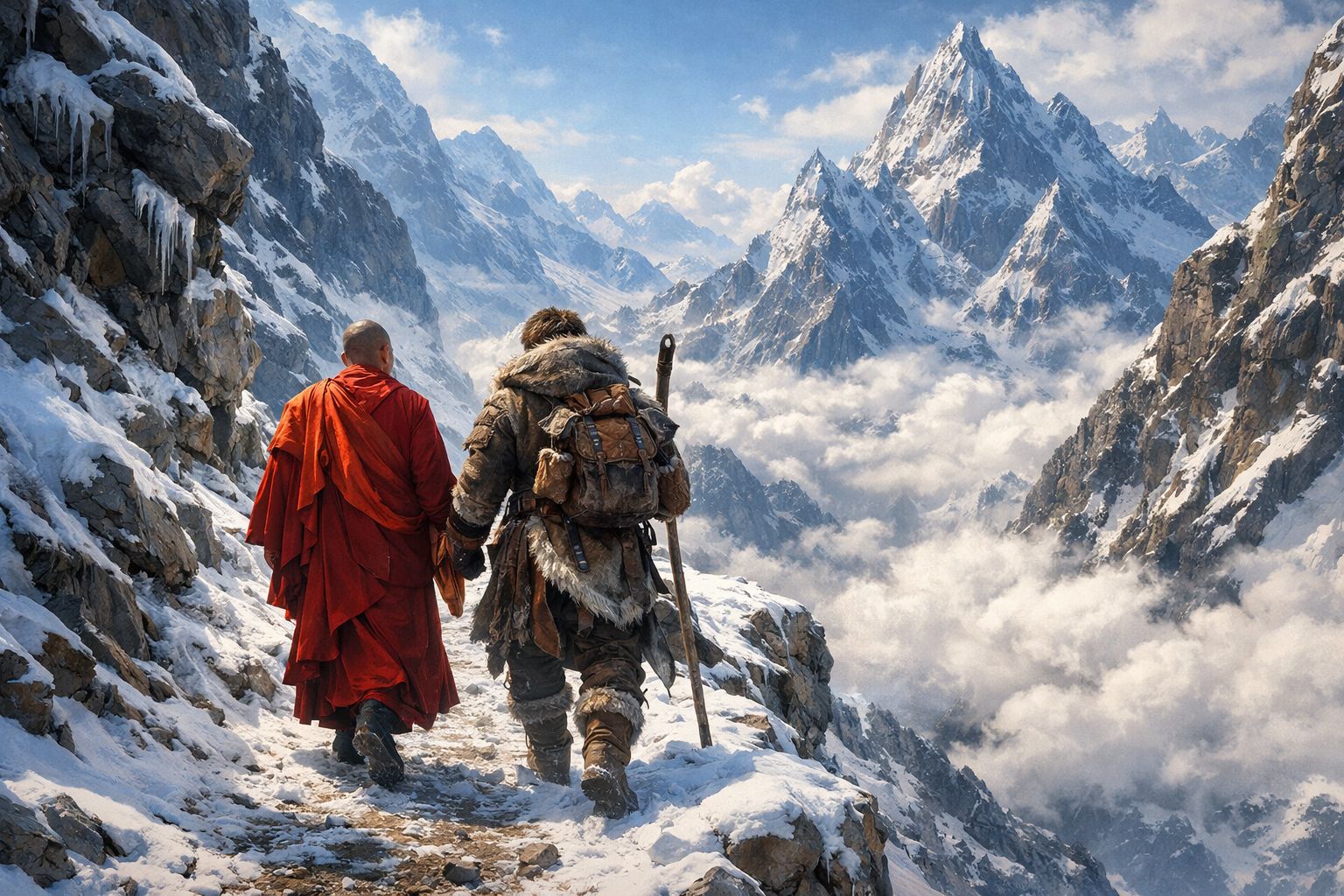
Description
Khazryn is felt before it is seen. The air turns sharp, scents flatten and every breath seems to cost a little more. Distant sounds arrive late and changed, avalanches like far thunder, wind like a low flute through stone gaps. When the clouds lift you glimpse terraces cut into mountainsides and houses clinging to ledges, smoke crawling instead of rising. Travelers notice how quickly weather becomes personal up here, as if the mountains decide, moment by moment, what you are allowed to do.
Land And Weather
Khazryn sits in the Spine of the World, all ridges, high valleys and narrow passes that can close without warning. Summer is short and bright, with days of clear sky followed by sudden hail. Winter is long and heavy, with snowfields above the villages that feed cold meltwater into the lower slopes. The ground is mostly rock and scree, with thin soils on terraces where barley, hardy tubers and bitter greens can survive. Yak pastures appear in patches wherever grass manages to hold. The most reliable roads are stair paths carved into stone, often with rope rails, prayer flags or simple cairns marking turns that can vanish in fog.
Settlements And Travel
Khazryn has no true city. It has villages, each small and self reliant, built from stacked slate, timber beams and thick roofs weighted against wind. Homes are compact, made to hold heat, with low doors that force you to bow when entering. Outsiders call the villages grim. Locals call them sensible. Community spaces matter more than private comfort, shared storehouses, drying sheds, communal hearth halls and small shrines at the edge of a cliff path where people stop for a breath and a word of respect before crossing.
Travel is measured in effort rather than distance. A mile can take an hour if the slope is cruel. Pack animals are yaks and shaggy mountain ponies. Guides are essential in bad weather and respected even by proud visitors. A common guide name is Dorje Ren, a weathered man with a scar across one cheek who speaks little, checks knots twice and never hurries a client who is about to make a lethal mistake.
Tseradun Monastery
Tseradun is Khazryn’s heart. It is carved into the living face of Mount Khazra, reached by a long stair of worn steps that climbs from the valley like a pale ribbon. From below it looks like a fortress pinned to the mountain, walls painted in deep reds and golds that catch thin sunlight. Prayer flags snap in the wind. Bells carry far. Pilgrims arrive with butter, grain, wool and offerings of simple craft, not because the monastery demands it, but because the villages treat it as the natural exchange between hardship and meaning.
To visitors, Tseradun is orderly and severe. The monks rise before dawn, keep long hours of silence and divide their days between meditation, study, chores and physical practice. Some are scholars who copy texts by butter lamp, debate doctrine or teach novices to control breath and attention. Others are warrior monks who drill forms in cold courtyards until their muscles obey without argument. Outsiders are welcome in the outer halls, given shelter in storms and guided through the public shrines, but they are expected to respect silence, follow instructions and accept that some doors are simply not for them.
People And Society
Khazryni are proud, resilient and slow to trust. They value competence and restraint, the ability to endure discomfort without complaint and to offer help without ceremony. Hospitality is real but practical. A traveler who arrives half frozen will be given heat, soup and a dry corner, then asked direct questions and watched for how they treat tools, animals and elders. Gossip travels fast between valleys, carried by traders, pilgrims and monks. A reputation can follow you for years because there are not enough strangers for bad behavior to be dismissed as anonymous.
Family ties are strong, but so is village obligation. Everyone has roles that keep winter survivable, cutting and storing fuel, keeping roof stones set, mending rope bridges, maintaining the terrace walls. Failure is not romantic here. It is hunger.
Authority And Law
Most villages are led by a headman or elder council. Leadership is less about power and more about being the person trusted to coordinate labor and settle disputes before they become blood. The monastery holds moral authority across Khazryn, not as a ruling throne, but as a stabilizing center. When villages argue, they may ask a monk to mediate. When someone breaks an oath in a way that threatens the community, exile is the harshest common punishment, because it turns a person into a liability during winter.
Faith And Customs
Khazryn’s faith is often called the Way of the Peaks. Mountain spirits are treated as real presences, not as distant gods but as stern neighbors. Respect is shown at thresholds, ridge shrines, pass markers and cliff edges where wind can take a careless step. Offerings are simple, a bit of butter, a coin, a braided cord, a whisper of thanks for safe passage. Pilgrimage to Tseradun is common, sometimes for blessing, sometimes for counsel, sometimes simply to prove to oneself that hardship can be chosen rather than suffered.
Visitors quickly learn small customs. Do not speak loudly in a shrine. Do not step over prayer cords or cairns. Do not interrupt a monk in silent practice. When you are offered butter tea, drink it even if you do not like it, because refusing reads as refusing the shelter that made it possible.
Trade And Foreigners
Khazryn has little surplus, but what it has is valuable in the right markets. Wool, rope, salt cured meat, carved bone charms, potent herbs gathered from dangerous slopes and tough mountain leather. In return, Khazryn imports iron tools, needles, lamp oil, grain and cloth that can survive repeated mending. Foreigners are tolerated when they are useful and respectful. Those who treat the monastery as a spectacle or the villagers as simpletons find doors closing, prices rising and guides suddenly unavailable.