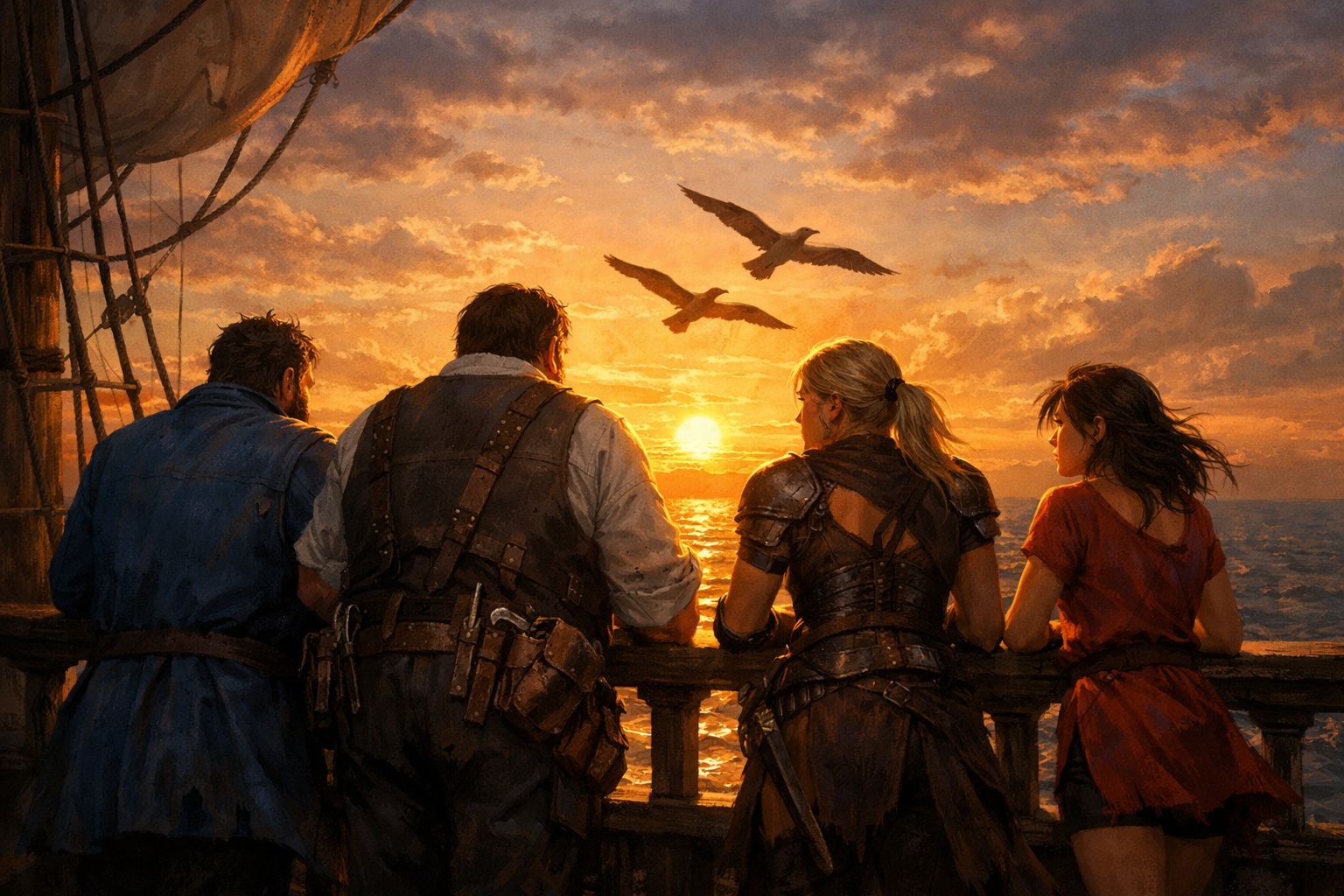
Campaign: Zverilov
Act Synopsis
Arrival in Moryanev
The Blue Marlin arrives in Zverilov under ordinary pretenses. The port functions smoothly and without warmth. Trade is efficient, questions are answered politely but shallowly, and nothing invites deeper curiosity. This is deliberate. Zverilov’s ports exist as masks, places designed to be useful but forgettable. The crew can trade, resupply, and ask cautious questions, but the inland remains distant, hidden behind jungle, rumor, and quiet enforcement.
The Urgent Offer
The calm breaks when a woman bearing official insignia approaches the ship in haste. She is accompanied by two silent men and introduces herself as Milena Chernovna, a state agent acting under emergency authority. She explains that a ship has already departed Zverilov waters bound for Zarhalem and that it must not be allowed to arrive. Time is short. She asks for immediate departure, promising full explanation once underway.
Negotiation is intentionally constrained. Milena speaks quickly, persuasively, and frames the job as voluntary but urgent. Payment is practical rather than extravagant, a full cargo of supplies suited to long travel. She insists on bringing two scouts of her own, dismissing concerns about their usefulness at sea with a vague assurance that it will become clear. The emphasis is momentum over deliberation.
The Secret Revealed
Once the Blue Marlin is clear of the harbor, Milena reveals the truth. The ship they are hunting is a slaver in service to the Khalif of Zarhalem, searching for rare and exotic captives for his harem. By chance rather than design, its captain learned Zverilov’s greatest secret.
Milena demonstrates that secret briefly and without spectacle, transforming into a black panther and back again. She explains the Zveri and the absolute necessity of secrecy. If Zarhalem learns the truth, Zverilov will not merely be threatened. It will be consumed. Slavers, zealots, and empires alike would descend upon them.
She explains why the Blue Marlin was chosen. She explains that they needed a ship that could overtake the slaver quickly and decisively, and the Blue Marlin was both the fastest vessel in reach and already in port when the need arose. The Zveri have also been observing the crew for some time through an agent named Jonaton, a seagull Zveri who witnessed the Waverider’s visit and later followed the Blue Marlin. Jonaton’s reports did not speak of virtue, but of pattern. The crew had consistently opposed slavers, protected freed captives, and accepted cost and risk to do so. To the Zveri, this marked them as predictable in the one way that mattered. This is not blind trust, but a calculated risk taken because no better option exists.
The Hunt Across the Myrrhwaters
The pursuit carries the ship across the Myrrhwaters and along scattered island chains. Milena’s scouts reveal their nature by taking albatross form, ranging far ahead to track the fleeing vessel. The chase is direct and time bound. The slaver has a head start but cannot outrun the Blue Marlin indefinitely.
The pursuit ends among the Shark Isles, where the slaver is finally cornered. What begins as a brief, chaotic clash collapses into a standoff. Outnumbered and wounded, the slaver drags his last bargaining chip into the open: a captured Zveri, blade pressed to their throat.
From that moment, every action risks a life. Any rush could kill the hostage. Any delay gives the slaver room to maneuver. He offers surrender, promising silence and disappearance if allowed to leave alive. The threat is explicit and constant.
The Zveri are unequivocal. He cannot be allowed to live. As long as he breathes, exposure is only a matter of time.
The crew must choose under pressure rather than fury. Whether they force the issue, attempt deception, or accept the cost of a deliberate killing, the choice is made with a life hanging in the balance. Whatever path they take, it is not clean, and it leaves a mark.
Here the arc reaches its moral core. The Zveri insist the slaver cannot be allowed to live. His survival means eventual exposure. The crew is forced to decide whether one deliberate killing is acceptable to prevent the destruction of an entire people. Whatever choice is made, it is not clean and it leaves a mark.
The Return Becomes an Odyssey
With the immediate threat resolved, the arc does not simply conclude. Damage sustained during the chase complicates the return. What should have been a straightforward journey back to Zverilov stretches into something longer and more uncertain.
Repairs take time. Weather shifts unfavorably. Navigation becomes cautious. At one point the ship may be forced to beach for temporary repairs, turning safety into vulnerability. From shore, lookouts spot the Prowler on the horizon. The pirate ship does not see the Blue Marlin, but its presence alone reshapes every decision. Vexar Bloodwake becomes a looming threat without ever attacking. They do not know if he has hear rumors about them and is hunting, or just happened to pass by.
Ports such as Richport or Bayport become tempting options. Each can solve practical problems while introducing new risks. Rumors spread quickly. Familiar faces notice the ship. Every stop trades stability for exposure.
At some point, the Silver Moon may cross their path. Its captain offers aid, trade, or conversation. It is a moment of familiarity and relief that quietly tests restraint. What the crew chooses to say or not say matters as much as what they do.
These events are not a fixed path but a collection of pressures. The return journey becomes a test of endurance, judgment, and discretion rather than heroism.
Trust and Reward in Zverilov
When the Blue Marlin finally returns, the reception is calm and restrained. Milena keeps her word. The crew receives the promised supplies along with symbolic gifts. Each is given a pendant bearing an animal form and taught a challenge response phrase used to identify trusted outsiders. One soul is answered by two bodies.
Milena admits openly that the crew was watched throughout the mission. A pod of dolphin Zveri shadowed the ship as insurance. She apologizes without shame. Trust in Zverilov never excludes caution.
Drevobor and the Waverider’s Trail
With time to spare, the crew is directed inland to Drevobor to meet the retired harbormaster, Bogdan Volkov. There they see the true Zveri culture openly for the first time. Joy, confidence, and community rather than fear.
Bogdan recounts the Waverider’s visit with dry amusement. He and the other Zveri deliberately misled the ship, filled its supply stocks, and sent it on its way without suspicion. The Waverider was not deceived by failure but by competence.
He provides the next confirmed destination of the Waverider and shares his quiet satisfaction at how thoroughly they were fooled.
Departure and Lingering Consequences
The Blue Marlin leaves Zverilov carrying more than information. They carry a secret that could destroy a nation if mishandled and the weight of a choice made in full awareness of its cost.
Had they failed or refused, the consequences would not have been immediate. They would have unfolded slowly. Raids, rumors, escalation, and eventually open war framed as righteousness. That future now remains deferred.
The arc ends not with triumph, but with survival bought at a price, and the uneasy knowledge that even the right decision can make the journey home longer and harder.
Arrival in Moryanev
First Impressions
Moryanev does not feel like a destination. It feels like a pause.
The harbor is small, quiet, and almost unnervingly slow compared to what the crew is used to. One narrow stone pier. A handful of fishing boats tied loosely, rocking without urgency. A squat lighthouse of whitewashed stone watches the bay more out of habit than necessity. There are no banners, no calls from dockhands, no crowds waiting to see who arrived.
Within twenty minutes, it is clear that they have seen nearly all of it.
The Port Itself
There is a single tavern, The Driftwood Lantern, run by an aging man named Radek who looks mildly surprised whenever a new customer walks in. His ale is decent. His food is plain. He closes early.
A few low warehouses sit near the pier, timber and stone, practical and unadorned. They hold dried fish, salt, hardwood bundles, resin, and spices packed for export. Nothing exotic. Nothing tempting.
A cluster of hut like houses sits back from the shore, half hidden by palms and broad leafed trees. Fisher families. Port laborers. People who wake early, sleep early, and have little interest in strangers beyond polite curiosity.
There are no slaves. No chains. No overseers. There is not even a typical harbor brothel catering to sailors passing through. If anyone asks, they are met with mild confusion rather than disapproval. That simply is not something Moryanev has.
What Is Missing
What stands out most is absence.
There are no other merchant ships in port. No caravels unloading cargo. No privateers boasting of prizes. No rumors shouted over dice. No foreign accents arguing prices.
No sense of urgency.
Restocking the Blue Marlin will take a day or two. Supplies must be brought in from upriver and nearby villages. Everyone involved is competent, polite, and unhurried. They work at the pace of people who have never needed to rush.
Nothing To Do
Once business is arranged, there is nothing left.
No interesting shops.
No gambling dens.
No trouble to stumble into.
No obvious patrons to impress or offend.
If the crew goes looking for something to do, they find only quiet routines. Nets being mended. Fish being cleaned. Lamps being refilled. People nodding hello and returning to their work.
After a while, the boredom settles in.
Let it sit.
Let the players prod at it. Let them test the edges of the town and find nothing pushing back, except warnings that the jungle has some dangerous animals. Let them realize that Moryanev is not hiding excitement. It genuinely has none to offer.
This is a place meant to be passed through, not explored.
The Calm Before
Make it clear that this stillness is not suspicious. It is not tense. It is simply empty of hooks.
The sense that something should be happening will come from the players themselves, not from the world.
Only after that feeling has had time to grow should the tempo break.
Only then should someone come running down the pier.
The Urgent Offer
Milena reaches the end of the pier at a fast, purposeful walk, boots striking wood in a steady rhythm. Two men follow close behind her, both in plain traveling coats marked only by a small metal clasp worn at the throat. They do not look at the ship. They look at angles, distances, hands.
She stops at the foot of the gangplank and looks up.
"I need the captain and whoever speaks coin and consequence," she says. Her voice carries without effort. Hurried but calm. Controlled but unthreatening. Already moving ahead of the moment.
Scarnax steps forward, hands loose at his sides. Ayesha joins him a half step back, eyes already measuring the woman, the men, the insignia.
"You have them," Scarnax says. "Start slower."
Milena does not.
"My name is Milena Chernovna. I speak with the authority of the crown of Zverilov. A ship left this port two hours ago bound for Zarhalem. It must not arrive."
Ayesha smiles faintly. "That is an interesting problem, but not automatically ours."
Milena nods once, sharp. "It becomes yours because you are the fastest ship in port, because you are already crewed and sufficiently provisioned, and because every minute we stand here talking puts distance between you and your target."
Scarnax frowns. "You are asking us to chase a ship without telling us why."
"Yes."
Ayesha tilts her head. "And if we decline."
"Then I lose time I cannot afford," Milena says. "And you continue restocking for the next two days."
Mbaru shifts his weight slightly. Amaxia crosses her arms, gaze fixed on the two men behind Milena. Neither speaks.
"What kind of ship," Scarnax asks.
"Small. Fast. Lightly crewed."
"And armed?"
"Lightly, not dangerous unless mishandled."
Ayesha steps in smoothly. "Payment."
"A full cargo of supplies drawn from our stores," Milena says without hesitation. "Food, water, sailcloth, resin, hardwood, salt. More than enough to justify the detour."
"And risk," Ayesha adds.
Milena meets her eyes. "Yes."
Scarnax folds his arms. "You want us to sail blind."
"I want you to sail now."
Ayesha exhales softly through her nose. "You also want to bring people aboard."
"Two," Milena says. "Scouts."
Ayesha raises an eyebrow. "On the sea."
Milena allows herself the barest hint of a smile. "You will understand later."
Scarnax shakes his head. "You are not very good at reassuring people."
Milena looks past him to the lines already being checked along the deck. "Reassurance costs time."
There is a brief silence, stretched thin. The harbor is quiet enough that the creak of rope is audible.
Milena breaks it.
"Once we are underway, I will explain everything," she says. "If, after that, you choose to turn back, you may do so. No reprisals. No debt. But the ship must move first."
Ayesha glances at Scarnax. "That is a clever way to frame consent."
Milena inclines her head. "It is an honest one."
Scarnax studies her for a moment longer, then looks to Ayesha again. This time she does not smile. She nods once.
Milena does not wait for verbal confirmation. She steps onto the gangplank as if the decision has already been recorded.
Scarnax releases a slow sigh and turns toward the deck.
"Cast off."
Caelin’s voice snaps the order across the ship, sharp and practiced, and the Blue Marlin begins to move before the harbor has time to object.

Purpose of the Scene
This scene exists to break the stillness of Moryanev and replace it with momentum. It is not a negotiation scene and not an investigation scene. Its function is to put the crew in motion before they fully understand why, and to make that feel intentional rather than forced.
Let Milena control tempo. The players should feel slightly off balance, talked over rather than talked with, without ever feeling threatened or disrespected.
Playing Milena Chernovna
Milena is official, competent, and in a hurry. She does not panic, argue, or bluff. She answers questions briefly and only as far as necessary. If pressed for details, she redirects to urgency. Anything requiring more than a single sentence will be answered with a conversation stopping "Later."
Her authority is real, but she does not lean on it. Her power comes from certainty and time pressure, not intimidation.
If players push hard, she gives them the escape clause once underway. That is the pressure valve. Do not give explanations before the ship moves.
The Scouts
Milena brings two scouts aboard.
Their names are Luka Desely and Anya Morozova.
They present as quiet, capable travelers with no visible weapons beyond knives. They say little, observe constantly, and follow Milena’s lead without question. If spoken to, they answer politely but vaguely. They do not explain their skills or background. Clearly, Milena is the one doing the talking.
They should read as professionals, not bodyguards.
Crew Posture
Scarnax and Ayesha will be the ones expected to do the talking. If neither is a player character, assume they are below deck, and let someone else handle it.
The fighters of the crew are visibly present, calm, and ready. They do not escalate, but their posture makes it clear that violence would be decisive if it happened. Milena notices this and adjusts her spacing slightly. That is enough acknowledgment.
Player Agency
This scene should move forward on decisions, not discussion. Let questions happen, but do not let them slow the moment. If the conversation stalls, Milena pushes it forward.
The crew can refuse. Make that clear.
But refusing should feel costly, not punished. Lost opportunity, unanswered questions, and the sense that something important just sailed away without them.
If they accept, move immediately to casting off. Do not linger.
Timing the Break
Do not introduce the secret here.
End the scene with the ship moving.
The explanation comes only once the harbor is behind them and the choice can no longer be undone without consequence.
The Secret Revealed
The Blue Marlin has barely cleared the harbor when Milena asks for the crew’s attention.
The sails are filling. The shoreline of Moryanev is already shrinking behind them. Ropes creak, water breaks against the hull, and the familiar rhythm of a ship getting underway settles in. It is the moment when departure becomes real and return begins to cost effort.
Milena waits until that moment passes.
She steps to a clear stretch of deck where most of the crew can see her and raises her voice just enough to carry.
"What I am about to show you has been shared with fewer than a handful of outsiders in all of our history," she says. "There is no danger. But you need to stay calm."
That alone is enough to draw full attention.
Scarnax watches her carefully, jaw set. Ayesha’s expression is neutral, but her eyes are sharp, already searching for angles and implications. Ileena has climbed onto a coil of rope without being told, tail flicking with interest. Shaedra stands a little apart, arms folded, gaze steady and suspicious.
Milena takes a slow breath, then simply steps out of her sandals and pulls her coat free.
There is no chant. No gesture. No warning.
Her shape flows.
Bone shifts. Muscle lengthens. Skin ripples and darkens. In the space of a heartbeat, where Milena stood now stands a black panther, massive and sleek, paws gripping the deck with quiet certainty. The animal turns its head once, golden eyes scanning the crew.
There is a collective gasp.
Someone swears under their breath.
Ileena leans forward, ears pricked, eyes wide not with fear but fascination.
Milena holds the form just long enough for disbelief to curdle into understanding. Then the panther contracts, reshapes, and resolves back into human form, clothes left in a neat spill at her feet.
She stands naked before them, unbothered, and looks at their faces.
"You can stop staring," she says dryly. "Clothes do not change with the body."
One scout snorts softly. The other smiles at him, brief and familiar, before looking back to the crew.
Milena bends, gathers her clothing, and begins to dress with unhurried efficiency. Only now does the crew notice the design. Slits, ties, reinforced seams placed with deliberate care so fabric does not bind or tangle when discarded in a hurry.
"We are not the warewolves of your stories," she continues, as if she has not just rewritten their understanding of the world. "We are a people. Shapeshifters, yes, but no more cursed than you are. We call ourselves the Zveri."
She gestures briefly to the two scouts.
"Luka Desely. Anya Morozova. Albatross Zveri."
Luka inclines his head once. Anya offers a small, unapologetic smile.
"We live as people," Milena says. "We trade. We build. We raise children. We change shape. And if the world knew that, we would be hunted to extinction."
Shaedra’s jaw tightens.
"Slavers would take us as exotic flesh," Milena goes on. "Harems. Arenas. Brothels. Religious zealots would kill us to prove their faith. Nations would dissect us to understand us. So we hide."
She finishes dressing and meets their eyes one by one.
"The ship we are hunting belongs to Yasir ibn Khaled, a slaver employed by the Khalif of Zarhalem, Al-Rasid ibn Jahlil. His appetite for filling his harem with exotic rarities is famous. This man was sent to find new flesh."
Her mouth tightens slightly.
"He wandered. By accident. He saw a group of us change. He was not equipped for a raid this time, only a purchase mission. But he understood what he had found."
Ayesha exhales slowly. "And left to come back prepared."
"Yes," Milena says. "His ship is small. Fast. Crew of six. Sailors, not fighters, save for him. He intends to return with force."
Scarnax’s knuckles whiten on the rail.
Milena hesitates, just a fraction, then continues.
"We chose your ship because we needed speed, and because you were here. The Blue Marlin is the fastest ship afloat, and the only one in port."
She meets Scarnax’s eyes squarely.
"But we did not choose blindly."
There is a murmur among the crew.
"We have watched you," Milena says. "In Ardenvale, we had an agent. A seagull Zveri named Jonaton. He saw the Waverider pass through. Tried to follow it. Lost it in a storm."
Ileena’s ears twitch.
"When you arrived asking about the Waverider, he followed you instead. Closely. What he saw mattered. How you treated freed slaves. What you opposed. What you were willing to lose to do it."
She does not call them good. She does not praise them.
"He recommended you."
Silence settles over the deck.
Milena draws a breath and asks the question plainly, without ornament.
"Will you help us?"
Scarnax does not answer immediately. He looks around the deck. At Ayesha, who gives a slow, thoughtful nod. At Ileena, who looks almost offended that the answer could be anything but yes. At Shaedra, whose expression has hardened into something cold and certain. At Ormun briefly looking at Cassandra, then giving a resolute nod and bumping his fist against his chest.
He looks at the crew beyond them and sees agreement reflected back at him.
Then he turns to Milena.
"We will," he says.
After Scarnax speaks, Milena holds his gaze for a heartbeat longer, as if weighing the sound of the words rather than their meaning.
Then she gives a single, short nod.
Not to him.
To the scouts.
Luka and Anya are already moving. They step to the rail without ceremony, shrug off packs and sandals, and slip free of the last pieces of clothing with the same unselfconscious ease Milena showed moments earlier. The crew barely has time to register the motion before bodies flow and reshape again.
Feathers burst where arms were. Wings unfurl, wide and pale against the sky. In seconds, two albatrosses perch on the rail, massive, balanced, utterly at home in the wind rolling off the open sea.
One of them turns its head back toward the deck. For a moment, there is unmistakable awareness in its eye.
Then both birds leap.
They catch the wind cleanly, wings stretching, banking outward and upward in a wide spiral that carries them ahead of the ship. Within moments they are silhouettes against the sky, already ranging far beyond where human eyes can follow.
Milena watches them go, then turns back to the crew.
“We will have a direction soon,” she says. “From this point on, speed matters.”
Ahead, the albatrosses fan out over the Myrrhwaters, and the hunt truly begins.

Purpose of the Scene
This scene exists to transfer the arc from urgency to meaning. The players are no longer acting blind, as they now understand what is at stake and why speed matters. The goal is not suspense but comprehension followed immediately by commitment.
Let the reveal land before you move on. Do not rush reactions, but do not invite debate yet.
When to Trigger It
Run this scene as soon as the ship is clearly underway and turning back would require effort. The sails should be set, the harbor shrinking behind them, and the moment where leaving becomes real should be unmistakable.
Do not wait for a quiet moment later, as the immediacy matters.
Playing Milena
Milena is calm and deliberate here. This is not a confession and not an apology. She is explaining necessity.
She warns the crew first, asks for calm, and then demonstrates. That order matters, as it frames the transformation as proof rather than threat.
After the transformation, she controls the flow of information. She answers what needs to be answered and keeps moving forward. She does not ask permission until the end.
Handling the Transformation
Describe the transformation clearly and physically, without mysticism or magic words.
Allow shock, gasps, silence, and curiosity to surface, and do not interrupt those beats.
Nudity should be handled matter of factly. The Zveri do not treat it as notable, while the crew might, and that contrast is intentional.
Crew Reactions
Do not force specific reactions from player characters.
If players hesitate, use Milena’s steady tone and continued explanation to anchor the scene.
If players react strongly, let it happen, as the scene can absorb emotion without breaking.
The Information Dump
This is one of the few places where a longer explanation is correct.
Focus on three points.
- They are a people, not monsters.
- Exposure means extinction.
- The slaver represents a system backed threat, not just a single ship.
Do not elaborate beyond what is in the story unless players ask directly.
Jonaton and Surveillance
When Milena explains that the crew was observed, play it neutrally.
This is not an accusation and not flattery. It is an assessment.
Avoid praising the crew, and emphasize behavior and pattern instead.
The Question
Milena asks plainly if they will help.
Do not soften the question or frame alternatives.
Let the table answer.
The Scouts’ Departure
Once the answer is yes, move immediately to action.
Milena nods, the scouts transform, and they take flight.
This marks the end of discussion and the beginning of pursuit.
If the Answer is No
If the players decline the mission, they can simply turn around and let the Zveri leave, ending the Zverilov arc. The Zveri will keep them under surveillance and will act if they begin to talk. The crew will find no information or help here beyond ordinary business transactions. For long term consequences, see the act summary.
After the Scene
Once the albatrosses are gone, shift focus back to sailing.
The crew has chosen, and the world is moving again.
From this point forward, speed matters.
The Hunt Across the Myrrhwaters
Scope and Intent
This section covers the pursuit itself. Its purpose is to establish time pressure, uncertainty, and endurance. The hunt should feel active but not dramatic moment to moment. What matters is accumulation. Days passing. Fatigue building. Stakes rising.
The chase is not a sprint. It is a sustained push.
Duration and Rhythm
The pursuit lasts several days and catches up to the target on the evening of the third day.
Each day follows a repeating rhythm. Morning uncertainty. Daytime progress. Evening exhaustion. This repetition is intentional. It makes the eventual break in pattern feel significant.
The crew should feel that they are gaining ground, but never comfortably.
The Scouts and Daylight
The scouts can only fly by day. At night, they must return to the ship to rest.
Each morning begins with waiting.
The scouts must relocate the target ship. The island chains provide countless hiding places, false leads, and blind angles. Even when they find the ship again, it should never feel guaranteed. Play the delay, let it take a lot longer the second day. Let the crew scan the horizon and wonder before the scouts return.
Once the target is found, Luka and Anya take turns shuttling back and forth. One remains high to track movement. The other flies back to the Blue Marlin to relay direction and speed. This continues throughout the day.
The evening settles gently over the Blue Marlin.
The sea has gone dark and flat, broken only by the ship’s wake and the thin line of moonlight laid across the water like a blade left forgotten. A narrow moon hangs low, more suggestion than presence, just enough to soften edges without truly lighting anything. The sails whisper rather than snap. For the first time since leaving Moryanev, the ship feels unhurried.
Scarnax leans against the rail with a cup in his hand, not really drinking. Nasheem sits nearby, cross legged on a coil of rope, talking softly with Galenor, who has a half dismantled lantern in his lap for no reason other than habit. Ileena crouches on the rail itself, tail flicking lazily, eyes bright.
A little apart from them sit Milena, Anya, and Luka.
They are closer together than coincidence would require. Luka’s shoulder brushes Anya’s arm as they sit. When he shifts, she shifts with him without looking. There is no display, no attempt to explain. It is simply how they are.
Nasheem notices first.
“So,” he says lightly, glancing their way, “I take it you two fly together as well as you scout together.”
Anya looks at Luka, then back to Nasheem, and smiles. It is smaller than before, but warmer.
“We have for years,” she says. “It is easier to watch the horizon when someone else knows exactly where you are without asking.”
Luka nods. “And easier to land.”
There is a brief, shared look between them that needs no translation.
Galenor clears his throat. “That trust,” he says, gesturing vaguely between them, “that’s a rare thing. You don’t hand it out lightly.”
Milena’s gaze lifts to him.
“No,” she says. “We do not.”
She lets the silence sit a moment before continuing.
“You are aware that what we have shown you ends us if mishandled,” she says calmly. “Not politically. Not diplomatically. Completely.”
Scarnax exhales slowly. “Aye,” he says. “We noticed.”
Milena inclines her head. “Good.”
Nasheem turns his cup slowly in his hands. “You must have other ways. Other ships. Other allies.”
“We have watchers,” Milena replies. “We have patience. What we do not have is speed when bad luck intervenes.”
She looks around the deck, at the ship, the crew, the night.
“You were present. You were capable. And you had already shown what you do when chains are involved.”
Ileena tilts her head. “So,” she says brightly, “you trusted us.”
Milena studies her for a long moment.
“Yes,” she says. “We did.”
The weight of that word settles more heavily than any threat. Galenor looks away first. Scarnax tightens his grip on the rail. Nasheem nods once, sober.
The moment breaks when Ileena hops down from the rail and pads over to Milena, crouching in front of her.
“When this is over,” Ileena says, eyes shining with curiosity, “do you want to share his heart?”
There is a pause.
Nasheem blinks. Galenor coughs into his sleeve. Scarnax opens his mouth, then closes it again.
Milena, to her credit, does not flinch.
She smiles.
“No,” she says, evenly, “You take it, it is yours. All of it.”
Ileena’s ears flick forward in delight. “Oh. Thank you,” she says sincerely. “That is very generous of you.”
She pads back to her place, clearly pleased, already lost in thought.
Anya stares at Milena for a heartbeat longer, then lets out a quiet, incredulous laugh. Luka shakes his head, lips twitching despite himself.
Milena watches Ileena go, then looks back at the sea. "I don't eat hearts, but I do feel a certain kinship with her. We are not that different."
The moon slides behind a cloud. The ship sails on.
The Feel of the Sea
Weather throughout the hunt is generally favorable. Winds are steady. Visibility is good. The sea does not fight them.
That is important. The difficulty comes from distance and persistence, not adversity.
Most of the time, sailing is uneventful. For sailors, it is work. For everyone else, it is waiting. Watching the horizon. Watching the scouts. Watching islands slide past.
Lean into the boredom. It contrasts with the urgency and makes the eventual violence sharper.
Pressure Without Panic
They are closing in, but there is no room to ease off.
The target ship is fast. Any slack means losing ground. The crew must push the Blue Marlin hard but not recklessly. Sails are strained. Watches are long. Small efficiencies matter.
Reinforce that speed is a choice they keep making, not a passive state.
The Second Day Incident
On the second day, during one of the scouts’ passes, the slaver ship takes a shot.
It is not a planned ambush. It is a lucky arrow.
Luka is hit in the wing and loses control. He goes down hard into the water near the target ship and is taken aboard.
Anya sees it happen.
She does not attempt rescue. She returns to the Blue Marlin to explain. She screams in rage, circles once, then flies harder and lower than before, cutting back toward the prey.
From that moment on, her behavior changes. She flies longer. Takes fewer breaks. Pushes closer. Her reports become sharper and more urgent. After that, she does not land again to report, just swoops over the Blue Marlin, and flies off in the direction they should go. During the night, she is restless, worried and angry.
Uncertainty and Stakes
After Luka is taken, the morning becomes heavier.
There is more at risk now. The scouts’ success matters more. The waiting feels longer. Anya’s absence becomes noticeable.
The shot also means that they now know they are being hunted.
Emphasize that the hunt is still not guaranteed. The islands still offer hiding places. The dawn carries tension until Anya returns.
Nearby Pirate Waters
The route passes close to Richport and Bayport.
This should register as background concern. Distant sails. Smoke on the horizon. Rumors exchanged at sea.
During the hunt, pirates do not interfere. They are a risk, not an obstacle. Their presence reinforces that lingering or slowing down would invite complications.
The Battle
The third evening brings it suddenly.
As the Blue Marlin rounds the shoulder of a low island fringed with palms, a sail slips into view against the low sun. Small. Lean. Running hard. Above it, Anya circles high, a pale shape against the thinning sky, banking once in a tight arc that leaves no doubt.
They have found them.
The evening breeze fills the sails cleanly, and the Blue Marlin answers like a living thing. Its unusual hull cuts the water with predatory ease, outriggers skimming and biting, speed building without strain. Distance collapses faster than instinct expects. What had been a chase becomes a closing grip.
The other ship shows no sign of surrender.
Figures move along its deck. A course correction, sharp and panicked. Too late.
Shaedra does not hesitate. Her bow sings once, clean and final. One of the slaver’s sailors drops where he stands, the body crumpling without ceremony. There is shouting now. Fear, sharp and sudden.
Yasir ibn Khaled takes in the narrowing gap, the angle of pursuit, the speed he cannot match. He understands the truth of it in a glance. He cannot outrun them. He cannot win them hand to hand.
So he turns.
The slaver ship slews sideways in a desperate maneuver, aiming not for escape but for impact. Wood screams as hull meets outrigger. The shock runs through the Blue Marlin like a struck bell. One outrigger splinters and buckles, shattered but not torn free.
The collision works partially. The Blue Marlin is wounded. She can only limp, not hunt.
But Yasir’s ship is no longer moving.
Its bow is jammed hard against the broken outrigger, rigging tangled, hulls locked together in a grinding embrace neither can escape. Waves slap uselessly between them as momentum bleeds away.
Shouts rise from both decks. Steel is drawn. Ropes are grabbed. Hands find rails.
The chase is over. The killing is about to begin.
Purpose of the Scene
This phase exists to collapse the hunt into a moral and tactical crisis. The initial violence should be brief and decisive, followed by a sudden stop where force becomes dangerous rather than useful. The goal is not a prolonged melee but a sharp transition from action to stillness under threat.
Yasir’s Disappearance
As soon as the ships lock together and boarding becomes inevitable, Yasir ibn Khaled disappears below deck.
Do not draw attention to it. Let it register only as absence. He is not fleeing in panic. He is moving with intent.
The Sailors’ Fight
The slaver’s crew are sailors, not fighters. They are outnumbered and outmatched.
The first clash should be fast and brutal. A few blows. A few bodies. Panic setting in. Any sailors who survive the initial exchange are likely to surrender quickly rather than die for a man who has already vanished.
This part should be resolved cleanly and without drama. The real conflict is still coming.
The Return With the Hostage
Once the deck is largely secured, Yasir reappears.
He comes up from below deck with Luka bound and injured, one arm useless, blood dark against a dirty tunic. A knife is pressed tight to Luka’s throat. The blade is steady. Yasir’s voice is not.
He shouts for the fighting to stop. Immediately. He makes it clear that if anyone moves toward him, Luka dies first.
This is the moment the scene changes.
The impact has barely finished shuddering through the hulls before the decks erupt.
Nasheem is over the rail first, moving low and fast, blade flashing once before a sailor even understands he is being attacked. Mbaru follows like a breaking wave, heavy and unstoppable, his strike sending a man sprawling across the deck boards. Amaxia comes in behind him, precise and brutal, cutting off retreat before it can begin.
Skarnulf roars as he lands, sword slamming between ribs, boots finding purchase among blood slick planks. Shaedra has already loosed her bow and then cast it aside, blade drawn, eyes cold. Ileena hits the deck last, not from the rail but from above, dropping among them with feline grace and tearing momentum apart in a heartbeat.
It is over almost before it starts.
The sailors are not fighters. They break under pressure. One goes down screaming. Another drops his weapon and raises shaking hands. A third turns to run and is cut down before he takes three steps. Steel rings once, twice, then not at all.
Milena pounces in panther form. A sailor goes down under her weight, and when she lifts her head his throat is gone. She watches Anya from the corner of her eye even as the last sailor collapses, breath rasping, fear everywhere.
Then a voice cuts through the noise.
"Stop!"
Yasir ibn Khaled stands at the edge of the hatch, dragging Luka up from below deck. Luka’s hands are bound. One arm hangs useless at his side. Blood stains his tunic dark and sticky. Yasir’s knife is pressed hard against his throat, the edge biting enough to draw a thin line of red.
Everything freezes.
Anya lets out a sound that is half scream and half cry, pointing in rage as she surges forward.
"Albatross shooter! A curse on you!"
Milena’s hand comes down on her shoulder, firm and immediate. Anya strains against it, trembling with fury, but restrains herself.
The crew spreads without a word. Not rushing. Not retreating. Just enough movement to claim angles, to close space without crossing it. Steel stays low. Eyes stay locked.
Scarnax steps into view beside Ayesha. He does not speak.
Ayesha does.
"If Luka dies, so do you," she says calmly. "That is not a threat. That is the shape of things."
Yasir’s eyes flick from face to face, counting weapons, distance, intent. His grip tightens.
"If you release him," Ayesha continues, "we can find another solution."
Yasir jerks the knife closer, panic cracking through his voice.
"No closer!"
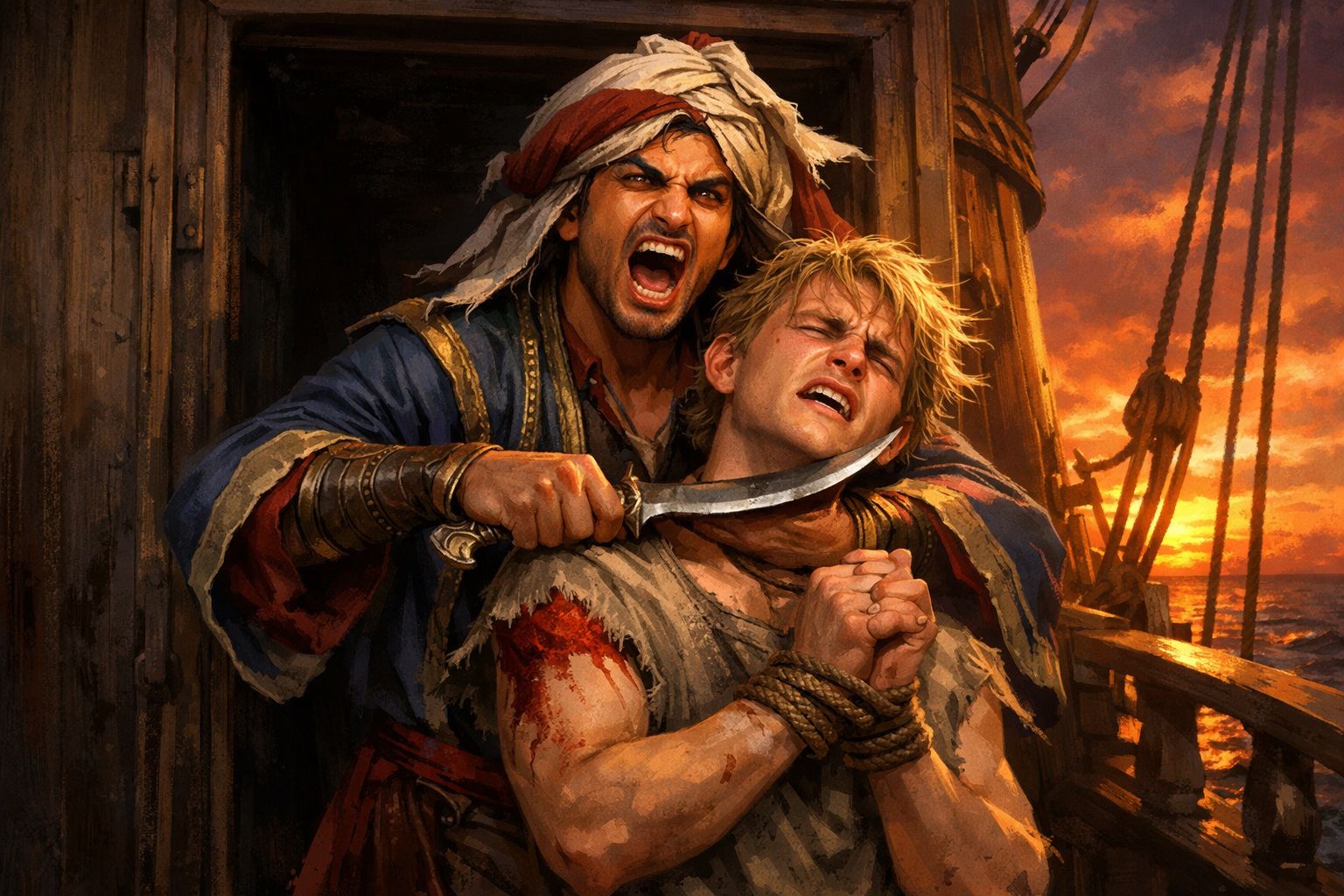
The Standoff
The ships are still entangled. The distance is wrong for a rush. The angle is wrong for a clean shot.
An arrow might reach Yasir, but it is a difficult shot under pressure, and not guaranteed to be instantly fatal. A slow kill risks Luka’s life.
A stealth approach might be possible. Ileena or another fast mover could try to circle or strike from below or behind, but again, there is no certainty of an immediate kill.
Make it clear that violence is now dangerous rather than decisive.
Yasir’s Position
Yasir knows he is finished.
His ship is crippled and no longer seaworthy. He cannot outrun the Blue Marlin. Even if he survived this encounter, he would not be allowed to leave with the secret he carries.
He understands this, and it makes him desperate rather than clever.
Threats do not work well on him. He has already crossed the line where fear of death matters less than fear of dying without leverage.
He will promise silence if spared. He will swear oaths. He will claim he can disappear. These offers are self serving and hollow, but they are all he has left.
Negotiation Limits
Negotiation is possible, but it is narrow and unstable. A drawn out negotiation is a viable tactic, so do not rush it.
If Yasir believes there is any real chance he will be spared, he may surrender. If he becomes convinced that death is inevitable, he will lash out.
If he chooses to fight, Luka is the first victim. Make that clear. Not as threat. As fact.
Ending This Phase
Do not rush resolution.
Let the players feel the weight of distance, time, and consequence. Let them understand that this is no longer about winning, but about choosing how it ends.
Whatever choice is made, it should feel deliberate, costly, and final.
The outcome of this standoff will echo forward.
The Choice
Purpose of This Phase
This phase resolves the standoff and forces the consequences of the crew’s decision into the open. There is no clean outcome. Whatever happens next should feel final, heavy, and slightly wrong, even when it is necessary.
Do not soften this moment. Let it land.
Luka
If Luka survived, he is in bad shape.
Junia can stabilize him using practical medical skill. She does not use magic, because of the unfamiliar Zveri anatomy. Treatment is painful, slow, and uncertain, but it works. Luka lives because people chose to act, not because of miracles.
If Luka died, Anya is devastated.
She does not scream. She does not lash out immediately. She goes very still.
If Yasir is still alive and Anya is given even the slightest opportunity, she will kill him. This is not a threat. It is not negotiable. It is grief made decisive.
Yasir
If Yasir died during the standoff, the mission is over.
There is no victory celebration. There is only aftermath.
Ileena may again offer to share the heart with Milena. Milena declines calmly and tells Ileena that she earned it. There is no judgment in this. Just difference.
If Yasir survived and surrendered, the real moral fracture appears.
The Zveri insist that Yasir must die. So must any surviving sailors who know what he knows. It is the only way to be certain the secret dies here. From their perspective, this is not vengeance. It is survival.
The crew may object. Yasir surrendered. The sailors laid down arms. By most moral frameworks, they should live.
This is the heart of the dilemma.
A nation versus a man. Or a few men. Certainty versus principle. Responsibility versus cleanliness.
Who Does the Killing
The crew is not required to carry out the executions.
If the decision is made to kill Yasir and the sailors, Anya will do it without hesitation. Not out of cruelty, but because she believes it must be done, and because she wants revenge for what they did to Luka.
If the crew refuses, the Zveri will remember that refusal. Not with anger, but with distance.
Running the Moment
Do not rush this.
Let players talk. Let them argue. Let silence stretch.
Do not provide an easy out. There is none.
Whatever choice is made should feel deliberate, costly, and irreversible.
When the decision is done, move on. The world will not pause to validate it.
If Yasir Is Spared
If Yasir is allowed to live and leave, regardless of promises made, the outcome is only delayed.
Yasir is not motivated by honor, fear, or gratitude. He is motivated by value. What he has seen is worth fleets, armies, and holy wars. He will return in force, better prepared, better armed, and with allies who understand exactly what is at stake.
The Zveri will be hunted.
The escalation will be slow at first. Raids. Disappearances. Rumors framed as superstition. Then organized expeditions. Then open justification. Slavery, purification, and conquest wrapped in righteousness and profit.
The end result is the same as if the crew had refused the mission entirely. It will not happen immediately, and it will not be traceable to a single decision, but it will be inevitable.
If they choose to spare him anyway, accept the choice and move on. The consequences belong to the future.
Aftermath
Once the standoff resolves, the noise drains out of the moment quickly. The sea reasserts itself. Waves slap against damaged wood. The smell of blood and salt lingers, but there is no sense of victory, only completion.
The slaver’s ship does not last long. Once it is cut free from the shattered outrigger, water pours in through the damage it took during the collision. It lists, settles, and sinks within minutes, taking bodies, cargo, and evidence with it. Whatever happened here will never be proven. Yasir ibn Khaled’s disappearance will be blamed on pirates, storms, or bad luck, and the world will move on without asking too many questions.
Damage to the Blue Marlin
The Blue Marlin is wounded.
One outrigger is badly damaged. Not destroyed, but cracked, and one of the ribs holding it broken, and no longer trustworthy under strain. The ship can still sail, but only with reduced sail and reduced speed. Pushing her hard in this state would be dangerous. Bad weather would be worse.
Galenor understands the damage immediately. Nera, if she is part of the crew, reaches the same conclusion. Repairs are possible, but not at sea.
To fix the outrigger properly, the ship must be beached on a sandy shore. Galenor estimates a few days of work, assuming calm conditions and no interference. The work is straightforward, but it cannot be rushed without risking failure later.
This creates urgency, but not panic. The ship is not sinking. The clock is simply ticking.
Immediate Care
If Luka is alive, Junia takes charge of his treatment as soon as the fighting ends. She relies on practical medical skill rather than magic, working cautiously around unfamiliar anatomy. The process is slow, but he will recover. For the rest of the return journey, though, he can't fly.
Junia also tends to any other injuries from the fight. Cuts are cleaned. Bones are set. Blood is washed from decks and hands. The ship returns to routine surprisingly quickly, as crews tend to do after violence.
Departures and Gratitude
Once it is clear that the immediate danger has passed, Anya prepares to leave.
She takes off without ceremony, heading back toward Zverilov to report what happened. Whether Luka lives or dies, she carries the outcome with her. Her departure marks a shift. The Zveri crisis is resolved. What remains now is consequence.
Milena remains for the return to Zverilov. If Yasir is dead, her gratitude is plain and unembellished. There are no speeches. No promises. Just acknowledgment.
The Problem Ahead
Repairs must be made soon.
The chain of islands around them is a maze of coves, inlets, and beaches. There are many possible places to beach the Blue Marlin and work unseen. That is the good news.
The risk is discovery.
Without speed, the Blue Marlin loses its greatest advantage over pirates. While beached, she is vulnerable. A pirate ship appearing on the horizon would mean trouble, especially if spotted before repairs are complete.
Weather is the second concern. A sudden change could make sailing on a damaged outrigger fatal. Galenor knows this. Nera knows this. The crew will feel it in the air and in the way decisions suddenly carry more weight.
Tone and Pacing
Run this phase with concern, not panic.
There are problems to solve, but no immediate disaster. The crew has time to choose where to land, how cautious to be, and how to balance speed against safety.
This is the calm after violence, not the end of danger.
The return journey begins here, and it will be more complicated than expected.
The Odyssey Home
Framing the Return
The return journey begins under the assumption that the worst is over.
The crew has won the confrontation, dealt with its consequences, and identified a clear, practical problem to solve. The Blue Marlin is damaged, but not crippled. Repairs are possible. The islands offer options. Nothing feels out of control yet.
That assumption is wrong.
Do not signal this immediately. Let the crew believe that what follows is cleanup rather than escalation.
Structure of This Phase
Unlike the pursuit and the battle, the return journey is not linear.
There is no fixed path and no prescribed order of events. Instead, this phase is a collection of complications, pressures, and interruptions that can be introduced as needed. The order suggested works well, but feel free to change it. Some are triggered by circumstance, others by time, damage, or simple bad luck.
Use these events to respond to player choices, pacing needs, or moments where tension needs to rise again. Not everything must happen. Not everything must be explained. The sense of danger should come from accumulation rather than a single threat.
Mood and Escalation
The initial mood should be concern, not alarm.
The ship is wounded. Decisions matter more now. Speed is limited. Shelter looks different when you cannot leave quickly. Let that unease settle in before introducing external problems.
As the journey continues, shift the tone.
Concern turns into vigilance. Vigilance turns into expectation. The crew should begin to feel that every solved problem is merely making room for the next one. Repairs invite discovery. Waiting invites attention. Movement invites risk.
By the time this phase is underway, the dominant feeling should not be fear, but anticipation. Not “Will something go wrong?” but “What will go wrong next?”
Running the Phase
Do not rush this section.
Let events breathe. Let players plan, adapt, and react. Allow moments of relative calm between complications so that danger never becomes background noise.
This journey is not about punishment. It is about vulnerability.
Events During Repair
Unsafe Waters
Setup
The Blue Marlin is beached on a broad stretch of pale sand. Palms lean inland. The water is clear, warm, and inviting. Repairs are underway, but not everyone is needed at once. Some crew work. Others rest. Swim. Laugh. For a brief moment, it feels like an unearned reward.
This is the right mood.
If possible, have a player character enter the water, possibly by having some NPCs do it first. If no one does, use Nera helping Galenor from the water, or another crew member taking advantage of the heat. Do not frame this as dangerous. Let it feel casual, even luxury.
The Incident
While the swimmer is some distance from shore, they notice movement.
A tailfin breaks the surface nearby. Smooth. Silver blue. Almost playful. It flicks once, deliberately, then vanishes beneath the water.
If the swimmer looks down, they see it coming.
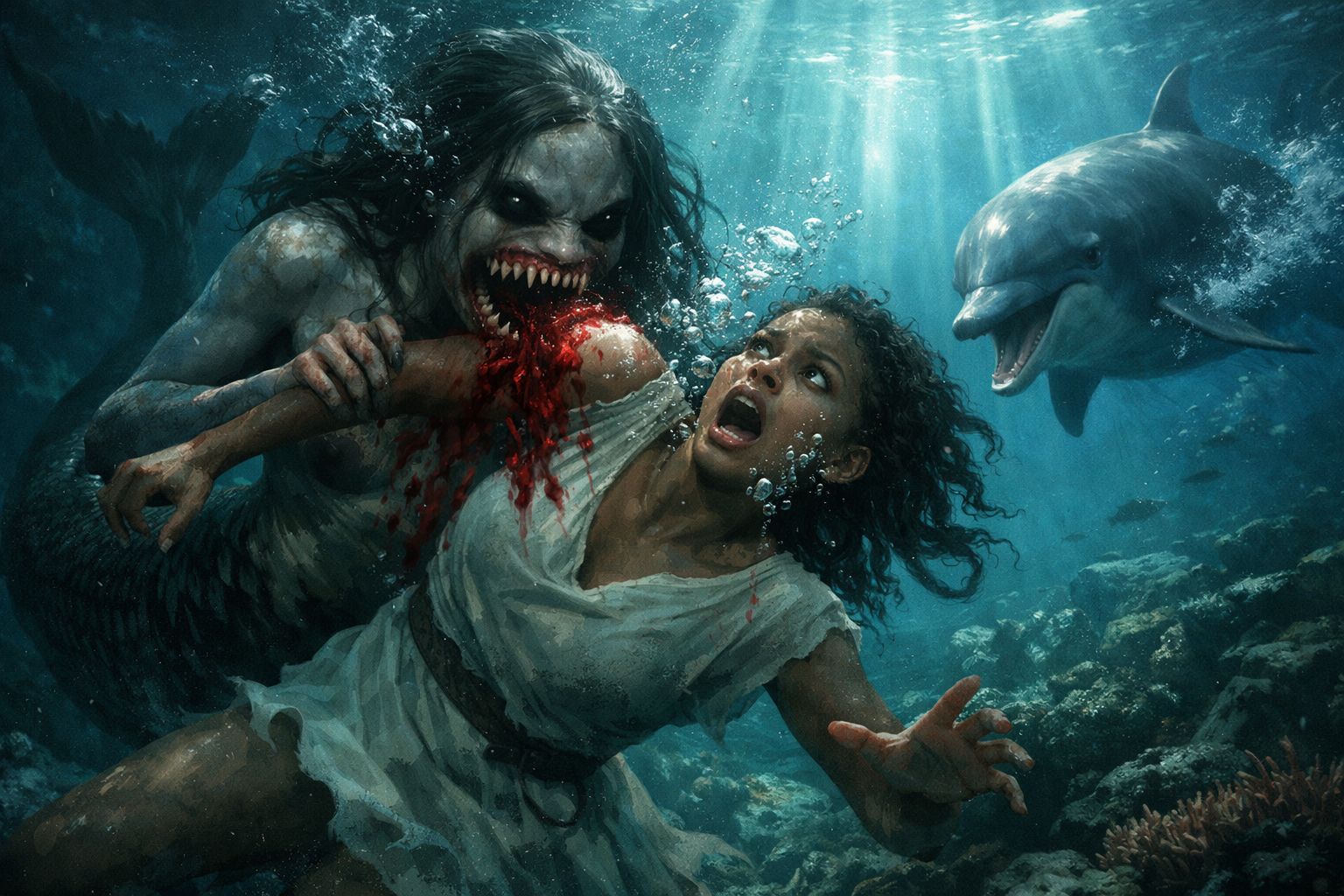
A siren charges from below, fast and direct. There is no hesitation. No warning. Jaws clamp around an arm. Pain is immediate and overwhelming, knocking the air from their lungs as they are dragged downward.
Seconds stretch. Water fills vision. Panic rises.
Then something hits the siren from the side.
A dolphin slams into it hard enough to jar both bodies. The grip loosens. Another impact follows. Then another. More dolphins appear, moving with sudden, brutal coordination. The siren is torn apart in a flurry of motion and blood.
As quickly as they arrived, the dolphins are gone.
The swimmer is left gasping, injured, and dragged or helped back to shore.
Outcome
Junia can treat the injured arm. Flesh can be saved. The injury will heal.
What does not heal is confidence.
From this point on, the water no longer feels safe. Swimming stops. Working in the shallows slows. Repairs take longer as people avoid entering the water unless absolutely necessary.
This is not panic. It is caution learned the hard way.
What the Crew Does Not Know
The dolphins were not chance.
They are dolphin Zveri, assigned by Milena to shadow the Blue Marlin from a distance during the mission. They intervened because they were already watching.
This should not be revealed now.
Let the crew assume luck, or coincidence, or that the sea simply turned in their favor this once.
The feeling you want to leave behind is simple.
The island is beautiful. The water is warm. And it is not safe.
The Shadow on the Horizon
Setup
Repairs are underway. The ship is quiet in the early morning, that particular stillness that comes just before heat settles in. Tools knock softly against wood. Voices are low. The island blocks the rising sun, throwing the beach and the Blue Marlin into shadow.
Visibility is good. Too good.
The Sighting
A sail appears on the horizon.
Long. Low. Moving with confidence rather than haste.
Anyone who has been part of the crew for some time recognizes the silhouette almost immediately. The line of the hull. The way it cuts the water. The spacing of the masts.
It is the Prowler.
For a long moment, it simply passes through the edge of sight, sliding along the horizon like a blade being tested. The rising sun is behind the island. From the Prowler’s perspective, the Blue Marlin vanishes into shadow, hull and rigging broken into the island’s silhouette.
No signal is given. No course correction is made.
The Prowler sails on.
The Question It Leaves Behind
What matters is not that the Prowler passed.
It is that it was close enough to see.
No one can say whether Bloodwake knows the Blue Marlin is nearby. Whether he has heard rumors of a damaged ship in the islands. Whether this was chance, or the edge of a hunt already begun.
The Prowler does not linger. It disappears back over the horizon, swallowed by distance and glare.
That makes it worse.
Outcome
Nothing happens.
Repairs continue. Tools resume their rhythm. Orders are given. Work progresses.
But the tone has changed.
Every sound carries farther. Every sail on the horizon becomes something to watch. The crew understands what it means to be slow in waters where predators move by choice rather than necessity.
This is not an attack. It is a reminder. The sea has not forgotten them.
The Coming Storm
The change comes quietly at first.
Heat fades without ceremony. The air grows heavy, then restless. Clouds pile up inland, dark and tall, blotting out the easy blue of the morning. By the time anyone comments on it, the first drops are already falling, fat and warm, darkening sand and deck alike.
Within minutes, the rain is everywhere. It comes down hard and straight, drumming on planks, turning the beach into wet sand and the shallows into froth. Palms bend and shudder under its weight. Work slows, then stops, as visibility shrinks and tools become slick in hand. For hours it does not let up. Just rain, relentless and loud, washing paradise clean of comfort.
By late afternoon, the downpour eases. The rain thins into a steady drizzle that clings rather than strikes. But the wind takes its place.
It creeps in from the open water, first as a cool breath, then as something sharper. The sea darkens. Waves grow longer, heavier, no longer playful. Whatever calm might have followed the rain does not arrive.
Scarnax watches the horizon from beneath a soaked cloak, jaw tight.
“This isn’t passing weather,” he says. “It’s settling in.”
Pelonias squints up at the clouds, water running from his beard. “A slow turn,” he agrees. “Not a storm yet. Worse. This kind drags its feet.”
Nasheem folds his arms, eyes on the damaged outrigger. “We can ride this if the repairs hold,” he says. “But we won’t outrun it. Not like this.”
Caelin shakes his head slightly. “And if it worsens before we’re done?”
No one answers right away.
The wind answers instead, pushing harder against the hull, tugging at lines that were never meant to feel strain while the ship sat still.
Rain continues to fall. The island feels smaller. The sea feels closer.
Scarnax exhales slowly. “Then the way home won’t be gentle.”
Mood
This is not a storm. It is worse.
The shift from heat to rain to wind should feel natural and inescapable. What was a pleasant, lazy repair stop now feels exposed and uncomfortable. The beach is still beautiful, but it no longer feels kind.
Run this with concern, not urgency. The danger is not sudden. It is persistent.
Immediate Consequences
Heavy rain slows work and forces pauses. Wind adds strain to lines, rigging, and the damaged outrigger. Repairs cannot be rushed, and mistakes made in poor conditions will carry forward. Poor visibility makes it harder to watch for more sirens, increasing the danger of the repair work.
The crew understands that once they leave the island, the journey will be rough. Speed will be limited. Comfort will be minimal. Bad decisions now will compound later.
Nothing breaks yet. But from this point on, the way home will be harder than planned.
The Missing Lumber Team
Setup
Galenor reaches the same conclusion he was hoping to avoid.
Palm wood will not do. It is too soft, too fibrous, and too unreliable for an outrigger that must take strain in bad weather. If the Blue Marlin is to leave safely, he needs proper lumber.
At first light, he sends a small group of NPC crew inland to search the island for suitable trees. They are given clear instructions, tools, and an expected return well before nightfall. This is routine work. Nothing about it feels dangerous.
That is the mistake.
The Delay
By afternoon, the team has not returned.
At first, this is dismissed. Dense growth. Slow cutting. Poor footing. All reasonable explanations.
As the sun begins to lower and there is still no sign of them, Galenor raises the alarm.
Search teams are organized. The island is not huge, but it is thick with jungle, uneven ground, and shallow ravines hidden beneath leaves and shadow.
The Search
Search parties move out, likely led by Ileena, Shaedra, and Milena.
They find no tracks leading away from the island. No signs of violence. No blood. No struggle.
As daylight fades, the teams return empty handed. Only Ileena and Milena refuse to stop, being the ones who can see in low light.
The Return
Near midnight, they come back. With them is the missing lumber team.
One crew member has a badly broken leg, the result of a simple accident while cutting a tree. A misjudged fall. A snapped branch. Nothing dramatic. Nothing malicious.
The rest of the team built a stretcher and waited, unable to move quickly through the jungle with an injured person. With the stretcher, they could not retrace their way back and were forced onto rougher ground, where they eventually became disoriented.
Junia can heal the leg and prevent permanent damage.
Outcome
The repairs can continue.
But the lesson lands heavily.
For hours, key crew were away from the ship. During that time, the Blue Marlin could not have left the beach quickly if danger had appeared. One accident, one twisted step, one broken bone was enough to freeze everyone in place.
Play this event for worry, not fear. Nothing attacked. Nothing hunted them. Nothing went wrong in the dramatic sense. And yet, everyone understands how easily it could have.
Repairs Done, Leaving?
They were ready to leave.
The tide had turned. The repairs were finished. Sails were bent and lines checked in the grey light before dawn. The plan was simple. Push off at first light, catch what wind there was, and put distance between themselves and the island before the weather worsened.
The sea had other ideas.
Over the days of rain and shifting surf, the waves had worked the Blue Marlin deeper into the sand. Not stranded, but held. The hull sat heavy, unmoving, as if the island had decided to keep it.
At first they tried muscle. Lines pulled. Voices called. Feet dug into wet sand. The ship did not move.
Galenor swore softly and changed the plan.
Trees were cut and trimmed into long poles. Pulleys were rigged. Lines were re run and re tied. Everything took longer than it should have. Rain slicked hands. Sand-heavy water filled boots. Shoulders burned. Backs screamed.
The work went on without complaint, because there was nothing else to do.
By the time the hull finally shifted, daylight was already thinning. The Blue Marlin came free in a slow, reluctant lurch, water surging under her as if surprised to have her back. Cheers tried to rise and died halfway. There was no breath left for them.
They cast off with less than an hour of light remaining.
Everyone was soaked. Clothes clung heavy and cold. Hands shook from exhaustion. Every movement felt borrowed from tomorrow. The rain never stopped, not for a moment, turning deck and rigging into a constant hazard.
As the island slid back into the rain and shadow, there was no sense of escape. Only motion.
The Blue Marlin was afloat again. The way home had begun, and it began tired.
Emotional Focus
This is not a logistical problem. It is an emotional grind.
Run this as a slow sink in mood. Hope drains first, not strength. Muscles ache. Tempers shorten. Small irritations flare and then die because no one has energy left to argue. The ship does not move, and with each failed pull it feels less like a delay and more like being stuck.
Let the crew feel that heaviness. Let the thought of not getting free linger longer than it should.
The Release
When the Blue Marlin finally shifts, the release is immediate but muted.
There is no real celebration. Relief comes first, then collapse. People laugh once, stop halfway, and lean on whatever is closest. Hands shake. Legs tremble. The ship is free, but no one feels victorious.
Aftermath
The next day, the cost is everywhere.
Muscles are sore. Sleep was poor. Everyone is tired and irritable. Small tasks feel heavier than they should. Patience is thin.
The ship is moving again, but the crew carries the effort with them. This is exhaustion made tangible.
Events While Sailing
Encounter with Prowler
The Prowler does not announce itself.
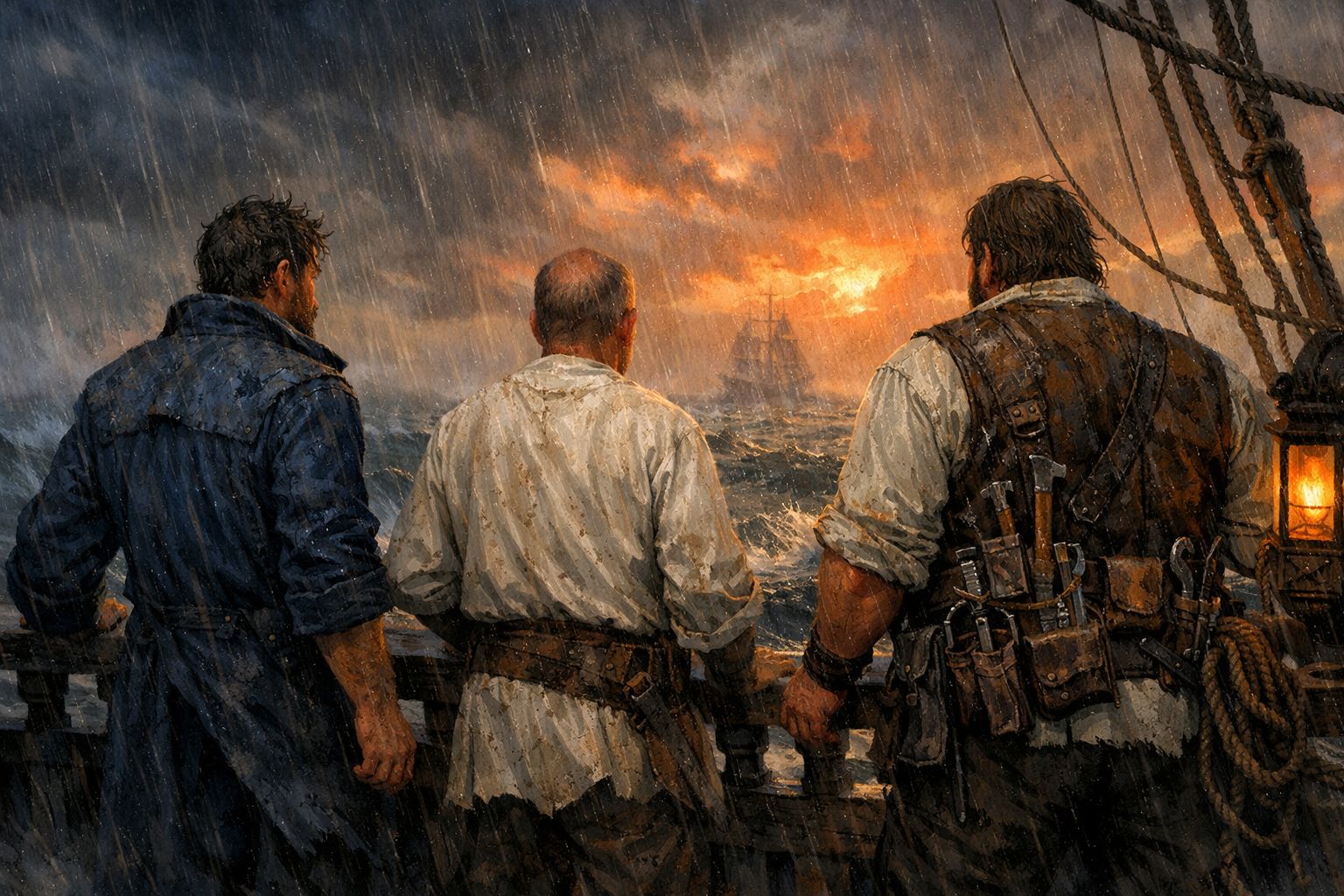
It simply emerges between sheets of rain, a dark line against darker water, sails reefed but steady, holding position with a patience that feels deliberate. The sea is rough enough that no ship should be lingering here without purpose. That alone is enough.
Someone spots it first. Then everyone does.
It keeps its distance, far enough that details blur, close enough that there is no doubt. The angle changes subtly over time. A degree here. A correction there. When the Blue Marlin shifts course, the Prowler answers minutes later, never hurried, never careless.
Then a squall rolls through and the ship vanishes.
Hope flares. Brief. Unwelcome.
An hour later it is back, cutting across a gap in the rain, exactly where it needs to be to remind them it never truly left.
On the quarterdeck, Scarnax grips the rail hard enough that his knuckles pale.
“He knows,” he says quietly. “He knows we’re hurt.”
Pelonias wipes rain from his face and squints toward the horizon. “He’s not pressing,” he says. “That’s the worrying part.”
Galenor shakes his head. “He doesn’t need to,” he replies. “Not yet. He’s waiting for the sea to calm. Once it does, we won’t have the speed to break away.”
Pelonias folds his arms, eyes never leaving the distant silhouette. “If we turn for shallows, we risk reefs in this weather. If we keep open water, he keeps us in sight. Either way, we’re reacting to him.”
Another curtain of rain sweeps through, swallowing the Prowler again.
No one speaks.
Seconds stretch. Then minutes.
When it does not reappear immediately, tension coils tighter rather than loosening. Every glance to the horizon carries the same unspoken question.
Is this the time it stays gone. Or the time it comes closer.
“He’s measuring us,” Pelonias says finally. “Watching how we handle stress. How tight we keep our lines. How tired we are.”
Scarnax exhales slowly. “Options?”
Galenor does not look at him. “None I like. We can try to limp for islands and hope terrain buys us something. We can keep steady and pray the weather holds. Or we can push the ship harder than she should be pushed and risk breaking what we just fixed.”
Pelonias nods once. “Every choice costs something.”
"Prowler is built for a fight," Nasheem points out. "We are built for speed."
"Except that we don't have speed now," Pelonias responds.
The Prowler slips back into view, closer this time. Not enough to act. Enough to be seen.
Scarnax straightens. “Then we keep moving,” he says. “No heroics. No panic. We don’t give him the moment he’s waiting for.”
Rain lashes the deck. The wind howls through rigging that creaks under strain.
Out there, somewhere beyond the curtain of weather, Vexar Bloodwake waits.
The Blue Marlin sails on, no longer hunter, no longer confident. Only moving.
Purpose
This encounter is about pressure, not combat.
The Prowler is not here to fight yet. It is here to test, observe, and remind the crew that their usual advantage is gone. The goal is to shift the crew’s mindset from confidence to vigilance.
How to Play It
The Prowler appears at long range, then vanishes behind weather, then reappears hours later. It never closes enough to force action. It always positions itself intelligently.
Emphasize patience. Bloodwake is waiting for conditions to improve, not forcing a mistake. Each disappearance should raise hope. Each return should make that hope feel foolish.
Tactical Reality
Make it clear that options are limited and risky.
Speed is unreliable. Shallows are dangerous in this weather. Open water keeps them visible. Pushing the ship risks damage. Conservatism risks being boxed in.
There is no correct answer. Every choice costs something.
Outcome
There is no resolution here.
The Prowler eventually fades from sight again, leaving the crew uncertain whether it is gone or simply waiting. The encounter should end with tension intact, not released.
The crew should come away with one clear understanding.
They are being hunted, and only circumstance is delaying the strike.
The Prowler Pounces
The rain thins just enough to show them the trap.
The Blue Marlin slips into a narrow strait between two low islands, white sand close on either side, palms clawing at the wind. The channel feels tight even before the sea ahead gives itself away. A long white line of breaking water stretches across the mouth of the passage. Foam. Repeated impact. The unmistakable signature of a reef binding the islands together.
Ahead is shallow water and risk.
Behind them, the sea opens.
And then the Prowler is there.
It comes out of the rain almost directly astern, closer than before, sails full, hull steady. Not rushing. Not hesitating. Exactly where it needs to be. Whoever is at its helm understood this place. Understood the timing. Understood that the Blue Marlin would have to choose. This is familiar hunting grounds for the Prowler.
On the quarterdeck, voices rise over wind and rigging.
Pelonias is already looking ahead. “That reef is not on our charts,” he says. “Could be a shelf. Could be teeth. We might skim it. We might tear ourselves open.”
Nasheem glances back at the Prowler, then forward again. “If we turn and fight,” he says, “we lose people. A lot of them. We are not a war ship. They are.”
Amaxia nods once. “They are built to board and kill. We don't have the crew or the hull to match them.”
Galenor crouches by the rail, eyes on the water ahead. “If we hit the reef,” he says slowly, “the hull will probably hold. Probably. But the leeward outrigger will be deep with full sail. If it strikes, it may not survive.”
“And if it goes,” Pelonias adds, “we won’t be fast anymore. At least not until we can repair in a proper shipyard, and that seems far now.”
Amaxia’s voice stays flat. “If we ground on the reef, at least they cannot ram us. Maybe they cannot even get close enough for arrows.”
Nasheem looks at her. “We would still be stuck.”
The Prowler closes a little more. Not enough to strike. Enough to make the space behind them feel smaller.
Scarnax steps forward, rain running off his cloak, eyes moving from reef to pirate ship and back again.
“Fight,” he says. “Or chance the reef.”
He lets the words hang.
The channel narrows. The surf ahead grows louder. The Prowler waits, patient as a blade held just out of reach.
Scarnax turns back to the helm.
“It’s time to decide.”
Mood
This moment should feel tight, heavy, and unavoidable.
The crew understands that this is not a clever puzzle with a correct solution. It is a narrowing corridor where every option costs something important. The pressure comes from time, geography, and exhaustion, not from shouted threats or sudden violence.
Emphasize that Bloodwake has engineered this situation. The reef, the weather, and the damaged ship have all aligned in his favor. The crew is not panicking, but they are out of comfortable answers.
Let the silence before the decision stretch.
Presenting the Choice
Make it clear that there are two viable options, and neither is safe.
Do not frame either choice as a trick or punishment. Both are logical. Both are costly. The tension comes from deciding which loss they can live with.
Option One: Run the Reef
This is the sensible option.
If the crew commits to the reef, set the drama in the execution. Orders shouted over surf. Sails trimmed hard. The sound of breaking water growing louder. The sense that once they commit, there is no pulling back.
Describe the ship lifting as speed increases, then the scrape. Not a single impact, but a grinding vibration through the hull. Everyone feels it. Everyone waits for the sound of tearing that does not quite come.
Someone cheers in relief "Scrape good, thud bad!".
They clear the reef.
Behind them, the Prowler slows. It cannot follow. It turns away, forced to go the long way around, and the immediate threat recedes.
The cost comes afterward.
The hull has taken damage. Not catastrophic, but enough that water seeps in constantly. From this point on, someone must always be pumping. Watches grow longer. Sleep grows shorter. Fatigue compounds. The ship is alive, but wounded, and it will demand attention for the rest of the voyage.
This option preserves the Blue Marlin, but grinds the crew down further. Use exhaustion, irritation, and slow attrition to carry the consequence forward.
Option Two: Turn and Fight
This is the desperate option.
Make sure the crew understands the reality before they choose. The Prowler is built to ram. When it hits, the hull will be pierced and the ships will lock together. This is not a duel. It is a boarding slaughter.
When combat begins, focus on chaos rather than tactics. Screams, smoke, bodies, and confusion. The experienced core crew of the Blue Marlin should be targeted sparingly. Most casualties should be sailors and deckhands. The goal is not to kill player characters, but to make it clear that staying means death.
They will not win the fight.
However, chaos creates opportunity. In the confusion, the crew can abandon ship and reach the islands. Swimming under cover of rain and wreckage. Slipping away while Bloodwake’s crew focuses on securing their prize.
If they escape, the Blue Marlin is lost.
The aftermath is survival mode. No ship. Limited supplies. The need to build shelter, a raft, or steal passage. They will eventually find another ship, but it will not be the Blue Marlin. That loss should linger. This option trades long term capability for immediate survival.
Aftermath and Tone
Whichever choice is made, do not soften the outcome.
Running saves the ship but deepens exhaustion and risk.
Fighting preserves lives but costs their greatest asset.
Let the crew feel that Bloodwake forced this decision, even though he never spoke a word. The Prowler may withdraw or vanish afterward, but its mark remains.
This is a turning point. From here on, the journey home is shaped by what they chose to sacrifice. This is not a game, they are playing for keeps.
Blown Away
The storm does not arrive. It closes its fist.
Rain thickens until the world beyond the bow ceases to exist. Wind howls across the deck in a single sustained force, shoving the Blue Marlin sideways as often as forward. Waves rise without rhythm, striking from angles no navigator would choose, lifting the ship and dropping it again with bone jarring violence.
Scarnax braces at the helm, boots skidding on soaked planks.
“Hold her. Hold her,” he shouts, more to himself than anyone else.
The wheel fights back. Every correction costs effort. This is no longer steering. It is endurance.
Pelonias clings to the rail, eyes narrowed against rain that feels like thrown gravel.
“Leeward strain rising,” he calls. “Ease the forward sail. Ease it now.”
Caelin is already moving.
“Ease forward. Ease forward,” she yells, hauling on a line with two others as the wind snaps it taut. “Keep it steady. Don’t dump it.”
A wave slams into the hull hard enough to stagger everyone on deck.
“Brace,” Scarnax roars. “Brace for it.”
The Blue Marlin shudders, outriggers biting deep into water they were never meant to meet like this. Wood groans. Rigging screams. Somewhere below, something loose crashes and rolls.
Pelonias wipes water from his face. “We’re drifting,” he shouts. “Nothing we can do about it. Just keep her alive.”
Caelin nods once, soaked through, hands moving by memory rather than feeling.
“Pumps manned,” she calls. “All hands rotate. Don’t stop.”
The storm gives no answer. It simply presses harder.
Nothing breaks. Not yet.
But everyone aboard understands the truth of it. This storm does not care what the ship was built to do.

Purpose and Tone
This storm is not an encounter to win. It is an ordeal to endure.
Run it as prolonged pressure rather than a single dramatic spike. The danger does not come from one catastrophic moment, but from everything demanding attention at once. The crew is already exhausted. The sea takes advantage of that.
The core feeling should be overwhelm. Too many problems. Too little time. No clean priorities.
Running the Storm
Frame the storm as a sequence of overlapping demands.
Hatches come loose and must be secured before water pours below. Pumps need to be manned constantly as leaks worsen. Cargo shifts and has to be lashed down again. Lines chafe and threaten to part. A sail tears and must be cut free or replaced under brutal conditions. Someone slips, is thrown, or gets caught by a snapping rope and is injured. Nothing is fatal on its own. Together, it is crushing.
Do not present these as optional tasks. Make it clear that if one thing is ignored, it makes everything else worse.
Let different crew members call for attention at the same time. Let players choose where to go and what to trust others to handle. Even correct decisions should feel like compromises.
This is not about precision. It is about survival through effort.
Stakes Without Punishment
The goal is not to cripple the ship or kill the crew, even if it feels like that in the moment.
Damage should be real but limited. Broken fittings. Torn canvas. Leaks that can be managed. Injuries that hurt but do not remove characters from play permanently.
What matters is fatigue. By the end of the storm, everyone should be wrung out. Tempers short. Hands shaking. Decisions slower. Wet and cold.
Make it clear that the sea does not need to destroy them to assert dominance. It only needs to exhaust them.
The Storm Breaks
When the weather finally eases, do not make it dramatic. The wind drops first. Then the rain thins. Waves shorten. The ship stops fighting every second.
They are alive. The ship still floats. Repairs will be needed, but nothing is beyond fixing. For the moment, they are safe.
Let that relief land.
The Hidden Cost
Then introduce the real problem.
During the storm, they lost their bearings. No stars. No horizon. No landmarks. Instruments were useless or unreadable. When the sky clears, all they see is open water.
They do not know where they are.
They cannot tell if they were blown east or west of the island chain. They have to choose a direction and commit to it.
Here, quietly decide that whichever direction they choose is correct. Do not signal this. Let uncertainty sit with them. The point is not to get lost, but to feel lost.
One Mercy
Make one thing clear.
The Prowler is gone. No ship could have followed through that storm. Bloodwake has lost their trail, at least for now. They paid for that escape in exhaustion and uncertainty, but it bought them distance.
End the storm with that balance.
The sea asserted its rule. They survived on its terms.
The sea finally lies down. Not calm, not friendly, but no longer actively hostile. Long swells roll under the hull instead of crashing into it, and the wind has dropped to something that can be worked with rather than fought. The Blue Marlin creaks as she settles into this new rhythm, every sound now suspect, every groan examined for meaning.
Scarnax stands at the rail with Galenor and Pelonias, all three of them soaked, hollow eyed, and running on whatever was left after the storm took its share. No one speaks at first. They listen to the ship.
Galenor breaks the silence eventually, rubbing at his shoulder and staring down the length of the damaged outrigger. “She held,” he says. There is relief in the words, but no pride. “We’ve got leaks to mind and canvas to replace, but nothing fatal. Not today. If we treat her gently, she’ll carry us.”
Scarnax nods once. “And if we don’t.”
Galenor snorts softly. “Then she’ll remind us why that’s a bad idea.”
Pelonias has the compass out, turning it slowly in his hands, watching the needle settle and resettle. He squints at the horizon, then back at the instrument, then out again, as if the sea might flinch and reveal something useful if stared at hard enough. “I know where east is,” he says at last. “And west. That much is certain. But I don’t know where the islands are relative to us. The storm scrambled everything. We could be on the east side of the chain. Or we could already be past it to the west.”
“And if we guess wrong,” Scarnax says.
Pelonias shrugs, a tired motion. “Then we sail longer than we wanted. Or we sail into something we didn’t plan for. Either way, we commit.”
Galenor looks back at the ship, at the crew moving slowly across the deck, every step careful, every motion measured. “She can make it,” he says again, more quietly. “But she needs a decision. Drifting won’t do.”
Scarnax breathes out, slow and steady, then straightens. The storm has passed, but the weight it left behind has not.
“Then we choose,” he says. “East or west. And we live with it.”
Spoiled & Rotten
Yasmira waits until Scarnax is alone before she brings it up.
She stands beside him near the hatch, ledger tucked under one arm, hair still damp and clinging to her neck. She does not rush. She does not soften it either. When she speaks, it is quiet and precise, the tone of someone who has already checked the numbers twice and wishes they were wrong.
“We have a problem,” she says.
Scarnax turns, already bracing himself. After the storm, everything feels like it might be another problem layered on top of the last. “Tell me.”
She opens the ledger, but does not really look at it. “Most of our stores were flooded. The lower holds took more water than we thought. Barrels shifted. Lids cracked. Sea water got in.”
She pauses, letting that settle before continuing.
“Grain is ruined. Dried meat is soaked through. Anything packed in cloth or leather is lost. What survived is what was high enough or sealed well enough, and that is not much.”
Scarnax exhales slowly. “How long.”
“A couple of days,” Yasmira answers. “Three, if we stretch it and people don’t complain. Less if we keep everyone working hard.”
“And water.”
She nods. “Some loss there too. Not catastrophic, but we cannot afford waste.”
For a moment, the only sound is the ship moving under them, slower now, careful, as if aware of its own fragility.
Scarnax rubs at his face. “So on top of damage, fatigue, and not knowing where we are, we’re also running out of food.”
“Yes,” Yasmira says evenly. “I wanted you to hear it from me first.”
He looks out across the open sea. Empty horizon. No sails. No islands. Just water and sky and the weight of choices stacking up.
“We’ll have to resupply,” he says.
Yasmira closes the ledger. “We will. I just wanted you to understand that it’s no longer optional.”
She waits a heartbeat longer, then adds, not accusing, just factual, “Every hour matters now.”
Scarnax nods once. There is no argument to be had. Another problem joins the list, not loud, not dramatic, but heavy all the same.
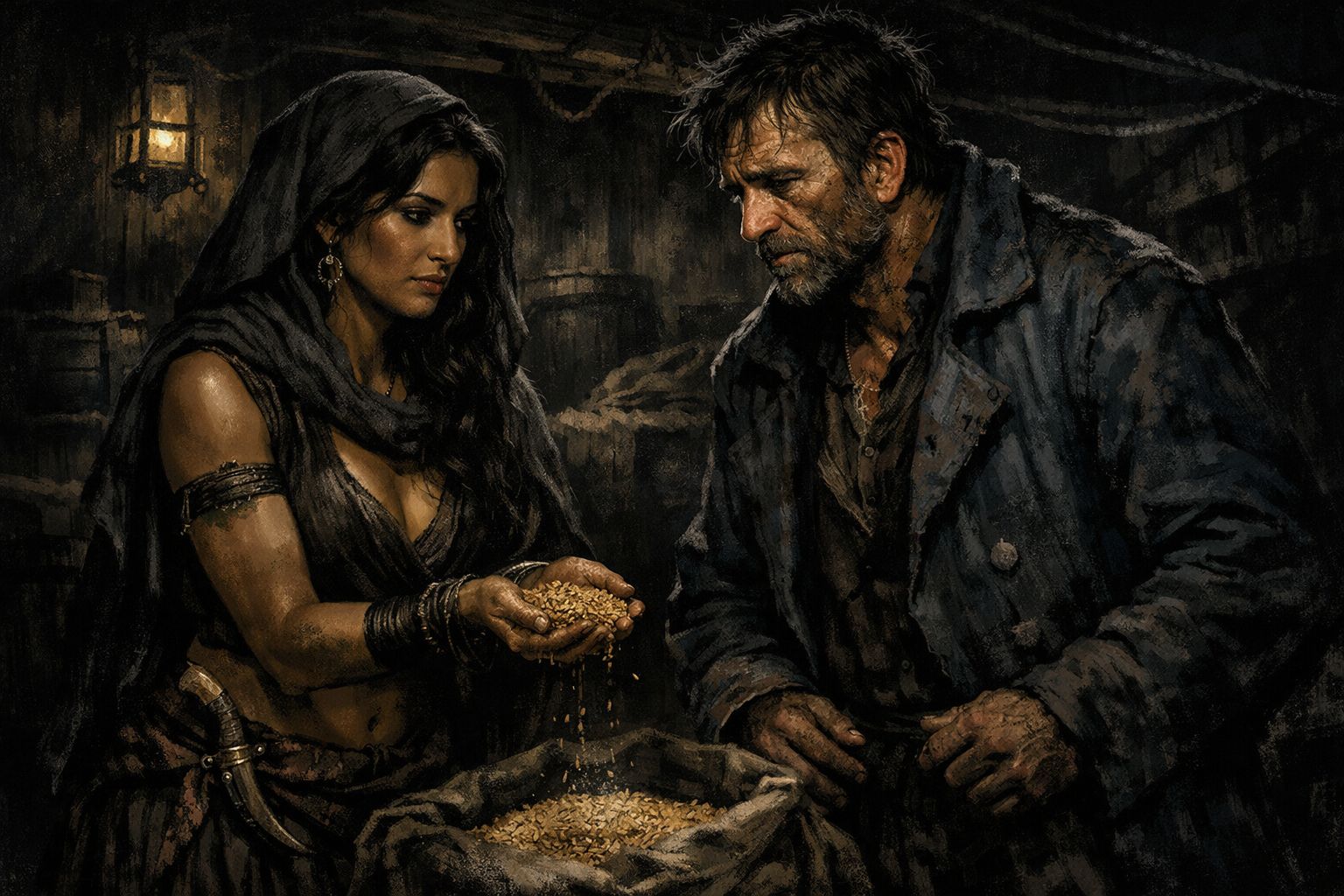
Purpose
This event exists to add pressure, not panic.
It turns existing problems into time-sensitive ones and removes the option of simply enduring at sea. The crew can no longer afford delay, hesitation, or extended detours.
How to Use It
From this point on, food and water are a visible clock. Rations can be stretched briefly, but morale and strength will suffer quickly. Every decision now has an added layer: how long it takes.
Yasmira’s cooking has been one of the quiet things holding spirits together. Now she is working with what can be salvaged. Meals are edible, but joyless. Portions are smaller. The smell of the galley no longer lifts anyone’s mood.
Let that loss be felt in small ways. Fewer jokes. More silence at meals.
Effect on the Journey
Resupplying is no longer optional.
Whether through landfall, trade, theft, or risk, the crew must address this need soon. Combined with fatigue, damage, and uncertainty of position, this pushes the journey from difficult into unsustainable if ignored.
Use this to force some action from the crew. It is another problem in a growing stack, and it is not the last.
Safe Harbor
Relief spreads across the deck the moment land reappears.
Low shapes rise from the sea as the sun sinks toward the horizon, dark against the fading light. Islands. Real ones. Not imagined, not hoped for. Someone laughs, short and surprised, and the sound ripples outward, catching before it can grow too loud. Shoulders loosen. A few people simply sit where they stand and stare.
The Blue Marlin slows as evening deepens. No one wants to thread unknown channels in failing light, not after the storm, not with a wounded hull and tired hands. Sails are eased. The ship drifts cautiously, keeping open water beneath her keel.
Then darkness settles, and with it, a single point of light appears.
A beacon burns on one of the nearer islands. Steady, human. Not a signal flare, not a trick of lightning, just a light meant to be seen.
A small knot of people gathers near the rail.
“Probably a fishing village,” Scarnax says, watching it without moving. “These waters aren’t empty.”
Nasheem shakes his head slightly. “Probably,” he agrees. “But we don’t know that.”
Pelonias squints toward the shore. “It’s placed like one,” he says. “High enough to mark the coast. Low enough to guide boats in. That argues for locals, not pirates.”
“And if it isn’t,” Yasmira asks quietly.
Galenor answers without looking away from the water. “Then we’ll find out in the morning. Either way, we can’t push on without supplies. And we shouldn’t move in the dark.”
Silence settles again, thoughtful rather than tense.
Scarnax nods once. “We anchor here,” he says. “At dawn, we go in.”
No one argues.
The anchor drops with a splash. Lines are secured. Watches are set. The beacon burns on through the night, steady and indifferent, while the Blue Marlin rests at the edge of unknown shores, waiting for morning.
Mood and Setup
Run the approach with cautious optimism.
The storm has passed, the morning is clear, and the sea is calm enough to feel almost forgiving. The crew is exhausted, sore, and irritable, but spirits are noticeably higher than they have been in days. Land is real. Supplies are within reach. For a moment, it feels like the worst may be behind them.
Lean into that contrast. This scene works because hope precedes the trap.
First Impressions
As the Blue Marlin draws closer, the island resolves into a horse shoe shaped atoll, rocky along most of its rim, with a wide inlet opening into a protected lagoon. The interior water looks calm and deep enough for safe anchorage. On the far side, a strip of white sand curves along the inner shore, and a few small boats lie pulled up above the tide line. Fishing skiffs, work boats, nothing threatening at a glance.
This should read as plausible refuge, not obvious danger.
The Trap Springs
Once the Blue Marlin reaches the center of the lagoon, something changes.
A heavy chain rises out of the water at the mouth of the inlet, hauled up by unseen hands. It locks into place with a metallic finality, blocking the exit completely.
Give the crew just enough time to understand what that means.
Then the arrows come.
They fall in scattered volleys, inaccurate but persistent, shot from high ground along the rocky rim of the atoll. The range is long, near the limit of effective fire, but volume compensates for precision. A few sailors still aloft in the rigging are clipped, not badly, but enough to force risky rescues under fire as others scramble to get them down.
Emphasize that this is harassment fire, not a killing blow. The danger comes from exposure and attrition, not from immediate lethality.
The Standoff
Once the crew takes cover, the attack settles into a pattern.
Any attempt to peek over the rail draws another volley. Any obvious movement brings arrows splashing into the water or thudding into wood. The attackers do not advance. They cannot. Their small boats are not suited to boarding a ship the size of the Blue Marlin, especially against a prepared crew.
The result is a deadlock.
The pirates rely on distance, patience, and panic. They expect fear, injury, and eventually surrender or reckless action. They expected a smaller vessel. The size of the Blue Marlin limits what they can safely attempt.
Let this stretch. Let time pass. Let frustration build as the players test ideas and find most of them blocked.
Applying Pressure
If the players hesitate too long or become stuck, escalate slowly. First, increase the accuracy of the arrow fire slightly, suggesting the attackers are adjusting. Make it clear that staying aboard will eventually become worse than acting.
Intervention From the Sea
If the players have no workable plan after a long stretch of stalemate, introduce outside pressure in their favor.
The dolphin Zveri have followed the ship from a distance under orders not to reveal themselves unless absolutely necessary. They now act.
They land on the outer side of the atoll, unseen from the lagoon, move quickly and quietly along the rocks, and strike one group of archers from behind. The attack is fast and final. Bodies fall. Then the dolphins are gone again, leaving no explanation.
Do not announce this directly.
Instead, let the players notice that arrows now only come from one side of the lagoon.
Breaking the Deadlock
With fire reduced to a single direction, a path opens.
If the players don't take this chance, introduce fire arrows. Not many. Enough to splash near the hull, enough to force the realization that waiting indefinitely is not an option.
Swimming to shore on the silent side becomes viable. From there, the crew can move around the inner curve of the atoll and approach the remaining attackers from behind or the flank.
Encourage mixed approaches.
Stealth oriented characters can thin the pirates quietly, using terrain and confusion. Direct fighters can engage once positions are compromised. The pirates are numerous enough to be dangerous if rushed blindly, but they are not disciplined soldiers. Once their advantage of distance is gone, they break quickly.
The Shore Pirates
These attackers are wreckers, shore pirates who lure ships into traps and bleed them from a distance. They rely on fear, confusion, and attrition rather than close combat skill.
They are not cowards, but they are not hardened boarders either. Once pressed into direct fighting, they falter, scatter, attempt to flee or, if necessary, surrender.
Run the confrontation as a problem to solve, not a straight battle. Smart movement, timing, and coordination should matter more than brute force.
For a moment, no one quite believes it.
Another arrow should come, everyone expects it. Eyes stay fixed on the rocks, bodies tense, waiting for the familiar hiss and splash. Instead, there is only wind and the gentle slap of water against the hull.
Amaxia is the first to say it out loud. “They’ve gone quiet on the left.”
Mbaru leans out just enough to confirm it, then pulls back. “Right side still firing,” he says. “Same pattern, same range.”
That alone changes the shape of the problem.
“It’s still a long swim,” Skarnulf growls, peering toward the distant strip of sand. “Open water. Under fire the whole way.”
“Not the whole way,” Amaxia replies. “Only from one side now.”
Mbaru nods, already loosening his gear. “We can make it. Fast. Draw their attention. Once someone is on the rocks, the rest follows.”
Shaedra shakes her head. “Or they adjust. Or they rush the beach. Or someone takes an arrow halfway there and drowns.”
Nasheem folds his arms, eyes never leaving the shoreline. “We don’t know what changed. I don’t like acting before we understand why. It could be a trap.”
Milena says nothing at first. Her gaze is distant, thoughtful, tracking angles and distances. “Whatever happened,” she finally says, “it bought us an opening. Openings don’t stay open.”
The argument circles, tension rising but never quite tipping into shouting. Risks are weighed. Distances judged again and again. No option looks clean.
Then Ileena sighs.
It is a soft, bored sound, completely out of place.
“Oh, this is taking too long,” she says, more to herself than anyone else.
Before anyone can stop her, she climbs onto the rail and dives.
No warning. No flourish. Just a smooth, casual arc into the water, vanishing beneath the surface with barely a splash.
For half a heartbeat, the deck is frozen.
Skarnulf blinks. Shaedra swears under her breath. Nasheem lets out a sharp laugh he immediately tries to suppress. Milena mutters something, and the corner of her mouth twitches despite herself.
Amaxia looks at Mbaru. Mbaru shrugs. “Well,” he says, already moving, “guess we’re doing this.”
One by one, they follow.
Armor is shed. Weapons are gripped tight. Bodies slip over the side and into the water, some graceful, some less so, all committed now that the first leap has been taken.
Resolution and Aftermath
This phase exists to let the tension finally bleed out and to give the crew a sense that, for the first time in a long while, they are no longer reacting. They have survived the trap, broken the deadlock, and seized control of the situation. The danger is not gone, but it has been pushed back enough to allow choice again.
Run this as a decompression. Let the crew breathe, take stock, and feel the difference between desperation and stability.
Dealing With the Shore Pirates
If any of the shore pirates are captured or surrender, the question of their fate becomes unavoidable.
By maritime law, piracy is a hanging offense. There is no ambiguity here. No trial will be held. No authority will come to claim them. The law of the sea is clear, and it places responsibility directly on the crew.
It is entirely up to the crew how they handle this. They may carry out the sentence. They may choose mercy. They may abandon the pirates on the island with supplies. Each option has implications, but none are enforced by the world in this moment. The important thing is that the decision is acknowledged as theirs.
Do not editorialize. Present the fact, then step back and let the table decide what kind of crew they are willing to be.
Securing the Atoll
Once control of the island is established, practical advantages quickly become apparent.
The pirates’ supplies are intact and sufficient to restock the Blue Marlin. Food, fresh water, rope, canvas, and basic tools are all available. This immediately removes the most pressing survival clock.
The lagoon itself is defensible. If the chain across the inlet is left in place, no ship can enter without announcing itself well in advance. The atoll becomes a natural refuge rather than a trap.
The island is also suitable for another round of improvised repairs. Galenor and Nera can shore up damage properly, replace strained fittings, and reinforce weak points without the pressure of immediate departure. Nothing elegant, but enough to make the ship reliable again.
Rest and Recovery
For the first time since the storm, the crew can truly rest.
They remain on the island for several days, possibly close to a week. Work is done at a sustainable pace. Watches are light. Sleep is deep and uninterrupted. Junia treats lingering injuries properly. Bruises fade. Cuts close. Muscles recover slowly, painfully, but steadily.
The weather shifts again. Sun returns. The sea calms. The atoll becomes what it first pretended to be, a tropical paradise of warm water, white sand, and easy days.
Morale improves in quiet ways. Better meals. Laughter returning in small bursts. The simple luxury of not always being one crisis behind.
Tone and Transition
This is not a victory lap. It is a hard won pause.
Make it clear that things are finally going well again, but without erasing what came before. The crew is more tired than they realize. The ship is more fragile than it looks. Choices made along the way still matter.
When they eventually leave the atoll, they do so rested, supplied, and repaired enough to continue. Not untouched, not unchanged, but functional again.
End this phase on that note.
They are no longer trapped.
They are not safe forever.
But for now, they have earned solid ground beneath their feet and a few days where the world does not immediately demand blood.
The Silence of the Sirens
Cassandra has found a quiet spot along the rail, half leaning out over the water, eyes closed, face turned toward the sun. The sea is clear here, shallow enough that light reaches down in pale bands. For the first time in days, nothing hurts. Nothing demands her attention.
Something pale drifts into view below.
At first her mind refuses to place it. Just a shape, rolling slowly in the gentle swell. Then an arm turns. Hair fans out. The suggestion of a face flashes up through the water.
Cassandra inhales sharply and the sound catches halfway out of her throat. It comes out as a choked scream, short and raw.
Ormun is there instantly, crossing the deck in two strides, one hand already on her shoulder, the other hand raised as if to shield her from whatever she is seeing. Nasheem arrives a heartbeat later, scanning out of habit, then following Cassandra’s pointing hand down toward the water.
“It’s all right,” Ormun says, low and steady, turning Cassandra away from the rail just enough that she no longer has to look. “Breathe. I’ve got you.”
Nasheem leans over the side, squinting.
From a distance, the body might pass for human. Closer, the lie falls apart. The tail is wrong, too thick, the skin dull and rough. The face, when it turns, is frozen in something that is not fear so much as surprise, showing an impossible set of sharp teeth. The wounds are unmistakable. Deep rents torn across torso and flank, not cut, not bitten cleanly, but ripped apart by repeated force.
“This isn’t a person,” Nasheem says quietly. “It’s a siren.”
He watches as the current nudges the body past the hull, carrying it on without ceremony. Whatever killed it did not care to finish the work neatly.
Nasheem straightens and turns, his voice carrying across the deck.
“Everyone clear of the water,” he says. “No swimming. No dangling lines. Nothing over the side.”
The crew reacts immediately. Hands pull back. Movement tightens. The easy mood that had settled with the sun thins and fades.
Cassandra, still held by Ormun, looks back once more toward the empty water where the body vanished.
“What,” she asks softly, “could have done that to a siren.”
Purpose of the Scene
This scene exists to undermine the sense of safety around the water and to reassert that the sea remains dangerous even when nothing is actively attacking the crew.
It should not escalate into action. It should settle like a cold weight instead, making people think twice before swimming, wading, or working over the side. Placing it during the repair period reinforces that nowhere is truly safe, not even during rest.
When to Use It
Run this during daylight, while the ship is at the pirate island and repairs are ongoing. The contrast matters. Sun, calm water, routine work, and then sudden unease.
It works best when morale has begun to recover and vigilance has dipped slightly.
What the Crew Learns
From the crew’s perspective, this is a warning without an explanation.
They see a dead siren, clearly killed by something stronger, faster, and more violent than it was. They do not learn what did it. They are left with implications, not answers.
The important takeaway is simple. The water is not empty, and it is not neutral.
After this point, crew members should avoid the water unless absolutely necessary. Repairs that require entering the shallows slow down. Lines are handled more carefully. No one lingers at the rail without reason.
What the Crew Does Not Learn
The siren was killed by the dolphin Zveri.
Sirens are predators and a direct threat to them. The attack was deliberate, efficient, and overwhelming. Leaving the body to drift past the ship was not an accident. It was a warning.
Do not reveal this.
Let the crew attribute the death to something unknown and frightening rather than something protective. The dolphins’ role is to guard without reassurance, to keep the crew alive without making them feel watched over.
Tone and Follow Up
Do not answer Cassandra’s question in this scene.
Let it linger.
The right emotional result is not panic, but caution. The crew should feel that even allies in these waters are capable of violence beyond what they understand, and that survival often comes from forces acting unseen.
This reinforces a core theme of the journey. The sea does not care about intention. It only cares about who is stronger, faster, and more prepared.
The Shipwrecked Sailor
Purpose of the Event
This event exists to remind the crew that danger does not always announce itself, and that mercy without scrutiny can be lethal. It tests judgment rather than strength and reinforces that not every threat comes from monsters, pirates, or storms.
Run this quietly. The horror here should emerge through implication and discovery, not confrontation.
The Island
The island is barely more than a rise of rock and scrub, ringed by pale sand and shallow water. It would be easy to miss entirely if the crew were not already sailing cautiously.
A wreck lies half hauled onto the beach. The hull is broken open, ribs exposed, canvas shredded and stiff with salt. It has been here for some time. Long enough for weather and scavengers to do their work.
As the Blue Marlin passes close, a figure runs out from behind the wreck, waving frantically.
The Survivor
The man is thin, sun burned, and ragged. His clothes hang off him in stiff, salt crusted layers. His beard is wild. His eyes are bright in a way that does not quite match relief.
He begs to be taken aboard. He says his ship wrecked months, maybe years ago. He says he has been alone since. He says he will do anything for passage.
He avoids details.
If asked about the wreck, he gives vague answers about a storm. If asked about the crew, he says they died. He does not linger on how. He does not seem interested in the island itself, only in leaving it.
If the crew agrees to take him aboard, he insists on gathering his belongings first.
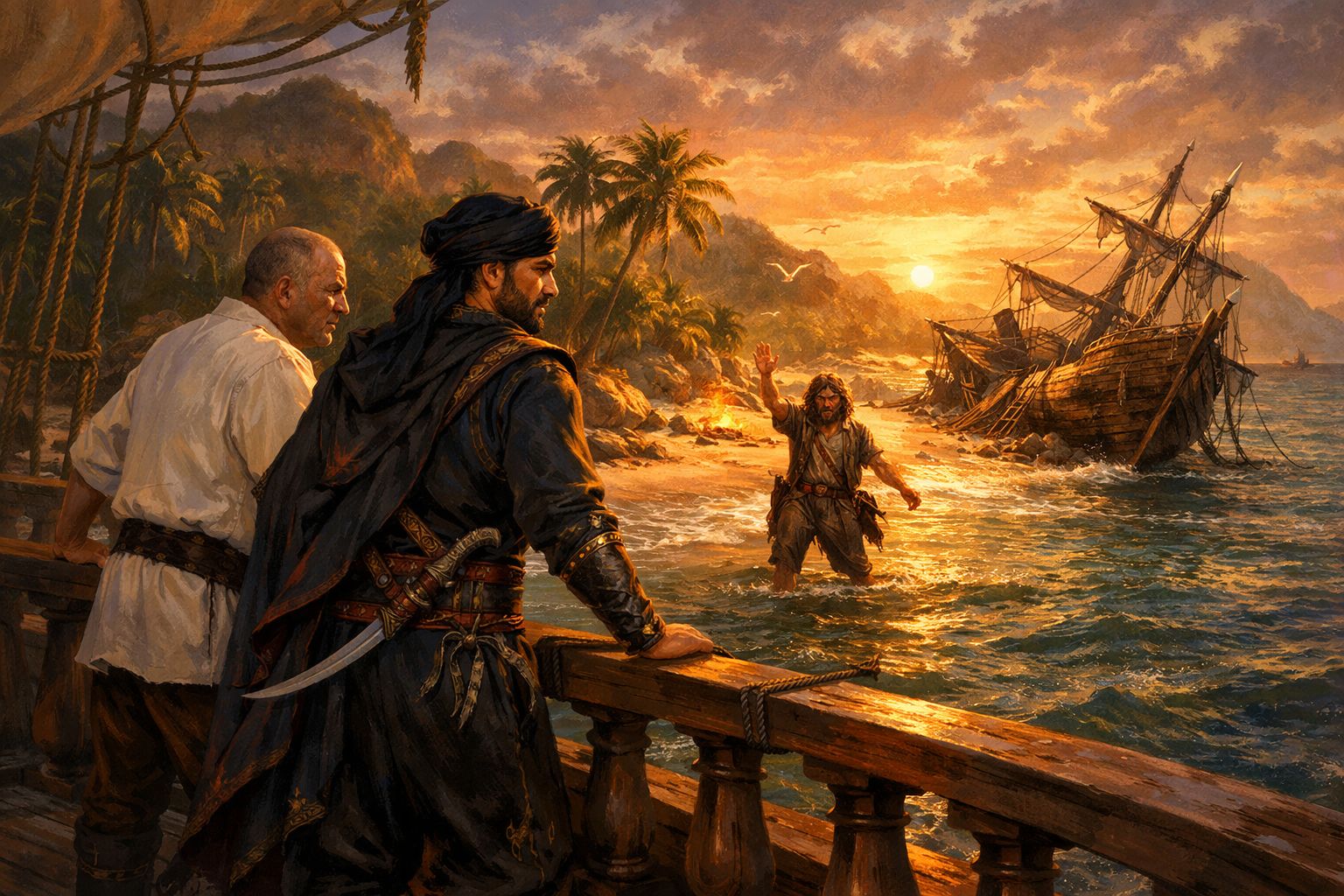
What Can Be Found
While helping him collect his things, the crew may notice signs that do not fit the story.
Clothes with stab marks, stiff with dried blood. Bones picked clean of flesh. Not scattered, but gathered. A human skull with the crown cracked open in a way which could only be done by a saw, and the interior scraped bare.
There are no animal tracks that would explain this. No bite marks. No gnawing.
If the wreck itself is searched, the captain’s log can be found, water damaged but readable in places. It describes growing fear aboard the ship. Sailors found dead at night. No wounds consistent with accidents. Talk of a beast hiding among them. The captain writes of paranoia, sleepless watches, and a crew turning on itself.
There was no beast.
The survivor killed them. One by one. He began before the wreck, when there was no need to ration food or water. He continued after, using the isolation to hide what he was.
Fourth week at sea, or near enough that I have stopped counting days with confidence.
We found Jerrik this morning. Or what was left of him. He was wedged behind the aft barrels, as if he had crawled there to hide. His throat was opened, clean and deliberate, not like an accident with a blade or a fall. There was less blood than there should have been. I do not like writing that sentence, but it is true.
No one heard anything in the night.
The watch swears it. Two men on deck, sober, alert. No splashing. No struggle. No sound at all.
We searched the ship again. Every locker. Every coil of rope. The bilge. The spaces between planks where rats crawl. There is nowhere a man could hide, not unless he was already part of the ship itself.
The crew whispers now. They do it when they think I am not listening. Some say it is a beast. Something small enough to move unseen, clever enough to wait. Others say it wears a man’s shape. I have forbidden such talk, but forbidding does not erase fear.
I am beginning to wonder if they are right.
This is the third body.
The first was called an accident. The second a knife in the dark, blamed on drink and old grudges. This one cannot be explained away so easily. The wounds are too careful. The bones of the neck were worked, not hacked. Whatever did this took time.
I have ordered double watches. No one moves alone after sunset. Blades are to be kept close, even below deck. I do not care if this offends the more pious among them. Prayer does not stop a knife.
I have begun to dream of footsteps behind me in the narrow passages. Of breathing that is not my own. I wake convinced someone is standing at the foot of my bunk, only to find nothing but shadow and the creak of the hull.
If this continues, we will tear ourselves apart without any beast needing to lift a hand.
I will keep this log locked. If the men read it, they will lose what little nerve they have left.
May the gods forgive me if I am wrong.
Handling the Choice
If the crew puts the pieces together, the decision becomes theirs. What to do with him is not prescribed. He is dangerous, but he is also human. From a legal and tradition standpoint, he can be executed for this, but the crew may not want to go that far.
If the crew misses the signs and takes him aboard, the threat does not end.
He will kill again.
Not immediately. Not dramatically. A sailor goes missing. A body is found later, staged to look like an accident or the result of the storm, but there will be meat eaten from it. He will continue until discovered or stopped.
Do not rush this. Let dread build slowly if he is taken aboard. This is not a jump scare. It is rot spreading quietly.
Tone and Emphasis
Play this for unease, not shock.
The most disturbing element is not the cannibalism itself, but how ordinary the man seems at first glance. He is not raving. He is not obviously monstrous. He is simply wrong in subtle ways.
This event reinforces a hard lesson of the journey. Survival does not make someone good. And saving someone does not mean they are worth saving.
What Lurks Below
Junia leans on the rail with her forearms crossed, letting the motion of the ship do what it can for her aching legs. The sea has settled into a slow roll, the kind that invites the eye downward rather than outward. Light slips through the surface in long, wavering bands.
Yasmira stands beside her, a folded cloth in her hands, absently wiping salt from the rail even though it will be back within minutes.
“Look,” Yasmira says quietly.
Junia follows her gaze.
Something moves beneath them.
Not close to the surface. Deeper. Far enough down that shapes blur and edges soften, but near enough that motion is unmistakable. Long forms slide through the water, pacing the ship with lazy confidence. One passes directly under the hull, a darker shadow crossing lighter blue, then fading again.
Junia narrows her eyes. “Sharks?” she asks, though she doesn’t sound convinced.
Yasmira tilts her head, tracking another shape as it drifts into view and then vanishes. “Too smooth,” she says. “And they’re not circling.”
Another shadow appears, then a second, moving in loose coordination. They do not rush. They do not scatter. They simply remain, adjusting their speed when the ship does, never quite falling behind.
Dolphins, perhaps. Or something that wants to be mistaken for them.
Junia’s fingers tighten on the rail. “They’ve been there a while,” she says. “I didn’t notice when they first appeared.”
“Neither did I,” Yasmira replies.
For a few heartbeats, neither of them speaks. The water keeps its secrets easily. Whatever swims below does not break the surface. It offers no sound, no sign, only presence.
After a while, the shapes drift farther down, dissolving into the blue until Junia can no longer be sure she isn’t imagining them.
Yasmira exhales softly. “I don’t like not knowing,” she says.
Junia nods. “Me neither.”
The ship sails on, and the sea gives no answers.
Purpose of the Scene
This event exists to reintroduce unease without escalation.
Nothing attacks. Nothing is explained. The goal is simply to remind the crew that they are not alone on the sea, even during calm stretches, and that some things move alongside them unseen.
What Is Really Happening
The shapes in the water are dolphin Zveri assigned to shadow the Blue Marlin.
They have been present for much of the journey, keeping watch from a distance. In this moment, they drift a little too close or linger a little too long, allowing their silhouettes to be noticed.
This is carelessness, not intent.
What the Crew Experiences
From the crew’s perspective, this is ambiguity.
The shapes are too deep to identify clearly. They could be sharks. They could be dolphins. They could be something else entirely. The lack of certainty is the point.
Do not confirm anything. Do not allow checks to resolve it cleanly. Let the shapes fade away without explanation.
Tone and Follow Up
Play this lightly but deliberately.
It should not provoke alarm or action, only a tightening of attention and a sense that the water is watching back. It pairs well with earlier events involving sirens and reinforces the idea that the sea is populated by forces operating on their own terms.
Once the shapes vanish, move on.
The unease should linger longer than the scene itself.
The Albatross
The call comes down from the rigging just as the light begins to soften.
“Bird off the starboard bow.”
Heads turn. Someone shields their eyes. Against the low sun, a broad winged shape glides in from the distance, white and grey catching the light as it dips and rises with effortless grace.
An albatross.
The mood shifts instantly. People move to the rail. Murmurs ripple across the deck. The bird circles the Blue Marlin once, then again, wide arcs that feel deliberate rather than curious. On the third pass, it folds its wings and lands cleanly near the foredeck.
There is a heartbeat of stillness.
Then the albatross blurs, bones folding inward, feathers collapsing into skin, and a naked woman stands where the bird had been, hair plastered to her shoulders by sea spray and wind.
Anya does not wait for anyone to speak.
“You have been gone far too long,” she says sharply. “I have been searching half the ocean for you.”
Relief breaks loose all at once. Someone laughs. Someone else swears softly. A few people exhale like they had been holding their breath for days.
Nasheem recovers first.
“Someone,” he snaps, “get her some clothes.”
Ormun is already moving. He disappears below deck and returns moments later with an armful of whatever he grabbed first. A loose shirt. A pair of trousers. A scarf. He is red from ears to collar as he thrusts them at her and then very pointedly looks anywhere but at her.
Anya takes them with a distracted nod and pulls them on without ceremony.
“Is Luka alive,” she asks immediately.
Junia steps forward. “He is,” she says. “Healing well. Arm’s still in a sling, but he’ll fly again.”
For a moment, Anya does not respond.
Then something in her shoulders loosens. Her breath comes out slow and unguarded. The tension that had sharpened her voice drains away, leaving her suddenly tired and very human.
Scarnax steps closer, smiling faintly. “Sun’s setting,” he says. “Go see him. We’ll eat, tell stories, and tomorrow you can guide us the rest of the way.”
She nods once. “Tomorrow,” she agrees.
By then, Luka has already made his way onto the deck, drawn by voices and movement. His arm is bound and held close, but he is steady on his feet. When he sees her, he stops, disbelief flickering across his face, then vanishing under something warmer.
They meet halfway.
Anya reaches him first. Luka nearly stumbles into her. They hold each other tightly, foreheads pressed together, arms careful and uncareful all at once. No one interrupts. No one looks away either.
The sun sinks into the sea, washing the deck in gold and red, and for a long moment the journey feels lighter than it has in weeks.
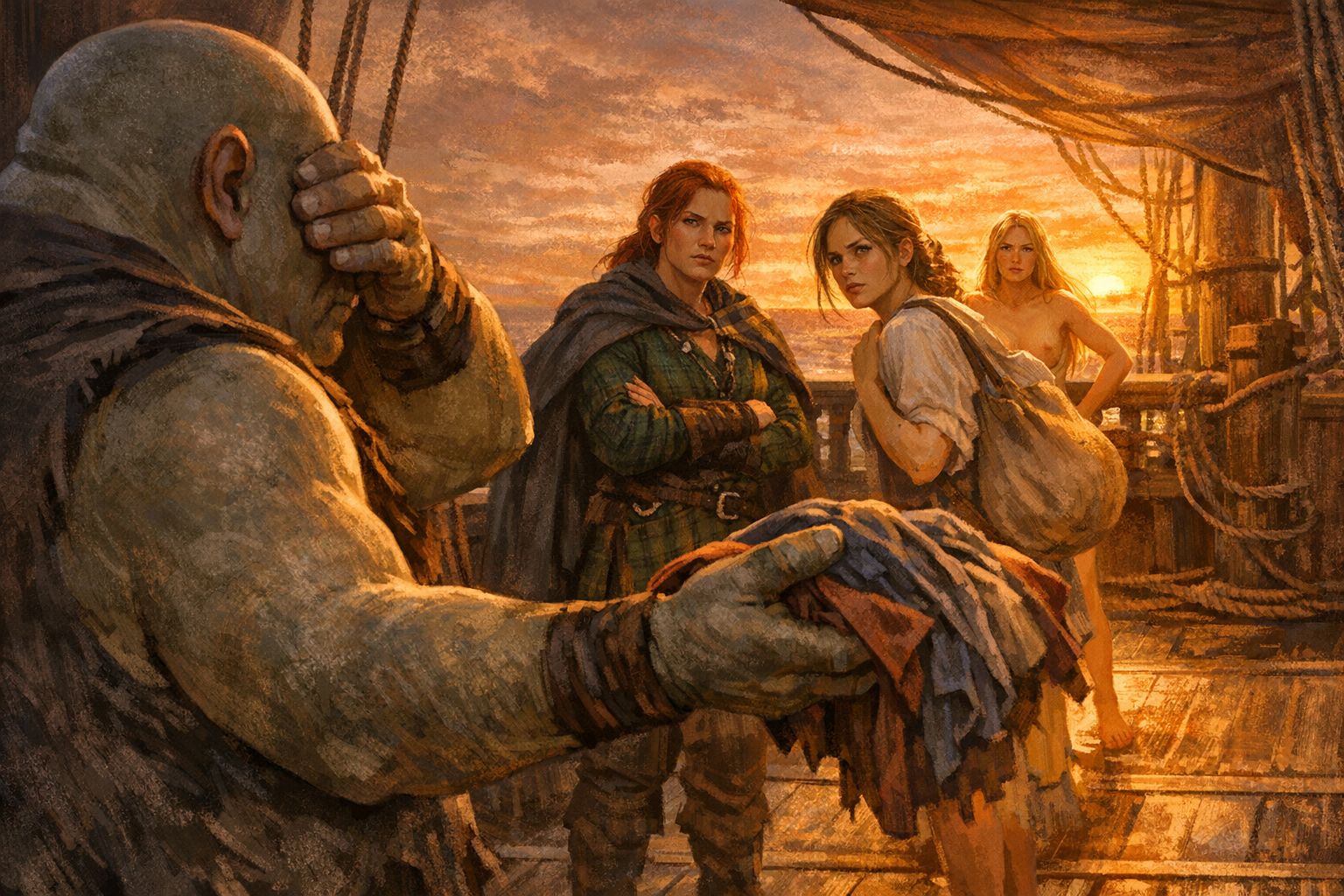
Purpose of the Scene
This moment exists to close the arc emotionally and to release the accumulated tension of the journey. Anya’s return is the signal that the worst is over. From this point on, the sea stops opposing the crew.
Run this as relief, not triumph.
Mechanical Outcome
Once Anya rejoins the ship, navigation becomes straightforward.
She guides the Blue Marlin the rest of the way, avoiding hazards, choosing favorable currents, and correcting for any lingering uncertainty from the storm. There are no further meaningful obstacles at sea. The ship is damaged but stable. The crew is tired but no longer pressed.
Do not introduce new complications after this point.
The Return to Moryanev
The Blue Marlin reaches Moryanev the following evening.
The port feels different now. Smaller. Quieter. Safe.
Let the contrast land. Where earlier arrival felt dull and empty, this return feels like shelter. A place where no one is hunting them. Where arrows are not expected. Where the water is finally just water.
Allow time for simple acts. Docking without urgency. Securing lines without fear. The sound of the hull settling against a pier instead of surf or reef.
Tone and Closure
This is not an ending, but it is a stopping point.
The crew has survived something that could have broken them. They return with scars, stories, and a deeper understanding of the sea and each other. Let that weight be acknowledged, but do not linger on it too long.
End this phase by making it clear, without saying it outright, that for tonight at least, they are safe.
Reception in Moryanev
The return to Moryanev does not feel like arrival so much as recognition.
Word has traveled ahead of the ship. By the time the Blue Marlin rounds into the familiar bay, people are already gathered along the pier. Not crowds, not cheers, but presence. Faces turned. Hands raised in greeting. The quiet, watchful port feels awake in a way it did not before.
Anya’s report has done its work.
Scarnax stands at the rail beside Ayesha as the ship is secured, both of them aware of the subtle shift in how they are being looked at. Not as strangers. Not as passing traders. As known quantities. As people who were trusted and did not break that trust.
Milena disembarks with them, then comes to a stop on the pier.
She does not make a speech. She does not embrace anyone. She simply inclines her head once, formally, and that alone carries weight.
“You kept the secret,” she says. “And you stopped him.”
From a small pouch at her belt, she produces a set of pendants. Simple pieces, each carved into the shape of an animal, one for each crew member, each an animal she thinks they embody. Not ornate. They feel heavy when placed in the hand.
“These mark you as friends of the Zveri,” she says. “They are not symbols of rank. They are symbols of trust.”
She meets Scarnax’s eyes, then Ayesha’s.
“If you ever need to make yourself known, you will say ‘One soul’. The answer will be ‘Two bodies’. Anyone who hears this and understands it will know who you are to us.”
That, more than the pendants, lands heavily. This is not a token. This is an open door.
Milena continues, practical as ever. The promised supplies will be delivered in full. Food, water, sailcloth, resin, timber. More than enough to restock and then some. She will also ensure that skilled hands and proper materials are made available for repairing the Blue Marlin. Whatever the ship needs, it will have.
Only then does she gesture toward the water.
“There is one more thing,” she says. “An apology.”
The surface of the bay breaks in four places.
Dolphins rise, sleek and powerful, then in a blink they are not dolphins at all. Four Zveri stand where they had been. Two men. Two women. Water streaming from skin and hair as they step up onto the pier with an ease that makes the transformation feel almost mundane.
They bow their heads slightly.
“We were assigned to shadow your ship,” one of them says. “As a safety precaution, should you betray us. We regret the deception.”
Scarnax studies them for a moment, then breaks into a broad grin.
“Was that you who dealt with the siren,” he asks.
They nod. “Actually, several sirens. And the shore pirates,” they confirm. Not bragging, just stating the fact.
Scarnax laughs, a real laugh, and steps forward to shake hands with each of them in turn. “Then you have nothing to apologize for. Looks to me like my crew owes you a debt.”
Milena clears her throat.
“No,” she says firmly. “By now, it is time to stop counting debts. You stood when it mattered. That makes you friends. Friends do not keep ledgers.”
The moment settles into something easier after that.
As things wind down, Scarnax asks about the Waverider. Milena listens, then shakes her head. She knows nothing of it. But she does know this.
“The previous harbormaster has retired,” she says. “He lives upriver now, in Drevobor. If anyone would remember a ship passing through, it would be him.”
She glances toward the river, dark and slow beyond the docks.
“There will be time,” she adds. “Your ship will need repairs and loading. You can go upriver while that is done.”
Scarnax follows her gaze. The river winds away into green and shadow, promising answers and complications in equal measure.
He nods once.
“Up river it is, then.”
Purpose and Use
This scene serves as closure and transition.
It confirms the crew’s standing with the Zveri, formalizes trust through the pendants and the phrase, and releases the last tension from the hunt and return journey.
Running the Scene
Let it play out cleanly.
Do not interrupt the moment with complications, checks, or side plots. The reception should feel earned and uncomplicated. This is a reward in tone and position, not in power.
Emphasize three things only:
- The crew is now openly recognized as friends of the Zveri.
- The promised supplies and repairs are delivered without issue.
- The relationship shifts from obligation to familiarity.
Moving Forward
Once the scene settles, transition naturally to downtime.
The ship will be repaired and loaded. The crew has time. The river route to Drevobor is now open, and the next lead is clear.
End this section by reinforcing that, for now, the crew is in a safe port, surrounded by allies rather than threats.
Up River to Drevobor
The river is calm, wide and slow moving, its banks thick with green. After the open sea and the long strain of danger, the journey upriver feels almost unreal in its ease. Oars dip lazily.
They stop at a small town near a bend in the river, little more than a cluster of wooden buildings and a dock worn smooth by generations of feet. Smoke rises from cooking fires. Children splash in the shallows. It smells of food, river mud and sun warmed wood.
Scarnax, Ayesha and Mbaru go ashore together. No ceremony, no escort. Just travelers looking for a meal.
The Zveri here are nothing like Milena and her scouts. No uniforms. No urgency. No sense of carrying the weight of a secret world on their shoulders. These are farmers, fishers, traders. People living ordinary lives.
They eat at a rough table under a shade tree, bowls of spiced river fish and flatbread passed around casually. While they eat, voices drift from nearby.
A leopard Zveri lounges against a post. “You lot stink like wet fur,” she says to a group of hyena Zveri passing by. “Dirty fleabags, every one of you.”
One of the hyenas laughs. “Better fleas than spots,” he shoots back. “At least we don’t think we’re royalty just because we climb trees.”
The leopard snorts. “And don’t get me started on lemur folk. Turn your back and your purse walks away.”
A lemur Zveri perched nearby bares his teeth in a grin. “If you lose your purse, that’s your fault. We just notice things faster.”
Later, as they finish eating, another voice rises from the dock. “Birdbrains,” someone mutters, watching a pair of bird Zveri argue loudly over a fishing net. “All that sky and still can’t think straight.”
Ayesha watches for a while, frowning.
Eventually she steps in, smile ready, voice smooth. She speaks of shared struggle, of how different kinds bring different strengths, of unity and understanding. She means well. It shows.
The reaction is immediate and unanimous.
Several Zveri turn toward her at once.
One of the hyenas tilts his head. “You wouldn’t get it,” he says, not unkindly.
“We bicker because we’re family,” the leopard adds. “That’s not something you explain. It just is.”
A bird Zveri laughs. “Besides, if we didn’t insult each other, how would we know we’re all still here.”
There are nods. Shrugs. The matter is settled without discussion.
Ayesha blinks, then laughs softly and raises her hands in surrender. She steps back to the table, conceding the point.
When they push off again and the town slips behind them, Ayesha looks out over the river and exhales.
“Well,” she says lightly, “people will always be people.”
Scarnax grunts in agreement. Mbaru smiles faintly.
Purpose of the Scene
This scene exists to recalibrate the crew’s understanding of the Zveri.
Up to this point, most Zveri the crew has encountered have been professionals in positions of trust: scouts, leaders, guardians, and emissaries. This stop deliberately breaks that pattern. It shows the Zveri as ordinary people living ordinary lives, complete with prejudices, habits, affection, and contradictions.
The goal is not to undermine the Zveri, but to humanize them.
What This Scene Establishes
The Zveri are not a monolith.
They argue, stereotype each other, joke cruelly, and close ranks instinctively when an outsider tries to mediate. Their internal frictions resemble family dynamics more than ideological conflict. There is no hatred here, but also no moral lesson being taught.
Make it clear that this is not exceptional behavior. This is normal.
Some Zveri are principled. Some are petty. Some are generous. Some are unpleasant. Most are a mix of all of it.
How to Run It
Do not turn this into a debate scene.
If players try to intervene socially, let them feel the soft but firm boundary of being outsiders. The Zveri are not interested in having their internal relationships explained to them, especially by someone who does not belong to those relationships.
Avoid moral judgment in narration. Let the dialogue and reactions speak for themselves.
Takeaway for the Crew
This moment should quietly dismantle the idea of the Zveri as “noble beasts” or morally elevated allies.
They are people.
They can be trusted or distrusted on individual terms, not on species or myth. The trust shown earlier by Milena and the scouts was earned, not guaranteed by what they are.
Carry this understanding forward. It will matter later, when alliances are tested and assumptions become dangerous.
Drevobor and the Waverider's Trail
The river widens as it bends, banks hardening into stone and timber, and then Drevobor rises ahead of them.
It is not revealed so much as accumulated. Roofs first, layered and uneven, then towers, squat and practical, bridges spanning the river in slow, heavy arcs. The sound reaches them before the detail does: voices overlapping, carts rattling, bells ringing somewhere deeper in the city. Smoke hangs low, not ominous, just busy.
This is the capital of Zverilov. And it shows.
Scarnax, Ayesha, and Mbaru walk together through the lower streets, following Milena’s directions with only occasional pauses to reorient themselves. The streets are crowded but not orderly. Stalls spill into walkways. People argue over prices. Someone laughs too loudly. Someone else shouts back.
Markets dominate the main thoroughfares. Fruit piled high. Fish laid out on crushed ice. Cloth dyed in colors loud enough to hurt the eyes. Zveri of every kind move through it all in human form, shoulders brushing, hands gesturing, voices rising and falling. There is no reverence in how they treat one another. Only familiarity.
Then Ayesha slows.
“Is it just me,” she says carefully, “or is… clothing optional here?”
Scarnax grunts, eyes forward. “Looks that way.”
It takes a moment to really register it. Many Zveri are dressed much like anyone else, tunics, belts, scarves, boots, but just as many are not. Some wear only a single loose garment. Some nothing at all. Bare skin moves through the streets without comment, without attention. A naked woman haggles loudly over the price of grain. A bare-chested man carries crates on his shoulders. A completely unclothed pair argue over directions in the middle of the street while passersby step around them with practiced ease.
No one stares. No one reacts.
Mbaru exhales slowly. “Right,” he mutters. “I keep forgetting their clothes don’t change when they do.”
Ayesha’s diplomatic composure wavers for just a heartbeat as she looks away from a group of laughing youths, several of whom are wearing little more than jewelry. “Back home,” she says, “this would start a riot.”
“Here,” Scarnax replies, “it’s just Tuesday.”
The city does not treat nakedness as intimacy or provocation. It is not displayed. It is not hidden. It simply exists, stripped of meaning beyond comfort and convenience. The only thing that draws attention is behavior, shouting, stealing, fighting, not bodies.
They pass a beggar slumped against a wall near the market gate, hand outstretched, eyes half closed. A passerby tosses him a coin without looking. Another steps over him without slowing. Further down, a group of youths loiter in an alley, too clean to be workers, too watchful to be idle, all with identical ragged haircuts. They quiet when Scarnax passes, eyes sharp, already weighing what kind of trouble he might be.
“This doesn’t look so different,” Ayesha murmurs, still clearly recalibrating.
Mbaru snorts. “Cities rarely are. Just fewer excuses.”
They pass a tavern with its doors thrown open despite the hour. A man staggers out, drunk enough that balance is more theory than practice, wearing nothing but a belt with a pouch still miraculously attached. Someone shouts after him to pay his tab. He waves vaguely and keeps going.
Down a side street, children dart past, laughing, nearly colliding with a heavily laden porter who curses them out of reflex and then smiles despite himself. On a corner, two Zveri argue fiercely over something neither Scarnax nor Ayesha can quite catch, until a third steps between them and tells them both to shut up. They do.
Ayesha watches it all, then shakes her head with a quiet laugh. “So much for the myth.”
Scarnax grunts. “Myths don’t survive capitals.”
They turn onto a broader avenue, stone underfoot worn smooth by generations of traffic. Somewhere ahead lives the retired harbormaster Milena mentioned. Someone with answers. Someone who watched ships come and go long enough to remember one that mattered.
As they walk, the city presses in around them. Alive. Uneven. Loud. Unembarrassed. Drevobor is not a sanctuary. It is not a den of monsters. It is not a noble ideal. It is a city where people live as they are allowed to live. And the Zveri here make no effort to pretend otherwise.
Purpose and Tone
Use this scene to ground the Zveri in normalcy.
Drevobor should feel busy, loud, imperfect, and lived in. It is not a sacred capital or a hidden utopia. It is a working city with all the friction that implies. Bargaining, begging, arguing, drunkenness, boredom, small cruelty, and casual kindness all exist side by side.
Run the mood as familiar chaos with unfamiliar details.
Sensory Emphasis
Lean into the bustle.
Crowded streets. Voices overlapping. Carts forcing people aside. Someone brushing past too close. The smell of food, river water, sweat, and smoke.
The lack of clothing should register as discomfort rather than shock. A naked person squeezing past in a tight crowd is awkward in a way that draws attention to the players’ own habits rather than the Zveri’s. No one reacts. No one explains. The city does not notice the difference, only the visitors do.
Aside from transformations and clothing norms, this is a very typical city. Markets, gangs, beggars, and taverns function much as they would anywhere else.
What Is Absent
One absence should be quietly noticeable.
There are no slaves. No chained laborers. No guarded pens. No markets where people are bought or sold. For all its flaws, this is not a society that practices slavery, and that absence stands out precisely because nothing calls attention to it.
Do not underline this with commentary unless players ask. Let it register through contrast and omission.
Reinforcing the Theme
This scene exists to strip away the idea of the Zveri as exceptional beings.
They are not more enlightened. They are not more savage. They are people shaped by different assumptions. Some are generous. Some are rude. Some are dangerous. Most are simply busy living their lives.
Let that recognition settle naturally.
Moving the Story Forward
Do not turn this into a navigation challenge.
Finding the retired harbormaster Bogdan Volkov is straightforward. Milena’s directions are clear and accurate. Following them leads directly to his home without incident or delay.
The city may be overwhelming, but it is not hostile.
Bogdan Volkov’s house sits back from the street behind a low fence and a riot of creeping green, the kind of place that looks grown into rather than built. A cooking fire smokes gently in the yard, and the smell of roasted roots and spiced meat drifts out to meet them before they even knock.
The door opens with a booming laugh.
Bogdan Volkov fills the frame. He is broad even for a boar Zveri, thick through the shoulders and belly, with a greying mane pulled back in a loose tie and a round nose dusted with flour. He wears a simple apron and nothing else, entirely unbothered by it. His eyes light up when he recognizes them.
“Well I’ll be rooted,” he says warmly. “If it isn’t the ones who made half the city start smiling again. Come in, come in. You look like you’ve earned a meal.”
Inside, the house is crowded and comfortable. Low ceilings. Heavy furniture. Shelves packed with ledgers, carved tokens, old harbor maps rolled and rerolled so many times they barely lie flat anymore. He waves them toward a sturdy table and sets bowls down without waiting for permission, ladling out food with the practiced ease of someone who enjoys feeding people.
They eat, and Bogdan talks.
He has already heard the story, or at least the shape of it. Yasir. The chase. The sea. He listens more than he speaks at first, nodding, snorting softly at the right moments, his approval never in doubt.
When Scarnax finally asks about the Waverider, Bogdan’s grin turns wide and unmistakably proud.
“Oh, I remember that one,” he says. “Clear as day. Slipped in as discreet as a whale with flatulence and thought no one noticed. Clever ship. Clever crew.”
He laughs, deep and genuine. “They never suspected a thing. To them, Moryanev was exactly what it pretends to be. A sleepy little pause town. Boring. Backward. Nothing worth digging into.”
He taps the side of his snout. “We played it just right. Slow paperwork. Fewer questions than expected. Enough incompetence to feel authentic. They sailed off thinking they’d seen all there was to see.”
Ayesha smiles despite herself. “Including Severin Valerius?”
Bogdan chuckles. “Especially Severin. Sharp mind, that one. Asked the right questions about the wrong things. Looked for the right things in the wrong places. If there’s a better compliment than fooling a smart man without him ever realizing he was fooled, I don’t know it.”
There is no malice in his tone. No mockery. Just satisfaction.
“This isn’t about tricking outsiders,” he continues, more serious now. “It’s about keeping Zverilov safe. Quiet works better than walls.”
He reaches for one of the old ledgers and flips through it with surprising delicacy, thick fingers moving carefully across fragile pages. He stops, taps a line with one blunt nail.
“He did tell me where they were headed next,” he says. “Didn’t think it mattered. It might now.”
He gives them the destination without ceremony, committing it to their memory as if it were simply another tide table or docking schedule.
When the meal is over and they stand to leave, Bogdan rises with them and grips each of their hands in turn, his grasp strong and lingering.
“You did good work,” he says plainly. “For us. For the ones who can’t afford mistakes.”
He waves them out with another laugh, already turning back toward his pots.
As they step back out into the street, the noise of Drevobor closes around them again, vendors shouting, carts rattling, arguments flaring and fading in moments. Behind them, Bogdan Volkov turns back to his ledgers and his cooking, one more citizen in a crowded city.
And yet, for all the laughter and food and easy pride, Scarnax cannot shake the sense that this is what Zverilov truly runs on. Not secrecy for its own sake, not cleverness, but people willing to look ordinary while doing necessary things well. The harbor is quiet because someone makes it quiet. The river is safe because someone pays attention.
Bogdan does not watch them leave. He does not need to. His work, like most that matters here, was already done.
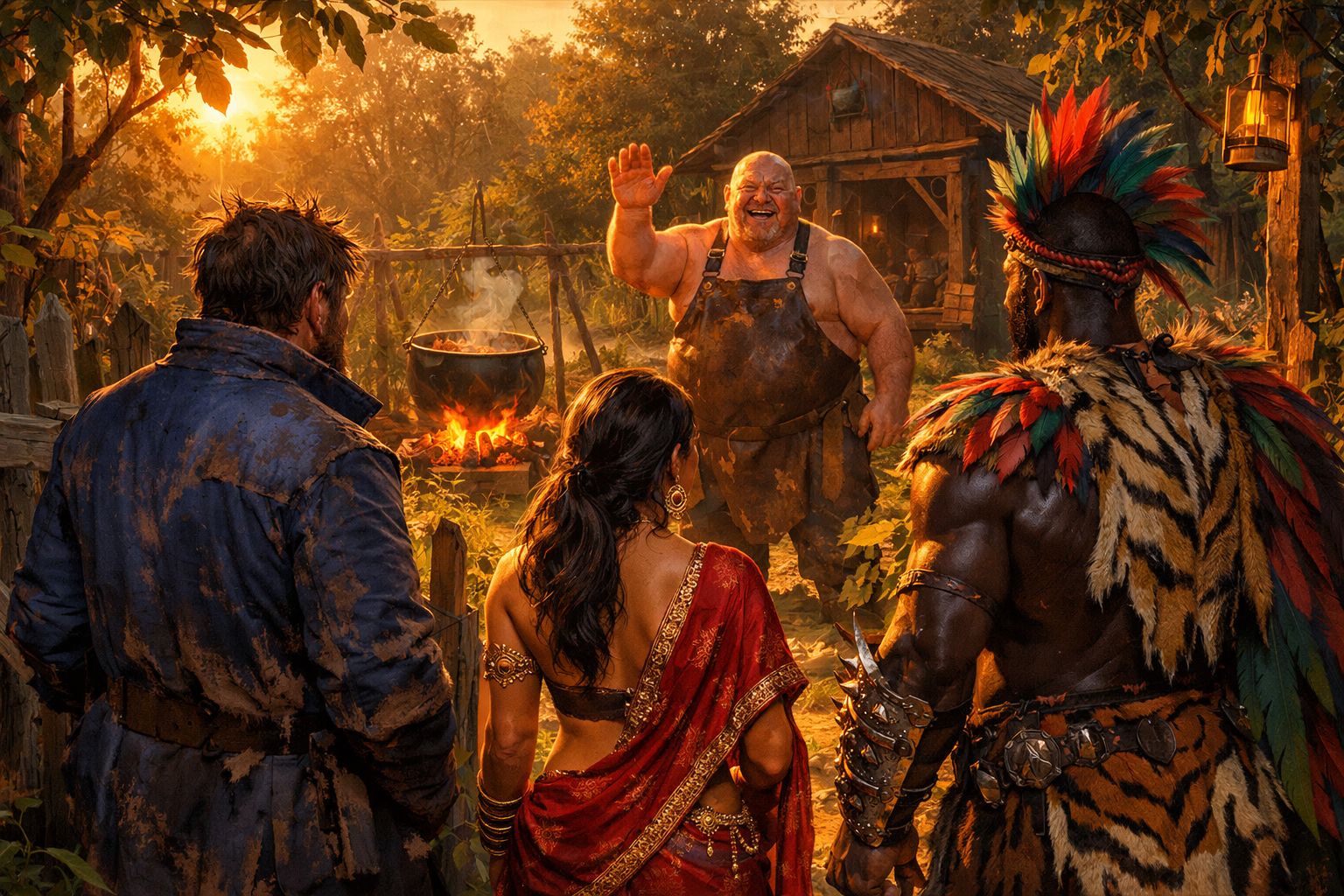
Running the Meeting with Bogdan Volkov
This scene is meant to be a release valve.
Bogdan Volkov is not a source of danger, suspicion, or hidden complication. He is openly friendly, genuinely pleased to see the crew, and happy to help. Let the players feel that they have earned this reception. Their actions earlier in the arc matter here, and Bogdan treats them accordingly.
Play Bogdan as warm, confident, and grounded. He enjoys food, company, and a good story, and he takes quiet pride in his past work. He laughs easily, but he is not foolish. When he talks about deception, it is not with cruelty or arrogance, but with the calm certainty of someone who knows why it was necessary.
Do not turn this into an interrogation or a negotiation. Bogdan answers questions freely. He remembers the Waverider clearly and enjoys recounting how it was misdirected, but he does not gloat. His satisfaction comes from having done his job well, not from humiliating others.
The key takeaway for the players should be simple: Zverilov survives because ordinary people make careful, unglamorous choices and stick to them.
Delivering the Information
When Bogdan reveals the Waverider’s next destination, present it plainly. This is not a riddle or a reward to be bargained for. He tells them because it is the right thing to do, and because he trusts that they will use the information responsibly.
Let the moment feel practical rather than dramatic. This keeps the focus on continuity rather than climax.
Tone and Table Pace
Keep the scene unhurried but concise.
Allow time for conversation, humor, and questions, but do not let it sprawl. This is a humanizing interlude and an information handoff, not the start of a new problem. Once the crew has what they came for, the scene should naturally wind down.
If you wish, this is also a good moment to share a personal story or two about the Waverider crew.
The Journey Downriver
The return journey downriver is uneventful.
The river is cooperative, the weather stable, and navigation straightforward. After everything that came before, this calm should feel earned. Do not introduce complications here. Let the crew rest, talk, and mentally file away what they have learned.
This is a deliberate contrast to the outbound journey. Where the trip upriver was about discovery and recalibration, the return is about consolidation.
Watching Eyes
As the ship moves back toward Moryanev, birds occasionally follow along the riverbanks or circle overhead.
They do nothing unusual. They do not approach closely. They simply remain present.
Do not confirm what they are.
Let the players wonder whether these are ordinary birds riding the thermals, or Zveri quietly ensuring that their friends reach home safely. Maybe it is Zveri honoring them, or simply people curious to catch a glimpse of those they have heard about. Either interpretation is valid, and neither needs to be resolved.
Closing the Arc
End this stretch with a sense of stability.
The crew has answers. They have allies. They have survived a series of escalating threats and come out changed but intact. The world is still dangerous, but it is no longer hostile in every direction.
From here, the story can move forward with momentum rather than recovery.
Return to Moryanev
Return to Moryanev
This return should feel like completion rather than transition.
When the crew arrives back in Moryanev, the practical work is already well underway. The Blue Marlin is nearly finished with repairs, her lines true, her hull sound, her outriggers restored. Cargo is stacked and secured. Supplies promised have been delivered in full. There is no scrambling, no shortage, no last minute complication. For once, preparation is not a problem.
Give the crew a full day here.
Moryanev no longer feels like a dull pause on the map. Familiar streets feel warmer. Faces are recognized. Conversations start without suspicion. The tavern is still small, the harbor still quiet, but the mood has shifted. The crew is treated as friends, not guests. Questions are asked out of interest, not caution. Meals are shared. Stories are traded. It is not celebration, but it is belonging.
This is a good moment to let players wander. To rest. To reflect. To enjoy small interactions without pressure. Nothing needs to happen here unless they seek it out. The point is that nothing is wrong.
Readiness
By the end of the day, everything is in place.
The ship is sound, supplies are full, charts are updated. A destination is known. There is no sense of improvisation left in this leg of the journey. Whatever dangers lie ahead, they will be met prepared rather than scrambling.
Make that contrast clear. This is not how the arc began.
About Zveri Joining the Crew
Players may reasonably consider inviting one of the Zveri to join the Blue Marlin, especially after everything they have shared. If this comes up, let the offer be received with warmth and respect.
The answer, however, is no.
From the Zveri perspective, this is not rejection but boundary. Their secrecy depends on control of exposure, routes, and context. Sailing openly with a foreign crew, visiting unknown ports, and crossing political borders would put that secrecy at constant risk. Even trusted friends cannot remove that risk. The Zveri who work as scouts, watchers, or guardians do so on their own terms, with clear lines of retreat and deniability. A permanent berth on a known ship removes all of that.
They will thank the crew sincerely. They will explain, calmly, that their place is here. Zverilov needs them. The work they do cannot be abandoned lightly.
From a Game Master perspective, this also preserves the structure of the campaign. Having a Zveri aboard would bypass too many obstacles, remove too much uncertainty, and collapse future tension around secrecy, pursuit, and cultural misunderstanding. Keeping the alliance external rather than embedded allows it to remain powerful without becoming a solution to every problem.
Frame this not as denial, but as maturity.
The trust between the crew and the Zveri is real. It does not need to be proven by proximity.
Farewell
Milena is there when they depart.
She does not linger or dramatize the moment. She offers thanks again, briefly, sincerely. There is no sense of obligation left between them, only mutual respect. She does not ask for promises or favors. What needed to be done has been done.
Let this goodbye feel clean.
As the Blue Marlin casts off and the familiar shoreline begins to slide away, the sense should be simple and grounded. They are leaving a safe port. They are leaving with allies. They are leaving with purpose.
The sea waits, as it always does. But this time, the crew leaves Moryanev ready.
Morning comes softly to Moryanev.
The Blue Marlin sits ready at the pier, lines coiled, sails loose and waiting, hull sound again beneath her. The harbor is quiet but not empty. People linger longer than necessary. Work pauses. A few faces turn toward the ship and stay there.
Milena is waiting when the crew gathers on deck.
She moves down the line without ceremony, thanking each of them in turn. Her grip is firm, steady, the handshake of someone who means exactly what she says and no more. There are no speeches. No formal words. Just simple acknowledgments, given and received.
When she reaches Ileena, she stops.
For a moment, it looks like she might say something carefully chosen. Instead, she steps forward and wraps her arms around her in a sudden, full embrace. It is warm and unguarded and completely unprofessional. Ileena stiffens for half a heartbeat, then laughs and hugs her back just as fiercely, tail flicking despite herself.
When they part, Ileena grins up at her. “Next time,” she says brightly, “I’ll save the heart for you.”
Milena exhales, something between a laugh and a sigh, and shakes her head. “Let’s hope,” she replies, gentle and sincere, “that there will be no more need to fight.”
That feels like the right kind of promise.
Lines are cast off. The Blue Marlin eases away from the pier, wood creaking softly as she finds her balance again. Along the dock, hands lift in farewell. Some wave openly. Others simply stand and watch. It is not a crowd, but it is enough.
As the ship glides out of the harbor and the water opens ahead, the sun climbs higher, bright and clean. Then someone points skyward.
Two albatrosses cut across the light, wings wide, silhouettes sharp against the morning glow. They dive low over the deck, close enough that the wind of their passing can be felt, circle the ship once, then again, playful and unmistakable. One dips so low it nearly kisses the waves.
Then they climb, banking together, and fly straight into the rising sun, shrinking until they are nothing but motion and light.

Act Summary
The Zverilov arc is about trust under pressure, exposure without revelation, and what it costs to protect a truth that cannot survive daylight. It begins as a straightforward job and becomes a test of character, endurance, and judgment, not through spectacle but through sustained strain.
By the end of the arc, the crew has not only completed a mission but crossed a threshold. They are no longer just travelers passing through. They are known, measured, and accepted by forces that value discretion over heroics.
Key Outcomes
The most immediate outcome is the bond formed with the Zveri.
The crew was entrusted with a secret shared with almost no outsiders. They were tested under time pressure, moral strain, and genuine risk, and they did not break. As a result, they are now recognized as friends of the Zveri, marked openly by pendants and a challenge response known only to those inside that trust. This is not a political alliance or a transactional favor. It is personal and rare, and it will carry weight long after Zverilov fades from view.
At the same time, the arc deliberately dismantles any notion of the Zveri as inherently noble or mythic. Through villages, cities, bickering, prejudice, humor, cruelty, and kindness, the crew learns that the Zveri are people. Capable of professionalism and brutality, generosity and narrowness, restraint and violence. They are not better than others. They are simply themselves, living under constraints that make their choices sharper.
The Cost of the Journey
The Blue Marlin and her crew are pushed harder here than in any previous stretch.
The ship is damaged, repaired, damaged again, and held together through exhaustion and improvisation. The crew endures storms, hunger, fear, attrition, and repeated moments where survival depends on choosing the least bad option rather than a good one. They are hunted, trapped, and reduced to reacting instead of planning.
What matters is that they endure.
They come out of the arc tired, scarred, and keenly aware of their limits, but also more cohesive. The crew has learned how they function when everything goes wrong at once. They have seen who steps forward, who hesitates, who carries weight quietly, and who breaks tension when it needs breaking. The Blue Marlin is repaired by the end, but it is not reset. It is a ship that has been through hell and survived because the people aboard it refused to let it fail.
The Prowler
This arc establishes the Prowler not as a random pirate threat but as a thinking enemy.
Vexar Bloodwake does not rush, posture, or waste effort. He probes, waits, engineers advantage, and forces choices rather than battles. The encounter in the straits makes it clear that the Prowler is not just dangerous, but patient, and that it will remain a long term presence rather than a problem to be solved quickly.
The crew does not defeat the Prowler here. They escape it at cost. That distinction matters. Bloodwake now has even more reasons for personal hate.
Character Development
This arc creates space for character development through sustained pressure rather than isolated moments.
The long chase, the damaged ship, the storm, and the series of compounding problems force the crew to function under conditions where comfort, clarity, and easy choices are absent. Time stretches. Fatigue accumulates. Decisions are made without full information. In that environment, relationships naturally shift.
The stress and duration of the journey give characters repeated opportunities to reveal how they handle responsibility, fear, frustration, and loss. Who takes initiative when plans fail. Who supports others quietly. Who argues, withdraws, adapts, or doubles down. These patterns emerge not once, but over days, and that repetition is what makes them meaningful.
Because the arc does not reset between scenes, interactions carry forward. A disagreement during the hunt colors cooperation during repairs. Trust built in one crisis matters in the next. Small gestures, jokes, silences, and shared exhaustion do more work than dramatic speeches.
By the end of the arc, relationships within the crew should feel altered and deepened, whether strengthened or strained. The crew knows itself better. Individuals know where they stand with one another. Not because the story demanded development, but because time and pressure allowed it to happen naturally.
This kind of growth is not flashy, but it is durable. It carries forward into future arcs as shared history rather than declared change, and it reinforces the sense that the crew is becoming something more cohesive, not through destiny, but through survival together.
Thematic Resolution
Zverilov reinforces several core themes of the campaign.
Secrets survive not because they are powerful, but because people choose to protect them at personal cost.
The sea is not an enemy or an ally. It is a force that demands respect and extracts payment for every mistake.
Not all victories look like triumph. Some look like survival, silence, and the absence of catastrophe.
By the time the crew leaves Moryanev for the final time, they do so prepared, supplied, and pointed toward a known destination. More importantly, they leave changed. They have allies who will not travel with them, enemies who will not forget them, and a reputation built not on noise but on trust.
The Zverilov arc closes not with celebration, but with readiness.
The world remains dangerous. The crew remains mortal. But they now know, in very practical terms, what it costs to stand between a secret and those who would exploit it, and they have proven to themselves that they can pay that price.