Campaign: Zarhalem
Act Synopsis
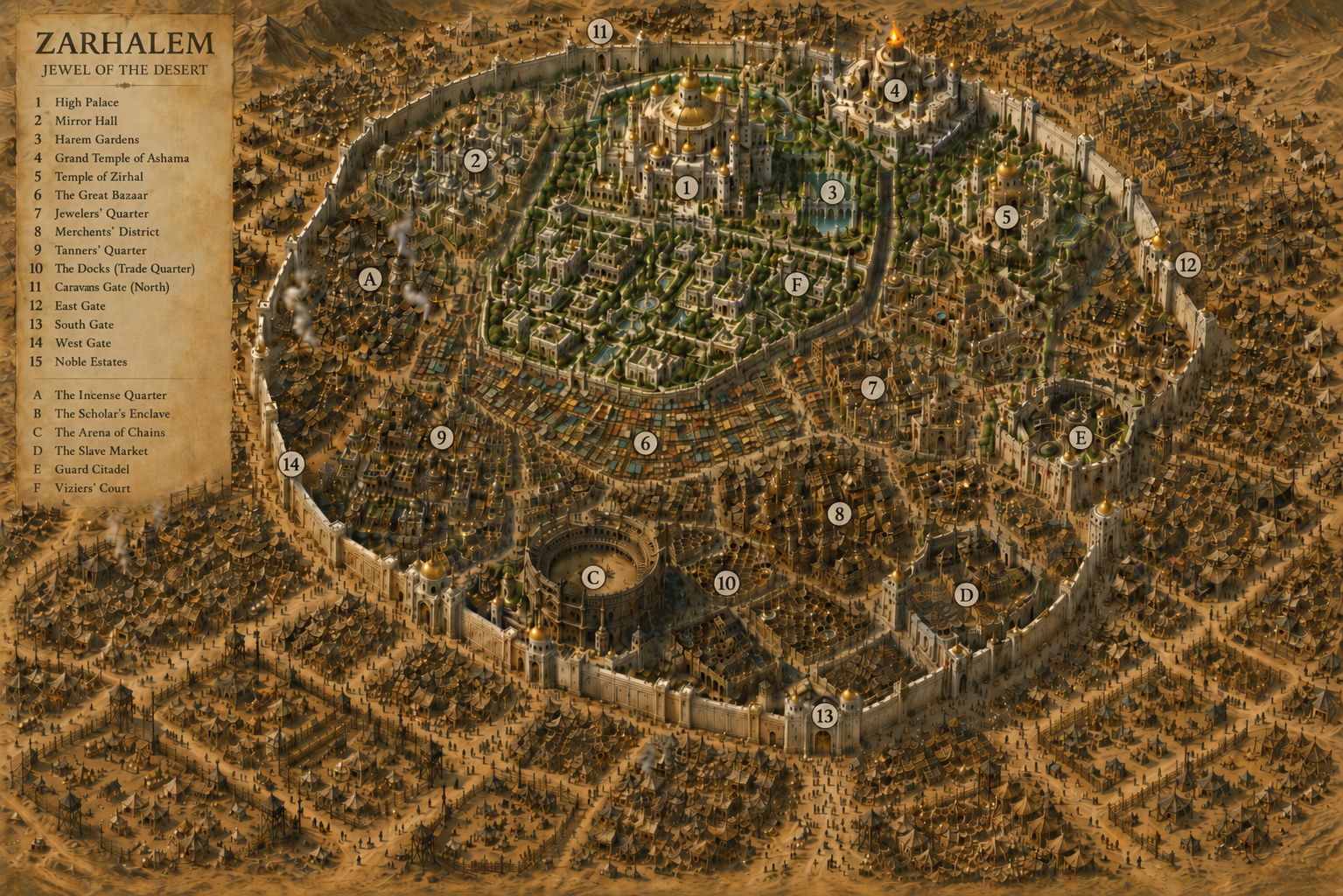
The Blue Marlin reaches Zarhalem while following the Waverider’s trail, but the city does not function as a clean investigation stop. Zarhalem is a place where law, wealth, religion and slavery are fused into one system, and the crew quickly finds themselves pulled into several personal crises at once. The city should feel beautiful, cruel and deeply unstable beneath its polished surface, with status deciding everything and enslavement always waiting as the final punishment.
This is an open arc built around conflicting priorities. The crew comes for Waverider clues, but Zarhalem instead tears open old wounds for Shaedra, Nasheem and Yasmira, while Nera becomes a new point of pressure and Sandros Pellaios offers a solution that is useful, dangerous and, later found to be morally foul. The emotional aim is compression. The players should feel pulled in several directions at once, then hit by the emotional aftermath when the dust settles. The Blue Marlin remains the place where these damaged people hold together.
Core Structure
The arc should not begin with every thread firing at once. Start with Shaedra and Nasheem, let those threads build pressure, then introduce Yasmira’s crisis once the crew is already engaged. Nera and the Waverider clue should start, but hang as an unresolved and not urgent problem until later, when Sandros appears with his offer. This keeps the arc tense without turning it into mush.
The city should feel like a machine that converts weakness, pride and vulnerability into ownership. Each major thread shows a different face of that machine. Shaedra’s is intimate and personal. Nasheem’s is bitter and backward looking. Yasmira’s is public and political. Nera’s is cold, transactional and objectifying in a more refined way.
Threads
Nera and the Vizier
A vizier, Sayd ibn Murad al Safiq, holds useful information about the Waverider and initially seems open to a practical arrangement. During a visit to the Blue Marlin, however, he notices Nera working with a clockwork music box. He becomes fascinated, and wants her. He does not want her for his harem. She is cute, but she is not harem beautiful in a way which would give status. He wants to possess her skill. To him, harem women are one category of status object. Nera would be another: a clever artisan who can create intricate luxuries, music boxes, mechanical birds, fountains and other marvels that display wealth and refinement.
Neither Nera nor the crew accepts this. Sayd does not abduct her or apply pressure. He simply turns the clue into a price, inviting them to return when they are ready to make an offer. He wants her as a slave, or employed on a long term contract spanning decades. This leaves the crew with a problem they cannot solve cleanly. It also gives Nera an active place in the story without reducing her to a passive target. The threat here is not lust first, but status appetite and possession through cultivated taste.
Shaedra and Ivy
Shaedra discovers a lead tied to her family. Her sister’s daughter, now given the slave name Lotus, has been sold into the household of a wealthy and prestigious artist, Nazeer al Qadim. He has made a career out of turning slaves into living artworks for the powerful elite, covering them in intricate full body tattooing and using them as status symbols, decorations and private playthings. Ivy is now about to be sold on again, which gives the crew a narrow window to act.
This thread becomes the emotional center of the first half of the arc. It begins as a rescue and can end in blood. Nazeer should not feel like a grand villain or a boss fight. He is a petty man made powerful by the system around him. Revenge should feel less like slaying a beast and more like exterminating a cockroach. The true horror is not his strength, but the cultivated cruelty of his home and workroom, where violation has been turned into refined practice.
Ivy survives, but she is deeply marked by what was done to her. She feels ugly, used and trapped in a body that now carries a violation she cannot remove. The recovery thread begins here rather than ending here. Ormun, Cassandra and especially Ileena can all help her in different ways. Ormun offers calm human grounding. Cassandra understands the damage of being turned into property. Ileena, with her spiritual relationship to body paint and her unashamed physicality, may cut through Ivy’s shame in a direct and unexpected way.
This also plants Ivy as a future crew addition. She was already in shamanic training before her capture. She is not fully trained, but she can enter the spirit world, which makes her useful and possibly dangerous. She may lack proper protection and risk dragging something back with her. Her long term arc is about learning to inhabit a body she did not choose, in a role she did not finish, while carrying power that can go wrong.
Nasheem and Safina
Nasheem reaches out to old contacts in Zarhalem and learns that Safina was bought by Rashid al Mazhar, the rival who destroyed his life and reputation. The purchase was likely an act of spite rather than desire. Nasheem hopes for rescue, but the investigation instead becomes a wound reopened. Safina is already dead. Rashid killed her soon after buying her, most likely for the same spiteful reasons that drove the purchase in the first place. Nasheem is denied not only reunion, but also the satisfaction of revenge, because someone believed to be Kethra of the Waverider appears to have killed the rival before the Blue Marlin ever arrived.
This thread should yield backstory, grief and emotional load rather than an active mission. It can also provide fragments of Kethra’s passage through Zarhalem and help reinforce that both ships contain people who will cross lines rather than walk away from certain kinds of evil. Nasheem finds a locket he once gave Safina.
There are two possible paths here, and they should be treated as different tools rather than random alternatives.
The tragic path. In the tragic version, Safina was pregnant and was killed before giving birth, deepening Nasheem’s grief and hardening the loss.
The exit path. In the exit version, the child survives, and has been adopted by one of Rashid's concubines, Nisrine, allowing Nasheem to choose to leave the crew and raise it, which can serve as a beautiful ending if he is not player controlled or if his player leaves the campaign.
Yasmira’s Fall
Yasmira encounters Qadir ibn Faruq al Mazhar Abd al Rasid, the diplomat she once served in Zarhalem. He is annoyed that she left his household and offers to hire her again, expecting old habits of submission and hierarchy to still apply. Yasmira, who has long since outgrown taking that kind of treatment, answers with contempt and tries to leave. When he grabs her arm, she punches him in the face.
In Zarhalem, status decides justice. People interfere, Yasmira is arrested and brought to trial. The outcome is never in doubt. She is sentenced to slavery, because in Zarhalem that is the answer to every crime. As the offended party, the diplomat is given first opportunity to purchase her from the state at a reduced price, which he does. This creates the second major rescue thread of the arc.
This thread should feel different from Shaedra’s. Ivy’s story is intimate and violated. Yasmira’s is public, humiliating and political. It is about a woman who escaped Zarhalem’s hierarchy being dragged back under it because she refused to bow when the old world put a hand on her again. The crew must get her back either through a heist, through influence or through some combination of planning and improvised chaos.
Sandros’s Favor
Later in the arc, when the crew is already under pressure, Sandros Pellaios returns to collect on a favor. He cannot get a message directly to the Khalif’s sorcerer, Iskander ibn Rafi al Luminara, but by using his own influence he can place Cassandra as a hired dancer at an event managed where the sorcerer will be present. He presents this as both repayment and opportunity. It allows the message to be delivered and creates an opening to free Nera from the vizier’s reach if needed, with the rest of the crew prepared outside the vizier’s home the following night.
The crew does not initially know the real content of the sealed message. It is blackmail. Sandros wants the sorcerer to instruct a golem he made for the vizier to kill that vizier, making it appear to be malfunction or miscommand.
When the golem turns on the vizier, the result is not a palace intrigue subplot but a burst of chaos. Guards run toward the disturbance, the household fractures into confusion and Nera can sneak out. Sandros should feel like the man who provides a poisonous, but effective solution, not the man who becomes the center of the arc.
Waverider Trail
The Zarhalem clue thread should stay present but not dominate. Nasheem’s investigation can yield fragments connected to Kethra. The vizier holds more concrete information, but only by playing his game, at least for a while. The point is not for the Waverider trail to disappear, but for it to become entangled with the crew’s personal stakes.
Tone and Outcome
This arc is heavy, personal and crowded by design. The crew should feel pulled between urgent loyalties, incomplete information and the moral filth of Zarhalem’s systems. There may be very little combat until the artist’s house, and even there the violence should feel ugly and specific rather than adventurous. The likely end state is that the crew leaves with people recovered, emotional wounds reopened, some new Waverider clues and a strong sense that Zarhalem is not a place one escapes cleanly. Most importantly, they leave with a new crew member.
It is entirely plausible that the arc ends with the Blue Marlin fleeing Zarhalem under pressure, with rescued crew and civilians aboard, loose ends behind them and several characters changed in ways that will matter for a long time afterward.
Nera and the Vizier
The heat of Zarhalem lay over the harbor like a hand that never lifted. Beyond the quays, white domes and golden towers gleamed in the sun, beautiful enough to seem unreal. The Blue Marlin lay moored at the quay among broader merchant ships, lean and foreign looking, with Scarnax and Ayesha waiting at the gangplank as a palanquin approached. Behind them, Nera sat on an overturned barrel with a music box in her lap, bent over it with a tool in hand and all her attention on the tiny mechanism inside.
The visitor came in style. Sayd ibn Murad al Safiq stepped aboard in pale robes and gold thread, attended by two servants and two hired guards. One servant announced him in a string of titles long enough to sour the air, and Scarnax answered with the flat tolerance of a man already tired of him. Sayd only smiled.
“I hear you are searching for the Waverider,” he said. “That may be fortunate. One of my ships sailed with her for a time, as protection against pirates. I know where they parted ways. I am willing to sell that knowledge.”
Ayesha inclined her head. “Then let us hear your price.”
Before he could answer, a small metallic trill sounded across the deck.
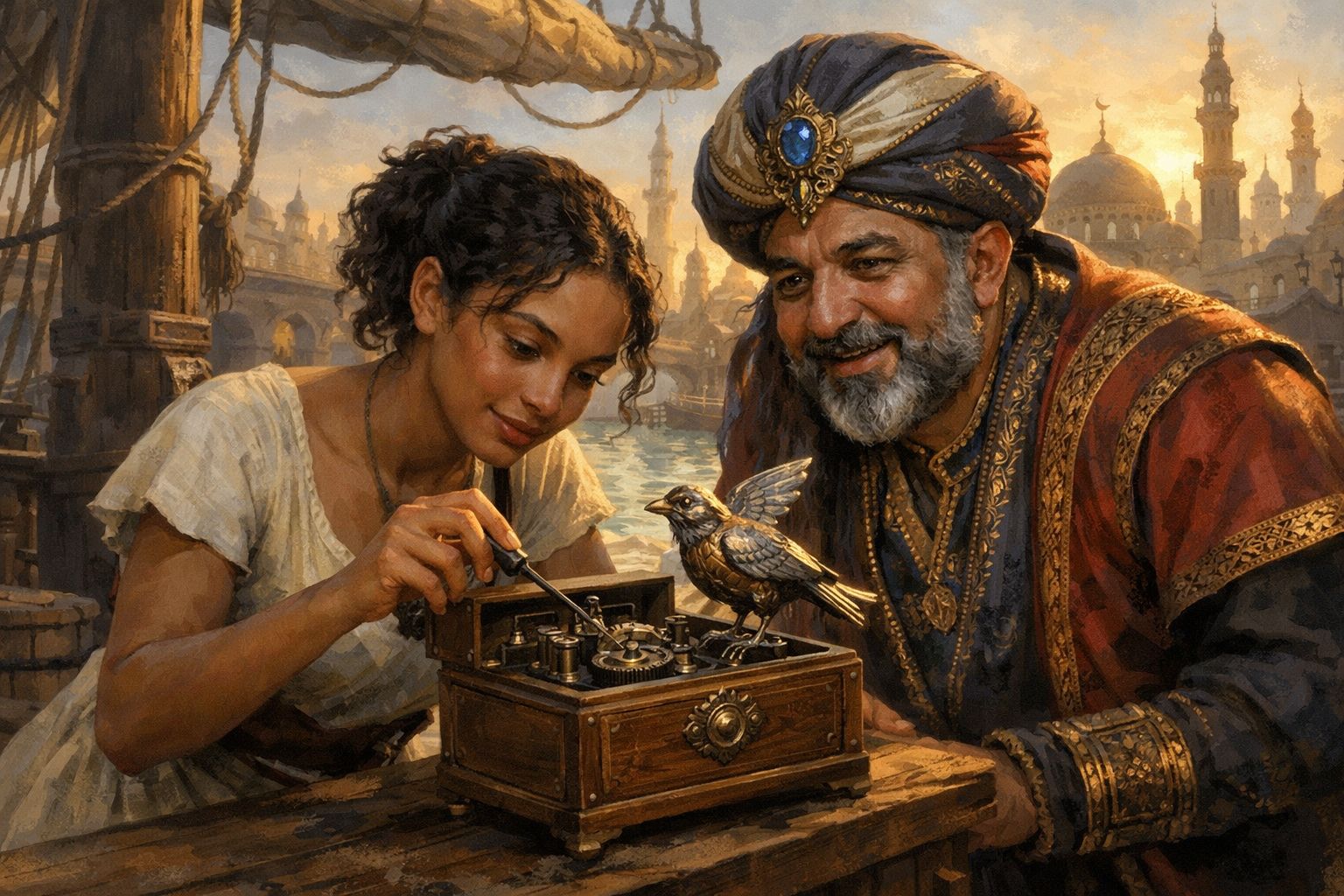
Sayd turned. Nera had coaxed the music box open, and on its lid a tiny brass bird dipped its head as the mechanism clicked. She looked up, startled to find him staring at her. He crossed the deck at once, all thought of negotiation gone.
“Did you repair this?” he asked.
Nera hesitated, then shook her head. “I made it.”
That changed him. He bent over the little bird with the absorbed fascination of a collector who had found something rarer than expected.
“You made this yourself.”
She nodded, and despite herself there was a trace of pride in her face. “It did not work properly before. I changed the spring and the gearing.”
Sayd straightened, turned and walked back to Scarnax as if nothing else in the world mattered now.
“She is the price,” he said simply. “I want her.”
Nera went pale and looked at Scarnax in open horror.
Ayesha answered first, still perfectly polite. “She is not for sale. She is not a slave.”
Sayd gave her a calm glance. “That can change.”
Scarnax’s reply was immediate. “No.”
Sayd folded his hands behind his back, untroubled. “Then not purchase. Employment, perhaps. Twenty years. She will have a workshop, tools, staff, whatever she requires. She will make beautiful things for me.”
“The answer is still no,” Ayesha said.
Scarnax stepped forward a fraction. “You heard her.”
Sayd looked past them both to Nera again, with the calm appraisal of a man already imagining the prestige she would add to his household.
“A pity,” he said. “She would be happier with purpose.”
“She has purpose,” Scarnax said.
For the first time, something colder entered Sayd’s smile. “Then you have chosen to make this expensive.” He inclined his head and turned for the gangplank. “When you are prepared to pay properly, send word.”
At the top he paused and looked back once, his gaze settling on Nera.
“In Zarhalem, refusal is only the first stage of a negotiation.”
Then he descended to the palanquin and was carried away.
No one spoke until he was out of sight. Nera still stood beside the barrel, one hand clenched around her tool, the music box open beside her like a small betrayal. Scarnax crossed to her first.
“He is not getting you,” he said.
Ayesha came to stand beside them and gently closed the lid of the box.
“No,” she said softly. “He is not.”
This scene is not meant to resolve the Nera and Waverider thread. Its purpose is to introduce it, define the problem and then leave it hanging.
Sayd ibn Murad al Safiq arrives as a polished representative of Zarhalem’s ruling class, a city where corruption, status games and slavery are not aberrations but the structure itself. He has genuine information about the Waverider, since one of his ships sailed with it for protection against pirates, but he immediately turns that information into an attempt to acquire Nera once he sees what she can do. Zarhalem is exactly the kind of place where a powerful man would treat a person as a negotiable asset, and Nera’s background makes that threat land especially hard. She is cautious, watchful and gifted with delicate mechanical work, especially clocks, trinkets, locks and repairs.
The scene should establish three things clearly. First, Sayd does know something useful about the Waverider. Second, he is not bluffing about wanting Nera. Third, the crew is very unlikely to accept his terms, because by this point Nera is not cargo or labor but one of their own. Scarnax in particular matters here, because Nera’s trust in him was built on the simple fact that he never once treated her as property. That makes his immediate refusal important both emotionally and structurally.
Basic Flow
Sayd arrives aboard the Blue Marlin in full style, with servants and guards enough to signal rank without making this an overt threat. He is courteous, expensive and self assured. He presents himself as a man who expects to be listened to. He states early that he has heard they are seeking the Waverider and that he knows where it went after leaving Zarhalem’s orbit, because one of his own ships traveled alongside it for safety against pirates. He is willing to sell that information.
The negotiation is interrupted when he notices Nera working on a small clockwork object, a music box with a mechanical bird. This matters because it makes his interest immediate and personal. He does not come aboard already intending to ask for her. He sees her skill and changes course at once. He approaches, confirms that she made the device herself and becomes visibly fascinated. Then he simply states that she is the price.
Sayd, being who he is, does not take the first refusal seriously. He suggests that Nera’s condition could change, then offers the alternative of a long employment contract instead of outright purchase. He frames it as generosity.
He is not lust driven here. He has a harem already, but Nera is not the kind of striking, ornamental beauty that would add status there. What he wants is a skilled artisan as a prestige possession, someone who can create rare mechanical marvels for his household. That makes him more specific and more Zarhalem. When the crew refuses again, he leaves without losing his composure, making it clear that they can speak again when they are prepared to pay properly.
Tone and Character Dynamics
Sayd should not feel like a ranting villain. He should be calm, elegant and perfectly at ease with the monstrous assumptions beneath his civility. In his mind, nothing improper has happened. He has something valuable, he has seen something he wants and he has named his price. That is how Zarhalem works.
Nera’s reaction matters. She should not become hysterical, but the fear should be plain. This is exactly the sort of attention her past taught her to dread. Her skill, which is normally a source of fragile pride, suddenly becomes the thing that puts her in danger. That is the emotional hook of the scene.
There is no wavering here. The later thread works better if the crew’s refusal is clean from the first moment. Nera needs to hear that refusal. This is not a scene about moral uncertainty. It is a scene about outside pressure colliding with an internal line the crew will not cross.
How to Use the Scene in Play
Most crews will refuse Sayd immediately, which is the expected outcome. If they do, the scene has done its job. The problem is now on the table. Sayd has the information. The price is unacceptable. The thread can sit and create pressure while the arc shifts toward Shaedra, Nasheem and then Yasmira.
If the players start trying to solve the problem immediately, do not let the session bog down into plans, counterplans and palace speculation yet. This is not the moment for that.
Instead, distract them by moving Shaedra’s thread into the foreground. The best version is for Shaedra to appear in a hurry, having just spotted a familiar face in the slave market or caught a lead that cannot wait. That pulls the crew into the Ivy rescue thread and leaves Sayd’s demand unresolved, exactly where it should be.
Later Function
This scene is a setup piece. It introduces Sayd, establishes the cost of the Waverider clue and puts Nera under a new kind of threat. It also creates the opening for Sandros later. When Sandros eventually appears with a poisonous but effective solution, he is not solving a fresh problem. He is offering a way through a problem the crew has already been forced to live with for a while. That is important, because Sandros works best when he arrives as the man who makes desperation useful. His whole mode is leverage, debts and soft voiced corruption.
In short, run this scene as a clear statement of the situation, then move on before they catch their breath. It should feel unsettling, unfair and unfinished. That is the point.
Shaedra and Ivy
Shaedra came up the gangplank so fast that Scarnax knew at once something had broken open.
He had still been standing with Ayesha and Nera, the taste of Sayd’s visit sour in the air, while Zarhalem glittered above the harbor as if nothing ugly had ever happened beneath its domes. Nera stood close to the rail with the music box held in both hands, still tense from the vizier’s interest. Ayesha had that hard, thinking stillness she got when her mind was already working ahead. Then Shaedra arrived, out of breath, eyes wide and raw.
“I found her,” she said.
Scarnax drew breath to say something, but she continued.
“My niece. Ivy.” Shaedra braced herself against a post, forcing the words out. “I was doing the usual search through the slave markets. I saw a private pre-sale viewing for the rich buyers, and she was there. They changed her name. They call her Lotus now.”
Her mouth twisted.
“She is being sold as some kind of living art piece. There is an artist, Nazeer al Qadim. He buys beautiful slaves, tattoos them from head to foot and sells them on as ornaments and amusements for the wealthy. The bastard did it to her. All of her.”
For a moment, nobody spoke.
Then Ayesha, ever practical, asked the question. “Can we buy her?”
Shaedra shook her head at once. “Not a chance. She is not being sold as a slave anymore. She is being sold as a luxury item, with his reputation added into the price. This is not slave prices, it is art prices. We cannot match what those people will pay.”
Nera looked up from the music box, her face pale. “Then how do we get her out?”
Scarnax’s expression went flat with decision.
“The vizier and his games can wait.” He turned and raised his voice across the deck. “Fetch Ileena. Fetch the marines.”
Then he looked back at Shaedra.
“We do it the hard way.”
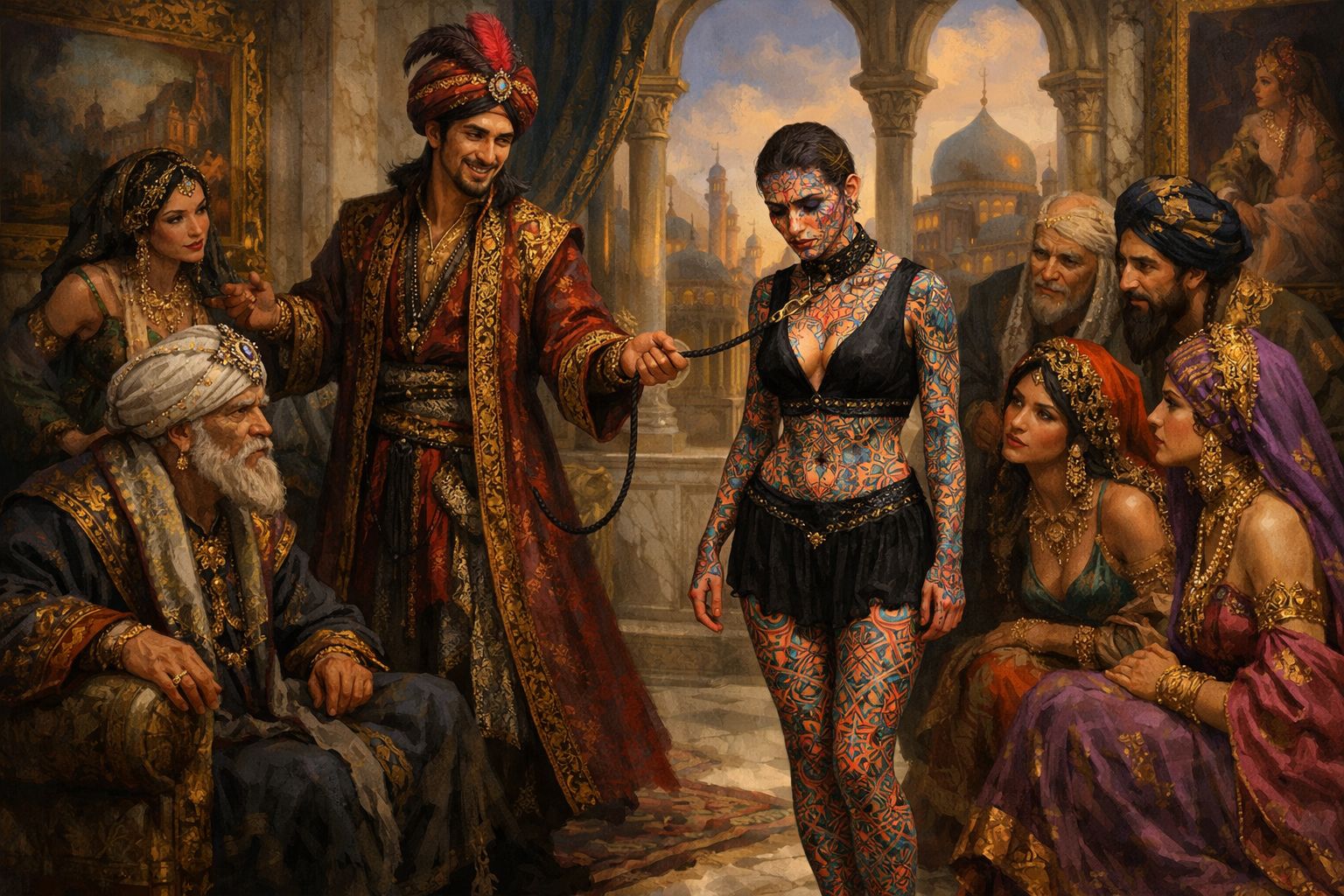
This scene shifts the arc away from Sayd and the Waverider clue and into Shaedra’s personal crisis. It should hit hard and fast. The purpose is to put Ivy in front of the crew as a concrete, immediate problem, define why time is short and make it clear that this is not something they can solve with money alone. In Zarhalem, slavery is woven into wealth, spectacle and status, and the city’s elite can afford prices far beyond anything a crew like the Blue Marlin can realistically meet.
Ivy is not being sold as an ordinary slave. She is being sold as a prestige object, with Nazeer al Qadim’s reputation built into the value. By the time she reached Zarhalem, she had already passed through years of slavery, and Nazeer spent more than half a year turning her into one of his living works before preparing to sell her onward at a far higher price. That is what Shaedra discovers here.
If Shaedra Is a Player Character
If Shaedra is player controlled, play out the search through the slave markets. This should not feel like a brisk information gathering scene. It should feel like a ritual of hope and despair that she has repeated many times before. The markets of Zarhalem should show wealth and degradation side by side, with polished buyers, imported luxuries and human misery treated as part of the same economy. Zarhalem thrives on spectacle, and its beauty is always paid for in blood.
The pre sale showing should be presented as an art exhibition rather than a slave pen. Ivy, now called Lotus, is displayed as a luxury piece for wealthy buyers. Nazeer al Qadim walks her on a leash, proud of his work, while prospective buyers sip wine, study her closely and discuss her in terms of taste, status and craftsmanship. This should feel less like a market than a polished ritual of revulsion, where ornament, cruelty and prestige have become the same thing. Shaedra should see at once both that it is Ivy and that the price will be hopelessly out of reach.
If Shaedra Is an NPC
If Shaedra is not player controlled, begin with her returning to the ship in haste and telling the story. She should be out of breath, emotionally stripped raw and speaking with the urgency of someone who has just found a lost piece of her family and is in danger of losing her again almost immediately.
She explains that during her usual search of the slave markets she found Ivy in a private pre sale viewing for elite buyers. She explains that Ivy has been renamed Lotus, turned into a living art piece by Nazeer al Qadim and prepared for sale as a luxury item for the extremely rich. She should also make clear that this is happening tomorrow evening. There is almost no time.
Price and Urgency
Do not let the players linger too long on the possibility of simply buying Ivy. They may ask, and it is reasonable that they do, but the answer should be clear. Zarhalem’s elite are obscenely wealthy, and a piece like this is being sold at art prices rather than slave prices. Nazeer’s name, reputation and the exclusivity of the sale drive the value even higher. The crew is not competing with merchants or overseers. They are competing with nobles, viziers and collectors who can spend fortunes for vanity alone.
That impossibility is important. It pushes the crew away from negotiation and toward infiltration, theft or violence. It also reinforces what Zarhalem is. In this city, a person can be transformed into a prestige object and priced accordingly.
Nazeer al Qadim’s House
Finding Nazeer’s home is not difficult. He is rich, well known and socially prominent. Unlike many high status people in Zarhalem, he lives alone. He keeps no regular household staff or slave retinue, other than the people he is currently working on as art projects. He wants privacy, control and freedom from interruption. Instead of resident staff, he pays workers to come in each morning to clean, cook and perform the practical tasks of maintaining the house.
The house stands in one of the rich quarters of the city. It is elegant, secure and designed to impress. At street level there is only one real entrance, the front door. That should matter for planning. The upper levels, however, have several balconies, which provide possible alternate routes in or out. The place should feel expensive, quiet and faintly obscene in its refinement. Nazeer is not a fortress lord. He is a decadent artist with too much money and too much confidence, who relies on status for protection.
Tone and Direction
This thread should become the emotional center of the first half of the Zarhalem arc. The discovery of Ivy is meant to cut across the crew’s discussion of Sayd and force an immediate reprioritization. Nera and the Waverider clue remain unresolved, but they are no longer the most urgent wound in the room.
Push speed here. Once the crew understands who Ivy is, how she is being sold and how little time remains, move them toward action. The point is not whether they care. They will care. The point is what they do, how fast they move and how ugly the rescue may need to become.
Ivy’s later role aboard the Blue Marlin gives this thread long weight, but in the moment it should feel immediate, furious and personal. Her background, her long years of captivity and the way she later joins the crew all make this more than a simple rescue. This is the moment where Shaedra’s loss becomes present again in living form.
The Rescue
The balcony rail still held the day’s heat when Ileena slipped over it and into Nazeer al Qadim’s house.
Below, in the shadow by the front wall, Shaedra, Amaxia and Skarnulf waited in silence. The rich quarter of Zarhalem lay quiet around them, all carved stone, perfume and money. A moment later the front door opened from within, and Ileena’s pale eyes glinted in the dark.
“Slow house,” she whispered. “Come.”
They moved inside. The place was all silk, marble and controlled quiet, the kind of luxury that made Shaedra’s skin crawl. Ileena led them down a corridor to a small locked room. Skarnulf broke the lock with a careful twist, and the door opened.
Ivy was there.
She lay chained to a bed, wrists and ankles fixed in iron, almost naked, the dense tattoos covering her visible skin like something done by hatred made patient. Her eyes flew wide at the sound, fear first, then disbelief as she saw Shaedra.
Shaedra crossed the room at once and dropped to her knees beside her. “Ivy.”
Ivy’s mouth trembled. “He has the key,” she whispered.
Amaxia had already turned. “Then we take it.”
The others moved on, leaving Shaedra with her niece.
They found Nazeer asleep in his bedroom, wrapped in soft linen and safety. Amaxia ripped him out of bed before he could properly wake. He hit the floor and tried outrage first.
“Do you know who I am!”
Amaxia hauled him upright and slammed him against the bedpost. “Yes,” she said. “Vermin.”
When he kept talking, she punched him in the gut. Skarnulf shut the door and said calmly, “You should listen to her.”
That broke him. He sagged, gasping, all status gone, and began to beg. Money. Jewels. Mercy. Amaxia only asked for the key.
Behind them, Ileena searched drawers until she found a ring of keys and held it up. “Here.”
Amaxia looked at Skarnulf. “Need him any longer?”
“End him before Shaedra gets here, or she'll take all night killing him,” Skarnulf said.
Amaxia stabbed Nazeer in the neck and let him crumple to the floor. Ileena glanced at the body and muttered to herself, “No heart worth eating. No strength, only money power.”
They ran back to the small room. Shaedra looked up at them, the question unspoken, and Amaxia gave a single nod.
Ileena unlocked the shackles while Skarnulf drew off his cloak. One by one the irons opened. Shaedra helped Ivy sit up, and Skarnulf wrapped the cloak around her shoulders. Ivy pulled it shut with both hands, still looking as though she did not believe any of this was real, clutching Shaedra as if she was afraid she was just a dream.
“Come,” Shaedra said.
They moved out into the night together, fast and silent, leaving the rich man’s house behind them.

This is the payoff to Shaedra’s discovery and the moment where revulsion turns into action. The point of the rescue is not tactical elegance for its own sake, though a careful crew can certainly approach it that way. The point is to break into Nazeer al Qadim’s private world, see what kind of man he truly is and take Ivy back before she is sold. The house should feel like a place where refinement and obscenity have been fused together so completely that one can hardly be told from the other.
The emotional center of the scene is Ivy. The practical center is speed. The moral center is Nazeer. He is not a dramatic rival or a dangerous champion. He is a small, vile man made bold by money, status and the assumption that no one will ever force him to answer for what he does. The rescue should strip that protection away.
The House
Nazeer’s home stands in one of Zarhalem’s wealthy districts, surrounded by the silence, beauty and expensive privacy of the upper city. It is not a fortress. It relies on status more than hard defense. That should matter. The place should feel secure because rich people assume the world will protect them, not because it was built for war.
At street level, there is only one real entrance, the locked front door. That makes the house feel closed and controlled from below. The upper floors, however, have several balconies and windows, which create clear opportunities for climbing, infiltration or escape. A stealthy entry from above is likely the most natural approach, especially with someone like Ileena involved, but clever crews may invent others.
Inside, the house is all marble floors, carved screens, silk hangings, expensive lamps, cushioned benches and polished wood. It should feel beautiful in the way wealth often is, but dead. Not warm luxury. Curated luxury. Too quiet, too clean, too deliberate. The whole place should seem arranged for control, isolation and aesthetic display.
Important Rooms
Ivy’s Room
Ivy is being kept in a small room without windows. The lack of windows matters. It makes the room feel less like a bedchamber and more like storage. The door is locked. Inside, she is chained to the bed. Do not overcomplicate this room. Its horror lies in how simple it is. There is no attempt to disguise what it is for.
Ivy should look marked, exhausted and emotionally frayed. Depending on how you want to present the scene, she may be fearful, stunned or numb when the crew arrives. The important thing is that rescue does not feel simple to her right away. She has been trapped, used and displayed for many years. Freedom may feel unreal, frightening or even hard to trust at first.
Nazeer’s Bedroom
This is a large and luxurious room, meant for comfort and private indulgence. There is a broad bed with expensive linen, carefully chosen furnishings and the sort of tasteful richness that would impress polite guests. Nazeer is sleeping here when the crew arrives, unless their timing or noise changes that.
The keys are here, in the drawer of a side table. Finding them should be quick and not especially difficult. The point is not to turn the room into a puzzle. The point is to force a confrontation between the rescuers and the man responsible.
Nazeer’s Studio
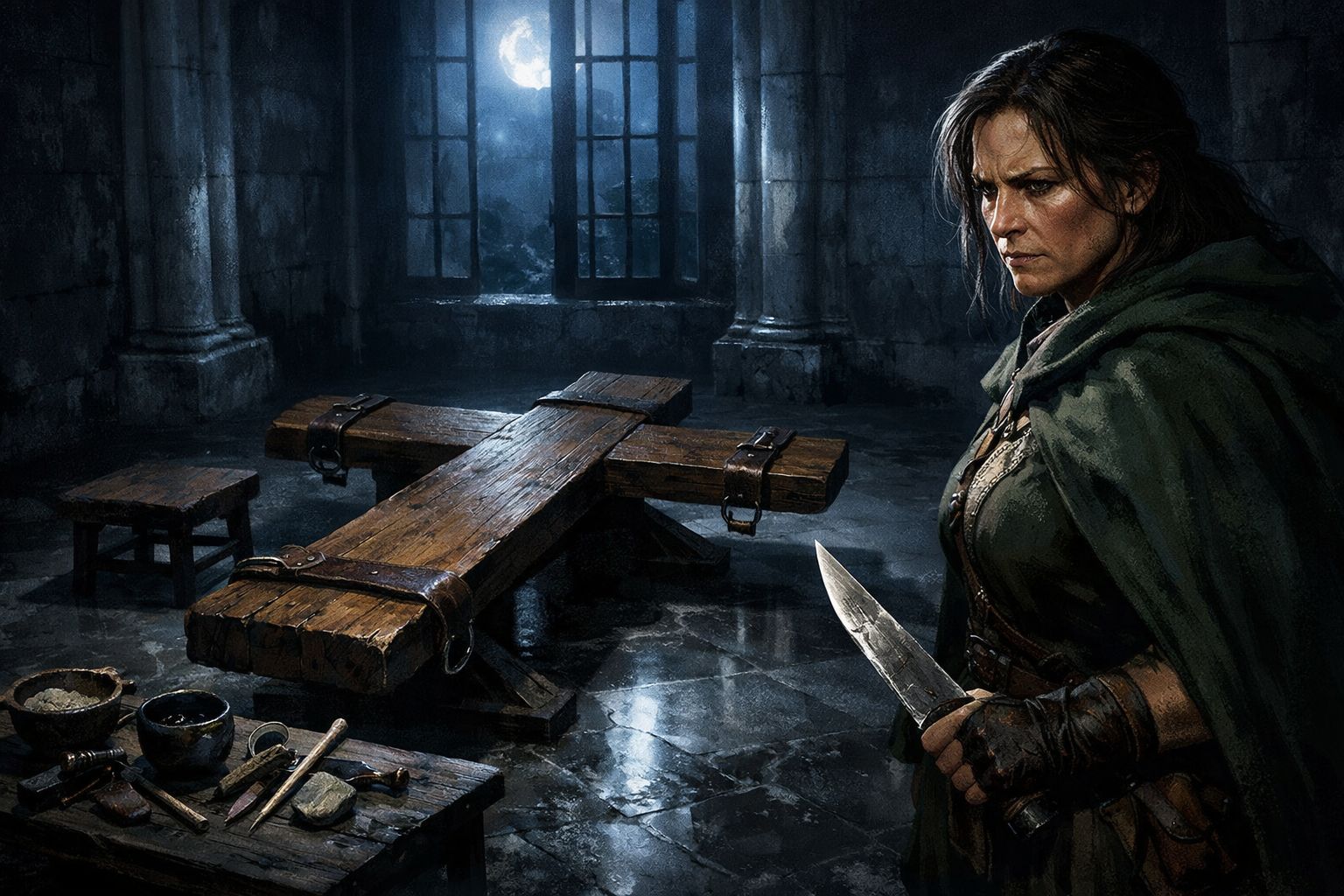
This is the real heart of the house, and the most disturbing room in it.
The studio is large, arranged for light, with broad windows designed to let in the sun. It should look at first like an artist’s workspace. There are sketches, pigments, tools, fabrics and reference pieces. Then the full ugliness of the room becomes clear. At its center is a cross-shaped bench fitted with multiple restraint points. Nearby stands a chair built not for comfort, but for immobilization, again with heavy restraints. Tattooing tools are laid out with care, cleaned and arranged like instruments of a respectable craft.
There should also be sketches for completed and planned work. These matter. They show the cold deliberateness of what Nazeer does. He is not impulsive. He plans violation as composition. Most horribly, among the sketches are notes and designs for his next project, and it becomes clear that he is now considering full body scarification as a new artistic direction. That should make the crew understand that Ivy was never the end of his cruelty, only one stage in it.
Nazeer al Qadim
Nazeer should not be played as brave. He should be played as a man whose confidence depends entirely on his protections.
When confronted, he begins with indignation, status and disbelief. He demands to know who is in his house. He invokes his name, his standing and the consequences of touching him. He expects the world to remember who he is before he has to remember what kind of people stand in front of him.
The moment that fails, he collapses fast. He should quickly turn from pompous outrage to sniveling self preservation. He offers money, influence, excuses, anything. There is no hidden steel in him. He is not admirable even in his fear. That is important. He should shrink.
Running the Confrontation
Do not treat this as a boss fight.
If the crew confronts Nazeer directly, the scene should feel ugly, brief and one sided. He is an artist, not a warrior. He may struggle, scream, beg or attempt to flee, but he should not become exciting as an opponent. This is not the kind of scene where a villain reveals surprising competence. If he dies, it should feel less like slaying a dangerous enemy and more like exterminating vermin.
That matters tonally. A dramatic duel would give him too much dignity. The house, the studio and Ivy’s condition are what should carry the horror. Nazeer himself is contemptible. The world is better without him, and everyone present should feel that clearly.
The Rescue Itself
The rescue should move in two beats.
First, entry and discovery. The crew gets inside, locates Ivy and understands the immediate problem. She is chained. The door is locked. The key is elsewhere.
Second, resolution and extraction. Once the key is recovered, the shackles can be opened and Ivy prepared for movement. Cover her at once. A cloak, blanket or loose robe is enough. The point is not only decency, but concealment. She must not be recognizable moving through the city.
Leaving the House
Once Ivy is free and covered, getting out is relatively simple unless the crew has made a great deal of noise or left obvious evidence. The rich quarter is quiet at night. There are few people in the streets, and in Zarhalem people learn not to ask questions that might attach them to powerful men’s scandals. A group moving quickly and quietly with a veiled or cloaked figure is not likely to be challenged.
The key is not to overcomplicate the exit unless the players themselves force complications. The real difficulty is inside the house. Once they are out, the tension should shift from immediate danger to concealment and aftermath.
Hiding Ivy
After the rescue, Ivy must be hidden aboard the Blue Marlin until the crew is ready to leave Zarhalem. She cannot be allowed to move openly in the city. Her appearance is too distinctive, and if word spreads quickly enough, anyone looking for Nazeer’s missing art piece may connect the disappearance to the harbor.
That said, no one is likely to search the Blue Marlin unless the crew leaves a good trail. Zarhalem is a city of wealth, vanity and competing scandals. If the rescue is done cleanly, suspicion may remain diffuse for a while. That gives the crew breathing room, but not safety. The more noise they make, the more that breathing room shrinks.
Tone and Aftermath
This should be a deeply satisfying scene, but not a triumphant one. Ivy is rescued, but what was done to her remains. Nazeer may be dead, but that does not undo anything. The satisfaction comes from ending one source of filth and taking her out of his hands, not from cleansing the wound.
The tone should therefore be grim relief. One foul thing has been removed from the world. One stolen person has been brought back. That is enough for the moment.
It also sets up Ivy’s later place aboard the Blue Marlin. She does not leave this scene healed. She leaves it alive, frightened, marked and clutching at the first real chance at a future she has had in years. That is what the rescue buys. Not peace. A beginning.
Nasheem and Safina
Nasheem left the Blue Marlin alone and walked into Zarhalem like a man returning to a grave that still remembered his name.
The city had not changed. White stone caught the evening light, gold trim gleamed on balconies and the air carried wine, perfume and hot dust cooling after the day. He passed streets he had once known well, courtyards where he had laughed, doorways where he had lingered too long, corners that still seemed to hold the shape of old habits. For a few dangerous moments, it even felt like home.
He went at last to the house of an old friend, Kahtim ibn Selim al Hareth. Kahtim opened the door himself, stared in shock and then pulled him quickly inside before the street could witness too much. They sat in a shaded courtyard room with a fountain whispering nearby, and Kathim poured wine with hands that were only slightly unsteady. At first they spoke of old days, of men they had known and scandals that had once seemed important, circling the true reason for the visit like both of them hoped it might somehow change if left untouched for long enough.
At last Nasheem set down his cup.
“Safina.”
Kahtim’s face changed at once. He looked down into the wine before answering.
“When your property was auctioned, Rashid al Mazhar moved quickly. He bought her almost at once.”
Nasheem went still. Then he let out a slow breath through his nose.
“That carrion bastard,” he said softly. “Was that part of it, then? Was that why he framed me?”
Kahtim said nothing, and that was answer enough.
Nasheem rose. Karim stood with him.
“Be careful,” he said. “This city remembers who it hates. And it does not forgive.”
Nasheem gave a faint smile that carried no warmth at all.
“No,” he said. “It never did.”
Then he stepped back out into the streets of Zarhalem, where the lanterns were being lit and the city shone all the brighter for the darkness gathering around it.
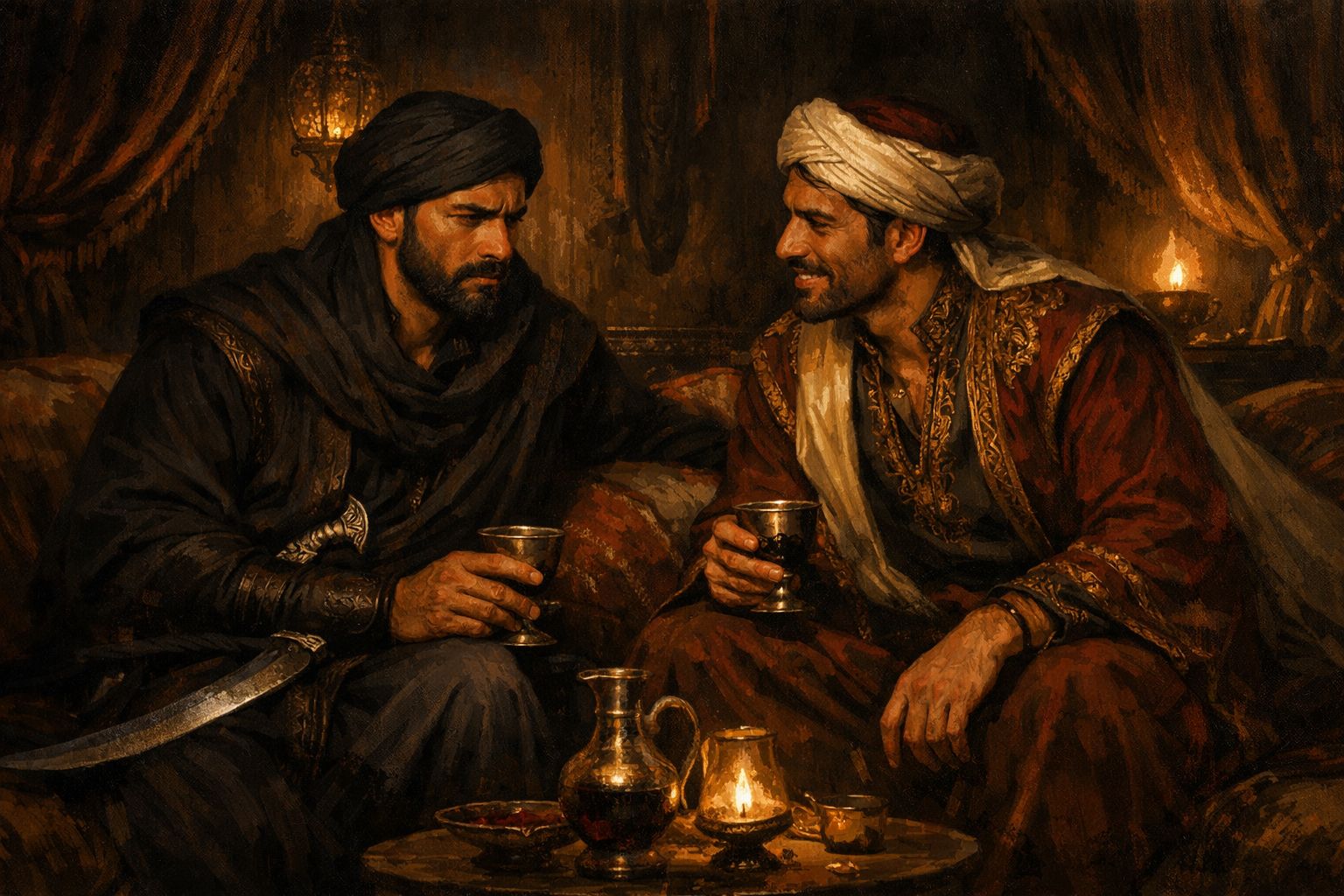
This thread is not really about action. It is about loss, belated truth and what remains when revenge has already been taken by someone else. Nasheem comes back to Zarhalem as a man who once belonged there, but now walks it as an exile shaped by shame, honor and the memory of Safina. Safina is the one regret that still aches quietly beneath everything else, and Zarhalem is exactly the kind of city where wealth, slavery and court intrigue make this kind of wound plausible.
The important thing is that the Game Master chooses the emotional direction of the thread before play begins. Do not drift into the answer. Decide it first. The two versions are not small variations. They change what the thread means, what Nasheem carries afterward and whether he remains part of the campaign. Nasheem is a calm, honorable man who rarely loses control and still carries a quiet hope that Safina may be alive. That is exactly why this thread hits as hard as it does.
The Two Paths
Path One: The Child Never Lived
This should be treated as the default and most probable version.
Safina was pregnant with Nasheem’s child, and Rashid al Mazhar killed her before the birth. In this version, the pregnancy itself is the reason he had her killed. The cruelty is total and final. This makes the thread purely tragic. Nasheem gets no future, no corrective choice and no clean target for revenge. Rashid is already dead by the time he gets there. All that remains is knowledge, grief, emptiness and the awareness that even his vengeance has been taken from him by someone else.
This version is best if you want the thread to deepen Nasheem without removing him from play. He returns to the Blue Marlin carrying a heavier shadow and will need the support of the crew to bear it.
Path Two: The Child Lived
This version should be chosen only if there is a strong campaign reason for it.
Use it if Nasheem is an NPC and you want to write him out cleanly, or if his player wants to leave the campaign or change character and wants a dignified, painful but beautiful exit. In this version, Safina survives long enough to give birth, then Rashid kills her because of the child. The daughter, Serafina, is now five years old and has been placed in the care of one of Rashid’s concubines, Zuleikha.
This creates a different thread. The pain is still there, but it becomes a choice instead of a void. Nasheem must decide whether to take a child who does not know him from the woman she sees as mother, or walk away and leave her where she is. If he chooses the child, it will remove him from further play. The Blue Marlin is no place to raise her, and the decision only has weight if it changes his life completely.
If Nasheem Is an NPC
If Nasheem is not player controlled, run this thread off screen.
He goes ashore, follows the trail and returns later to tell the crew what he found. The value here is not in making the players play detective through his private grief, but in letting the emotional weight land through his changed mood, his account of what happened and the support the crew then offers him.
In the tragic version, he returns quieter and more hollow. In the child version, he returns with a decision to make, and that decision could lead toward his departure from the Blue Marlin.
The Track
First Stop: Kahtim
The natural first stop is Nasheem’s old friend Kahtim. The Game Master can simply tell the player that this is the obvious place to start. Kahtim is his bridge back into old Zarhalem, someone who knew him before his fall and still has enough sympathy or loyalty left to receive him.
Kahtim confirms that Rashid al Mazhar was quick to buy Safina when Nasheem’s property was auctioned off. That information should wound immediately. It tells Nasheem that Rashid’s attack on him was not only political ruin, but deeply personal revenge. It also points the investigation toward Rashid’s household.
Following the Thread
From there, Nasheem can approach the problem in several ways. He may try Rashid’s house directly. He may gather rumors first. He may ask among servants, old contacts or minor retainers. The exact route can vary, but the thread should eventually lead him to one of Rashid’s former concubines, Zuleikha.
This woman is the real source of truth. She should not feel like a quest dispenser. She is someone who survived Rashid’s house and has every reason to fear men, especially strange men with old claims. Nasheem’s behavior matters here. His honor and softness are part of what define him, and they should matter in the scene.
What Zuleikha Knows
She tells him that Rashid killed Safina. He was a cruel man, and her death was brutal. Do not make this decorative. The point is not gore. Rashid has killed many women, and Zuleikha has been hurt by him as well and does not want to talk about it. The point is that Nasheem learns the truth and cannot hide from it.
She also tells him that Rashid is already dead. She glimpsed the killer, and believes it was a woman Rashid had previously tortured and who later escaped. The woman was named Kethra. That ties the thread back to the Waverider and reinforces that both ships carry people who do not always let certain kinds of cruelty stand. Zuleikha confides that she didn't raise the alarm, that she wanted Kethra to get away with the revenge.
She knows Safina was pregnant. From there, the thread splits according to the path chosen earlier.
In the tragic path, Safina’s pregnancy is the reason she was killed, and the child never lived.
In the exit path, Safina gave birth before Rashid killed her, and the child was then placed in Zuleikha’s care. The household is now under Rashid’s eldest son, who is a far better man than his father and, according to Zuleikha, has made it a point to not be like his father.
The Choice
If the Child Never Lived
This path leaves Nasheem with no just revenge left to take and no living future to claim. Rashid is dead. Safina is dead. The child is dead. Even vengeance has already been done by another hand. That is the shape of the tragedy.
What remains is guilt, grief and the sense that he was too late in every way that matters. If he returns to the crew after this, he should carry it heavily. He may become quieter, more tired or more brittle in private moments. The crew’s support matters here. This is not a thread that ends with a solved problem. It ends with a wound becoming fully known.
If the Child Lived
This path creates a terrible and human choice.
Nasheem’s daughter is now five. She does not know him. She sees Zuleikha as her mother. If he takes the child away, it will be traumatic for both Serafina and the woman who raised her. It will also mean he must settle somewhere and leave the Blue Marlin. If he walks away, he abandons his own daughter.
There is no easy moral victory here, and there should not be one. Zuleikha has no interest in him. She sees him as an outlaw and a dangerous complication. Building a new family with her is not an option. The choice is simply whether he tears the child from one truth to restore another, or lets the life she now knows remain intact.
If he chooses the Serafina, remove him from further play. That choice should cost him the sea.
Running the Meeting with the Concubine
Nasheem found Zuleikha in the market just after midday, a basket on her arm and a veil light enough to hide only what she chose. The shade cloths above the narrow street turned the sunlight into bands of gold and dust, and the air smelled of saffron, fruit and hot stone. When he said her name, she looked up sharply and went still at once, as if the wrong word from him might send her running.
“Zuleikha.”
He stopped where he was and kept his hands open at his sides.
“I am not here to trouble you,” he said. “My name is Nasheem.”
That made her study him more carefully. The fear did not vanish, but his calmness seemed to take some of the edge off it. She glanced once down the market, then back at him.
“You should not use that name here,” she said quietly.
“It is the only one I have.”
For a moment she said nothing. Then he spoke the name that mattered.
“Safina.”
Something changed in her face. She shifted the basket on her arm and nodded toward a quieter lane beside the market.
“Walk with me.”
They moved out of the busiest stretch, past sacks of grain and baskets of herbs where fewer people pressed close enough to overhear. There she told him the truth. Rashid al Mazhar had bought Safina quickly when Nasheem’s property was auctioned. He had been cruel to her, and in the end he had killed her. Rashid himself was dead now, killed by a woman named Kethra, one he had once tortured and who had escaped him. Zuleikha admitted, with a hard flicker in her voice, that she had not raised the alarm. Some revenges deserved to succeed.
Then she told him the thing that stopped the world.
“Safina was carrying your child.”
Nasheem went still.
“She gave birth before he killed her,” Zuleikha said. “A daughter. Her name is Serafina. She is five now.”
For the first time, all the steadiness left his face.
Zuleikha watched him closely. “She knows me as her mother. She knows nothing of you. If you take her, you tear her from the only life she knows."
She reached into her sleeve and drew out a small locket, worn smooth by years of handling. When she placed it in his hand and he opened it, Safina’s painted face looked back at him from one side, and on the other was a solemn little girl with dark eyes that looked like her mother's.
Nasheem stared at it for a long time.
"And if I leave her," he said quietly, "I abandon my own blood."
“I do not know what the right thing is,” he said at last.
Zuleikha gave a tired, sorrowful smile.
“No,” she said. “Neither do I. Please do not take her, I beg you.”
Then she turned back toward the market, leaving him alone in the shade with the face of his daughter in his hand.

The tone of this scene matters. If Nasheem handles it badly, becomes threatening or implies that she is stealing the child, the concubine will alert the authorities. That keeps the scene honest. She is sympathetic to his loss, especially as Safina was her close friend as well. However, she has every reason to protect herself and the child from a desperate man who suddenly appears with old claims.
If he is honest, controlled and kind, she should not turn him in. Nasheem’s quiet courtesy, honor and refusal of cruelty are central to who he is, and this is a good place to let those traits matter. He cannot win the situation cleanly, but he can avoid making it uglier.
If he wins her sympathy, she gives him a locket he once gave Safina. It contains a painting of Safina, and, if she was born, Serafina.
Tone and Outcome
This thread should not feel like an adventure victory. It should feel like walking through the afterlife of a choice already made. Rashid has already done the harm. Kethra has already taken the revenge. Nasheem arrives too late to save, too late to punish and just in time to understand.
That is the point.
If he returns to the Blue Marlin, he brings the weight of that understanding with him. He may need space, quiet or support from the crew.
If he leaves to raise the child, that should feel like a painful but meaningful severing of one life in order to reclaim another. Give him an emotional send-off, and let him ask the ship to take him to a good place to settle.
In either version, the thread should leave a mark. Not a twist. A mark.
Yasmira's Fall
Yasmira moved through the market with the absorbed seriousness she reserved for food, which was to say she moved like a scholar among holy texts. She paused at one stall to rub saffron between her fingers, at another to sniff a bundle of dried leaves, then leaned over a tray of powdered spices while the merchant offered little tin spoons for tasting. Beside her, Mbaru carried sacks that were growing steadily heavier, though his face wore the patient resignation of a man who had long ago accepted that accompanying Yasmira to market meant returning with half the bazaar on his back. Now and then she held something up for him to smell, and now and then he pretended to have opinions more refined than "it smells strong."
The market around them was all heat, perfume and color. Zarhalem always knew how to make its cruelties wear jewels. Sunlight filtered through cloth awnings in strips of gold and shadow. Silks hung from poles. Copper bowls flashed. Vendors called out prices in voices polished by long practice, and all the while the city’s real law remained where it always was, beneath the beauty, invisible until someone stepped across it.
Yasmira had just finished bargaining for a jar of preserved citrus peel when a voice behind her said, smooth as oiled brass, "I did wonder whether you would show your face here again."
She turned.
Qadir ibn Faruq al Mazhar Abd al Rasid stood a few paces away in embroidered robes the color of dark wine, one hand resting lightly on the head of a cane he did not need. His beard was trimmed with insulting precision. Two attendants lingered behind him, and around him the market seemed to shift by instinct, people making room not because they respected him, but because they recognized what rank could do.
For one heartbeat Yasmira was back in another life, in another polished hallway, hearing silk move and laughter from behind closed doors. Then the moment passed, and disgust took its place.
Qadir smiled as if he had caught a servant skulking where she ought not be.
"You left badly," he said. "I was annoyed."
Mbaru straightened a little behind her, the sacks in his arms settling with a soft rustle. He did not yet move, but his eyes had sharpened.
Qadir continued in the same overbearing, satisfied tone. "Still, I am prepared to be generous. You may return to my household. I will have someone speak to the harbor and settle whatever arrangement you currently imagine yourself to have."
Yasmira stared at him. Then, without a word, she spat on the ground between them and turned to walk away.
The market seemed to stop breathing.
Qadir’s hand closed around her arm.
It happened very fast after that.
Mbaru let the sacks fall at once, spices thudding against the stone. He stepped forward, but Yasmira was faster. She spun and drove her fist straight into Qadir’s face with all the force of years she had not spent bowing. There was a wet crack. He staggered back with a cry, blood pouring from his nose onto his robes.
For a heartbeat there was silence.
Then everything broke loose.
Qadir clutched his face and screamed, not in pain alone but in outrage so complete it sounded almost childish. "She struck me! Seize her! Seize her at once!"
People turned. Vendors backed away. One woman snatched her child aside. Mbaru was already moving toward Yasmira, but guards were converging from two directions, drawn by the cry and by the sight of a well dressed man bleeding in public.
Yasmira took one look at the number of them and understood at once that this had grown too large to fight cleanly.
They grabbed her arms. She struggled once, more from fury than hope, then turned her head sharply toward Mbaru.
"Get the captain!"
He hesitated for only a fraction of a second, every instinct pulling him in two directions. Then he ran.
Behind him, Qadir was still shouting through the blood, one hand pressed to his ruined nose as he pointed after Yasmira like a man denouncing a criminal before the gods. Guards dragged her into the street, and the market of Zarhalem swallowed the scene almost at once, as if the city had been waiting all along for someone to forget their place.
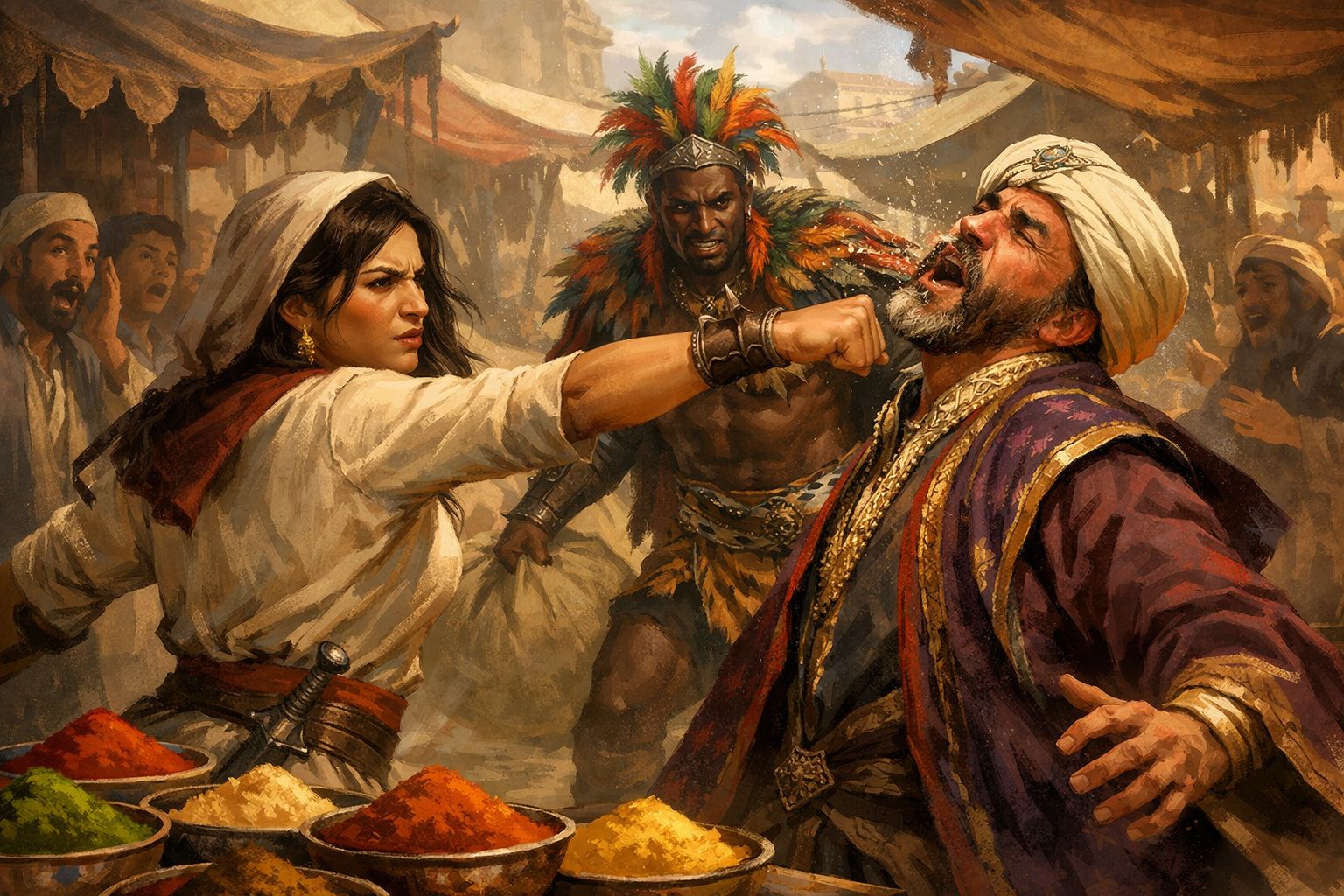
This thread is about status, humiliation and the way Zarhalem’s system closes ranks around the powerful. Yasmira’s arrest should not feel like bad luck. It should feel like the city revealing its true logic. She left Zarhalem once and built a life of her own aboard the Blue Marlin, but the city still assumes it can reach out, seize her and drag her back into the old pattern. Her background makes that especially sharp. She once served a noble household where polish and predation lived side by side, and aboard the Blue Marlin she later became both the ship’s cook and an important expert in poison and courtly danger. She often visits markets for ingredients and usually brings Mbaru as escort, because the two have a practiced rhythm there.
This is not a fair thread. That matters. The point is not whether the crew can prove Yasmira morally justified. The point is that in Zarhalem, proof matters less than rank. The city’s law supports slavery as infrastructure, and the punishment for crime is always enslavement. That is the logic Qadir exploits.
Best Timing
The best time to trigger this thread is when the crew is already under pressure, ideally just before the night they intend to rescue Ivy.
That timing matters for two reasons. First, it increases the sense that Zarhalem is overwhelming them with simultaneous demands. Second, it forces triage. They do not get to solve Shaedra’s crisis, Nasheem’s grief and the Waverider thread one at a time. Yasmira’s fall should make them feel the cost of being stretched thin.
Do not open Zarhalem with this scene. Let the crew settle into the city first. Then hit them when they are already trying to hold too many things at once.
If Yasmira Is an NPC
If Yasmira is not player controlled, do not play the market scene directly unless you have a strong reason.
Instead, have Mbaru, or whoever escorted her, come back to the Blue Marlin in haste and tell the story. If a player character escorted her instead, let that player be the witness. This keeps the focus where it belongs, on the pressure the crew now faces, rather than turning a non player character’s arrest into a scene the players only watch.
The report should be clear and urgent. Qadir approached her in the market, spoke to her as though she still belonged to him, she refused him publicly, he grabbed her and she broke his nose. Then the crowd and guards turned the moment into a legal crisis too large to fight through cleanly.
The Confrontation
Qadir ibn Faruq al Mazhar Abd al Rasid should arrive wrapped in the full weight of his own importance. He is not merely rude. He is overbearing in a way that assumes obedience. He speaks as a man who believes status is reality. His tone should make it clear that in his mind Yasmira’s refusal to return is not a decision, but insolence.
At first, he plays entirely on rank. He expects her to fold under authority. When she does not, and especially when she humiliates him by breaking his nose in public, he changes tactics at once. He does not stop using status. He simply changes how he uses it. He becomes the injured party, the outraged diplomat and the man whose public dignity has been attacked. That is how he gets the system behind him.
Do not let this become a street fight. Nearby people should react quickly, not because they love Qadir, but because they understand what happens to those who fail to respect what his status means. Guards should arrive in numbers, fast enough that the crew understands fighting through them would be a serious escalation. This is a scene about being swallowed by the city’s order, not winning a skirmish.
Immediate Aftermath
Once Yasmira is arrested, it should not be hard to learn where she has been taken. Zarhalem is used to this kind of thing. Everyone knows where the courthouse is. Anyone with a little effort or coin can learn that she is under arrest there and that the trial will be held first thing the next morning.
This is important for pacing. Do not make the crew waste time solving where she is. The point is not mystery. The point is pressure. They know where she is. They know when judgment is coming. Now they must decide what to do.
The Trial
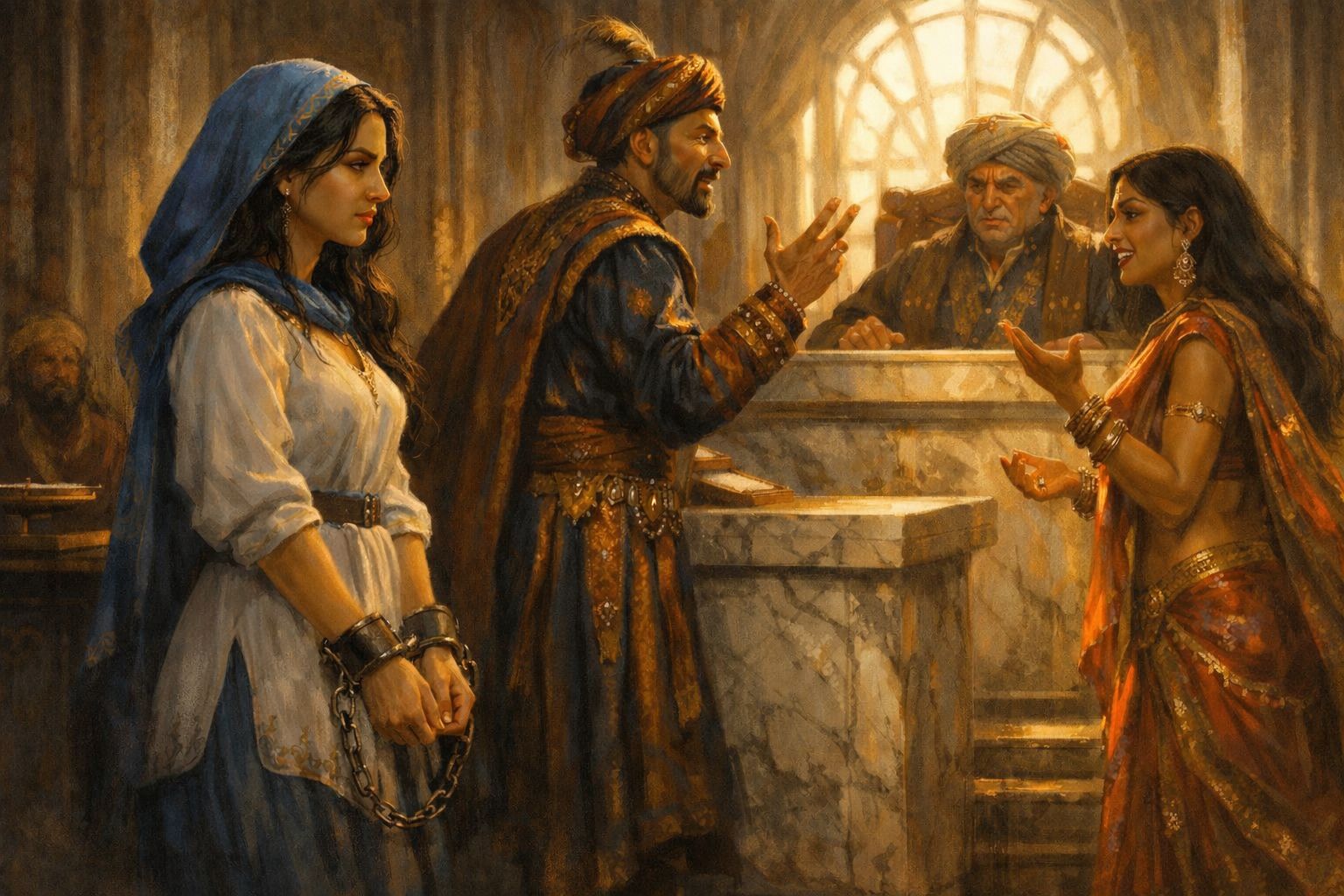
The trial should be fast, formal and fundamentally unwinnable.
Let the crew speak. Let them provide witnesses, arguments and eloquent rhetoric if they wish. Let them try to frame Qadir as the aggressor or describe Yasmira’s past with him. All of that is fine. It may even matter for tone. But it should not change the verdict.
This is a Zarhalem court. Status is the real law. Qadir has it. Yasmira and the Blue Marlin do not. That should be obvious in the room itself, in the way people speak to him, defer to him and interpret the facts in the light most favorable to his dignity. The verdict, as always in Zarhalem, is guilty. The punishment, as always, is slavery.
Qadir then argues that, as the injured party, he should have first right to purchase her from the state. The court grants this without difficulty. He buys her at once.
The point of the trial is not suspense. It is revelation. It shows the crew that Zarhalem’s system is not corrupt because it has failed. It is corrupt because it is functioning exactly as designed.
Rescue Options
Once Qadir has purchased Yasmira, the crew has several possible approaches.
Negotiation
Negotiation is possible, but it should be fruitless. Qadir is too rich, too proud and too invested in status to be tempted by ordinary offers from the Blue Marlin. He does not need their money. More importantly, selling her back would look like weakness, and public status is the center of his world.
Armed Rescue
An armed rescue is possible, but harder than Ivy’s rescue. Qadir takes security seriously. He has a larger household, more guards and a better organized domestic structure. The crew can attempt direct violence, but it should feel risky and noisy, with a real risk that servants, slaves or household staff are caught in the middle.
Heist
A stealth approach is also possible, though still difficult. The household is large, inhabited and socially important. This is not the sort of place one enters casually. A heist can work, but it should feel like a real challenge.
Blackmail
This is the most effective path.
Ayesha can pull on diplomatic contacts, especially the Mataraaj and Estoria ambassadors, both people she knows well, to look for workable dirt on Qadir. The Game Master can hint at this route discreetly by consistently referring to him as “diplomat Qadir,” reminding the players that his strength lies in reputation, office and public standing. That also implies where he may be vulnerable. If the crew can find something he cannot afford to have exposed, they may force release or some face saving arrangement.
Escape and Consequences
If Yasmira is rescued by armed force or theft, it will not be hard for Qadir or the law to work out who took her. In that case, hiding her aboard the Blue Marlin becomes risky, and Ivy must also be hidden elsewhere. That creates further pressure and can complicate the crew’s departure from Zarhalem.
If she is recovered through blackmail, manipulation or some other quieter means, that particular problem disappears. No one has a reason to search for her openly, and the crew can absorb her back onto the ship without the same immediate danger.
This distinction matters. The method of rescue changes the shape of the arc afterward.
Time Pressure
Do not let the crew delay comfortably.
Yasmira is a slave now, legally and socially, and given Qadir’s earlier interest in her, the implication should be clear. Delay makes abuse likely. If the players begin to postpone action for too long, let NPC crew members, especially former slaves, point this out plainly. The crew should feel that waiting is itself a decision with consequences.
This does not mean railroading them into one method. It means keeping the moral clock visible.
Tone and Outcome
This thread should feel different from Shaedra and Ivy’s. Ivy’s thread is intimate, hidden and obscene in private. Yasmira’s is public, political and humiliating. It is the city reaching out in broad daylight to remind her that freedom lasts only as long as rank permits it.
That is why status matters so much here. Qadir does not win because he is right, nor because he is strong. He wins because the city is built to turn his injury into law.
Bringing Yasmira back should feel like defiance against structure, not the correction of a misunderstanding. The system knew exactly what it was doing.
Sandros’s Favor
Sandros Pellaios came up the gangplank as though the ship already belonged to his schedule.
Skarnulf was on watch and stepped forward at once, broad enough to block the way if he chose. Sandros did not slow. He wore one of his usual dark coats, perfectly cut and irritatingly neat, with that same polished calm that always made him look less like a man arriving and more like a man resuming a conversation he had never truly left. Skarnulf looked at him for a moment, then gave the smallest shrug and stepped aside.
By the time Sandros reached the deck proper, Scarnax and Ayesha were already there. They had learned that one never truly received Sandros. One merely discovered he had decided to appear. Harbor noise drifted around them, ropes creaked softly and somewhere farther down the quay a mule brayed in protest at being alive. Sandros let his gaze pass over the deck once, taking in everything, then came straight to the point.
“You owe me a debt,” he said in a voice calm enough to make the words sound almost courteous. “This may be a convenient moment to begin settling it. For you as well as for me.”
Scarnax’s face gave nothing away. Ayesha folded her arms.
“That is an efficient opening,” she said. “What do you want?”
Sandros’s mouth moved in the faintest suggestion of a smile. “I know about the vizier. I know about the girl, Nera. And I happen to have a piece of work that, as a byproduct, solves both problems.”
Ayesha gave him a long look. “Is there anything you do not know?”
He tilted his head, considering it with false seriousness. “Not that I know of.”
Scarnax cut in before Ayesha could answer.
“The deal.”
Sandros accepted the interruption without offense. “A sealed message must be placed directly into the hands of the Khalif’s sorceror, Iskander ibn Rafi al Luminara. I cannot reach him myself. However, he will be present at a banquet tomorrow evening, and the man arranging the entertainment for that event owes me a favor. Through him, I can place Cassandra among the performers. Not as a slave. As a hired dancer.”
Scarnax’s expression hardened slightly, though Sandros either did not notice or chose not to care.
Sandros went on in the same even tone. “Once the message is delivered, there will soon after be a considerable disturbance at the vizier’s residence. During that disturbance, if you have allowed Sayd ibn Murad al Safiq to employ Nera, she will have a clear opportunity to leave without meaningful opposition. All you need do is wait outside and take her back to the ship.”
The quiet after that was not empty. It was hostile.
Scarnax let it sit for a moment. “You are asking me to send two of my crew into that alone.”
“Yes,” Sandros said.
“I do not like it.”
Sandros’s expression did not change. “I am seldom wrong.”
Scarnax snorted softly. “It is not your competence I question. It is your motives.”
Sandros spread his hands a little. “My motives are always excellent. For someone. This time, they coincide with yours.”
Ayesha’s eyes narrowed, though there was a glint of reluctant interest in them now. Sandros noticed that too, of course.
Scarnax looked from him to Ayesha and back again. “I will ask Nera. And Cassandra.”
Sandros nodded once, like a clerk acknowledging terms already understood.
“Of course you will.” He adjusted one cuff with immaculate care. “I shall return in an hour.”
He turned as if the matter were already settled, then paused and glanced back over one shoulder.
“Do try not to make any desperate decisions before then. I dislike having to improve on chaos.”
Then he went back down the gangplank with the same measured calm he had arrived with, leaving the deck quieter than before and no one on it any more comfortable.
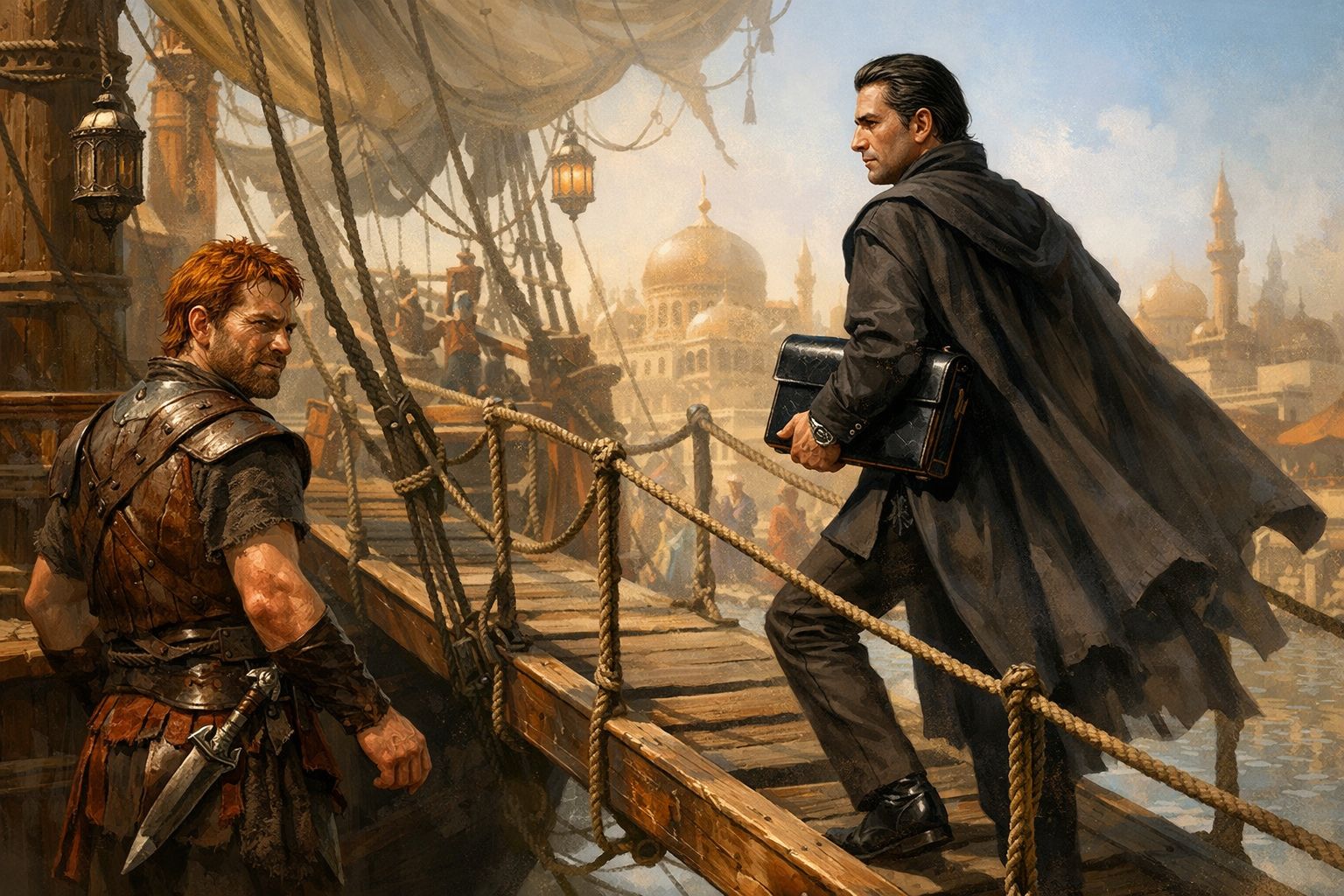
This thread is the crew’s dirty solution to their main problem. It is not meant to become the center of the Zarhalem arc. The emotional center should remain Shaedra, Ivy, Nasheem and Yasmira. What this thread does is turn Sandros Pellaios into the man who offers a way through the knot around Nera and the Waverider clue, but only by dragging the crew into something morally foul and politically dangerous.
That is important. Sandros should feel useful, competent and poisonous all at once. He is not rescuing the crew. He is making their desperation useful to himself.
The Offer
Sandros approaches the Blue Marlin and calmly presents the debt the crew owes him as something that can now be repaid in a way that benefits both sides. He says he knows about the problem with Sayd ibn Murad al Safiq and Nera, and that he has a job whose side effect will solve that problem.
His proposal is simple on the surface. A sealed message must be delivered directly into the hands of the Khalif’s sorcerer, Iskander ibn Rafi al Luminara. Sandros cannot get close enough himself, but the sorcerer will attend a banquet hosted by the Khalif, and Sandros has leverage over the man arranging the entertainment. Through that contact, Cassandra can be placed among the performers, not as a slave but as a hired dancer. That gives her a chance to pass the message.
At the same time, the crew has the opportunity to let Sayd take Nera into his service. Once the banquet is over, Sandros predicts that a major disturbance will erupt at the vizier’s residence. During that chaos, Nera will be able to leave without meaningful resistance. The crew only needs to be waiting outside to collect her and get her back to the Blue Marlin.
The Message
The crew does not initially know the real content of the sealed message.
It is blackmail. Sandros knows that Iskander has had relations with one of the Khalif’s sons. If that becomes public, both would likely die, and the palace would be thrown into serious scandal. Sandros uses that vulnerability to force the sorcerer into action.
What he wants is not merely panic or embarrassment. He wants Iskander to instruct a golem he previously made for Sayd to kill that vizier, making it appear to be malfunction or miscommand. This should remain background for most tables. The players may discover it if they interfere with the message, force it open or start digging into Sandros’s true intent, but otherwise it simply functions as hidden leverage driving the plan.
That balance matters. The players do not need a palace intrigue subplot. They need a believable mechanism for why Sandros’s plan works and why the resulting chaos is so abrupt and useful.
The Banquet
The banquet is a very high status event hosted by the Khalif. It should feel decadent, polished and intimidating, full of gold, flame light, expensive silks, courtiers, entertainers and the brittle civility of a court where power is everywhere and politeness is superficial. Zarhalem thrives on spectacle, and the Khalif’s court is the city’s love of beauty and cruelty made official.
Cassandra will be able to get close enough to pass the message. There should be a few close calls, enough to make the event feel dangerous, but the actual delivery is still relatively low risk if the crew follows the plan. Do not play this scene out directly unless Cassandra is player controlled. If she is an NPC, resolve it off screen and let her tell the crew afterward how it went. The important thing is the effect, not the stage time.
Cassandra told it later in the quiet after midnight, when the worst of the city had finally stopped pressing at the hull and the lamps aboard the Blue Marlin had been turned low. She sat with one knee drawn up, one hand wrapped around a cup gone cold long ago, and for a while she did not begin at all. Ormun sat near enough to be felt rather than noticed. Gastved stood a little apart, still as a post. The others listened.
“They brought us in through the servants’ gate,” she said at last. “Not the front. Of course not. The Khalif’s guests go in through gold and marble. We went in through a courtyard full of crates, lanterns, half-drunk musicians and men shouting over costumes.”
She gave a tired little smile that did not quite become one.
“There were six of us dancers. Hired, not owned. That mattered. You could feel it in the way they looked at us. The guards at the gate watched us like men watching something pretty pass by, but not like handlers checking stock. No hands. No searching. No one touched us. They only stared and counted.”
She looked down at the rim of the cup.
“Inside, it was all silk, polished stone and too much light. Gold everywhere. Flame in bronze bowls. Wine that probably cost more than my old price ever did.” Her mouth tightened at that, but she kept going. “Backstage was the opposite. Sweaty girls adjusting straps. Musicians tuning strings. Powder in the air. One woman crying because she thought her anklet had gone missing and she would be fined for it. Then one of the organizers came through and gave us the rules.”
Her voice shifted slightly, mimicking him with dry contempt.
“Three dances each. Wait until called. Smile. Do not speak unless spoken to. This is a clean banquet for the Khalif, so keep it clean. No touching, no invitation, no private nonsense.”
Cassandra exhaled through her nose. “That was a relief, at least.”
She turned the cup slowly between her fingers.
“During the first dance I found him. Iskander.” She glanced up at Ayesha. “Sandros described him well enough. He wasn’t hard to spot. There were only three people in the room who looked Imperial, and only one of them had the right age.”
The hall had stayed with her. That much was obvious. Her eyes had gone a little unfocused, as if she still saw it.
“The Khalif sat high enough that the whole room bent around him. Everyone was careful. Too careful. The sort of careful that means one wrong glance can ruin a life. Iskander stood lower down, speaking when spoken to, listening more than he talked. I thought that would help.” She shook her head once. “It did not.”
After the first dance she had gone back behind the screens, changed jewelry, checked that the message was still hidden and gone out again when called. After the second, she saw her opening, or thought she did.
“I came off the floor on the right side of the room,” she said. “Close enough to pass behind him. I thought I could brush by, let the note fall into his sleeve or his hand and keep moving.” She gave a small bitter laugh. “Except he was talking to the Khalif’s son. Not idling. Talking closely. And when the son is standing still, the guards do not let the world breathe too near him.”
She spread two fingers an inch apart.
“That close. And I could not reach him.”
She had gone back for the third dance with the failure already sitting in her stomach.
“I started thinking about Nera,” she said quietly. “Not the message. Not Sandros. Nera. I kept thinking that if I failed, then she was the one who would pay for it.”
So she danced again under all that gold, with her pulse in her throat and the sealed note hidden against her skin like a coal. When it ended, she made one more attempt.
“The same thing,” she said. “Still with the son. Still deep in it. Not a word between them I could hear, but enough intensity that no one else was getting near.”
She thought then that it was over.
“They told us to gather our things and leave. The musicians were packing. The girls were gossiping already, laughing too loud the way people do when the stress is behind them. I remember thinking that I would have to come back here and tell you I had failed.”
For the first time, her voice thinned a little.
“And I remember thinking about Ormun’s face when I said it.”
Ormun lowered his eyes. Gastved did not move at all.
“We were halfway down a side corridor on the way out when luck finally chose to notice me. Iskander came the other way with the Khalif’s son. No guards. Just the two of them, walking fast and talking low, like the guards had been left behind on purpose.”
The other dancers saved her without ever knowing it. They were noisy, tired, full of relief and chatter, bracelets clinking, veils slipping, one of them complaining loudly about her feet. The corridor became cluttered with silk and movement.
“They made a screen,” Cassandra said. “Not a good one. Just enough.”
She shifted slightly, reenacting the motion with two fingers.
“I stumbled a little as we crossed. Reached out as if to steady myself. Touched his sleeve. Put the message in his hand.”
Then she did the only thing she could do.
“I kept walking.”
She had not looked back. Not then. She slipped back into the knot of girls, let their noise swallow her and went on with them through the servants’ way, out past the last gate and into the cooler dark beyond the palace walls.
“Gastved and Ormun were waiting outside,” she said.
That time, she did smile, though only faintly.
“Gastved looked exactly as he always looks. Calmly waiting.” Her eyes moved, briefly, to Ormun. “Ormun looked relieved enough that I thought he might stop breathing if I took too long getting to him.”
Ormun’s ears reddened slightly. Nobody commented on it.
Cassandra lowered her cup.
“That was all,” she said. “No chase. No alarm. Just pressure, and then a corridor, and then luck.”
She was quiet for a moment longer, then added, more softly, “I did not think the chance would come. That was the worst of it. Not the room. Not the Khalif. Not even the guards. It was those moments after the second dance, and then after the third, when I thought I had failed and Nera would be trapped because of me.”
Her fingers tightened once around the cold cup.
“But it came.”
“Good work,” Scarnax said, tension still in his voice. “Now we see if Galenor and Amaxia can bring Nera home.”

Nera in Sayd’s House
Sayd is delighted to employ Nera. He sees her not as a person but as a prestige acquisition, a clever artisan whose work will make his wealth and refinement more visible. He is overjoyed to have her and, in his satisfaction, gives up the next Waverider clue quickly. But he is also in a hurry, because he too is going to the banquet.
Before leaving, he shows Nera the room that will serve as her workshop, and also her personal quarters. He invites her to write down everything she needs. Tools, materials, assistants, slaves. For him, this is status camouflaged as generosity. For Nera, it should feel like gilded possession.
The house should look exactly like what Sayd values. It is a small palace, expensive in every visible direction, built to display wealth and power rather than comfort. Precious materials, polished surfaces, decorative excess and orderly servants should be everywhere. He has many servants, slaves, guards, harem girls and administrators. Within the house, in a role much like a butler, is a golem plated or adorned with precious metals and gems. This matters both as atmosphere and as setup. Sayd’s whole life is arranged as spectacle.
Later that evening, Sayd returns from the banquet in the company of Iskander. He, somewhat irritated, instructs the sorcerer to fix or adjust whatever he needed to change on the golem. Iskander tinkers with it briefly, then leaves. The household settles. It is late. Sayd goes to bed, and the house falls quiet.
A few hours later, the noise begins.
There are screams from Sayd’s bedroom, followed by heavy, repeated thuds. The golem has turned on him and is attacking with the kind of mindless, stubborn force only a construct can sustain. Golems are not clever, but they are relentless. If given a command badly enough, they simply continue until the task is done. That is why the scene works. This is not a duel. It is a piece of magical labor turning into murder.
The house explodes into confusion. Guards rush toward the bedroom. Servants wake and run, some towards the noise, some away from it. Orders are shouted. Everyone’s attention is dragged toward the violence, exactly as Sandros predicted. In that chaos, it is easy for Nera to simply walk out.
Nera told it later with both hands wrapped around a cup she had forgotten to drink from.
She sat near the stern with the lamp turned low, speaking in that careful, quiet way of hers, as if the words had to be coaxed into the open one by one. Galenor sat close enough to lean in when she faltered. Amaxia stood nearby with her arms folded, the hard line of her mouth saying that if Sayd had somehow survived the night, she would still happily correct that mistake. Scarnax listened without interrupting.
"He was happy," Nera said at last. "That was the first thing. Really happy. Like a child who had been given a toy he wanted to show off to his friends."
Sayd had brought her through the front of the house this time, not like a guest, not exactly, but not hidden either. The place was vast. Bigger than she had imagined. More like a palace than a private house. There were servants moving with trays, guards at every turn, slaves carrying cloth and ledgers, clerks hurrying between rooms, women in fine silks laughing too loudly in shaded corners. The whole place breathed wealth. Not comfort. Display.
"And everywhere he went," Nera said, "that thing followed him."
The golem.
It moved with the smooth, patient certainty of something that had never once doubted its right to be where it was. Gold and pale metal gleamed over its shape, with stones set into it in places where no practical object would ever need them. It did not look made to serve. It looked made to be seen serving.
Sayd led her first to the workshop.
"It was big," she said, and despite everything there was still a trace of wonder in her voice. "Bigger than Galenor's space by ten times, maybe more. Good light. Strong tables. Wall space. Storage. At the moment there was hardly anything in it, just a couple of benches and some empty shelves, but he..." She hesitated, then went on. "He told me to write down everything I wanted. Tools. Materials. Assistants. Slaves. He said to make a proper list and he would have it all there within days."
Galenor made a small sound through his nose, half disgust and half professional pain at the thought of such resources in such hands.
Nera looked down at her cup. "I hated him for saying it. But I was still impressed."
That was the worst part, and she knew it. The house was monstrous, but it was also full of things she had never been allowed even to imagine asking for. Space. Light. Precision. Tools chosen for skill rather than survival.
She swallowed.
"He told the golem to fetch writing things. It went away and came back with paper and ink and put them in my hands like it was the most natural thing in the world."
Then he showed her her rooms.
Not room. Rooms. A small suite. A large sleeping chamber, its own washing room, polished stone, carved furniture, expensive rugs, brass lamps and a bed softer than anything she had ever touched. She had thought at first, with a sickness rising in her throat, that this was where he meant to come to her.
"I thought I understood," she said quietly. "I thought that was what he was showing me."
But Sayd had only smiled and said these would be her private quarters. He opened a wardrobe and showed her row after row of fine silk clothing, all of it chosen for display, all of it meant to mark her new status.
"If they do not fit," he had said, "speak to Ania. She will have a tailor adjust them."
Nera’s fingers tightened around the cup.
"He said it like kindness. Like he thought he was being generous."
He had apologized then, almost courteously, because he had to leave for the banquet. They would speak more in the morning, he said. She should make her list.
"So I sat there," Nera said, "in that room with all that silk and all that polished stone, and I felt..." She searched for the word. "Small. And trapped. It was beautiful. That made it worse."
She had not tried to run then. There had been too many people, too many guards, too many doors watched by eyes that knew exactly who belonged and who did not. So she waited, exactly as they had planned, with Sandros's promise sitting in the back of her head like something she did not trust but had no choice except to trust anyway.
Late in the night, Sayd returned.
"He was tired," she said. "And annoyed."
Not frightened. Not cautious. Just irritated, like the world had made him stay awake longer than he wished. With him came Iskander ibn Rafi al Luminara, elegant and pale in the lamplight, carrying his own weariness like another layer of clothing. Sayd waved him toward the golem with the impatience of a man who expected obedience from everything around him.
He told Iskander to fix whatever needed fixing. Iskander bent over the construct and worked for a little while, adjusting a symbol on the chest and then one on the forehead. Nera had watched from the doorway of her workshop, pretending to be smaller than she was, just another quiet thing in a rich man's house.
"They talked a little after," she said. "Nothing important. At least nothing I could understand. Then Iskander left."
Soon after that, the house quieted. Lamps were lowered. Voices thinned. Doors shut. Sayd went to bed.
Nera paused there in the telling, and Galenor looked at her more closely.
"A couple of hours later," she said, "I heard screaming."
Not one scream. Repeated ones. The sound of a man in absolute terror. Under the screams came another sound, worse in its own way. Heavy, repeated thuds. Slow, brutal and steady.
"The screams stopped first," Nera said.
Nobody spoke.
"But the banging kept going."
That was what frightened her most. Not rage. Not frenzy. Just the relentless, mechanical persistence of the thing. It was not angry. It was working.
Then the house woke all at once. Guards ran toward Sayd's rooms. Servants stumbled half dressed into corridors. Women cried out. Someone started giving orders. Someone else started screaming over them. Some people ran toward the noise, some away from it, and for a few breaths the whole great shining house forgot how to be orderly.
"And that was all I needed," Nera said.
She had taken nothing. Not the silk clothes, not the writing paper, not a tool, not even the list she had begun. She had simply walked.
Not rushed. Walked. Down one corridor, then another, past an open door, past a pair of shouting clerks, past two guards both running the other way. Out through the front of the house while everyone inside was thinking of the same room and the same sounds.
"I kept waiting for someone to stop me," she said. "No one did."
Outside, the night air had felt strange after all that perfumed stone.
"And then Galenor stepped out of the dark."
Her voice changed there, softened.
"He did not even say anything first. He just grabbed me."
That made the faintest smile touch her mouth.
"He hugged me so hard I thought he might break something."
Galenor looked mildly offended. "I have excellent control."
That got the smallest breath of laughter from her.
"And Amaxia," Nera said, glancing over at the amazon, "just looked once at the house and said we needed to move."
Amaxia gave a short grunt. "Still true."
Nera lowered her eyes to the cup again. The deck was quiet around her now. The worst of Zarhalem lay behind them, though not far enough behind for anyone to be easy yet.
"I thought it would feel better than it did," she said softly. "Getting out. I was relieved. Very relieved. But mostly I kept thinking about how beautiful it all was. And how none of it was meant to be mine. Not the room. Not the tools. Not the clothes. Not even me. Even the kindness was only another kind of chain."
No one interrupted her.
After a moment she lifted her head again, looking not at Galenor or Amaxia, but toward Scarnax.
"That is all," she said.
Scarnax had been listening with the same hard stillness he wore whenever he was already halfway into the next decision. When she finished, he nodded once.
"That is the last loose end," he said. "Let's get out of this place before it gets around to stopping us."
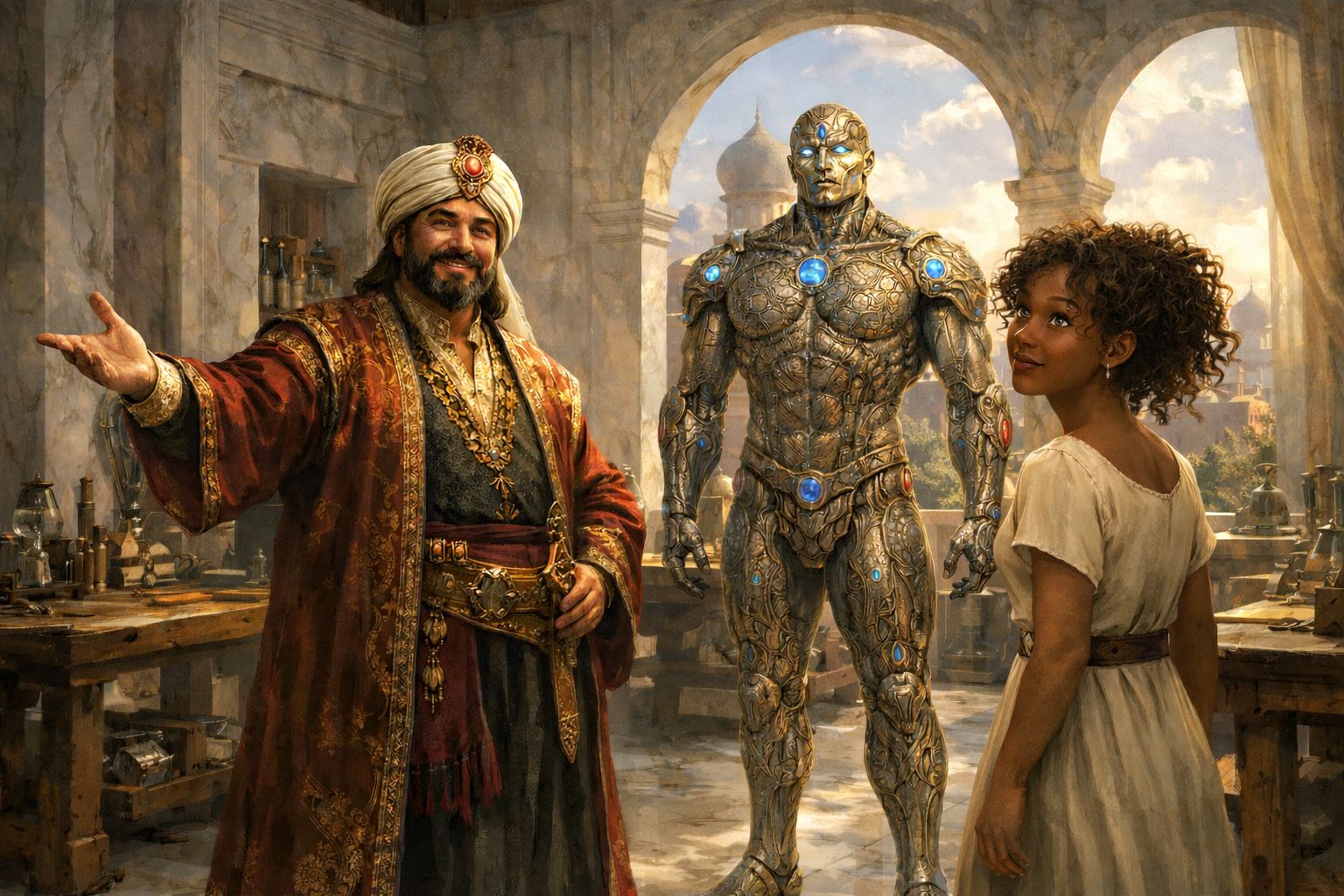
Extraction
Getting Cassandra and Nera back to the Blue Marlin should be straightforward, especially if the crew is waiting outside to escort them. Do not make this part harder than it needs to be. The tension belongs in the setup and the moral compromise, not in a late street chase unless the players have done something especially reckless.
The important thing is that Sandros’s plan works. That makes him more dangerous, not less. The crew has now been helped by someone whose methods are deeply compromised and whose motives are never clean.
Consequences
The morning after, once the house quiets and the dead are counted, Nera’s disappearance may become a problem. If she is simply gone when the household regains control, suspicion is possible. That means staying in Zarhalem too long after this event is dangerous. Even if no one can prove the Blue Marlin’s involvement, the timing is suspicious enough to draw attention.
Because of that, it is probably wise not to delay departure from Zarhalem after the plan succeeds. The crew may still have other loose ends to manage, but this event should narrow their time window sharply.
Tone and Use
This should feel like a clever plan with rot inside it. On the surface, it is elegant. In truth, it is blackmail leading to murder, wrapped in palace spectacle and delivered through the labor of women the crew cares about. That is why Sandros matters here. He solves problems by making ugliness efficient.
Run it that way. Let it work. Let the crew benefit from it. And let them feel, afterward, that they now owe part of their success to a man whose help always leaves a stain.
Ivy Joins the Crew
Shaedra found Scarnax near the rail in the late afternoon, when the light over the harbor had begun to soften and the worst of the heat was finally lifting. He had one hand braced on the wood, watching the water with the look he got when he was thinking through three problems at once. Ivy stood half a step behind Shaedra, still in the silk tunic, her posture quiet and careful, as if she still expected the world to object to her presence if she took up too much space.
Scarnax glanced at them, then turned fully. He read enough in Shaedra’s face to know this was not a casual talk.
“There is nowhere safe to leave her,” Shaedra said without preamble. “Not here. Not anywhere near here. If we put her ashore and sail away, some slaver will have her again soon enough.” Her jaw tightened. “And there is more. Before she was taken, she was training as a shaman. She did not finish, but the gift is real.”
Scarnax looked past her to Ivy. For a moment he said nothing. Then his expression softened.
“I had already been thinking about the first part,” he said. “The shaman part is new, but I do not dislike it.”
He stepped closer and held out his hand to Ivy, broad and weathered and offered without hesitation.
“Welcome to the crew of the Blue Marlin,” he said with a wide, warm smile. “We are all misfits here, and we could certainly use somebody for the less tangible kinds of trouble. You will fit right in.”
Ivy stared at his hand for a heartbeat as if she did not quite trust what she was seeing. Then she lifted her own and placed it in his. Her fingers were light in his grip.
“Thank you,” she said, almost too softly to hear.
But she was smiling when she said it, shy and uncertain and real, and for the first time since her rescue there was something in her face that looked less like survival and more like the beginning of belonging.

Ivy should not join the Blue Marlin simply because she has nowhere else to go. That reason is true, but too weak on its own. The stronger point is that there is nowhere safe to leave her, and that she can offer something real in return. Her unfinished shamanic training gives her a genuine future role aboard the ship, even if that role is unstable and not yet fully formed. Her ability brings the ship a capacity it lacks.
This moment should feel quietly important. For Shaedra, it is proof that rescuing Ivy was not only about saving her from immediate harm, but about giving her a future. For Ivy, it is the first step from being protected to belonging. For Scarnax, it is a natural extension of what the Blue Marlin already is: a ship full of damaged, useful people who do not fit easily anywhere else.
Act Summary
Zarhalem should leave a double impression. The crew sees the city at its most splendid and its most rotten, not as two separate things, but as the same thing seen from different angles. Its courts, banquets and noble houses are dazzling, but all that beauty rests openly on slavery, status and the reduction of people into property. That is the real value of the arc. It reveals what Zarhalem truly is.
The Waverider trail does advance here, and by the end of the arc the crew has a clear next port of call and a reason to leave quickly.
Shaedra and Ivy
The most important personal gain of the arc is Ivy. She is rescued, brought out of Nazeer al Qadim’s hands and taken aboard the Blue Marlin, where she begins the long work of recovery. More importantly, she does not remain just a victim or a rescued relative. She becomes a real future crew member, with unfinished shamanic training and the potential to matter far beyond Zarhalem.
For Shaedra, this matters beyond family reunion. Ivy’s rescue proves that the search is not hopeless. It does not heal Shaedra’s guilt, but it gives her something more useful than comfort. It gives her proof that persistence can still bring someone back. That should harden her resolve for the rest of the campaign.
Nasheem and Safina
Nasheem’s thread is about late truth rather than action. Safina remains the quiet ache at the center of his past, and Zarhalem finally forces that ache into the open. The important result is not revenge, but understanding. He learns what happened, and that knowledge either leaves him carrying a heavier shadow back to the Blue Marlin or leads to his departure if the living child path is chosen. Safina was the one wound he never truly put down, which is why this lands so heavily.
His personal relation to Kethra of the Waverider also grows complicated. On one hand, she took revenge on Rashid, but on the other hand, he wanted to take that revenge himself. At the same time, they share a common pain and a common goal. This is something he needs to come to terms with.
If he stays, he needs time and support. If he leaves, it should feel like a painful but meaningful severing from one life in order to reclaim another. Either way, Zarhalem leaves a permanent mark on him.
Yasmira
Yasmira’s thread is the city’s social cruelty made public. Her past catches up to her through diplomat Qadir ibn Faruq al Mazhar Abd al Rasid, and the system immediately sides with rank over truth. What matters here is not only that the crew gets her back, but that Yasmira herself is revealed more clearly. She does not fold. She does not slip back into old habits of submission. She spits on the old order, strikes back and pays the price for refusing to bow. That is the point.
Her rescue therefore matters twice. It saves her physically, but it also confirms how much she has changed. She is no longer a woman who will quietly endure the hand on her arm because rank says she must.
Sandros
Sandros comes out of this arc exactly as he usually does. He is useful, informed and utterly ruthless. Once again, he proves that he is on top of information before anyone else and willing to weaponize it without hesitation. That is the main takeaway. He is not simply a shady ally. He is a man who turns other people’s desperation into a working method.
This is important going forward. The crew benefits from him, but never cleanly. Every time he helps, he leaves behind the sense that the problem was solved by someone who does not share their scruples, and may not share their goals.
Cassandra and Nera
Cassandra and Nera both gain something important here. Each is pushed into a solo mission and comes through it. For Cassandra, the banquet mission confirms that she can still move through high status spaces, read danger and act under pressure without collapsing into old patterns. For Nera, Sayd’s house becomes a twisted test of selfhood. She sees what a life of skill, luxury and admiration could look like if bought at the cost of freedom, and she walks away from it. That matters.
Both come out of Zarhalem stronger. Not healed, not unscarred, but more confident, more self-aware and more certain that they can act alone when they must.
Final Use
The main function of Zarhalem is to compress personal pressure until it reveals character. The city gives the crew the next lead, but more importantly it forces several of them to confront old wounds in a place built entirely out of wealth, spectacle and ownership. By the time they leave, they should feel relieved to be rid of it, changed by what happened there and keenly aware that they are sailing on with new scars, one new crew member and at least one relationship to the Waverider trail deepened in painful ways.
The Blue Marlin lay at anchor a short way off the island, its hull rising and falling gently on a turquoise bay while the jungle darkened under the last red light of evening. Tomorrow they would go ashore for food and fresh water if Ileena judged the island safe. Tonight she would go in first, alone.
Ormun and Cassandra sat by the rail, watching the sunset over the palms, when Ivy came and lowered herself beside them. Her short black tunic stirred in the wind. In the fading light her tattoos seemed almost alive in the reflected light from the waves, every inch of visible skin turned into color and pattern.
She said nothing.
Cassandra glanced at her, then let the silence sit. Ormun lasted a little longer before turning to her with that plain gentleness of his.
"Are you all right?"
That was enough.
Something in Ivy broke. The words came out all at once, torn loose by grief and anger she had held in too long.
"I hate it," she choked. "I hate what he did to me. I hate being made into this. It was not my choice. He had no right."
Ormun opened his arms and let her fall into them if she wished. She did. He held her carefully while she wept against his chest, one huge hand resting between her shoulders.
After a while he said quietly, "If you ever need advice about being ugly without it being your own choice, come to me. I have done it all my life." He hesitated, then added awkwardly, "Not that you are ugly. You are not."
Cassandra turned to him at once. "Neither are you. You are a beautiful man, Ormun. Inside and out. And Ivy is a beautiful woman. Inside and out."
Ormun blushed so hard that Ivy nearly laughed through her tears.
He cleared his throat and said, "Cassandra is right. You did not choose this, but you are beautiful. There is nothing wrong with being different. People look at me with fear. They look at you with admiration."
Ivy wiped at her face, then with a miserable little sound pulled her tunic aside enough to show the side of her breast.
"He even signed me," she wept. "The bastard signed me..."
Cassandra's expression hardened. "Nazeer had no right to do what he did, and he deserved everything he got and more. But this part is true as well. It is what it is now. It is not going away."
Ivy shut her eyes.
"So," Cassandra said, more softly, "in the next port, we find a truly talented tattoo artist. We turn that mark into something beautiful. We remove that bastard from your skin and make your body yours again."
Ivy stared at her, then smiled through her tears.
At that moment Ileena passed across the deck toward the waiting skiff, already painted for the jungle in leopard markings. She slowed, looked at Ivy, and said in her usual blunt way, full of admiration, "I wish I could get my paint that good. It must really make you powerful."
For a heartbeat there was silence.
Then all three of them burst out laughing. Ivy laughed hardest of all, until the tightness in her chest finally began to ease. Ileena only looked puzzled by the whole thing, flicked an ear, and climbed down into the skiff.
When the laughter faded, Ivy looked from Cassandra to Ormun with wet eyes and a trembling smile.
"I will really try to accept myself as much as you both accept me."
Then she leaned forward and hugged Cassandra tightly, and after that Ormun as well. He made a startled sound and blushed all over again, which only made Ivy smile more.
As the skiff pushed away toward the darkening island, the three of them remained by the rail together, watching the last of the sunset fade.

The deck was quiet, silvered by moonlight and the soft wash of black water along the hull. Most of the crew had gone below. Only the night watch moved, slow and small at the far ends of the ship, careful not to disturb the stillness.
Nasheem sat on the railing near the stern, balanced with the easy grace of a man long at home at sea. One hand rested loosely on the wood. The other hung between his knees. From a distance he looked composed, as he so often did, the moon catching the folds of his Zarhalem coat and turning him into something almost elegant enough to belong again among white domes and perfumed courtyards.
Up close, the illusion did not hold.
His gaze was fixed somewhere far beyond the dark water. Not on the horizon. Not on the stars. Somewhere inward.
Amaxia approached without sound. She did not announce herself at first. She simply stopped beside him and leaned one forearm on the rail, leaving him room. That was one of the ways she cared for people. Not through softness, but by giving them room.
For a while they listened to the sea.
Then she asked, in her blunt way, "Will you be all right?"
Nasheem let out a slow breath through his nose. A bitter smile touched his mouth, but only for a moment.
"Eventually," he said. "Perhaps. I do not know."
Amaxia said nothing. He glanced at her once, as if checking whether she wanted politeness. Finding none, he looked back out at the water.
"It was one thing not knowing," he said quietly. "For years I could tell myself anything. That Safina had escaped. That she had survived. That perhaps one day I would walk into some market on the far side of the world and hear her voice insulting me for taking so long."
His mouth twitched, but there was no humor in it now.
"And the child too. I loved the thought of that life." He swallowed. "Not knowing was torment. But knowing there is no hope is worse. It closes the door. One cannot even stand outside and pretend."
Amaxia's jaw tightened. The moonlight caught the hard line of her cheek.
Nasheem looked down at his own hands.
"What shames me most," he said, "is that part of me wanted vengeance. Something sharp. Something personal. Some man to cut down. Some throat to open. And instead I am left with grief and nothing to strike at. I feel cheated even of revenge."
Amaxia gave a short breath that might almost have been a laugh.
"Revenge is overrated," she said. "I got mine. You were there. For a moment it felt good. Then it was just emptiness wearing a mask."
Nasheem turned his head a little toward her.
She kept her eyes on the sea.
"And Kethra had the right to it too," Amaxia went on. "More than most. Zarhalem used her first. Shaped her into a blade and pointed her at whoever it wanted dead. Rashid tortured her as well. She did not come out of that place untouched either."
Nasheem made a sound halfway between a laugh and a sob.
"Then perhaps we should have organized it better," he murmured. "A proper queue. Take a number. Wait your turn to avenge yourself upon Rashid."
Amaxia's mouth moved, just barely.
"Maybe."
The word sat between them a moment.
Then she said, "But if anything, you and Kethra share the same wound more than you differ. Rashid took from both of you. Broke pieces off both of you. I do not think she is really where your anger belongs."
Nasheem nodded slowly.
"No," he said. "Probably not."
He rubbed a thumb against the heel of his hand, as if trying to wear something away.
"The pain and the anger need somewhere to go," he said. "That is all. They do not care whether the place is right."
Amaxia turned then and looked at him directly. There was nothing gentle in her face, but there was understanding.
"They pass," she said. "Not quickly. Not kindly. But they pass."
Nasheem let the words settle. The rigging creaked softly overhead. Somewhere forward, a sailor coughed in his sleep.
"Yes," he said at last. "I believe that."
Then he gave a tired little shake of his head.
"But they will not pass tonight."
Amaxia accepted that at once. No argument. No comfort forced where it was not wanted.
"I need to be alone for a while," he said.
She nodded.
"I am here if you want to talk."
That was all. No hand on the shoulder. No soothing phrase. Just the offer, plain and solid.
Then she pushed away from the rail and walked off across the deck, her boots soundless on the planks, her broad shoulders black against the moonlit sea.
Nasheem watched her go for a moment, then turned back to the night.
Above him the moon hung white and distant, cold over the dark water. He looked at it for a long time, saying nothing.