Campaign: Zanakwe
Act Synopsis
The Blue Marlin arrives in Zanakwe during a period of visible strain. The empire stands intact and confident, yet anxious beneath the surface. Several interior villages have fallen silent. Scouts did not return. The jungle beyond the sanctioned routes has been declared ritually unsafe, and no further attempts are made to investigate.
Zanakwe does not look outward for answers. It tightens inward.
Executions increase. Sacrifices become more frequent and more public. Nobles demonstrate loyalty and confidence by offering slaves for ritual blood. Criminal law grows harsher, not out of cruelty, but necessity. Blood is needed, and criminals are available.
Nothing is resolved. Everything is justified.
This arc presents Zanakwe as a society managing fear through escalation, with a single public trial becoming the focal point around which politics, ritual, and survival revolve.
Arrival and Mood
From the moment the Blue Marlin docks, the atmosphere is unmistakable. Guards are numerous and attentive. Priests move through markets and docks, marked by fresh bloodletting. Ritual symbols have been repainted recently, sometimes layered over older markings.
Lists of names are displayed in public spaces. Some are newly added. Others are crossed out. No explanations are given, and none are needed.
Trade continues. Law functions. But everything feels provisional.
The forest is never far. Paths leading inland are ritually closed. Hunters avoid speaking of the interior. No one claims the jungle is hostile. They say instead that it is listening.
The Quiet Cost
Away from the marble halls and ritual platforms, the cost of escalation becomes visible.
Slaves are diverted from productive labor to ritual use. Workshops slow. Supply chains strain. Craftspeople work longer hours with fewer hands. Markets feel thinner, not empty, but brittle.
The crew encounters exhaustion rather than rebellion. People do not question the system. They simply struggle to keep pace with its demands.
Small interventions are possible. Helping individuals. Solving local shortages. Protecting someone who would otherwise be reclassified as a criminal to meet ritual needs.
None of this changes Zanakwe’s course. It only exposes the human friction beneath the smooth surface of order.
Mbaru as Lens
Throughout the arc, Mbaru serves as a lens rather than a focal point.
This is his homeland. He understands the language being used, the meanings beneath the words, and the way responsibility is redirected when outcomes are unacceptable. He recognizes which threats are ceremonial and which are real.
His history with the Lionblood House adds tension, but does not define the plot. The Lionbloods will try to implicate him, though, and to get the court to act against him. Some houses see him as leverage. Others see him as an inconvenience. A few quietly prefer that he remains untouched, if only to deny their rivals satisfaction.
Mbaru offers context rather than solutions.
The Trial
A major public trial is announced soon after the crew’s arrival. It is presented as a corrective act, meant to reassure the population that order is being maintained.
The accused is a secondary figure. Once a mentor to Mbaru, now tied to a noble household. The charges are framed in ritual language. Corrupting the truth of the duel.
From the beginning, it is clear that guilt or innocence is irrelevant.
This is not a trial to determine truth. It is a formalized feud between two rival noble houses, one of them the Lionblood House. The courtroom becomes a political arena where houses maneuver for influence, precedent, and narrative control.
Support is courted. Favors are called in. Ritual endorsements are negotiated. Each house seeks alliances, under the guise that its interpretation of failure preserves Zanakwe’s strength, while the other’s endangers it.
The outcome will not be decided by evidence. It will be decided by who stands where when judgment is pronounced.
Noble Rivalry by Proxy
As the trial approaches, noble maneuvering intensifies.
The Lionbloods press their case aggressively, framing it as lawful redress for an old grievance finally brought to proper conclusion. Other houses resist, not out of sympathy for the accused, but because denying the Lionbloods closure weakens a rival.
Smaller houses are pressured to declare support. Larger ones wait, watching the balance shift. Religious authorities encourage participation while carefully avoiding taking a clear side.
Mbaru’s concern pulls the crew into the struggle. They are outsiders, but useful ones. Their visibility, neutrality, or quiet alignment matters. Invitations are extended. Warnings are issued. Doors open or close based on perceived sympathies.
The crew is offered information about the Waverider as payment for assisting either side. In the end, however, this turns out to be a lie, neither side has that information.
This is a chess game of people. Every move is framed as piety. Every sacrifice is political.
The Question of Standing
Before the trial begins, the Lionblood House raises a procedural objection. They do not accuse Mbaru directly. Instead, they question his right to stand in court at all. An unresolved accusation of corrupting a duel, they argue, makes his presence ritually contaminating. Allowing an unpurified oath breaker to witness judgment would call any verdict into question.
As they state it: “What stands untested stands condemned.”
Zanakwe does not resolve matters of honor through testimony or evidence. There is only one accepted proof. A ritual duel beneath Ngolo’s gaze. The Lionbloods formally offer Mbaru the chance to cleanse his standing by facing their appointed champion according to strict duel law. Victory restores his honor. Defeat confirms the old accusation. If he will not stand to be judged beneath Ngolo’s gaze, then the judgment is already given, and carried out in the usual way.
The champion is presented as a duelist of unbroken record, chosen for his exact adherence to form and the finality of his victories.
For Mbaru, the choice is poisoned. Victory would legitimize the same system now poised to destroy his former mentor. The duel exists to place him back inside Zanakwe’s logic, or exclude him cleanly once and for all.
The crew is forbidden from intervening. Any interference would invalidate the ritual, confirm the Lionblood claim and have both the interloper and Mbaru executed. Their influence lies only in counsel, preparation, and the acceptance of consequences. The trial will proceed regardless. The duel decides only whether Mbaru is allowed to stand within it.
The Trial’s Resolution
When judgment is finally delivered, it will anger some, but not enough to break the peace.
The accused is condemned or spared according to political balance, not moral clarity. Each house declares the outcome proof that the system works. Priests bless the decision. The crowd accepts it.
Nothing improves.
Executions continue. Sacrifices continue. The forest remains closed and watchful. The lost villages remain unspoken.
Departure
The Blue Marlin leaves Zanakwe with the situation unchanged.
The empire endures. Its rituals intensify. Its noble rivalries sharpen. Its response to fear remains escalation rather than understanding.
Mbaru departs knowing that his homeland has not failed. It is functioning exactly as wrongly as designed.
There is a feeling of disappointment in the crew, failing to find the track of the Waverider has put a large dent in morale. They feel used and misled and fed perfomances instead of truth.
As the ship anchors for the night in the swamps near the coast, Sister Meyrha contacts the crew. She does not speak of the trial or the villages. She speaks of Samden, his aid to the crew, his disappearance, and her desire to join the crew.
Zanakwe remains strong. Zanakwe remains afraid.
Arrival and First Impressions
The Blue Marlin slides into the harbor at low tide, her hull brushing against stone that has been cut, recut, and cut again. The dock is crowded, not with welcome, but with presence. Guards stand in pairs along the quay, spears upright, eyes moving constantly. None of them look surprised to see a foreign ship. None of them look relieved.
Mbaru rests a hand on the rail, knuckles whitening slightly as he takes it in.
“It’s worse,” he says quietly. Not to anyone in particular.
A priest walks past the gangplank as the crew prepares to disembark. His robes are stiff with drying blood, dark at the hem. He nods politely, distracted, as if passing neighbors on a familiar street. Behind him, two acolytes carry bronze buckets already half full. The smell is sharp and metallic, layered over incense and rot.
Junia swallows. “They don’t even hurry.”
“They don’t need to,” Shaedra replies, eyes tracking the buckets. “No one’s stopping them.”
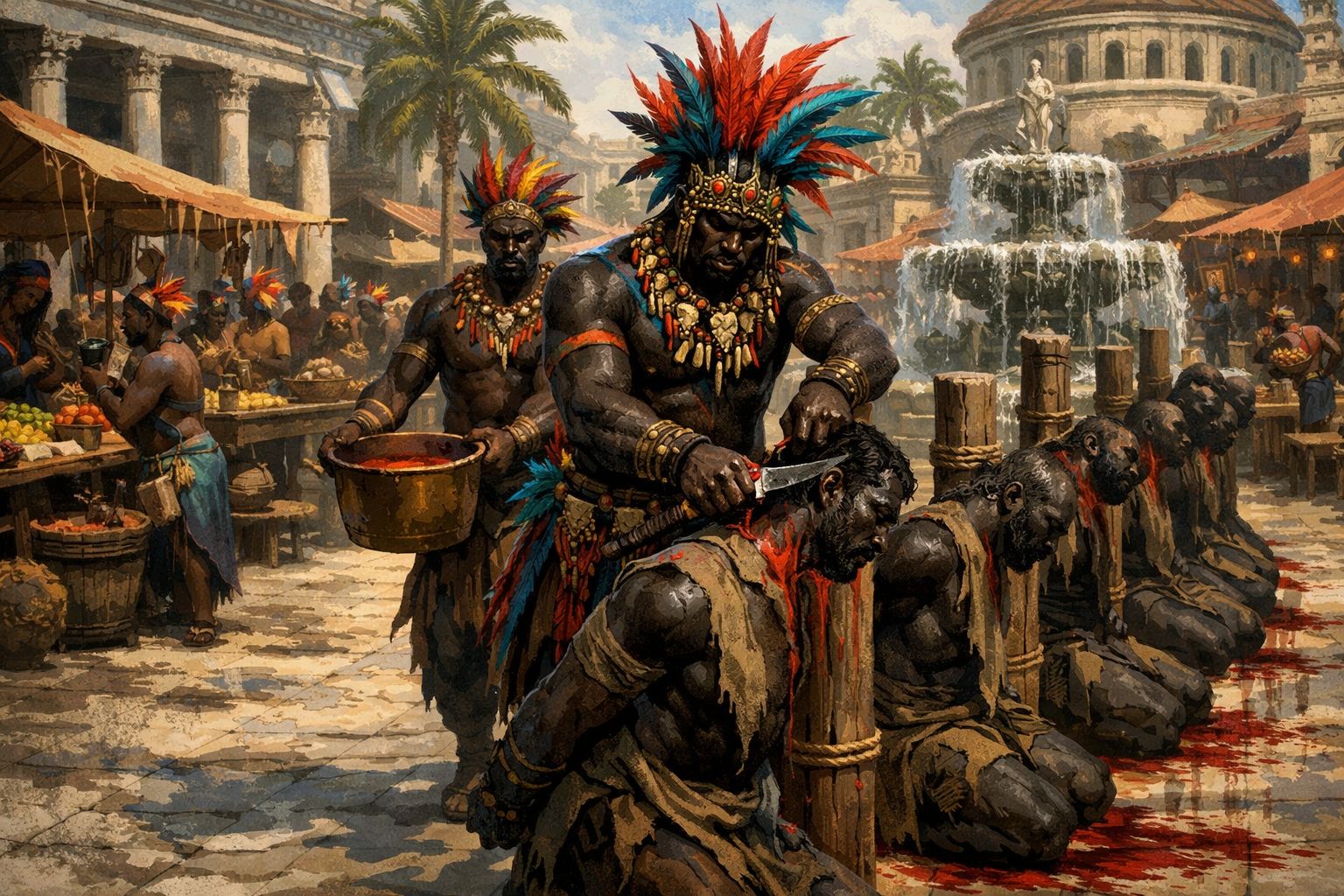
In a city square just beyond the docks, in front of a temple facade carved with old victories, a line of slaves is tied to stone posts set directly into the pavement. Their feet are bare. Their heads are bowed. A channel has been cut into the stone at their feet, shallow and polished from use, leading toward a wide basin sunk into the ground.
The priests move down the line without ceremony.
A hand on the shoulder. A practiced cut. Blood runs where it has been taught to run.
A man slumps sideways, ropes holding him upright for a moment longer than dignity allows. One acolyte steps forward immediately, adjusting the flow so nothing spills. Another murmurs a correction prayer under his breath, annoyed, not horrified.
Nasheem looks away, then forces himself to look back. “They’re harvesting,” he says. “Not killing.”
“No,” Mbaru answers. “They’re paying.”
Trade continues around it. Crates are unloaded. Weights are checked. A fishmonger haggles loudly over price while a body goes still not five steps away. Law functions. Routine holds.
Later, near the palace steps, a crowd has gathered. Not large. Not excited. Just present.
Mbalame’s Hand stands at the center of the square, a massive stone hammer suspended from a carved arch, its surface darkened by old stains that no amount of washing has ever fully removed. Channels run from its base, carefully cut, leading toward waiting vessels.
The first man is dragged forward screaming. His crime is announced clearly, loudly, for the record. Rape of a noblewoman.
There is no argument. No plea.
The hammer falls.
Bone breaks with a sound that makes Junia flinch despite herself. The man’s pelvis collapses inward, his scream cutting off into a wet, animal wimper before it ends entirely. Blood pours out beneath him, guided neatly along the channels. Priests step in immediately, eager hands steadying the flow.
“That’s justice,” a woman beside them says calmly, almost approvingly.
The second man is quieter. He does not resist. His crime is announced just as clearly. Fornication with another man’s slave.
A murmur passes through the crowd. Not outrage. Calculation.
His hand is placed beneath the hammer.
Nasheem exhales slowly as it comes down. Fingers flatten. The man howls, but he lives. He is dragged away bleeding, ruined, marked.
“Property,” Shaedra mutters. “They punish damage. Not violation.”
Priests collect the blood just as carefully as before.
As the crew moves on, they pass walls freshly repainted with ritual marks. Older symbols show through beneath the new layers, half erased, half remembered. Lists are nailed to public boards at every major crossing. Names written carefully in black. Some crossed out in red. No reasons given. No one asks.
In the markets, priests move among the stalls, stopping occasionally to press a bloodied thumb to a pillar or doorway. Merchants pause, bow their heads, then resume counting coin. The gestures are automatic now. Fear has been practiced into habit.
The forest presses close. Even here, the canopy looms over the rooftops, a dark mass beyond stone and plaster. Paths leading inland are blocked with ritual cords and carved markers. Hunters lower their voices when asked about the interior.
“It’s not angry,” one tells Mbaru, not meeting his eyes. “It’s listening.”
Away from the open platforms and polished halls, the cost shows itself more quietly. Workshops run short handed. Looms stand idle for hours at a time. A potter works through the night because two of his apprentices were taken at dawn. In the markets, shelves are not empty, but they feel fragile, as if one more absence would cause the whole arrangement to collapse.
People do not argue. They do not resist. They are tired. They speak in careful tones and measure every task against what might be demanded next.
A dock clerk leans close to Nasheem and whispers, “My brother’s name was on the list yesterday. It was crossed out by evening.”
Small kindnesses matter here. Carrying a load. Covering a shift. Standing between a guard and someone who has already given enough.
None of it changes anything.
The knives still fall. The bowls still fill.
As night settles and the sounds of chanting drift over the water, Mbaru looks back toward the city lights, jaw tight.
“They think this will save them,” Junia says softly, shaking her head slowly.
Mbaru nods. “It always has. Until it doesn’t.”
Zanakwe holds itself together through blood and certainty. It is clear that the city believes salvation will come the same way it always has.
By paying more.
This section exists to establish Zanakwe as a society under strain that is responding exactly as it was taught to respond. Nothing here is meant to be solved and nothing is meant to be fixed. The purpose is orientation. The players should come away with a clear emotional and cultural understanding of how Zanakwe deals with fear and uncertainty.
Zanakwe is not panicking or collapsing. It is compensating. It is doing more of what has always worked, even as the cost grows higher and the returns grow smaller. This section should make that logic visible everywhere the crew looks.
The Core Idea to Convey
Zanakwe believes in payment.
When something goes wrong, the response is not investigation, doubt, or restraint. The response is escalation. More blood. Cleaner blood. Better blood. The underlying assumption is that the system itself is correct and that failure only means it has not yet been sufficiently satisfied.
This belief is not presented as fanaticism. It is presented as practicality. People speak of blood the way other cultures speak of taxes, repairs, or reinforcements. Fear here is not loud or hysterical. It is orderly, procedural, and deeply ingrained.
The Dock and First Contact
At the docks, emphasize normality rather than hostility. Guards are present and alert, but not aggressive. Priests are busy rather than theatrical. No one reacts strongly to the arrival of a foreign ship, trade is bustling. Outsiders are not the problem Zanakwe is worried about.
Blood should be described as background detail rather than spectacle. Stains on robes. Buckets carried past conversations. The smell lingering beneath incense and sea air. This is maintenance work, not ceremony.
If players comment on the violence, NPCs should react with mild confusion rather than offense. If asked why this is happening, answers should be practical and unadorned. The rites must be kept. The balance is delicate. Better this than worse. Avoid theological speeches. Zanakwe’s certainty does not need justification.
Public Sacrifice and Casual Brutality
When describing sacrifices in city squares, keep the pacing steady and procedural. The lack of ceremony is the point. There is no buildup, no crowd anticipation, no dramatic framing. It happens the way unloading cargo happens.
NPCs nearby should behave as if the sacrifices are inconvenient rather than horrifying. Haggling pauses and resumes. Children are redirected without explanation. Conversations continue a few steps away. This communicates more than any explicit statement ever could.
Have someone say that the slaves were charitably provided by a noble, and have them say it without irony. To them, this is a gift of blood, not of people.
If a player intervenes verbally, guards should warn them calmly and politely. If a player intervenes physically, make it clear that this is not a moral confrontation but a logistical one. The city will respond efficiently and overwhelmingly, not angrily. Zanakwe is not cruel in its own eyes. It is confident.
Executions at Mbalame’s Hand
Executions are where Zanakwe’s moral hierarchy becomes unmistakable. Use them to show that justice here is proportional to social damage, not human suffering.
Crimes should be announced clearly and formally. The language matters. The contrast matters. A crime against a noble body is treated as a violation of order and lineage and punished absolutely. A crime against property is punished as damage, not transgression.
Priests collecting blood during executions is essential. Punishment and ritual are not separate systems. Justice produces payment. Waste would be immoral.
If players react with outrage or disbelief, NPCs should respond with calm, practical statements. Would you have the blood wasted. The gods do not distinguish between sources. This reinforces that the horror lies not in malice, but in certainty.
The Forest as Pressure
The forest should feel present even when unseen. Blocked paths, ritual cords, carved markers, and lowered voices are more effective than any description of danger.
Do not describe monsters or attacks. The forest is not hostile. It is listening. It remembers. It weighs what has been paid and what has not.
NPCs should never describe the forest as angry. Anger implies personality and intention. Zanakwe frames the problem as imbalance, not opposition.
The Quiet Cost
Away from ritual sites, show attrition rather than drama. Workshops running short handed. Craftspeople working through the night. Delays explained apologetically and without complaint.
This is where players can act without changing the world. Carrying loads. Covering shifts. Standing between a guard and someone who has already given enough. These acts should matter locally and immediately.
Gratitude should be sincere and quiet. Reinforce that the system neither rewards nor punishes kindness. It simply absorbs it and moves on.
What this Section is Not
This section is not a mystery hook, not an invitation to rebellion, and not a moral test with a right answer.
It is an orientation.
By the end of this section, the players should understand three things.
- Zanakwe is afraid.
- Zanakwe believes blood will save it.
- Zanakwe is willing to pay any price except doubt.
If the players leave uneasy, angry, or tired, the section has done its job.
Ivy and the Spirit World
If Ivy choose to enter the spirit world in, or close to, the jungle, she will immediately feel a hungry presence, and see human spirits cowering in the shadows, in almost animal like fear. The animals seem unaffected. One of the human spirits whispers to her that she must get out.
The Trial
Mbaru finds Nkarno in a side chamber of the old dueling hall, a place that smells of oil and old sweat. The walls are scarred where blades once struck stone. Nkarno sits straight backed on a low bench, hands folded, guards standing a little too close behind him.
“They are using my crime,” Mbaru says the moment he sees him. The words come out sharp. “They are saying you did what they accused me of.”
Nkarno looks up and allows himself a thin smile. “They say I corrupted the truth of a duel,” he replies calmly. “That I taught a student how to bend form without breaking it.”
Mbaru steps forward before he catches himself. His fist tightens.
“That duel was clean,” he snaps. “You never taught us to cheat.”
A guard shifts. Nkarno raises a hand, not in fear, but habit. “Lower your voice,” he says evenly. “They listen for anger.”
Mbaru exhales hard. For a heartbeat his temper flares, raw and unguarded. Then it folds back into discipline. He straightens.
“Who employed you,” he asks.
“The Tigerfang family,” Nkarno answers. “A household duel. Ordinary work.”
Mbaru closes his eyes briefly. “Lionblood,” he says.
Nkarno nods. “They framed you once. Now they want to prove it was not an accident.”
“They want me silent,” Mbaru says.
“They want you gone,” Nkarno replies. “You owe me nothing.”
Mbaru shakes his head once. “You taught me better than that.”
He goes straight to Captain Scarnax and stands at attention. “Captain. I request leave to aid my mentor, Nkarno. He stands accused under trial law.”
Scarnax studies him for a long moment. Then he shakes his head. “Permission denied. We can not risk lone wolves.”
Mbaru blinks.
“If this is worth doing,” Scarnax continues, “we do it together. Or not at all.”
Mbaru laughs, surprised and genuine. He steps forward and grips Scarnax’s forearm.
“Then we can not fail,” he says warmly. “Because I will not fail you, and you will not fail me.”
Outside, the bells begin to toll, slow and measured, calling the city to a trial that already knows who it wants to break.

This section establishes the structural backbone of the Zanakwe arc. It introduces the legal fiction Zanakwe uses to resolve noble conflict, defines the time pressure that drives player action, and clarifies how Mbaru’s personal history intersects with but does not override the larger political game. The trial is not about truth. It is about leverage, ritual correctness, and narrative control.
How the Crew Learns of the Trial
The trial is discovered because of Mbaru, not despite him. As the only crew member who understands Zanakwe’s customs, he suggests speaking to his former mentor, Nkarno, as a well connected person who might know about the Waverider, or at least know who knows.
This meeting serves two purposes. In story, it grounds the conflict in personal stakes and confirms Lionblood involvement. At the table, it gives the players a clear explanation of what is happening, who is involved, and why the trial matters without requiring them to decode Zanakwe law themselves.
The Political Premise
The trial is a move in a long standing rivalry between the Lionblood and Tigerfang houses. Nkarno is not important because of who he is, but because of who employs him and what his condemnation would prove. If Lionblood succeeds, they demonstrate that Tigerfang influence corrupts ritual truth. If Tigerfang resists successfully, they weaken Lionblood authority and deny them vengeance.
Everyone involved understands this. The judge. The priests. The rival houses watching quietly from the margins. Even the accused.
No one pretends this is neutral. They only pretend it is proper.
The Legal Structure of the Trial
The trial is divided into two formal sessions, separated by three days.
The first session is held publicly and serves as presentation rather than adjudication. The Lionbloods present their accusation. The Tigerfangs respond. Nkarno gives a formal statement. No witnesses are called and no judgment is passed. From a game perspective, this session exists to orient the players, introduce key figures, and make the stakes explicit.
The second session is held three days later at noon. During this session, the judge hears witnesses privately and weighs ritual balance. The final judgment is delivered publicly and can take only one of three forms. The case is dismissed. The accused is ordered to duel. Or the accused is condemned outright and executed under Mbalame’s Hand.
This structure creates a fixed and visible time frame. The players know exactly how long they have and what is at stake. The witnesses giving statements i public allows for them to go against their houses, if given sufficient incentive.
The Three Day Window
The three days between sessions are the heart of the arc. During this time, everyone of any importance will move around the area near the palace, and the crew can move through Zanakwe’s social landscape, meeting nobles, retainers, and intermediaries from both houses. Favors are offered. Debts are implied. Information is traded indirectly. The overall feeling is a large cocktail party facade on a deadly diplomatic chess game.
Use the person gallery for this arc as the primary driver of interaction. Each figure represents a potential shift in support, not because they care about justice, but because alignment has consequences.
The trial outcome is determined mechanically through a simple point system derived from these interactions, reflecting which narrative the judge ultimately finds better supported. These points are not shown to the players.
Make it clear that there is no single correct path. Every gain comes with a cost, and some alliances will quietly close others. Not every interaction needs to be successful or productive. Failed conversations, closed doors, and polite refusals should also define the landscape.
The Lionblood Challenge
On the second day, the Lionbloods introduce a deliberate complication. They formally challenge Mbaru’s right to testify, claiming that his unresolved past accusation makes him ritually impure. They frame this not as an attack, but as concern for the court’s integrity, invoking their mantra: “What stands untested stands condemned.”
This challenge is legal, and apropriate according to traditions and law, even if their intentions are hostile.
This puts Mbaru in a trap. Refusal means loss of standing, inability to testify, and likely exile or execution. Defeat in the duel means death. Victory restores his standing and gives his testimony extraordinary weight in the eyes of Zanakwe.
The duel is scheduled for sunset that same day, leaving little room for avoidance or delay.
The Duel
The duel is fought against a champion drawn from the Lionblood retinue, Ibanel, an experienced and capable duelist chosen for ritual correctness as much as lethality.
If Mbaru is played by a player, resolve the duel normally using the combat rules. Make it dangerous and consequential.
If Mbaru is an NPC, treat the duel as brutal and close, but he ultimately wins. The purpose of the duel is not to remove Mbaru from the story, but to raise the stakes, confirm Lionblood intent, and dramatically alter the weight of the final trial. Most importantly, it allows him a way to clear his name.
Regardless of outcome, the duel reinforces that Zanakwe resolves uncertainty through violence dressed as law.
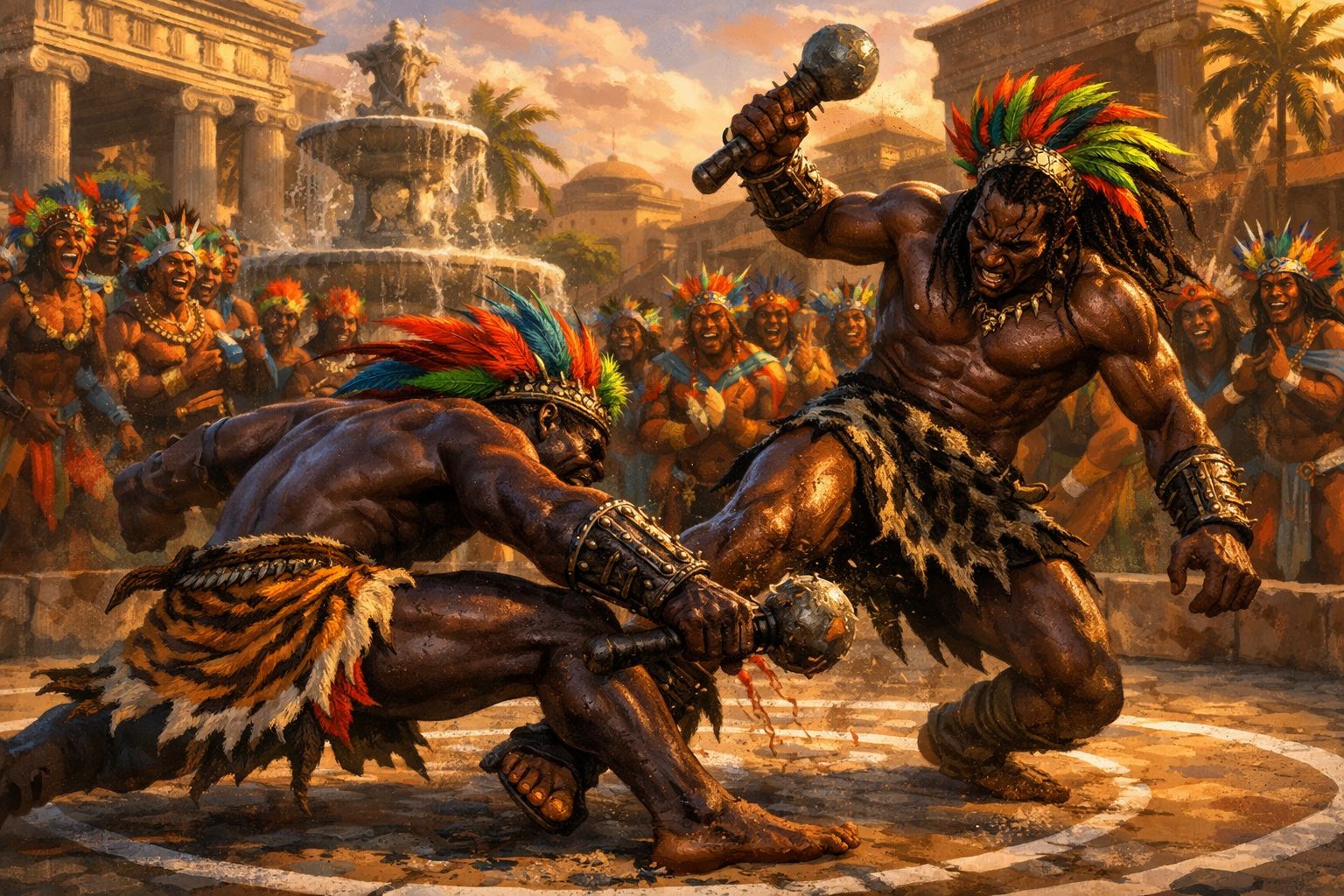
The duel is held at sunset, when the light turns the stone courtyard the color of old copper. The crowd gathers quietly. Not to cheer. Not to judge. Only to witness.
Ibanel waits already inside the ring. He is broad shouldered and calm, his stance practiced and exact. The short club rests easily in his hand. The spiked vambrace is strapped tight to his forearm. He looks at Mbaru once, inclines his head, and says nothing.
Mbaru returns the gesture.
The judge recites the forms. The weapons are confirmed. The ground is declared clean. The words are spoken that turn violence into law.
They begin.
Ibanel moves first, testing distance, circling left. His club snaps out in short, economical arcs meant to bruise and break rather than kill. Mbaru answers with footwork, giving ground, letting the blows pass close enough to feel the wind of them. Stone rings against stone. Metal scrapes. The sound carries across the square.
They trade attacks. Ibanel presses, methodical and relentless, driving Mbaru back step by step. A blow glances off Mbaru’s shoulder. Another catches his forearm, numbing it. Mbaru answers with a sharp strike to the ribs that Ibanel absorbs without flinching.
Neither man wastes motion. This is not spectacle. It is correctness.
Sweat and blood begin to slick the stone. The sun sinks lower. Shadows stretch.
Ibanel feints high and comes in low, his club aimed at Mbaru’s thigh. Mbaru shifts just enough to take it glancing, pain flaring bright and hot. He grits his teeth, breath steady, eyes fixed. He sets the trap, lets Ibanel close, and Ibanel takes the bait.
Then he steps inside the next swing and drives his heel hard into Ibanel’s knee.
There is a sound like splitting wood.
Ibanel goes down with a sharp grunt, one hand catching himself on the stone. Mbaru is already moving. The club comes down once, clean and final, against Ibanel’s head. The body stills, but not fully.
Mbaru does not hesitate.
He drops the club, seizes Ibanel by the shoulder, and pulls him close. The spikes of the vambrace flash once. There is a short, wet sound as he slashes across the throat.
Blood spills fast and dark, pooling beneath them, running into the carved channels cut long ago for this purpose.
Silence follows.
Mbaru stands and steps back. His chest rises and falls. His hands are red to the elbows. Blood runs down his face and drips from his jaw. He does not raise his arms. He does not look to the crowd.
The judge speaks. The words are formal and precise. Mbaru is pronounced victorious. His standing is restored. His name is declared clean. He is named honest before the law.
The crowd accepts it and begins to disperse.
Mbaru looks down at Ibanel’s body as priests move in to collect what remains useful. Ibanel’s face is slack now, peaceful in a way that unsettles him. A man who fought correctly. A man who did his duty.
A good man.
Mbaru turns away, feeling no pride, only the dull certainty that he had been made to kill someone who did not deserve it, for reasons that had nothing to do with truth.
The duel is over.
The stain is gone.
The cost remains.
Person Gallery
The person gallery represents the real battlefield of the trial. This is where influence is built, favors are traded, and outcomes are shaped long before judgment is spoken. The trial itself is a formality. The gallery is where the result is decided.
Each person in the gallery matters not because they care about justice, but because they care about position, survival, reputation, or advantage. Some want something openly. Others hide their needs behind ritual language or courtesy. All of them can shift the balance.
How to Use the Gallery
Each listed person has three things that matter.
First, what they want. This can be a favor, protection, information, deniability, or the removal of a rival. These desires are rarely framed as such. They are presented as obligations, concerns, or opportunities.
Second, what they can offer. This may be testimony, influence over the judge, ritual endorsement, silence at a key moment, or access to someone more important. Some people promise much and deliver little. Others deliver quietly.
Third, a possible point contribution to the trial outcome. This represents how much weight their support carries if secured. Points are not votes. They reflect narrative momentum and ritual plausibility. The points are for the Game Master, do not show them to the players. The players will simply have to go by feel, judging reactions and promises.
Starting Position and Pressure
The crew begins the trial at -10.
This represents Lionblood dominance, institutional bias, and Mbaru’s tainted standing at the outset. The crew is expected to claw their way out of a losing position. Partial success matters. Every point shifts tone, leverage, and confidence.
Not every interaction must succeed. Refusals, delays, and closed doors are part of the landscape. Some people will never help. Others may help only at a cost. Handled badly, they may instead favor Lionbloods.
What This Is Not
This is not a checklist to be completed.
The gallery is not balanced. It is not fair. Some people are dangerous to approach. Others will happily take payment and then do nothing.
The goal is not to reach a perfect outcome. The goal is to survive the process with something intact.
The trial does not reward righteousness. It rewards alignment.
Tigerfang House
A proud and pragmatic house whose power rests on dueling tradition, instructor patronage, and control of several inland trade routes. They present themselves as defenders of proper form against Lionblood dominance, but they are perfectly willing to let others bleed to make that point.
They are resisting Lionblood pressure, not because they are innocent, but because submission would be worse.
Matembe Tigerfang

House Head
Matembe is old by Zanakwe standards and has survived three major shifts in noble balance. He speaks slowly, listens carefully, and never interrupts. He believes patience is a weapon and uses it well.
He is a busy man, and a meeting needs to be set up with Badu first.
- What he wants: Matembe wants the case against Nkarno dismissed without open escalation. A duel outcome is acceptable, execution is not. Above all, he wants to deny Lionblood a clean narrative victory.
- What he can do: He can exert pressure on the judge through precedent and ritual advisors. He can quietly neutralize lesser houses that might otherwise side with Lionblood, but he first needs to know which houses will side with Lionblood. His support carries significant weight, but he will not commit unless he believes the crew understands the cost.
- Trial outcome effect: +1 per minor house pushed, three max. +1 for putting preasure on the judge.
Zalika Tigerfang
Matembe’s Sister
Zalika is sharper and more openly confrontational than her brother. She views the trial as a test of resolve rather than legality. Where Matembe preserves, Zalika pushes.
She is a busy woman, and a meeting needs to be set up with Badu first.
- What she wants: She wants Lionblood publicly embarrassed. Not necessarily defeated, but made to look overreaching or clumsy. She is willing to risk escalation to achieve this.
- What she can do: She carries social weight. She can shape rumor and public sentiment around the idea of ritual misuse. Her backing increases momentum but also increases risk. She will need some dirty secrets on the Lionbloods to spin the social scene.
- Trial outcome effect: Her participation is a risk move. If it works, it's +2, but it can also backfire and give -1. Give the players a feel for how the mood is going, and a chance to affect the outcome.
Keshari Tigerfang
Daughter of Matembe
Keshari is being groomed to inherit but has not yet learned caution. She is idealistic by Zanakwe standards and genuinely believes the Lionbloods are corrupting the law.
- What she wants: She wants Nkarno cleared completely and publicly. She wants proof that Tigerfang influence is just, not merely strong.
- What she can do: She can speak openly in court aligned circles and influence peers who will matter in future trials. Her support helps long term positioning, but she may overplay her hand if not guided.
- Trial outcome effect: If she is given diplomatic guidance, +1. Ayesha can do this. If not, she will get too emotional, lose her composition, and it will be a -1.
Badu Maseko
Chief Administrator
Badu runs the house. He controls schedules, access, and information flow. He knows where every favor is owed and where every debt is buried.
- What he wants: Badu wants stability. He does not care who wins as long as Tigerfang survives intact and he remains indispensable. He is deeply wary of escalation.
- What he can do: He can grant or deny access to Matembe and Zalika. He can quietly alter which witnesses are “available”. He is extremely useful, but only if handled carefully.
- Trial outcome effect: None in himself, but he can affect which others who can affect the trial.
Amari N’Kono
House Legal Specialist
Amari is responsible for translating house interest into acceptable ritual language. He genuinely believes in Zanakwe’s legal theology, even as he bends it.
- What he wants: He wants the trial to be seen as correct, regardless of outcome. A duel is acceptable. Dismissal is acceptable. An execution that looks rushed or sloppy is not.
- What he can do: He can shape how arguments are framed and which interpretations are considered plausible by the judge. His influence is subtle but reliable.
- Trial outcome effect: +1 for each testimony where he gets a chance to coach the witness beforehand, three max.
Sefu Kalume
Former Duelist
Sefu once fought for Tigerfang honor and now trains household guards. He respects Nkarno deeply and considers the accusation an insult.
- What he wants: He wants vengeance against Lionblood, openly or indirectly. He is less concerned with legality than outcome.
- What he can do: He can intimidate lesser figures, pressure potential witnesses, and provide physical protection. His involvement raises stakes and danger.
- Trial outcome effect: He can be directed at a specific Lionblood male, threatening a duel. If the target is not an experienced fighter, +1, otherwise, -1. If sent at the head of the Lionbloods, -2.
Jabari Odede
Diplomat and traitor
Jabari presents himself as a smooth intermediary between Tigerfang and the court. He is articulate, respectful, and always seems to know who to speak to.
Do not reveal Jabari’s betrayal early. Let him be useful. Let him provide real assistance mixed with subtle sabotage. The discovery of his treachery should be a turning point, not a gotcha.
- What he wants: Jabari wants Lionblood favor. He believes Tigerfang is not the winning side and intends to survive by switching allegiance at the right moment.
- What he can do: He can leak information, misdirect the crew, and quietly undermine Tigerfang efforts while appearing helpful. If exposed, the damage to Tigerfang credibility is severe.
- Trial outcome effect: If allowed to testify, -3. If not, but not exposed as a traitor either, -1.
Lionblood House
The Lionbloods were a minor house, who, through clever maneuvering, has become a major house. They now have their sights set on the Tigerfangs, who they see as their main competitor at the moment. Where Tigerfang maneuvers defensively and socially, Lionblood acts offensively and procedurally. They believe the law already belongs to them. Everyone else is being corrected.
Their authority rests on ritual enforcement, execution rights, and a long cultivated image of being the final arbiters of correctness. They do not argue that the law should be harsh. They argue that it already is, and always has been.
They are not trying to win the trial. They are trying to make resistance look improper.
Khotaro Lionblood

House Head
Khotaro is a broad shouldered, soft spoken man whose calm never wavers. He treats violence as maintenance and judgment as inevitability. He rarely raises his voice and never explains himself unless required by form. Behind the soft demeanor lies a mind which is razor sharp, ruthless and fueled by ambition.
- What he wants: He wants Nkarno executed. Not primarily out of necessity, but because it closes an old wound involving Mbaru and reasserts Lionblood dominance. Anything less is a compromise he does not feel obliged to make.
- What he can do: He has direct influence over the judge through ritual authority and execution precedent. He can accelerate procedures and remove delays when it suits him.
- Trial outcome effect: If left unopposed, automatic -2. This cannot be removed, only countered by other actions.
Dambala Lionblood
Khotaro’s Eldest Son
Dambala is openly aggressive, proud of his physicality, and eager to prove himself. He sees the trial as a stage rather than a process.
- What he wants: He wants a duel. Preferably involving Mbaru, who he thinks is responsible for the death of his brother. Public blood is proof of righteousness to him.
- What he can do: He can challenge individuals to ritual duels or push for duels as acceptable resolutions. His involvement raises the likelihood of violent outcomes.
- Trial outcome effect: If encouraged toward escalation, -1. If redirected or publicly denied a duel, +1, as it makes Lionblood appear overeager. If he testifies, he will lose control of his feelings and go into rage, hurting the Lionblood case, +1.
Nyasha Lionblood
House Social Matron
Nyasha controls Lionblood’s public face. She never appears in court herself, but her influence is visible everywhere it matters. She is precise, patient, and merciless in social spaces.
- What she wants: She wants the trial to appear clean and inevitable. She does not care which path leads there, only that Lionblood dignity remains intact.
- What she can do: She can poison social sentiment against Tigerfang allies, undermine reputations, and quietly isolate wavering houses.
- Trial outcome effect: If left unchallenged, -1. If her narratives are publicly contradicted with proof, +1.
Mosi Lionblood
House Ritual Enforcer
Mosi oversees ritual compliance and the execution apparatus, including Mbalame’s Hand. He treats his role as sacred duty. To him, violence is truth.
- What he wants: He wants clarity. A decisive outcome that reaffirms the righteousness of enforcement. Ambiguity offends him.
- What he can do: He can pressure witnesses, hasten ritual schedules, and frame delays as impiety.
- Trial outcome effect: If allowed to frame the trial as delayed or improper, -1. If publicly forced to acknowledge proper form, +1.
Tarek Omondi
Senior Legal Advocate
Tarek is the Lionblood equivalent of Amari. He is articulate, rigid, and deeply invested in precedent. Unlike Amari, he believes the law should be feared.
- What he wants: He wants the judgment to strengthen Lionblood precedent for future trials. A dismissal weakens him. A duel is acceptable. Execution is ideal.
- What he can do: He can dismantle testimony, challenge standing, and frame opposing arguments as technically invalid.
- Trial outcome effect: If he successfully discredits a witness, -1. If his objections are met and countered publicly, +1.
Barika Sone
House Administrator
Barika manages logistics, witness access, and scheduling for Lionblood interests. She is efficient and invisible.
- What she wants: She wants the trial to conclude quickly and cleanly. Prolongation increases risk.
- What she can do: She can delay or accelerate access to key figures, misplace requests, or “lose” permissions.
- Trial outcome effect: None directly. She modifies who the crew can reach and when.
Ibanel
Lionblood Champion
Ibanel is a professional duelist chosen for correctness rather than cruelty. He believes in ritual violence and accepts death as part of the system.
- What he wants: He wants to perform his duty without shame. He does not hate Mbaru, but he does not hesitate.
- What he can do: He represents Lionblood’s ability to resolve uncertainty through force.
- Trial outcome effect: If the duel is denied -2, if he wins the duel -3, if he lose and Mbaru wins, +5. Mbaru winning does a lot to prove the Lionbloods righteous, as he will be judged honest and clean by winning the duel, and his testimony will be seen as proven truth.
Chuma Kalele
Court Whisperer
Chuma is not officially Lionblood, but he feeds them information and narrative positioning. He is a parasite who has chosen a powerful host. His only loyalty is to himself.
- What he wants: He wants to remain useful. He will say whatever keeps him inside the circle.
- What he can do: He can leak partial truths, distort timelines, and seed doubt among neutral parties. If given sufficient incentive, such as a position in the Lionblood house and a large amount of money, he will switch sides.
- Trial outcome effect: If relied upon uncritically, -1. If exposed as unreliable, +1. If he switches sides, +3, but he will never be a reliable servant for Lionblood either.
Minor houses
Below is a compact roster of minor houses active around the trial, each represented by a single visible spokesperson. These houses do not drive events on their own, but they tip balance, amplify narratives, and signal which way the political wind is blowing.
They are watching Lionblood and Tigerfang closely, and most are trying to survive without committing too early.
Minor houses should rarely act alone. Their power comes from clustering. Two or three leaning the same way creates visible momentum.
A single house breaking rank at the right moment can change the judge’s confidence.
They are ideal tools for showing progress without resolving the trial early.
None of them are loyal, they can all be swayed.
House Nkatha

Spokesperson: Mirembe Nkatha, House Diplomat
House Nkatha controls river access and ferry rights along the inner waterways. Their wealth depends on stability and predictable enforcement.
Mirembe is calm, polite, and evasive. She never speaks first in a room.
- What she wants: Assurance that trade routes will not be disrupted by escalation or reprisals.
- What she can do: Quietly encourage neutrality among other trade focused houses or withdraw logistical support if alarmed.
- Trial outcome effect: If promised a monopoly on ferry rights, House Nkatha will testify in favor of Lionblood, +1.
House Balefu
Spokesperson: Kondo Balefu, House Head
Balefu is an old but weakened house that once held ritual authority and lost it to Lionblood generations ago.
Kondo is bitter, formal, and deeply attentive to precedent.
- What he wants: Lionblood embarrassed, even slightly. Not out of loyalty to Tigerfang, but revenge.
- What he can do: Invoke old rulings and ritual contradictions that complicate Lionblood narratives.
- Trial outcome effect: He only needs to be asked, he'll support Tigerfang to get to Lionblood, +1.
House Tazani
Spokesperson: Aya Tazani, Social Patron
House Tazani thrives on patronage, festivals, and public favor. They do not fight. They host.
Aya is charming, flamboyant even by Zanakwe standards, and always surrounded.
- What she wants: To be seen backing the winning side without risking herself.
- What she can do: Shift public mood subtly through who is invited, praised, or excluded.
- Trial outcome effect: Will support Tigerfang if shown credible signs that they will win, +1. However, if the evidence is not believed, -1.
House M’Rako
Spokesperson: Duma M’Rako, Veteran Enforcer
M’Rako provides guards, escorts, and muscle for hire. They respect strength over legality.
Duma is blunt, scarred, and unimpressed by ceremony or intimidation.
- What he wants: Proof that Tigerfang can protect its own if things turn violent.
- What he can do: Deter intimidation from Lionblood retainers or signal that violence will be answered.
- Trial outcome effect: None, but he can help by keeping heat off the Tigerfangs during the process.
House Senabi
Spokesperson: Nyiri Senabi, Court Attendant
House Senabi has no real power, but they have access. Nyiri works in the outer layers of the court bureaucracy.
She is quiet, observant, and extremely well informed.
- What she wants: Security and continued relevance.
- What she can do: Ensure documents are seen, misplaced, delayed, or quietly emphasized.
- Trial outcome effect: If she can be convinced that Tigerfang is being unjustly accused, she can control information in their favor, +1.
House Kalondo
Spokesperson: Rashid Kalondo, Merchant Prince
Kalondo controls inland grain storage and emergency reserves.
Rashid is practical, openly transactional, and unimpressed by ritual language.
- What he wants: Guarantees that emergency levies and confiscations will not target his stores.
- What he can do: Apply economic pressure quietly by restricting or releasing supplies.
- Trial outcome effect: He will support whoever he feels gives credible guarantees. +1 or -1.
House Ulemba
Spokesperson: Jengo Ulemba, Young Noble
Ulemba is a rising house with little history but growing ambition.
Jengo is earnest, ambitious, and eager to be taken seriously.
- What he wants: Association with legitimacy and future favor.
- What he can do: Publicly align early and loudly, for better or worse, influencing other undecided houses.
- Trial outcome effect: If his house gets taken under the protection of Tigerfang, he will support them, +1, and will make other houses easier to influence.
House Zoreni
Spokesperson: Safiya Zoreni, Widow and Matron
Zoreni holds funerary contracts and ancestor rites. Her husband was killed in a duel with a Lionblood.
Safiya is composed, distant, and deeply respected.
- What she wants: That the Lionbloods are shamed.
- What she can do: Frame outcomes as respectful or disrespectful to tradition, affecting ritual legitimacy.
- Trial outcome effect: She only needs to be asked, +1.
Court Officials
Below is a focused roster of court officials relevant to the trial. These figures are not neutral arbiters. They are custodians of process, and each one interprets that duty in a way that can subtly shape outcomes.
They do not argue politics openly. They enforce tone, timing, and legitimacy.
Court officials should rarely be persuaded through argument alone. They respond to confidence, correctness, and inevitability. They are sensitive to who appears aligned with proper form rather than moral force. Shifting their behavior should feel like nudging a mechanism, not winning a debate.
If the court begins to feel uncomfortable, uncertain, or rushed, the officials will push back hard. If it feels inevitable, they will help it happen.
Judge Kamau Nyerere

Presiding Judge
Kamau is elderly, precise, and famously unreadable. He speaks rarely and never off the record. His reputation rests on consistency rather than fairness.
- What he wants: A ruling that appears correct, balanced, and defensible in precedent. He does not want this trial remembered as unstable or exceptional.
- What he can do: He decides which arguments are heard, which witnesses are deemed relevant, and when the court has heard enough. His confidence in the narrative matters more than any single testimony.
- Trial outcome effect: He needs to be convinced that the Lionblood cause is unjust, +2
Esi Mbeki
Registrar of Proceedings
Esi records all formal statements, rulings, and ritual acknowledgments. Her records become precedent.
- What she wants: Clarity and order. She dislikes ambiguity and contradictions in testimony.
- What she can do: She can frame how events are remembered by what is emphasized, summarized, or omitted in the official record.
- Trial outcome effect: She will not affect the outcome of the trial, but she can affect how it will be remembered.
Jabir Kone
Verifier of Form
Jabir ensures that rituals, oaths, and duels adhere to required form. He is deeply conservative.
- What he wants: Procedural purity. He would rather delay than allow an irregularity.
- What he can do: He can invalidate testimony, delay proceedings, or demand repetition if form is breached.
- Trial outcome effect: If foul play by House Lionblood can be pointed out, he will act against them, +1.
Sitali Okoye
Marshal of Witnesses
Sitali controls witness access, scheduling, and readiness. She is efficient and unsentimental.
- What she wants: Order and compliance. She does not care who wins.
- What she can do: She can ensure witnesses are present, absent, exhausted, or unprepared at critical moments.
- Trial outcome effect: If opposing witnesses are distracted or otherwise prevented from appearing on schedule, she will not allow them to testify, +1.
Makena Dube
Court Appointed Advocate
Makena formally presents charges and ensures that accusations are properly framed. Though nominally neutral, she is sensitive to dominant narratives.
- What she wants: A case that reflects well on the court’s authority. She prefers outcomes that reinforce enforcement.
- What she can do: She can sharpen or soften how accusations are presented and which charges are emphasized.
- Trial outcome effect: She already has the facts. Present the emotional side of it to gain her help, +1.
Tobari Mwangi
Custodian of Sentences
Tobari oversees the practicalities of punishment once judgment is passed. He treats execution as logistics.
- What he wants: Efficiency and preparedness. Surprises are failures.
- What he can do: He ensures that sentences are carried out immediately and visibly. His readiness signals inevitability.
- Trial outcome effect: Nothing, he is not useful for the players.
Amina Selam
Representative of the Collegium
Amina attends on behalf of scholarly and religious institutions. She does not intervene directly.
- What she wants: That the trial does not damage institutional legitimacy.
- What she can do: She can signal approval or concern to outside bodies, affecting how the trial is remembered beyond Zanakwe.
- Trial outcome effect: Nothing, but she can affect how it is seen afterwards, turning it into a disgrace for the Lionbloods even if they win.
Biko Tembo
Master of the Court Space
Biko controls seating, access, and movement within the court chambers.
- What he wants: Smooth proceedings without disruption.
- What he can do: He can subtly privilege or marginalize participants through placement, proximity, and visibility.
- Trial outcome effect: If promised a clean trial, he can have witnesses who show emotional outbursts removed, +1.
Final Judgment and Outcomes
At noon on the third day, the second session of the trial is held and judgment is passed.
There are three possible outcomes.
Condemned
If the total points gathered by the crew are -3 or lower, Nkarno is condemned and executed under Mbalame’s Hand.
The judge will declare that the Lionblood claim is sufficiently supported, and that Nkarno is guilty of tainting the sanctity of the duel, and, by extension, this also taints House Tigerfang.
Duel
If the total is between -2 and 2, Nkarno is ordered to duel a Lionblood champion, transferring the conflict into ritual violence.
In this case, the judge will declare that the facts are unclear, and the only way to reach the truth is through a duel between Nkarno and a champion of the Lionblood house.
If this happens, the duel will be long and brutal. Nkarno will win, but the cost will be high. In Nkarno's final attack, his opponent will get a hit against his knee, smashing it. He wins, but will never fight again.
This is a clear loss for Lionblood, but the cost for Tigerfang is high. Nkarno was an important asset, which is now much less useful.
Dismissed
If the total is 3 or higher, the case is dismissed, not because Nkarno is declared not at fault, but because the accusation is deemed insufficiently supported.
The judge will declare the Lionblood accusations without merit, as well as dishonest. Nkarno is declared cleared of all charges, and House Lionblood is given a formal reprimand, which will damage their social standing.
Departure from Zanakwe
The departure from Zanakwe is not a victory lap. It is a release. This section exists to close the arc emotionally and thematically, reinforce that Zanakwe’s deeper crisis remains unresolved, and reorient the campaign back toward the Waverider. The crew leaves having survived, not having fixed anything.
Use this section to let consequences breathe, to let exhaustion settle, and to clearly signal that it is time to move on.
Zanakwe After the Trial
Regardless of the trial’s outcome, Zanakwe does not stabilize.
If Lionblood was checked, they retreat only enough to sharpen their knives. If they were reinforced, they press harder. Rivalries do not end, they realign. Tigerfang licks its wounds or consolidates losses. Minor houses take notes and adjust loyalties.
Most importantly, the jungle remains hungry.
The belief that blood payment will solve the problem intensifies. Sacrifices become more frequent. Executions are framed as preventative rather than corrective. The logic hardens. Each failed attempt convinces the city that the answer was insufficient blood, not the wrong answer.
The jungle has learned a taste for blood, and they feed it.
The Cold Trail
The crew finds nothing of substance about the Waverider.
Rumors contradict each other. Leads dissolve under scrutiny. Promises made during the trial turn out to be exaggerations, misunderstandings, or outright lies. No one in Zanakwe knows where the Waverider went next, and those who claim they do cannot prove it.
Do not present this as a mystery to solve. Present it as absence.
This is important for tone. The crew did not miss something. There is nothing here to find.
Morale should dip. They have invested effort, risk, and blood, and the trail remains cold. Let that disappointment sit for a moment before moving on.
Leaving the City
As the Blue Marlin departs the harbor, emphasize contrast.
The city does not mark their leaving. Guards remain attentive. Priests continue their work. The sound of ritual carries over the water. Zanakwe neither thanks nor curses them.
This indifference is part of the cost.
As the city recedes, let the crew feel relief mixed with bitterness. It feels good to leave, and that feeling itself should feel slightly shameful.
The Swamp Anchorage
A cold mist drifted across the deck of the Blue Marlin as night deepened. Lanterns swayed gently, their light swallowed by the fog rolling through the mangrove. Scarnax stood at the rail, studying the shoreline, uneasy without knowing why. Shaedra watched from the aftcastle, brow tight, her hunter’s instincts prickling. Amaxia muttered that she did not like how quiet the world felt.
A faint splash touched the silence.
Nasheem spun toward it. "Someone is approaching."
A slender figure stepped out of the fog, one foot meeting the deck without a sound. Dark blue silk robes clung to her in the damp air, and a long veil hid part of her face. She looked thin, exhausted, as if she had walked through storms that refused to leave her. Pale eyes caught the lantern light with an eerie clarity.
Amaxia lifted her spear. "Move again and I drop you."
The woman raised both hands, palms open. "I am not here to harm you."
Scarnax stepped forward, voice hard. "Say your name."
"Meyrha."
Junia frowned. "Who."
Meyrha drew a slow breath that shook at its edges. "The one bound to Samden."
Shaedra’s eyes narrowed. "We do not know that name."
"I know," Meyrha whispered. "He kept himself hidden. That was his duty. To walk unseen and act when your path faltered."
Nasheem blinked. "What do you mean, our path."
"The amazon," Meyrha said softly, looking at Amaxia’s wrists. "The gaol. The officer who slept instead of raising the alarm. You were not alone that night."
Amaxia’s jaw tightened. "So who freed me."
"Samden." Meyrha’s voice thinned. "One of the Hands of Khazra. A monk who walked the world while I watched it through him."
"The arrow in the dirt in Necropolis. Samden. The antidote found in your skiff. Samden. There are more. All Samden." Her voice grew thick with grief.
Scarnax stared at her. "And where is he now."
Meyrha looked down. For a moment her composure wavered. "Gone. His bond broke three months ago. I felt it tear. I followed the echo to you."
The deck fell silent. Scarnax spoke up. "We owe a debt we can't repay."
"He guarded you more than once," she said. "Not because he served you, but because the path you walk matters. Far more than you know."
Shaedra studied her closely. "Why come here. Why reveal any of this."
"Because I felt what killed him." Meyrha pressed a trembling hand against her temple. "And because without Samden I can no longer bear these visions alone. They arrive as storms, relentless, and they point always toward the same truth."
Nasheem swallowed. "Which is."
"Your fate is tied to the Waverider," she said. Her voice steadied. "And you can't sail blindly into fate."
Amaxia lowered her spear a fraction. "So you want passage."
"No." Meyrha met her eyes. "I want to help you live long enough to finish what he began."
Another wave of fog rolled over the rail, cold as grave breath. Meyrha looked toward it, her expression tightening in dread.
"You will understand why I came."

That night, the ship anchors in the coastal swamp, where mangroves choke the water and insects fill the air. The city lights are distant and muted. The blood soaked stone is out of sight.
This is where the tone shifts.
Meyrha approaches quietly, without ceremony. She does not come as a supplicant or a priest on duty. She comes as someone who has already decided.
She speaks of Samden, not dramatically, but plainly. She has lost contact. She believes he is in danger. She does not ask the crew to solve it now, only to understand why she cannot stay behind in Khazryn.
She then offers something tangible. She knows where the Waverider went next. She knows several of the Waverider’s prior stops and can place them in sequence. She knows names, tensions, and half remembered incidents that make the ship feel real again.
This is the first true forward momentum the crew has had in some time.
Choosing to Move On
Meyrha’s request to join the crew should feel natural rather than urgent. She is not fleeing Zanakwe in panic. She is leaving because she believes in the cause of the Waverider and the Blue Marlin, and because the Blue Marlin represents her best chance of finding Samden.
Her presence represents a shift. The crew is no longer searching blindly. They are following a thread again.
When the Blue Marlin finally leaves the swamp and turns toward open water, underline the contrast one last time.
The air clears. The smell of blood fades. The jungle recedes into shadow. Zanakwe remains behind, still paying, still afraid.
Act Summary
This act establishes Zanakwe as a functioning society under pressure rather than a broken one, and marks a turning point for the crew both emotionally and structurally. Nothing here is resolved in a comforting way, but several things are clarified, hardened, or set in motion permanently.
The crew leaves changed, with clearer lines behind them and a sharper sense of what lies ahead.
Mbaru and Standing
If the ritual duel occurred, Mbaru’s name is now clean in the only way Zanakwe recognizes as real. His honor has been proven publicly and violently, and the old accusation no longer has power over him.
This does not make him respected by all, but it makes him undeniable. His words carry weight in court and among ritual authorities. At the same time, the duel forces him to confront the cost of that legitimacy. He did not win because he was right. He won because the system demanded blood and he provided it.
This permanently shifts how Mbaru relates to his homeland. He is no longer a man in exile or a man accused. He is a man who has proved his honor.
Nkarno and the Trial
The trial resolves, but only on its own terms. Whether Nkarno is executed, crippled, or cleared, the outcome reinforces the same truth. The trial was never about truth. It was about narrative, leverage, and ritual correctness.
If Nkarno survives the duel, he does so at a cost that removes him from the future as a fighter. If he dies, he becomes a political fact rather than a man. In all cases, Tigerfang and Lionblood emerge altered but intact, their rivalry sharpened rather than ended.
Zanakwe absorbs the result and moves on.
Meyrha and Samden
Meyrha joins the crew during the departure from Zanakwe. Her decision is deliberate and grounded. She has lost contact with Samden and believes remaining behind would mean becoming part of a system that consumes people quietly.
Through her, the crew learns more about Samden’s past involvement and about the Waverider itself. She brings concrete knowledge. Prior ports of call. Familiar names. Stories that make the Waverider feel less like a rumor and more like a ship with habits, conflicts, and history.
This restores forward momentum to the campaign. The search is no longer blind.
Relationships in Zanakwe
The crew does not leave Zanakwe alone.
They have made contacts among Tigerfang, minor houses, court officials, and intermediaries. Some are genuine allies. Others are situational. None are safe.
These relationships are transactional and conditional, but they persist. Zanakwe remembers who stood where, even when it pretends not to. Those memories may matter later.
Just as importantly, the crew has earned a reputation as people who understand the rules, even when they do not agree with them. Most important, they have shown that they can play the game, even when the opponent cheats.
Understanding Zanakwe
The crew has seen how Zanakwe works, not in theory, but in practice.
They have seen that fear is managed through escalation, not restraint. That blood is payment, not punishment. That violence is validation. That legality and ritual exist to make outcomes acceptable, not just.
This understanding is permanent. Even after leaving, it will color how the crew interprets similar systems elsewhere.
Zanakwe is not evil in its own eyes. It is correct. That may be the most disturbing lesson of the act.
The Waverider Trail
Zanakwe provides no direct answers about the Waverider’s fate. The trail here is cold.
What the crew gains instead is direction. Through Meyrha, they now have a sequence of ports, fragments of stories, and a sense of the Waverider’s movement. This is enough to continue the chase with intent rather than hope.
The search resumes, but on new footing.
Leaving Zanakwe
When the Blue Marlin finally departs, the dominant feeling is relief.
Not triumph. Not closure. Relief at distance. Relief at leaving blood, certainty, and ritual violence behind.
Zanakwe remains strong. Zanakwe remains afraid. Zanakwe remains convinced it is doing the right thing.
The crew is glad to leave it to itself.
The coastline of Zanakwe is already pulling itself apart into shapes and shadows when Mbaru comes up on deck. The stone terraces blur into jungle, the jungle into a dark line pressed against the sky. Smoke still rises in thin threads from the city, ritual fires fed even as the ship turns away.
Ayesha stands at the rail, arms resting on the wood, watching the same horizon. She does not look at him when he joins her. She does not need to.
“I used to imagine this moment,” Mbaru says after a while. His voice is steady, but tight. “Coming back. Being seen. Being proven right.”
Ayesha nods once. “Vindication is a powerful fantasy.”
“I thought if I could clear my name, I could belong again.” He swallows. “Instead I killed a good man. For a system that wanted blood, not truth.”
She turns her head slightly, just enough to show she is listening.
“That duel,” he continues, quieter now. “Ibanel did everything right. He fought clean. He believed in it. He was good, as good as I. Either of us could have won. Luck chose me. And I tore his throat out because the law demanded it.” His hands curl at his sides. “That was the price of being welcomed home.”
Ayesha exhales slowly. “And now?”
“Now Zanakwe feels foreign to me.” He shakes his head. “I am ashamed of it. And the vindication means nothing. I do not want to stand there again. I just want distance.”
The ship creaks softly beneath them. Water slaps against the hull in a slow, patient rhythm.
“I never understood,” Mbaru says after a moment, “that diplomacy is just another battlefield. I thought it was softer. Cleaner.”
Ayesha lets out a short, humorless breath. “A soldier kills a man and everyone sees it. A diplomat moves a word, signs a name, withholds a favor, and a thousand men die somewhere else.” She finally looks at him. “There is blood. It is just spread thin enough that no one feels it warm.”
He nods. “In a fight, you know where you stand. Here…” He gestures vaguely back toward the darkening coast. “Everything pretends to be clean.”
They stand in silence as the last of the shoreline sinks beneath the curve of the world. The jungle disappears first, then the stone, then even the smoke.
“Well,” Mbaru says at last. “All we can do is fight for the right side. And fight well.”
Ayesha’s expression softens, just a fraction. “We can try,” she says. “It is not easy. No one can demand more of us.”
They do not speak again. The horizon empties. Zanakwe is gone, and the sea takes its place, wide and indifferent, as the Blue Marlin carries them on.